
Fluvial Depositional Landforms
As the river flows, it keeps creating marvelous landforms through erosion, transportation, and finally deposition. When the river slows down or its force decreases, it begins to deposit its load, giving birth to depositional landforms. Let’s now explore some of these artistic landforms created by the river.
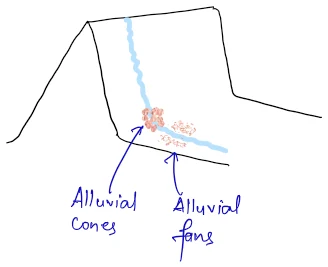
Alluvial Fans and Alluvial Cones
Picture this: A river is flowing down from a mountain with tremendous energy, carrying large and small sediments. As it reaches the base of the mountain (foothill) and enters the plains, the river suddenly slows down. Why? Because the slope becomes gentler, reducing its velocity. As a result, the river is forced to drop its load — just like a person who slows down when entering a house and drops their heavy bags at the doorstep.
- This deposition forms a fan-shaped landform called an Alluvial Fan if the materials deposited are mostly gravel and coarse sand, spreading over a large area.
- If the materials are extremely coarse (like massive boulders and unsorted debris) and form a steeper slope, it is called an Alluvial Cone.
👉 Difference:
| Feature | Alluvial Fan | Alluvial Cone |
|---|---|---|
| Material | Gravel, pebbles, and coarse sand | Massive boulders and unsorted debris |
| Slope | Gentle to moderate | Steeper slope |
| Size | Large | Relatively smaller |
Natural Levees
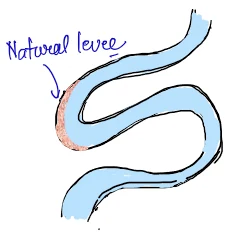
Now picture the river during floods — the water overflows its banks, spreading out sediment onto the nearby land. The heavier materials like sand and gravel are deposited close to the riverbank, while finer materials travel farther. Over time, repeated flooding builds up small natural embankments (walls) along the riverbanks.
- These embankments are called Natural Levees (pronounced: ‘leh-vees’).
- They act like natural barriers, reducing the chances of minor floods.
- However, during extreme floods, these levees may breach, causing devastating floods.
Example: The Ganges and Brahmaputra rivers in India often form natural levees along their banks.
Delta
When a river reaches the end of its journey (at the sea or lake), it slows down drastically and deposits huge amounts of sediments, forming a delta — a fan or triangular-shaped depositional landform.
✅ Ideal conditions for delta formation:
- Shallow sea: Allows sediment to accumulate.
- Long river course: Gives the river enough time to collect and carry sediments.
- Abundant fine sediments: Silt and clay that settle rapidly at the coast.
- Large water discharge: Ensures continuous deposition.
- Calm sea: Prevents strong waves from dispersing the sediments.
Types of Deltas
Just like artists have different styles, rivers also create different types of deltas based on conditions:
Arcuate Delta (Fan-shaped):
- Resembles a wide fan or bow-shaped landform.
- Formed when strong sea waves smoothly and evenly distribute the river’s sediment along the coast.
- Composed mainly of heavy and fine mixed sediments like gravel, sand, and silt.
- Example: Ganges Delta, Nile Delta.
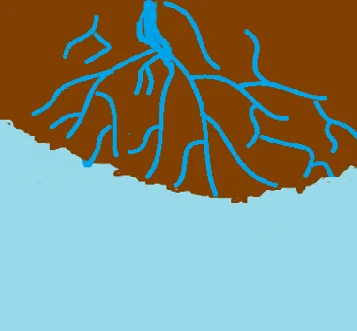
Bird-Foot Delta:
- Resembles the claw of a bird extending into the sea.
- Formed when river water is lighter than sea water, allowing sediments to extend far into the sea.
- Example: Mississippi Delta, USA.
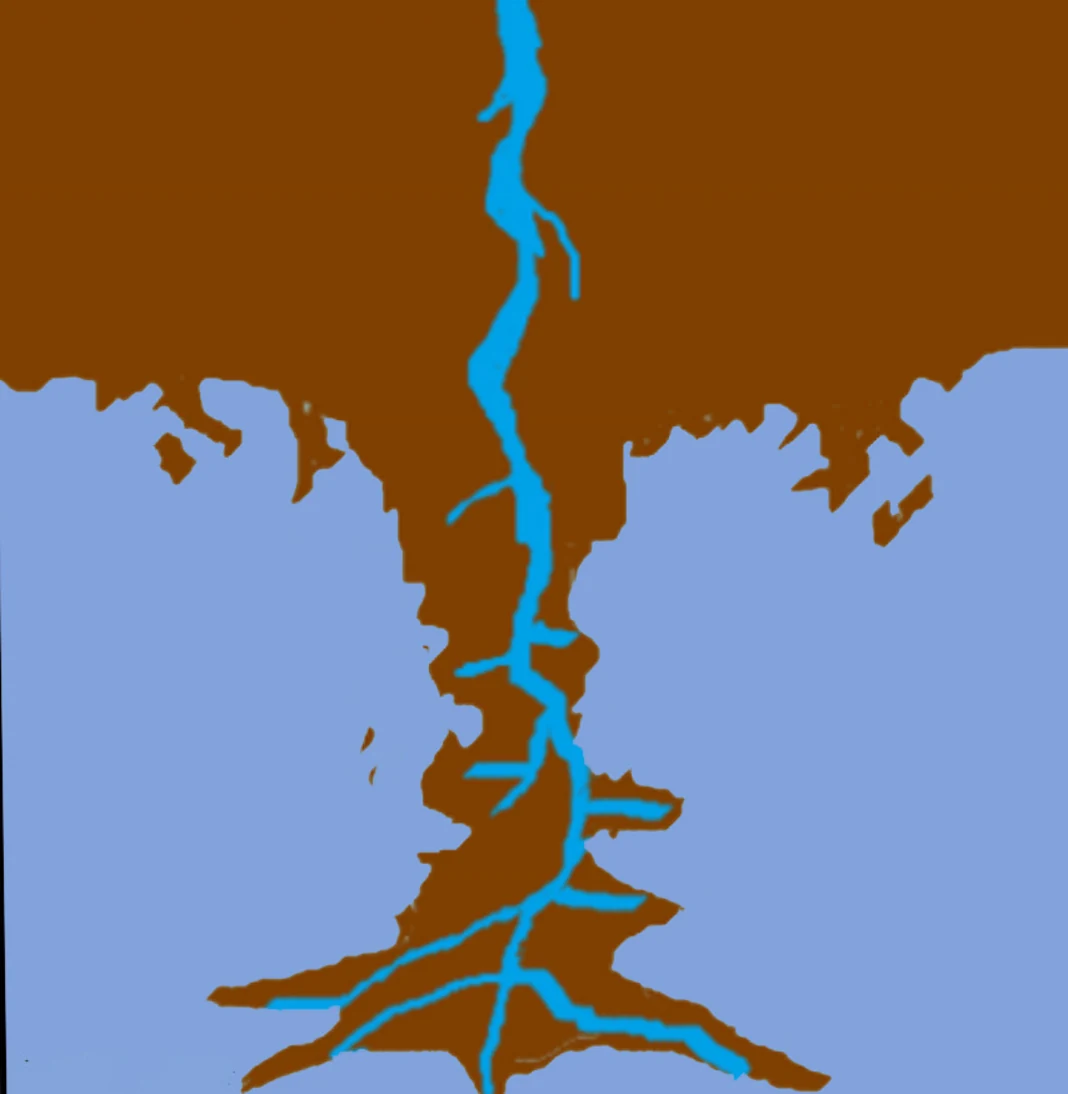
Cuspate Delta:
- V-shaped delta with curved sides, like a tooth or spearhead.
- Formed where strong waves hit the delta head-on, pushing sediments sideways.
- Example: Ebro Delta, Spain.
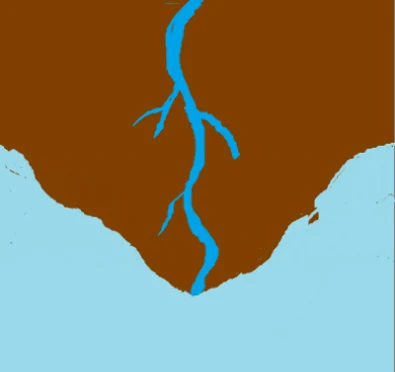
Estuarine Delta:
- Formed when the river meets the sea through an estuary (funnel-shaped mouth).
- This happens in rivers that flow through hard rocky terrain or steep slopes.
- Example: Seine River (France), Mackenzie River (Canada)
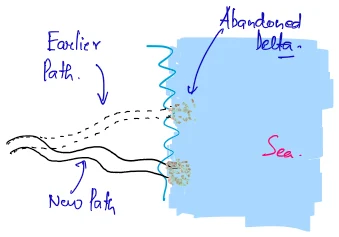
Abandoned Delta:
- When a river changes its course, the previous delta stops receiving sediment and gradually dries up.
- This older delta is called an Abandoned Delta.
- Example: Hooghly River (once the main course of the Ganga).
Blocked Delta:
- If ocean currents or waves continuously disperse the deposited sediments, the delta formation is halted.
- In a Blocked Delta, waves and currents prevent further seaward growth.
Truncated Delta:
- Here, the delta initially forms, but later strong sea currents and waves reshape or cut-off its shape.
- So, the delta still exists but in a deformed state.
👉 Note: A Blocked Delta stops growing seaward, while wave and current erosion cuts back a Truncated Delta
Why Is This Important?
Depositional landforms greatly influence human settlements, agriculture, and transportation. For example:
- Deltas are highly fertile, making them ideal for agriculture (e.g., Ganga Delta).
- Alluvial Fans often lead to the formation of new fertile plains.
- Natural Levees protect settlements from floods, though sometimes they fail.
Thus, by understanding these depositional features, we can better plan human settlements, flood management, and agriculture.
2 Comments