
Agriculture, Food Security & MSP System in India (Economic Survey 2025–26)
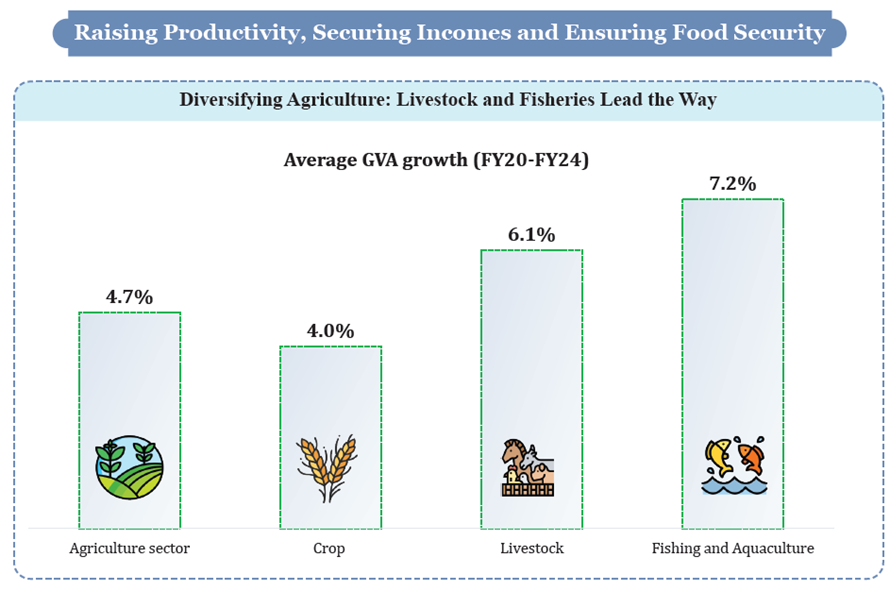
India’s agriculture and allied sectors remain central to economic growth, employment, and food security, contributing nearly one-fifth of national income while supporting over 46% of the workforce. The sector has demonstrated resilience with an average growth of about 4.4% in recent years, driven largely by allied activities such as livestock and fisheries.
A structural shift is underway from traditional foodgrain production toward high-value sectors like horticulture, which now surpasses foodgrain output in volume and contributes significantly to agricultural GVA.
Despite progress, challenges such as low productivity, fragmented landholdings, climate vulnerability, and regional disparities persist. Productivity remains below global benchmarks for many crops, highlighting the need for technological interventions, better irrigation, and improved input use.
Government initiatives—ranging from seed quality improvement, irrigation expansion, digital agriculture, and credit support to market reforms—are focused on enhancing productivity, income, and sustainability.
However, emerging trade-offs, such as ethanol-driven crop shifts and imbalanced fertiliser use, raise concerns about long-term food security and soil health. Overall, the sector is transitioning towards diversification, efficiency, and sustainability, but requires calibrated policy interventions to balance growth, equity, and resilience.
Key Points
1. Structural Importance & Growth Trends
- Agriculture employs a disproportionately large workforce relative to its income share, making it critical for inclusive growth.
- The sector recorded an average annual growth of around 4.4% in recent years, outperforming the global average.
- Allied sectors such as livestock and fisheries have emerged as major growth drivers with higher growth rates than crops.
- Foodgrain production has increased steadily, reaching record levels due to favourable monsoons and policy support.
- Horticulture has surpassed foodgrain production, indicating diversification towards high-value agriculture.
2. Shift Towards Allied & High-Value Sectors
- Livestock and fisheries have significantly expanded, contributing to income stability and rural livelihoods.
- Horticulture contributes about one-third of agricultural GVA and is a major driver of value addition.
- India has emerged as a global leader in horticulture production, including fruits, vegetables, and onions.
- Diversification into high-value crops improves income but requires better infrastructure and market linkages.
- Allied sectors act as buffers against crop failure and climate risks.
3. Productivity Challenges & Regional Disparities
- Crop yields in India remain below global averages for several major crops.
- Rainfed agriculture and climate variability significantly affect productivity, especially for pulses and oilseeds.
- Regional disparities persist due to differences in irrigation, soil quality, and technology adoption.
- Climate phenomena like El Niño reduce acreage, production, and yields, particularly in pulses.
- States with better seed systems, irrigation, and crop alignment show higher productivity.
4. Policy Interventions & Government Initiatives
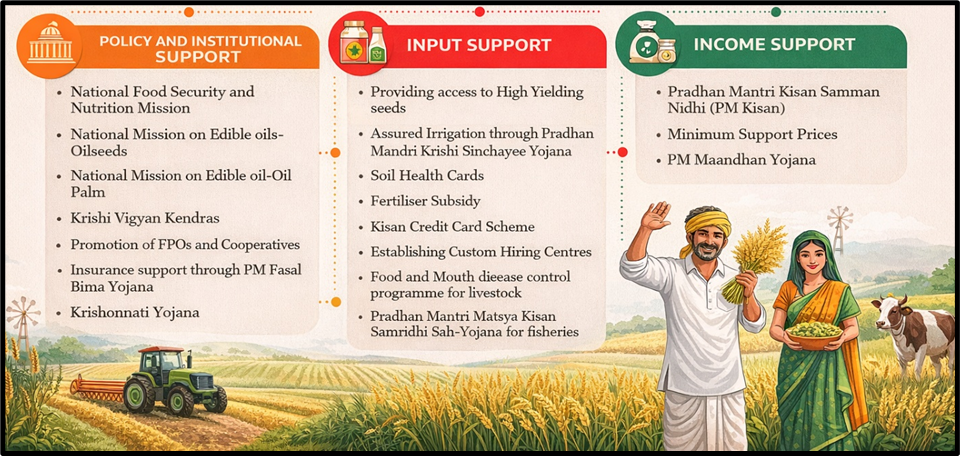
- Schemes like NFSNM, NMEO-OS, andNMEO-OP aim to improve productivity and reduce import dependence.
- PM-KISAN provides income support, whilePMKSY promotes irrigation and water efficiency.
- Digital initiatives such as e-NAM and AgriStack enhance market access and information flow.
- FPOs and PACS strengthen collective action and improve farmers’ bargaining power.
- Agricultural Infrastructure Fund (AIF) promotes investment in storage, processing, and logistics.
5. Inputs, Technology & Infrastructure
- Quality seeds, irrigation, soil health management, and mechanisation are key productivity drivers.
- Micro-irrigation and water-use efficiency measures are expanding but remain uneven across regions.
- Soil degradation and fertiliser imbalance (high nitrogen use) affect long-term productivity.
- Mechanisation is constrained by small landholdings but supported through Custom Hiring Centres.
- Digital agriculture and extension services are increasingly important for knowledge dissemination.
6. Credit, Markets & Institutional Support
- Institutional credit has expanded significantly, with schemes like KCC improving access for farmers.
- Regional disparities in credit distribution persist despite policy efforts.
- Market reforms such as e-NAM improve price discovery and reduce intermediaries.
- Infrastructure investments in storage and cold chains reduce post-harvest losses.
- Fisheries and livestock sectors benefit from targeted financial and technological support.
7. Emerging Issues & Trade-offs
- Ethanol policies are incentivising maize cultivation, potentially reducing pulses and oilseed production.
- Fertiliser subsidy distortions lead to imbalanced nutrient use and declining soil health.
- Food security concerns arise due to shifting cropping patterns and import dependence.
- Climate change and resource constraints necessitate sustainable agricultural practices.
- Policy coordination is required to balance energy security and food security objectives.
Data & Facts
- Agriculture employs 46.1% of workforce but contributes ~20% of GDP.
- Average annual growth: ~4.4% (recent years).
- Livestock GVA growth: ~195% increase (FY15–FY24).
- Fisheries production increased by 140% (2014–2025).
- Foodgrain production: 3577.3 LMT (2024–25).
- Horticulture production: ~362 MT, higher than foodgrains.
- Irrigation coverage increased from 41.7% to 55.8% of cropped area.
- Ground Level Credit: ₹28.69 lakh crore (FY25).
- e-NAM coverage: 1522 mandis, 1.79 crore farmers.
- Fertiliser imbalance: N:P:K ratio deteriorated to ~10.9:4.1:1 (vs ideal 4:2:1).
Concepts
- Allied Activities: Non-crop agricultural activities like livestock, fisheries, and horticulture that supplement farm income.
- Agricultural Productivity: Output per unit of land or input, reflecting efficiency of farming practices.
- MSP (Minimum Support Price): Government-guaranteed price ensuring farmers receive a minimum return.
- Micro-Irrigation: Water-efficient irrigation methods such as drip and sprinkler systems.
- FPO (Farmer Producer Organisation): Collective of farmers for better input purchase, production, and marketing.
- Nutrient Imbalance: Disproportionate use of fertilisers (especially nitrogen), reducing soil health and efficiency.
- Cropping Diversification: Shift from staple crops to high-value crops like fruits, vegetables, and oilseeds.
One Comment