
Education System & Healthcare Sector in India (Economic Survey 2025–26)
EDUCATION: ENHANCING QUALITY, ACCESS & HUMAN CAPITAL
Education is central to India’s transformation into a developed economy by 2047, as it directly shapes human capital, productivity, and innovation capacity. Despite a strong demographic advantage—with nearly 27% of the population in the school-age group—India’s education outcomes remain constrained by relatively low expected years of schooling (EYS) and uneven quality.
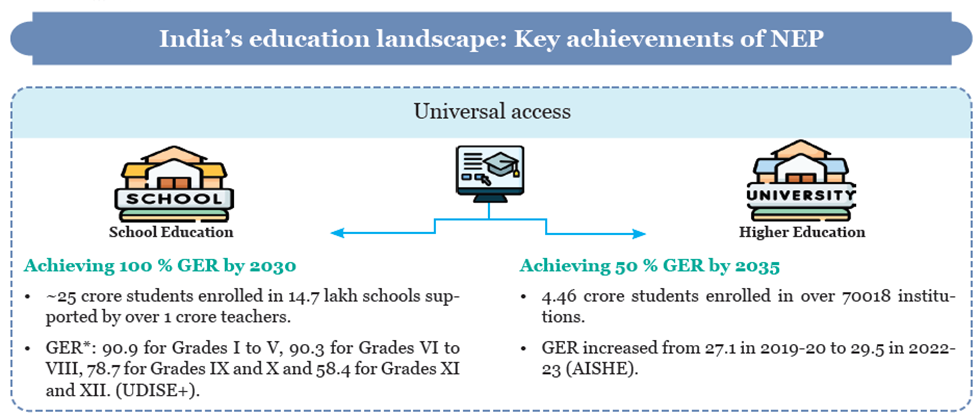
The National Education Policy 2020 (NEP) provides a comprehensive framework to address these challenges through a lifecycle approach, emphasising Early Childhood Care and Education (ECCE), foundational literacy and numeracy (FLN), and universal secondary education. Significant progress has been made in expanding school infrastructure, enrolment, and digital access, supported by schemes like PM SHRI, NIPUN Bharat, and DIKSHA.
However, key concerns remain in terms of low secondary enrolment, regional disparities, and learning outcomes. Assessment reforms such as PARAKH indicate post-pandemic recovery but highlight gaps in conceptual learning and student well-being. The education system is also increasingly aligned with skill development and labour market needs, although vocational training penetration remains low.
In higher education, expansion of institutions, flexible academic frameworks, and regulatory reforms aim to improve access, quality, and global competitiveness. Overall, India’s education strategy is transitioning from access-centric to quality- and outcome-oriented development.
Key Points
1. Demographic Advantage & Education Gap
- India has nearly 27% population in the 3–18 age group in 2024, which will remain above 20% by 2047.
- Despite this, India’s Education Index remains low due to lower Expected Years of Schooling (EYS).
- India’s EYS (~13 years) lags behind developed countries (15–17 years).
- Converting demographic advantage into human capital requires improving both access and quality.
2. National Education Policy (NEP) Framework
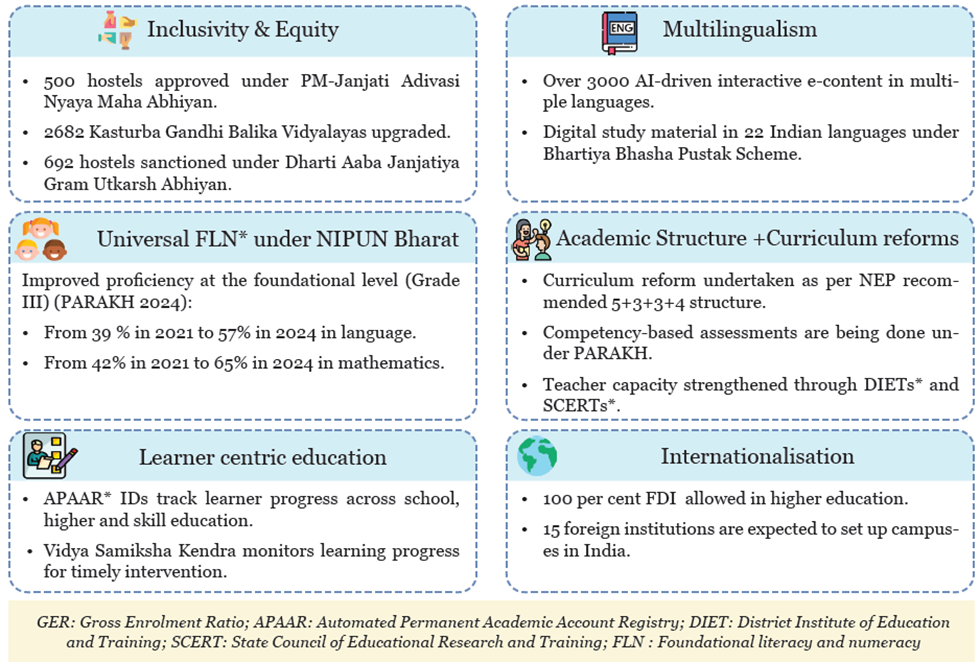
- NEP adopts a 5+3+3+4 structure integrating ECCE into formal education.
- It focuses on FLN, critical thinking, problem-solving, and holistic development.
- It promotes multidisciplinary learning, flexibility, and vocational integration.
- Key reforms include National Research Foundation and regulatory restructuring.
- NEP shifts focus from rote learning to competency-based education.
3. School Education System & Infrastructure
- India has 24.69 crore students, 14.71 lakh schools, and 1.01 crore teachers.
- Government schools dominate (69%), while private schools account for 41% enrolment.
- GER is high at primary levels but declines sharply at secondary level (68.5%).
- Infrastructure improvements include sanitation, ICT, electricity, and digital access.
- Digital tracking through APAAR IDs supports enrolment monitoring.
4. Government Initiatives in School Education
- PM SHRI schools aim for holistic, NEP-aligned transformation.
- NIPUN Bharat Mission focuses on FLN achievement by Grade III.
- DIKSHA and PM e-Vidya enable digital learning access.
- ULLAS promotes adult literacy and lifelong learning.
- Schemes like PM POSHAN improve nutrition and retention.
5. Learning Outcomes & Assessment Reforms
- PARAKH Rashtriya Sarvekshan evaluates competency-based learning outcomes.
- Post-COVID recovery is visible in foundational learning (Grades III).
- Girls slightly outperform boys in language outcomes.
- Rural students and government schools show improved performance.
- However, assessments still need to focus on diagnostic insights rather than scores.
6. Structural Challenges in School Education
- Secondary Net Enrolment Ratio (NER) is low at 52.2%, indicating retention issues.
- Rural areas lack secondary schools, causing transition losses and dropouts.
- Economic factors (44%) and domestic responsibilities (especially for girls) drive dropouts.
- Uneven distribution of schools creates accessibility challenges.
- Emotional well-being and inclusivity remain concerns.
7. Role of Community & Innovative Pedagogy
- Community participation improves enrolment, accountability, and learning outcomes.
- Parental involvement significantly enhances student performance.
- Peer-learning models and local innovations strengthen engagement.
- Teacher communities improve motivation and knowledge sharing.
- Experiential and community-based learning builds practical skills.
8. Skill Development & School-to-Work Transition
- Nearly 2 crore adolescents (14–18) are out-of-school.
- Only 0.97% receive formal vocational training, while ~92% lack any training.
- Economic pressures drive school dropouts, especially among boys.
- Vocational education integration is essential for employability.
- Aligning education with labour market needs is critical for productivity.
9. Higher Education Expansion
- HEIs increased from 51,534 (2014-15) to 70,018 (2025).
- Student enrolment increased to 4.46 crore, with GER at 29.5%.
- Expansion includes IITs, IIMs, AIIMS, and international campuses.
- Increased access reflects progress toward mass higher education.
10. Higher Education Reforms under NEP
- National Credit Framework enables integration of academic and skill learning.
- Academic Bank of Credits supports flexible learning pathways.
- Flexible entry-exit and multidisciplinary education are promoted.
- ANRF strengthens research ecosystem.
- MERITE scheme improves technical education quality.
Data & Facts
- School-age population: ~27% (2024)
- Expected Years of Schooling: India ~13 years
- Students: 24.69 crore
- Schools: 14.71 lakh
- Teachers: 1.01 crore
- Secondary NER: 52.2%
- Out-of-school adolescents: ~2 crore
- Formal vocational training: 0.97%
- Higher education GER: 29.5%
Concepts
- EYS (Expected Years of Schooling): Total years a child is expected to spend in education.
- FLN (Foundational Literacy & Numeracy): Basic reading, writing, and arithmetic skills.
- GER (Gross Enrolment Ratio): Enrolment as a percentage of eligible population.
- NER (Net Enrolment Ratio): Age-appropriate enrolment ratio.
- APAAR ID: Digital academic identity for tracking student progress.
Analysis
India’s education system is undergoing a structural transition from expansion to quality enhancement. While enrolment and infrastructure improvements are significant, the real challenge lies in improving learning outcomes, retention, and employability.
NEP provides a comprehensive roadmap, but implementation gaps persist, especially in secondary education and skill integration. The low penetration of vocational training and high dropout rates indicate a disconnect between education and labour markets.
Strengthening assessment systems, community participation, and digital learning can address these gaps. Higher education reforms signal a move towards flexibility, global competitiveness, and innovation-driven growth.
HEALTH, NUTRITION & DIGITAL WELL-BEING: STRENGTHENING HUMAN CAPITAL
India’s progress in human capital formation is increasingly supported by improvements in public health, nutrition, and digital well-being. Over the past decades, the country has achieved remarkable reductions in maternal and child mortality, alongside rising life expectancy, driven by targeted public health interventions, immunisation programmes, and healthcare infrastructure expansion.
However, India is currently undergoing a complex epidemiological transition, characterised by the coexistence of communicable diseases and a rapidly rising burden of non-communicable diseases (NCDs). Lifestyle changes, especially the growing consumption of ultra-processed foods (UPFs) and sedentary behaviour, have led to rising obesity and associated health risks.
Simultaneously, nutrition outcomes are improving, with increased calorie and protein intake and narrowing rural-urban gaps, although issues of dietary quality and diversity persist. Another emerging concern is digital addiction, particularly among youth, which impacts mental health, productivity, and social capital.
India’s response integrates healthcare expansion, digital health systems, behavioural change strategies, and regulatory reforms. Moving forward, a holistic approach combining preventive healthcare, improved nutrition, behavioural interventions, and digital wellness policies will be essential to sustain human capital development and economic growth.
Key Points
1. Progress in Public Health Outcomes
- India has significantly improved health indicators, including reductions in maternal mortality, infant mortality, and child mortality rates.
- Maternal mortality declined by 86% since 1990, outperforming global averages.
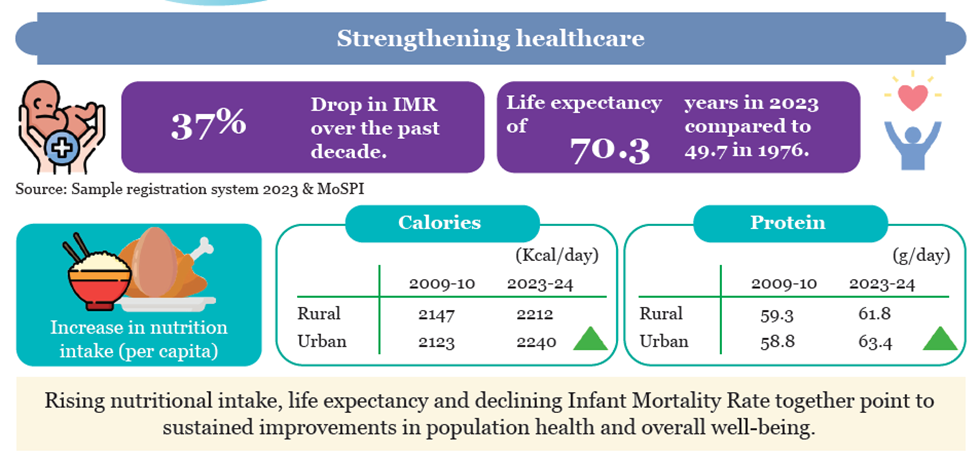
- Infant mortality reduced from 40 (2013) to 25 (2023), reflecting better healthcare access.
- Life expectancy increased to 70.3 years (2023) from 49.7 years in 1973.
- These gains are driven by immunisation, neonatal care, and healthcare expansion.
2. Digital Health & Healthcare Infrastructure
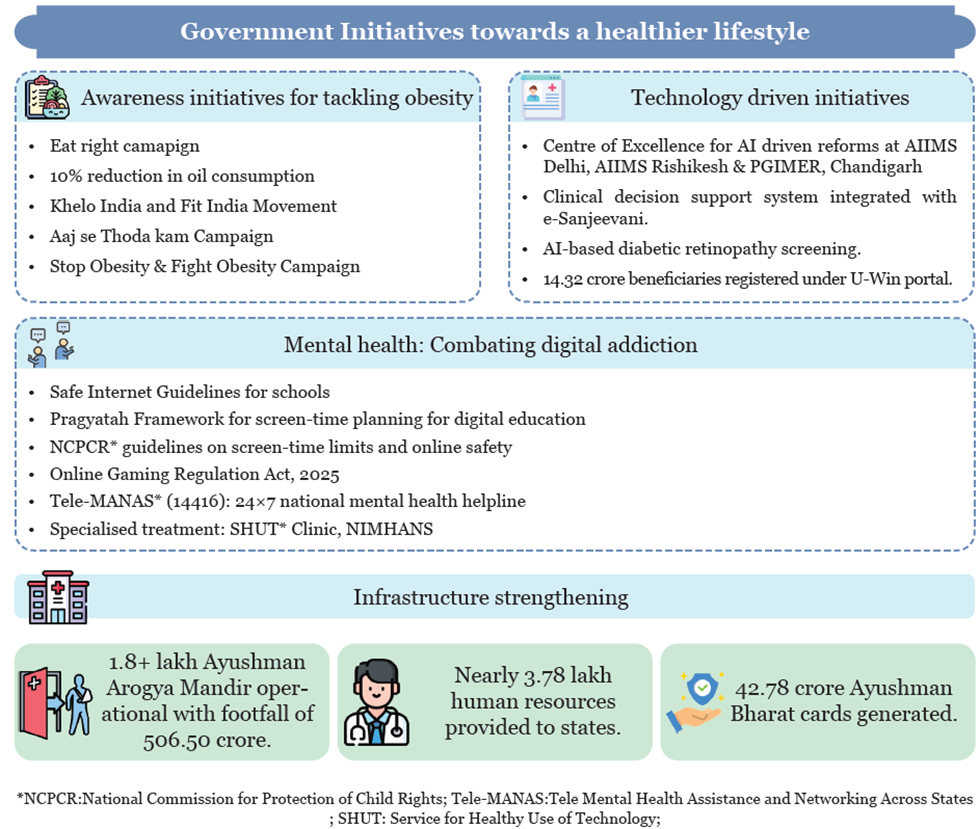
- Digital platforms like ABDM and e-Sanjeevani improve healthcare accessibility and efficiency.
- ICT integration enhances transparency, reduces fragmentation, and enables evidence-based policymaking.
- AI-based tools support disease detection, surveillance, and clinical decision-making.
- Ayushman Bharat ecosystem strengthens primary, secondary, and tertiary care continuum.
- Telemedicine has expanded healthcare reach, especially in remote areas.
3. Epidemiological Transition in India
- India faces a double burden of communicable diseases (TB, infections) and non-communicable diseases (diabetes, cancer).
- NCDs account for over 57% of total deaths.
- Cardiovascular diseases are the leading cause of mortality.
- Regional disparities exist, with some states showing developed-country patterns.
- Health policy must balance infectious disease control and chronic disease management.
4. Rising Obesity & Ultra-Processed Foods (UPFs)
- Obesity is increasing due to sedentary lifestyles and dietary changes.
- UPF consumption has increased sharply, with a 40-fold rise in sales (2006–2019).
- Obesity prevalence is rising across adults and children.
- UPFs are linked to diabetes, heart disease, and mental health issues.
- This trend imposes long-term economic and healthcare costs.
5. Policy Responses to Nutrition & Obesity
- National Multi-sectoral Action Plan targets reduction in unhealthy diets.
- Measures include front-of-pack labelling, advertising restrictions, and awareness campaigns.
- Initiatives like POSHAN Abhiyaan, Eat Right India, and Fit India promote healthier lifestyles.
- Screening programmes identify high-risk individuals for early intervention.
- Behavioural change is central to long-term success.
6. Nutrition Trends & Food Security
- Calorie and protein intake have increased in both rural and urban areas.
- Rural-urban nutritional gap is narrowing across income levels.
- NFSA ensures food security, while POSHAN schemes focus on nutrition security.
- Dietary diversity is improving but remains uneven across regions.
- Overdependence on cereals and low intake of protective foods remain concerns.
7. Importance of Behavioural Change (SBCC)
- Social and Behaviour Change Communication improves effectiveness of welfare schemes.
- Rajasthan’s Cash Plus Model shows improved utilisation of nutrition benefits.
- Community involvement enhances awareness and adoption of healthy practices.
- Behavioural interventions address myths, gender norms, and decision-making barriers.
- SBCC ensures sustainability of outcomes beyond financial support.
8. School-Based Health & Nutrition Interventions
- Schools act as critical platforms for promoting nutrition and physical activity.
- Measures include healthy food options, physical activity, and wellness policies.
- Teacher and parent involvement improves effectiveness of interventions.
- School well-being scores can incentivise holistic development.
- Early interventions shape lifelong health behaviours.
9. Digital Addiction: Emerging Challenge
- Rapid digital expansion has increased risks of excessive screen time and addiction.
- Digital addiction affects productivity, academic performance, and mental health.
- It is associated with anxiety, depression, sleep disturbances, and social isolation.
- Youth are particularly vulnerable due to high exposure and usage.
- Economic costs include reduced productivity and increased healthcare burden.
10. Policy Responses to Digital Addiction
- WHO recognises gaming disorder as a mental health condition.
- India has introduced guidelines, tele-mental health services (Tele-MANAS), and regulatory measures.
- Online Gaming Regulation Act restricts harmful gaming practices.
- Schools are encouraged to promote digital wellness and reduce screen dependency.
- International examples show regulation, awareness, and parental control approaches.
11. Way Forward: Holistic Human Capital Approach
- Integrated policies are required linking health, nutrition, and behavioural factors.
- Preventive healthcare must complement curative systems.
- Digital wellness should be incorporated into education and public policy.
- Community participation and decentralised implementation are critical.
- Data-driven policymaking is needed for targeted interventions.
Data & Facts
- Maternal mortality reduction: 86% since 1990
- Life expectancy: 70.3 years (2023)
- NCD share in deaths: >57%
- Obesity: 24% women, 23% men (NFHS-5)
- UPF market growth: 40× (2006–2019)
- Internet users: 96.96 crore (2024)
- Tele-MANAS usage: 32 lakh calls
Concepts
- Epidemiological Transition: Shift from infectious diseases to chronic diseases as major causes of death.
- NCDs: Non-communicable diseases such as diabetes, cancer, and cardiovascular diseases.
- UPFs: Ultra-processed foods high in sugar, fat, and additives.
- SBCC: Behavioural strategies to influence health-related decisions.
- Digital Addiction: Excessive and compulsive use of digital devices causing impairment.
Analysis
India’s human capital strategy is increasingly multidimensional, integrating health, nutrition, and behavioural factors. While traditional health indicators show significant improvement, emerging challenges such as NCDs, obesity, and digital addiction reflect the changing nature of development.
The coexistence of undernutrition and overnutrition highlights structural imbalances in food systems and lifestyle patterns. Policy responses are evolving towards preventive, technology-enabled, and behaviour-driven approaches.
However, gaps remain in regulatory clarity, awareness, and implementation capacity. A balanced approach combining public health investment, behavioural change, and regulatory reforms is essential for sustaining long-term economic productivity and social well-being.
One Comment