
AI Ecosystem in India: Growth, Challenges & Opportunities (Economic Survey 2025–26)
Artificial Intelligence (AI) has transitioned from a speculative technology to a widely adopted economic tool, with increasing integration across business functions globally. While AI adoption is expanding, the development of advanced foundational models remains concentrated among a few resource-rich firms, creating structural asymmetries in the global AI ecosystem.
For India, the challenge lies not in competing at the frontier level but in designing a development-oriented AI strategy aligned with its resource constraints and labour-rich economy. The Economic Survey advocates a bottom-up approach focused on application-specific, small models, leveraging India’s strengths in data, talent, and digital infrastructure.
At the same time, AI introduces complex trade-offs involving labour markets, regulation, data governance, and resource use. A balanced approach is required to ensure productivity gains without exacerbating inequality or job displacement. The strategy emphasises human capital development, governance reforms, and data as a strategic asset, alongside ensuring AI safety and ethical deployment.
Ultimately, India’s success in the AI era will depend on its ability to combine innovation with inclusivity, ensuring that AI enhances economic resilience while preserving human-centric development.
Key Points
1. Changing Nature of AI Adoption
- AI has shifted from a theoretical concept to widespread adoption, with about 88% of firms using it in at least one business function.
- Adoption is expanding beyond high-income countries into developing economies, including India.
- Despite widespread usage, advanced AI development remains concentrated among a few global firms.
- High capital, compute, data, and energy requirements create barriers to entry.
2. AI and Labour Market Dynamics
- Current evidence suggests limited immediate disruption to employment due to AI adoption.
- AI initially complements labour by enhancing productivity rather than replacing workers.
- Over time, the labour intensity of output may decline as AI adoption deepens.
- Labour-abundant economies like India face the challenge of balancing productivity with employment.
3. Key Asymmetries in the Global AI Ecosystem
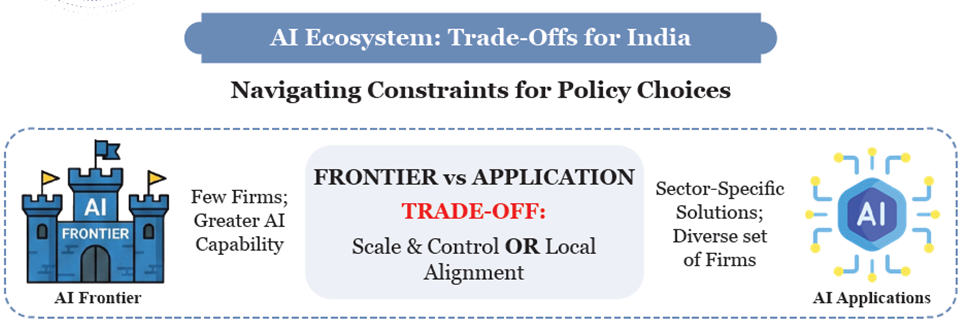
(a) Frontier vs Application Development
- Advanced model development is concentrated among a few firms with high resource access.
- Most countries, including India, are better positioned in application-level innovation.
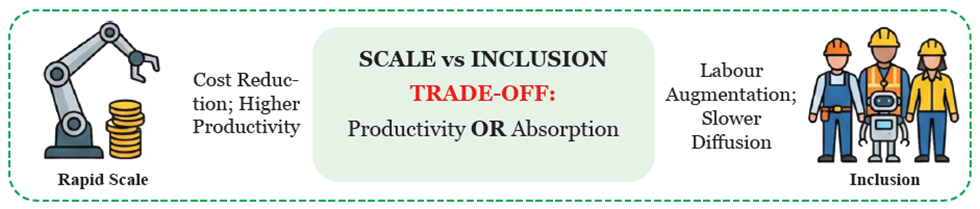
(b) Capital vs Labour Trade-off
- AI increases capital productivity, potentially reducing demand for certain labour segments.
- Rapid adoption may displace jobs, while delayed adoption risks productivity stagnation.
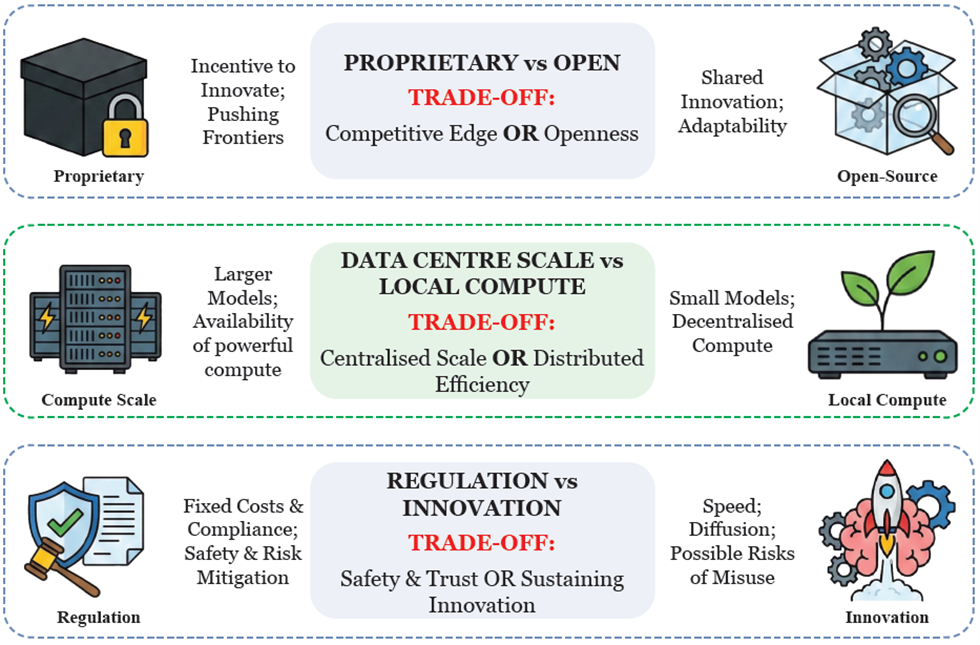
(c) Open vs Proprietary Models
- Proprietary models offer high performance but limit transparency and control.
- Open-source models reduce entry barriers but require governance frameworks.
(d) Compute vs Resource Constraints
- AI infrastructure demands high energy, water, and financial resources.
- Resource constraints in India necessitate efficient and decentralised AI models.
(e) Regulation vs Innovation
- Excessive regulation may hinder innovation, while weak regulation creates risks.
- A balanced, risk-based approach is essential.
4. India’s Strategic AI Approach
Bottom-Up Development Model
- Focus on small, application-specific AI models tailored to sectoral needs.
- Encourage decentralised innovation across startups, institutions, and public agencies.
- Leverage domestic data and digital infrastructure for scalable solutions.
Strengths of India
- Strong AI talent pool and research contributions.
- Large and diverse data ecosystem.
- Growing digital infrastructure and connectivity.
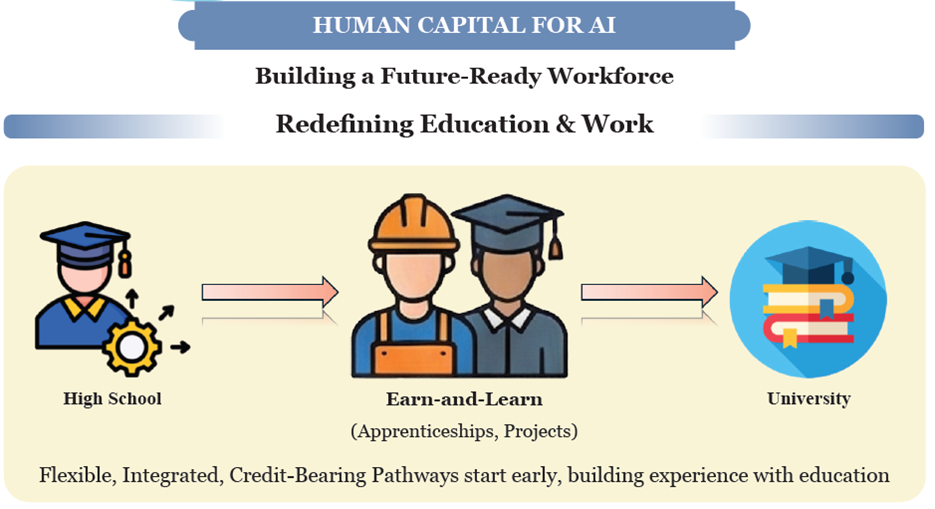
5. Role of Human Capital
- AI development requires expertise in both algorithms and software engineering.
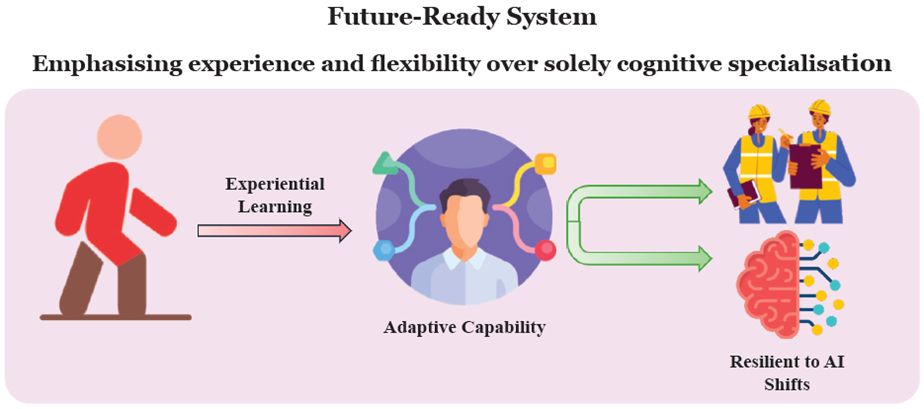
- Education must integrate practical experience through “earn-and-learn” models.
- Foundational skills like problem-solving and adaptability are increasingly important.
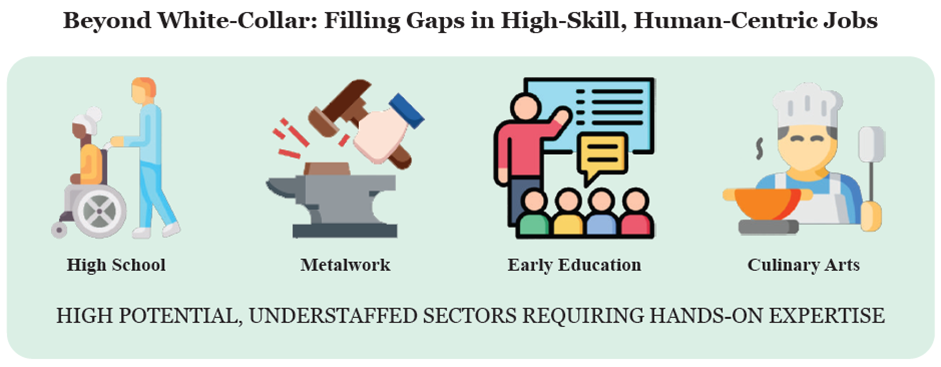
- Human-centric jobs (healthcare, skilled trades) will gain importance in the AI era.
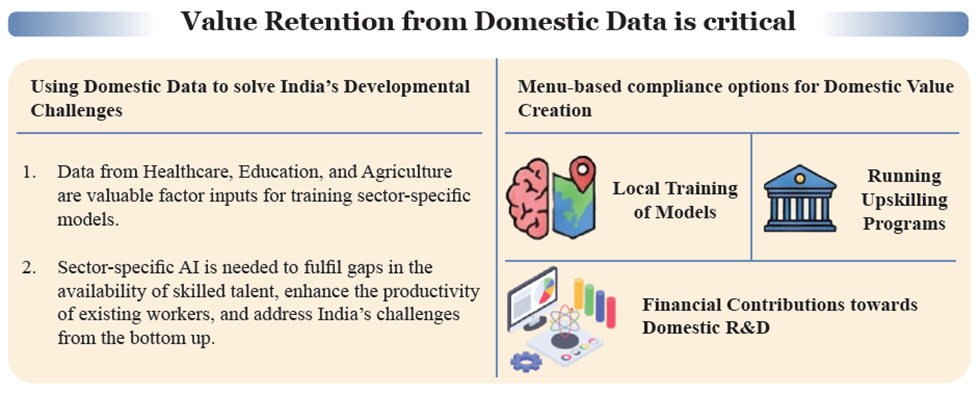
6. Data as a Strategic Resource
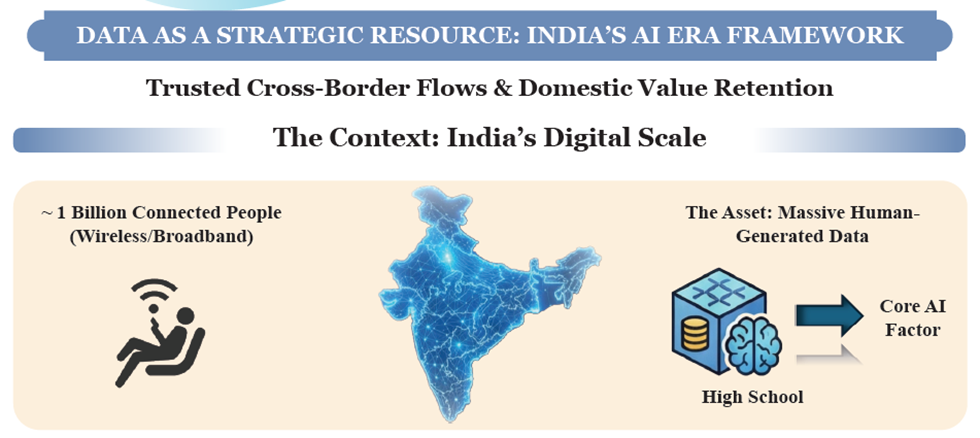
- Data is a critical factor of production in the AI economy.
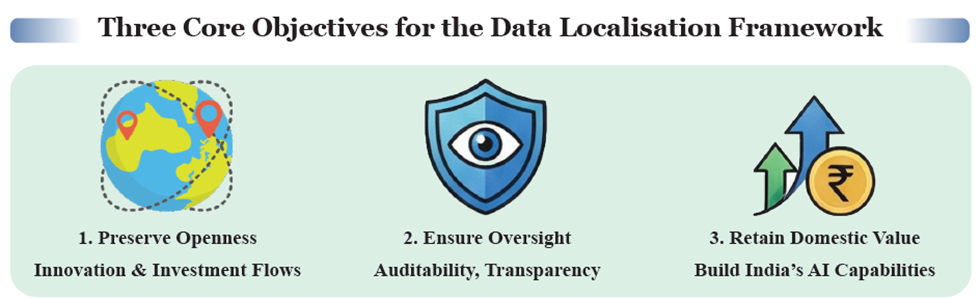
- India must balance openness to data flows with domestic value retention.
- Proposed framework emphasises:
- Accountable cross-border data flows.
- Risk-based data categorisation.
- Incentive-driven localisation and value creation.
- Data governance should focus on economic value capture rather than rigid localisation.
7. Governance and Institutional Framework
- AI governance must align with India’s socio-economic realities.
- Proposal for an AI Economic Council to manage labour impacts and policy coordination.
- Regulation should be:
- Risk-based
- Flexible
- Incentive-driven
- Transparency, accountability, and phased adoption are critical.

8. AI Safety and Risks
- AI poses risks similar to other powerful technologies like nuclear energy.
- Concerns include misuse, ethical violations, and unintended consequences.
- Need for:
- AI Safety Institute
- Transparency in AI model evaluation
- Red-teaming and risk testing
- Certain applications (e.g., surveillance misuse) require strict boundaries.
9. Phased AI Strategy for India
Short-Term
- Build institutional capacity and enable experimentation.
- Promote open-source innovation and shared infrastructure.
Medium-Term
- Scale successful applications and formalise regulations.
- Expand domestic compute and data ecosystems.
Long-Term
- Achieve resilience in hardware, talent, and infrastructure.
- Align education and labour markets with AI-driven changes.
Data & Facts
- 88% firms globally use AI in at least one function (2025).
- AI usage share: 58.4% (high-income countries), 22.5% (upper-middle), 18.7% (lower-middle).
- India accounts for only ~3% of global data centres.
- India contributes significantly to global AI talent and research output.
- AI data centres consume massive resources (electricity and water), highlighting sustainability concerns.
Concepts
- Artificial Intelligence (AI): Technology enabling machines to perform tasks requiring human intelligence.
- Foundational Models: Large-scale AI models trained on vast datasets for general-purpose use.
- AI Augmentation: Use of AI to enhance human productivity rather than replace it.
- Data Localisation: Requirement to store data within a country’s borders.
- Open-Source AI: AI systems with publicly accessible code and models.
Analysis
India’s AI strategy reflects a pragmatic understanding of global technological asymmetries. Instead of competing in capital-intensive frontier AI, the focus on application-led, decentralised innovation aligns with India’s comparative advantages. The emphasis on human capital, data governance, and institutional coordination highlights a holistic approach.
However, challenges remain in balancing productivity with employment, ensuring equitable data value capture, and managing resource constraints. The success of this strategy will depend on effective policy sequencing, strong governance, and continuous adaptation to technological changes.
One Comment