
Urbanisation in India: Challenges, Planning & Growth (Economic Survey 2025–26)
Urbanisation is a central driver of economic growth, productivity, and innovation, rooted in the concept of agglomeration economies where proximity enhances efficiency and knowledge exchange. India’s urban population is expanding rapidly, yet its cities face a paradox: despite scale, they underperform in productivity, liveability, and global competitiveness. Structural constraints such as fragmented governance, weak fiscal autonomy, inefficient land use, inadequate mobility systems, and infrastructural deficits limit the realisation of urban potential.
Urban expansion in India is increasingly peripheral, with growth occurring beyond formal city boundaries, highlighting the need for metropolitan-scale planning. Informality in housing, labour, and enterprises remains a defining feature, serving as a functional response to systemic constraints rather than a temporary anomaly. While initiatives like Smart Cities Mission, AMRUT, and SBM-U have improved infrastructure access, challenges now lie in improving quality, efficiency, and behavioural compliance.
The future of Indian urbanisation depends on integrated planning, stronger governance, financial empowerment of cities, and a robust social contract between citizens and institutions. Cities must transition from being administrative units to economic engines that are liveable, inclusive, and innovation-driven.
Key Points
1. Concept and Economic Logic of Urbanisation
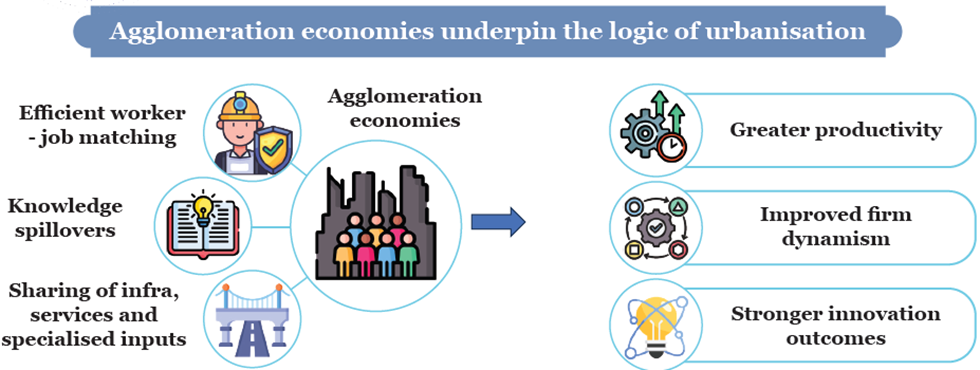
- Urbanisation is driven by agglomeration economies, where clustering of people and firms enhances productivity, innovation, and economic diversification.
- Cities function as economic infrastructure by enabling efficient labour-market matching, knowledge spillovers, and shared services.
- Productivity gains in India show that doubling city size can increase productivity by about 12 per cent.
- Urban areas disproportionately host modern sectors such as services, manufacturing, and knowledge industries.
- A city emerges when demographic density, economic diversification, and institutional recognition converge.
2. Urbanisation Trends in India
- India’s urban system is top-heavy, with a large share of population concentrated in metropolitan and Class I cities.
- Urbanisation appears slow by Census definition but may be underestimated due to methodological limitations.
- Alternative measures using satellite data suggest India could be significantly more urban than officially reported.
- Urban growth is increasingly occurring in peri-urban and suburban regions rather than city cores.
- Night-time light data indicates expansion of economic activity beyond traditional administrative boundaries.
3. Governance Deficit in Indian Cities
- Urban governance is fragmented across multiple agencies, reducing coordination and accountability.
- Cities lack fiscal autonomy, with low own-source revenues and high dependence on transfers.
- Municipal revenues in India are significantly lower compared to global standards.
- Weak alignment between authority and accountability limits long-term planning and investment.
- Cities function more as administrative units rather than autonomous economic actors.
4. Land, Housing, and Infrastructure Constraints
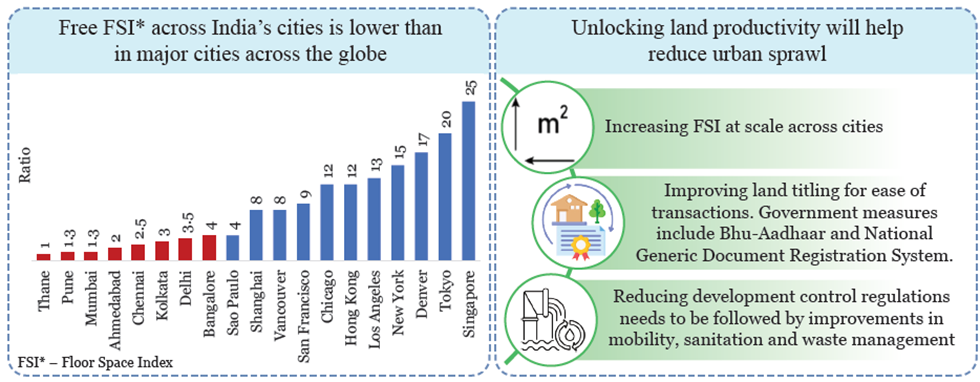
- Restrictive land-use regulations and low Floor Space Index (FSI) limit vertical growth and increase land prices.
- Land remains “dead capital” due to unclear titles, fragmented ownership, and inefficient markets.
- Affordable housing shortages are acute, particularly for low-income groups.
- Peripheral housing development lacks adequate infrastructure and connectivity.
- Infrastructure investments often fail to deliver productivity gains due to poor integration with land-use planning.
5. Mobility Challenges and Solutions
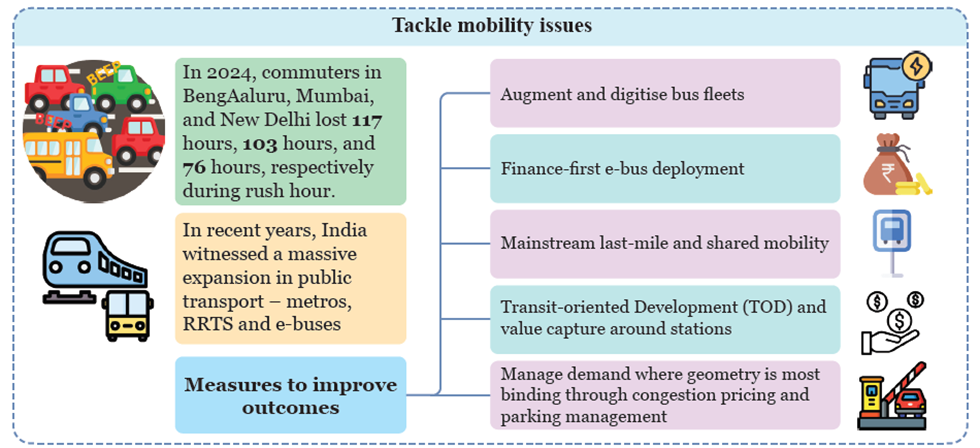
- Traffic congestion imposes high economic costs through productivity losses and increased travel time.
- Indian cities face inadequate public transport capacity, especially in bus systems.
- Overdependence on private vehicles reduces road efficiency and increases congestion.
- Solutions include expanding public transport, improving last-mile connectivity, and adopting transit-oriented development (TOD).
- Demand management tools such as congestion pricing and parking reforms can improve mobility efficiency.
6. Urban Services: Waste, Water, and Sanitation
- Significant progress has been made in sanitation under SBM-U, including elimination of open defecation.
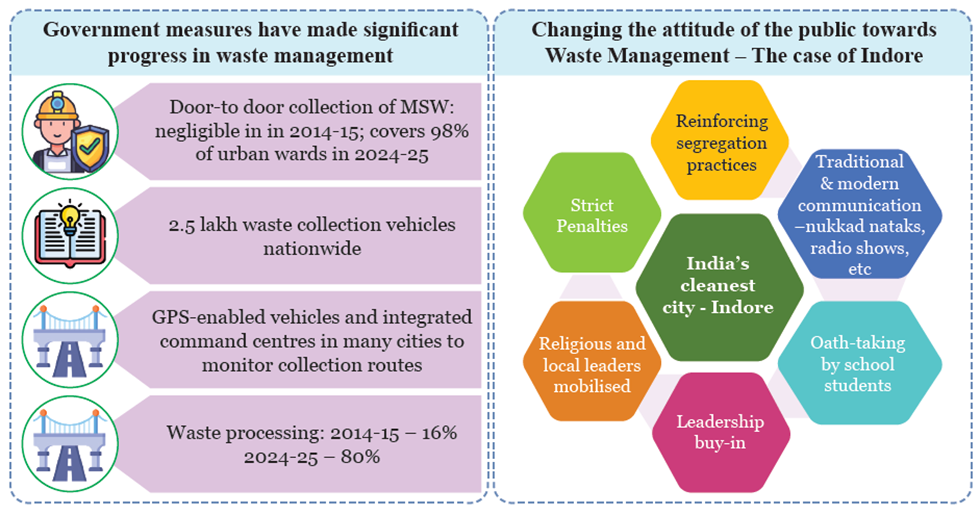
- Waste collection coverage has improved substantially, but segregation and processing gaps persist.
- Urban India generates large volumes of waste and wastewater, with limited treatment and reuse.
- Behavioural and institutional challenges are major constraints in achieving sustainable waste management.
- Circular water economy offers economic and environmental benefits through reuse of treated wastewater.
7. Informality in Urban Systems
- Informality in housing, labour, and enterprises is a structural feature of Indian urbanisation.
- Slums and informal settlements provide affordable housing near employment centres.
- Informal labour markets absorb migrants and support urban economies.
- Informal enterprises contribute significantly to employment and supply chains.
- Policy shift is required from eradication to integration of informal systems.
8. Social Contract and Civic Behaviour
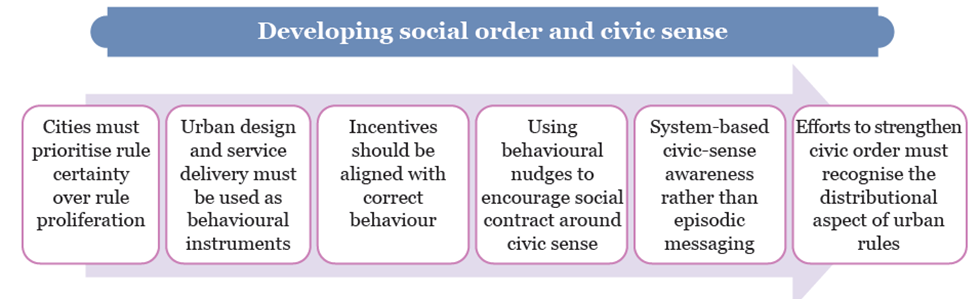
- Urban outcomes depend not only on infrastructure but also on citizen-institution trust and cooperation.
- Weak enforcement and inconsistent service delivery undermine civic discipline.
- Behaviour is context-dependent and improves when systems are predictable and well-designed.
- Global cities achieve compliance through clear rules, reliable services, and credible enforcement.
- Strengthening civic sense requires aligning incentives, enforcement, and service quality.
9. Future of Urbanisation in India
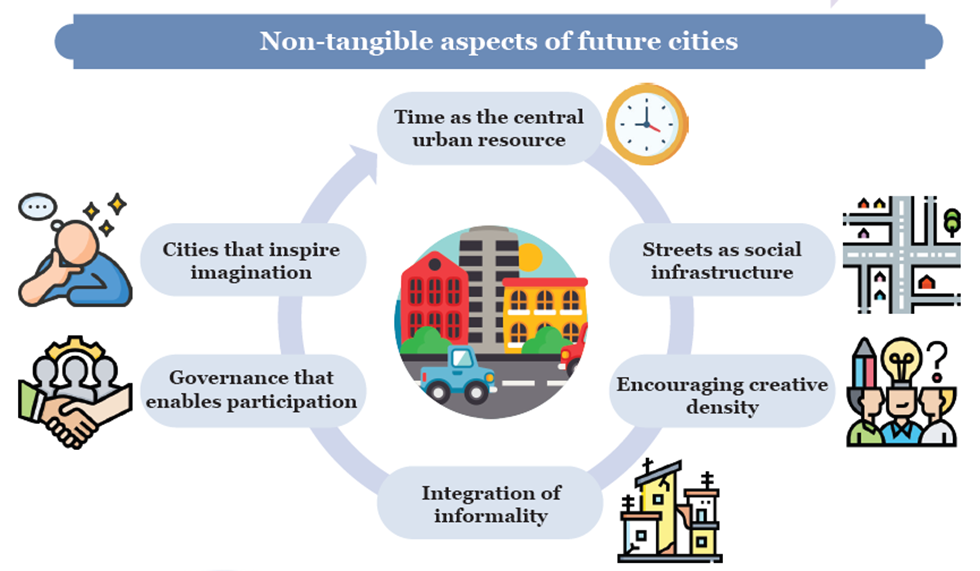
- Cities must prioritise liveability, creativity, and inclusiveness alongside economic growth.
- Urban planning should focus on reducing time costs and improving accessibility.
- Streets should function as social spaces, not merely transport corridors.
- Cultural and creative ecosystems must be supported to enhance urban vibrancy.
- Participatory governance and citizen engagement are essential for sustainable urban development.
Data & Facts
- Doubling city size increases productivity by approximately 12% in India.
- Over 70% of urban population lived in Class I cities (2011 Census).
- India’s urban population may be around 63% using satellite-based estimates.
- Urban areas contribute nearly 70% of GDP but house about 40% of population (projected).
- Municipal own-source revenue is less than 0.6% of GDP in India.
- Waste processing improved from 16% (2014–15) to about 80% (2025–26).
- India generates approximately 1.6 lakh tonnes of municipal solid waste per day.
- Only about 28% of wastewater is treated and around 8% reused.
- Urban housing shortage is estimated at around 29 million units.
Concepts
- Agglomeration Economies: Productivity gains arising from clustering of people and firms in cities.
- Dead Capital: Assets like land that cannot be productively used due to legal or market constraints.
- FSI/FAR: Ratio determining allowable built-up area on a plot of land.
- Transit-Oriented Development (TOD): Urban planning approach integrating transport with high-density, mixed-use development.
- Peri-Urban Areas: Transitional zones between rural and urban regions experiencing rapid growth.
- Informality: Economic activities operating outside formal regulatory frameworks.
- Circular Water Economy: System of reusing treated wastewater for sustainable resource management.
- Congestion Pricing: Charging vehicles for using roads during peak hours to reduce traffic.
Analysis
- India’s urbanisation challenge is not merely about expansion but about efficiency and governance.
- The mismatch between infrastructure investment and institutional capacity reduces returns.
- Informality reflects systemic gaps and must be integrated rather than eliminated.
- Weak fiscal and administrative autonomy prevents cities from acting as growth engines.
- Urban planning must shift from fragmented, project-based approaches to integrated system-based frameworks.
- Behavioural and institutional reforms are as important as physical infrastructure investments.
One Comment