
CHAPTER 10: ENVIRONMENT AND CLIMATE CHANGE (Economic Survey 2025-26)
GLOBAL REALITIES, INDIA’S STRATEGY AND ADAPTATION FRAMEWORK
The global climate discourse has entered a phase of realism, where ambitious decarbonisation targets are increasingly constrained by infrastructural, financial, and institutional limitations. Experiences of advanced economies highlight that rapid renewable expansion without adequate grid readiness, storage capacity, and system resilience can lead to instability, higher costs, and inefficiencies.
This underscores the importance of sequencing and institutional preparedness in climate transitions. For emerging economies like India, climate strategy must balance growth, energy security, and resilience alongside mitigation goals. India’s approach is anchored in three pillars: prioritising adaptation due to high vulnerability, pursuing mitigation through diversified and secure energy transitions, and relying largely on domestic resources amid limited global climate finance.
A key insight is that development itself acts as adaptation by enhancing resilience through better infrastructure, health systems, and livelihoods. India’s strategy integrates climate action into development planning through national missions, state-level initiatives, and community-driven interventions. Public investment plays a central role in building climate resilience across sectors such as agriculture, water, and coastal ecosystems.
Overall, India advocates a pragmatic, growth-compatible, and context-specific climate pathway that ensures sustainability without compromising development priorities.

Key Points
1. Global Climate Transition: Emerging Realities
- The global climate agenda is shifting from idealistic targets to practical constraints involving infrastructure, finance, and institutional capacity.
- Rapid renewable deployment without grid readiness and storage has caused instability and inefficiencies in advanced economies.
- Energy transitions must account for system-level costs such as storage, balancing, and transmission upgrades.
- A lack of sequencing can increase systemic fragility instead of resilience.
- Policymaking is moving towards evidence-based and pragmatic climate strategies.
2. Lessons from Advanced Economies
- Countries like the Netherlands and Spain have faced grid congestion and instability due to rapid renewable expansion.
- Intermittency of renewable energy increases costs related to backup capacity and grid reinforcement.
- Storage and transmission bottlenecks remain major constraints in energy transitions.
- Overemphasis on capacity addition without system readiness can weaken reliability.
- These experiences highlight the importance of balancing ambition with feasibility.
3. Shift in Global Climate Discourse
- Climate policy is increasingly recognising uncertainties and limitations in scientific projections.
- There is a move away from alarmist narratives towards calibrated and context-specific approaches.
- Policymakers are focusing on balancing climate action with economic stability and competitiveness.
- Climate risk management requires nuanced interpretation rather than deterministic conclusions.
4. Development as Adaptation
- Economic development enhances resilience by improving infrastructure, health systems, and livelihoods.
- Growth and climate action are complementary rather than conflicting objectives.
- Investments in agriculture, health, and poverty reduction strengthen adaptive capacity.
- Climate strategies should prioritise human welfare alongside environmental goals.
5. India’s Climate Strategy: Three Pillars
- Adaptation is prioritised due to India’s high vulnerability to climate risks such as floods, heatwaves, and water stress.
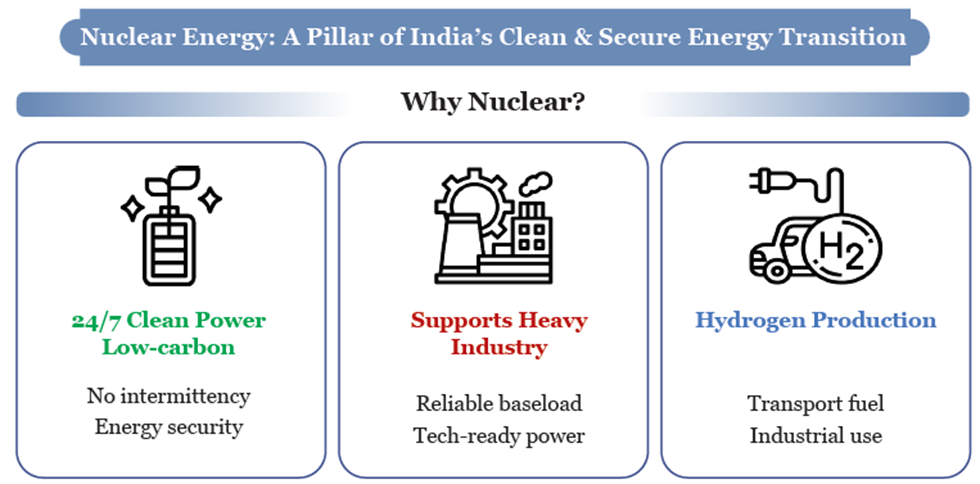
- Mitigation focuses on renewable energy expansion, energy efficiency, and diversification into green hydrogen and nuclear energy.
- Climate finance relies heavily on domestic resources due to limited and costly international funding.
- India promotes a balanced approach combining growth, resilience, and sustainability.
6. Climate Finance and Regulatory Evolution
- High cost of capital and limited global finance constrain climate investments in developing countries.
- India is developing innovative financial instruments such as green bonds and sustainable finance frameworks.
- Regulatory approaches are shifting from command-and-control to risk-based and outcome-oriented systems.
- International reforms are needed in multilateral finance and credit rating mechanisms.
7. Adaptation: Central to Climate Policy
- Adaptation provides immediate economic benefits by reducing losses and stabilising livelihoods.
- Developing countries require USD 310–365 billion annually by 2035, but current flows are inadequate.
- Climate adaptation must be integrated into development planning for long-term sustainability.
- Localised and context-specific solutions are essential for effective adaptation.
8. India’s Public Investment–Led Adaptation
- India’s adaptation strategy is driven by domestic public investment integrated into development sectors.
- Adaptation-related spending increased from 3.7% of GDP (FY16) to 5.6% (FY22).
- National Action Plan on Climate Change (NAPCC) provides a mission-based framework.
- Missions focus on agriculture, water, health, and sustainable habitats.
- This approach ensures resilience while supporting economic growth.
9. Sectoral Adaptation Initiatives
- Agriculture initiatives promote climate-resilient farming and efficient water use.
- Water management focuses on conservation, rainwater harvesting, and equitable access.
- Coastal resilience programmes integrate ecosystem protection with livelihood security.
- Urban initiatives enhance climate-resilient infrastructure and liveability.
10. Role of States and Local Governance
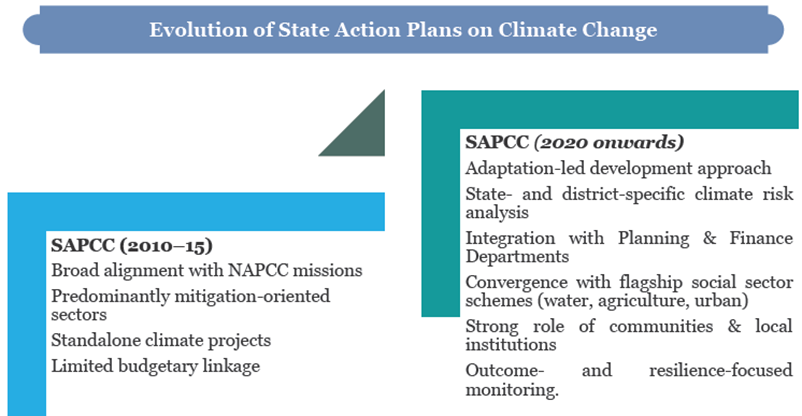
- State Action Plans on Climate Change (SAPCCs) translate national strategies into local action.
- Recent SAPCCs emphasise adaptation-led development and district-level planning.
- Community participation and local institutions play a critical role in implementation.
- Climate governance is increasingly decentralised and context-specific.
11. Subnational Innovations (Case Studies)
- Meghalaya focuses on ecosystem-based water management and community participation.
- Odisha integrates irrigation, agriculture, and community governance for resilience.
- Tamil Nadu adopts coastal ecosystem-based adaptation strategies.
- Ahmedabad uses heat insurance and action plans to protect vulnerable workers.
- Urban innovations like cooling stations and early warning systems enhance resilience.
Data & Facts
- Adaptation finance requirement: USD 310–365 billion/year by 2035
- Current adaptation finance: ~USD 26 billion/year
- India’s per capita emissions: ~2.9 t (vs global 6.7 t)
- Adaptation spending: 3.7% → 5.6% of GDP (FY16–FY22)
- Mangrove restoration under MISHTI: ~540 sq km
- Employment from MISHTI: ~22.8 million person-days
Concepts
- Adaptation: Adjusting systems to reduce vulnerability to climate impacts.
- Mitigation: Efforts to reduce greenhouse gas emissions.
- NAPCC: India’s framework for climate action through national missions.
- SAPCC: State-level climate action plans tailored to regional needs.
- Climate Finance: Funding for mitigation and adaptation activities.
Analysis
The chapter highlights a critical shift from idealistic climate narratives to pragmatic, system-oriented approaches. India’s strategy stands out for integrating climate action within development priorities rather than treating it as a standalone objective. The emphasis on adaptation reflects ground realities, while mitigation is pursued in a balanced manner to ensure energy security and economic growth.
However, global inequities in climate finance and technology access remain major challenges. India’s approach of combining domestic resource mobilisation, decentralised governance, and ecosystem-based adaptation offers a scalable model for other developing economies.
MITIGATION, CLIMATE FINANCE & REGULATORY REFORMS
India’s climate strategy in the contemporary phase is shaped by the need to balance mitigation, energy security, and development priorities within a constrained global financial environment. While significant progress has been made in expanding non-fossil energy capacity—crossing 50% of installed capacity—challenges related to intermittency, storage, and critical mineral dependence remain.
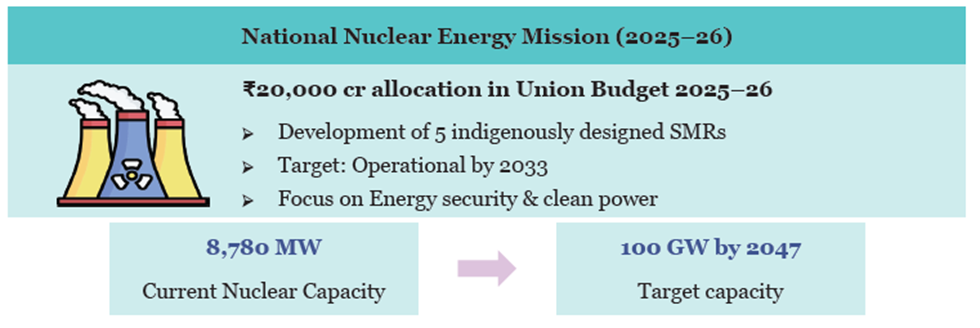
Policy initiatives such as the Green Hydrogen Mission, Nuclear Energy Mission, and battery storage frameworks reflect a systems-based approach to energy transition. Simultaneously, climate finance emerges as the most binding constraint, with global capital flows skewed towards developed economies and insufficient support reaching vulnerable developing countries.
India relies predominantly on domestic financing while attempting to deepen green financial markets through instruments like sovereign green bonds and regulatory reforms. Environmental governance is also undergoing a transformation from command-and-control approaches to risk-based, market-oriented, and technology-enabled systems. Mechanisms like carbon markets, emissions trading, and digital clearance platforms aim to improve efficiency and reduce compliance burdens.
Overall, India’s climate pathway reflects a pragmatic, development-centric model that integrates resilience, competitiveness, and sustainability, while advocating for equitable global financial and institutional reforms.
Key Points
1. India’s Mitigation Strategy
- India is pursuing a diversified energy transition including solar, wind, nuclear, green hydrogen, and bioenergy.
- The country has already achieved over 50% installed capacity from non-fossil sources ahead of targets.
- Renewable expansion is supported by large-scale policy initiatives and capacity additions.
- However, energy transition is constrained by intermittency, storage requirements, and system integration challenges.
- A balanced approach emphasises energy security, affordability, and industrial competitiveness.
2. Challenges in Renewable Energy Transition
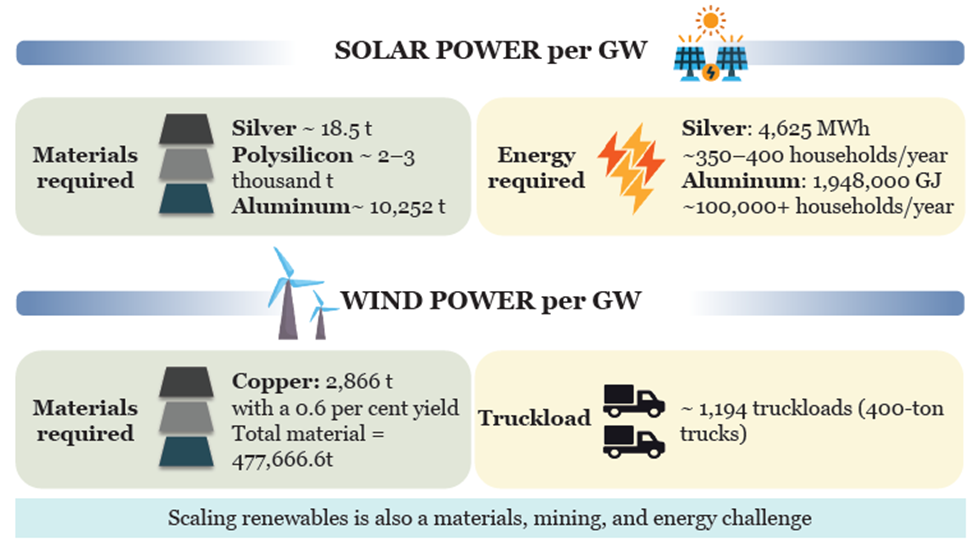
- Renewable energy systems are material-intensive and depend oncritical minerals such as lithium and cobalt.
- Energy storage remains capital-intensive and technologically challenging.
- Grid stability requires backup thermal capacity and transmission upgrades.
- Rapid transition without system readiness can increase costs and reduce reliability.
- These challenges highlight the importance of system-level planning.
3. Energy Storage Ecosystem
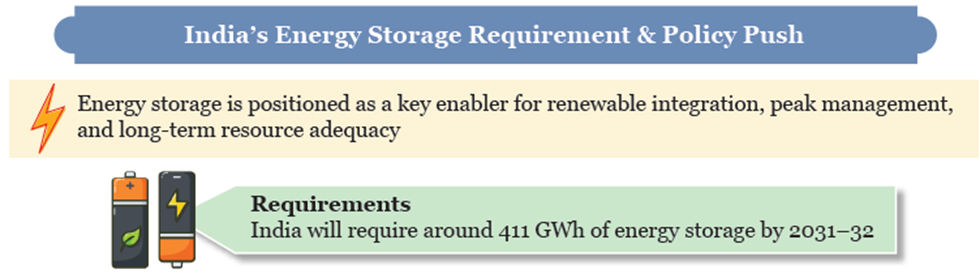
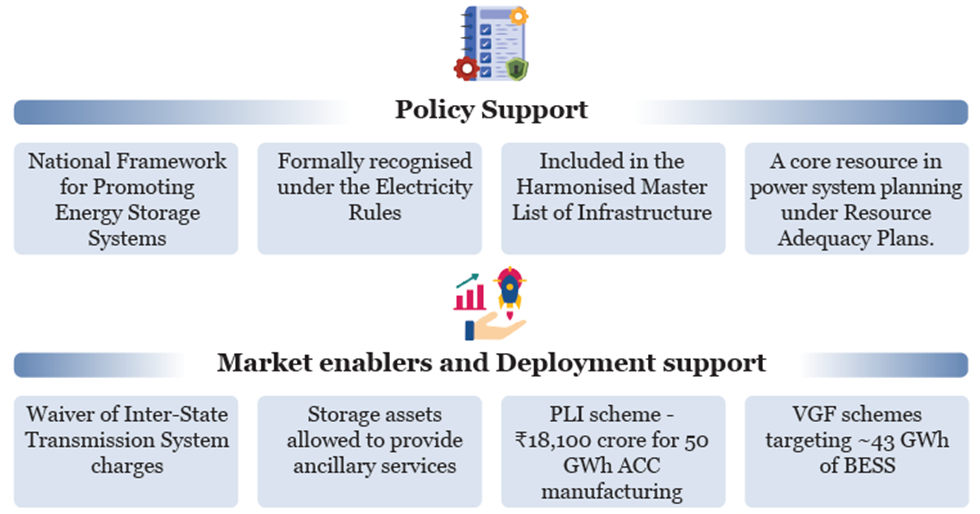
- India requires 336 GWh storage by 2030 and 411 GWh by 2032 for renewable integration.
- Policy support includes viability gap funding, transmission charge waivers, and market participation mechanisms.
- Battery Energy Storage Systems (BESS) and pumped storage are being promoted.
- Storage is recognised as critical infrastructure for grid stability.
- Manufacturing is incentivised through PLI schemes for advanced battery technologies.
4. Critical Minerals & Strategic Concerns
- Energy transition depends heavily on minerals like lithium, copper, and rare earth elements.
- Supply chains are concentrated geographically, creating geopolitical risks.
- Standards-based markets may act as barriers for developing countries.
- India launched the National Critical Mineral Mission (NCMM) to secure supply chains.
- Recycling and domestic exploration are key strategies for resilience.
5. Carbon Market Framework
- India introduced the Carbon Credit Trading Scheme (CCTS) in 2023.
- It includes a compliance mechanism for industries and a voluntary offset mechanism.
- Emission intensity targets are set for sectors like cement and aluminium.
- Market-based instruments aim to improve cost efficiency and incentivise innovation.
- Lessons from global ETS highlight the need for gradual and context-specific implementation.
6. Mission LiFE (Behavioural Transformation)
- Mission LiFE promotes sustainable consumption and lifestyle changes.
- It integrates behavioural change with climate policy implementation.
- Programmes like LED adoption and energy efficiency reflect this approach.
- Climate action is embedded in everyday practices and community participation.
Climate Finance
7. Global Climate Finance Challenges
- Developing countries require USD 5–6 trillion by 2030 for climate action.
- Global finance flows remain skewed toward developed economies.
- Only ~15% of private climate finance reaches developing countries (excluding China).
- High cost of capital and risk perceptions limit investment in developing economies.
- Structural issues in global finance hinder equitable climate action.
8. India’s Climate Finance Landscape
- Around 83% of mitigation and 98% of adaptation finance is sourced domestically.
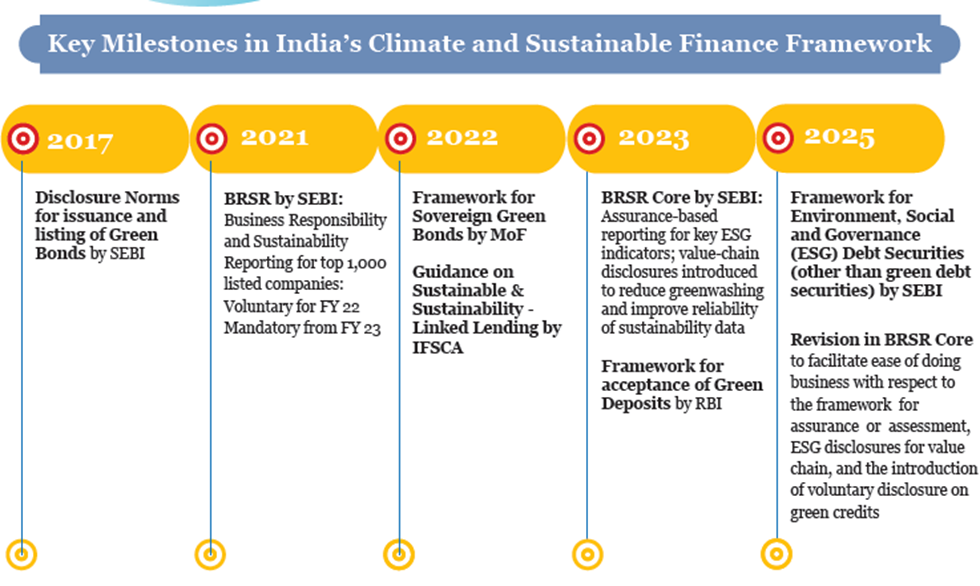
- Sovereign green bonds and regulatory reforms are strengthening financial markets.
- Institutions like IREDA, NABARD, SIDBI, PFC, and REC support climate investments.
- RBI and SEBI frameworks improve transparency and investor confidence.
- Despite progress, financing gaps remain significant.
9. Domestic Financial Strengthening
- Deepening bond markets is essential for long-term infrastructure financing.
- Municipal green bonds enable local-level climate investments.
- Development finance institutions play a catalytic role.
- Insurance mechanisms help manage climate risks.
- Blended finance and risk-sharing tools are needed for scaling investments.
10. International Climate Finance Issues
- Developed countries’ commitments (USD 100 billion/year) remain contested.
- Multilateral Development Banks prioritise low-risk lending, limiting impact.
- Regulatory frameworks like Basel III restrict capital flows to developing countries.
- Structural reforms are needed to align global finance with climate goals.
- Equity and differentiated responsibilities remain key negotiation principles.
Environmental Regulation
11. Evolution of Regulatory Framework
- Early regulations followed command-and-control approaches (Water Act, Air Act, EPA).
- Environmental Impact Assessment (EIA) introduced ex-ante regulation.
- Judicial institutions like NGT strengthened enforcement.
- Market-based instruments like PAT scheme introduced flexibility.
- Carbon markets represent the next phase of regulatory evolution.
12. Shift to Modern Governance
- Regulation is moving towards risk-based and outcome-oriented frameworks.
- Market-based instruments improve efficiency and innovation.
- Digital platforms enhance transparency and compliance.
- Trust-based governance reduces regulatory burden.
- Balance between environmental protection and ease of doing business is emphasised.
13. Key Reforms in India
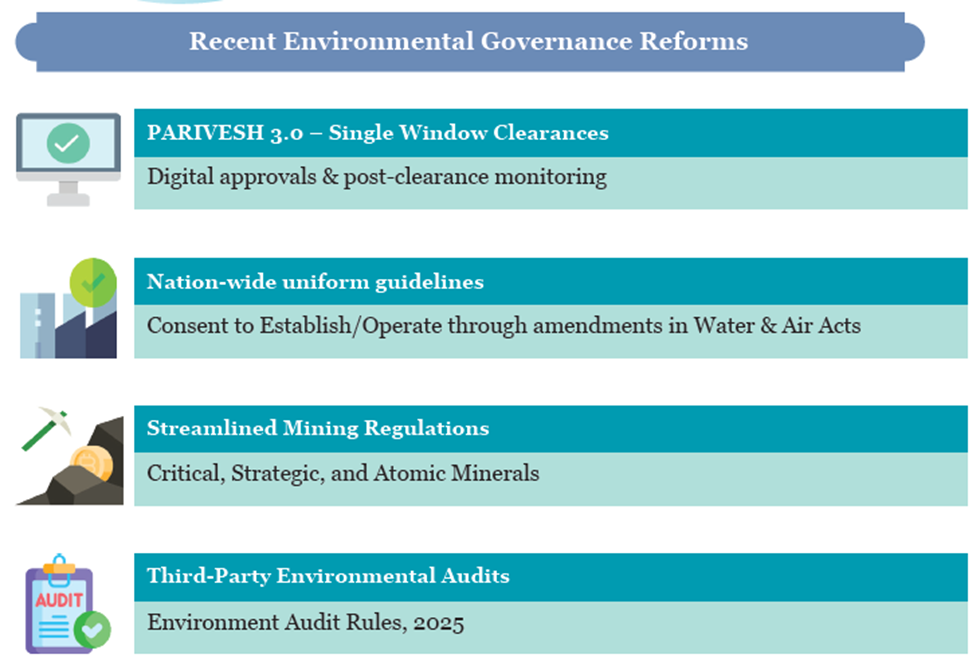
- PARIVESH 3.0 enables single-window digital environmental clearances.
- Third-party environmental audits improve compliance credibility.
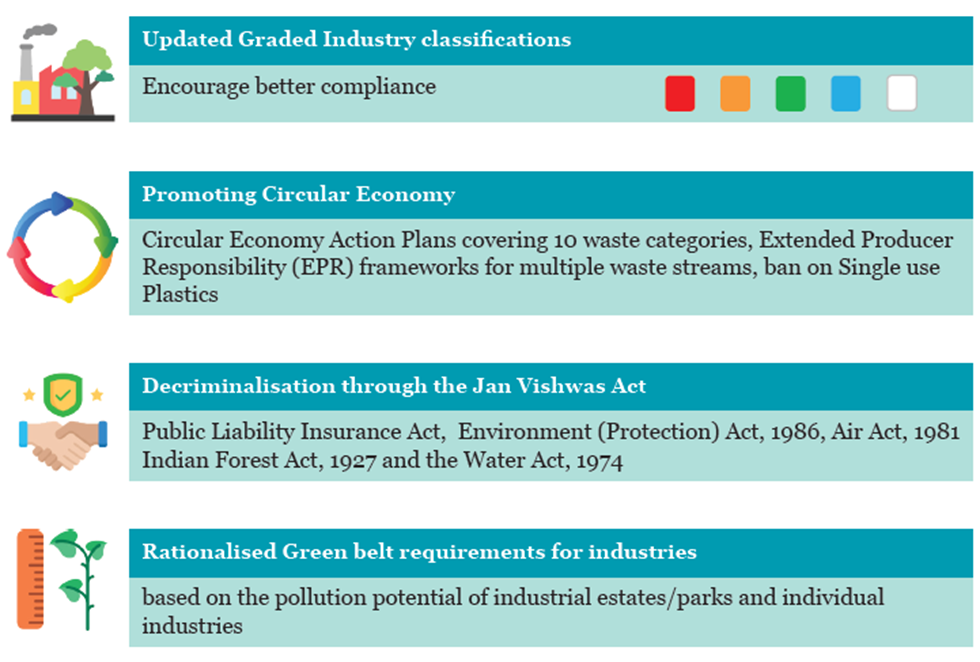
- Industry classification (Red, Orange, Green, etc.) aligns regulation with pollution risk.
- Circular economy policies and EPR frameworks promote sustainability.
- Decriminalisation of minor offences enhances ease of doing business.
14. Waste Management & Circular Economy
- Ban on single-use plastics and promotion of recycling frameworks.
- Over 300 lakh tonnes of waste recycled under EPR systems.
- Circular Economy Action Plans cover multiple waste streams.
- Digital monitoring platforms ensure compliance and transparency.
Data & Facts
- Climate finance requirement: USD 5–6 trillion by 2030
- Global climate finance: USD 1.9 trillion (2023)
- India’s non-fossil capacity: ~51.93% (2025)
- Storage requirement: 336–411 GWh
- Sovereign green bonds issued: ₹72,697 crore (since FY23)
- Domestic climate finance share: 83% mitigation, 98% adaptation
Concepts
- Carbon Market: A system where emission permits are traded to reduce pollution cost-effectively.
- Green Bonds: Debt instruments used to finance environmentally sustainable projects.
- Blended Finance: Combining public and private funds to reduce investment risks.
- EPR (Extended Producer Responsibility): Producers are responsible for post-consumer waste.
- Pigouvian Tax: Tax imposed to correct negative externalities like pollution.
Analysis
India’s climate approach reflects a pragmatic balance between ambition and feasibility. While mitigation efforts are significant, systemic challenges such as storage, critical minerals, and financing constraints limit rapid transitions. Climate finance emerges as the most critical bottleneck, highlighting inequities in global financial architecture.
India’s emphasis on domestic capacity, regulatory reforms, and gradual transitions provides a sustainable pathway. The shift toward market-based and digital governance frameworks signals a modernisation of environmental policy, aligning sustainability with economic growth.