
CHAPTER 7: SERVICES (Economic Survey 2025-26)
TRENDS IN SERVICES SECTOR
The global economy is undergoing a structural transformation where the services sector has emerged as the primary engine of growth, resilience, and global integration. Unlike goods trade, which has stagnated due to geopolitical tensions and supply chain disruptions, services trade continues to expand, acting as a stabilising force.
This shift has been further accelerated by the rise of digitally deliverable services, enabling economies to transcend geographical barriers and participate in global markets. India stands out in this transformation, having adopted a services-led growth model at a relatively lower level of per capita income compared to traditional manufacturing-led pathways.
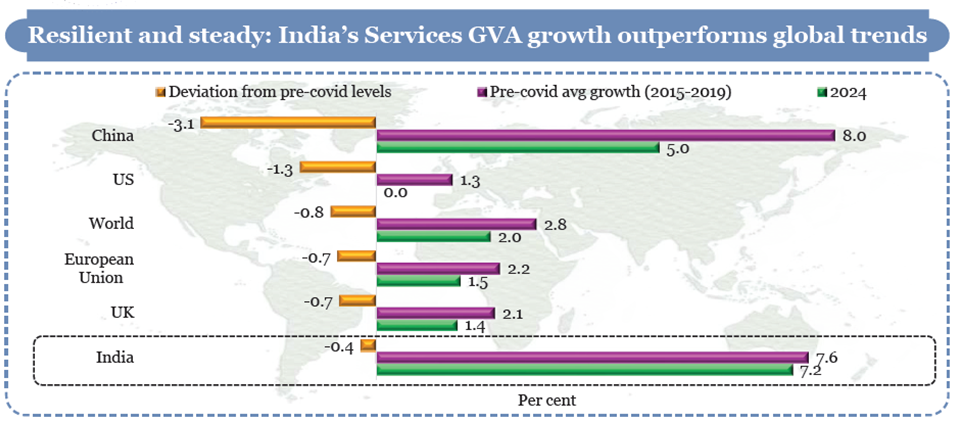
The sector contributes over half of India’s Gross Value Added (GVA), drives exports, and remains the largest recipient of FDI. Despite global headwinds, India’s services sector has demonstrated resilience, maintaining steady growth and expanding its share in global trade.
However, emerging challenges such as skill gaps, technological disruptions, and regulatory constraints pose risks to its future trajectory. Overall, services continue to anchor both global and Indian economic stability, while also opening new frontiers of growth.
Key Points
1. Global Shift Towards Services
- The global economy is increasingly driven by the services sector as the main source of growth and stability.
- Services trade has continued to expand even when global goods trade has stagnated.
- The sector acts as a buffer against global economic shocks and volatility.
- Digitally deliverable services have enabled cross-border integration without physical constraints.
2. India’s Unique Services-Led Growth Model
- India has achieved services-led growth at a relatively low level of per capita income.
- This deviates from the traditional manufacturing-led development path followed by most economies.
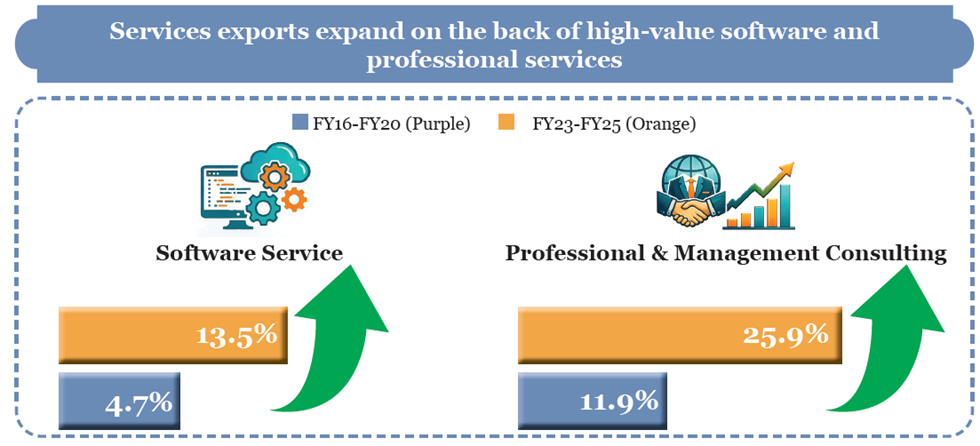
- The model is supported by strong performance in IT, finance, and professional services.
- It reflects early adoption of digital and knowledge-based economic activities.
3. Contribution of Services to Indian Economy
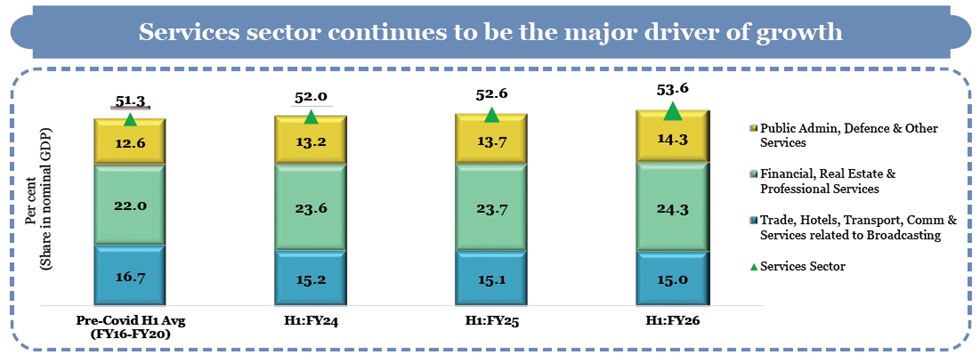
- The services sector contributes more than half of India’s Gross Value Added (GVA).
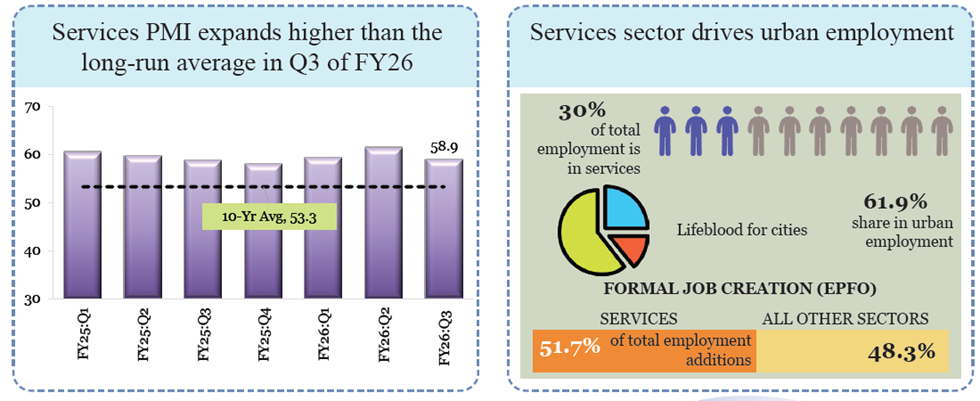
- It is a major driver of exports and employment in the economy.
- The sector shows higher stability with lower volatility compared to agriculture and industry.
- Average annual growth has remained around 7–8 per cent over time.
4. India in Global Services Trade
- India is the world’s seventh-largest exporter of services.
- Its share in global services trade has increased significantly over time.
- The country has strong comparative advantage in digitally deliverable services.
- Services remain the largest recipient of foreign direct investment inflows.
5. Post-Pandemic Structural Changes
- The pandemic accelerated growth in digital, financial, and professional services.
- Contact-intensive services like tourism and hospitality were severely disrupted.
- The composition of services has shifted towards high-value, technology-driven segments.
- This shift has increased the overall share of services in global output.
6. Emerging Challenges in Services Sector
- Rapid technological advancement is creating skill gaps in the workforce.
- Firms and workers are struggling to adapt to fast-changing technologies.
- Regulatory constraints such as data localisation and immigration policies are rising.
- These factors challenge the sector’s role as a stable growth engine.
7. Structural Rebalancing and Growth Dynamics
- Services share in GDP has increased globally as well as in India post-pandemic.
- India’s increase in services share is higher than that of many advanced economies.
- Global services growth has moderated due to weaker trade and productivity trends.
- India remains relatively resilient compared to major economies.
Data & Facts
- Services contribute more than 50% of India’s GVA.
- Average services growth: ~7–8% annually.
- India’s share in global services trade: ~4.3% (2024).
- India’s global rank: 7th largest services exporter.
- Services share in India’s GDP: ~49.9% (2024, World Bank data).
- Services FDI share globally: ~53.5% (2022–24).
Concepts
- Services Sector: Economic activities that provide intangible value such as IT, banking, tourism, and education.
- Digitally Deliverable Services: Services that can be provided remotely using digital platforms (e.g., IT services).
- Structural Transformation: Shift in economic activity from agriculture to industry and then to services.
- Services Trade: Cross-border exchange of services like IT, finance, and consulting.
- GVA (Gross Value Added): Measure of economic output contributed by different sectors.
Analysis
The rise of the services sector represents a paradigm shift in economic development, especially for India. Unlike traditional industrialisation models, India’s growth is anchored in knowledge-intensive sectors, providing resilience against global shocks. However, this model also creates structural imbalances, particularly in employment generation, as high-end services are less labour-intensive.
The increasing dominance of digital services strengthens India’s global competitiveness but also exposes it to regulatory and technological disruptions. Therefore, while services-led growth has been a strength, its sustainability depends on addressing skill gaps, diversifying sub-sectors, and improving adaptability to technological change.
SUB-SECTORAL PERFORMANCE & WAY FORWARD
India’s services sector exhibits strong internal dynamism driven by diverse sub-sectors such as tourism, IT-ITeS, transport, telecom, real estate, media, and emerging domains like space services. Each sub-sector reflects distinct growth drivers—ranging from domestic demand in tourism to global integration in IT services and infrastructure-led expansion in transport.
The tourism sector is increasingly supported by domestic demand and niche segments like medical tourism, while IT-ITeS continues to evolve towards high-value, innovation-driven activities led by Global Capability Centres (GCCs) and AI adoption. Transport and telecom act as foundational enablers, improving connectivity and logistics efficiency across the economy.
Meanwhile, sectors like real estate and media are benefiting from formalisation, digitalisation, and rising incomes. Emerging frontiers such as space and ocean services signal a shift towards high-technology, export-oriented services.
Despite this strong performance, challenges persist in the form of skill gaps, regulatory bottlenecks, infrastructure constraints, and global competition. Going forward, sustained growth will depend on innovation, skill development, policy reforms, and enhanced coordination across stakeholders to ensure that the services sector remains resilient, competitive, and inclusive.
Key Points
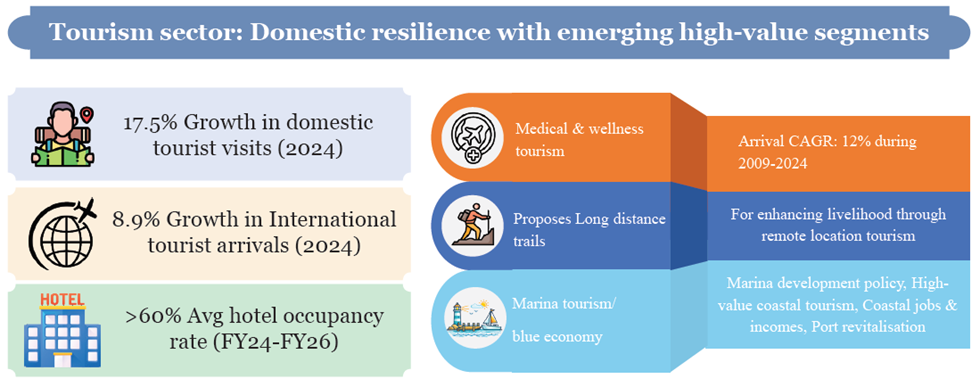
1. Tourism Sector: Domestic Strength with High-Value Potential
- Domestic tourism has emerged as the primary driver of growth with strong post-pandemic recovery.
- International tourism is improving but remains uneven due to global uncertainties.
- Medical and wellness tourism has emerged as a high-value segment with higher spending per visitor.
- Government initiatives like Swadesh Darshan and PRASHAD promote sustainable and thematic tourism.
- State capacity and local governance play a crucial role in unlocking tourism potential.
2. IT-ITeS Sector: Moving Towards High-Value Innovation
- The IT-ITeS sector remains a global leader with steady revenue growth and export performance.
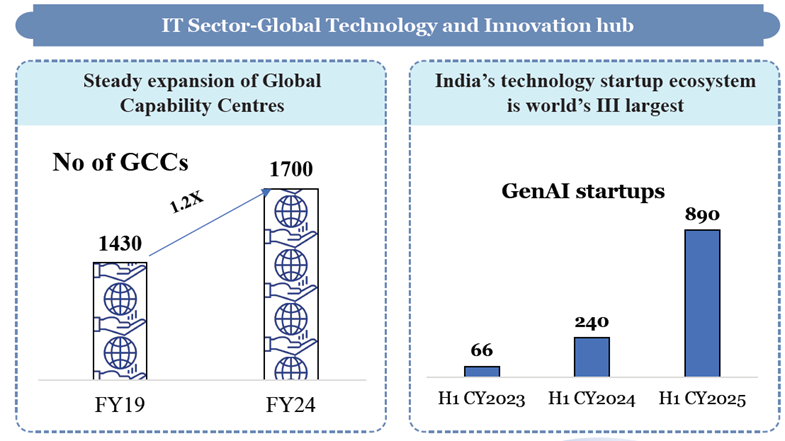
- Global Capability Centres (GCCs) have become key drivers of employment and innovation.
- The sector is shifting towards advanced technologies like AI, cloud computing, and cybersecurity.
- India’s startup ecosystem, especially in deep tech and GenAI, is expanding rapidly.
- Skill gaps and adaptation challenges remain critical constraints for future growth.
3. Transport Services: Backbone of Economic Activity
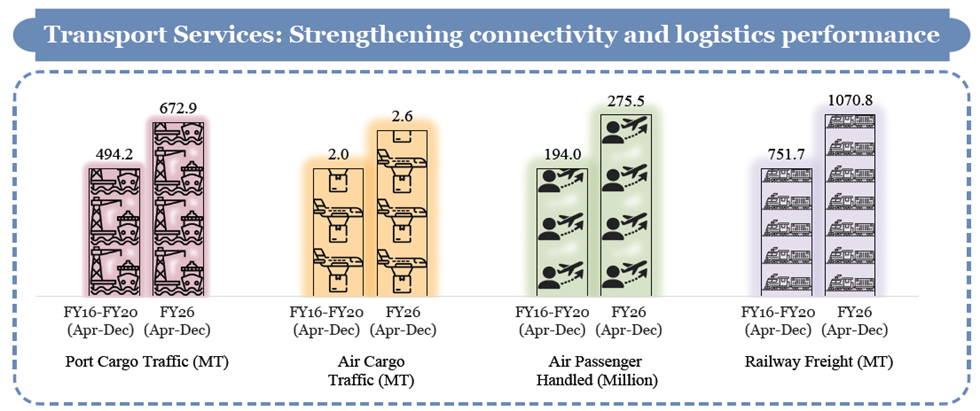
- Transport services contribute significantly to GVA and enable trade and industrial activity.
- Port capacity and efficiency have improved through modernisation and digitisation.
- Aviation has expanded passenger and cargo movement despite short-term fluctuations.
- Rail freight remains a cost-effective and efficient mode for bulk transportation.
- Infrastructure investments and logistics integration are key growth drivers.
4. Telecommunications: Digital Backbone of Economy
- Telecom connectivity has expanded rapidly, improving digital inclusion.
- Internet penetration and data consumption have increased significantly due to affordability.
- Indigenous development of 4G and 5G technologies strengthens strategic capabilities.
- Telecom infrastructure supports digital economy expansion and service delivery.
- Cybersecurity and network resilience have become increasingly important.
5. Real Estate and Housing: Formalisation and Financialisation
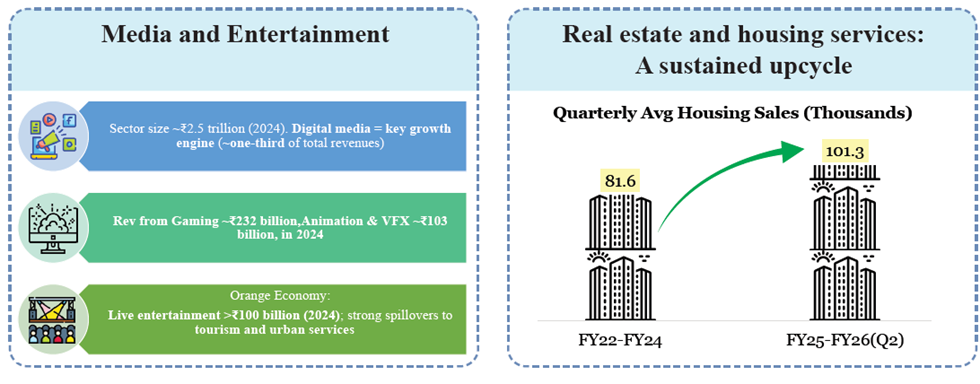
- Real estate contributes significantly to GVA and has strong linkages with other sectors.
- Policy reforms like RERA and GST have improved transparency and formalisation.
- Housing demand is supported by government schemes and urban infrastructure development.
- Household savings are increasingly directed towards physical assets like housing.
- Growth in housing finance indicates deeper financial integration of the sector.
6. Media & Entertainment: Rise of Digital and Creative Economy
- The sector is undergoing a structural shift towards digital platforms and OTT services.
- Digital media has become the primary growth driver due to internet penetration.
- High-growth segments include animation, VFX, gaming, and live entertainment.
- The “Orange Economy” highlights the role of creativity and intellectual property.
- The sector generates strong spillovers to tourism, employment, and urban services.
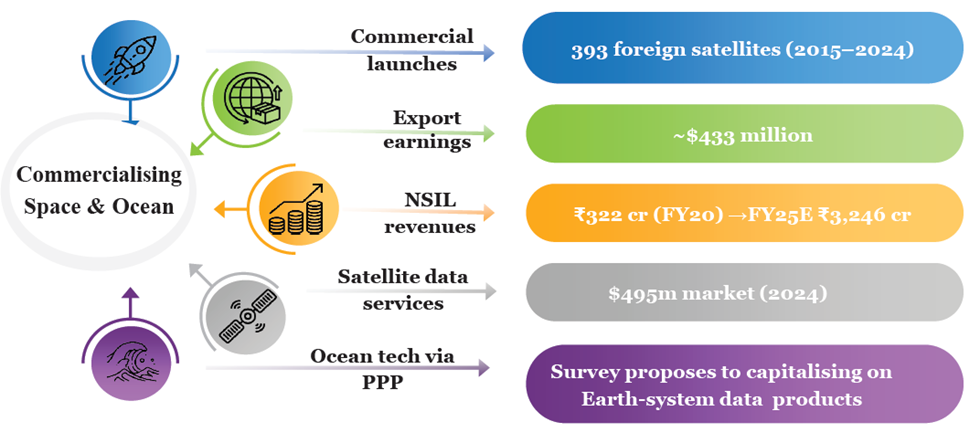
7. Emerging Sectors: Space and Ocean Services
- India’s space sector is becoming a high-value, export-oriented services segment.
- Commercialisation through public-private partnerships is accelerating growth.
- Satellite services and launch capabilities are expanding global market presence.
- Ocean services and blue economy offer untapped opportunities.
- These sectors represent the future frontier of services-led growth.
Data & Facts
- Tourism contribution to GDP: ~5.2% (FY24)
- Employment in tourism: ~8.46 crore (13.3%)
- IT-ITeS revenue: USD 283 billion (FY25)
- GCCs in India: 1700+ employing ~19 lakh people
- Data centre capacity: 1.4 GW → projected 8 GW by 2030
- Telecom connections: 1.2 billion+ (2025)
- Internet subscribers: ~101.8 crore
- Real estate share in GVA: ~7%
- Space sector size: USD 8.4 billion → projected USD 44 billion
Concepts
- Global Capability Centres (GCCs): Offshore units of multinational companies handling core business operations.
- Orange Economy: Economic activities based on creativity, culture, and intellectual property.
- Blue Economy: Sustainable use of ocean resources for economic growth and livelihoods.
- Digital Public Infrastructure (DPI): Digital systems enabling services like payments, identity, and data exchange.
- Formalisation: Shift from informal to regulated and organised economic activity.
Analysis
The services sector’s strength lies in its diversity and adaptability, with different sub-sectors responding to distinct demand drivers. High-value segments like IT and space services enhance global competitiveness, while labour-intensive sectors like tourism generate employment.
However, the sector faces a structural challenge: balancing high productivity growth with inclusive employment generation. The increasing role of technology introduces both opportunities and disruptions, particularly in skill requirements.
Additionally, infrastructure gaps and regulatory complexities can constrain growth. Therefore, future success depends on a coordinated approach integrating innovation, skills, infrastructure, and governance reforms.
One Comment