
CHAPTER 9: INFRASTRUCTURE AND INVESTMENT (Economic Survey 2025-26)
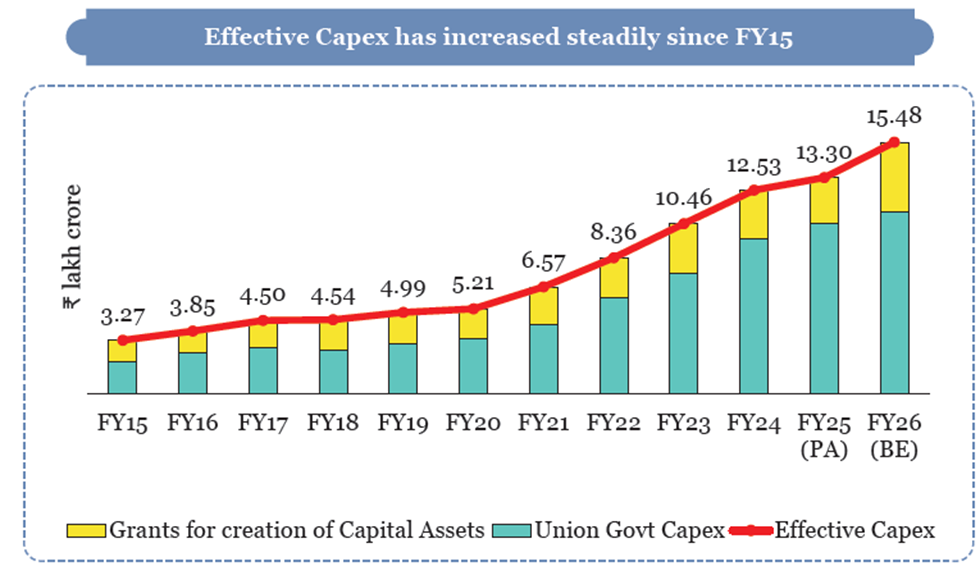
Infrastructure has emerged as the central pillar of India’s growth strategy, driven by sustained public capital expenditure and systemic reforms in planning, financing, and execution. Since FY20, the government has significantly increased capital outlay, recognising its high multiplier effect on economic growth.
This expansion is not limited to traditional infrastructure like roads, railways, and energy but also includes digital public infrastructure and renewable energy systems, reflecting a shift towards integrated and future-ready development. Institutional innovations such as PM GatiShakti and the National Logistics Policy have improved coordination, efficiency, and logistics competitiveness.
Simultaneously, the financing landscape is evolving from bank-dominated credit to diversified sources like NBFCs, InvITs, REITs, and capital markets. Public-Private Partnerships (PPPs) continue to play a crucial role, supported by improved regulatory frameworks and project pipelines.
Sectoral progress across transport, energy, telecom, and water infrastructure highlights strong capacity expansion and technological adoption. However, challenges such as project delays, financing constraints, and the need for better institutional capacity remain.
Overall, infrastructure development is transitioning toward an integrated, technology-driven, and sustainability-oriented model, positioning it as a key enabler of India’s long-term growth vision.
Key Points
1. Infrastructure as Growth Engine
- Public capital expenditure has increased sharply, with strong multiplier effects of 2.5–3.5 times GDP.
- Government capex rose from ₹3.07 lakh crore (FY19) to ₹11.21 lakh crore (FY26 BE).
- Infrastructure expansion now includes digital and renewable components alongside physical assets.
- Focus has shifted from capacity addition to efficiency, integration, and competitiveness.
2. Institutional and Policy Reforms
- PM GatiShakti enables GIS-based integrated infrastructure planning.
- National Logistics Policy and ULIP improve logistics efficiency and coordination.
- Digital Public Infrastructure (DPI) such as UPI, Aadhaar, and FASTag acts as a force multiplier.
- Improved planning reduces project delays and execution risks.
3. Infrastructure Financing Transformation
- Financing is shifting from bank credit to diversified sources like NBFCs, REITs, and InvITs.
- NBFC credit to the commercial sector grew at ~43.3% CAGR (FY20–FY25).
- RBI Project Finance Directions (2025) standardise infrastructure lending practices.
- Capital markets are increasingly supporting long-term infrastructure funding.
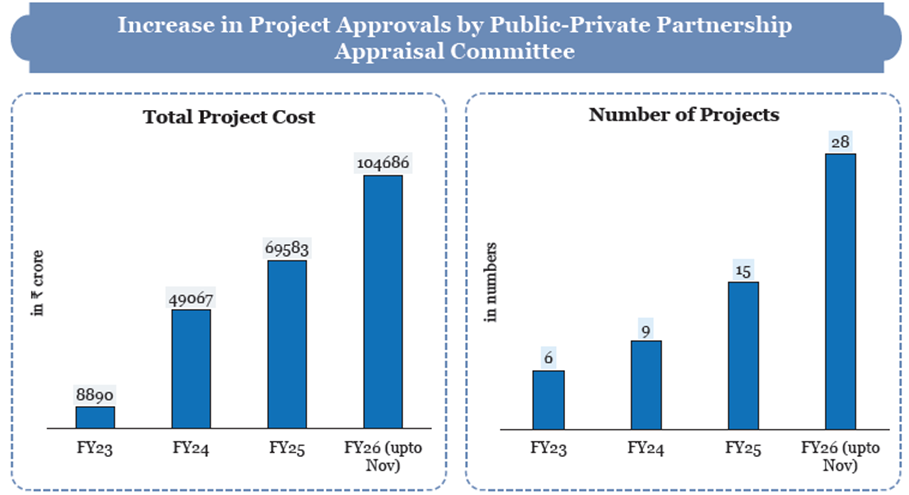
4. Public-Private Partnerships (PPP)
- PPPs enable private sector participation in infrastructure development.
- India ranks among top countries in private infrastructure investment globally.
- Multiple models exist such as BOT, HAM, DBFOT, and TOT.
- Institutional mechanisms like PPPAC and VGF strengthen PPP frameworks.
- Future PPP focus is shifting towards partnership-based models and risk-sharing.
5. Roads & Highways
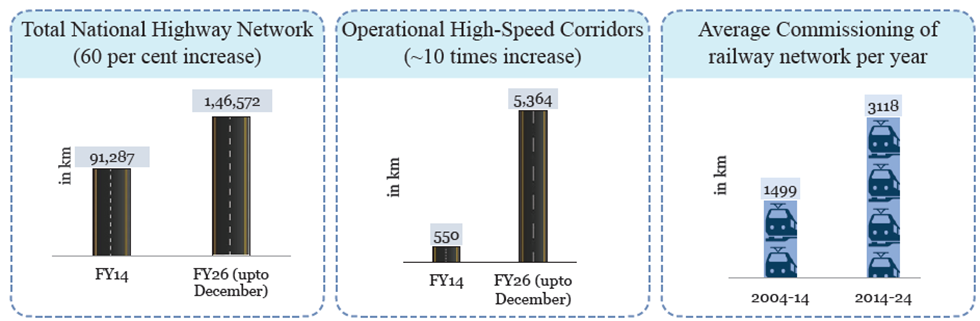
- National Highway network expanded by ~60% since 2014.
- High-Speed Corridors increased nearly 10 times.
- Focus is shifting toward logistics efficiency and multimodal connectivity.
- PMGSY has achieved ~99.7% rural connectivity.
6. Railways Transformation
- Rail network reached 69,439 route km with ~99.1% electrification.
- Dedicated Freight Corridors reduce congestion and logistics costs.
- High capital investment focuses on safety, signalling, and capacity expansion.
- Projects like high-speed rail and station redevelopment are underway.
7. Civil Aviation Growth
- Airports increased from 74 (2014) to 164 (2025).
- Passenger traffic expected to rise from 412 million (FY25) to 665 million (FY31).
- UDAN scheme enhances regional connectivity.
- Aviation sector shows strong future growth potential.
8. Ports, Shipping & Inland Waterways
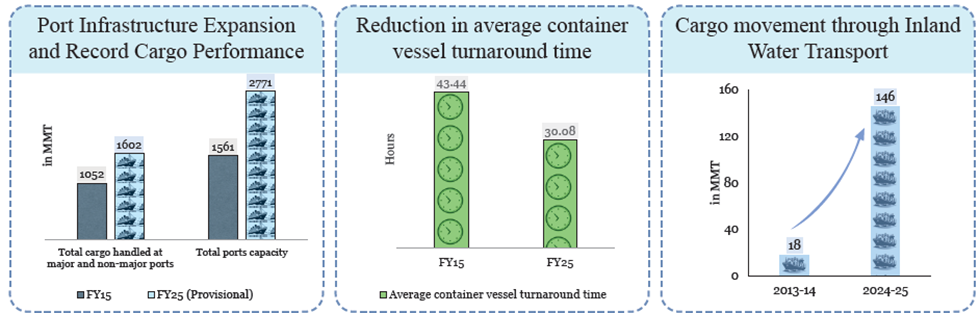
- Ports have improved efficiency and global competitiveness rankings.
- PPP participation in ports has increased significantly.
- Inland Water Transport cargo increased from 18 MMT (2014) to 146 MMT (2025).
- Maritime Vision 2030 and 2047 guide long-term development.
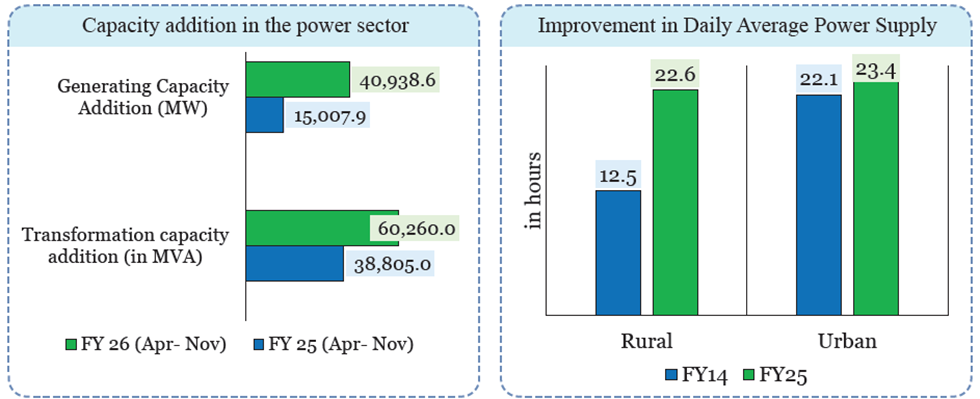
9. Energy Infrastructure
- Installed power capacity reached 509.74 GW (Nov 2025).
- Renewable energy accounts for ~49.83% of capacity.
- Distribution sector reforms improved DISCOM finances and reduced losses.
- India Energy Stack aims to digitise and modernise the power ecosystem.

10. Digital Infrastructure
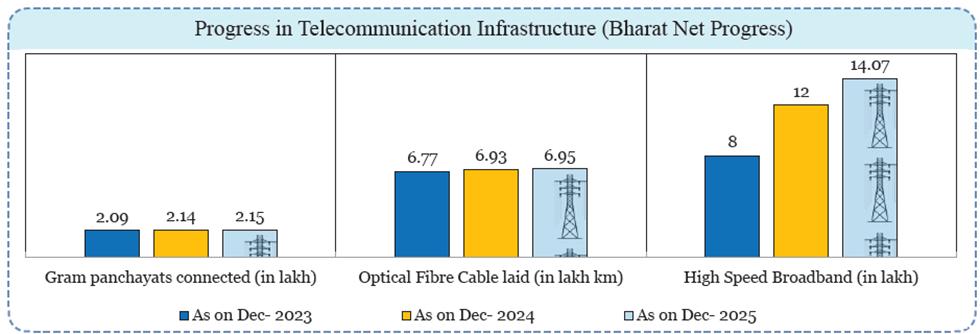
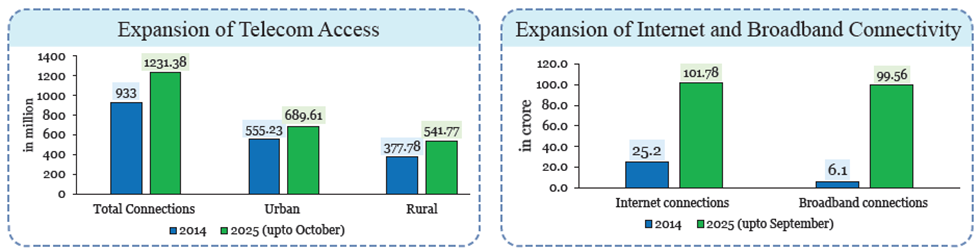
- Tele-density increased to 86.76%, with strong rural growth.
- 5G rollout covers ~99.9% districts.
- BharatNet connects 2.14 lakh Gram Panchayats.
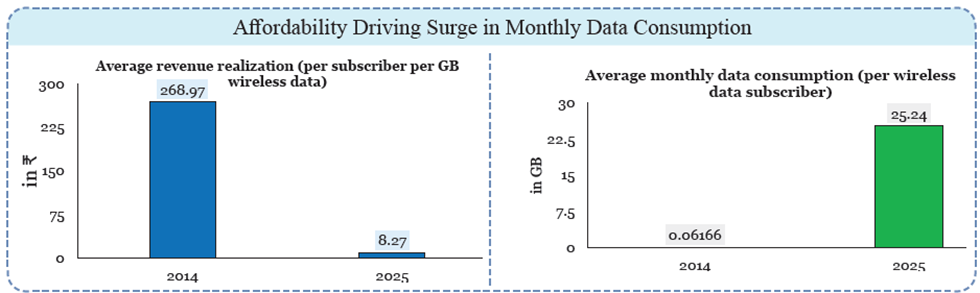
- Data centre capacity expected to expand significantly by 2030.
11. Social & Emerging Infrastructure
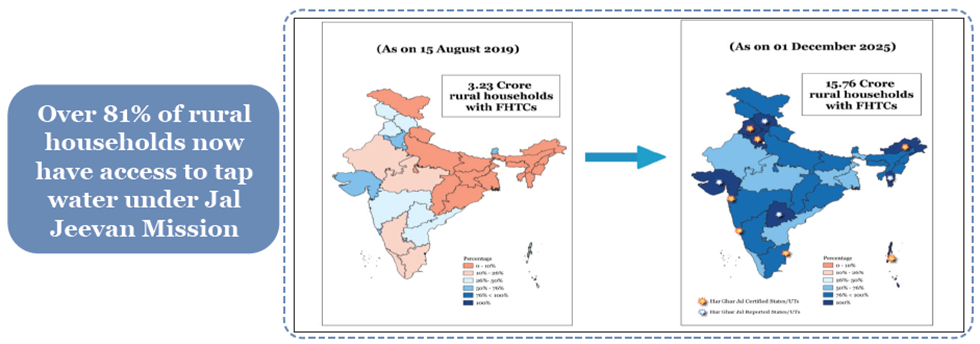
- Jal Jeevan Mission provides tap water to over 81% rural households.
- Namami Gange integrates ecological restoration with infrastructure.
- Tourism infrastructure expanded under Swadesh Darshan 2.0 and PRASHAD.
- Space sector reforms have boosted private participation and innovation.
Data & Facts
- Capex (FY26 BE): ₹11.21 lakh crore
- Multiplier effect: 2.5–3.5x GDP
- NBFC credit growth: 43.3% CAGR (FY20–FY25)
- NH network growth: ~60% increase since 2014
- Rail electrification: 99.1%
- Airports: 164 (2025)
- Renewable energy share: ~49.83%
- Inland waterways cargo: 146 MMT (2025)
- Rural tap water coverage: 81%+ households
Concepts
- Infrastructure Multiplier: The additional GDP generated from infrastructure investment.
- PPP (Public-Private Partnership): Collaboration between government and private sector for infrastructure projects.
- InvIT/REIT: Investment vehicles that pool funds for infrastructure or real estate assets.
- DPI (Digital Public Infrastructure): Digital platforms enabling service delivery at scale (e.g., UPI).
- Multimodal Connectivity: Integration of different transport modes for efficiency.
Analysis
India’s infrastructure strategy reflects a transition from fragmented development to integrated and technology-driven growth. The strong emphasis on public capex has stimulated economic activity and crowding-in of private investment.
Institutional reforms like PM GatiShakti have improved coordination, reducing inefficiencies. However, challenges remain in project execution, financing sustainability, and institutional capacity, especially at sub-national levels.
The expansion of digital and green infrastructure indicates alignment with future economic priorities such as sustainability and resilience. The success of infrastructure development will depend on maintaining investment momentum, improving governance, and enhancing private sector participation.