
Ethical Ideas in Indian Philosophical Tradition
Introduction: Why Indian Ethics Matters
Imagine you are in the UPSC interview and the chairperson asks you: ‘A colleague who is your friend is engaged in corruption. What do you do?’ You cite the Bhagavat Gita and say ‘Nishkama Karma means I act without attachment to personal loyalty.’ If you do not understand what that means at its roots, your answer sounds hollow. If you do, it is gold.
India’s ethical tradition is not a museum piece. It is a living, breathing moral vocabulary that shaped a civilisation for over three thousand years. Unlike Western ethics, which often starts with one thinker — Kant, Aristotle, or Bentham — Indian ethics is a grand synthesis: Vedas, Upanishads, epics, saints, reformers, and activists have all contributed. That plurality is its strength.
This section covers four major traditions: Hinduism (especially the Bhagavat Gita), Jainism, Buddhism, and Gandhian Ethics. Each has distinct insights; together they form a comprehensive moral architecture. Let us begin, as a good teacher always does — at the very beginning.
HINDUISM
Hindu ethics is ancient, plural, and evolving. Its sources include the Vedas, Upanishads, Dharmasastras, Puranas, and the great epics Ramayana and Mahabharata. There is no single consolidated scripture — though the Bhagavat Gita comes closest.
Hindu saints and reformers have continuously interpreted and reinterpreted these teachings. What follows is the moral core that has endured.
The Four Purusharthas: Life’s Complete Blueprint
Before prescribing rules of conduct, Hindu philosophy asks the foundational question: What should a human being aim for in life? Its answer is remarkable for its balance. Instead of picking one single aim, it recognises four legitimate goals — the Purusharthas.
| The Purusharthas are not a hierarchy where one replaces the other. Think of Dharma as the traffic signal that regulates everything; Artha and Kama are the vehicles on the road; and Moksha is the final destination. |
| Purushartha | Literal Meaning | Core Concept | Modern Parallel |
| Dharma | Moral Law / Right Conduct | The correct way to fulfil personal, social and moral needs. Rational control of human passions and appetites. | Constitutional morality, rule of law, professional ethics |
| Artha | Wealth / Material Well-being | Legitimate wealth to sustain family and pursue cultural activities. Not greed — just sufficiency and security. | Economic security, sustainable livelihood, financial independence |
| Kama | Desire / Happiness | Wholesome desires common to family life — not endless cravings but joy arising from natural human fulfilment. | Work-life balance, family happiness, recreation, cultural life |
| Moksha | Liberation / Salvation | Liberation of the soul from the cycle of birth and death. The soul transcends the material world permanently. | Maslow’s Self-actualisation, spiritual fulfilment, inner peace |
Notice the genius: wealth (Artha) and desire (Kama) are legitimate goals. You are not required to renounce the world to be ethical. But both must be regulated by Dharma. This is why Hindu ethics is neither purely ascetic nor hedonistic — it charts a balanced middle path for ordinary life.
Two Views on the Nature of Dharma
Scholars have long debated what exactly Dharma is. Two broad positions have emerged:
| View 1: Divine Command | View 2: Transcendent Moral Ideal |
| Dharma is God’s command. What God prescribes is right; what God prohibits is wrong. | Dharma is a moral ideal that transcends even God — beyond the physical world of space and time. |
| Moral duty is external — obeying divine prescription. | Men can only strive towards this ideal; perfection lies beyond human reach. |
| Similar to Natural Law tradition in Western ethics. | Dharma has an objective, universal character independent of any personal God. |
| UPSC Takeaway: Dharma is not arbitrary. Whether from a divine command or transcendent ideal perspective, it has an objective, universal character. It is not what you feel like doing — it is what you ought to do. This is the foundation of ethical governance. |
Varnashrama Dharma: Social Ethics in Classical India
Hindu ethics has two dimensions: personal morality (how an individual should behave) and social morality (how people in society should relate to each other). The second is captured in Varnashrama Dharma, which links ethics to one’s social role and stage of life.
The Four Varnas (Occupational Groups)
| Varna | Classical Role | Core Duties | Modern Parallel |
| Brahmins | Priests & Scholars | Master Vedas, perform ceremonies, guard academic & spiritual traditions | Teachers, researchers, academics, knowledge creators |
| Kshatriyas | Warriors & Rulers | Acquire military skills, defend society against internal & external threats | Armed forces, civil services, governance officials |
| Vaishyas | Traders & Merchants | Conduct commerce, industry; ensure economic vitality of society | Entrepreneurs, business community, industrialists |
| Shudras | Artisans & Craftsmen | Create the amenities of civilisation through skilled labour and craftsmanship | Skilled workers, craftsmen, service providers |
| Critical Note: The original Varna concept was based on occupation and aptitude — not birth. Over time, it became rigid and birth-based, giving rise to the caste system with its grave injustices. Mahatma Gandhi fought lifelong against untouchability. The valid insight for today: every professional has distinct duties that must be performed with integrity and competence. |
The Four Ashramas: Ethics Across the Lifespan
Beyond one’s occupation, Hindu ethics also prescribes duties appropriate to different stages of life — a developmental ethics that recognises what is appropriate at 20 differs from what is appropriate at 60.
| Life Stage | Ashrama | Core Duties | Modern Relevance |
| Student Life | Brahmacharya | Pure & chaste life, learning from teachers, mastering knowledge and skills | Focus, discipline, character-building in formative years |
| Householder | Grihastha | Marry, raise family, pursue Artha & Kama within the framework of Dharma | Career, family responsibility, active social contribution |
| Forest Dweller | Vanaprastha | Begin gradual withdrawal from worldly life; dedicate to prayer and meditation | Mentoring, philanthropy, spiritual reflection in later life |
| Renunciant | Sanyas | Wander as a monk, live on alms, devote oneself entirely to service and God | Total service orientation, wisdom transmission to younger generations |
The Law of Karma: Moral Accounting in the Universe
The Law of Karma is perhaps Hinduism’s most famous ethical concept. Every action has an inevitable consequence — not necessarily immediate, but inescapable. Good actions create Punya (merit); bad actions create Papa (demerit). Think of it as a cosmic moral ledger.
| GOOD DEED → MERIT (Punya) → HAPPINESS | EVIL DEED → DEMERIT (Papa) → MISERY |
| Demerits can be overcome by doing good acts | Merit can be lost by committing sinful acts |
| The cycle: birth → life → good/bad deeds → merit/demerit → death → rebirth. Release from this cycle comes through realisation of God. | Purushardha (human will) + Daiva Anugraha (divine grace) both necessary for success in any enterprise. |
| Critical Angle for UPSC: The Law of Karma has been MISUSED. When people argue that a beggar ‘deserves’ poverty because of past-life sins, they use karma to justify inaction against injustice. Swami Vivekananda fought tirelessly against this distortion. The Bhagavat Gita is actually a call to vigorous action. Karma theory leads to fatalism only through a FALSE interpretation — not the original teaching. |
Samyama: Moderation as a Universal Moral Standard
A thread that runs through Hinduism, Buddhism, and Jainism alike is Samyama — moderation. The Bhagavat Gita is explicit about this, warning against extremes in both directions:
| Harmful Excess | Middle Path (Samyama) | Harmful Deficiency |
| Over-eating | Balanced, moderate diet | Fasting to starvation |
| Overwork / Workaholism | Balanced, sustained effort | Inactivity / Laziness |
| Over-sleeping | Adequate, refreshing rest | Sleeplessness |
This is strikingly similar to Aristotle’s Doctrine of the Golden Mean. Two great civilisations — Indian and Greek — arrived at the same insight independently: virtue lies in the middle, between excess and deficiency.
Sources of Moral Standards in Hindu Texts
| Text / Thinker | Moral Standard | Key Insight |
| Manu | Achara (customary law) | Customary law sanctified by generations of practice. Also recognises conscience. Freud’s ‘superego’ is a modern parallel to this moral inner voice. |
| Mahabharata | Vedas + Smritis + Conscience + Social Welfare | Dharma is what virtuous people do across many places. It carries the sanction of conscience and promotes welfare of all creatures. |
| Ramayana | Vedic law + Reason + Custom + Social Norms | Devotion to the good of humanity is the highest virtue. Vedas prevail in case of conflict between criteria. |
| Nyaya-Vaisheshika | Divine Law (God’s command) | God created the world as a moral order. Divine laws are in the Vedas. This is opposed to Charvakas, who considered king’s command as the only law. |
There are also two modes of moral life noted by Sankaracharya:
- Pravitti (personal morality applicable to the empirical world) and
- Nivritti (spiritual withdrawal from worldly preoccupations to seek God).
Both are valid paths — they are not in conflict but at different levels of spiritual evolution.
THE BHAGAVAT GITA
The Bhagavat Gita is simultaneously a work of religion, philosophy, psychology, and ethics. Set on the battlefield of Kurukshetra, it begins with Arjuna — a warrior paralysed by moral doubt: should he fight his own kinsmen?
Krishna’s response over 18 chapters is the Gita. But its message speaks not just to warriors — it speaks to every person navigating the complex terrain of duty, emotion, and right action in the world.
The Central Message: Nishkama Karma
| Core Verse: ‘Karmanye vadhikaraste ma phaleshu kadachana’ — You have the right to perform your duties, but you are not entitled to the fruits of your actions. Perform your duty without attachment to results. |
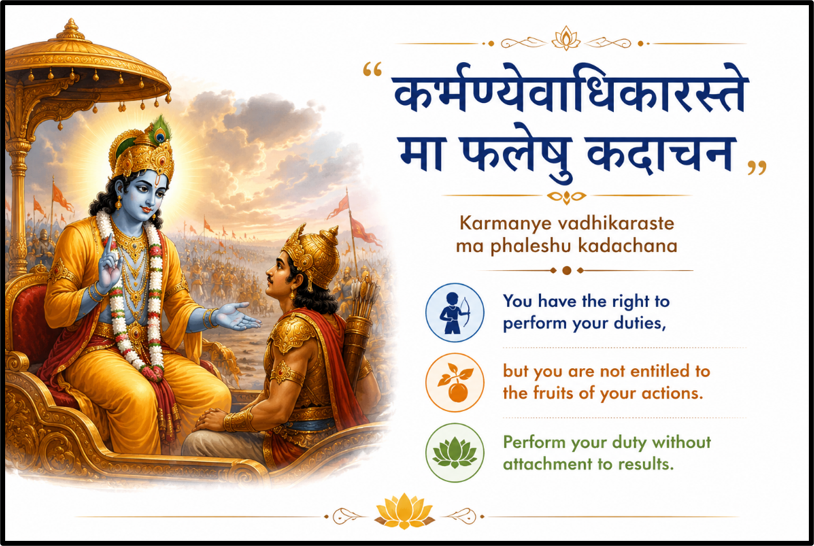
Nishkama Karma (desireless action) is the Gita’s central ethical principle. When we act motivated wholly by expected outcomes — salary, votes, marks, promotions — we compromise the quality of our action. We cut corners when rewards seem unlikely; we stop acting when the reward disappears.
Nishkama Karma asks: What if you acted because the action itself is right? The civil servant who helps citizens not because it looks good in the annual appraisal, but because it is simply the right thing to do — that is Nishkama Karma in modern governance. The Gita argues this orientation is not only morally superior; it is actually the path to spiritual liberation.
| UPSC Connection: Nishkama Karma directly underpins ‘service before self’ in public administration. It is the ethical foundation of probity, impartiality, and dedication. In essays and ethics answers, go beyond stating the principle — demonstrate its application in governance contexts. |
Three Paths to God: The Democratic Spirituality of the Gita
The Gita does not prescribe one single path to liberation. It offers three — recognising that people have different temperaments, capacities, and inclinations.
| Path | Sanskrit Term | What It Involves | Suited For |
| Path of Action | Karmayoga | Performing duties disinterestedly (Nishkama Karma) in service of God and humanity | Active people, professionals, householders, administrators |
| Path of Devotion | Bhakti Yoga | Complete devotion and surrender to God through love, worship, and prayer | Emotionally inclined individuals seeking divine connection |
| Path of Knowledge | Jnana Yoga | Attaining enlightenment through sacred knowledge, wisdom, and philosophical inquiry | Intellectuals, philosophers, those with inquiring minds |
All three paths lead to the same destination. The Gita is genuinely pluralistic — it does not dismiss devotion as less valid than knowledge or action. For the UPSC aspirant, Karmayoga — ethical action in the world — is the most directly relevant.
Virtues Associated with Occupations
The Gita links virtues to a person’s vocation, much like Plato does in The Republic. One’s profession shapes one’s character and the virtues one must cultivate. In modern terms, these can be understood as vocational virtues:
| Brahmins (Intellectuals) | Kshatriyas (Warriors/Rulers) | Vaishyas (Merchants) |
| Control of senses | Heroism | Commercial skills |
| Control of mind | Spiritedness | Organisational abilities |
| Tranquillity | Steadfastness in battle | Economic insights |
| Austerity | Generosity | |
| Purity | Firmness | |
| Magnanimity | Sovereignty / Leadership | |
| Knowledge, Wisdom, Faith | Military / Leadership skills |
The Platonic parallel is striking: philosopher-kings need wisdom; soldiers need courage; traders need temperance. Two great civilisations — Indian and Greek — independently reached the same insight about vocation-specific virtues.
Positive and Negative Emotions: The Gita’s Emotional Intelligence Framework
Long before Daniel Goleman wrote about Emotional Intelligence, the Gita had a comprehensive map of emotions and how to manage them:
| NEGATIVE EMOTIONS — To Be CONTROLLED | POSITIVE EMOTIONS — To Be CULTIVATED |
| Attachment and Aversion (Raag-Dvesha) Selfishness and Arrogance Jealousy and Greed Hypocrisy and Malice Anger, Hatred, and Envy Fear, Lust, and Illusions Obsession with success or failure | Universal goodwill and benevolence Kindness towards people in trouble Magnanimity and Serenity Humility, Purity, and Determination Steadfastness and Self-control Compassion and Charity Truthfulness, Wisdom, and Detachment |
The Gita vs. Western Moral Philosophies
| Western School | Core Claim | Gita’s Position |
| Hedonism | Happiness / pleasure is the end of life | Gita does NOT follow hedonism. The aim is ‘good’ — not merely happiness. Good is wider and deeper than pleasure. |
| Utilitarianism | Greatest happiness for greatest number | Gita supports human welfare but not as a utilitarian calculus. Duty is intrinsically important — not just instrumentally useful. |
| Kantianism | Duty-based ethics; follow moral law unconditionally | Closest comparison — both centre on duty. BUT Kant excludes God; Gita centres God. Kant focuses on individual; Gita emphasises social welfare too. |
| Green’s Eudemonism | Life’s value = highest form of happiness | Jadunath Sinha: Gita is CLOSEST to this — happiness understood in its most sublime, spiritual form, not sensory pleasure. |
JAINISM
Jainism is one of the world’s oldest living religions, dating back to the sixth century BC. Its founder, Mahavira, was a contemporary of the Buddha. Jainism arose partly as a reaction to the elaborate ritualism and animal sacrifices that had become dominant in Vedic religion. What makes Jainism remarkable is its radical, uncompromising commitment to non-violence and its extraordinarily rigorous ethical code.
Ahimsa: The Cornerstone of Jain Ethics
| Core Definition: Ahimsa in Jainism means that no existent being with life — or even the essence or potential of life — should be injured. Injury is defined broadly as destruction, subjection, or denial of another’s living essence. This extends to plants, microorganisms, and elements believed to contain life-force. |
The logic is elegant and empathetic: all sentient beings are vulnerable to pain and sorrow. Just as we would not want to be harmed, we should not harm others. This is moral reasoning based on universalised empathy — similar to the Golden Rule found in all great religions.
| Narrow Ahimsa (Minimum) | Broad Ahimsa (Full Scope) |
| Do not kill or physically injure others | Also includes emotional harm through bad behaviour or offensive language |
| Avoid violence to large animals | Life is equal — harming small or large animal is equally bad |
| Do not commit direct acts of violence | Also avoid indirect harm — eating meat, using false weights, keeping lost property |
Ratnatraya: The Three Jewels of Jainism
Life in Jainism is a spiritual odyssey toward divine consciousness. The path to liberation — release from the bonds of karma — is through Ratnatraya: three jewels that must shine together.
| Samyak Darshan | Samyak Jnana | Samyak Charitra |
| RIGHT FAITH | RIGHT KNOWLEDGE | RIGHT CONDUCT |
| Correct belief in the nature of reality. All souls are equal and have the potential for liberation. | True knowledge of self and the universe — understanding karma, soul, and the path to liberation. | Ethical action in daily life — following the Five Moral Principles with discipline. |
Pancha Mahavrata: The Five Great Moral Principles
Jainism prescribes moral principles for both monks (more rigorous) and householders (more practical). These five principles are the ethical backbone of Jainism:
| # | Principle | Sanskrit | Explanation & Modern Relevance |
| 1 | Non-violence | Ahimsa | No harm to any living being — physical or emotional. Householders must minimise harm. No meat-eating. Connects to environmental ethics and animal rights. |
| 2 | Truthfulness | Satya | Faithful rendering of what one knows. One cannot depart from truth even to save oneself — similar to Kant’s Categorical Imperative. Exception: altruistic lies to prevent harm to others. |
| 3 | Non-stealing | Asteya | Broader than legal theft: includes asking others to steal, using false weights, receiving stolen goods, and keeping lost property without returning it. |
| 4 | Celibacy / Fidelity | Brahmacharya | For monks: complete celibacy. For householders: marital fidelity and respectful treatment of all women. A rule of dignity and self-control. |
| 5 | Non-possessiveness | Aparigraha | Curb acquisitive instincts. A householder needs minimum wealth; beyond that, greed leads to dissatisfaction and suffering. Lead a simple, contented life. |
Pride: The Eight Sources of Arrogance
In Jain ethics, pride (Maan) is one of the greatest obstacles to spiritual progress. Just as Christianity lists pride among the seven deadly sins, Jainism identifies eight specific sources of human arrogance that must be abandoned for the soul to become pure:
| First Four Sources of Pride | Last Four Sources of Pride |
| 1. Pride in one’s intelligence / education | 5. Pride in one’s physical and mental strength |
| 2. Pride in one’s physical beauty | 6. Pride in one’s magical or supernatural powers |
| 3. Pride in one’s noble family or lineage | 7. Pride in one’s mode of worship or religious piety |
| 4. Pride in one’s caste or community | 8. Pride in one’s tapas (meditation) and yoga |
| Comparative Insight: Jainism has notable parallels with Stoicism in Western philosophy. Like the Stoics, Jains advocate austere mental and bodily discipline, reject superstition, and believe the world is governed by natural laws rather than a personal God. Jains who achieve total mastery of these principles become ‘Jina’ — spiritual conquerors. |
BUDDHISM
Buddhism begins with one of the most remarkable personal transformations in human history: a prince who had everything — wealth, beauty, family, power — gives it all up to seek the answer to one question: Why do people suffer, and can suffering be ended?
The Life of Siddhartha: The Four Sights
Siddhartha Gautama was born around 583 BC in present-day Nepal. His father, King Suddhodana, shielded him completely from suffering. For 29 years, Siddhartha lived inside palace walls, knowing nothing of old age, disease, or death.
Then came four encounters that shattered his comfortable worldview — the Four Sights:
- An old man — he saw that youth is impermanent
- A sick man — he saw that health is uncertain
- A corpse — he saw the inevitability of death
- A wandering ascetic — he saw a possible path beyond suffering
These four sights catalysed a complete transformation. Siddhartha left his palace, his young wife, his newborn son, and his royal inheritance.
After years of study with renowned teachers and extreme physical austerities (which nearly killed him), he tried the Middle Way — and under the Bodhi Tree in Bodh Gaya, he attained enlightenment. He became the Buddha — the Awakened One.
| Metaphor Alert: Buddha’s spiritual struggle was mythologised as a battle with Mara — a demon whose name means ‘destruction’ and who represents human passions. This is a profound metaphor: the real battle is not against external enemies but against the demons of desire, anger, and delusion within ourselves. |
The Four Noble Truths (Arya Satya)
The essence of Buddha’s teaching is contained in the Four Noble Truths, which he articulated at his first sermon at Sarnath. These truths are the diagnostic framework for understanding suffering and finding liberation.
| # | Noble Truth | Explanation |
| 1 | Dukkha (Suffering) | Life involves suffering, anxiety, and dissatisfaction. THREE TYPES: (1) Dukkha-dukkha — ordinary suffering (birth, illness, aging, death). (2) Viparinama dukkha — suffering from change; anxiety from clinging to impermanent things. (3) Samkhara dukkha — existential dissatisfaction from life’s impermanence. |
| 2 | Samudaya (Origin) | Suffering originates from craving (Tanha) conditioned by ignorance (Avijia). Three tracks of craving: craving for sensory pleasure; craving to exist and persist; craving not to exist (escapism). Ignorance = misunderstanding one’s self and reality. |
| 3 | Nirodha (Cessation) | Suffering CAN be ended. This is the good news: suffering is not permanent or inevitable. By eradicating craving and ignorance, one achieves Nirvana — a state of liberation, peace, and freedom. The more serene the mind, the greater the nirvana it experiences. |
| 4 | Magga (Path) | The Noble Eightfold Path (Ashtangika Marga) is the practical route to ending suffering. It is not eight sequential steps but eight interconnected dimensions of a well-lived life — a complete way of being in the world. |
The Noble Eightfold Path: Buddhism’s Practical Ethics
The Eightfold Path is not a staircase — it is a wheel. All eight elements support and reinforce each other simultaneously. Think of them as eight facets of one diamond of wisdom.
| # | Path Element | Meaning & Modern Relevance |
| 1 | Right View (Samma Ditthi) | Intellectual wisdom: understanding impermanence, the law of karma, and the Four Noble Truths. For administrators: correct understanding of public interest, constitutional values, and the consequences of policy decisions. |
| 2 | Right Intention (Samma Sankappa) | Commitment to moral self-improvement: resisting craving, anger, and violent impulses; cultivating compassion. Relevant to the internal motivation of civil servants — acting from conscience, not compulsion. |
| 3 | Right Speech (Samma Vaca) | Abstain from lies, slander, harsh words, and idle chatter. Relevant to political discourse, media ethics, and official communication. Truth-telling is a virtue, not merely a rule. |
| 4 | Right Action (Samma Kammanta) | Act compassionately and honestly; respect others’ property; avoid sexual misconduct. For public servants: transparent and honest conduct in all official dealings. |
| 5 | Right Livelihood (Samma Ajiva) | Earn through legal and nonviolent means. Buddha explicitly prohibits: arms trade, human trafficking, meat production, drug trade. Highly relevant to corporate ethics and public procurement integrity. |
| 6 | Right Effort (Samma Vayama) | Harness psychic energy constructively: prevent unwholesome states; banish those that arise; cultivate wholesome states; sustain them. The same energy that fuels anger can fuel compassion — it depends on direction. |
| 7 | Right Mindfulness (Samma Sati) | Clear perception without intellectual distortion or past biases. Four foundations: contemplation of body, feelings, state of mind, and phenomena. Directly relevant to modern mindfulness and mental health in the workplace. |
| 8 | Right Concentration (Samma Samadhi) | Single-pointed focus of all mental faculties on wholesome objects, achieved through meditation. Leads to self-control, tranquillity, and freedom from obsessive passions. |
Buddhist Social Ethics
| Relationship | Duties of the First | Duties of the Second |
| Parents & Children | Provide education; bequeath property; love children | Take care of aged parents |
| Teachers & Students | Instruct in arts, sciences, and virtues | Show respect and gratitude to teachers |
| Husband & Wife | Treat wife affectionately, provide needs, observe marital fidelity | Manage household wisely; remain faithful and loving |
| Master & Servants | Treat servants well; pay fair wages; provide adequate rest | Be faithful, contented, and serve cheerfully |
Distinctive Features of Buddhist Ethics
- Non-violence and Universal Compassion: Cultivate happiness and serenity; overcome hatred with love, evil with good. ‘Returning good for evil is greater than returning good for good.’ Buddha anticipates Christ’s ‘Love thy enemy.’
- Middle Course: Neither extreme asceticism nor indulgent hedonism. Basic physiological needs must be met — otherwise the mind cannot attain the composure needed for meditation. Similar to Aristotle’s Golden Mean.
- Purity of Heart over External Ritual: Inner transformation matters more than outward conformity. Men must free themselves from malice, greed, and delusion. Mere external decent conduct is of no avail.
- Strong Altruism: Advocates universal compassion (Karuna) and benevolence (Metta) to all life forms — not just humans. Reacted against animal sacrifices and rigid social hierarchy.
- Rational Outlook: Buddha avoided metaphysical questions (Does God exist? Is the soul immortal?) and focused on practical ethical action to reduce human suffering — a form of moral empiricism.
GANDHIAN ETHICS
Gandhi is one of the most unusual figures in moral philosophy. He was not an academic thinker — he was a mass leader. His ethical ideas were not worked out in a study; they were forged in political struggle, in jails, in fasts, and in conversations with millions of ordinary people.
Precisely because of this, Gandhian ethics has a quality purely academic philosophy lacks: it was tested in reality.
Gandhi drew from multiple wells: Hindu philosophy, Jainism, Christianity, Buddhism, and Western thinkers like Tolstoy (on truth), Ruskin (on work and simplicity), and Thoreau (on civil disobedience). The result is a synthetic, practical, deeply humane ethical system.
Faith in God: The Root of All Gandhian Ethics
Everything in Gandhian ethics flows from his faith in God. But Gandhi’s God is not the personal deity of conventional religion alone. He regarded God as an impersonal force and benevolent governor of the universe — present (immanent) in every human soul. From this faith flow all his ethical principles.
Gandhi equated God with specific attributes: Truth, Love, Fearlessness, Light, and Life. This is the key to understanding his ethics: if God = Truth = Love = Ahimsa, then practising truth and non-violence IS the path to God. Ethics and spirituality are the same thing.
| Gandhi revised a famous formulation: First he said ‘God is Truth.’ Then he changed it to ‘Truth is God.’ Why? Because even an atheist can believe in Truth — but not everyone can believe in God. By making truth the ultimate, Gandhi made his ethics accessible to everyone — believers and non-believers alike. This is a mark of ethical inclusivity. |
Truth (Satya): Gandhi’s First and Fundamental Principle
Gandhi’s concept of Truth goes beyond the logical or scientific meaning of the word. It is not merely about making statements that match facts (the Correspondence Theory). Truth for Gandhi is a value — a way of being in the world, a way of ordering social, political, and economic life.
| Logical Truth | Scientific Truth | Gandhian Truth |
| Correspondence: statement matches a fact in the world (‘There is a dog near the gate’) | Empirically verifiable and falsifiable, based on evidence and observation | A value system — moral ideal for ordering social, political, and economic life. Not amenable to strict logical analysis. |
‘I am devoted to nothing but truth and I owe no discipline to anybody but truth.’ — Mahatma Gandhi
Gandhi regarded the Indian freedom struggle as standing for Truth — because it represented a just struggle for national and individual autonomy. Truth, in this sense, is a property not just of statements but of causes and movements. This is a powerful and expansive understanding of truth for use in UPSC essay writing.
Ahimsa: Gandhi’s Method and Mission
Gandhi’s understanding of Ahimsa was both negative (what you refrain from) and positive (what you actively embrace). It is far richer than simply ‘not killing.’
| Negative Ahimsa (What to Avoid) | Positive Ahimsa (What to Actively Practice) |
| Refraining from killing or physically injuring others | Showing overflowing love to all mankind and living beings |
| Not harming anyone by thought, word, or deed | Extending love even to enemies — ‘Love thy enemy’ |
| Shunning all forms and aspects of violence | Active service to humanity as the highest expression of ahimsa |
| Common Misconception Corrected: Non-violence is NOT passive acceptance of evil. Gandhi was emphatic: ‘It is better to be violent than to be cowardly.’ Non-violence requires immense courage — the courage to face injustice without retaliation. It is the weapon of the strong, not the refuge of the weak. It requires complete self-purification, faith, and fearlessness. |
Satyagraha: The Politics of Truth-Force
Satyagraha — literally ‘holding firmly to truth’ — was Gandhi’s unique contribution to political action. It was not passive resistance (which implies helplessness); it was active, non-violent struggle based on the power of truth and love. A Satyagrahi is the ‘foot soldier’ of this movement.
| Qualities of a Satyagrahi | ||
| Truthfulness (Satya) | Humility | Renunciation |
| Non-violence (Ahimsa) | Silence | Thought control |
| Self-sacrifice | Universal benevolence | Non-use of intoxicants |
The 11 Vows of Gandhi’s Ashram
Residents of Gandhi’s Kochrab and Sabarmati Ashrams had to observe 11 specific vows — the operational principles of Gandhian ethics at the individual level:
| # | Vow (Sanskrit) | Meaning |
| 1 | Satya | Truth — in thought, word, and deed |
| 2 | Ahimsa | Non-violence — physical, verbal, and mental |
| 3 | Brahmacharya | Celibacy — disciplined control of sexual desires |
| 4 | Asvada | Control of the palate — eating simply without indulgence |
| 5 | Asteya | Non-stealing — not taking what does not belong to you |
| 6 | Aparigraha / Asangraha | Non-possession — not accumulating beyond genuine need |
| 7 | Sharira Sharama | Physical (bread) labour — earning one’s living through manual work |
| 8 | Swadeshi | Indigenisation — preferring locally made goods and promoting self-sufficiency |
| 9 | Abhaya | Fearlessness — fearing none but God |
| 10 | Asprishyatanivarana | Removal of untouchability — treating all human beings with equal dignity |
| 11 | Sarva Dharma Sambhava | Equal respect for all religions — seeing truth in all faiths |
| The first five vows — Satya, Ahimsa, Brahmacharya, Asteya, Aparigraha — are the ‘Pancha Mahavratas’ (Five Great Vows) that Gandhi called universal. They appear in essence in Hinduism, Jainism, Buddhism, Christianity, and Islam alike. |
Ends and Means: Gandhi vs. Machiavelli
One of Gandhi’s most philosophically significant positions is his insistence that means must be as pure as ends. This directly contradicts the Machiavellian doctrine that ‘the ends justify the means.’
| Machiavellian View | Gandhian View |
| Bad means can be used to achieve good ends. What matters is the outcome. | Means and ends are interchangeable. Pure ends require pure means. No good can come from bad deeds. |
| Society’s suffering from bad means is compensated by the noble ends achieved. | ‘The path to hell is paved with good intentions.’ Following unethical means opposes divine injunctions. |
| Example: Stalin’s collectivisation — communist ideal pursued through massacre of millions of Kulaks. | Example: Gandhi’s non-violent freedom movement — independence achieved while preserving moral authority. |
Gandhian Economic Ethics
- Bread Labour: Everyone should earn their living through manual work. Those who do not labour have no right to consume.
- Simplicity: Reduce wants and live simply. This releases resources for the poor.
- Non-exploitation: Accumulating great wealth without exploiting others is impossible. Exploitation is a form of violence.
- Doctrine of Trusteeship: The wealthy are merely trustees of their excess wealth, which ultimately belongs to God and therefore to society. They must use it to help the poor.
| Gandhi vs. Marx: Both identified economic exploitation as a problem. Marx advocated violent revolution and forcible redistribution. Gandhi advocated class harmony, voluntary sharing, and moral transformation of the wealthy. Gandhi preferred evolutionary revolution — a ‘bloodless revolution in the sphere of spirit and thought.’ |
Gandhi’s Seven Social Sins: The Most UPSC-Relevant Framework
Gandhi identified seven social sins — systemic moral failures that occur when institutions lose their ethical foundation. These remain extraordinarily relevant to modern governance and make for excellent UPSC answer material:
| # | Social Sin | Why It Matters for Governance |
| 1 | Politics without principles | Democratic systems collapse when political actors pursue power without moral moorings. Governance becomes a means of personal enrichment. |
| 2 | Wealth without work | Unearned wealth through speculation, corruption, or inheritance without social contribution is destructive and unjust. |
| 3 | Commerce without morality | Profit maximisation cannot override public good and ethical responsibility. Corporate ethics is not optional — it is essential. |
| 4 | Education without character | Mere technical knowledge without values produces what Gandhi called ‘educated barbarians’ — clever people who can do great harm. |
| 5 | Science without humanity | Technology without ethical reflection causes environmental destruction, weapons of mass destruction, and dehumanisation. |
| 6 | Pleasure without conscience | Consumption and enjoyment divorced from awareness of social impact and consequences leads to moral blindness. |
| 7 | Worship without sacrifice | Religion without genuine commitment and selfless service is ritualism. Faith must manifest in action and sacrifice, not mere ceremony. |
Religious Tolerance: Gandhi’s Gift to Indian Democracy
Gandhi was perhaps the most eloquent and sincere advocate of religious tolerance in modern history. His approach was not political pragmatism — it flowed from his deepest spiritual convictions:
- God is unfathomable and unknowable — no religion has a monopoly on the divine.
- God reveals himself through all traditions — hence all are valid paths.
- Non-violence is a central theme of ALL religions.
- All religions are imperfect and continually evolving — none can claim finality.
- One must show for other religions the same regard as one’s own — equal respect, not mere tolerance.
| In today’s India, Gandhi’s emphasis on communal harmony is more relevant than ever. It is not about erasing religious identity — it is about building an unbreakable bond of brotherhood across religious boundaries, rooted in genuine mutual respect. All religions preach that men should live harmoniously. |
Conclusion: The Enduring Relevance of Indian Ethics
We began with a question: why should a UPSC aspirant engage deeply with Indian philosophical traditions? By now the answer is clear. These are not museum pieces. They are live moral frameworks that address perennial human challenges — how to act rightly in the world, how to manage desire without suppressing it, how to serve without seeking reward, how to resist injustice without becoming violent.
| Tradition | Core Ethical Insight | UPSC Governance Relevance |
| Hinduism | Dharma as framework for all action; four goals of life; samyama | Constitutional morality, rule of law, work-life balance |
| Bhagavat Gita | Nishkama Karma — duty without attachment to outcomes | Impartial administration, probity, service before self |
| Jainism | Ahimsa, truth, non-possession — ethical minimalism and simplicity | Environmental ethics, anti-corruption, equitable resource use |
| Buddhism | Middle path, Eightfold path, compassion, rational ethics | Emotional intelligence, right livelihood, mindful governance |
| Gandhian Ethics | Truth, Ahimsa, pure means, trusteeship, religious tolerance | Civil service conduct, social justice, communal harmony, anti-corruption |
‘The simplest acts of kindness are by far more powerful than a thousand heads bowing in prayer.’ — Mahatma Gandhi
As you write your UPSC answers, remember: ethics is not about quoting philosophers. It is about demonstrating that you understand what it means to be a good person in a difficult world — and that you are prepared to be that person in public service. Indian philosophical traditions give you a rich, profound vocabulary for that conversation.