
India and Australia Relations
Introduction: Two Democracies of the Indo-Pacific
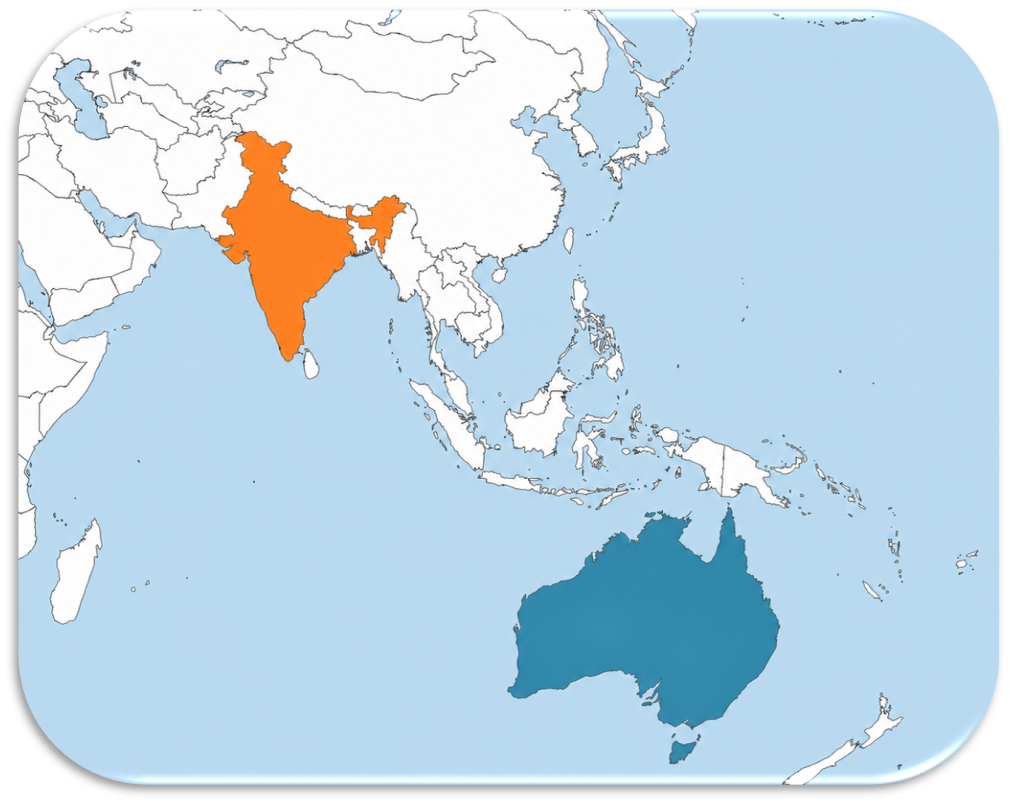
India and Australia are two vibrant democracies bound by shared Commonwealth traditions, the common law, the English language and a growing web of people-to-people ties. Their engagement is not new — it dates back to 1788, when the British East India Company conducted its early trade with the Australian colony through Kolkata (Calcutta), and during the colonial era Indian labour worked the plantations and cane fields of Queensland. Formal diplomatic contact began in 1941 with the opening of an India Trade Office in Sydney.
For most of the twentieth century, however, the two nations barely featured in each other’s strategic calculus. What has transformed the relationship in the twenty-first century is a powerful strategic convergence — driven above all by the rise of an assertive China and a shared stake in a free, open and rules-based Indo-Pacific.
Complementary economies (Australia’s resources and India’s market and talent), overlapping membership of the Quad, and a large and influential Indian diaspora have together lifted the partnership to a Comprehensive Strategic Partnership (CSP) in 2020.
| The Key Drivers at a Glance Strategic: convergence on a rules-based Indo-Pacific and balancing China; partnership through the Quad. Economic: complementary economies — Australian coal, LNG and critical minerals for India’s market, talent and services. Energy & Minerals: uranium, lithium, cobalt, rare earths, and joint work on green hydrogen and solar. People & Values: shared democratic values, a booming Indian diaspora and a huge student community. |
Historical Evolution: Three Phases
Since independence the relationship has passed through three distinct phases — Nehruvian divergence, a period of undulation, and, finally, strategic convergence.
Phase 1 (1947–1970): Ideological Divergence
India converted its Australian mission into a High Commission in 1947 but the two soon drifted apart ideologically. India embraced Non-Alignment (NAM), whereas Australia anchored itself firmly to the United States — through the ANZUS treaty (1951) and later SEATO (1954). Australia’s early ‘White Australia’ policy and support for the US in Vietnam contrasted sharply with India’s outlook.
There were positive notes — Australia extended aid under the Colombo Plan and supported India during the 1962 war with China — but the ideological gulf kept ties shallow.
Phase 2 (1970s to End of Cold War): Undulation
A domestic shift in Australia — Gough Whitlam replacing Menzies — briefly warmed relations, with a cultural cooperation agreement in 1971. But the 1971 India–Pakistan war and the Indo-Soviet Treaty of Friendship cooled things quickly.
In 1975, PM Malcolm Fraser criticised India’s proximity to the USSR and its stance on the US base at Diego Garcia, leaving the relationship uneven.
Phase 3 (Post-Cold War): Strategic Convergence
The end of the Cold War revealed shared ideals of democracy and peace. Economic cooperation was identified as the anchor: an Australia–India Council was set up, a joint working group on coal (1992) formed, and a landmark 1994 study, *’India’s Economy at the Midnight Hour,’* mapped investment opportunities.
The attacks of 9/11 drew India, Australia and the US closer on counter-terrorism. Yet ‘speed breakers’ remained — Australia’s sale of Mirage aircraft to Pakistan (1990) and its sharply negative reaction to India’s 1998 nuclear tests, when it withdrew its High Commissioner and suspended defence and trade ties.
Normalisation came only after the 2005 India–US civil nuclear deal, after which the relationship deepened steadily — culminating in the Strategic Partnership Agreement (2009), the Framework for Security Cooperation (2014) and the CSP (2020).
The Arc of India–Australia Relations
| Phase 1 (1947–70): Ideological Divergence — NAM vs US Alliance |
▼
| Phase 2 (1970s–1991): Undulation — Brief Thaw, then Cooling |
▼
| Phase 3 (Post-1991): Strategic Convergence — SPA 2009 → CSP 2020 |
Significance of the Relationship
- Strategic: As a fellow maritime democracy, Australia is central to India’s Indo-Pacific vision. Both cooperate to counter China’s assertiveness through the Quad and initiatives like the Australia-India Indo-Pacific Oceans Initiative Partnership (AIIPOIP) on maritime security.
- Economic & Trade: The economies are highly complementary. Bilateral trade has crossed roughly $30 billion, and the Economic Cooperation and Trade Agreement (ECTA) is opening markets by cutting tariffs.
- Energy & Critical Minerals: Australia is a leading global producer of uranium, lithium, cobalt and rare earths — resources vital to India’s energy transition and manufacturing ambitions.
- Education & Migration: The Indian diaspora is nearly 9.76 lakh and is Australia’s largest overseas-born group; India remains a major source of students and skilled migrants.
- Multilateral: Australia supports India’s bid for a permanent UN Security Council seat, and the two work together in the G20 and the Indian Ocean Rim Association (IORA).
Areas of Cooperation
Strategic and Defence Cooperation
Defence is now the fastest-growing dimension. Australia’s 2012 white paper, *’Australia in the Asian Century,’* recognised that the strategic centre of gravity had shifted to the Indo-Pacific. Since then the two have built a dense architecture:
- Foundational agreements: the Framework for Security Cooperation (2014), a Mutual Logistics Support Arrangement (MLSA) and an Air-to-Air Refuelling arrangement, backed by a ‘2+2′ Foreign and Defence Ministers’ Dialogue.
- Joint exercises: the naval AUSINDEX (inaugurated 2015 at Visakhapatnam), the army exercise AUSTRAHIND, the multinational air exercise Pitch Black, and Australia’s inclusion in the MALABAR exercise — an important shift, given India’s earlier reluctance to admit Australia while its strategic posture toward China remained ambiguous.
- Quad revival: After Australia withdrew from the original 2007 Quadrilateral Security Dialogue for fear of upsetting Beijing, the grouping’s 2017 revival now anchors joint work on a rules-based order.
Economic and Trade Cooperation
Commercial ties matured from an FTA feasibility study begun in 2008 into the India-Australia ECTA, an interim free-trade agreement that slashes tariffs, with negotiations continuing toward a fuller Comprehensive Economic Cooperation Agreement (CECA).
India imports coal, LNG, gold and copper and exports textiles, pharmaceuticals, gems and IT services. The Supply Chain Resilience Initiative (SCRI) with Japan promotes diversified, China-free supply chains, while the Australia-India Business Exchange (AIBX) deepens commercial connectivity.
Energy, Critical Minerals and Clean Energy
- Critical minerals: a Critical Minerals Investment Partnership channels Indian investment into Australian lithium, cobalt and rare-earth projects essential for batteries, electronics and defence.
- Clean energy: the India-Australia Green Hydrogen Taskforce and the Solar Taskforce, together with a Renewable Energy Partnership (REP), advance cooperation in green hydrogen, solar PV and energy storage.
Civil Nuclear Cooperation
The nuclear question long turned on the Non-Proliferation Treaty (NPT): Australia holds vast uranium reserves but refused to supply a non-signatory. The logic shifted after the 2005 India–US deal and Australia’s support for India at the Nuclear Suppliers Group (NSG).
A 2011 policy change opened uranium exports for civilian use, and PM Tony Abbott concluded the Civil Nuclear Agreement in September 2014, later given effect by Australia’s Civil Nuclear Transfers to India Act.
Education, Migration and the Diaspora
Education is a flagship of the partnership. The two have signed a landmark agreement for mutual recognition of qualifications, and a Migration and Mobility Partnership Agreement (MMPA) eases the movement of students, professionals and researchers.
Australia’s New Colombo Plan (launched at Mumbai University in 2014) sends Australian youth to study in India, reversing the traditional one-way flow. Past friction — notably the racial attacks on Indian students in 2010–2012 — prompted stricter Australian laws and has since receded.
Science, Technology and Space
Cooperation now reaches into space: under an implementing arrangement, Australia hosts transportable telemetry terminals on the Cocos Islands to support India’s Human Space Flight (Gaganyaan) Mission.
Key Agreements and Exercises — Ready Reckoner
| Domain | Instrument / Exercise | Note |
| Strategic | Comprehensive Strategic Partnership (2020) | Highest tier of the relationship |
| Defence — logistics | MLSA + Air-to-Air Refuelling | Mutual military access and support |
| Defence — dialogue | ‘2+2’ Ministerial Dialogue | Foreign + Defence ministers |
| Naval exercise | AUSINDEX (from 2015), MALABAR | Interoperability, Indo-Pacific |
| Army / Air exercise | AUSTRAHIND, Pitch Black | Joint readiness |
| Trade | ECTA (interim FTA); CECA (under talks) | Tariff cuts; deeper agreement pending |
| Nuclear | Civil Nuclear Agreement (2014) | Uranium for civilian use |
| Minerals / Energy | Critical Minerals Partnership; Green Hydrogen & Solar Taskforces | Batteries, rare earths, clean energy |
| People | MMPA; Mutual Recognition of Qualifications | Mobility of students & professionals |
3rd Annual Leaders’ Summit (2026) – Key Outcomes
- Defence and maritime security: Joint Declaration on Defence and Security Cooperation, Maritime Security Collaboration Roadmap and an Indian Coast Guard -Maritime Border Command MoU expanded interoperability, information sharing and law enforcement.
- Energy and nuclear ties: The administrative arrangement for the 2014 Civil Nuclear Agreement was operationalised and a Joint Statement on Energy Security adopted.
- PACTS: New partnership across critical-mineral and semiconductor supply chains, AI, space, telecom, biotechnology, cyber resilience, digital public infrastructure and defence R&D.
- Investment, education and innovation: AustralianSuper increased NIIF investment; two Australian universities received Indian-campus approval; TKDL access was extended to IP Australia.
- Space, culture and sports: Support for Gaganyaan tracking, repatriation of three artefacts and a sports-collaboration roadmap.
Issues and Challenges
- Stalled trade deepening: the CECA remains unconcluded, and non-tariff barriers — strict sanitary, technical and pharmaceutical pricing rules — limit the entry of Indian generics and other exports.
- Extremism and anti-India activity: rising Khalistani activity, including temple vandalism in Melbourne, has strained community ties and bilateral goodwill.
- Nuclear trade unrealised: despite the 2014 agreement, no commercial uranium trade has yet materialised, owing to slow progress and viability concerns on the Indian side.
- Visa and mobility friction: a steep hike in student visa fees raises costs for Indian students and could dampen educational exchange.
- Australia’s China dilemma: Australia’s deep economic dependence on China (its largest trading partner) can complicate strategic alignment, requiring careful balancing on both sides.
Way Forward
- Deepen economic engagement: fully implement the ECTA and expedite the CECA, encouraging investment in clean energy, mining and high-technology sectors.
- Expand security cooperation: widen collaboration on maritime security, cyber defence and counter-terrorism to meet evolving threats.
- Strengthen the Indo-Pacific partnership: work jointly through the Quad, ASEAN and the Pacific Islands Forum to support regional development and strategic balance.
- Tackle extremism proactively: improve intelligence-sharing and community-level engagement to curb radical activity.
- Invest in people: sustain the education and migration partnership as the human bedrock of the relationship, converting goodwill into lasting strategic depth.
Conclusion
The India–Australia story is one of a relationship transformed — from Cold War strangers, divided by ideology and indifferent to each other’s strategic worth, into Comprehensive Strategic Partners at the heart of the Indo-Pacific.
The key drivers are clear and durable: a shared interest in balancing China and defending a rules-based order, deeply complementary economies in trade, energy and critical minerals, and the warm ballast of democratic values and a thriving diaspora.
Real frictions persist — an unfinished trade agreement, stalled uranium commerce, extremism and Australia’s own China dilemma — but the strategic logic binding the two is now firmly set. If both act on the convergence they have discovered, this partnership will remain one of the most natural and consequential of India’s rise.