
UPSC CURRENT AFFAIRS — 3 OCTOBER 2026
Cleaning the Rolls or Shrinking the Electorate? The SIR Deletion Debate
(POLITY AND GOVERNANCE) (FL) A fresh analysis of the nationwide Special Intensive Revision (SIR) of electoral rolls argues that the share of names struck off has risen with every phase — raising the question of whether a clean-up exercise is turning into the exclusion of eligible voters.
The SIR is a house-to-house re-enumeration of electors carried out by the Election Commission of India (ECI). Unlike the routine annual summary revision, it rebuilds the roll afresh: every elector submits an enumeration form, and entries of the dead, the permanently shifted, duplicates and ineligible persons are removed.
The legal scaffolding
| Provision | What it does |
| Article 324 | Vests superintendence, direction and control of the preparation of electoral rolls and the conduct of elections in the ECI. |
| Article 326 | Guarantees elections on the basis of adult suffrage — every citizen aged 18 or above, not otherwise disqualified, is entitled to be registered. |
| Section 21, RP Act, 1950 | Provides for revision of rolls; Section 21(3) lets the ECI order a special revision of any roll at any time, for reasons recorded. |
| Registration of Electors Rules, 1960 | Lays down the procedure for claims, objections, notices and deletions. |
| Section 24, RP Act, 1950 | Appeals against an Electoral Registration Officer’s (ERO) decision — first to the District Magistrate, then to the Chief Electoral Officer. |
These provisions sit within the wider framework of election laws in India.
How the exercise has unfolded
| Phase | Coverage | Period | Change in final roll |
| Phase I | Bihar | June–September 2025 | 7.89 crore → 7.42 crore (about 47 lakh fewer; 5.95%) |
| Phase II | 9 States + 3 UTs (incl. Uttar Pradesh, West Bengal) | 27 Oct–4 Dec 2025 (enumeration) | 50.99 crore → 45.81 crore (5.18 crore fewer; 10.2%) |
| Phase III | 16 States + 3 UTs | Announced 14 May 2026 | Draft-stage deletion ratios reported higher than in earlier phases |
Taken together, draft-stage removals across the three phases are reported to exceed 13 crore entries — the figure at the centre of the present debate.
In May 2026 the Supreme Court upheld the ECI’s power to conduct the SIR as part of its constitutional duty, while directing safeguards: persons suspected to be non-citizens must be told the grounds and heard, Aadhaar must be accepted among identity documents, and deleted names must be published in an accessible form.
The deletion pipeline
Enumeration form by BLO ➜ Draft roll ➜ Claims & objections ➜ Notice and hearing by ERO ➜ Final roll ➜ Appeal: DM → CEO
Why critics are worried
- Rising exclusion ratios: Each phase has removed a larger share of names than the one before, which critics read as a sign of over-deletion rather than genuine clean-up.
- Who gets left out: Internal migrants, women who moved after marriage, Denotified and Nomadic Tribes, Adivasis, Dalits and minorities are least likely to hold old documents or be found at a fixed address.
- Documentary burden: Electors not traceable in the last intensive-revision rolls must prove eligibility through documents. Under Section 3 of the Citizenship Act, 1955, the test tightens by date of birth — birth in India before 1 July 1987 suffices; later births also require proof about parents’ citizenship.
- Migration penalty: Seasonal and urban migrants deleted at their source constituency are not automatically enrolled where they now live, shrinking the overall electorate (see Internal Migration in India).
- Ground-level errors: Overburdened Booth Level Officers (BLOs) and centralised software flags can mark living voters “dead” or “shifted”, while EROs have limited tools to roll back mistaken flags.
- Welfare spill-over: Electoral rolls increasingly double as identity baselines for State schemes, so a deletion can cascade into the loss of entitlements.
The other side of the ledger
- Many States had not seen an intensive revision for about two decades, during which deaths, migration and duplicate entries piled up.
- Clean rolls protect the principle of one person, one vote and blunt allegations of bogus voting — core to electoral reforms.
- The Supreme Court’s safeguards (notice, hearing, published deletion lists) give affected voters a route to restoration.
Way forward
| Reform | How it would work |
| Due process before deletion | Written notice, a physical hearing and provisional deletion lists displayed at panchayat and ward offices before any name is struck off. |
| Social audit | Draft additions and deletions read out in Gram Sabhas and ward committees in the presence of all parties’ Booth Level Agents (BLAs). |
| Portability for migrants | Automatic transfer of entries when an elector is deleted at source and found at a new address. |
| Rollback powers | Simple tools for EROs to restore wrongly flagged electors without fresh paperwork. |
| Independent audit | Statistical audits by academic bodies to test whether deletion patterns match demographic reality. |
📖 Read More: Election Commission of India • Electoral Reforms • Election Laws in India • Citizenship • Internal Migration in India
“Daylight Dacoity” at the Chemist’s Counter: SC Questions Drug Mark-ups
(POLITY AND GOVERNANCE) (IE) Hearing petitions on medicine pricing, a Supreme Court Bench of Justices Vikram Nath and Sandeep Mehta called a ten-fold gap between a cancer drug’s price-to-retailer (PTR, about ₹2,700) and its MRP (₹27,000) “broad daylight dacoity”, and asked the Centre why the MRP of all medicines and medical devices cannot be capped at a uniform 16% over PTR.
The remarks put the spotlight on a quiet gap in India’s price-control architecture: strict ceilings for a listed set of essential medicines, but near-free pricing for everything else.
Who regulates what
| Instrument / body | Role |
| Essential Commodities Act, 1955 | Parent law; drugs are notified as essential commodities, letting the government control their supply and prices. |
| Drugs (Prices Control) Order, 2013 (DPCO) | Issued under the ECA; the legal framework for fixing ceiling prices. |
| National Pharmaceutical Pricing Authority (NPPA) | Set up in 1997 under the Department of Pharmaceuticals (Ministry of Chemicals and Fertilizers); fixes and revises prices, enforces the DPCO and recovers overcharged amounts. |
| National List of Essential Medicines (NLEM) 2022 | 384 medicines — these “scheduled” formulations come under price ceilings. |
| Drugs and Cosmetics Act, 1940 + CDSCO | Governs quality, approvals, manufacture and sale; the Central Drugs Standard Control Organisation is the apex regulator. |
Scheduled versus non-scheduled drugs
| Feature | Scheduled (NLEM) drugs | Non-scheduled drugs |
| Price fixing | Ceiling = simple average PTR of brands with at least 1% market share + 16% retailer margin | Manufacturer fixes the launch price freely |
| Annual change | Revised in line with the Wholesale Price Index (WPI) | MRP may rise by up to 10% a year |
| Market coverage | A limited basket | The bulk of the market by value |
How a mark-up is built
Ex-factory cost ➜ Price to Stockist ➜ Price to Retailer (PTR) ➜ MRP paid by patient
For uncapped drugs, companies widen the PTR–MRP gap (the trade margin) to reward distributors, chemists and hospital pharmacies for pushing their brand. The patient, who cannot compare chemically identical generics at the counter, pays the printed MRP.
Why this matters
- Out-of-pocket burden: Households still met 43.4% of total health expenditure from their own pockets in 2022–23, and medicines are a major component (see Health: A Social Perspective).
- Captive buyers: In corporate hospitals, in-house pharmacies bill at full MRP and patients have little choice.
- Information asymmetry: Prescriptions by brand rather than by generic name limit price comparison.
- Constitutional angle: Courts read the right to health into Article 21; Article 47 directs the State to improve public health.
Existing correctives
- Trade Margin Rationalisation: Using its extraordinary powers under the DPCO, the NPPA has capped trade margins on select items such as anti-cancer medicines, cutting their MRPs sharply.
- Pradhan Mantri Bhartiya Janaushadhi Pariyojana (PMBJP): Quality generics through Jan Aushadhi Kendras at a fraction of branded prices.
- Free Drugs Service Initiative under the National Health Mission: essential medicines free at public facilities.
- Pharma Sahi Daam app (NPPA) to check prices and report overcharging; revised Schedule M making WHO-standard Good Manufacturing Practices mandatory.
Way forward
- A cap on trade margins across the supply chain, not merely on final prices of NLEM drugs.
- Strict enforcement of generic-name prescribing and price display in hospital pharmacies.
- Periodic widening of the NLEM, and harmonised Centre–State drug regulation for uniform quality enforcement.
📖 Read More: Drugs and Pharmaceuticals Industry • PMBJP • Health and Nutrition • National Health Mission
From Toilets to Habits: Swachh Bharat Mission-Grameen Comes of Age
(POLITY AND GOVERNANCE) (PIB) A government backgrounder released for the Swachhata Hi Seva season traces how the Swachh Bharat Mission–Grameen (SBM-G) has grown from a toilet-construction drive into a people-led movement built on behaviour change and village-level waste management.
Access (toilets, 2014–19) ➜ Usage (behaviour change) ➜ Sustainability (ODF Plus, waste management)
The journey in numbers
| Indicator | Figure |
| Rural sanitation coverage when SBM began (2014) | 39% |
| Toilets built, 2014–19 | 10.28 crore+ across 36 States/UTs |
| ODF status | Rural India declared Open Defecation Free in 2019 |
| ODF Plus villages (as of 17 Sep 2026) | 5.69 lakh, of which 5.25 lakh are “Model” |
| Villages with solid / liquid waste arrangements | 5.38 lakh / 5.65 lakh |
| GOBARdhan biogas plants operational | 1,314 in 582 districts |
| Household-level assets (cumulative) | 12.22 crore individual toilets; 98,273 biogas plants |
Phase II and the ODF Plus ladder
Having achieved ODF status, SBM-G Phase II shifted to sustaining it and building solid and liquid waste management. Villages climb three rungs:
| Category | Criteria (with ODF sustained) |
| Aspiring | Arrangement for either solid or liquid waste management |
| Rising | Arrangements for both solid and liquid waste management |
| Model | Both waste systems + visual cleanliness + display of ODF Plus messages |
Pillars of a people’s movement
- Behaviour Change Communication: Safe toilet use, handwashing, safe water storage, composting and no littering — sanitation as daily practice, not just infrastructure.
- Women as change agents: Guidelines prefer women as Swachhagrahis and use DAY-NRLM Self-Help Groups. In Howrah (West Bengal), SHGs collected 9.32 tonnes of plastic from 18 Ganga-adjacent gram panchayats in 18 days.
- Schools: Hygiene habits travel from classroom to home; in Jharkhand, child cabinets even manage menstrual-hygiene supplies.
- Gram Panchayats and VWSCs: Panchayats plan and implement village sanitation; Gadli GP (Haryana) reached Model status with drainage, five greywater ponds and GOBARdhan plants.
- Jan Bhagidari: Swachhata Hi Seva (since 2017) drew over 18.06 crore citizens in 2025; the 2026 theme is “Swachhata Mein Sahbhag; Swachh Bharat, Viksit Bharat”.
- Livelihoods: Waste collection, recycling, composting and masonry have created local jobs — from a woman e-rickshaw waste collector in Betul to 2,400 trained masons in Nadia.
Convergence: SBM-G draws on Union allocations, Finance Commission grants, Viksit Bharat–Guarantee for Rozgar and Ajeevika Mission (Gramin) funds, DAY-NRLM and the Jal Jeevan Mission (for greywater).
What still needs work
| Concern | Measure needed |
| Slippage back to open defecation | Sustained BCC through Swachhagrahis, SHGs and schools |
| Gaps in solid and plastic waste handling | Village-level collection, segregation, recycling and scientific disposal |
| Poor greywater management | Local drainage, treatment, reuse and recharge solutions |
| Weak panchayat capacity | Technical, financial and managerial strengthening; sanitation in village development plans |
| Waste treated as a burden | Circular-economy models — GOBARdhan, composting, women-led enterprises |
📖 Read More: Swachh Bharat Mission (Grameen) Phase II • Solid Wastes • Self-Help Groups • Schemes under Ministry of Jal Shakti
Samudra Manthan: Churning India’s Deep Seas for Oil and Gas
(ECONOMICS) (TOI) The ₹84,084-crore Samudra Manthan – National Offshore Exploration Scheme, approved by the Union Cabinet on 31 July 2026, is India’s largest push yet to de-risk oil and gas exploration in its deep and ultra-deep offshore basins.
The logic is simple: India imports most of its crude — an annual bill of about USD 144 billion (~₹13 lakh crore) — while mature fields such as Mumbai High decline naturally every year. New discoveries, especially in deep water, are the only way to hold and raise domestic output.
The scheme at a glance (Phase I, up to 2030–31)
| Component | Outlay | Purpose |
| Seismic data acquisition | ₹28,534 crore | 2D surveys (₹12,000 cr), 3D surveys (₹12,534 cr), re-processing of National Data Repository data with AI (₹4,000 cr) |
| Exploration acceleration | ₹43,200 crore | Support for 60 deepwater/ultra-deepwater wells — up to 50% of eligible drilling cost or ₹675 crore per well, whichever is lower |
| Common offshore infrastructure | ₹10,000 crore | Shared subsea and evacuation facilities so that small, isolated finds become viable |
| Manufacturing/services zone | ₹2,000 crore | Domestic offshore equipment and service supply chain (Make in India) |
| Monitoring and support | ₹350 crore | Oversight and regulatory support |
What it aims to deliver
- Convert prospects into over 600 MMTOE of recoverable reserves; expand the resource base from 1.6 to 2.2 billion tonnes of oil equivalent.
- Raise domestic oil and gas output from about 62 MMTOE to 80 MMTOE a year.
- Tap a geological potential of over 5,600 MMTOE in water depths of up to 3,000 metres.
- Save nearly ₹1 lakh crore a year on crude imports, easing pressure on the balance of payments.
How upstream policy evolved
NELP (production-sharing contracts) ➜ HELP, 2016 (revenue sharing, single licence) ➜ Open Acreage Licensing (OALP) ➜ No-Go areas opened ➜ Samudra Manthan, 2026
- More than 99% of earlier “No-Go” offshore areas — restricted for defence or maritime reasons — have been released, freeing over 1 million sq km of India’s Exclusive Economic Zone.
- Under OALP, 172 blocks covering 3.8 lakh sq km have been awarded.
Where the drill bits will go
| Basin | Why it matters |
| Mahanadi (Odisha) | Deepwater appraisal of earlier gas finds; a test-bed for the shared-infrastructure model |
| Andaman–Nicobar | Frontier basin with an estimated resource of 371 MMTOE; ultra-deep water and signs of an active petroleum system |
| Krishna–Godavari and Cauvery | Extension of producing provinces into ultra-deep water |
| Kutch–Mumbai (western offshore) | High evacuation costs for small finds — ideal for common infrastructure |
Basin-wise reserves are covered in Distribution of Petroleum in India.
Hurdles ahead
- Cost and technology: Deepwater (up to 3,000 m) and ultra-deepwater (up to 5,000 m) drilling needs drillships, subsea blowout preventers and advanced seismic imaging; a dry well can cost hundreds of crores.
- Stranded discoveries: Isolated fields rarely justify their own pipelines and platforms.
- Harsh environment: Cyclones and strong currents in the Bay of Bengal and Andaman Sea; high-pressure, high-temperature (HPHT) reservoirs.
- Long gestation: Moving from geochemical signs of hydrocarbons to commercial production takes several appraisal rounds.
Way forward
- Build multi-user subsea manifolds and shared risers so satellite fields can pool production.
- Partner with experienced deepwater operators for HPHT and frontier drilling.
- Single-window environmental clearance desks to avoid costly rig idling.
- Use the ₹2,000-crore allocation to localise subsea trees, manifolds and intervention vessels.
📖 Read More: Distribution of Petroleum in India • Petroleum and Mineral Oil • Natural Gas • Oil and Energy Diplomacy • Schemes under Ministry of Petroleum and Natural Gas
RoDTEP Gets a Year-End Lifeline: Export Tax Refunds Extended to December 2026
(ECONOMICS) (PIB) The Department of Commerce, through Notification No. 41/2026-27 dated 30 September 2026, has extended the Remission of Duties and Taxes on Exported Products (RoDTEP) scheme up to 31 December 2026 for exports by Domestic Tariff Area units, Advance Authorisation holders, SEZ units and Export Oriented Units — with existing rates and value caps unchanged.
What RoDTEP does
- Principle: “Export goods, not taxes.” It refunds embedded, un-rebated Central, State and local duties and levies — including prior-stage cumulative indirect taxes — that are not refunded under GST or any other mechanism.
- Typical examples: Taxes on fuel used in transport and farming, electricity duty, mandi tax and stamp duty on export documents — items outside the GST credit chain.
- Origin: Introduced from 1 January 2021 in place of the Merchandise Exports from India Scheme (MEIS), after a WTO panel found MEIS-type export-contingent incentives inconsistent with global subsidy rules.
- Rates: Notified in Appendix 4R (DTA exports) and Appendix 4RE (AA, SEZ and EOU exports) as a percentage of FOB value, with per-unit value caps.
MEIS versus RoDTEP
| Feature | MEIS | RoDTEP |
| Nature | Reward/incentive on exports | Refund of taxes actually embedded in exports |
| WTO position | Challenged as a prohibited export subsidy | Designed as a WTO-compatible remission |
| Basis of rate | Product–market reward rates | Estimated incidence of un-rebated taxes, with value caps |
How an exporter gets the benefit
Claim declared in shipping bill ➜ Processed by Customs (ICEGATE) ➜ Transferable electronic duty-credit scrip issued ➜ Used to pay Basic Customs Duty or sold
Significance and concerns
- Level playing field: Removes the tax cost Indian exporters carry relative to competitors, supporting the goals of the Foreign Trade Policy 2023.
- Certainty deficit: Short, quarter-by-quarter extensions make pricing of long-term export contracts difficult.
- Rate adequacy and budget limits: Exporters argue that capped rates do not always cover actual embedded taxes.
📖 Read More: RoDTEP — Schemes under Ministry of Commerce and Industry • Foreign Trade Policy 2023 • India’s International Trade
Charging Ahead: Where PM E-DRIVE Stands on India’s EV Journey
(ECONOMICS) (PIB) A government factsheet issued on 1 October 2026 shows that the PM Electric Drive Revolution in Innovative Vehicle Enhancement (PM E-DRIVE) scheme has supported the sale of 26.59 lakh EVs (as of June 2026) and now runs until 31 March 2028.
The scheme’s outlay now stands at ₹11,900 crore — enhanced from the original ₹10,900 crore through a gazette notification in August 2026.
The scheme at a glance
| Feature | Details |
| Ministry | Ministry of Heavy Industries |
| Launch | September 2024; implemented from October 2024 (originally for two years) |
| Tenure | Extended to 31 March 2028 |
| Coverage | e-2Ws, e-3Ws (incl. e-rickshaws, e-carts and L5), e-ambulances, e-trucks, e-buses, public charging and upgradation of testing agencies |
| Delivery | E-vouchers give buyers the incentive as an upfront price cut; MHI reimburses the OEM |
Progress by component
| Component | Support / status |
| e-2 Wheelers | ₹2,500 per kWh, capped at ₹5,000 per vehicle (ex-factory price up to ₹1.5 lakh); ₹2,767 crore; aims to support 45.79 lakh+ vehicles |
| e-3 Wheelers (L5) | Target sales achieved; segment closed on 26 December 2025 |
| e-rickshaws and e-carts | Support continues until March 2028 |
| e-Buses | ₹4,391 crore for 14,028 buses; 14,000 allocated (Aug 2026); 13,800 to Delhi, Bengaluru, Hyderabad, Mumbai, Ahmedabad, Pune and Surat |
| Public charging (EV PCS) | ₹2,000 crore earmarked; ₹851 crore approved for 8,147 chargers to 3 oil marketing companies and 10 States (as of 28 Sep 2026) |
| Testing agencies | ₹780 crore for modernisation and upgradation |
Building the domestic ecosystem
- Localisation: Registered OEMs must meet the Phased Manufacturing Programme (PMP); compliance is certified by MHI testing agencies.
- Complementary schemes: The PLI scheme for Advanced Chemistry Cell (ACC) battery storage targets the costliest component — the battery.
- Battery Waste Management Rules, 2022 set up extended producer responsibility for collection and recycling.
Demand incentive ➜ Wider EV adoption ➜ Scale for domestic manufacturing ➜ Lower costs and imports ➜ Cleaner air and energy security
Challenges
- Charging density remains thin outside big cities and along highways.
- Dependence on imported cells and critical minerals.
- Tapering subsidies may slow demand in price-sensitive segments; grid readiness and battery recycling capacity need to keep pace.
📖 Read More: PM E-DRIVE • PLI – ACC Battery Storage • The Automobile Industry • Energy Technologies
Smart Bins at Sacred Sites: Haryana’s IoT Plan for Pilgrimage Waste
(ENVIRONMENT) (NIE) Haryana’s Urban Local Bodies Department has drawn up a blueprint for sensor-enabled, four-stream waste management at major pilgrimage sites, beginning with three pilot locations.
Pilot sites
| Site | District |
| Shri Mata Sheetla Devi Mandir | Gurugram |
| Shri Mansa Devi Mandir | Panchkula |
| Brahma Sarovar, Thanesar | Kurukshetra |
Key design features
- Dense bin network: Four bins every 50 metres on the pilgrim route and every 25 metres in queue corridors, with four-stream segregation stations and covered storage.
- IoT smart bins: Sensors send real-time fill-level data and open lids automatically, enabling timely pickup and waste audits — a practical use of the Internet of Things.
- 500-metre clean zone: A buffer covering approach roads, vendor belts, parking and transit routes, with no open collection point inside it.
- Geo-tagging: Littering hotspots are mapped for targeted action, with data maintained at local-body, district and directorate levels.
- Bulk waste generators: Bhandaras, prasad and flower shops, dharamshalas, hotels and dhabas in the buffer zone are to be registered as bulk generators.
Segregation at source ➜ Sensor-tracked collection ➜ Covered storage ➜ Processing: compost, biogas, recycling ➜ Data-driven audit
Why pilgrimage sites need special handling
- Footfall spikes sharply during festivals and fairs, overwhelming routine municipal systems.
- Floral offerings, food from community kitchens and single-use plastic create a distinct, largely biodegradable waste mix — ideal for composting if segregated.
- Many sacred sites adjoin water bodies (such as Brahma Sarovar), where litter directly pollutes the water.
📖 Read More: Solid Wastes • Plastic Pollution • Emerging Technologies
Roar Returns to Buxa: First Tigress Released Under a Phased Reintroduction Plan
(ENVIRONMENT) (PIB) (IE) On 2 October 2026, marking the start of Wildlife Week, a tigress translocated from Valmiki Tiger Reserve (Bihar) was released into Buxa Tiger Reserve (West Bengal) — the first phase of a planned programme to rebuild a viable, self-sustaining tiger population.
Buxa at a glance
| Feature | Details |
| Location | Alipurduar district, North Bengal; Bhutan to the north and Assam to the east |
| Status | Tiger Reserve in 1983 (India’s 15th); part of it notified as Buxa National Park in 1997 |
| Area | About 760 sq km |
| Rivers | Raidak and Jayanti, among others |
| Connectivity | Phibsoo Wildlife Sanctuary (Bhutan), Manas National Park (Assam) and Jaldapara National Park (West Bengal) |
| Fauna | Asian elephant, gaur, sambar, clouded leopard and other species |
| Source reserve | Valmiki Tiger Reserve, West Champaran — Bihar’s only national park |
Why the tigers disappeared
Habitat degradation and fragmentation, changes in land use and a falling prey base left Buxa without a stable resident tiger population for a long period — a case of local extirpation highlighted in Big Cat Conservation in India.
Laying the groundwork
- Tiger Augmentation and Recovery Project: Run since 2018 by the West Bengal government with the NTCA and the Wildlife Institute of India.
- Prey first: More than 800 chital released and about 380 hectares of grassland restored over eight years.
- Natural movement: Camera traps recorded tigers in 2021, 2023 and 2026; a 2023 individual matched a tiger from Manas Tiger Reserve.
- Community buy-in: 64 Eco-Development Committees/Joint Forest Management Committees engaged on livelihoods and human–wildlife conflict mitigation.
The reintroduction model
Habitat and prey restoration ➜ Source-site assessment ➜ Translocation under protocol ➜ Telemetry and camera-trap monitoring ➜ Phased augmentation ➜ Self-sustaining population
Significance and challenges
- Landscape value: Buxa links North Bengal, Assam and Bhutan; a healthy population here strengthens a transboundary tiger landscape.
- Precedents: India has successfully re-established tigers after local extinction, notably in Sariska and Panna.
- Risks: Conflict at forest fringes, poaching, the adequacy of prey and maintaining genetic diversity through further, scientifically justified releases.
📖 Read More: Big Cat Conservation in India • National Parks in India • India’s Wildlife Laws, Policies and Institutions • Human Animal Conflict in India
Keeping the Tahr Wild: Kedarnath Sanctuary Moves to Curb Human Interference
(ENVIRONMENT) (NIE) The Kedarnath Wildlife Division in Uttarakhand plans to restrict human activity in the sanctuary’s alpine meadows (bugyals) after surveys found that feeding by tourists, pilgrims and locals is drawing Himalayan tahr out of their natural habitat towards roads and settlements.
Planned steps include curbing activity in bugyals around Chopta and adjoining areas, cleanliness drives, “do not feed” signboards and awareness campaigns on wildlife and alpine vegetation.
Species profile
| Feature | Details |
| Scientific name | Hemitragus jemlahicus — a wild relative of goats (family Bovidae) |
| Range | Himalayas of northern India, Nepal, western Bhutan and southern Tibet |
| Habitat | Steep, rugged rocky slopes and wooded cliffs, mainly between 2,500 and 5,000 m |
| Body | Thick reddish-brown coat; males grow a shaggy mane in winter; backward-curving horns up to 46 cm. Males usually weigh around 73 kg, females about 36 kg |
| Conservation status | IUCN Red List: Near Threatened; Wild Life (Protection) Act, 1972: Schedule I |
| Introduced populations | New Zealand (1904), where it is now a managed invasive; South Africa |
Two tahrs, two ranges
| Feature | Himalayan tahr | Nilgiri tahr |
| Region | Himalayas | Southern Western Ghats |
| IUCN status | Near Threatened | Endangered |
| Stronghold in India | Kedarnath WLS and other Himalayan PAs | Eravikulam National Park (Kerala); State animal of Tamil Nadu |
About Kedarnath Wildlife Sanctuary
- Also called the Kedarnath Musk Deer Sanctuary; at 975 sq km it is the largest protected area in the western Himalayas.
- Notified as a sanctuary on 21 January 1972; elevation ranges from about 1,160 m to Chaukhamba peak (7,068 m).
- Known for musk deer, Himalayan tahr, Himalayan griffon, Himalayan black bear and snow leopard (see Wildlife Sanctuaries in India).
Why feeding wild animals harms them
Human feeding ➜ Loss of fear and food dependence ➜ Movement to roads and villages ➜ Road kills, disease and conflict ➜ Degraded natural behaviour
📖 Read More: Species of Conservation Concern: Mammals • Wildlife Sanctuaries in India • Conservation of Major Indian Wildlife Species
TAPAS-1: India’s First Commercial Thermal Eye in Orbit
(SCIENCE AND TECHNOLOGY) (IE) Ahmedabad-based start-up SatLeo Labs’ TAPAS-1, described as India’s first dedicated commercial thermal-imaging payload, was launched aboard SpaceX’s Falcon 9 on the Transporter-18 rideshare mission at the start of October 2026.
TAPAS-1 is a payload of about 1.5 kg hosted on Dhruva Space’s LEAP-2 satellite mission, rather than a free-flying satellite of its own.
Mission snapshot
| Feature | Details |
| Developer | SatLeo Labs, Ahmedabad |
| Launch | SpaceX Falcon 9, Transporter-18 rideshare |
| Sensor band | Long-wave infrared (LWIR) |
| Native resolution | About 60 metres; temperature accuracy of roughly 1 Kelvin |
| Data processing | Ground-based machine learning; TAPAS-2 (planned 2027) is to carry onboard edge-AI |
| Road map | 12–15 PYRO satellites plus 4–5 TAPAS satellites over three to four years, aiming at twice-daily global coverage |
How thermal imaging works
Every object emits infrared radiation in proportion to its temperature. A long-wave infrared sensor records this emitted energy — unlike optical cameras that rely on reflected sunlight — so it can image by day and night and convert readings into land-surface temperature maps (the principle of thermography).
Surface emits heat ➜ LWIR sensor records radiance ➜ Land-surface temperature derived ➜ ML analytics ➜ Maps and alerts to users
Applications
- Cities: Mapping urban heat islands to guide cool roofs, tree cover and heat-action plans.
- Agriculture: Early crop-stress and drought detection; irrigation planning.
- Disasters and forests: Forest-fire detection and monitoring.
- Infrastructure: Surveillance of pipelines, industrial sites and heat leaks.
Why it matters
TAPAS-1 reflects the growth of India’s private space economy after the 2020 reforms, with IN-SPACe authorising and handholding non-government players. Small payloads riding on shared buses and rideshare launches cut costs and speed up in-orbit validation. Sensor classes are explained in Satellites and Sensors.
📖 Read More: Satellites and Sensors • Commercial Space Economy • Orbits in Space Technology
KAZIND-2026: India and Kazakhstan Train for Counter-Terror Operations
(INTERNATIONAL RELATIONS) (AIR) The ninth edition of the India–Kazakhstan joint military exercise KAZIND-2026 is under way at Oskemen, Kazakhstan, from 28 September to 11 October 2026.
Exercise snapshot
| Feature | Details |
| Edition | 9th |
| Venue | Oskemen (East Kazakhstan) |
| Indian contingent | 60 personnel, mainly from a battalion of the Garhwal Rifles, with other arms and services and the Indian Air Force |
| Kazakh contingent | Equal strength, primarily from its Land Forces |
| Mandate | Joint counter-terrorism operations in a sub-conventional environment under a United Nations mandate |
Focus areas
- Counter-terrorism drills in semi-urban and mountainous terrain; joint planning and execution.
- Air mobility, Unmanned Aerial Systems and counter-UAS capabilities.
- Raids, search-and0-destroy missions, cordon-and-search operations, securing helipads and special heliborne operations.
- A joint command post and an intelligence and surveillance centre, culminating in a validation exercise against a simulated terrorist threat.
India–Kazakhstan: the wider canvas
- Diplomatic relations were established in 1992, soon after Kazakhstan’s independence; ties have since grown into a strategic partnership.
- Kazakhstan is India’s largest trade partner in Central Asia and a key supplier of uranium for its civil nuclear programme.
- Both cooperate in the SCO, the UN and CICA, and through the India–Central Asia Dialogue under India’s outreach to Central Asia.
- Connectivity via Chabahar Port and the International North–South Transport Corridor (INSTC) is central to deepening trade.
📖 Read More: India and Kazakhstan • India and Central Asia • Shanghai Cooperation Organisation
Kaliningrad: Russia’s Baltic Fortress at the Heart of NATO Tensions
(GEOGRAPHY) (BS) Kaliningrad is back in focus after Russia warned NATO on 30 September 2026 that it would use its “entire arsenal”, including nuclear weapons, if the alliance tried to isolate the exclave.
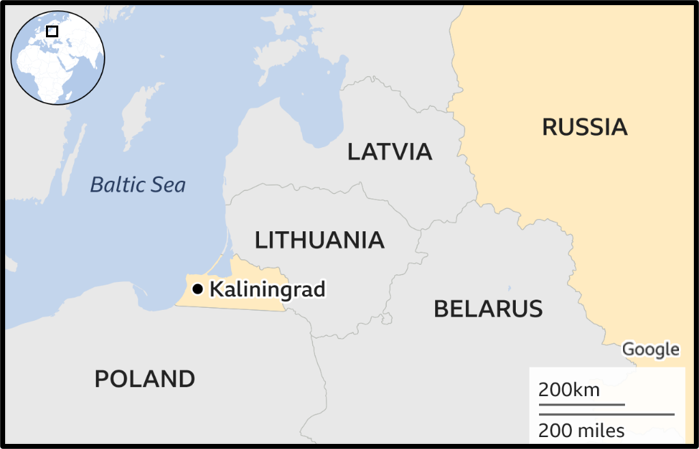
Location and profile
| Feature | Details |
| Position | Between Poland (south) and Lithuania (north and east), with the Baltic Sea to the west — a Russian semi-exclave cut off from the mainland |
| Area and population | About 15,125 sq km; ~1.03 million people (2021) |
| Capital | Kaliningrad (formerly Königsberg, capital of East Prussia) |
| Naval base | Baltiysk — headquarters of the Baltic Fleet and Russia’s only Baltic port that stays ice-free in winter |
From Königsberg to Kaliningrad
Königsberg, East Prussia ➜ Potsdam Agreement (1945) transfers it to USSR ➜ Renamed Kaliningrad (1946) after Mikhail Kalinin ➜ Exclave after USSR dissolves (1991)
Why it matters strategically
- Forward military base: Hosts naval, air-defence and missile assets; Iskander missiles were deployed here from 2016, putting several European capitals within range (see Missile Technology).
- Suwałki Gap: The narrow Polish–Lithuanian border strip on the shortest route between Belarus and Kaliningrad — the Suwałki Gap — is seen as NATO’s most vulnerable choke point.
- Encircled by NATO: With Finland (2023) and Sweden (2024) joining the alliance, nearly the entire Baltic rim outside Russia is NATO territory, sharpening Kaliningrad’s isolation.
- Supply vulnerability: Land supply must cross EU territory, so any blockade quickly becomes a flashpoint.
Map check — Baltic Sea littoral states: Russia, Finland, Sweden, Denmark, Germany, Poland, Lithuania, Latvia and Estonia (see Political Map of Europe).
📖 Read More: Political Map of Europe • Europe After Cold War • Cold War • India – Russia Relations
Jawahar Dweep: Mumbai’s Island Oil Terminal Goes Plastic-Free
(GEOGRAPHY) (TW) On Gandhi Jayanti (2 October 2026), the Mumbai Port Authority’s Jawahar Dweep marine oil terminal was declared India’s first plastic-free oil terminal after eliminating single-use plastics, as announced by Union Shipping Minister Sarbananda Sonowal.
The island and its terminal
| Feature | Details |
| Other name | Butcher Island |
| Location | Mumbai Harbour, about 8.25 km from the Gateway of India, near Elephanta Island; a restricted area |
| Operator | Mumbai Port Authority (MbPA) — set up as the Bombay Port Trust in 1873, renamed MbPA in January 2022 |
| Function | Crude oil and petroleum products offloaded from tankers, stored, and piped to Wadala for onward refining |
| Infrastructure | Five oil jetties; JD-5 (completed December 2020) is 470 m long with 17 m draft for vessels of up to 1.5 lakh tonnes |
| Plans | A sixth oil berth for Suezmax tankers (about 22 million tonnes a year) and a trestle link to Pir Pau terminal are under consideration |
Why plastic-free ports matter
- Ports are major entry points of marine litter; plastic fragments harm marine life and foul intakes and equipment.
- International rules under MARPOL Annex V prohibit the discharge of plastics from ships into the sea.
- The move supports the green-port agenda under Sagarmala and India’s wider fight against plastic pollution.
Ban single-use plastics ➜ Segregated collection on berths and vessels ➜ Recycling and safe disposal ➜ Monitoring and certification
📖 Read More: Major Ports of India • Sagarmala • Plastic Pollution