Think of a missile as the ‘arrow’ of the modern age — just as Arjuna had his gandiva and arrows guided by skill and purpose, a missile is an unmanned, rocket-propelled weapon system designed to deliver a warhead to a specific target with accuracy and speed. The difference? Arjuna guided his arrows manually. A missile carries its own ‘brain’ — a guidance system that steers it. Missiles can carry conventional warheads (like explosives) or nuclear warheads. They can be launched from land, sea, air, or even space.
Formal Definition:
A missile is an unmanned, rocket-propelled weapon system designed to deliver a warhead to a specific target with accuracy and speed. Missiles may carry conventional or nuclear warheads and can be launched from land, sea, air, or space.
Types of Missiles
Based on Range
Range Classification — The most fundamental classification. Think of it like calling a cricket shot — single, four, or six!
Type
Abbreviation
Range
Description
Indian Examples
Short-Range Ballistic Missile
SRBM
< 1,000 km
Tactical battlefield use
Prithvi-I, Prithvi-II, Agni-I, Shaurya, Prahaar
Medium-Range Ballistic Missile
MRBM
1,000–3,000 km
Regional strikes
Agni-II
Intermediate-Range Ballistic Missile
IRBM
3,000–5,500 km
Long-range strategic strikes
Agni-III, Agni-IV
Intercontinental Ballistic Missile
ICBM
> 5,500 km
Global strikes, often nuclear-armed
Agni-V, Agni-VI (under dev.)
Submarine-Launched Ballistic Missile
SLBM
Varies
Launched from submarines; part of nuclear triad
K-15 Sagarika, K-4
🧠 MNEMONIC — Range Types “Some Men In India Swim” → SRBM, MRBM, IRBM, ICBM, SLBM
Based on Launch Platform
From where the missile is fired — land, air, sea, or submarine. Think ‘who fires’ not ‘who it hits’.
Type
Abbreviation
Launched From
Indian Examples
Surface-to-Surface Missile
SSM
Land-based launchers
Agni series, Prithvi series, Prahaar
Surface-to-Air Missile
SAM
Ground against air targets
Akash, QRSAM, Barak-8
Air-to-Air Missile
AAM
Aircraft against aircraft
Astra Mk-I, Astra Mk-II
Air-to-Surface Missile
ASM
Aircraft against ground targets
BrahMos-A, Rudram-1
Submarine-Launched Ballistic Missile
SLBM
Submarines
K-15 Sagarika, K-4
Ship-Launched Missile
—
Warships
BrahMos, Dhanush
Based on Purpose
What is the missile trying to destroy? This is the ‘mission profile’ classification.
Type
Function
Indian Examples
Ballistic Missiles
High-speed trajectory, long-range delivery
Agni series, Prithvi series, Shaurya
Cruise Missiles
Low-altitude, continuously guided flight
BrahMos, Nirbhay
Anti-Tank Guided Missile (ATGM)
Destroy enemy tanks
Nag, HELINA, MPATGM
Anti-Ship Missile
Target and sink warships
BrahMos, Dhanush
Anti-Aircraft Missile
Intercept enemy aircraft
Akash, VL-SRSAM
Anti-Radiation Missile (ARM)
Target enemy radar installations
Rudram-I
Anti-Satellite Missile (ASAT)
Destroy enemy satellites in orbit
Mission Shakti (2019)
Based on Guidance System
This is the ‘brain’ of the missile. Just like GPS on your phone, or your sense of direction, or a heat-seeking dog that follows a scent — different missiles use different ways to find their target. The guidance system determines the missile’s accuracy (CEP — Circular Error Probable).
Guidance Type
How It Works
Indian Example
Inertial Guided
Onboard sensors (gyroscopes, accelerometers) — fully autonomous, no external signal needed
Agni series, Prithvi series, Shaurya
Command Guided
External operator controls trajectory via radio signals or wire links
Older generation missiles
Active Radar Guided
Missile emits its own radar to locate and home in on target (fire-and-forget)
Astra air-to-air missile
Semi-active Radar Guided
External radar illuminates target; missile homes in on reflection
Certain Akash variants
Passive Guided
Detects emissions from target — infrared (heat) or radar signals
Nag ATGM (imaging infrared)
Laser Guided
Follows a laser beam directed at the target by ground troops or aircraft
HELINA, Smerch, Pinaka rockets
GPS/Satellite Guided
Uses satellite navigation for positional accuracy; combined with INS
BrahMos cruise missile
Terrain Following
Uses radar altimeters + stored maps for low-altitude terrain-hugging flight
Nirbhay cruise missile
Based on Propulsion System
What ‘engine’ does the missile use? This determines speed, range, launch readiness, and complexity.
Type
Description
Key Characteristics
Examples
Solid-Fueled
Burns a solid propellant
Simple, reliable, high thrust, ready to launch quickly — preferred for strategic missiles
Agni series, K-15 Sagarika, Prahaar, Pralay
Liquid-Fueled
Combustion of liquid propellants
More complex, better thrust control, longer burn times — being phased out for most systems
Dhanush, Prithvi-I/II
Hybrid/ Multi-Stage Propulsion
Combines two or more propulsion types
Optimised flexibility — solid booster for launch + ramjet for cruise phase
BrahMos (solid booster + ramjet)
Ramjet-Powered
Air-breathing engine — compresses incoming air for combustion
No moving parts! Efficient at supersonic speeds, needs initial velocity
BrahMos, Akash
Scramjet-Powered
Advanced ramjet — combustion occurs at supersonic airspeed
Air-breathing engine using turbine to compress air for sustained flight
Good fuel efficiency, enables long-range cruise at subsonic speed
Nirbhay
KEY INSIGHT: India’s shift from liquid to solid fuel propulsion is strategically important. Solid-fueled missiles can be launched in minutes with no pre-launch fuelling, making them survivable and responsive.
Based on Speed
Category
Speed Range
Description
Indian Examples
Subsonic Missiles
< Mach 1 (< 1,235 km/h)
Slower than sound; good for stealth, maneuverability, and longer range
Nirbhay Cruise Missile
Supersonic Missiles
Mach 1–5 (1,235–6,174 km/h)
Faster than sound; harder to intercept; shorter range than ballistic
BrahMos, Astra, Akash, Prithvi-II
High-Supersonic
Mach 3–5 (3,704–6,174 km/h)
Subset of supersonic — advanced cruise missile range
BrahMos (~Mach 2.8–3)
Hypersonic Missiles
> Mach 5 (> 6,174 km/h)
Extremely fast — virtually impossible to intercept with current systems
Shaurya (SRBM), HSTDV, BrahMos-II (under dev.)
Transonic
Near Mach 1
Transition zone — some older generation AAMs
Some legacy air-to-air missiles
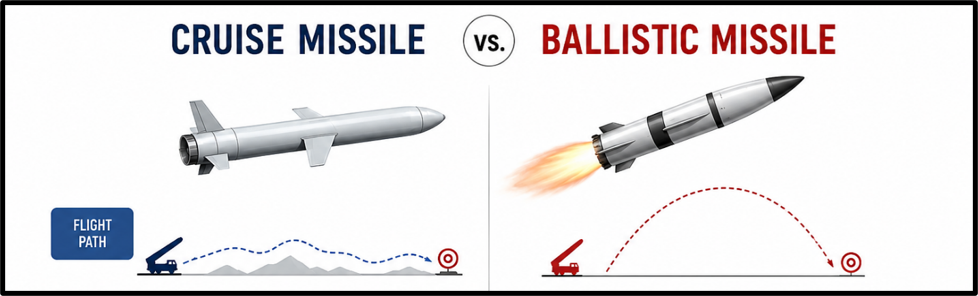
Ballistic Missiles
Imagine throwing a cricket ball with great force at an angle — it rises, follows a parabolic arc, and falls. No one is guiding it mid-air. That is a ballistic missile! A ballistic missile is powered and guided only in the initial ‘boost phase’. After that, it follows a FREE-FALL trajectory determined by gravity and physics. The magic of modern ballistic missiles is their incredible speed (Mach 5+) and ability to carry nuclear warheads to targets thousands of km away.
Definition:
A ballistic missile follows a high-altitude ballistic trajectory to deliver one or more warheads to a predetermined target. It is powered and guided only during the initial boost phase, after which it follows a free-fall trajectory influenced by gravity and atmospheric conditions.
Key Features of Ballistic Missiles
Ballistic Trajectory — The Parabolic Path:
The missile follows a parabolic path after the powered phase ends, similar to the trajectory of a thrown object.
The trajectory is determined by: missile’s initial velocity, gravity, atmospheric drag, and the Coriolis effect (due to Earth’s rotation).
Three Phases of Flight:
BOOST PHASE Rocket engines fire Missile is actively guided (seconds to minutes)
→
MID-COURSE PHASE Coasts through space or upper atmosphere (for longer ranges)
Propulsion: Typically, solid or liquid-fueled rockets in the boost phase.
Warhead Types: Conventional, nuclear, chemical, or biological warheads.
Speed: Hypersonic (Mach 5+) in terminal phase.
MIRV Technology: Advanced ICBMs use Multiple Independently Targetable Reentry Vehicles (MIRVs) — one missile carries multiple warheads that can hit different targets simultaneously.
If a ballistic missile is like a cricket ball thrown in an arc — a cruise missile is like a paper aeroplane that keeps flying at low altitude, constantly powered, steering itself around hills and buildings, guided by its own intelligence system. A cruise missile is essentially an ‘unmanned aircraft with a warhead’. It stays within the Earth’s atmosphere throughout its flight. Key distinction: Ballistic = rocket-powered only in boost phase, free-fall after. Cruise = continuously powered throughout.
Definition
A cruise missile is a guided missile designed to fly at low altitude and remain within the Earth’s atmosphere throughout its flight. It is powered throughout its flight by a jet engine, allowing high precision and manoeuvrability.
Key Features of Cruise Missiles
Sustained Powered Flight: Use jet engines (turbofan, turbojet, ramjet, or scramjet) for continuous thrust. They can adjust course mid-flight like an unmanned aircraft.
Advanced Guidance Systems: Use GPS, Inertial Navigation System (INS), Terrain Contour Matching (TERCOM), and Digital Scene-Matching Area Correlation (DSMAC) for pinpoint accuracy.
Low Altitude Flight: Fly at typically 20–100 metres above ground — below most radar horizons!
Speed Variety: Can be subsonic (Nirbhay), supersonic (BrahMos), or hypersonic (BrahMos-II, under development).
Warhead Flexibility: Can carry conventional or nuclear warheads.
Types of Cruise Missiles
Based on Speed:
Type
Speed
Example
Subsonic
Less than Mach 1
Nirbhay (1,000–1,500 km range, Mach 0.8)
Supersonic
Mach 1–5
BrahMos (~Mach 2.8–3, 290–800 km range)
Hypersonic
Mach 5+
BrahMos-II (Mach 7–8, under development)
Based on Range
Type
Range
Example
Short-Range Cruise Missile (SRCM)
< 1,000 km
BrahMos (Shorter variants)
Medium-Range Cruise Missile (MRCM)
1,000–3,000 km
Nirbhay (1,500 km)
Long-Range Cruise Missile (LRCM)
> 3,000 km
Under development in India
Based on Launch Platform:
Type
Abbreviation
Launch Mode
Example
Air-Launched Cruise Missile
ALCM
Fighter jets and bombers
BrahMos-A (Su-30MKI)
Surface-Launched Cruise Missile
SLCM
Land-based platforms
Nirbhay, BrahMos (land version)
Submarine-Launched Cruise Missile
SLCM
Submarines (underwater)
BrahMos (submarine variant, under testing)
Sea-Launched Cruise Missile
SLCM
Warships
BrahMos-NG (Naval Version)
Advantages of Cruise Missiles
Surgical Precision: GPS + TERCOM + DSMAC guidance can achieve accuracy within a few metres (CEP). Minimises civilian and collateral damage.
Stealth and Evasion: Fly at low altitudes (terrain-hugging) to evade radar detection and air defences.
Launch Flexibility: Can be launched from land, air, sea surface, and submarines — true multi-domain capability.
Mid-flight Maneuverability: Can change course, loiter over a target area, or re-target during flight.
Cost-Effective for Tactical Missions: Generally cheaper than ballistic missiles for precision strikes on specific targets.
Disadvantages of Cruise Missiles
Slower Speed: Most operational cruise missiles are subsonic or supersonic — not as fast as ballistic missiles.
Vulnerable to Air Defences: Modern air defence systems can detect and intercept subsonic cruise missiles.
Electronic Warfare Vulnerability: GPS jamming and spoofing can disrupt GPS-guided cruise missiles.
Limited Range vs. Ballistic Missiles: Even the longest-range cruise missiles fall short of ICBM ranges.
Integrated Guided Missile Development Programme (IGMDP) 1983–2008
This is arguably the most important! IGMDP was India’s ‘missile revolution’ — similar to how the Green Revolution transformed agriculture. It was the programme through which India said: ‘We will not beg for missiles from other countries. We will build our own.’ Led by Dr. A.P.J. Abdul Kalam — the ‘Missile Man of India’ who later became our President — IGMDP was launched in 1983 by DRDO and completed in 2008. The programme gave birth to five game-changing missile systems: Prithvi, Agni, Akash, Trishul, and Nag — remembered as ‘PAANT’ (पांत).
Background and Objectives
Why was IGMDP needed?
Post-1962 (Sino-Indian War) and 1971 (Indo-Pak War): Both wars exposed India’s critical dependency on foreign weapon systems.
Post-Pokhran-I (1974): After India’s first nuclear test, international sanctions restricted India’s access to critical nuclear and space technology.
No indigenous missile technology: India had no credible, self-developed delivery system for strategic deterrence.
Five Objectives of IGMDP:
Self-Reliance in Missile Technology: Design, develop, and produce indigenous missile systems — reducing foreign dependence.
Comprehensive Missile Coverage: Cover all tactical and strategic needs — from short-range battlefield to long-range deterrent systems.
India’s only naval ballistic missile; deployed on Sukanya-class ships
Operational (2004)
Significance of Prithvi Missiles:
Birth of Indigenous Missile Power: First missile under IGMDP — marked India’s entry into the exclusive club of ballistic missile nations.
Nuclear Triad Foundation: Prithvi I/II cover land leg; Dhanush covers the sea leg of India’s nuclear triad.
Doctrine Support: Supports India’s Credible Minimum Deterrence (CMD) and No First Use (NFU) policy.
Tri-Service Coverage: Army (Prithvi-I), Air Force (Prithvi-II), Navy (Dhanush) — all three services covered.
Cold Start Doctrine Enabler: High mobility makes the system survivable and quick to deploy — critical for proactive battlefield scenarios.
Cold Start Doctrine (CSD)
After the 2001 Parliament attack, India mobilised its military through ‘Operation Parakram’. But it took almost 3 weeks to fully mobilise! Pakistan used this delay to mount international diplomatic pressure. India realised: by the time we fully respond, the window has closed. So, India developed the Cold Start Doctrine — a strategy of FAST, LIMITED conventional response, without crossing nuclear thresholds. Think of it as: instead of one giant attack, India deploys multiple small, integrated battle groups that can strike rapidly and independently.
Definition: The Cold Start Doctrine (CSD) is a proactive military strategy involving the rapid mobilisation of Integrated Battle Groups (IBGs) to launch limited, swift conventional attacks across the border in response to provocations — while avoiding full-scale war or nuclear retaliation.
Origin: Emerged after the 2001 Indian Parliament attack and the slow mobilisation during Operation Parakram.
Type: SRBM / MRBM / IRBM / ICBM (depends on variant) | Range: 700 km to 5,000+ km Warhead: Nuclear or Conventional | Propulsion: All variants use Solid Fuel IGMDP scope: Only Agni I, II, and III were developed under IGMDP. Agni IV, V, P, VI continued beyond. Significance: Backbone of India’s land-based nuclear deterrence
Missile
Type
Range
Warhead
Key Features
Status
Agni-I
SRBM/MRBM
700–1,200 km
Conv. & Nuclear
Pakistan-specific; road-mobile
Operational (2004)
Agni-II
MRBM
2,000–2,500 km
Nuclear
All-weather & night-ready; covers Pakistan & W. China
True global ICBM; submarine-compatible; MIRV-capable
Under Development
Significance of Agni Missiles:
Strategic Nuclear Deterrence: The backbone of India’s land-based nuclear arsenal. Essential to India’s Minimum Credible Deterrence and NFU policy.
MIRV Technology: Agni-V carries MIRVs — placing India in an elite group (USA, Russia, China, France, UK) with this technology.
Second-Strike Capability: Ensures India can retaliate even after absorbing a nuclear first strike — the cornerstone of credible deterrence.
Geopolitical Signalling: Agni-V’s 5,000+ km range covers entire Asia-Pacific region; Agni-VI under development will achieve true global reach.
MTCR Entry (2016): India’s demonstrated ICBM capability (Agni-V) helped secure India’s entry into the Missile Technology Control Regime in 2016.
Quick Launch Readiness: Solid-fuel propulsion and road/rail mobility ensure rapid deployment and enhanced survivability.
Akash Missile System
Type: Medium-Range Surface-to-Air Missile (SAM) | Range: 25–30 km | Speed: ~Mach 2.5 Warhead: High-explosive fragmentation (60 kg) | Altitude: 18 km (max engagement height) Propulsion: Solid-fuel rocket motor with ramjet | Special: Can engage 4 targets SIMULTANEOUSLY
Variant
Range
Key Features
Status
Deployment
Akash Mk-I
~25 km
First version; all-weather; multi-target engagement
Operational
Army & Indian Air Force
Akash S1
~30–35 km
Better ECCM (Electronic Counter-Countermeasures) and extended range
Operational
Army
Akash Prime
~25–30 km
Better reliability in extreme conditions; upgraded Mk-I
Tested, in production
Indian Air Force
Akash-NG (Next Gen)
~70 km
Canister-launched; quicker reaction; compact; high mobility
Cleared for induction (2023)
Army & IAF (Future)
Trishul — The IGMDP Missile That Was Discontinued
Trishul is the only IGMDP missile that was DISCONTINUED — a lesson in the challenges of indigenous defence R&D. Despite being named after Lord Shiva’s trident (a symbol of ultimate power), Trishul could not meet the operational requirements of the armed forces. It was discontinued in 2008 after failing to meet performance requirements, facing delays, and suffering cost overruns. Lesson: Not every indigenous programme succeeds on the first attempt. The learning from Trishul fed into better systems.
Type: 3rd-Generation ‘fire-and-forget’ Anti-Tank Guided Missile (ATGM) Range: 4–7 km (land version via NAMICA), 7–10 km (helicopter-launched) Warhead: Tandem High-Explosive Anti-Tank (HEAT) — can defeat modern tanks with explosive reactive armour Key Advantage: ‘Fire-and-Forget’ = no need for operator guidance after launch; thermal imaging for night battles
Variant
Launch Platform
Range
Guidance
Status
Deployment
Nag
NAMICA (tracked amphibious vehicle)
~4–7 km
Fire-and-forget
Operational
Army
HELINA
Helicopter (HAL Rudra)
~7 km
Fire-and-forget
Operational
Army
Dhruvastra
Helicopter (IAF platforms)
~7 km
Fire-and-forget
Operational
Indian Air Force
MPATGM
Man-portable (infantry)
~2.5 km
Fire-and-forget
Under final trials
Army
SANT (Standoff Anti-Tank)
Air-launched (long-range)
~15–20 km
Lock-on After Launch (LOAL)
Advanced user trials
Indian Air Force
Overall Significance of IGMDP
Birth of Indigenous Missile Capability: Marked a strategic shift from import dependency to indigenous R&D.
Comprehensive Missile Arsenal: Developed a full spectrum — SRBM (Prithvi), MRBM/ICBM (Agni), medium-range SAM (Akash), short-range SAM (Trishul), and ATGM (Nag).
Boosted Defence Industrial Base: Involved DRDO, BEL, BDL, HAL, and private industry — building India’s defence ecosystem.
Demonstrated Strategic Autonomy: Proved India can develop critical defence systems despite international sanctions and technology denial regimes.
Foundation for Future Programmes: IGMDP technology fed into BrahMos, K-series, QRSAM, Shaurya, Pralay — the next generation of Indian missiles.
Enhanced Export Potential: Akash and Nag variants being considered for export, strengthening India’s role as a defence equipment supplier.
BrahMos Missile System
If IGMDP was India’s ‘missile independence movement’, BrahMos is the crown jewel of India’s missile capabilities. BrahMos is not just a missile — it is a symbol of India-Russia partnership, indigenous manufacturing excellence, and export diplomacy. Name origin: BRAHMaputra (India) + MOSkva (Russia) = BrahMos. A perfect metaphor for Indo-Russian cooperation. At Mach 2.8–3, it is the WORLD’S FASTEST SUPERSONIC CRUISE MISSILE currently in operational service.
BrahMos is a supersonic cruise missile (Mach 2.8–3.0) developed jointly by DRDO (India) and NPO Mashinostroyeniya (Russia) through the BRAHMOS Aerospace joint venture. It can carry both conventional and nuclear warheads.
Variant
Launch Platform
Range
Speed
Key Features
Status
BrahMos Block-I
Land-based
~290–300 km
Mach 2.8–3
Basic variant; high-speed precision strike
Operational (Army)
BrahMos Block-II
Land-based
~290–300 km
Mach 2.8–3
Advanced targeting — can engage urban targets with precision
Operational (Army)
BrahMos Block-III
Land-based (Mountain Warfare)
~290–300 km
Mach 2.8–3
Steep dive capability; designed for mountainous terrain (e.g., Ladakh)
Operational (Army)
BrahMos-ER (Extended Range)
Land / Sea / Air
~450–800+ km
Mach 3+
Extended range enabled post-MTCR entry; better standoff capability
Operational (Tri-Service 2022)
BrahMos-NG (Next Gen)
Land, Air, Ship, Submarine
~290–300 km
Mach 3.5
Lighter, smaller; compatible with Tejas and MiG-29
Under Development
BrahMos-A (Air-Launched)
Su-30MKI aircraft
~400–450 km
Mach 2.8–3
Modified for air-launch; India’s first air-launched cruise missile
World’s Fastest Supersonic Cruise Missile: Due to speed (Mach ~3) and precision, it can evade modern air defence systems. The 3-2-1 principle: fires at 3 times the speed of sound from a distance of 2 km, hitting with 1 kg pressure per sq cm.
Tri-Service Deployment: Deployed by the Indian Army, Navy, and Air Force — one of very few missiles globally with this multi-platform capability.
70%+ Indigenous Components: Though a joint Indo-Russian project, it has over 70% Indian content — supporting ‘Aatmanirbhar Bharat’.
Export Diplomacy Milestone: India’s FIRST major defence export deal — sold to the Philippines in 2022, followed by Indonesia. Positions India as a global defence technology supplier.
Foundation for Hypersonic Era: Technology from BrahMos feeds directly into BrahMos-II (Mach 7-8) development — India’s entry into the hypersonic missile club.
The nuclear triad has three legs: land (Agni missiles), air (Jaguar/Rafale/Mirage aircraft), and sea (K-series SLBMs from submarines). The sea-based leg is the most critical for nuclear deterrence — because submarines can hide deep in the ocean, they are the HARDEST to destroy in a first strike. This ensures India’s ‘second-strike capability’ — even if India is attacked first, its submarines can retaliate. K-Series is named after Dr. APJ Abdul Kalam — a fitting tribute to the Missile Man of India.
The K-series is a family of nuclear-capable Submarine-Launched Ballistic Missiles (SLBMs) developed by DRDO to equip India’s nuclear-powered submarines (INS Arihant and INS Arighat). The K-series SLBMs form the underwater leg of India’s nuclear triad, ensuring second-strike capability.
Missile
Range
Warhead
Key Features
Status
K-15 (Sagarika)
~750 km
Nuclear
India’s FIRST SLBM; deployed on INS Arihant; primary deterrent for Arihant-class submarines
Operational
K-4
~3,500 km
Nuclear
MIRV-capable; deeper strategic strike range; meant for INS Arighat and future SSBNs
Operational (2020)
K-5 (unconfirmed)
~5,000–6,000 km
Nuclear
MIRV-likely; intercontinental range from submarine
Under Development
K-6 (speculated)
~6,000–8,000 km
Nuclear
MIRV-capable; for future S5-class SSBNs; true intercontinental SLBM
Under Development
Significance of K-Series SLBMs:
Completes the Nuclear Triad: K-series provides the sea-based leg, complementing land-based Agni and air-delivered nuclear weapons.
Strategic Stealth and Invulnerability: Submarines are virtually undetectable when submerged — making them immune to pre-emptive first strikes.
Assured Second-Strike: Even in a worst-case nuclear scenario, India’s submarines can retaliate — this is the ultimate deterrence.
Indo-Pacific Posture: K-series strengthens India’s blue-water naval capability and strategic presence in the Indo-Pacific region.
Surface-to-Air Missile (SAM) Systems of India
Just as a goalkeeper defends the net in football, SAM systems are India’s air defence ‘goalkeepers’ — designed to detect, track, and destroy incoming aerial threats: enemy aircraft, helicopters, drones, cruise missiles, and ballistic missiles. India operates a multi-layered air defence system — short-range, medium-range, and long-range SAMs — creating overlapping defence umbrellas.
Short-Range SAMs (SRSAM)
System
Range
Origin
Users
Key Feature
VL-SRSAM
~40–50 km
DRDO (Indigenous)
Indian Navy
Vertical-launch naval SAM; point defence for warships against missiles and aircraft
QRSAM (Quick Reaction SAM)
~25–30 km
DRDO (Indigenous)
Indian Army (Mobile)
Mobile system; quick reaction air defence on the battlefield; all-weather
Spyder-SR
~15–20 km
Israel (Rafael)
IAF & Army
Quick-reaction SAM using Python-5 & Derby missiles; all-weather capability
Medium-Range SAMs (MRSAM)
System
Range
Origin
Users
Key Features
Akash
~25–30 km
DRDO
Army & Air Force
Mobile, all-weather, can engage 4 targets simultaneously; ramjet propulsion
Akash-NG
~70 km
DRDO
IAF (planned)
Under development; faster reaction time; active seeker; canister-launched
MR-SAM (Barak-8)
~70–100 km
DRDO + Israel
Navy & Air Force
Advanced radar; high manoeuvrability; jointly developed with Israel’s Rafael
Spyder-MR
~35–50 km
Israel (Rafael)
Indian Air Force
Quick-reaction; Python-5 & Derby missiles; mobile and all-weather
Long-Range SAMs (LRSAM)
System
Range
Origin
Users
Key Features
S-400 Triumf
~400 km
Russia (Rosoboronexport)
Indian Air Force
India ordered 5 regiments; multi-layered detection & interception; can target ballistic missiles, cruise missiles, aircraft
Barak-8ER
~150 km
DRDO + Israel
Navy (planned)
Under development; extended range; enhanced altitude interception
XRSAM
~250 km
DRDO (Indigenous)
IAF & Navy (planned)
Under development; bridges gap between MR-SAM and S-400; India’s long-range indigenous SAM
Air-to-Air Missile (AAM) Systems of India
Air-to-Air Missiles (AAMs) are fired by fighter aircraft to destroy other aircraft in the sky. There are two categories based on range: Short-Range Air-to-Air Missiles (SRAAMs) for visible dogfights, and Beyond Visual Range (BVR) missiles for hitting targets you cannot even see — sometimes 100+ km away! India’s Astra Mk-1 is the country’s first indigenous BVR missile — a major achievement in aerospace self-reliance.
Short-Range Air-to-Air Missiles (SRAAMs)
Used for dogfight engagements — aerial battles between fighter aircraft at close, visible range (within a few km).
Missile
Range
Origin
Platform
Key Features
R-73
~30 km
Russia
MiG-29, Su-30MKI
Infrared-guided; excellent for close-combat dogfight
ASRAAM
~25–30 km
UK
Jaguar upgrade
High off-boresight capability — can target aircraft beside or behind the launch aircraft
Python-5
~20 km
Israel (Rafael)
Tejas
Dual seeker (IR + electro-optical); extremely high agility
Beyond Visual Range Missiles (BVRAAMs)
Strikes targets beyond visual range — typically >30 km. The pilot fires and may never see the target.
Missile
Range
Origin
Platform
Key Features
Astra Mk-1
~110 km
India (DRDO)
Su-30MKI, Tejas
India’s FIRST indigenous BVR missile; active radar homing; all-weather day-night capability
Astra Mk-2
~160 km
India (DRDO)
Su-30MKI, Rafale
Under development; longer range; improved kill probability
Dual seeker (Radar + IR); versatile for short-to-medium range
Meteor
~150–200 km
Europe (MBDA)
Rafale
Ramjet-powered; large ‘no-escape zone’ — hard to evade
Anti-Radiation Missiles
These missiles home in on the electromagnetic emissions (radar signals) of enemy radar installations and air defence systems.
Missile
Range
Origin
Platform
Key Features
Rudram-1
~150–200 km
India (DRDO)
Su-30MKI
India’s FIRST indigenous anti-radiation missile; passive radar homing
Rudram-2 & 3
~300–500 km
India (DRDO)
Su-30MKI + future IAF platforms
Under development; improved range and precision; will suppress deeper enemy radar networks
Jet Engines — The Power Behind Missiles and Aircraft
A jet engine is the ‘heart’ of a missile or aircraft. Understanding the different types of jet engines is essential —especially Ramjet vs. Scramjet — as it directly explains WHY BrahMos is supersonic and BrahMos-II will be hypersonic. All jet engines work on Newton’s Third Law: ‘For every action, there is an equal and opposite reaction.’ Air enters → is compressed → mixed with fuel → ignited → expelled at high speed → thrust is generated in the OPPOSITE direction.
Types of Jet Engines
Turbojet: The basic and earliest type of jet engine. Compresses all intake air, mixes with fuel, ignites, expels. Used primarily in military aircraft due to high speed.
Turbofan: Most common in commercial aviation (Boeing 737, Airbus A320). A large fan at the front pushes significant air AROUND the engine core (bypass air) — more fuel-efficient.
Turboprop: Combination of turbojet and propeller. The turbine drives the propeller for thrust. Used in regional and smaller aircraft.
Ramjet: Simple air-breathing engine with NO MOVING PARTS! Air enters at high speed, is compressed by the vehicle’s own motion (ram effect), mixed with fuel, and ignited. Used in high-speed missiles (BrahMos).
Scramjet (Supersonic Combustion Ramjet): Advanced ramjet where combustion occurs at SUPERSONIC speeds within the engine. Designed for Mach 5+ (hypersonic) flight. Used for space launch vehicles and hypersonic weapons (BrahMos-II, HSTDV).
Comparison of Jet Engine Types
Feature
Turbojet
Turbofan
Turboprop
Ramjet
Scramjet
Design
Core jet engine
Core + large front fan
Jet engine + propeller
No moving parts
No moving parts
Speed Range
Subsonic to Supersonic
Subsonic to Low Supersonic
Subsonic (<Mach 0.8)
Supersonic (Mach 1.2–5)
Hypersonic (Mach 5+)
Fuel Efficiency
Moderate
High (due to bypass)
Very high at low speeds
Low (only efficient at high speed)
High (at very high speeds)
Initial Thrust
Can start from zero
Can start from zero
Can start from zero
Needs high initial speed
Needs very high initial speed
Applications
Military aircraft
Commercial aircraft
Small/regional aircraft
High-speed missiles
Hypersonic weapons; space research
Indian Use
MiG-21 (legacy)
IAF Transport aircraft
Dornier aircraft
BrahMos cruise phase
HSTDV; BrahMos-II (dev.)
Ramjet vs. Scramjet
Feature
Ramjet
Scramjet
Full Form
Ram Air Jet
Supersonic Combustion Ramjet
Operating Speed
Supersonic (Mach 1–5)
Hypersonic (Mach 5+)
Airflow in Combustion Chamber
Subsonic — air is SLOWED DOWN before combustion
Supersonic — air REMAINS supersonic during combustion
Combustion Process
Conventional combustion after deceleration of air
Supersonic combustion — very fast and extremely complex
The Internet is the single most impactful invention of the 20th century — more impactful than the automobile or the television, because it contains and accelerates all other technologies. The Internet is a global network of interconnected computers and communication systems that allows users to share information, access services, and communicate across long distances. It…
Space Debris: The Scattered Danger in Orbit Let’s begin with a small everyday picture. Imagine you are driving on a highway at 100 km/h, and suddenly a tiny pebble flies up and hits your windscreen. Even at that modest speed, a small stone can crack the glass. Now take that same scene and move it…
Militarisation of Space There is an important conceptual distinction you must remember: Militarisation vs. Weaponisation. Militarisation is using space to SUPPORT military operations — like using GPS for troop coordination. Weaponisation is placing or using WEAPONS in space itself. The Outer Space Treaty (1967) does not ban militarisation. It only bans WMDs in orbit. This…
Space Traffic Management (STM) Think of outer space as a busy international airspace — except there is no Air Traffic Control, no unified radar network, no binding rules for who gives way to whom, and no international police. Over 9,000 active satellites and millions of debris fragments share the same sky. Without STM, catastrophic collisions…
Major Lunar Missions — The Story of the Moon The Moon has always been humanity’s first space destination — simply because it is the nearest. But getting there was never a straight line; it was a clear evolution: first we went just to take photographs, then we attempted soft landings, then we sent humans, and…
India is not a latecomer to science. Before Europe had universities, India had Nalanda and Takshashila. Before the West developed algebra, India gave the world Zero. Before modern surgery, India had Sushruta performing rhinoplasty. The story of Science and Technology in India is, in many ways, the story of a civilisation’s journey — from ancient…