
UPSC CURRENT AFFAIRS — 17 NOVEMBER 2026
1. New Aviation Rulebook and a Green-Fuel Roadmap
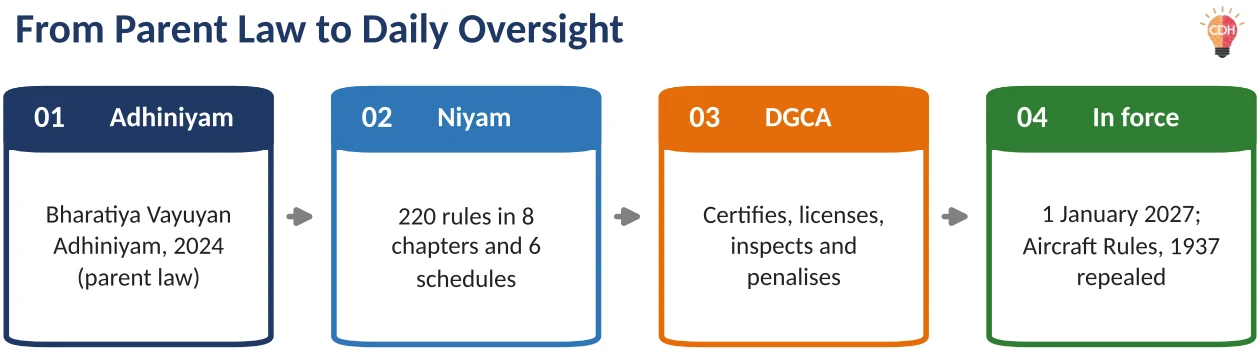
(ECONOMICS) (PIB) The Centre has notified the Bharatiya Vayuyan Niyam, 2026, replacing the colonial-era Aircraft Rules, 1937 from 1 January 2027. Separately, the Ministry of Civil Aviation has circulated a draft National Sustainable Aviation Fuel (SAF) Policy that would make green-fuel blending compulsory for international flights.
Why a New Rulebook
India’s civil aviation has outgrown rules written for propeller-age flying. Operational airports rose from 74 in 2014 to 166 by October 2026, and newer needs — aircraft leasing, fractional ownership and Indian-designed aircraft — call for modern rules. The parent law is the Bharatiya Vayuyan Adhiniyam, 2024, which replaced the Aircraft Act, 1934.
Key Provisions at a Glance
| Area | What the Niyam provides |
|---|---|
| Structure | 220 rules in 8 chapters and 6 schedules; also replaces Part IX of the Aircraft Rules, 1920 |
| Design and airworthiness | DGCA can issue type certificates where India is the ‘State of Design’; it can also validate foreign certificates and issue airworthiness directives |
| Registration | Nationality mark ‘VT’ plus three letters; IDERA de-registration requests to be processed within five working days |
| Leasing | Works with the Protection of Interests in Aircraft Objects Act, 2025, which applies the Cape Town Convention to aircraft leasing |
| Personnel | 23 categories of licences, ratings and certificates; air traffic controllers capped at 60 years for specified privileges |
| Crew safety | No alcohol within 12 hours before or during flight duty; fatigue and rest limits prescribed |
| Passengers | Websites and tickets must show the total fare with a break-up of taxes and charges |
| Penalties | 21 punishable offences (up to 2 years jail and/or ₹1 crore fine); 18 compoundable offences; 10 severity levels with penalties of ₹10,000–₹1 crore |
The design balances ease of doing business with safety: many contraventions move from jail to graded fines, while a State Safety Programme and non-punitive voluntary reporting strengthen the safety culture expected under the Chicago Convention.
The Draft SAF Policy
Sustainable Aviation Fuel is a ‘drop-in’ jet fuel made from waste oils, crop residue and other biomass. It works in existing engines and can cut lifecycle emissions sharply. India’s push is tied to the mandatory phase of the ICAO’s CORSIA, which starts on 1 January 2027.
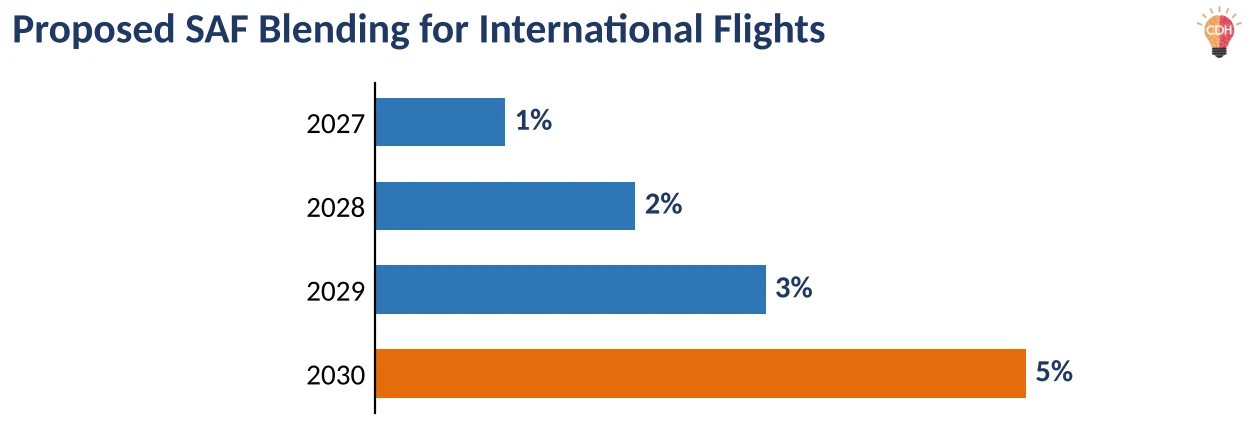
- Fuel-uplift rule: airlines flying international routes must buy about 90% of their annual fuel for those flights at Indian airports, to stop ‘economic tankering’ of cheaper foreign fuel.
- Support: viability gap funding, green finance, long-term offtake contracts and possible tax relief for SAF producers.
- Exemptions: domestic, humanitarian, medical and emergency flights.
- Status: the policy is still a draft; blending obligations are not yet law.
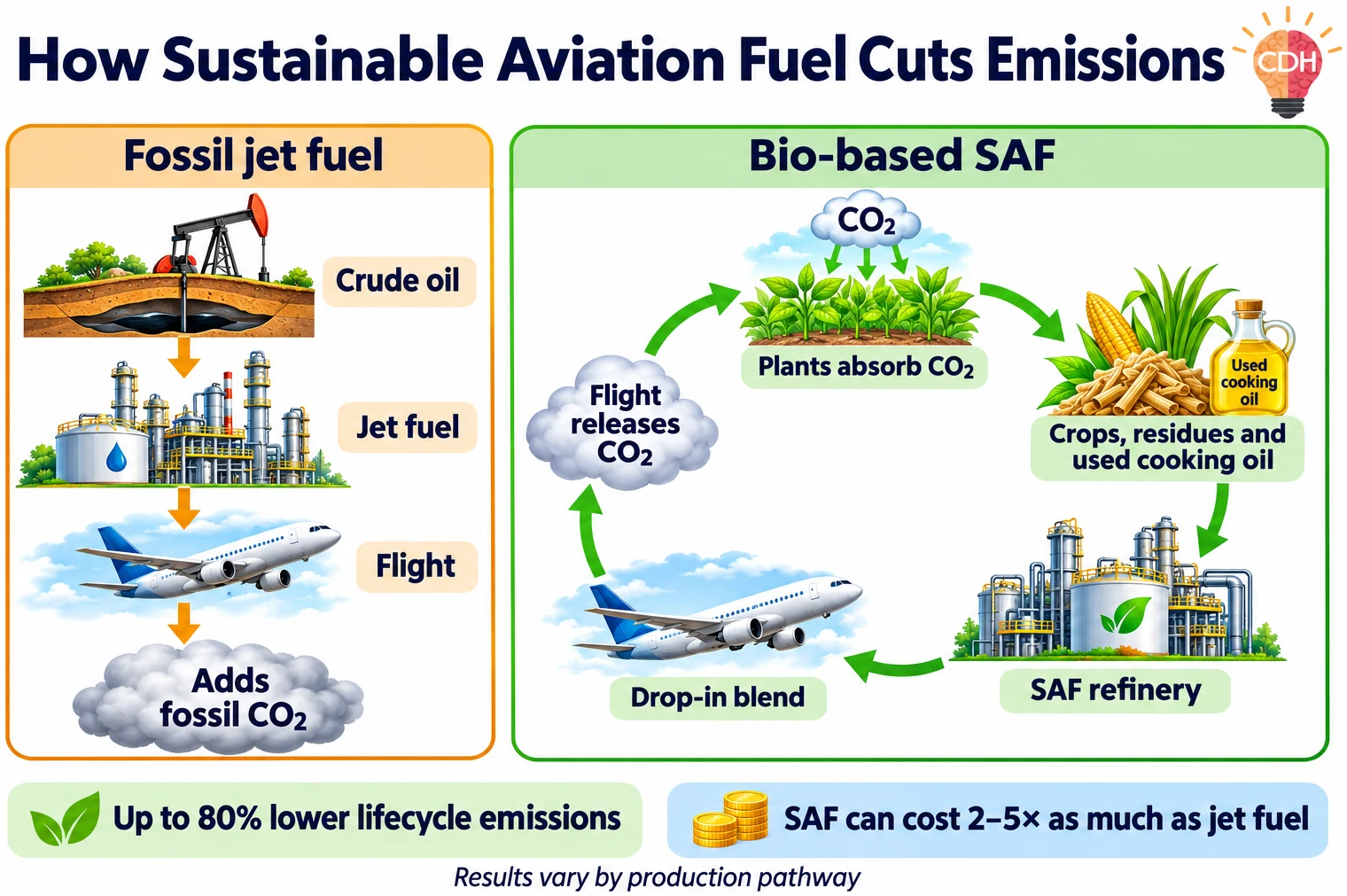
Challenge: SAF costs two to five times more than fossil jet fuel, and feedstock supply is limited. Linking it with India’s ethanol and biofuel programmes will decide whether targets are met without raising airfares.
📖 Read More: Civil Aviation Schemes • Infrastructure Sector • Biofuels • Prevention and Control of Air Pollution
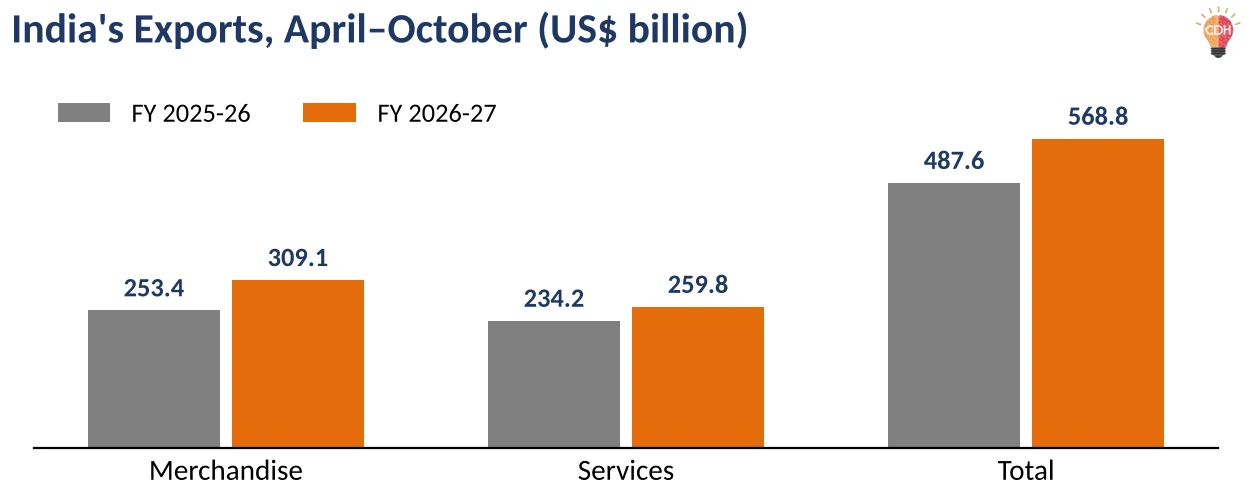
2. Exports Climb 16.66% in First Seven Months
The Numbers
- Merchandise: up 21.96%; October alone saw goods exports jump 45.06% to US$ 49.47 billion.
- Services: up 10.93%; they now form about 45.7% of total exports. India’s share of world services exports rose from 3.1% to 4.3% between 2015 and 2025.
- Fastest-growing items: electronic goods (46.92%), petroleum products (47.71%), meat, dairy and poultry (40.81%) and engineering goods (22%).
- Markets: exports to Singapore and Malaysia more than doubled; eight of the ten largest destinations grew in double digits.
What Is Driving the Surge
PLI and electronics push → wider product basket
FTAs/CEPAs → better market access
Logistics reforms → lower trade costs → competitive exports
| Policy tool | How it helps exporters |
|---|---|
| Foreign Trade Policy 2023 | Umbrella framework since 1 April 2023 under the Foreign Trade (Development and Regulation) Act, 1992 |
| Export Promotion Mission | Outlay of ₹25,060 crore (FY 2025-26 to 2030-31) for MSMEs, first-time and labour-intensive exporters |
| Advance Authorisation | Duty-free import of inputs physically used in export products |
| RoDTEP / RoSCTL | Refund of embedded taxes; both extended till 31 December 2026 |
| Districts as Export Hubs | Every district as a unit of export planning; plans drafted for 590 districts |
| Special Economic Zones | 372 SEZs notified as of July 2026 |
Risks to Watch
- Imports grew too: total imports touched about US$ 662 billion, so the combined trade deficit still widened.
- Protectionism and carbon rules: tariffs, non-tariff barriers and measures like the EU’s carbon border tax could hurt steel and aluminium.
- Concentration: heavy dependence on a few products and markets leaves exporters exposed to shocks.
Way forward: diversify markets through new trade agreements, cut logistics costs under PM GatiShakti, and help MSMEs with cheaper credit and export insurance.
📖 Read More: India’s International Trade • Foreign Trade Policy 2023 • Balance of Payment • MSME Productivity (RAMP)
3. RBI Weighs ₹50-Lakh Cap Within Overseas Remittance Scheme
(ECONOMICS) (TH) The Reserve Bank of India has reportedly proposed a ₹50 lakh sub-limit for some discretionary spending — such as business travel and pilgrimages — within the US$ 250,000 yearly ceiling of the Liberalised Remittance Scheme (LRS), to slow dollar outflows and support a weakening rupee.
What Is the LRS
- Origin: introduced in 2004 under the Foreign Exchange Management Act (FEMA), 1999, with an initial limit of US$ 25,000.
- Who can use it: resident individuals (including minors), not companies or firms.
- Limit: US$ 250,000 per financial year, in force since May 2015.
- Uses: both current account spending (travel, study, medical care, gifts) and capital account spending (foreign shares, property, overseas bank accounts).
Why the Curb Now
FPI outflows + costlier crude + geopolitical tension
Rising demand for dollars → rupee weakens (over 4% in 2026)
RBI trims discretionary LRS outflows → eases pressure on forex
LRS remittances crossed US$ 20 billion between January and August 2026. Essential remittances for education and medical treatment are expected to stay outside the new sub-limit, and businesses are unaffected because the scheme covers only individuals.
Precedent: 2013 ‘Taper Tantrum’
When the US Federal Reserve signalled an end to cheap money in 2013, the rupee fell sharply. The RBI then cut the LRS limit from US$ 200,000 to US$ 75,000 and barred buying property abroad, restoring and later raising the ceiling as forex reserves recovered.
Assessment
| For the curb | Against the curb |
|---|---|
| Quick, targeted brake on non-essential outflows | Sends a signal of capital controls; may hurt investor sentiment |
| Protects reserves without raising interest rates | Small effect: LRS is a modest share of total outflows |
| Keeps education and health spending safe | Encourages informal channels such as hawala |
📖 Read More: Exchange Rate • Currency Convertibility • Foreign Exchange Reserves • Balance of Payment
4. Counting Unpaid Care to Fix Women’s Workforce Gap
The Time Burden
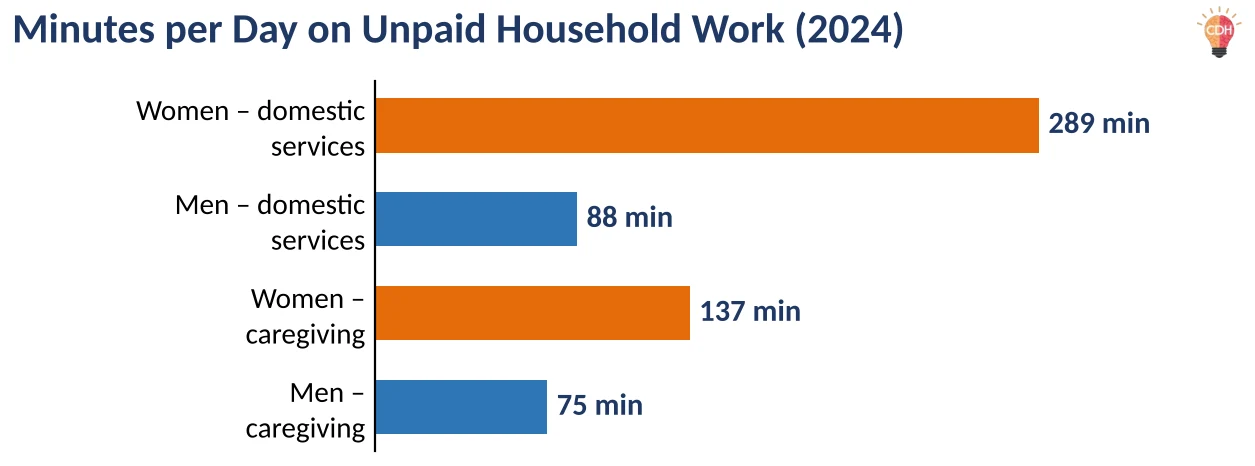
The Time Use Survey 2024 found that women spent 289 minutes a day on unpaid domestic services against 88 minutes for men. Women’s labour force participation is improving — rural women rose from 37.2% to 39.2% between April–June and July–September 2026 — but urban women remain near 25%.
What Changes in the Surveys
| Survey | Proposed change |
|---|---|
| Periodic Labour Force Survey (PLFS) | New questions on unpaid household production, caregiving, willingness to take paid work, job-search behaviour and reasons for not seeking work |
| Annual Survey of Unincorporated Sector Enterprises (ASUSE) | How time, mobility limits and care duties affect women entrepreneurs |
In PLFS 2025, about 44% of women outside the labour force named childcare or homemaking as the main reason. Separating household work for self-use from market work will show whether women stay home by choice or because care duties leave no option.
Why It Matters
- Growth: a higher FLFPR is essential for sustaining fast growth on the road to Viksit Bharat 2047.
- Better targeting: data can guide spending on crèches, safe transport and working-women hostels — the ‘care economy’.
- Proof of concept: Tamil Nadu’s industrial dormitories show how housing and mobility support can pull women into factory jobs.
The key idea is the ‘3R’ approach to care work: recognise it in statistics, reduce it through public services, and redistribute it within families.
📖 Read More: Women-Led Development • Role of Women in Indian Society • Unemployment
5. Lakhpati Didi Reaches 3.76 Crore Rural Women
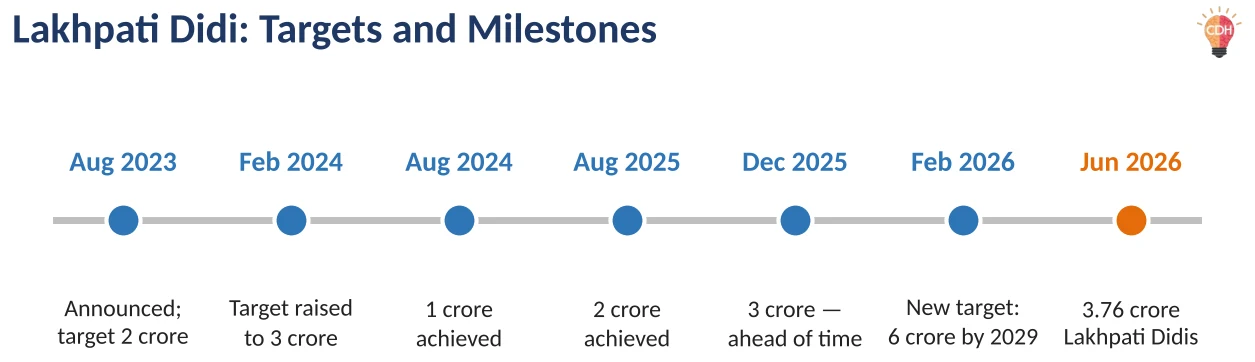
(SOCIAL JUSTICE) (PIB) A government backgrounder shows that 3.76 crore rural Self-Help Group (SHG) women had become Lakhpati Didis by June 2026, with 5.70 crore more identified as potential Lakhpati Didis; the target is six crore by March 2029.
Who Is a Lakhpati Didi
An SHG member whose household earns at least ₹1 lakh a year on a sustainable basis — counted after expenses and across at least four farm seasons or business cycles. The initiative runs through the Deendayal Antyodaya Yojana–National Rural Livelihoods Mission (DAY-NRLM) of the Ministry of Rural Development.
How It Works
SHG/LokOS identification → household income survey
Business plan by Community Resource Person → credit, skills, assets, markets (3 years)
Digital Aajeevika Register tracks income → State mission validates
The base is large: DAY-NRLM had about 10.13 crore members in 94.40 lakh SHGs as of 12 November 2026. Twelve priority sub-sectors — including bamboo, honey, goat rearing, poultry and tasar silk — were chosen with the States.
Impact
An independent study by IIM Ahmedabad covering 6,531 respondents in 17 States/UTs found a 61% rise in average monthly household income and a 61.7% rise in monthly savings.
Challenges and Way Forward
| Challenge | Way forward |
|---|---|
| Thin, costly credit for women’s enterprises | Wider collateral-free loans and financial literacy |
| Weak branding and market links | Tie-ups with e-commerce, retail chains and SARAS fairs |
| Care burden and limited mobility | Childcare, transport and social awareness |
| Income shocks from weather and prices | Diversified, climate-resilient livelihoods |
| Self-reported income figures | Continued data checks and third-party audits |
The scheme advances SDG 1, 5, 8 and 10 and marks a shift from welfare to women-led development, building on financial inclusion through SHG–bank linkage.
📖 Read More: DAY-NRLM • Self-Help Groups • Women-Led Development • Poverty
6. India Signs San Francisco Declaration on AI Supply Chains
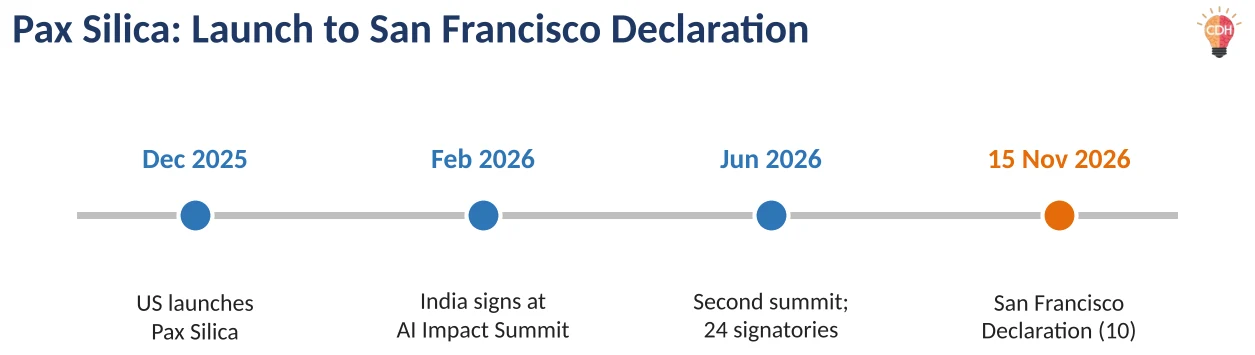
(INTERNATIONAL RELATIONS) (AIR) India, the United States and eight other partners have signed the San Francisco Declaration on the Secure Foundations of Enduring Prosperity under the US-led Pax Silica initiative, pledging to jointly protect the technologies and infrastructure behind artificial intelligence.
The Declaration
- When and where: signed on 15 November 2026 at the Pax Silica Founders Retreat in San Francisco.
- Signatories (10): the US, India, Australia, Israel, Japan, South Korea, Qatar, Singapore, the UAE and the UK.
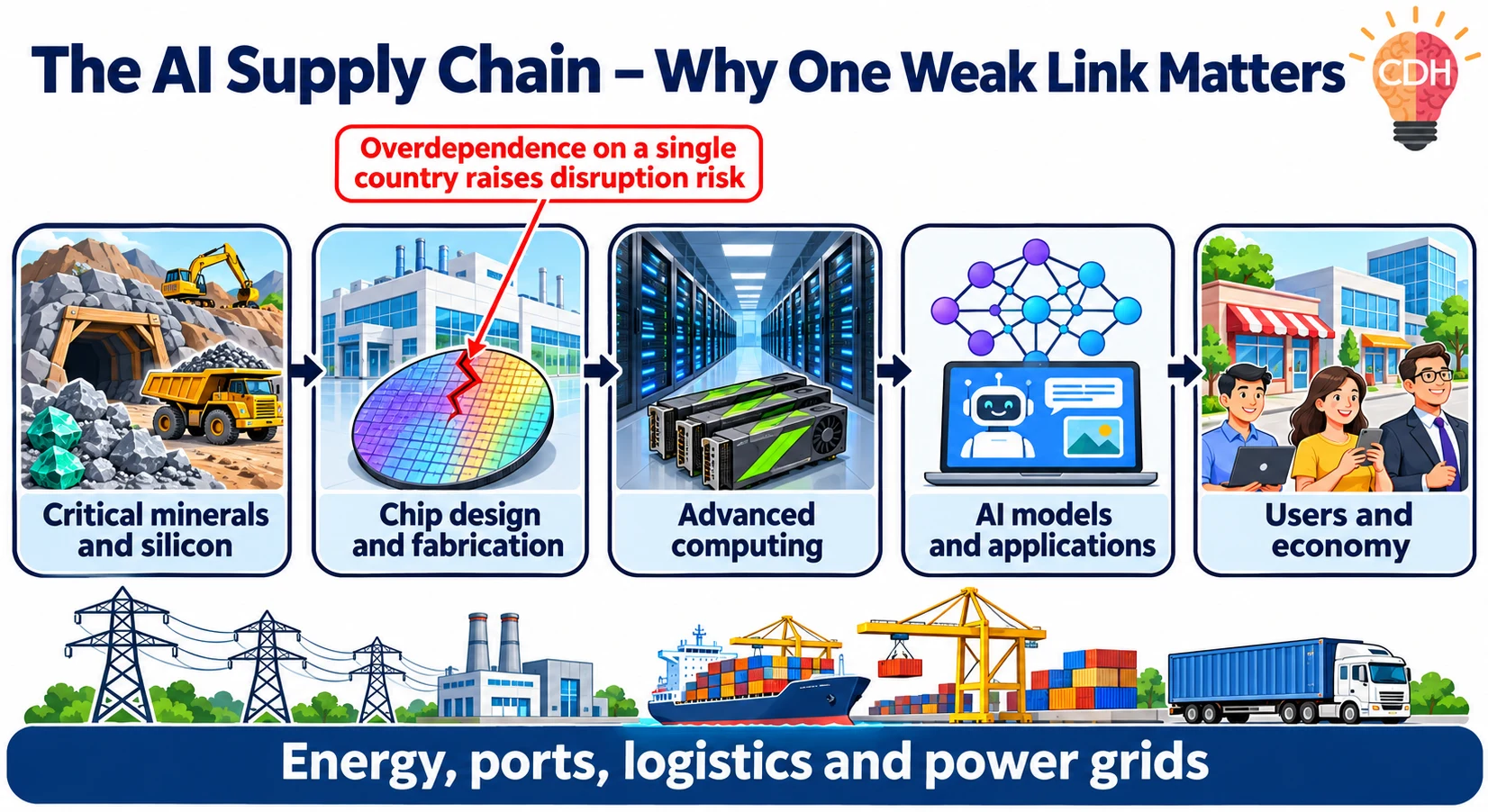
- Aim: identify sensitive technologies and critical infrastructure, and share information on where supply chains need diversifying — from chips and minerals to ports, power grids and logistics software.
What Is Pax Silica
A US State Department initiative launched in December 2025 to build secure supply chains across semiconductors, critical minerals, energy, advanced manufacturing and AI computing. ‘Pax’ means peace; ‘Silica’ refers to the silicon at the heart of chips.
Significance for India
- Access: better access to advanced chips and computing — a key bottleneck for Indian AI models.
- De-risking: less dependence on any single country for critical inputs, supporting the India Semiconductor Mission.
- Strategy: deepens India–US relations on technology while keeping India’s own AI ambitions.
Concerns
Critics see Pax Silica as a bloc aimed at China, which could invite retaliation or restrict India’s commercial options. India will need to protect its strategic autonomy, push for joint manufacturing and talent mobility, and avoid being a mere assembler in someone else’s supply chain.
📖 Read More: Semiconductor Industry • Artificial Intelligence • AI Governance • India–United States Relations
7. India–Thailand Review Trade at 14th Joint Committee
(INTERNATIONAL RELATIONS) (PIB) The 14th India–Thailand Joint Trade Committee (JTC) met in Nonthaburi, Thailand, on 16 November 2026 to review trade, ease market access and explore linking India’s UPI with Thailand’s PromptPay.
Key Outcomes
| Area | Details |
|---|---|
| Trade | Bilateral trade of US$ 21.49 billion in FY 2025-26, up 12.6%; Thailand is 16.7% of India’s trade with ASEAN |
| Agreements | Better use of the ASEAN–India Trade in Goods Agreement (AITIGA) and the India–Thailand Early Harvest Scheme; call for an early AITIGA review |
| Market access | Agricultural, livestock and marine products; SPS measures; removal of non-tariff barriers |
| Payments | UPI–PromptPay linkage, local-currency settlement and FinTech cooperation between the RBI and the Bank of Thailand |
| Investment | Thailand’s ‘Co-Creation Co-Investment’ approach; India pitched EVs, food processing, electronics and tourism |
Why Thailand Matters
- Act East anchor: a member of both ASEAN and BIMSTEC, Thailand links India to mainland South-East Asia.
- Connectivity: the India–Myanmar–Thailand Trilateral Highway ends here.
- Digital diplomacy: a UPI link would extend India’s digital payment stack to a top tourist destination for Indians.
Thailand: Quick Geography
Thailand borders Myanmar, Laos, Cambodia and Malaysia; its capital is Bangkok. The Chao Phraya basin is its rice bowl, the Mekong marks part of its border with Laos, and the Khorat Plateau covers the north-east. It has a tropical monsoon climate.
📖 Read More: India and South-East Asia Policy • ASEAN • BIMSTEC • Digital Payment Infrastructure
8. Mitra Shakti 2026: India–Sri Lanka Army Exercise
(INTERNATIONAL RELATIONS) (PIB) A 170-member Indian contingent is in Sri Lanka for the 12th edition of Exercise Mitra Shakti, held at the Army Training School, Maduru Oya, from 13 to 26 November 2026.
- Nature: annual bilateral exercise between the Indian Army and the Sri Lanka Army, held alternately in the two countries.
- Aim: joint counter-terrorism operations in a semi-urban setting under a UN mandate.
- Indian troops: mainly a battalion of the Rajputana Rifles, with other arms and services and Indian Air Force personnel.
- Drills: road blocks, urban patrolling, convoy protection, area ambush, crowd dispersal and attacks on fortified positions, ending with a validation exercise.
- Naval counterpart: SLINEX (Sri Lanka–India Naval Exercise), first held in 2005.
The exercise supports India’s Neighbourhood First and MAHASAGAR outlook, building trust with a key Indian Ocean partner amid growing external naval presence in the region.
📖 Read More: India and Sri Lanka
9. National Press Day: The Press Council at 60
(POLITY AND GOVERNANCE) (AIR) National Press Day was observed on 16 November 2026 with the theme ‘Journalism: Populist or Responsible’. The day marks the start of work by the Press Council of India (PCI) on 16 November 1966 — so the Council completes 60 years this year.
Press Council of India
- Origin: recommended by the First Press Commission (1954); first set up under the Press Council Act, 1965.
- Present law: re-established under the Press Council Act, 1978, after being abolished during the Emergency.
- Nature: a statutory, quasi-judicial body that acts as a watchdog of — and for — the press.
- Chairperson: by convention a retired Supreme Court judge.
| Members (28 besides the Chair) | Number |
|---|---|
| Working journalists (editors and others) | 13 |
| Owners or managers of newspapers | 6 |
| Managers of news agencies | 1 |
| Nominees of UGC, Bar Council of India and Sahitya Akademi | 3 |
| Members of Parliament (Lok Sabha 3, Rajya Sabha 2) | 5 |
Powers and Limits
The PCI hears complaints against and by the press, and can warn, admonish or censure newspapers and journalists. It cannot impose fines or jail, and its remit covers print media only — TV and digital news fall outside it, which is why many call for a broader media regulator.
Press freedom in India flows from Article 19(1)(a), subject to reasonable restrictions under Article 19(2). The 2026 theme asks whether the chase for clicks is eroding the press’s role as the ‘fourth pillar’ of democracy.
📖 Read More: Press and Media Freedom in India • Media and Broadcasting Governance
10. Earthshot Prize Comes to Mumbai
(ENVIRONMENT) (TH) At the Earthshot Prize 2026 Impact Assembly in Mumbai — the first time the award has come to India — Prince William praised India’s clean-energy progress, saying it shows that prosperity and ecological protection can advance together.
About the Prize
- Founded: in 2020 by Prince William; each year it names 15 finalists and five winners, who receive £1 million each.
- Five ‘Earthshots’ for 2030: Protect and Restore Nature, Clean our Air, Revive our Oceans, Build a Waste-Free World, and Fix our Climate.
- Indian finalists 2026: Mahila Housing Trust (Fix our Climate) for women-led heat resilience — cool roofs and heat insurance — and Mahindra Last Mile Mobility (Clean our Air) for affordable electric three-wheelers.
Indian Winners and Finalists So Far
| Innovator | Year and status | Earthshot | Solution |
|---|---|---|---|
| Takachar | 2021, Winner | Clean our Air | Portable machine turning crop residue into fuel and fertiliser — an answer to stubble burning |
| Vinisha Umashankar | 2021, Finalist | Clean our Air | Solar-powered ironing cart replacing charcoal irons |
| Kheyti | 2022, Winner | Protect and Restore Nature | Low-cost ‘Greenhouse-in-a-Box’ for small farmers |
| Phool (Fleather) | 2022, Finalist | Build a Waste-Free World | Leather alternative from temple-flower waste |
| S4S Technologies | 2023, Winner | Build a Waste-Free World | Solar food-processing units run by rural women |
| Boomitra | 2023, Winner | Fix our Climate | Satellite- and AI-based soil-carbon credits for farmers |
| Gujarat Emissions Trading Scheme | 2025, Finalist | Clean our Air | World’s first particulate-matter emissions trading scheme (Surat) |
India’s Climate Record Highlighted
India met its updated NDC goal of 50% installed power capacity from non-fossil sources in 2025 — five years before the 2030 deadline. Solar power drives this shift; see solar energy and renewable energy measures.
📖 Read More: Air Pollution • Solar Energy • Paris Agreement (COP 21) • PM E-DRIVE
11. World Diabetes Day 2026: Early Action Matters
(SOCIAL JUSTICE) (AIR) World Diabetes Day was observed on 14 November 2026 under the theme ‘Early Action on Diabetes’, stressing early diagnosis, timely treatment and fair access to care. The theme runs for 2026–27.
About the Day
- Why 14 November: the birth anniversary of Sir Frederick Banting, who discovered insulin with Charles Best in 1921.
- Started: in 1991 by the International Diabetes Federation (IDF) and the WHO.
- UN recognition: an official UN Day since UN General Assembly Resolution 61/225 (2006).
- Why ‘early action’: more than 40% of people with diabetes worldwide are undiagnosed, per the International Diabetes Federation.
Understanding Diabetes
Diabetes is a chronic metabolic disease in which blood glucose stays high because the pancreas makes too little insulin or the body cannot use it well. Over time it damages the heart, kidneys, eyes and nerves.
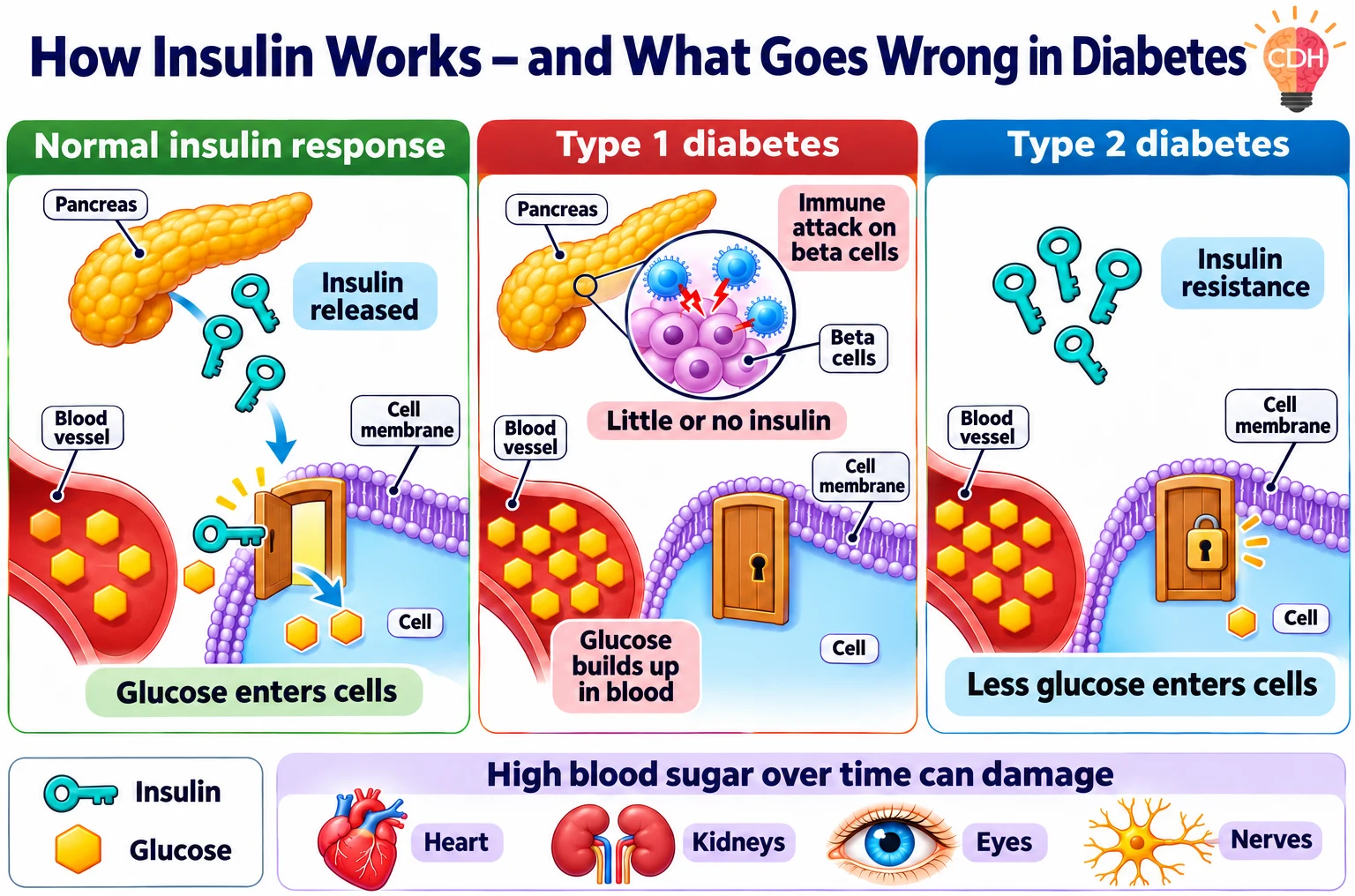
| Feature | Type 1 | Type 2 |
|---|---|---|
| Cause | Autoimmune destruction of insulin-making beta cells | Insulin resistance, often with obesity and inactivity |
| Usual onset | Childhood or youth | Adulthood (now rising in the young) |
| Share of cases | Small minority | Most cases |
| Treatment | Lifelong insulin | Diet, exercise, oral drugs; insulin if needed |
| Prevention | Not preventable at present | Largely preventable |
India tackles diabetes under the National Programme for Prevention and Control of Non-Communicable Diseases (NP-NCD), with population-based screening at Ayushman Arogya Mandirs under the National Health Mission.
📖 Read More: Major Human Diseases • Important Diseases Explained • Health and Nutrition
12. Five New Horned Frogs Found in Arunachal
(ENVIRONMENT) (TH) Scientists from the University of Delhi and Harvard University have described five new species of diminutive horned frogs (genus Jingophrys) from Arunachal Pradesh, including India’s first known snail-eating frog.
About Jingophrys
These are small Asian horned frogs of the family Megophryidae, found across the Himalayas and Indo-Burma — two of India’s biodiversity hotspots. Their ancestors reached the Himalayas in the Mid-Miocene and diversified as the mountains rose and the Asian monsoon strengthened.
- The study nearly doubled known Jingophrys species — from 6 to 11 worldwide and 1 to 8 in India (including two new country records).
The Five New Species
| Species | Common name | Name origin |
|---|---|---|
| Jingophrys tanogogo | Snail-eating Horned Frog | Apatani word for snails; micro-CT scans found whole land-snail shells in its gut — a first for the family |
| J. taniitatii | Tanii Horned Frog | Tanii tribe of Ziro Valley + ‘tatii’ (frogs and toads in Apatani) |
| J. siangensis | Siang Horned Frog | Siang region of Arunachal Pradesh |
| J. hrdy | Hrdy’s Horned Frog | Honours a supporter of herpetology research |
| J. wularsoni | Wu-Larson’s Horned Frog | Honours supporters of herpetology research |
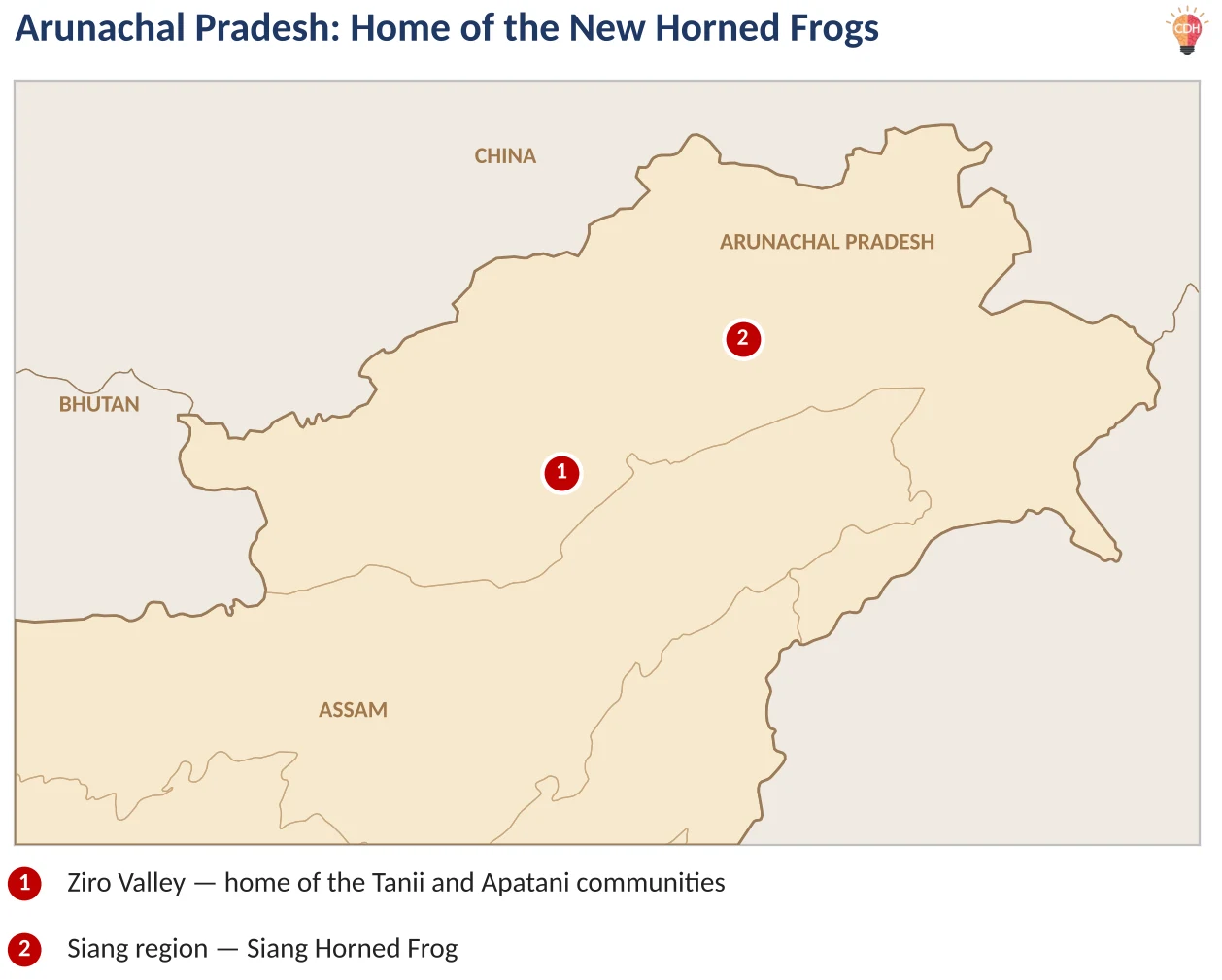
Significance: naming species after local tribes and languages links science with indigenous knowledge. The finds also show how little of the eastern Himalaya has been surveyed, and why its forests — threatened by roads, dams and jhum changes — need protection.
📖 Read More: Biodiversity Hotspots
13. Three Butterflies Recorded First Time in Silent Valley
(ENVIRONMENT) (TOI) A survey by the Kerala Forest and Wildlife Department and the Malabar Natural History Society has recorded three butterfly species for the first time in Silent Valley National Park.
The New Records
- Branded Royal — a rare forest butterfly, protected under Schedule II of the Wildlife (Protection) Act, 1972.
- Extra Lascar — known for its brown-and-orange wing pattern.
- Orange-spotted Grass Jewel — a lycaenid of grasslands and open scrub found from India to West Asia and Africa.
Butterflies are sensitive bio-indicators. Tracking their spread across altitudes, their host plants and mud-puddling (sipping minerals from wet soil) reveals changes in forest health and vegetation.
About Silent Valley National Park
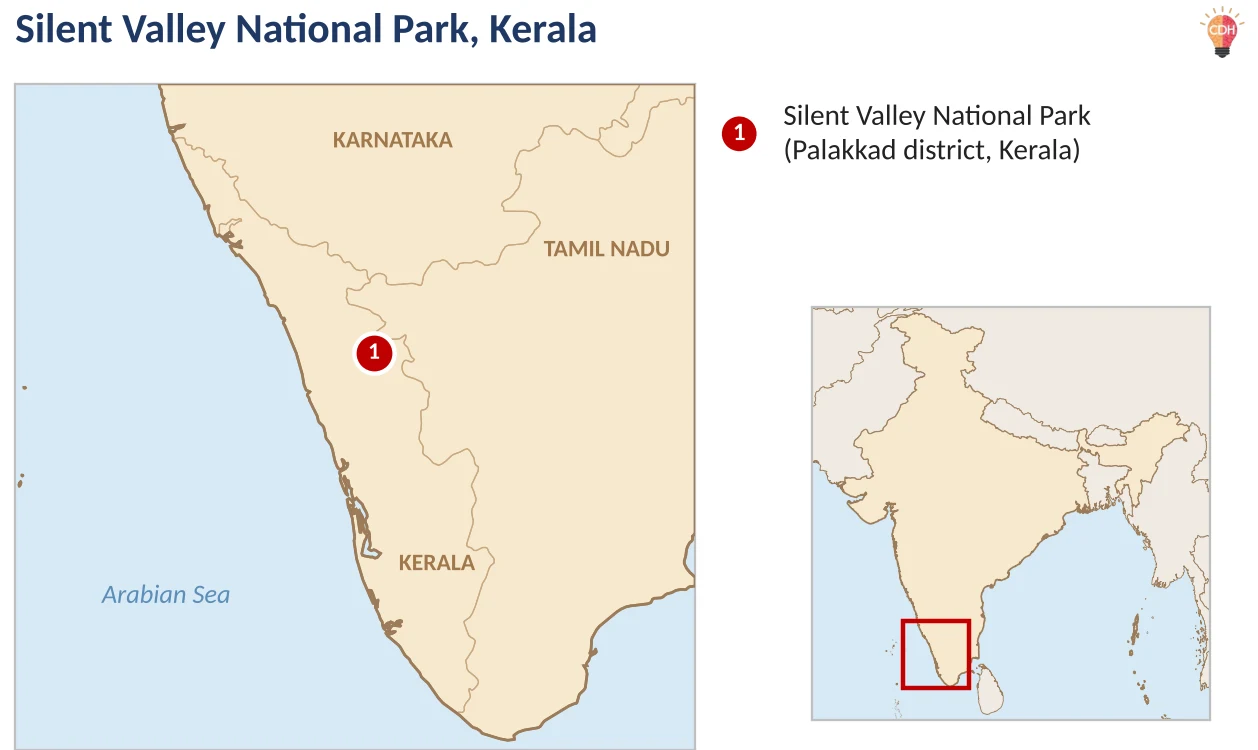
| Feature | Details |
|---|---|
| Location | Nilgiri Hills, Palakkad district, Kerala — part of the Western Ghats |
| Status | National Park since 1984; core of the Nilgiri Biosphere Reserve, India’s first biosphere reserve (1986) |
| Vegetation | Largely undisturbed tropical evergreen rainforest, with shola–grassland at higher reaches |
| Rivers | Kunthipuzha (tributary of the Bharathappuzha) rises here; the Bhavani (tributary of the Kaveri) rises nearby in the Nilgiris |
| Fauna | Largest population of the lion-tailed macaque (Endangered), plus Nilgiri tahr and Malabar giant squirrel |
| History | The Save Silent Valley movement, led by the Kerala Sasthra Sahithya Parishad, stopped the Kunthipuzha hydel project |
📖 Read More: National Parks in India • Biosphere Reserves in India • Species of Conservation Concern: Mammals