Imagine you are teaching a child to recognise a cat. You show her hundreds of pictures — cats of different colors, sizes, and breeds — and every time she correctly identifies one, you say ‘Yes!’ When she makes a mistake, you correct her. Over time, she gets better and better. Now replace ‘the child’ with ‘a computer’, replace ‘pictures’ with ‘labelled data’, and replace ‘your correction’ with ‘an algorithm’. What you have just described is the essence of Artificial Intelligence.
Artificial Intelligence is not science fiction anymore — it is the engine quietly running behind your Google search, your Netflix recommendations, your bank’s fraud-detection system, and India’s Aarogya Setu.
What is Artificial Intelligence?
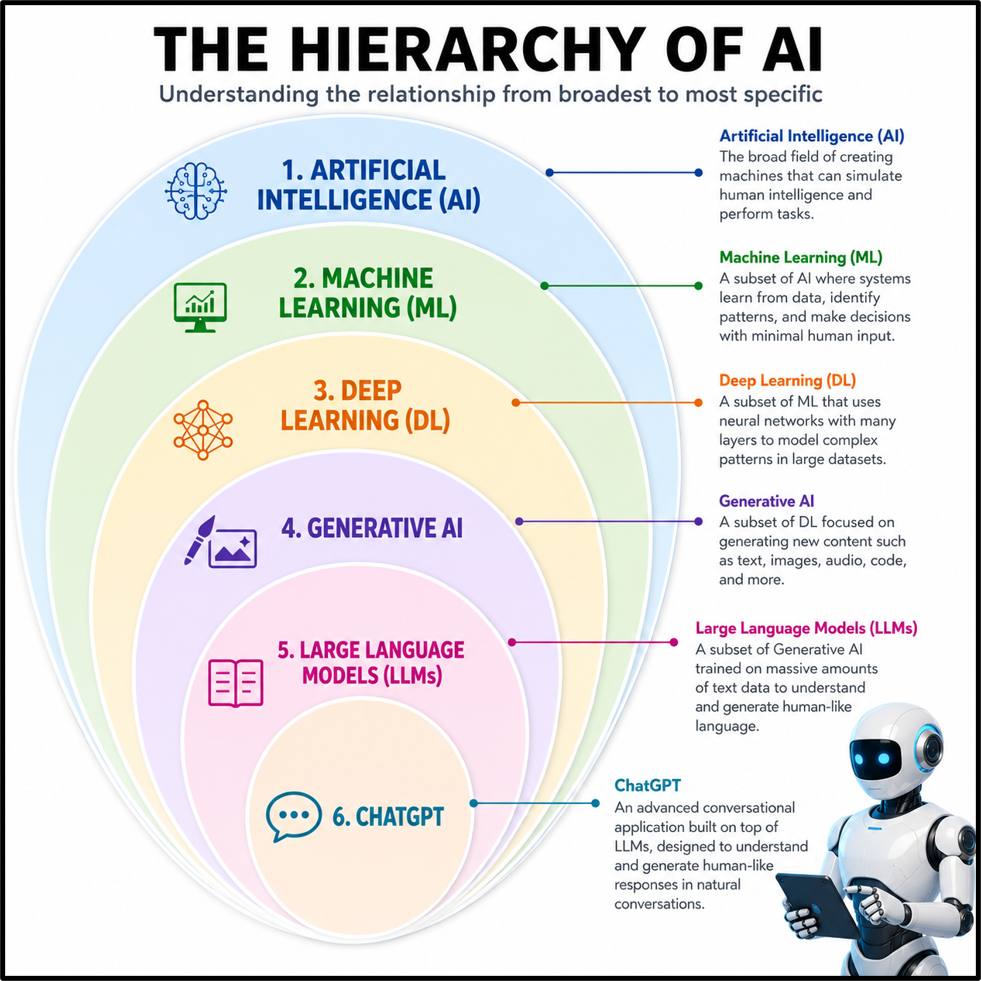
Artificial Intelligence (AI) is the ability of machines and computer systems to simulate human intelligence — including learning, reasoning, problem-solving, perception, and decision-making — by using algorithms and data.
In simpler words, AI makes machines ‘smart’ so they can do things that normally require a human mind.
🧠Key Insight
Notice the word ‘simulate’. Machines do NOT actually think. They mimic intelligent behaviour through mathematical patterns. This distinction is philosophically important.
Core Components of AI
AI is not a single technology — it is an ecosystem of several interlocking components.
Think of it as a car: the engine is Machine Learning, the brain is Neural Networks, the eyes are Computer Vision, the mouth and ears are Natural Language Processing, the fuel is Data, and the road map is Algorithms. Let us now examine each component carefully.
Machine Learning (ML)
Machine Learning is a subset of AI that enables machines to learn from data and improve performance automatically without being explicitly programmed for every situation. This is the revolutionary shift: instead of writing rules, you feed the machine data and let it discover the rules by itself.
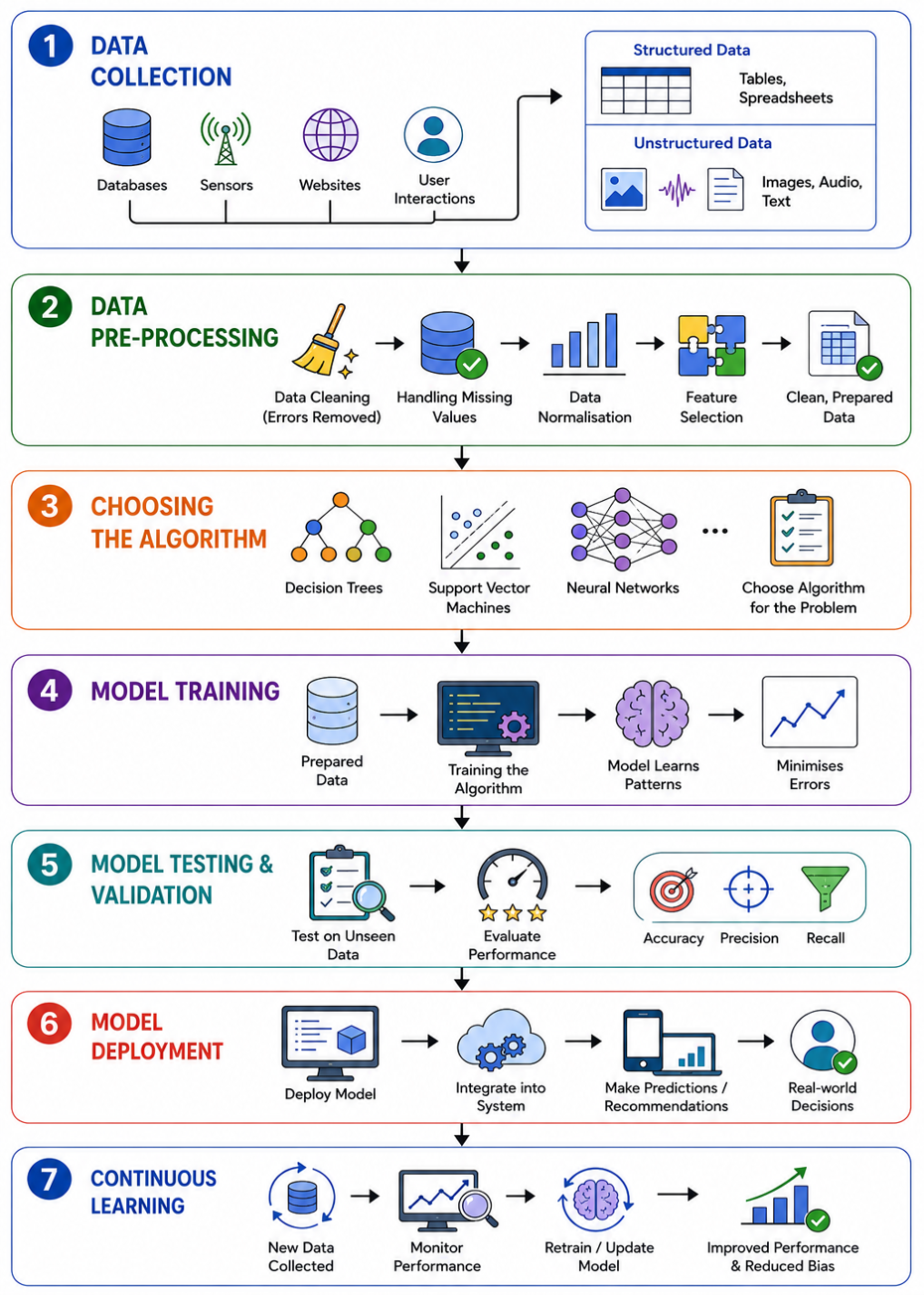
How Machine Learning Works — Step by Step
Step 1
Data Collection Data is gathered from databases, sensors, websites, and user interactions. It can be structured (tables, spreadsheets) or unstructured (images, audio, text). Data quality directly determines model quality.
▼
Step 2
Data Pre-processing Raw data is cleaned — errors removed, missing values handled, data normalised, and features selected. Garbage in = Garbage out.
▼
Step 3
Choosing the Algorithm An ML algorithm is chosen based on the problem type: Decision Trees, Support Vector Machines, Neural Networks, etc.
▼
Step 4
Model Training The algorithm is trained on prepared data. It adjusts its internal parameters to minimise errors and detect patterns.
▼
Step 5
Model Testing & Validation The trained model is tested on unseen data. Performance is measured by accuracy, precision, and recall.
▼
Step 6
Model Deployment The model is deployed in real-world systems for predictions, recommendations, or decision-making.
▼
Step 7
Continuous Learning Model performance is monitored continuously and updated with new data to adapt to changes and reduce bias.
Types of Machine Learning
There are four major types of Machine Learning, each suited to different kinds of problems:
Type
How It Works
Key Use
Example
Supervised Learning
Trained on labelled data (input-output pairs known)
Classification & Regression
Spam detection, Disease diagnosis
Unsupervised Learning
Finds hidden patterns in unlabelled data
Clustering & Association
Customer segmentation, Market basket analysis
Reinforcement Learning
Agent learns by reward & penalty through trial and error
Dynamic environments
Robotics, Autonomous vehicles, Game AI
Semi-Supervised Learning
Small labelled + large unlabelled data
When labelling is costly
Image & Speech recognition
Self-Supervised Learning
System generates its own labels from data
Foundation of LLMs
Modern deep learning, GPT-type models
✅Advantages & ⚠️Limitations of Machine Learning
✅ Handles massive datasets beyond human capacity ✅ Improves accuracy with more data and feedback ✅ Automates complex pattern recognition tasks ⚠️ Biased data → biased predictions ⚠️ Needs large, high-quality datasets ⚠️ ‘Black Box’ problem: decisions hard to explain ⚠️ Cannot apply human ethical judgment or emotional intelligence
Deep Learning
Deep Learning is a subset of Machine Learning that uses artificial neural networks with multiple hidden layers to automatically learn complex patterns from huge volumes of data. It is inspired by the structure of the human brain — specifically, how our neurons connect and fire.
🧠Brain Analogy
Just as your brain has billions of neurons connected in layers — and when you see a face, signals pass through layers of neurons until your brain says ‘that is Rahul’ — a deep learning neural network passes data through multiple computational layers until it arrives at a conclusion.
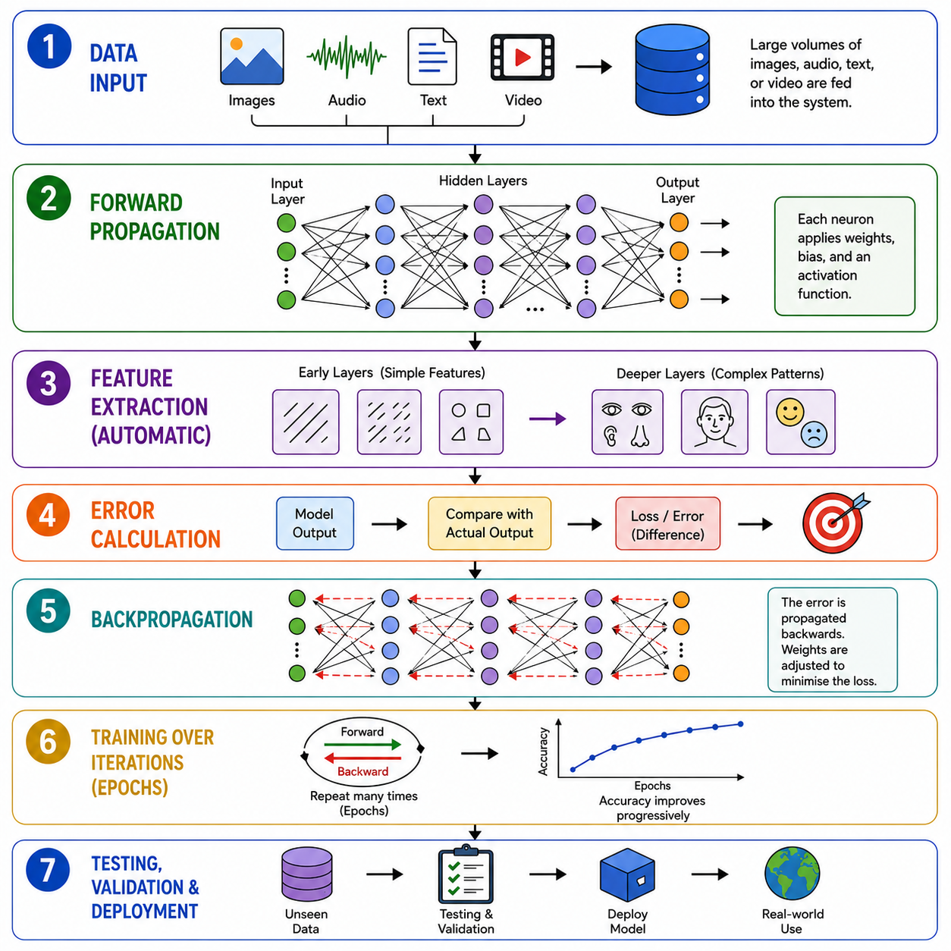
How Deep Learning Works — The Forward & Backward Journey
Step 1
Data Input Large volumes of images, audio, text, or video are fed into the system.
▼
Step 2
Forward Propagation Data flows through Input Layer → Hidden Layers → Output Layer. Each neuron applies weights, bias, and an activation function.
▼
Step 3
Feature Extraction (Automatic) Early layers detect simple features (edges, tones); deeper layers detect complex patterns (faces, sentiments).
▼
Step 4
Error Calculation Model output is compared to actual output. The difference = Loss / Error.
▼
Step 5
Backpropagation The error is propagated backwards. Weights are adjusted to minimise the loss.
▼
Step 6
Training Over Iterations (Epochs) Forward + backward steps repeat many times. Accuracy improves progressively.
▼
Step 7
Testing, Validation & Deployment Trained model is tested on unseen data, then deployed for real-world use.
Key Components of Deep Learning Neural Networks
Component
Description
Artificial Neural Networks (ANNs)
Foundation of deep learning; interconnected artificial neurons arranged in layers — inspired by the human brain.
Input Layer
Receives raw data (images, text, numbers)
Hidden Layers
Multiple layers that automatically extract increasingly complex features from data
Output Layer
Produces the final prediction or classification
Neurons
Basic processing units; apply weights, bias, and an activation function to each input
Introduce non-linearity enabling the network to learn complex patterns. E.g., ReLU, Sigmoid, Softmax.
Types of Deep Learning Models — A Quick Reference
Model
What it does
Best For
Examples
ANN
Basic pattern recognition
Classification, Regression
Simple ML tasks
CNN (Convolutional Neural Network)
Processes spatial data
Image recognition, Face detection, Medical imaging
Image classifiers
RNN (Recurrent Neural Network)
Has memory of past inputs
Sequential data, Speech, NLP
Speech recognition
LSTM (Long Short-Term Memory)
Overcomes RNN short memory
Long text, Time series, Speech-to-text
Financial forecasting
Transformer
Attention-based, no recurrence
NLP, Translation, Generative AI
GPT, BERT, Gemini
Autoencoder
Learns efficient data representations
Compression, Anomaly detection, Noise removal
Data compression
GAN (Generative Adversarial Network)
Generator vs Discriminator — adversarial training
Image generation, Deepfakes, Data augmentation
DALL-E, Deepfakes
Machine Learning vs Deep Learning — Quick Comparison
Aspect
Machine Learning
Deep Learning
Nature
Subset of AI
Subset of ML
Feature Extraction
Primarily manual
Automatic
Data Requirement
Moderate
Very large
Model Complexity
Low to moderate
Very high
Number of Layers
Few layers
Many hidden layers
Computing Power
Low to moderate
Very high (GPU needed)
Accuracy
Good
Very high (for complex tasks)
Explainability
Relatively better
Poor — black-box
Best Suited For
Structured data
Unstructured data (images, text, audio)
Natural Language Processing (NLP)
NLP is the branch of AI that enables machines to understand, interpret, process, and generate human language — whether text or speech. It bridges the gap between how humans speak and how computers compute.
🗣️Analogy
When you talk to Siri or Google Assistant and they actually understand your Hindi-English mixed query, that is NLP doing its magic. It is the reason your phone keyboard predicts the next word, and why Google Translate works at all.
Key NLP Components
Component
What It Does
Tokenisation
Breaks text into smaller units — words, phrases, or sentences — for analysis
Stemming
Reduces a word to its root form (e.g., ‘playing’ → ‘play’)
Lemmatisation
Converts words to their meaningful base form using grammar (e.g., ‘better’ → ‘good’)
Syntax Analysis
Analyses grammatical structure and relationships between words in a sentence
Semantic Analysis
Determines the meaning of words and sentences, including resolving ambiguity
Context Analysis
Interprets intent and real-world meaning beyond the literal words
Applications of NLP
Governance: Language translation of government documents, chatbots for grievance redressal, speech-to-text services
Healthcare: Medical report analysis and clinical documentation
Education: Automated essay evaluation and language learning tools
Business: Customer support chatbots, sentiment analysis, voice assistants
Computer Vision
Computer Vision is the branch of AI that enables machines to acquire, process, analyse, and interpret visual information — from images and videos — in a way that mimics human sight and cognitive analysis.
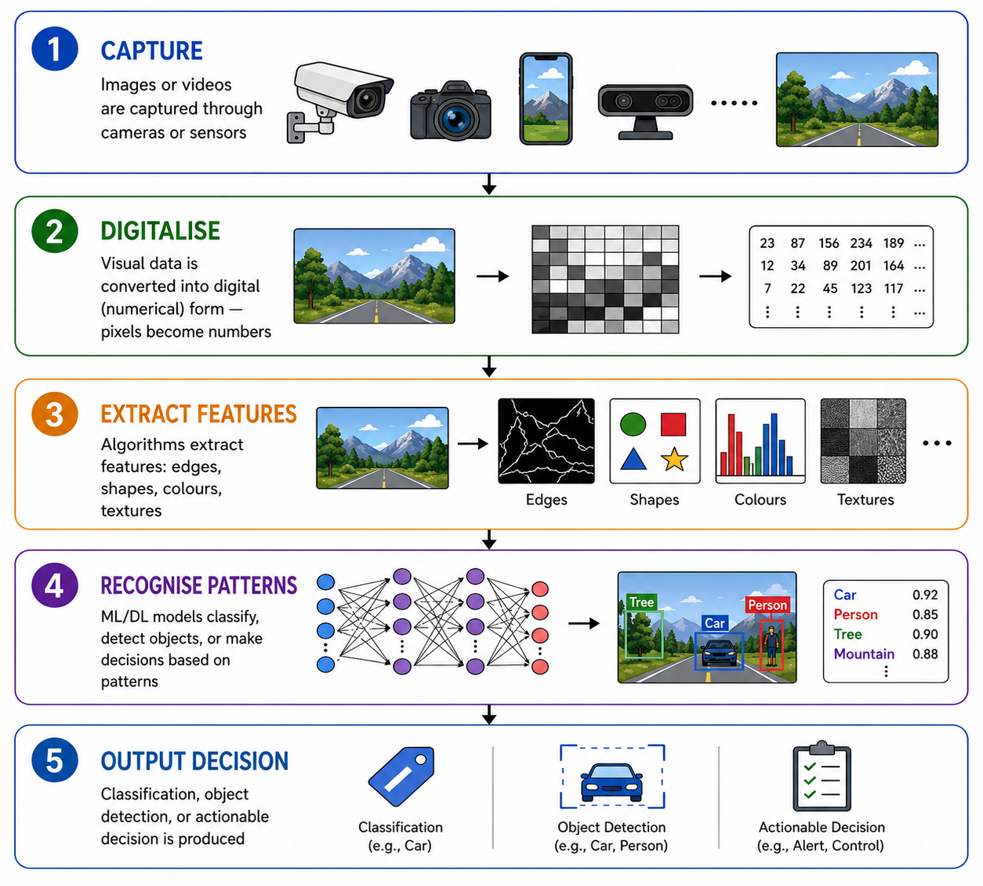
How Computer Vision Works
Step 1
Capture Images or videos are captured through cameras or sensors
▼
Step 2
Digitalise Visual data is converted into digital (numerical) form — pixels become numbers
▼
Step 3
Extract Features Algorithms extract features: edges, shapes, colours, textures
▼
Step 4
Recognise Patterns ML/DL models classify, detect objects, or make decisions based on patterns
▼
Step 5
Output Decision Classification, object detection, or actionable decision is produced
Applications of Computer Vision
Sector
Applications
Healthcare
Medical imaging (MRI/CT scan analysis), tumour detection, pathology
Crop health monitoring, pest and disease detection, yield assessment
Industry
Quality inspection, defect detection on assembly lines
Transportation
Autonomous and assisted driving, traffic management
Data — The Fuel of AI
In AI, Data is the fuel. Without data, AI cannot function — no matter how sophisticated the algorithm. Data provides AI systems with the raw material to learn patterns, make predictions, and take decisions.
Types of Data in AI
Structured Data: Highly organised, stored in rows/columns (databases, spreadsheets). Easy to process.
Unstructured Data: No fixed format — text, images, audio, video, social media. Harder to process but more abundant.
Semi-Structured Data: Some organisational properties but no rigid format — JSON, XML, log files.
Characteristics of Data (The 4 Vs)
Characteristic
Meaning
Importance for AI
Volume
Quantity of data generated
AI models need large datasets; more data generally means better performance
Variety
Different types and formats
Diverse data improves model robustness and reduces bias
Velocity
Speed of data generation and processing
Critical for real-time applications — fraud detection, traffic management
Veracity
Accuracy, reliability, and quality
Poor-quality data → biased, incorrect AI outcomes
Algorithms — The Thinking Framework of AI
Algorithms are well-defined sets of mathematical and logical instructions that enable AI systems to process data, learn patterns, and make decisions. If Data is the fuel, Algorithms are the engine.
Types of Algorithms in AI
Type
Purpose
Example
Search Algorithms
Explore possible solution paths in a problem space
Pathfinding algorithms, Game-playing AI
Machine Learning Algorithms
Learn patterns from data and improve over time
Regression, Decision Trees, Clustering
Optimisation Algorithms
Minimise error / maximise performance by adjusting parameters
Gradient Descent
Reasoning Algorithms
Support logical inference and decision-making based on rules
Expert systems, Decision-support systems
Computing Infrastructure
Computing infrastructure refers to the hardware, software platforms, and network resources required to store data, train AI models, and deploy AI applications efficiently.
Component
Role in AI
CPUs (Central Processing Units)
General-purpose processors. Suitable for basic AI tasks, data pre-processing, and logic operations. Less efficient for large-scale AI training.
AI Chips / Accelerators (GPUs, TPUs)
Specialised processors for large-scale AI computation — massively parallel, far faster than CPUs for model training.
Databases
Store structured data; enable fast querying. Examples: user records, sensor data, logs.
Cloud Storage
Scalable, on-demand storage for large datasets. Enables cost-effective, globally accessible AI applications.
Distributed File Systems
Store data across multiple nodes for high availability and parallel access. Used in big data and large-scale AI.
Cloud Computing Platforms
Provide on-demand computing resources. Enable scalability, cost efficiency, and rapid AI deployment.
Networking Infrastructure
High-speed networks for data transfer between storage, processors, and cloud. Supports distributed AI systems.
Types of Artificial Intelligence
AI is classified in two major ways — by its capability (what it can do) and by its functionality (how it behaves). Understanding this classification is crucial for UPSC, as questions are frequently framed around these distinctions.
Based on Capability
Type
Description
Current Status
Narrow AI (Weak AI)
Performs specific, well-defined tasks in a limited domain. Cannot generalise across tasks.
EXISTS — ALL current AI systems are Narrow AI
General AI (Strong AI)
Human-like intelligence; can learn, reason, and apply knowledge across multiple domains like a human.
THEORETICAL — Not yet achieved
Super AI
Surpasses human cognitive abilities in ALL aspects; possesses self-awareness and autonomous decision-making.
HYPOTHETICAL — Does not exist
⚠️UPSC Critical Note
All currently operational AI systems — ChatGPT, Gemini, Siri, Alexa, self-driving cars, fraud detection systems — are Narrow AI. General AI and Super AI remain in the realm of theory and science fiction.
Based on Functionality
Type
Description
Status & Example
Reactive Machines
No memory; responds only to current inputs based on predefined rules. Cannot use past experience.
EXISTS — Rule-based game AI; limited real-world use
Limited Memory AI
Learns from historical data and past observations. Decisions combine current input and stored data.
WIDELY DEPLOYED — Self-driving cars, recommendation systems
Theory of Mind AI
Understands human emotions, beliefs, and intentions. Enables socially aware AI interaction.
RESEARCH STAGE — Not yet achieved
Self-Aware AI
Possesses consciousness and self-awareness; understands its own internal states.
HYPOTHETICAL — Does not exist
Key Features of AI
What makes AI distinctively different from traditional software? Here are the defining features:
Feature
Description
Learning Ability
AI systems learn from data and experience; improve without explicit reprogramming
Reasoning & Logical Inference
Analyses inputs, applies logical rules, derives conclusions using algorithms
Pattern Recognition
Identifies hidden patterns in large, complex datasets beyond human capacity
Perception
Interprets sensory inputs (images, speech, text) through Computer Vision and NLP
Adaptability
Adjusts behaviour and outputs when exposed to new data or changing environments
Self-Improvement
Refines accuracy and efficiency over time through feedback and continuous learning
Autonomy
Operates independently with minimal human intervention in routine or well-defined tasks
Scalability
Can serve millions of users simultaneously without proportional increase in human effort
Generalisation Ability
Applies learned knowledge to new, unseen data — not just training data
Context Awareness
Interprets inputs relative to surrounding context (still imperfect in current systems)
Consistency
Provides uniform outputs under similar conditions — unlike variable human performance
Applications of AI — India & the World
AI is not just a laboratory concept — it is transforming every sector of human activity. For UPSC, understanding AI’s sectoral applications through an Indian governance lens is especially important.
Sector
Key AI Applications
Healthcare
Disease diagnosis from medical imaging (MRI, CT scans), drug discovery, personalised medicine, epidemic prediction, public health surveillance
Agriculture
Precision farming, crop disease & pest detection, yield prediction, weather-based advisory systems — improving farmers’ income and sustainability
Governance & Public Administration
Automated grievance redressal, welfare scheme targeting, language translation of government documents, document processing
The Internet is the single most impactful invention of the 20th century — more impactful than the automobile or the television, because it contains and accelerates all other technologies. The Internet is a global network of interconnected computers and communication systems that allows users to share information, access services, and communicate across long distances. It…
Space Debris: The Scattered Danger in Orbit Let’s begin with a small everyday picture. Imagine you are driving on a highway at 100 km/h, and suddenly a tiny pebble flies up and hits your windscreen. Even at that modest speed, a small stone can crack the glass. Now take that same scene and move it…
Militarisation of Space There is an important conceptual distinction you must remember: Militarisation vs. Weaponisation. Militarisation is using space to SUPPORT military operations — like using GPS for troop coordination. Weaponisation is placing or using WEAPONS in space itself. The Outer Space Treaty (1967) does not ban militarisation. It only bans WMDs in orbit. This…
Space Traffic Management (STM) Think of outer space as a busy international airspace — except there is no Air Traffic Control, no unified radar network, no binding rules for who gives way to whom, and no international police. Over 9,000 active satellites and millions of debris fragments share the same sky. Without STM, catastrophic collisions…
Major Lunar Missions — The Story of the Moon The Moon has always been humanity’s first space destination — simply because it is the nearest. But getting there was never a straight line; it was a clear evolution: first we went just to take photographs, then we attempted soft landings, then we sent humans, and…
India is not a latecomer to science. Before Europe had universities, India had Nalanda and Takshashila. Before the West developed algebra, India gave the world Zero. Before modern surgery, India had Sushruta performing rhinoplasty. The story of Science and Technology in India is, in many ways, the story of a civilisation’s journey — from ancient…