
UPSC CURRENT AFFAIRS — 11 NOVEMBER 2026
1. Two-Child Norm for Panchayat Polls Goes to Larger Bench
(POLITY AND GOVERNANCE) (IE) On 4 November 2026, a Supreme Court Bench of Justices P.S. Narasimha and Alok Aradhe referred the 2003 ruling in Javed v. State of Haryana to a larger Bench. Javed had upheld laws barring people with more than two children from panchayat posts; the Bench felt the population fears behind such laws no longer hold.
How the Case Reached the Court
Mangala Bhimrao Ingle was elected sarpanch of Kakoda gram panchayat in 2022. Her election was challenged because her third child was born in 2014, which attracts disqualification under Section 14(1)(j-1) of the Maharashtra Village Panchayats Act, 1959.
Elected sarpanch (2022) ➜ Disqualified by Additional Collector (Oct 2024) ➜ Appeal dismissed (Apr 2025) ➜ Bombay HC upholds (Aug 2025) ➜ SC refers Javed to larger Bench (Nov 2026)
What Is the Two-Child Norm?
- Who decides: ‘Local government’ is a State subject (Entry 5, List II). Under Article 243F, State laws may prescribe disqualifications for panchayat membership — the route States used to add the two-child norm (see Panchayati Raj and decentralisation).
- Maharashtra’s version: inserted by a 1995 amendment. People who already had more than two children when it came into force are spared if the number does not rise; a multiple birth after one child counts as one; adopted children are excluded.
- Other States: similar rules for local bodies have been enacted in States such as Rajasthan, Haryana and Odisha; details and exceptions vary from State to State.
- Roots: the K. Karunakaran Committee on Population (1992–93) had urged a central law disqualifying persons with more than two children from all elected posts, from gram panchayat to Parliament. No such central law was made.
Javed (2003) and the 2026 Bench Compared
| Issue | Javed v. State of Haryana (2003) | View of the 2026 Bench |
|---|---|---|
| Right to contest | Purely statutory, not fundamental; can be conditioned by law | Representation and holding office are among the most important rights of citizenship |
| Article 14 | Rational nexus with family planning; reasonable classification | Targets only grassroots representatives while sparing MPs and MLAs; ‘replete with prejudice’ |
| Article 21 | No violation: one may have more children but ‘pay a little price’ | Forces an ‘unconscionable choice’ between reproductive autonomy and public life |
| Gender | Law applies equally to men and women | Burden falls on women: forced abortions, desertion of pregnant wives, denial of paternity (2009 Panchayati Raj Ministry study) |
| Demography | Population explosion justified the curb | TFR has fallen from 3.0 to 1.9, below the replacement level |
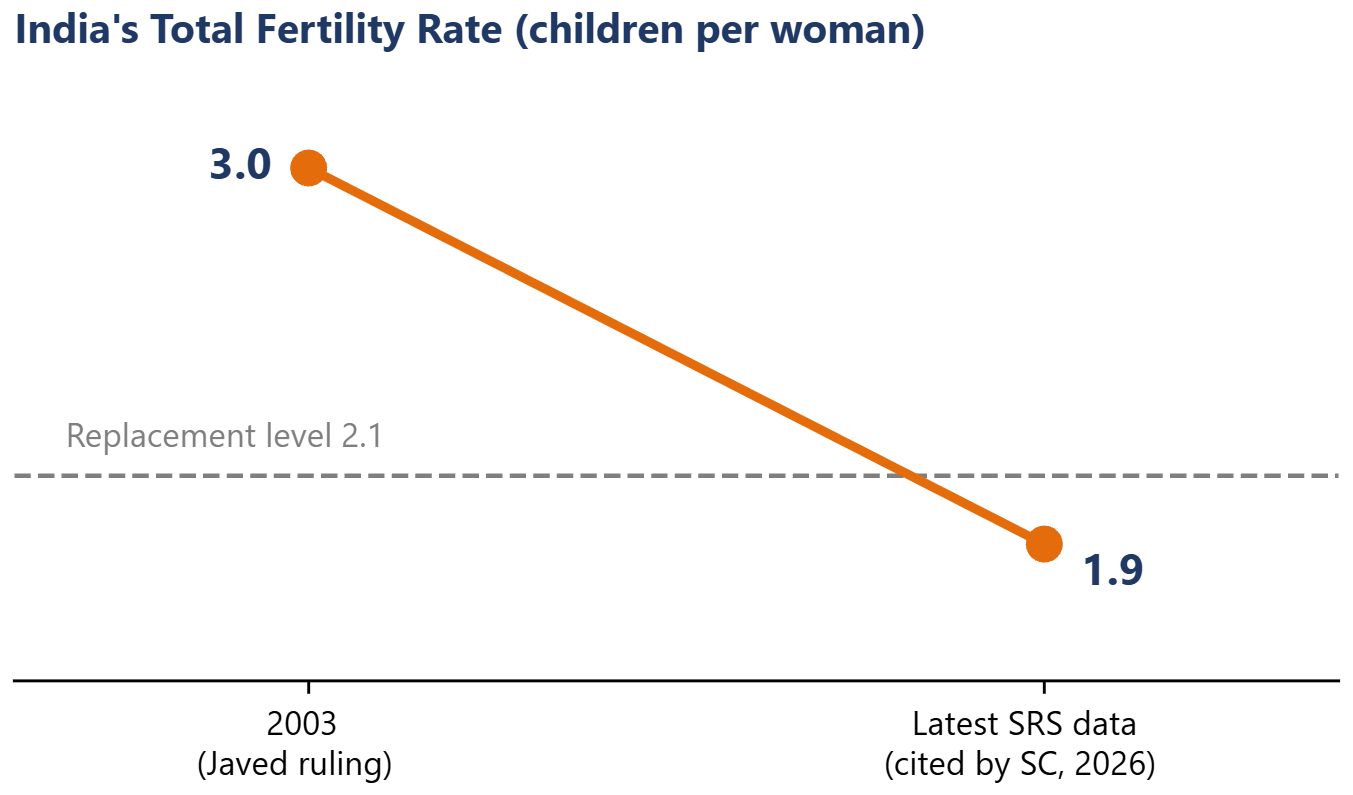
The replacement level of about 2.1 children per woman is the total fertility rate at which each generation exactly replaces itself. The Bench reasoned that a law valid when made can turn arbitrary once the facts that justified it disappear — the old maxim that when the reason for a law ceases, the law itself ceases.
Way Forward
- Rights over coercion: the 1994 Cairo ICPD and India’s National Population Policy, 2000 favour voluntary, target-free family planning (see family planning and population control).
- New demographic agenda: with fertility below replacement, policy must shift to health, skills and the demographic transition, learning from ageing societies such as China, which reversed its one-child policy.
- Settle the law: the larger Bench’s verdict will decide whether States must revisit these disqualifications under Articles 14 and 21 (see Right to Equality).
📖 Read More: Panchayati Raj and Decentralisation in India • 73rd Constitutional Amendment Act, 1992 • Family Planning and Population Control in India • Right to Equality
2. Safe Harbour Under Review: Rethinking Platform Immunity
(POLITY AND GOVERNANCE) (IE) The Centre has begun preliminary, exploratory talks on whether social media platforms that rank and amplify posts through algorithms should keep safe harbour — legal immunity for content their users post. No decision has been taken, and a broad withdrawal would need amendments to the IT Act passed by Parliament.
What Is Safe Harbour?
Section 79 of the Information Technology Act, 2000 grants conditional immunity to intermediaries — internet and telecom providers, online marketplaces and social media platforms — for third-party content. Without it, a platform could be sued over every post as if it were the publisher.
Does not initiate the transmission ➜ Does not select the receiver ➜ Does not select or modify content ➜ Follows due diligence ➜ Acts on court order or government notice ➜ Immunity retained
- Due diligence: the IT Rules, 2021 require large platforms to appoint India-based compliance officers (Chief Compliance Officer, Nodal Contact Person, Grievance Officer) and publish monthly compliance reports.
- Losing protection: under Section 79(3)(b), immunity goes if a platform fails to remove unlawful content promptly after valid notice.
- Tighter timelines: under the IT Amendment Rules, 2026, takedown windows have been cut to 3 hours for unlawful content and 2 hours for sensitive content such as non-consensual intimate imagery and deepfakes.
- Judicial gloss: in Shreya Singhal v. Union of India (2015), the Supreme Court read down Section 79(3)(b): takedown duty arises only on a court order or authorised government notification, not private complaints.
| Feature | Section 79 (safe harbour) | Section 69A (blocking) |
|---|---|---|
| Nature | Conditional immunity plus notice-and-takedown of unlawful content | Centre’s power to block public access to information |
| Grounds | Specific unlawful acts flagged by court or government | Article 19(2) grounds: sovereignty, security, public order, etc. |
| Safeguards | Court order or authorised notification (Shreya Singhal) | Reasoned written order, review committee; upheld in 2015 |
Why the Rethink Now
- Digital arrest scams: in August, the Indian Cyber Crime Coordination Centre (I4C) told the Supreme Court that a review of safe harbour and even a victim-compensation mechanism were being examined.
- Moderation clashes: in July, Facebook briefly withheld a video posted by the Prime Minister; the IT Ministry summoned Meta executives, and the parliamentary standing committee on IT warned that immunity could be withdrawn.
- Child safety: an October 15 Supreme Court order on online child sexual abuse material questioned Section 79’s adequacy, preferring proportionate penalties with withdrawal of immunity as an exceptional step.
- Algorithms: unlike passive carriers, platforms promote and amplify content, raising doubts about their claim to neutrality.
The Free-Speech Worry
Digital rights groups such as the Internet Freedom Foundation warn of a chilling effect: a platform liable for every post will rationally delete anything risky, so criticism, protest reporting and satire suffer first, undermining Article 19(1)(a) (see press and media freedom).
Way Forward
- Graded liability: keep full immunity for passive conduits; attach duties of care to large platforms that curate and amplify content.
- Algorithmic transparency: independent audits of recommender systems and published risk assessments.
- Due process: retain the Shreya Singhal safeguards so takedowns rest on lawful orders, not executive pressure.
- Victim focus: a statutory fund to compensate victims of platform-enabled fraud (see social media and internal security).
📖 Read More: Shreya Singhal Case (2015) • Social Media and Internal Security • Press and Media Freedom in India • India’s Cyber Security Framework
3. Semicon 2.0 Portal Opens; ECMS Adds 12 Projects
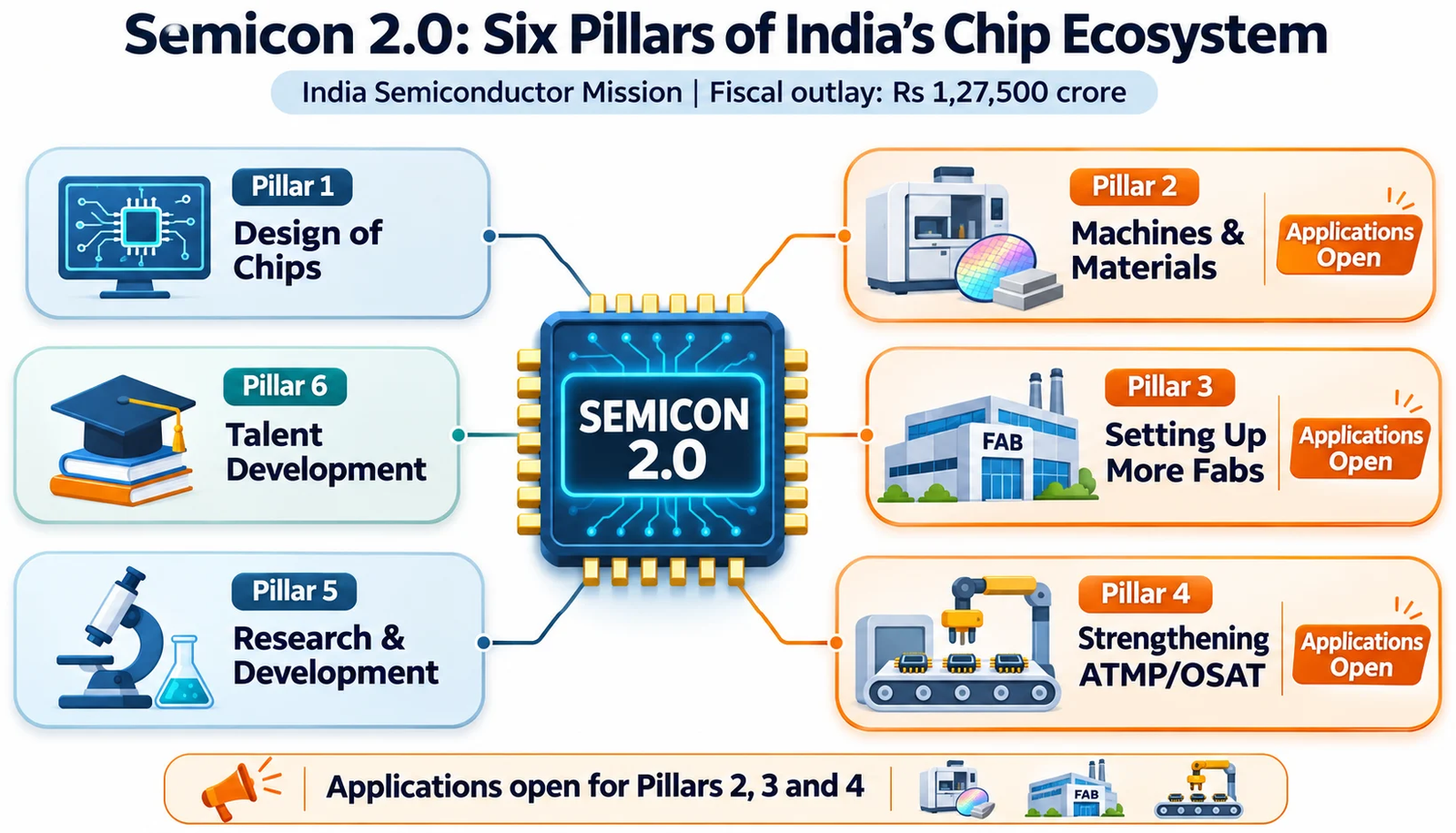
(ECONOMICS) (PIB) On 6 November 2026, the Union Minister for Electronics and IT launched the Semicon 2.0 Web Application Portal under the Semicon India Programme, opening applications for Pillars 2, 3 and 4, and announced 12 new approvals under the Electronics Component Manufacturing Scheme (ECMS).
Semicon 1.0: The Scorecard
- Projects: 12 projects in six States with cumulative investment of over ₹1.64 lakh crore; five had begun commercial production by October 2026.
- Design talent: under the Chips to Startup (C2S) programme, 70,000 students were trained and EDA tools reached 332 institutions and 105 startups; 24 startups received funding.
Semicon 2.0: Six Pillars
The Union Cabinet approved Semicon 2.0 under the India Semiconductor Mission (ISM) with a fiscal outlay of ₹1,27,500 crore. It aims to attract at least three major equipment makers and five chemicals and gases companies to India (see semiconductor industry).
What the New ECMS Approvals Cover
| Category | Products approved in this round |
|---|---|
| Components | Multi-layer PCBs, relays, heat sinks, specialty ceramics |
| Supply-chain products | Copper foil (for copper-clad laminates and Li-ion cells), anode material, cathode active material, capacitor-grade polypropylene film, camera rims |
| Capital goods | Precision moulds and tooling, power and control systems, factory-automation equipment |
- This round: projected investment ₹7,503 crore, production ₹39,045 crore and 7,127 direct jobs across seven States — Gujarat, Karnataka, Madhya Pradesh, Maharashtra, Punjab, Tamil Nadu and Uttar Pradesh.
- Firsts: copper foil, cathode active material and specialty ceramics are approved under ECMS for the first time.
- Cumulative: 118 applications covering 34 products in 16 States, with expected investment of ₹77,051 crore, production of ₹5,73,146 crore and 81,755 direct jobs; nearly half the units are MSMEs.
Climbing the Value Chain
Assembly of devices ➜ Modules and sub-assemblies ➜ Components (PCBs, passives) ➜ Materials and capital goods ➜ Chips: fabs and ATMP/OSAT
India’s electronics boom began with assembly under schemes like the PLI for large-scale electronics manufacturing. ECMS and Semicon 2.0 push upstream, where value addition is higher and import dependence deepest (see schemes of MeitY).
📖 Read More: Semiconductor Industry • Miscellaneous Schemes under Ministry of Electronics and IT • PLI Scheme for Large Scale Electronics Manufacturing • Make in India Initiative
4. PLI for Medical Devices Extended Till 2035-36
(ECONOMICS) (PIB) The Department of Pharmaceuticals has extended the Production Linked Incentive Scheme for Promoting Domestic Manufacturing of Medical Devices (PLI-MD) up to 2035-36 and invited fresh applications under its revised form, PLI-MD 2.0. About ₹2,700 crore of the outlay is available for the new round.
Phase One in Brief
- Launch: 2020-21, under the Department of Pharmaceuticals, Ministry of Chemicals and Fertilizers (see PLI for medical devices).
- Design: greenfield projects earned an incentive of 5% on incremental sales over the base year 2019-20 in four import-heavy segments such as cancer care and implants.
- Results: over 60 high-end devices and components made in India — X-ray tubes and detectors, 1.5 Tesla MRI, LINAC, CT scanners, mammography machines, cath labs, orthopaedic and cardiac implants, dialyzers — with production above ₹16,000 crore.
What Changes in PLI-MD 2.0
| Target segment | Coverage | Average incentive |
|---|---|---|
| TS1 | Medical consumables, disposables and implants | ~5% |
| TS2 | Critical components | ~9% |
| TS3 | High-end devices at a nascent stage of domestic manufacturing | ~9% |
| TS4 | High-end devices presently only assembled in India | ~6% |
- Tapering incentives: rates fall year by year, pushing firms towards competitiveness.
- Easier rules: the minimum sales threshold for claims is dropped, the minimum investment trimmed, and applicants get three years to set up plants.
- Flexibility: firms may file any number of applications across segments; the window stays open over a long period.
- Targets: equipment not yet made in India, such as 3 Tesla MRI, PET-CT, ultrasound probes and consoles, and high-throughput IVD analysers.
Why It Matters
Critical components are where Indian device makers depend most on imports. Backing them helps MSMEs, complements common facilities under AMD-CF, and supports cheaper, quality ‘Made in India’ devices in line with Atmanirbhar Bharat.
📖 Read More: PLI Scheme for Medical Devices • Assistance to Medical Device Clusters (AMD-CF) • Drugs and Pharmaceuticals Industry
5. Used Vehicles: States Ranked on Ease of Ownership
(POLITY AND GOVERNANCE) (IE) The Ease of Vehicle Ownership Index (EVOI) 2026, released on 4 November by the Minister of State for Road Transport and Highways, ranks 15 States on how smoothly a pre-owned vehicle can be bought, sold and transferred. Andhra Pradesh topped the list; Uttar Pradesh came last.
About the Index
It was prepared by the start-up industry body IndiaTech.org with consumer organisation Consumer VOICE. The 15 States covered account for over 85% of India’s organised used-car market. Scores rest on six pillars:
| Pillar | What it measures |
|---|---|
| Regulatory clarity | Clarity and consistency of ownership-transfer rules |
| Digital infrastructure | Availability and reliability of online systems |
| Procedural efficiency | Speed, predictability and paperwork burden |
| Transparency | Fee clarity, application tracking, grievance redressal |
| Consumer protection | Dealer support, safeguards and trade infrastructure |
| Transaction cost | Gap between official fees and the real all-in cost |
Key Findings
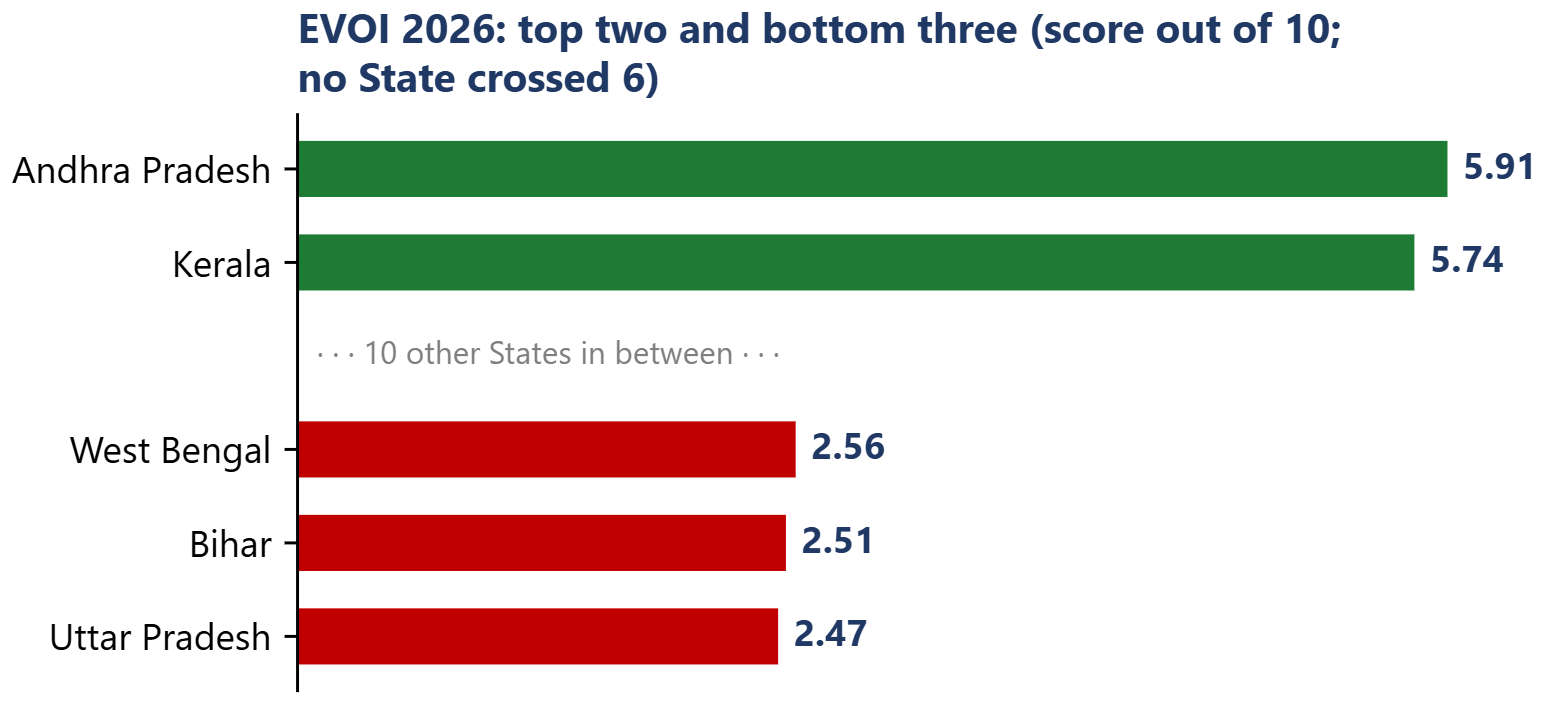
- Top and bottom: Andhra Pradesh (5.91) led, followed by Kerala (5.74); Uttar Pradesh (2.47), Bihar (2.51) and West Bengal (2.56) trailed.
- Cost is the weakest pillar: 12 of 15 States scored below 3.5; manual steps and informal payments push the real cost to nearly ten times the statutory fee.
- Speed gap: a registration-certificate transfer takes 7–10 days in Andhra Pradesh, with biometric authentication, but over 30 days in Uttar Pradesh. In 13 States, online applicants must still submit physical copies.
- Tax mismatch: road tax on a ₹6 lakh petrol car ranges from 3% in Uttar Pradesh to 14% in Karnataka.
Why It Matters
The pre-owned market was worth USD 36.4 billion in 2024-25 and may reach USD 73.5 billion by 2030, when used cars could outsell new ones 1.7:1. Since 60–65% of buyers are first-time owners, a smooth transfer system is a matter of affordable road transport and consumer protection.
Suggested Reforms
Stepwise transfer timeline in the Motor Vehicles Act ➜ DigiLocker and mParivahan papers as primary proof ➜ Real-time bank–VAHAN link to lift hypothecation ➜ Dealers allowed to clear pending challans
Amending the Motor Vehicles Act and accepting DigiLocker records at every RTO would end dual online-and-physical submission, a core aim of the Digital India Programme.
📖 Read More: Road Transport in India • Consumer Protection • Digital India Programme
6. World Bank Hails India’s Water and Sanitation Missions
(GEOGRAPHY) (NOA) Ahead of the 2026 UN Water Conference in Abu Dhabi (8–10 December), the World Bank’s Global Director for Water called India’s Jal Jeevan Mission, Namami Gange and Swachh Bharat Mission a remarkable success story and urged India to share its experience with other developing countries.
The Abu Dhabi meet is the third UN Water Conference, after Mar del Plata (1977) and New York (2023), and the first co-hosted by two Global South nations, the UAE and Senegal. The World Bank also lauded India’s work on the safety of nearly 900 dams.
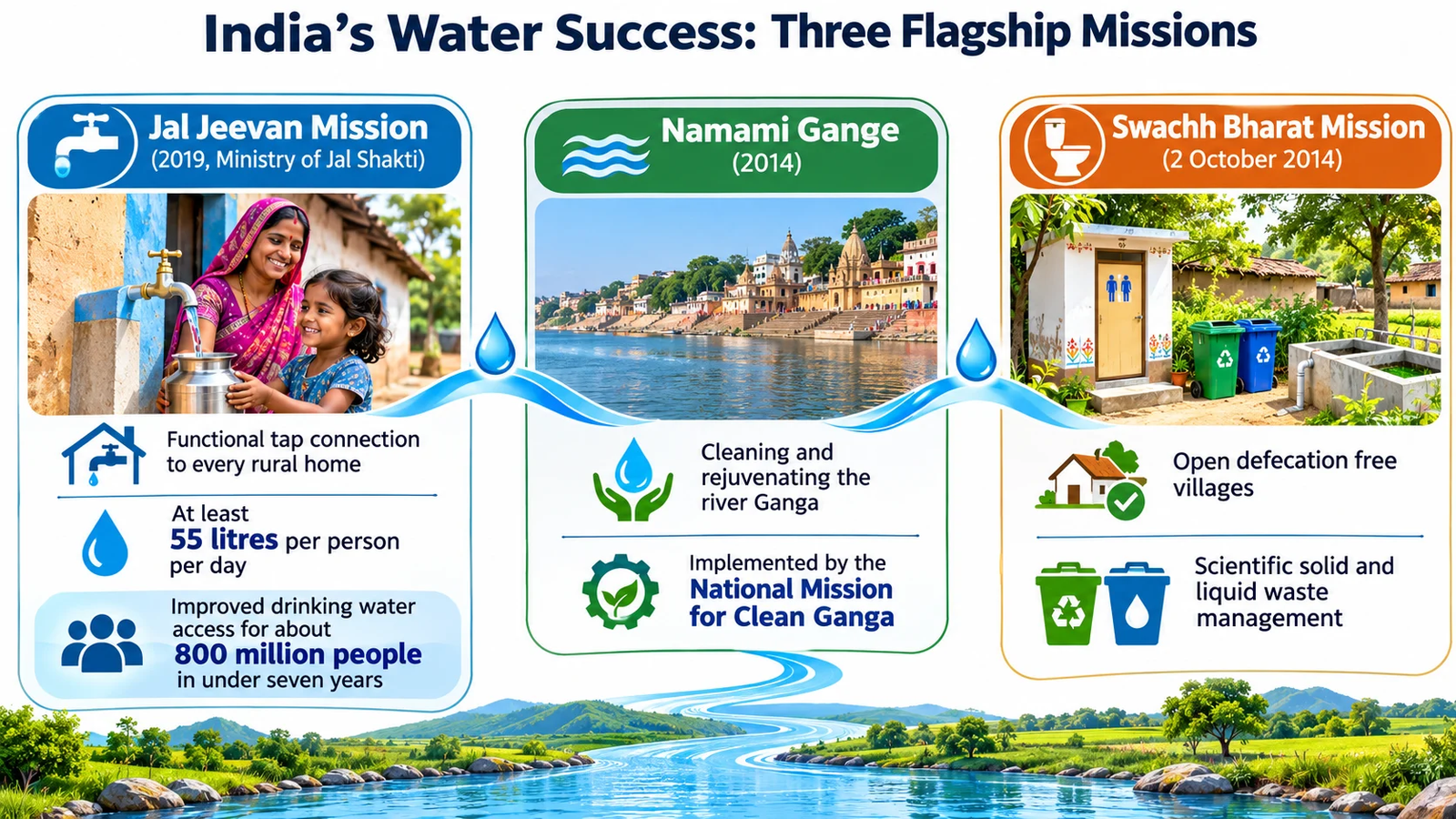
| Mission | Launched / nodal body | Core goal | Milestones |
|---|---|---|---|
| Jal Jeevan Mission | 2019; Department of Drinking Water and Sanitation, Ministry of Jal Shakti (Centrally Sponsored) | Functional household tap connection for every rural home, at least 55 lpcd meeting BIS 10500 norms | Better drinking-water access for about 800 million people in under seven years; extended to 2028 |
| Namami Gange | 2014; implemented by the National Mission for Clean Ganga, overseen by the PM-chaired National Ganga Council (Central Sector) | Abate pollution and rejuvenate the Ganga | Named among the UN’s top ten World Restoration Flagships at CBD COP15 (2022) |
| Swachh Bharat Mission | 2 October 2014; Grameen under DDWS, Urban under MoHUA | Open defecation free India and scientific waste management | All villages declared ODF on 2 October 2019; now ODF Plus (rural) and ‘Garbage Free’ cities under SBM-U 2.0 |
People at the Centre
- Pani Samitis: gram panchayats and Village Water and Sanitation Committees run in-village supply under Jal Jeevan Mission; at least half their members must be women.
- Water testing: five women in every village are trained to check quality with Field Test Kits.
- Legal backbone: NMCG, registered as a society in 2011, has acted as an authority under the Environment (Protection) Act, 1986 since 2016 (see Namami Gange).
- Next stage: SBM-G Phase II seeks to sustain ODF status through solid and liquid waste management.
📖 Read More: Jal Jeevan Mission (JJM) • Namami Gange Programme • Swachh Bharat Mission (Grameen) Phase II • Swachh Bharat Mission – Urban 2.0 • Water Conservation
7. COP30 Roadmap to Halt Deforestation by 2030
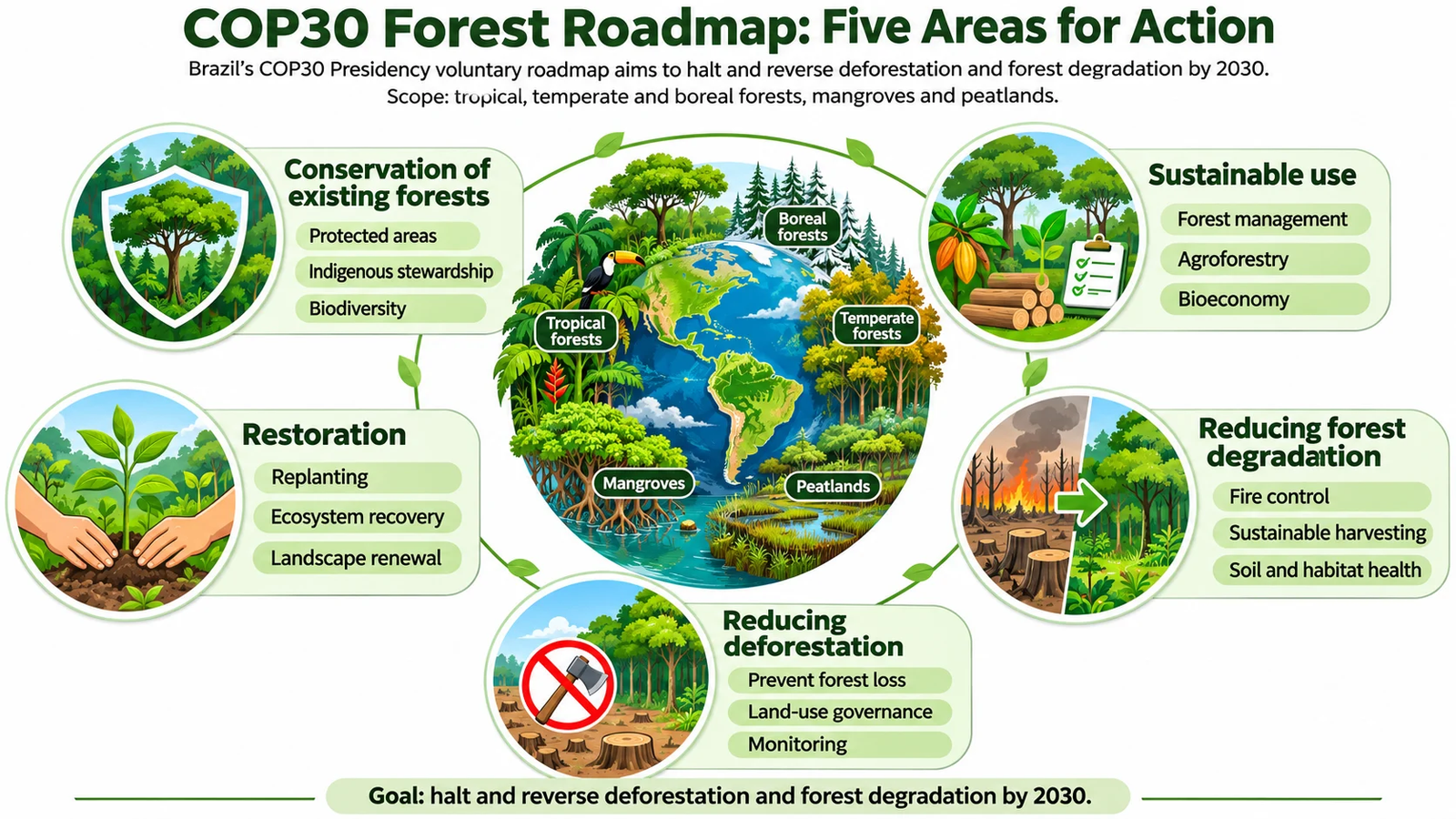
(ENVIRONMENT) (DTE) Ahead of COP31 in Antalya, Türkiye, Brazil’s COP30 Presidency has released a global roadmap to halt and reverse deforestation and forest degradation by 2030. It warns that progress remains too slow and that forest finance falls far short of need.
Nature of the Roadmap
- Voluntary guidance: it sets no new commitments or binding targets and is not a negotiated COP decision.
- Mandate: it helps implement the forest pledges of the Paris Agreement’s first Global Stocktake at COP28 (2023).
- Scope: tropical, temperate and boreal forests, plus mangroves and peatlands (see wetland ecosystem).
- Structure: five areas for action backed by 18 policy approaches, aligned with Targets 2 and 3 (‘30 by 30’) of the Kunming-Montreal Global Biodiversity Framework.
What the Numbers Say
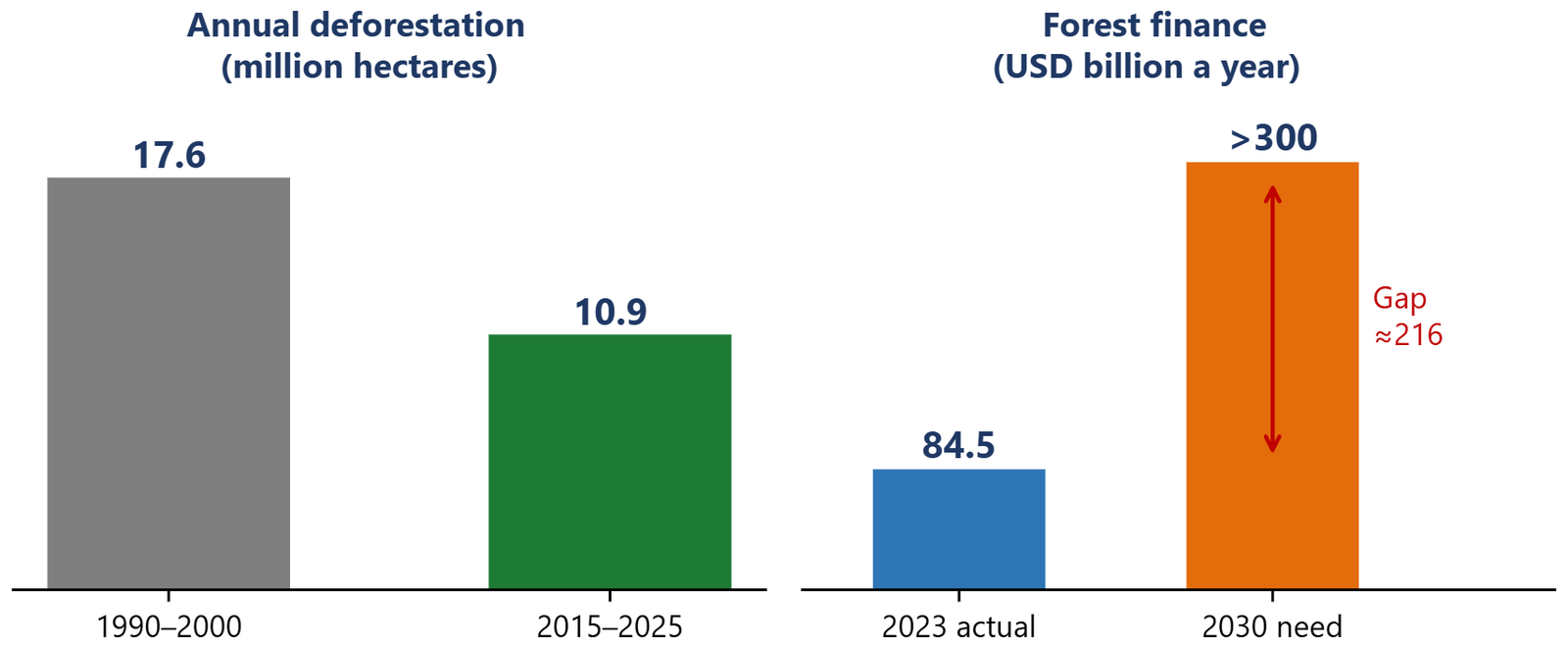
- Tropical hotspot: tropical forests make up about 45% of global forest area but caused 88% of deforestation during 1990–2025.
- Amazon risk: by 2050, 10–47% of Amazonian forests could face overlapping disturbances able to trigger abrupt ecosystem shifts.
- What works: protected areas cover about 813 million hectares (20% of forests) and show deforestation rates about 41% lower than comparable unprotected land.
- Indigenous stewardship: in the Amazon, Indigenous territories and protected areas held 58% of aboveground carbon (2016) but only 10% of net carbon losses (2003–2016).
- Money gap: forest investment of USD 84.5 billion (2023) must exceed USD 300 billion a year by 2030 — a gap of about USD 216 billion — and rise to USD 498 billion by 2050.
Recall that COP30 was held at Belém, Brazil, in November 2025 — the first UNFCCC COP in the Amazon (see COP30).
📖 Read More: COP30 (Belem, Brazil 2025) • UNFCCC • International Initiatives for Biodiversity Conservation • Forest Governance and Legal Frameworks
8. BRIC Turns Three: One Network for Biotech Institutes
(SCIENCE AND TECHNOLOGY) (TH) The Biotechnology Research and Innovation Council (BRIC) marked its third Foundation Day on 10 November 2026 at BRIC–National Institute of Immunology (NII), New Delhi. BRIC and the UK’s Centre for Process Innovation signed a Letter of Intent to cooperate on biomanufacturing and biofoundries.
What Is BRIC?
- Structure: an integrated network under the Department of Biotechnology, Ministry of Science and Technology, uniting 13 premier institutions in 11 cities under one governance system funded through intramural core grants.
- ‘Joint family’ model: institutes pool resources and cut procedural delays while keeping their identity, independence and autonomy; other ministries have replicated the model.
- Lab to market: the i3C PhD programme (about 200 scholars so far) and BRIC–BIRAC entrepreneurship schemes link discoveries to industry.
Basic discovery ➜ Translational research ➜ Start-up and BIRAC support ➜
Biomanufacturing and biofoundries ➜ Market
Highlights from the Event
- Bioeconomy: grown from about USD 10 billion to more than USD 195 billion; biotech start-ups from 50–60 to over 11,000.
- Biofoundries: hubs at Mohali, Hyderabad, Pune and Thiruvananthapuram.
- Training: the Wellcome Trust announced up to ₹21.7 crore for a five-year programme for over 250 iBRIC+ PhD scholars.
- Precision medicine: a Genomics Centre of Excellence is drawing interest from institutions such as AIIMS (see biotechnology in healthcare).
📖 Read More: Basics of Biotechnology • Biotechnology in Healthcare • Science and Technology in India
9. India–Saudi Arabia Sign Haj Agreement for 2027
(INTERNATIONAL RELATIONS) (AIR) India and Saudi Arabia have signed the bilateral Haj Agreement for 2027 in Jeddah, allowing 1,75,025 Indian pilgrims. Union Minority Affairs Minister Kiren Rijiju signed it after talks with Saudi Minister of Hajj and Umrah Tawfiq bin Fawzan Al Rabiah on logistics and pilgrim welfare.
About Haj
- Pillar of faith: the Haj is one of the Five Pillars of Islam, an annual pilgrimage to Mecca (Makkah) held in Dhu al-Hijjah, the twelfth month of the Islamic lunar calendar (see Islam).
- Ritual sites: Mecca, Mina, Arafat and Muzdalifah.
- Quota system: Saudi Arabia fixes country-wise quotas each year because space and facilities at the holy sites are limited.
Who Manages Haj in India
| Body | Role |
|---|---|
| Ministry of Minority Affairs | Nodal ministry for Haj policy and administrative coordination |
| Haj Committee of India | Statutory body under the Haj Committee Act, 2002; organises pilgrims’ arrangements |
| Private Haj Group Organisers | Handle the share of the quota allotted to the private route |
The Haj subsidy on airfares was phased out by 2018, following a 2012 Supreme Court direction to end it by 2022; savings were redirected to minority education, especially of girls.
Haj cooperation is a steady people-centric strand of a broader partnership that spans energy, trade and the diaspora (see India and Saudi Arabia relations).
📖 Read More: India and Saudi Arabia Relations • Islam • Minorities in India
10. India–Lebanon Hold First Foreign Office Consultations
(INTERNATIONAL RELATIONS) (NOA) India and Lebanon held their first Foreign Office Consultations in New Delhi on 9 November 2026, co-chaired by MEA Secretary (CPV & OIA) Sripriya Ranganathan and Lebanese Foreign Ministry Secretary-General Abdel Sattar Issa. Trade and investment, digital public infrastructure and pharmaceuticals were named priorities.
Lebanon on the Map
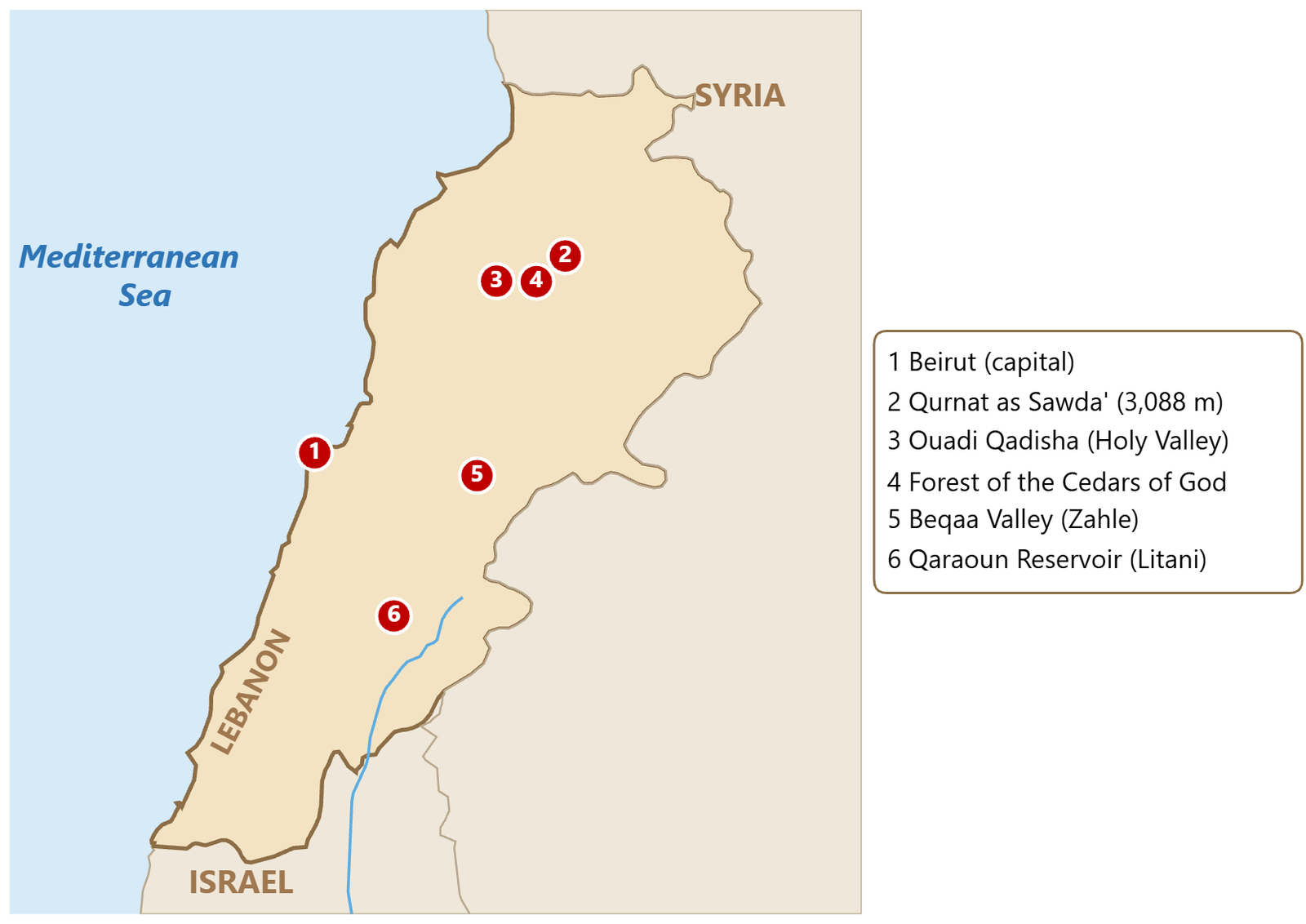
- Location: Lebanon (capital Beirut) lies on the eastern Mediterranean coast in the Levant, the heartland of ancient Phoenicia.
- Neighbours: Syria to the north and east (longest land border) and Israel to the south; it shares a maritime boundary with Cyprus.
- Blue Line: a UN-demarcated withdrawal line separating Lebanon from Israel; it is not an international border.
| Feature | Details |
|---|---|
| Mountains | Mount Lebanon range in the west; Anti-Lebanon range, including Mount Hermon, along the Syrian border |
| Highest point | Qurnat as Sawda’ (3,088 m), in the Mount Lebanon range |
| Valley | Beqaa Valley, the farm heartland, between the two ranges |
| Rivers and lake | Litani (longest, wholly within Lebanon); Orontes (Asi), flowing through Lebanon, Syria and Türkiye; Qaraoun reservoir on the Litani |
| UNESCO site | Ouadi Qadisha (Holy Valley) and the Forest of the Cedars of God, inscribed in 1998 |
Why Lebanon Matters to India
- Peacekeeping: an Indian battalion serves with the UN Interim Force in Lebanon (UNIFIL) in the south (see UN peacekeeping).
- New pillars: structured consultations add economic and digital content to ties within India’s West Asia policy.
- Regional stake: stability in Lebanon matters for the security of the eastern Mediterranean and the Indian community in the region (see conflict in Lebanon).
📖 Read More: Conflict in the Lebanon • India and West Asia Policy • The UN as a Peacekeeping Organization • World Heritage Sites
11. Siddis: Gujarat’s African-Origin Tribe in the Spotlight
(SOCIETY) (IE) Fifteen-year-old judoka Khushbu Rajakbhai Darjada won silver in the girls’ 63-kg category at the 2026 Youth Olympic Games in Dakar, Senegal. She is the first Siddi athlete, and only the second Indian, to win a Youth Olympics medal in judo.
Who Are the Siddis?
The Siddis, also called Siddi Badshah and in places Habshi, are Indians of East African descent. How they arrived is debated: as slaves brought by the Portuguese, via overland routes with medieval invaders from Central and West Asia, or as guards invited by the Nawabs of Junagadh.
In Gujarat they are concentrated in 18 villages of Talala taluka, Gir Somnath district; Jambur is nicknamed ‘Mini Africa’. Communities also live in Karnataka, Maharashtra, Goa and Daman and Diu (see tribes of western India).
| Aspect | Details |
|---|---|
| Legal status | Scheduled Tribe in Saurashtra since 1956; declared a primitive tribal group in 1982 and now one of Gujarat’s PVTGs (population 12,959 per a community survey); Siddis outside Saurashtra are classed as SEBC |
| Faith | Mostly Muslim with strong Sufi influences and some Saurashtrian Hindu elements; revere the saint Baba Gor (dargahs at Ratanpur, Bharuch and Jambur) |
| Culture | Speak Gujarati with a Kathiawadi accent; Dhamal, a men-only dance of African origin dedicated to Baba Gor (see tribal dances) |
| Livelihood | Guides, drivers and labourers around Gir National Park; farm and transport labour, security work |
History has notable Siddis: Malik Ambar rose to lead the Ahmadnagar Sultanate’s forces, while Siddi rulers held the sea fort of Murud-Janjira. Sport now offers a new route to visibility for the community (see India and Africa).
📖 Read More: Particularly Vulnerable Tribal Groups (PVTGs) • Tribes of Western India Region • Tribal Dances of India • Sufism
12. Birsa Munda: Dharti Aaba and the Ulgulan
(HISTORY) (AIR) Maharashtra will observe a special Tribal Pride Service Week from 11 to 18 November, taking welfare schemes to tribal beneficiaries, to mark the birth anniversary of Bhagwan Birsa Munda on 15 November — observed nationally as Janjatiya Gaurav Divas.
Life in Brief
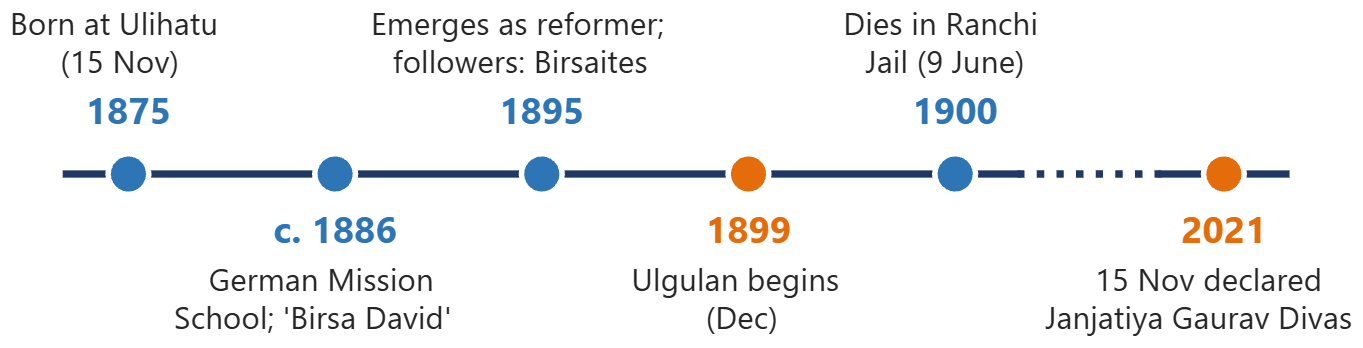
- Birth: 15 November 1875 at Ulihatu in present-day Jharkhand.
- Mission school: studied at the German Mission School, converted and was renamed Birsa David; he left, angered by missionaries’ contempt for tribal culture.
- Reformer: founded a new faith, Birsait, blending spiritual reform with social unity; his followers were called Birsaites.
- Death: 9 June 1900, in Ranchi Jail.
The Ulgulan (1899–1900)
Known as Dharti Aaba (Father of the Earth), Birsa led the Ulgulan, or ‘Great Tumult’, against British rule and its local agents (see anti-colonial tribal movements).
| Grievance | What it meant for the Mundas |
|---|---|
| Land alienation | Loss of community-held land to outsiders and landlords |
| Exploitative intermediaries | Moneylenders, traders and contractors draining tribal wealth |
| Beth begari | Forced, unpaid labour exacted by landlords and officials |
| Cultural interference | Attacks on traditional customs and tribal self-rule |
Land alienation and forced labour ➜ Birsa’s religious and social reform ➜ Armed Ulgulan (1899–1900) ➜ Arrest and death (1900) ➜ A lasting symbol of tribal pride
Legacy
- National recognition: the Union Cabinet decided on 10 November 2021 to observe 15 November as Janjatiya Gaurav Divas.
- Schemes in his name: the Dharti Aaba Janjatiya Gram Utkarsh Abhiyan targets saturation of basic services in tribal villages; PM-JANMAN focuses on PVTGs.
📖 Read More: Anti-Colonial Tribal Movements: Case Studies • Tribal Uprisings in British India • DAJGUA • PM-JANMAN