India is not a latecomer to science. Before Europe had universities, India had Nalanda and Takshashila. Before the West developed algebra, India gave the world Zero. Before modern surgery, India had Sushruta performing rhinoplasty.
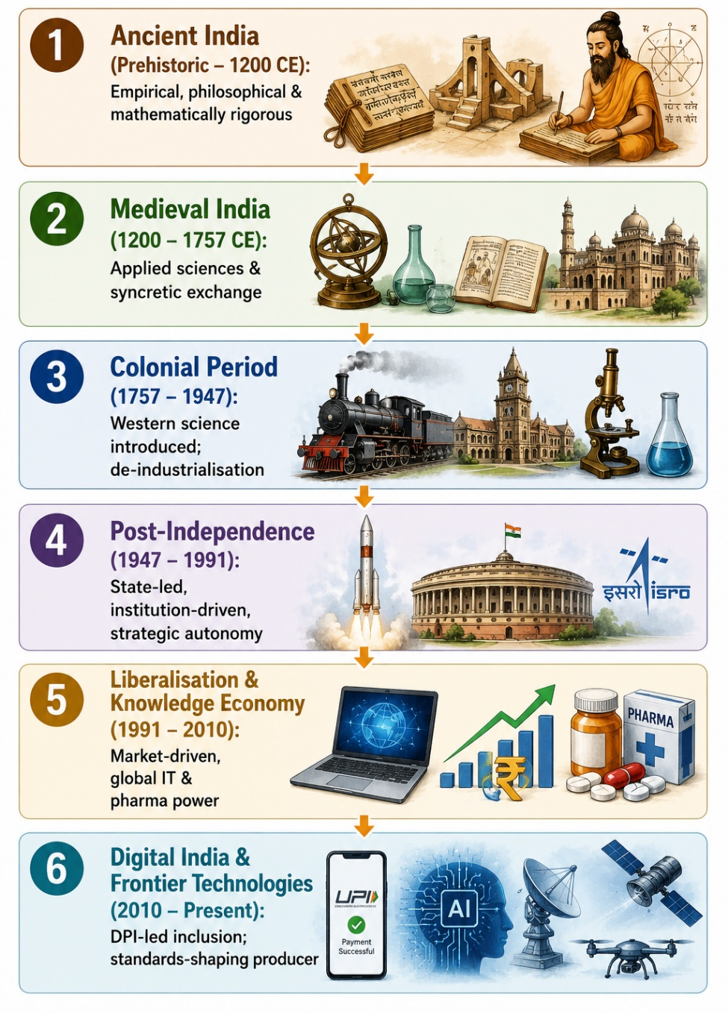
The story of Science and Technology in India is, in many ways, the story of a civilisation’s journey — from ancient glory, through colonial suppression, to post-independence resurgence, and now, into the frontier of global technological leadership. Let us trace this journey era by era.
🏛️Era Essence: Ancient Indian S&T was not primitive — it was empirical, philosophical, AND mathematically rigorous. India was a global knowledge leader, with original theoretical advances that influenced the world. Zero, surgery, steel — these were Indian gifts to civilisation.
Imagine trying to do mathematics without the number zero. No algebra, no calculus, no computers — nothing. When Brahmagupta of the 7th century CE formally defined zero and rules for negative numbers, he gave humanity one of its most powerful intellectual tools.
Brahmagupta (7th century CE): Formalised arithmetic rules for zero and negative numbers — revolutionary contributions that became the foundation of modern mathematics.
Aryabhata (5th century CE): Proposed Earth’s rotation on its axis (over 1,000 years before Galileo!), explained eclipses scientifically, approximated pi (π) ≈ 3.1416, and authored the landmark Aryabhatiya.
Varahamihira: Systematised astronomical knowledge in the Brihat Samhita, refining planetary motion and celestial calculations.
India formalised medicine as a science thousands of years before modern pharmacology. Two texts stand out as truly remarkable:
Text
Contribution & Significance
Charaka Samhita
Attributed to Charaka — a foundational Ayurvedic text systematising internal medicine, disease classification, diagnosis, and preventive care. It was the world’s first systematic textbook of internal medicine.
Sushruta Samhita
Authored by Sushruta — describes 300+ surgical procedures and 120 surgical instruments. Includes rhinoplasty (nose reconstruction), cataract surgery, and wound management. Sushruta is considered the Father of Surgery.
Wootz Steel: Ancient India produced high-quality wootz steel — ultra-high carbon steel — widely exported to West Asia, forming the basis of the world-famous Damascus Steel. European metallurgy could not replicate this for centuries.
Zinc Extraction: India pioneered early zinc extraction through distillation — a process the rest of the world discovered much later.
Indus Valley Civilisation (IVC):Advanced urban planning with grid layouts, drainage systems, and standardised weights — arguably the world’s first planned cities.
Iron Pillar of Delhi (4th century CE):A metallurgical marvel — standing for 1,600 years without significant rust. Its corrosion-resistant iron technology was so advanced that modern scientists took centuries to understand how it was made.
🕌Era Essence: Medieval India was not a period of stagnation — it was an era of APPLIED science and inter-civilisational synthesis. Persian-Arab knowledge merged with Indian classical traditions, producing remarkable advances in architecture, rocketry, medicine, and mathematics.
Jantar Mantar Observatories: Built by Sawai Jai Singh II (18th century) in Delhi, Jaipur, Ujjain, and Varanasi. These monumental masonry instruments improved the accuracy of celestial measurements with precision that rivalled — and sometimes exceeded — contemporary European instruments.
Kerala School of Mathematics: Advanced infinite series and trigonometric methods — anticipating aspects of calculus over 200 years before Newton and Leibniz! This is one of the most underappreciated contributions in the history of mathematics.
Unani-Ayurveda Synthesis: Integration of Unani (Perso-Arab) and Ayurveda created a syncretic medical culture, combining the best of both diagnostic and pharmacological traditions.
Rasashastra: Developed techniques in distillation, metal purification, and mineral-based medicines — contributing to early medicinal chemistry. Think of this as India’s version of early pharmaceutical science.
This is perhaps the most surprising section for many students. Medieval India was a technological powerhouse in engineering and military innovation:
Large Iron Cannons: Delhi Sultanate and Mughal periods had advanced metal casting for large iron cannons — demonstrating sophisticated metallurgy.
Mysorean Rockets (Tipu Sultan): Iron-cased rockets with bamboo sticks for stability — this influenced European rocketry! The British captured these after the fall of Seringapatnam (1799), and William Congreve’s famous rockets were directly inspired by Tipu’s design. India literally wrote the first chapter of modern rocketry.
Canal Engineering (Firoz Shah Tughlaq): Canal construction demonstrated applied hydraulic engineering for irrigation.
Mughal Architecture (Taj Mahal): Advanced load distribution, symmetry, double-dome design, and integrated water systems. The double dome creates insulation while the outer dome achieves visual grandeur — pure engineering elegance.
Rani ki Vav Stepwell (Gujarat): Sophisticated water conservation system — a UNESCO World Heritage Site demonstrating India’s mastery of hydraulic architecture.
⚠️Era Essence: The Colonial period is a tale of TWO stories happening simultaneously. On one hand, modern Western science arrived in India and new institutions were established. On the other hand, deliberate de-industrialisation dismantled India’s indigenous technological ecosystems. Yet, despite suppression, India produced world-class scientists who shone globally.
Institutional origins in 1767; laid the foundations of modern mapping and cartographic research in India.
Great Trigonometrical Survey (1802)
Famous for measuring the height of the Himalayas and establishing the Great Arc of India — one of the greatest surveying projects in history.
Geological Survey of India (1851)
Laid foundations of modern geological research — critical for mineral mapping and resource assessment.
Indian Association for Cultivation of Science (1876)
First research institution established by Indians — promoted scientific research by Indians for Indians.
Indian Institute of Science (1909)
Established in Bengaluru with Tata’s funding — strengthened higher scientific education and research. The IISc remains India’s premier research university today.
Even under colonial suppression, India produced some of the greatest scientific minds in history. Their stories are not just about science — they are about Indian pride and intellectual resilience:
Jagadish Chandra Bose: Pioneered research in radio waves and plant physiology. Demonstrated wireless communication using microwave apparatus in the 1890s — arguably before Marconi. Also proved plants feel and respond to stimuli.
C. V. Raman: Discovered the Raman Effect (1928) — Nobel Prize in Physics (1930). The first Asian to win a Nobel Prize in the sciences.
Satyendra Nath Bose: Developed Bose-Einstein Statistics in quantum theory — a work so profound that Einstein himself extended it, and an entire class of subatomic particles (Bosons) is named after Bose.
Meghnad Saha: Formulated the Saha Ionisation Equation — explained how stars are classified by temperature through their spectral lines. It opened the door to modern astrophysics.
🇮🇳Era Essence: Nehru called scientists and engineers ‘the builders of modern India’. This era was about CREATING FROM SCRATCH — building institutions, achieving nuclear capability, launching into space, and feeding a starving nation. The emphasis was on STRATEGIC AUTONOMY and SCIENTIFIC SELF-RELIANCE.
Apsara Reactor (1956): India’s first nuclear reactor — established at BARC, Trombay. Made India one of the few Asian nations with civilian nuclear capability.
Pokhran-I / Smiling Buddha (1974): India’s first nuclear test. Demonstrated India’s capability for a Peaceful Nuclear Explosion (PNE) — a major strategic milestone under PM Indira Gandhi.
Aryabhata Satellite (1975): India’s first satellite — launched by the Soviet Union on India’s behalf. Named after the great ancient astronomer. Marked India’s entry into the Space Age.
Green Revolution (1960s–70s): HYV (High Yielding Variety) seeds, expanded irrigation, and fertilisers — transformed India from a food-deficit nation to a food-surplus nation. Saved millions from starvation.
Early Electronics & Computing: Through ECIL (Electronics Corporation of India Limited) and TIFR (Tata Institute of Fundamental Research) — India began building domestic electronics and computing capacity.
💻Era Essence: 1991 was a turning point — India opened its economy and suddenly the world discovered Indian talent. Bengaluru became India’s Silicon Valley. TCS, Infosys, and Wipro became global names. India stopped being just a consumer of technology — it became a significant PRODUCER of software services.
IT Services Boom: Led by Infosys, TCS, and Wipro, Bengaluru emerged as a global tech hub. India became the world’s largest IT services exporter.
Telecom Revolution: Rapid expansion from 2G to 3G. Mobile phone penetration exploded — and with it, digital connectivity for millions of ordinary Indians.
PSLV Launches & Chandrayaan-1 (2008): ISRO established itself as a reliable, cost-effective launch vehicle provider. Chandrayaan-1 discovered water molecules on the Moon — a landmark discovery for lunar science.
Pokhran-II / Operation Shakti (1998): Five nuclear tests reinforced India’s nuclear deterrence under PM Vajpayee. India declared itself a full nuclear weapons state.
🚀Era Essence: India is no longer just a technology CONSUMER. It is now shaping global technology STANDARDS. From the UPI payment system being adopted worldwide, to Chandrayaan-3 landing where no nation had gone before — India is writing the next chapter of its S&T story.
India’s Digital Public Infrastructure is globally recognised as a model for inclusive technology. It is India’s greatest technology contribution to the 21st century — not just for India but for the developing world:
Aadhaar: World’s largest biometric identity system — 1.4+ billion people enrolled as of July 2026. Enables direct benefit transfer, eliminating middlemen.
UPI (Unified Payments Interface): India processes more digital payments than the USA and Europe combined on certain months. Singapore, UAE, France, and others have adopted or linked to UPI.
India Stack: The architecture of digital governance — Aadhaar + UPI + DigiLocker + eSign — making India’s government services paperless, faceless, and cashless.
CoWIN: COVID-19 vaccination management platform — administered 2.2 billion vaccine doses with real-time tracking. Many nations studied this model.
ONDC (Open Network for Digital Commerce): India’s answer to e-commerce monopolies — an open protocol for digital trade, like UPI for shopping.
National Quantum Mission: Approved in 2023 with ₹6,003 crore funding — aims to build quantum computers, communication systems, and sensing devices. Positions India among global quantum leaders.
Semiconductor Mission (India Semiconductor Mission): Aims to build domestic semiconductor fabrication — ending India’s dependence on imported chips.
National Supercomputing Mission: Building high-performance computing infrastructure — Param Siddhi AI ranked among world’s top 500 supercomputers.
5G Rollout & 6G Research: India rolled out 5G nationally in 2022–23; already researching 6G to avoid being a technology follower again.
Genome India Project: Sequencing 10,000 Indian genomes to build a reference database for personalised medicine, disease prediction, and drug development tailored to Indian genetics.
International Solar Alliance (ISA): India’s diplomatic-scientific initiative — 120+ nations pooling solar energy resources. India positioned as the global leader in solar transition.
Green Hydrogen Mission: Aims to make India a global hub for green hydrogen production and export — a potential energy superpower transition.
Nano Urea: IFFCO developed Nano Urea — liquid fertiliser in a tiny bottle replacing a 45 kg bag. Reduces chemical use, lowers import bills, and improves soil health.
e-NAM (Electronic National Agriculture Market): Digital marketplace for farmers — transparent price discovery, reduced middlemen.
The Internet is the single most impactful invention of the 20th century — more impactful than the automobile or the television, because it contains and accelerates all other technologies. The Internet is a global network of interconnected computers and communication systems that allows users to share information, access services, and communicate across long distances. It…
Space Debris: The Scattered Danger in Orbit Let’s begin with a small everyday picture. Imagine you are driving on a highway at 100 km/h, and suddenly a tiny pebble flies up and hits your windscreen. Even at that modest speed, a small stone can crack the glass. Now take that same scene and move it…
Militarisation of Space There is an important conceptual distinction you must remember: Militarisation vs. Weaponisation. Militarisation is using space to SUPPORT military operations — like using GPS for troop coordination. Weaponisation is placing or using WEAPONS in space itself. The Outer Space Treaty (1967) does not ban militarisation. It only bans WMDs in orbit. This…
Space Traffic Management (STM) Think of outer space as a busy international airspace — except there is no Air Traffic Control, no unified radar network, no binding rules for who gives way to whom, and no international police. Over 9,000 active satellites and millions of debris fragments share the same sky. Without STM, catastrophic collisions…
Major Lunar Missions — The Story of the Moon The Moon has always been humanity’s first space destination — simply because it is the nearest. But getting there was never a straight line; it was a clear evolution: first we went just to take photographs, then we attempted soft landings, then we sent humans, and…
Introduction to Satellites Long before we had the word ‘satellite’, the Moon was doing its job — faithfully orbiting Earth, influencing tides, and guiding ancient navigators. Today, humanity has sent over 9,000+ artificial satellites into orbit (though not all are active). These metal messengers in the sky touch almost every aspect of modern life —…