
UPSC CURRENT AFFAIRS — 15 OCTOBER 2026
1. Power, Water and Payback: NITI Aayog’s Rulebook for India’s AI Data-Centre Boom
(SCIENCE AND TECHNOLOGY) (IE) A framework prepared by the Frontier Tech Hub of the NITI Aayog asks States to approve data centres only after checking grid readiness, long-term water availability and measurable economic returns — not investment pledges alone. It comes as the Centre works on a dedicated data-centre policy amid rapid AI-driven expansion.
Why data centres matter now
A data centre houses servers, storage and networking equipment that process and store digital data. AI workloads pack thousands of power-hungry GPUs into one campus, so modern facilities need continuous electricity and heavy cooling. They form the physical layer of India’s digital infrastructure.
| Indicator | Figure |
| India’s data-centre capacity (mid-2026) | About 1.6 GW |
| Projected capacity by 2029 | About 6 GW |
| Investment needed to reach 6 GW | Around $110 billion |
| Flagship project | Google’s $15-billion AI infrastructure investment in Visakhapatnam |
Capacity estimates are from the real-estate consultancy JLL, as reported in the source article.
What the framework proposes
| Area | Key proposal |
| Electricity | A joint Power Readiness and Ramp-up Plan by developer, DISCOM and State transmission utility before approval; additional load only after upgrades are commissioned |
| Large loads | Facilities above 20 MW to have automated demand-response and integration with State Load Dispatch Centres |
| Grid costs | Developers pay for dedicated infrastructure; shared upgrades split among beneficiaries |
| Water | A 20–30-year water-availability assessment by States; allocations must not cut supplies to existing users; metering and treated wastewater in water-stressed areas |
| Incentives | Calculate net economic contribution after subsidies; release incentives against milestones such as jobs, local procurement, R&D and renewable use; suspend them if commitments are missed |
| Location | Notify data-centre-ready zones and restrict development in environmentally vulnerable areas; community impact assessments for large campuses |
| Oversight | A centralised compliance audit with MeitY as the nodal ministry |
The approval logic in one line
Grid and water readiness verified ➜ Net economic benefit assessed ➜ Milestone-linked incentives ➜ Periodic MeitY-led audit
Why the caution?
- Grid stress: Clustered loads can strain local networks and push up tariffs for ordinary consumers — a concern raised by the Union Minister of State for Electronics and IT.
- Water competition: Evaporative cooling can compete with drinking water and irrigation in peri-urban areas (see Water Conservation).
- Few permanent jobs: Data centres are capital-intensive and employ relatively few people once built, so large subsidies need clear returns.
- Local opposition: Residents near a proposed 422-MW campus in Thane, planned with 193 backup diesel generators, have protested over power, water, noise and pollution.
- Waste and emissions: Diesel backup and short hardware cycles add to air pollution and e-waste.
Way forward
- Plan ahead of demand: Build transmission and renewable evacuation capacity in designated zones.
- Efficiency metrics: Mandatory reporting of power usage effectiveness, water use and carbon intensity.
- Green power: Renewable energy backed by storage, recognised only once operational and verified.
- Policy coherence: Align the coming national data-centre policy with AI governance and data-protection goals.
📖 Read More: Digital Infrastructure in India • Artificial Intelligence (AI) • AI Governance • Electronic Waste (E-Waste) • Water Conservation
2. Mending the Planet’s Forests: FAO’s State of the World’s Forests 2026 Puts Restoration Centre-Stage
(ENVIRONMENT) (FAO) The Food and Agriculture Organization (FAO) has released The State of the World’s Forests (SOFO) 2026, focused on forest and landscape restoration. It warns that forests are being degraded faster than they recover and that at least 470 million hectares must be brought under restoration by 2030 to meet global goals.
Key numbers
| Indicator | Figure |
| Degraded forests worldwide | More than 460 million ha |
| Degraded land overall | About 1.56 billion ha — over 10% of the world’s land |
| Restoration pledged in two decades | More than 1 billion ha |
| Needed under restoration by 2030 | At least 470 million ha |
| Annual cost of inaction on land degradation | $878 billion to $6.3 trillion |
The report notes that degraded land alone is roughly 5.2 times India’s land area (SOFO 2026).
Four pathways to restoration
People: rights & participation ➜ Land: landscape-level planning ➜ Finance & business: fit-for-purpose funding ➜ Policy & law: coherent institutions
The report argues that restoration is context-specific: a dryland savannah, a coastal mangrove and a mountain forest each need different methods, from natural regeneration and agroforestry to soil and water conservation.
Case studies worth remembering
- Great Green Wall (Sahel): Launched by the African Union in 2007; evolved from tree planting into community-led landscape development.
- China’s Three-North (“Green Great Wall”) Programme: Running since the late 1970s against desertification; its current phase favours mixed, native vegetation.
- Demak, Indonesia: Permeable barriers trap sediment so mangroves regenerate naturally, protecting about 10,000 people from erosion.
Where India stands
India ranks 9th in global forest area and 3rd in annual net forest-area gain in the Global Forest Resources Assessment 2025, which feeds into SOFO 2026. Domestic efforts include the Green India Mission and compensatory afforestation, tracked through the India State of Forest Report.
Gaps the report flags
- Hectares over quality: Monitoring counts area planted rather than ecological recovery and community benefit.
- Insecure tenure: Unclear land rights discourage long-term stewardship (see Forest Rights and Conservation Strategies).
- Finance gaps: Pledges are rarely matched by multi-year funding for post-planting care.
- Policy conflict: Subsidies in other sectors can drive the very land-use change that restoration tries to reverse.
📖 Read More: Land Degradation and Conservation • India State of Forest Report (ISFR) • Forest Governance and Legal Frameworks • UNCCD • Forest Rights and Conservation Strategies
3. Beyond Species, Whole Habitats: Keralam Launches India’s First Ecosystem Red List Assessment
(ENVIRONMENT) (TH) Keralam has begun India’s first State-level Red List of Ecosystems (RLE) assessment, which rates the risk of collapse of entire ecosystems rather than individual species. Early findings show that the State’s tropical riparian evergreen forests in the southern Western Ghats have lost about 83% of their extent over the past century.
Species list vs ecosystem list
| Feature | IUCN Red List of Threatened Species | IUCN Red List of Ecosystems |
| Unit assessed | Individual species | Whole ecosystems (forests, wetlands, grasslands, coasts) |
| End point | Extinction | Collapse — loss of defining features and functions |
| Criteria | Population size, decline, range | Five criteria (A–E): decline in extent, restricted distribution, environmental degradation, disrupted biotic processes, quantitative risk analysis |
| Top threat category | Critically Endangered (CR) | Critically Endangered (CR); “Collapsed” (CO) for lost ecosystems |
The global methodology is maintained by the IUCN Red List of Ecosystems.
What the assessment has found so far
- Riparian evergreen forests: About 83% loss, driven by dams, invasive plantations and climate extremes; rated Critically Endangered, with possible collapse within 20–40 years.
- Other habitats at risk: Myristica swamps, high-altitude shola–grassland mosaics and coastal mangroves, threatened by urban expansion and sea-level rise (see Wetland Ecosystem).
How it will be used
Map ecosystem types ➜ Apply IUCN criteria A–E ➜ Risk register & typology atlas ➜ Restoration priorities for panchayats & BMCs
The State Biodiversity Board is backing the exercise, and outputs are expected to feed local planning through Biodiversity Management Committees under the Biological Diversity Act, 2002.
Why it matters
- Landscape thinking: Saving a species fails if its habitat collapses; ecosystem lists target the root problem.
- Disaster risk: Healthy wetlands, mangroves and forests buffer floods, landslides and storm surges — critical in a hotspot like the Western Ghats.
- Model for others: A State-level RLE can guide restoration spending and land-use decisions elsewhere in India.
📖 Read More: Biodiversity Hotspots • Terrestrial Ecosystems or Biomes • Wetland Ecosystem • National Initiatives for Biodiversity Conservation
4. The Chemicals That Never Leave: PFAS Contamination Surfaces in India’s Waters
(ENVIRONMENT) (TH) Studies across India have reported per- and polyfluoroalkyl substances (PFAS) — the so-called “forever chemicals” — in drinking-water sources, sewage and coastal waters. The findings have revived calls for national monitoring and drinking-water limits for these persistent pollutants, which are classed as hazardous chemicals.
What are PFAS?
PFAS are thousands of synthetic chemicals built around very strong carbon–fluorine bonds. That bond makes them water-, grease- and heat-resistant — ideal for non-stick cookware, stain-proof fabrics, food packaging and firefighting foams — but also nearly impossible to break down in nature.
Why they are a problem
Industrial & consumer use ➜ Release to water, soil & air ➜ Persistence & long-range travel ➜ Bioaccumulation in food chains & humans
- Persistence: They resist heat, microbes and conventional treatment, so standard chlorination and filtration remove little.
- Mobility: Many dissolve readily and spread through groundwater, rivers and oceans.
- Health links: Exposure is associated with certain cancers, thyroid disease, high cholesterol, reduced immune response and developmental effects (evidence summary).
Key compounds and global controls
| Compound | Typical use | Status |
| PFOA | Non-stick coatings, fluoropolymer production | IARC Group 1 (carcinogenic to humans); listed under the Stockholm Convention in 2019 |
| PFOS | Firefighting foams, stain repellents, metal plating | IARC Group 2B (possibly carcinogenic); listed under the Stockholm Convention in 2009 |
| PFHxS | Firefighting foams, surfactants | Listed under the Stockholm Convention as a persistent organic pollutant |
India’s gaps and the way forward
- No dedicated standard: India’s drinking-water specifications do not yet set limits for most PFAS.
- Monitor hotspots: Survey water near industrial clusters, airports, firefighting training sites and landfills.
- Treatment technology: Activated carbon, ion exchange and reverse osmosis can remove many PFAS from drinking water.
- Source control: Phase out non-essential uses and promote safer alternatives in line with global chemical conventions.
📖 Read More: Hazardous Waste — PFAS • Water Pollution • Water Pollution Control Measures • Pollution Related Laws
5. Spiral Horns Return: Chhattisgarh Reintroduces Blackbuck to Gomarda after Five Decades
(ENVIRONMENT) (IE) Chhattisgarh is translocating 50 blackbucks from Barnawapara Wildlife Sanctuary to Gomarda Wildlife Sanctuary in Sarangarh-Bilaigarh district. The antelope vanished from the region by the 1970s due to hunting, poaching, encroachment and development, and has been locally extinct there for over 50 years.
How the revival unfolded
2017–18: 77 blackbucks brought to Barnawapara ➜ Soft release from enclosures ➜ Herd grows to over 150 ➜ 2026: 50 moved to Gomarda
Of the original 77, 50 came from the National Zoological Park, New Delhi and 27 from Kanan Pendari Zoo, Bilaspur. The two sanctuaries lie about 70 km apart in the same landscape, and Gomarda offers grasslands and reliable water.
Know the species
| Feature | Details |
| Scientific name | Antilope cervicapra — the only living member of its genus |
| Habitat | Open grasslands and plains of the Indian subcontinent; a grazer |
| Look | Males have long, spiralling horns and a dark upper coat; females are fawn-coloured |
| IUCN status | Least Concern (not Endangered, as sometimes reported) |
| Legal protection | Schedule I of the Wild Life (Protection) Act, 1972 — highest protection |
Know the sanctuaries
- Barnawapara (Baloda Bazar): Undulating terrain with teak, sal and mixed forests; bounded by Mahanadi tributaries; home to gaur, chital, sambar and nilgai.
- Gomarda (near Sarangarh): Dry deciduous forest, rolling hills, grasslands and reservoirs suited to blackbuck (see Wildlife Sanctuaries in India).
Why reintroductions succeed — or fail
- Habitat first: Grassland quality and water decide survival more than numbers released.
- Threats remain: Free-ranging dogs and jackals prey on fawns; grassland conversion is a long-term risk.
- Community gains: Officials expect wildlife tourism and local jobs, which build support for conservation.
📖 Read More: Wildlife Sanctuaries in India • Species of Conservation Concern: Mammals • Wild Life (Protection) Act, 1972 • Conservation of Major Indian Wildlife Species
6. A New Name, a Wider Net: NSAP Becomes the Pradhan Mantri Samajik Sahayata Yojana
(SOCIAL JUSTICE) (PIB) The Union Cabinet has approved continuing the National Social Assistance Programme (NSAP) for five years (2026–27 to 2030–31) with an outlay of ₹53,428 crore, and renamed it the Pradhan Mantri Samajik Sahayata Yojana. Disability pensions have been significantly widened.
Old names, new names
| Earlier name | New name |
| National Social Assistance Programme (NSAP) | Pradhan Mantri Samajik Sahayata Yojana |
| Indira Gandhi National Old Age Pension Scheme | Pradhan Mantri Vridhavastha Pension Yojana |
| Indira Gandhi National Widow Pension Scheme | Pradhan Mantri Vidhawa Pension Yojana |
| Indira Gandhi National Disability Pension Scheme | Pradhan Mantri Divyangjan Pension Yojana |
| National Family Benefit Scheme | Pradhan Mantri Parivar Labh Yojana |
What changes for persons with disabilities
| Feature | Earlier | Now |
| Disability threshold | 80% (severe) | 40% benchmark disability |
| Minimum age | 18 years | From birth |
| Monthly central assistance | — | ₹375 (0–79 years); ₹625 (80 years and above) |
The 40% benchmark aligns the scheme with the Rights of Persons with Disabilities Act, 2016. Revised guidelines are to be issued and implemented within three months.
Scheme at a glance
- Coverage: About 3.20 crore beneficiaries across all 36 States/UTs (Cabinet decision).
- Nature: Non-contributory, centrally funded assistance to poor elderly persons, widows, persons with disabilities and bereaved households; States often top up amounts.
- Origins: Launched on 15 August 1995, it gives effect to Article 41 (right to public assistance in old age, sickness and disablement) — a Directive Principle.
- Administration: Department of Rural Development, Ministry of Rural Development.
Issues to watch
- Adequacy: Central assistance is modest relative to living costs; State top-ups vary widely.
- Exclusion errors: Reliance on BPL lists and documentation can leave out eligible people.
- Delivery: Timely DBT payments and Aadhaar-related failures affect the most vulnerable (see Vulnerable Sections and Social Justice).
📖 Read More: National Social Assistance Programme (NSAP) • Senior Citizens, Persons with Disabilities… • Vulnerable Sections and Social Justice • Concept and Nature of DPSPs
7. Festival of Festivals: Nagaland Readies the 27th Hornbill Festival
(HISTORY) (DD) Nagaland has begun preparations for the 27th Hornbill Festival, to be held from 1 to 10 December 2026 at the Naga Heritage Village, Kisama, about 12 km from Kohima. Chief Minister Neiphiu Rio chaired a review meeting urging coordination between departments and local communities.
Festival at a glance
| Feature | Details |
| Began | 1 December 2000, by the Government of Nagaland |
| Timing | 1–10 December, opening on Statehood Day (Nagaland became the 16th State on 1 December 1963) |
| Venue | Naga Heritage Village, Kisama |
| Participants | All 17 major Naga tribes and their sub-tribes |
| Scale | More than 300 events; grew from three days to five, then ten |
| Organisers | State departments of Tourism and Art & Culture |
Why the hornbill?
The festival is named after the great hornbill, a bird revered in Naga folklore; its feathers traditionally adorn ceremonial headgear as a symbol of valour. The bird itself is protected under Schedule I of the Wild Life (Protection) Act, so modern regalia often use substitutes.
What you see at Kisama
- Morungs: Each tribe builds a traditional bachelors’ dormitory (morung), showcasing distinct architecture.
- Living heritage: Folk songs, war dances, indigenous games, wood carving, weaving and cuisine.
- Modern stage: Rock concerts, fashion shows and film screenings alongside traditional events.
Significance
- Inter-tribal unity: A shared platform that strengthens a common Naga identity while respecting diversity (see Tribes of North-East India).
- Tourism economy: Draws domestic and foreign visitors, supporting artisans and homestays (see Tourism).
- Culture as soft power: Showcases the North-East as part of India’s cultural diversity.
📖 Read More: Festivals in India • Fairs in India • Tribes of North-East India • Places of Cultural Importance
8. From Observer to Rule-Maker: India Joins the Southern Indian Ocean Fisheries Agreement
(INTERNATIONAL RELATIONS) (PIB) The Centre has approved India’s accession to the Southern Indian Ocean Fisheries Agreement (SIOFA). India, a Cooperating Non-Contracting Party since 2022, will become a full Contracting Party with voting rights in decisions on high-seas fishing in the southern Indian Ocean.
SIOFA at a glance
| Feature | Details |
| Type | Regional Fisheries Management Organisation (RFMO) |
| Signed / in force | Rome, 7 July 2006 / June 2012 (SIOFA) |
| Secretariat | La Réunion (France) |
| Scope | Fish, molluscs, crustaceans and other sedentary species on the high seas — excluding highly migratory species (UNCLOS Annex I) and sedentary species under coastal-state jurisdiction |
| Key species | Squid, toothfish, alfonsino and other non-migratory stocks |
| Contracting Parties (before India) | Ten, including Australia, China, the EU, France, Japan, Republic of Korea, Mauritius, Seychelles and Thailand |
SIOFA vs IOTC
| SIOFA | Indian Ocean Tuna Commission (IOTC) | |
| Species | Non-tuna, non-migratory stocks | Tuna and tuna-like species |
| India’s status | Contracting Party (accession approved Oct 2026) | Contracting Party since 1996 |
What full membership brings
- A seat at the table: Full participation in the Scientific and Compliance Committees and binding decisions.
- Access: Indian-flagged vessels can undertake authorised fishing within SIOFA’s area, building on the High Seas Fisheries Guidelines (December 2025).
- Data: Access to stock assessments, research programmes and scientific data.
- Enforcement: India joins the High Seas Boarding and Inspection scheme against illegal, unreported and unregulated (IUU) fishing.
Why it matters
The high seas cover about 65% of the ocean but are dominated by a handful of distant-water fleets, while Indian vessels fish mostly close to the EEZ. Membership supports a rules-based Blue Economy and India’s maritime outreach under the Laws of the Sea.
Coastal fishing within EEZ ➜ High-seas guidelines (2025) ➜ SIOFA membership ➜ Sustainable deep-sea fishing
📖 Read More: Laws of the Sea • Fishing Industry • Blue Revolution Initiative • Indian Ocean • Coastal and Maritime Security
9. Made in India, Built with Prague: India and Czech Republic Deepen Defence-Industrial Ties
(INTERNATIONAL RELATIONS) (DD) Defence Minister Rajnath Singh and Czech Deputy Prime Minister and Industry and Trade Minister Karel Havlíček agreed in New Delhi on 13 October 2026 to expand defence-industrial cooperation, with a focus on joint ventures, Make in India and Aatmanirbhar Bharat.
What was agreed
- Review: Both sides reviewed the full range of defence-industrial cooperation and welcomed existing joint ventures.
- Mechanism: Ties will be strengthened through the India–Czech Joint Defence Committee.
- Visit agenda: The Czech minister’s four-day visit includes meetings with ministries and industry, and site visits in Bengaluru and Mumbai.
Know the partner
| Feature | Details |
| Location | Landlocked Central European country; capital Prague |
| Groupings | Member of the European Union and NATO |
| Industrial strengths | Engineering, automobiles, machinery, small arms, armoured vehicles and aviation components |
Why it matters for India
- Diversification: Reduces dependence on a few large suppliers by adding mid-sized European partners.
- Co-production: Technology partnerships with Indian firms support defence exports and supply-chain resilience.
- EU link: Complements India’s wider engagement with Europe.
Imports ➜ Licensed production ➜ Joint ventures ➜ Co-development & exports
📖 Read More: India and Europe • Make in India Initiative • Miscellaneous Schemes under Ministry of Defence
10. Seafarers in the Crossfire: India Condemns Attacks on Merchant Ships in the Black Sea
(INTERNATIONAL RELATIONS) (DD) The Ministry of External Affairs has condemned attacks on three commercial vessels in the Black Sea — the Togo-flagged Alfa Watan, Palau-flagged Able and Liberia-flagged Aframax Rio — and called for an immediate end to attacks on shipping. Indian sailors were aboard two of the ships.
Indians on board
| Vessel | Flag | Indian crew |
| Able | Palau | 7 of 18 crew; one injured; all evacuated to Varna, Bulgaria |
| Aframax Rio | Liberia | All 23 crew Indian; all rescued |
| Alfa Watan | Togo | Status of crew awaited at the time of the statement |
India is one of the world’s largest suppliers of seafarers, so attacks on shipping lanes directly endanger Indian lives. The MEA thanked Bulgarian authorities for their support.
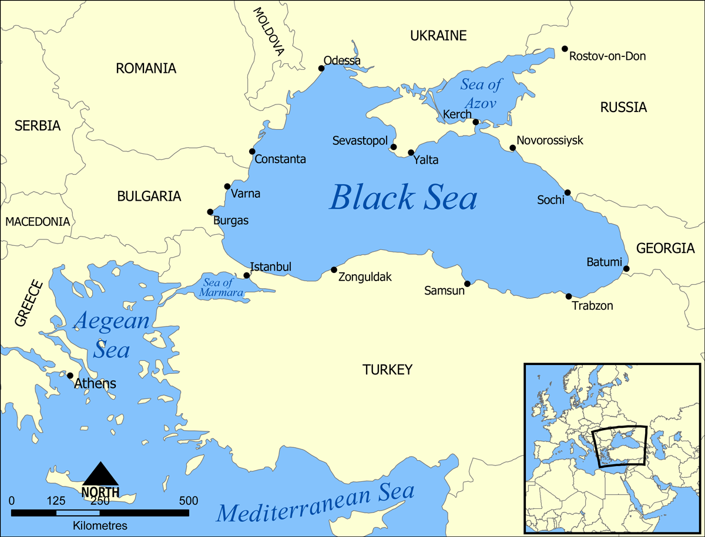
Black Sea: map facts
- Bordering countries: Ukraine, Russia, Georgia, Türkiye, Bulgaria and Romania (Black Sea).
- Outlets: Linked to the Mediterranean through the Bosporus, the Sea of Marmara and the Dardanelles (the Turkish Straits); the Kerch Strait connects it to the Sea of Azov.
- Unique feature: Over 90% of its deep water is anoxic (oxygen-free) below a density boundary at roughly 100–200 m.
- Straits regime: Under the 1936 Montreux Convention, Türkiye controls the Turkish Straits while merchant ships enjoy free passage.
Black Sea ➜ Bosporus ➜ Sea of Marmara ➜ Dardanelles ➜ Aegean & Mediterranean
Why it matters
- Food and energy: The sea carries grain and oil exports from the region to world markets.
- Seafarer welfare: Calls for safe corridors, quick evacuation and insurance support for crews.
- India’s stand: Consistent calls for de-escalation and protection of civilian shipping, in line with its maritime interests (see Maritime Foreign Policy Strategy).
📖 Read More: Political Map of Europe • Important Facts about Europe • Laws of the Sea • Maritime Foreign Policy Strategy
11. The World’s Oil Valve: Container Ships Hit in the Strait of Hormuz
(GEOGRAPHY) (NOA) Two Singapore-registered container ships were struck by unknown projectiles while transiting the Strait of Hormuz. GFS Pride caught fire and sank, while GFS Giselle suffered hull damage but reached safe anchorage; all crew on both ships were evacuated safely. Singapore’s maritime authority condemned the attacks.
Locating the strait
| Feature | Details |
| Connects | The Persian Gulf (west) with the Gulf of Oman and Arabian Sea (south-east) — the only sea channel linking them (Britannica) |
| Shores | Iran to the north; Oman’s Musandam exclave to the south |
| Islands | Hormuz, Qeshm and Larak; Abu Musa and the Greater and Lesser Tunbs are held by Iran but claimed by the UAE |
| Legal regime | Transit passage for international straits under UNCLOS |
Why the world watches it
| Indicator (2024) | Value |
| Oil flow | About 20 million barrels per day |
| Share of global petroleum liquids consumption | About 20% |
| Share of global LNG trade | Roughly one-fifth, mostly from Qatar |
| Share of crude/condensate flows going to Asia | 84% |
Figures are from the US Energy Information Administration.
What it means for India
- Energy security: A large part of India’s crude and LNG imports comes from Gulf suppliers whose cargoes pass through Hormuz (see Oil and Energy Diplomacy).
- Prices and inflation: Disruptions raise freight and insurance costs and push up oil prices.
- Diaspora and crews: Millions of Indians live in the Gulf, and many Indian seafarers work these routes.
- Hedging options: Strategic petroleum reserves, diversified suppliers, and links such as Chabahar and Oman’s Duqm port reduce vulnerability (see India and West Asia Policy).
Gulf producers ➜ Strait of Hormuz ➜ Arabian Sea ➜ Indian refineries
📖 Read More: India and West Asia Policy • India – Iran Relations • India and Oman Relations • Oil and Energy Diplomacy • Political Map of Asia
12. Gold in the Welsh Hills: Assam Regiment Shines at Exercise Cambrian Patrol 2026
(INTERNAL SECURITY) (TOI) (ANI) A patrol team from the Indian Army’s Assam Regiment won a Gold Medal at Exercise Cambrian Patrol 2026, held in Wales, United Kingdom, from 2 to 12 October. More than 100 teams from around the world took part, and the Indian team was one of only 10 to earn gold.
The exercise at a glance
| Feature | Details |
| Began | 1959, in Wales (Cambrian Patrol) |
| Organiser | British Army |
| Format | Eight-member teams cover about 65 km of mountainous terrain in under 48 hours |
| Tasks | Navigation, reconnaissance, casualty evacuation, river crossings and combat drills under fatigue |
| Assessment | Gold, silver, bronze or pass — judged against set standards, not a race between teams |
Why it is called the “Olympics of patrolling”
Physical endurance ➜ Navigation & fieldcraft ➜ Tactical decision-making ➜ Leadership under stress
Significance
- Professional benchmark: Gold reflects junior leadership and small-team skills valued in counter-insurgency and high-altitude operations.
- Military diplomacy: Builds ties with the British Army and other forces, complementing India–UK relations.
- The regiment: Raised in 1941, the Assam Regiment draws heavily from the North-East and has served across conflicts and UN missions.
📖 Read More: Armed Forces and Internal Security • India – United Kingdom Relations
13. A Horse Built from E-Waste: India’s First Cyber Trojan Horse Unveiled at c0c0n Kochi
(INTERNAL SECURITY) (TH) The Trojan Project, billed as India’s first Cyber Trojan Horse, was unveiled at c0c0n 2026, the 19th edition of the cybersecurity and hacking conference in Kochi organised by the Keralam Police with the Information Security Research Association. The installation aims to make cyber threats easier for the public to grasp.
The installation
- Scale: A 25-ft horse weighing about two tonnes.
- Material: Built by artist DaVinci Suresh from about 850 pieces of e-scrap — motherboards, processors, memory modules, circuit boards and cables.
- Twin message: Cyber safety and responsible e-waste management.
- Child safety: Launched with Childlight – Global Child Safety Institute (hosted by the University of Edinburgh) to raise awareness of online child sexual exploitation.
What is a Trojan?
A Trojan is malicious software disguised as a legitimate file or app. Once the user opens it, it can steal data, spy or open a backdoor for attackers. Unlike other malware, it needs the victim’s action to get in.
| Malware | How it spreads | Self-replicates? |
| Virus | Attaches to files and spreads when they are shared or run | Yes |
| Worm | Moves across networks on its own | Yes |
| Trojan | Disguised as harmless software; user installs it | No |
| Ransomware | Encrypts data and demands payment; often delivered by Trojans or phishing | Varies |
How a Trojan attack unfolds
Lure (fake app, email, link) ➜ User installs ➜ Backdoor opened ➜ Data theft or remote control
Staying safe
- Verify sources: Install apps only from official stores; check sender details before opening attachments.
- Update and protect: Keep systems patched and use reputable security software.
- Report: Cyber fraud can be reported at cybercrime.gov.in or helpline 1930 (see India’s Cyber Security Framework).
📖 Read More: Understanding Cyber Security and Cyber Threats • Cybersecurity • India’s Cyber Security Framework • Electronic Waste (E-Waste)