
UPSC CURRENT AFFAIRS — 7 OCTOBER 2026
Living Longer, Ageing Well: India’s Silver Transition
(SOCIETY) (STV) India is greying faster than it is growing. The elderly (60+) population is rising at roughly 3% a year, against overall population growth of under 1%. A recent national discussion asked how the country can turn this shift into a healthy ‘silver economy’ instead of a care crisis.
The numbers behind the shift
| Indicator | What the data shows |
| Elderly population, 2022 | About 14.9 crore people, or 10.5% of the population |
| Projection, 2050 | About 34.7 crore, or 20.8% — roughly one in every five Indians |
| Crossover point | By around 2046 the elderly are expected to outnumber children below 15 |
| Feminisation of ageing | Women form the larger share of the very old, and widows make up a large part of older women |
These projections come from the India Ageing Report 2023, prepared with the UN Population Fund. They show that the ageing population is growing fast and that the window of the demographic dividend is real but time-bound.
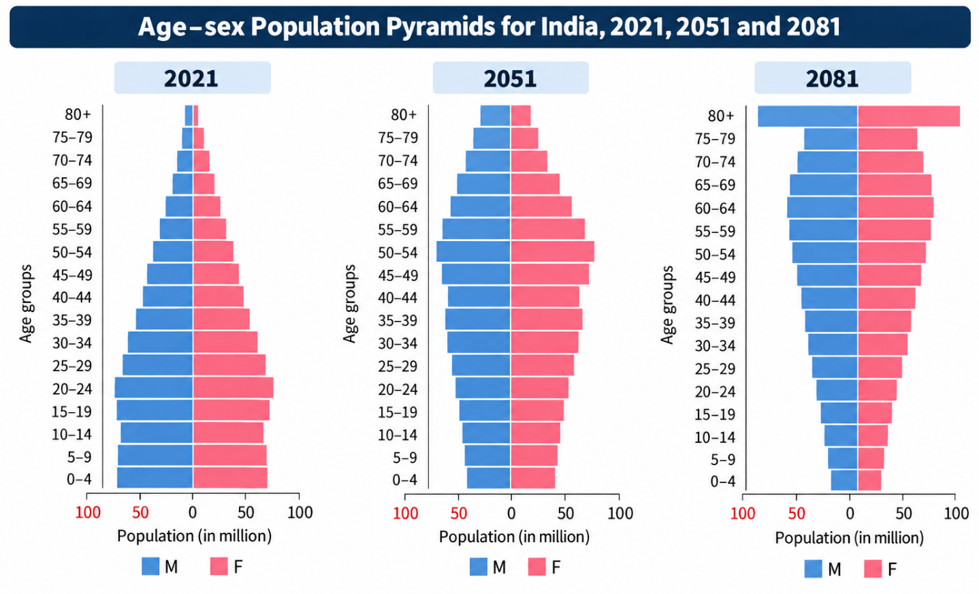
Population Crossovers and India’s Ageing Dynamics | Economic and Political Weekly
Why ageing in India is different
- Early onset of chronic disease: Diabetes and hypertension now appear in the 30s and 40s, so people may enter old age already carrying long-term conditions.
- Longer life, not always healthier life: Lifespan has risen faster than ‘healthspan’ — the years lived free of serious illness or disability.
- Loss of muscle and balance: Age-related muscle loss (sarcopenia) raises the risk of falls, fractures and dependency.
- Changing families: The shift from joint to nuclear households weakens traditional home-based care.
- Hospital-centric system: Care is skewed towards costly inpatient treatment instead of community and home support.
What the State already offers
| Intervention | Purpose |
| Ayushman Bharat PM-JAY | Hospitalisation cover of ₹5 lakh a year; extended to all citizens aged 70+ irrespective of income |
| National Programme for Health Care of the Elderly (NPHCE) | Dedicated geriatric services from district hospitals to sub-centres, with National Centres of Ageing and regional geriatric centres |
| Ayushman Arogya Mandirs | Primary-care centres under the National Health Mission for screening and managing chronic illness |
| Atal Pension Yojana | Contributory pension for old-age income security |
| SAGE and IPSrC | Support for senior-care start-ups and for NGOs running homes and day-care centres |
Building a healthy silver economy
Train ASHAs in geriatric care ➜ Strength and balance exercise ➜ Assistive tech and fall sensors ➜ Community care networks ➜ Active, independent ageing
- Prevention first: Make resistance training and balance exercise part of public health messaging from middle age.
- Technology for independence: Affordable robotics, home automation and wearable fall-detection can extend independent living.
- Care as an economy: Formal training for caregivers creates jobs while meeting need.
- Intergenerational bonds: Programmes that link the old and the young reduce isolation and keep elders socially active.
📖 Read More: Senior Citizens, Persons with Disabilities, LGBTQIA+ Communities and Minorities • Population and Associated Issues • Health: A Social Perspective • Ayushman Bharat – PM-JAY
Dignity in Transit: Kerala’s WOMN Scheme for Menstrual Needs
(SOCIAL JUSTICE) (TH) Kerala has launched the Women on the Move and Menstrual Needs (WOMN) scheme, placing sanitary-napkin vending machines and incinerators at KSRTC bus terminals. The aim is simple: no woman should have to cut short a journey because of an unexpected period.
The scheme at a glance
| Feature | Details |
| Nodal department | Kerala’s Women and Child Development Department |
| First phase | 14 KSRTC bus terminals, with machines placed near washrooms |
| Price | ₹10 for a packet of three napkins |
| Partners | KSRTC runs the machines and incinerators; HLL Lifecare supplies napkins and trains staff |
| Disposal | Incinerators installed alongside every vending machine |
| Next steps | Extension to more depots, tourist centres and other public places |
Why it matters
- Mobility and work: Safe, predictable facilities make long commutes and travel easier, supporting women-led development.
- Dignity in public spaces: Menstrual needs are treated as a basic public amenity, not a private embarrassment.
- Affordability: A low, fixed price widens access for daily-wage and low-income travellers.
- Sanitation link: On-site disposal prevents napkins from clogging toilets or ending up in open waste — a gap that schemes like Swachh Bharat Mission (Grameen) also target.
Need arises during travel ➜ Vending machine at terminal ➜ ₹10 pack of three ➜ Incinerator disposal ➜ Safe, dignified journey
Challenges to watch
- Upkeep: Machines often fail when refilling and repairs are neglected; clear service standards are needed.
- Emissions: Small incinerators must meet pollution norms to stay truly eco-friendly.
- Scale: Fourteen terminals are a start; rural bus stands and highways need coverage too.
For the ethics paper, the scheme is a neat example of empathy and gender sensitivity built into routine public service design. It complements other women and child development schemes.
📖 Read More: Equality, Empowerment and Women-led Development • Role of Women and Women’s Organisations in Indian Society • Miscellaneous Schemes for Women and Child Development
Aichi–Nagoya 2026: Reading India’s Asian Games Report Card
(POLITY AND GOVERNANCE) (ESPN) India ended the 20th Asian Games in Aichi–Nagoya, Japan, with 85 medals — 21 gold, 27 silver and 37 bronze — finishing fourth. A post-Games review asks what the haul reveals about India’s sporting system.
About the Games
- Edition and dates: 20th Asian Games, 19 September – 4 October 2026, co-hosted by Aichi Prefecture and Nagoya.
- Scale: 46 participating teams, 43 sports and 469 medal events.
- Organiser: The Olympic Council of Asia (OCA), founded in New Delhi in 1982 and headquartered in Kuwait City. The first Asian Games were held in New Delhi in 1951.
India’s campaign in numbers
| Metric | Aichi–Nagoya 2026 | Hangzhou 2022 |
| Medals (G–S–B) | 21–27–37 | 28–38–41 |
| Total | 85 | 107 |
| Rank | 4th | 4th |
| Contingent | Nearly 500 athletes (about a quarter smaller) | Larger contingent |
India held fourth place narrowly, edging Uzbekistan, which also won 21 golds, on the strength of a larger silver count. China, Japan and South Korea took the top three spots.
Bright spots
| Sport | Highlights |
| Archery | Kumkum Mohod won India’s first individual Asian Games archery gold; the women’s recurve team ended South Korea’s long winning run |
| Hockey | Women’s team won gold after 44 years and secured a direct berth for Los Angeles 2028; men’s team retained its title unbeaten |
| Boxing | Three golds — Ankush Panghal, Lovlina Borgohain and Parveen Hooda — making India the top boxing nation |
| Cricket | Both men’s and women’s teams won gold |
| Others | Golds in wrestling (Aman Sehrawat, Sujeet Kalkal) and shooting (Neeru Dhanda, women’s trap); Pranavi Urs won India’s first individual women’s golf gold |
What the medal mix tells us
- Team strength: 13 of the 21 golds came from team events, showing depth in squads such as hockey, kabaddi and cricket.
- Near misses: 19 of the 27 silvers came in individual events — athletes reached finals but fell short at the last step.
- Funding efficiency: Of the money released under the Target Olympic Podium Scheme (TOPS) during the cycle, only a small share went to athletes who later won gold, raising questions on targeting.
Grassroots talent (Khelo India) ➜ Elite support (TOPS) ➜ Coaching and sports science ➜ Podium finishes
Way forward
- Data-driven selection: Fund athletes on performance trends, not only past results.
- Professional federations: Better sports governance — transparent selection, athlete welfare and anti-doping compliance.
- Converting silver to gold: Invest in mental conditioning, competition exposure and specialist coaching for finals.
📖 Read More: Governance of Sports in India • Ministry of Youth Affairs and Sports
1.2 Billion Job-Seekers, Too Few Jobs: Bridging the Global Employment Gap
(ECONOMICS) (TH) Over the next decade, 1.2 billion young people in the Global South will reach working age, while only about 420 million jobs are expected to be created — leaving nearly 800 million without a clear path to work. The gap is a defining test for India.
Why jobs are not keeping pace
- Automation: Robotics and AI let factories raise output without adding workers, weakening the old link between growth and jobs.
- Premature deindustrialisation: Developing countries are seeing manufacturing’s share peak at far lower incomes than today’s rich nations did.
- Compliance burden: Heavy regulation keeps many MSMEs small, informal and unable to scale up.
- Logistics costs: India’s logistics cost was estimated at 7.8–8.9% of GDP for 2021–22; lowering it further makes exports more competitive.
India’s position
Nearly half of India’s workforce still depends on agriculture, though the sector produces only about a sixth of output. With a median age below 30, India has perhaps 15–20 years to absorb its young workforce before the demographic dividend begins to fade. Educated youth unemployment remains a persistent worry.
Where new jobs can come from
| Sector | Opportunity |
| Care economy | Formal jobs in nursing, elder care and early childhood care |
| Agro-processing | Cold chains, grading and packhouses in farm belts, supported by PM Kisan SAMPADA Yojana |
| Tourism and heritage | Decentralised, local tourism that spreads income to small towns |
| Green manufacturing | Electric two-wheelers, rooftop solar installation, e-waste sorting and recycling |
| Services | Labour-intensive parts of the service sector such as retail, logistics and hospitality |
Ease compliance for MSMEs ➜ Cheaper logistics ➜ Labour-intensive sectors grow ➜ Skilled youth absorbed ➜ Inclusive growth
Way forward
- Employment-linked incentives: Reward firms for jobs created, not only for capital invested.
- Skills that match demand: Align vocational training with local industry and care-sector needs.
- Women’s participation: Safe transport, childcare and flexible work can bring more women into the labour force — key to inclusive growth.
📖 Read More: Unemployment • Premature Deindustrialization and Growth of Services in India • Inclusive Growth
Upgrading the ITIs: PM-SETU Completes Its First Year
(ECONOMICS) (PIB) Pradhan Mantri Skilling and Employability Transformation through Upgraded ITIs (PM-SETU), launched on 4 October 2025, has completed one year. The scheme aims to turn Government Industrial Training Institutes (ITIs) into modern, industry-led skilling hubs.
The scheme at a glance
| Feature | Details |
| Ministry | Ministry of Skill Development and Entrepreneurship (MSDE) |
| Outlay | ₹60,000 crore — Centre ₹30,000 crore, States ₹20,000 crore, industry ₹10,000 crore |
| Coverage | 1,000 Government ITIs in a hub-and-spoke model: 200 hubs and 800 spokes |
| NSTI upgrade | Five National Skill Training Institutes — Bhubaneswar, Chennai, Hyderabad, Kanpur and Ludhiana |
| Governance | Cluster-level SPVs: anchor industry partner 51%, Centre 24.5%, State 24.5% |
How the hub-and-spoke model works
Hub ITI with advanced facilities ➜ Shared with about 4 spoke ITIs ➜ Modern labs and digital learning ➜ Industry-ready trainees
Hubs carry the heavy infrastructure, while spokes share it to reach more trainees. Industry partners shape the courses, so training follows the jobs on offer.
Progress in one year
- ITIs identified: 850 so far — 172 hubs and 678 spokes.
- Investment plans: 14 Strategic Investment Plans worth ₹3,446 crore approved across eight States and one UT, in steel, manufacturing, healthcare, pharma, automotive and defence electronics.
- State machinery: 35 States/UTs have set up State Steering Committees; 26 have begun bringing in industry partners.
- New-age courses: 32 courses added in AI, cyber security, electric vehicles, semiconductors, robotics, green hydrogen, drones, IoT, solar energy and 5G.
- Global partners: Agreements with Singapore (NSTI Chennai), France (NSTI Kanpur) and Australia (NSTI Bhubaneswar), and a joint declaration of intent with Germany (NSTI Hyderabad).
Why it matters
- Jobs for the young: Industry-ready skills help absorb the youth bulge discussed in the unemployment debate.
- From supply to demand: Industry co-ownership ties training to real job vacancies, unlike older supply-driven models under Skill India.
- Manufacturing push: Skilled technicians are essential for semiconductors, EVs and other new industrial sectors.
Challenges
- Industry interest: The model depends on finding willing anchor partners, especially in backward districts.
- Trainers: Modern labs need well-trained instructors, which remain scarce.
- Image of ITIs: Vocational training still carries lower social prestige than college degrees.
📖 Read More: Restructured Skill India Programme • Schemes under the Ministry of Skill Development and Entrepreneurship • Unemployment
From 266 to 375: VB–G RAM G Widens the Menu of Rural Works
(ECONOMICS) (DH) The Ministry of Rural Development has notified 375 permissible works under the Viksit Bharat – Guarantee for Rozgar and Ajeevika Mission (Gramin) Act, 2025 — a 41% jump from the earlier 266. The list now gives Gram Panchayats a far wider choice of assets to build.
Background: the Act
The Act replaced the MGNREGA framework of 2005 and raised the wage-employment guarantee from 100 to 125 days a year. It runs as a centrally sponsored scheme with 60:40 Centre–State funding (90:10 for North-Eastern and Himalayan States), and lets States pause works for up to 60 days in peak farming seasons.
Four pillars of permissible works
| Pillar | No. of works | Examples |
| Water security | 128 | Check dams, recharge shafts, injection wells, river and pond revival, rooftop rainwater harvesting, drip and sprinkler systems, ice stupas |
| Core rural infrastructure | 111 | Solar street lights, greywater treatment, waste segregation sheds, libraries, classrooms, health and veterinary centres, upkeep of Jal Jeevan Mission assets |
| Livelihood infrastructure | 98 | Agro-processing units, mini cold stores, flour mills, poly-houses, mushroom and sericulture sheds, worksheds for SHGs |
| Disaster preparedness | 38 | Flood and cyclone shelters, retaining walls, embankment strengthening, forest fire-lines |
Who benefits
- Farmers: 181 works relate to agriculture and allied activities, including 52 individual works such as farm ponds and cattle sheds.
- Vulnerable households: 107 works target Antyodaya and other vulnerable families, 68 of them on individual land.
- Women and youth: 36 works each are earmarked for women’s and youth empowerment.
How works are chosen
Gram Sabha sets needs ➜ Viksit Gram Panchayat Plan ➜ Digital rural infrastructure stack ➜ Convergence with other schemes ➜ Durable village assets
Bottom-up planning strengthens Panchayati Raj, while a digital stack helps converge funds with schemes like DAY-NRLM and PM Gati Shakti.
Significance and concerns
- Climate-proofing villages: A dedicated disaster-preparedness list is new and timely.
- Water first: Over a third of the list targets water conservation and efficient irrigation.
- Fiscal pressure on States: The 40% State share and costs beyond normative allocations may strain weaker States.
- Demand vs supply: Critics fear a planned, allocation-based model may dilute the demand-driven spirit of MGNREGA.
📖 Read More: VB–G RAM G • MGNREGA • Schemes under Ministry of Rural Development • Viksit Bharat @2047
Equity for the ‘Missing Middle’: The ₹10,000-Crore SME Growth Fund
(ECONOMICS) (PIB) The government has detailed the SME Growth Fund (SGF), a ₹10,000-crore commitment announced in the Union Budget 2026–27. It will put patient equity into growing small and medium firms that are too big for micro-credit schemes yet too small for venture capital.
Design of the fund
- Structure: An Alternative Investment Fund (AIF) regulated by SEBI.
- Instrument: Direct equity, which strengthens balance sheets instead of adding collateral-backed debt.
- Focus: Manufacturing and high-potential firms, especially in Tier-II and Tier-III industrial clusters.
Who qualifies
| Category | Investment up to | Turnover up to |
| Small enterprise | ₹25 crore | ₹100 crore |
| Medium enterprise | ₹125 crore | ₹500 crore |
Why MSMEs matter
MSMEs contribute about 31.1% of GDP, 35.4% of manufacturing output and 48.58% of merchandise exports. Yet many stay small because banks lend against collateral and equity investors rarely look beyond start-ups. This gap is the ‘missing middle’ of the industrial sector.
Where SGF fits
Micro units: PMEGP, CGTMSE ➜ Growing SMEs: SME Growth Fund ➜ Mature firms: capital market, IPOs
It complements credit-side support such as PMEGP and productivity reforms under RAMP, and can prepare firms to list on the SME platforms of the capital market.
Things to watch
- Exits: Equity investors need clear exit routes, which thin SME markets may not always offer.
- Fair selection: Professional, transparent fund managers are essential to avoid crowding into a few well-known firms.
- Reach: Clusters in less-developed regions must not be left out.
📖 Read More: Investment Funds in India • Miscellaneous Schemes for Ministry of MSME • SEBI • Financial Inclusion in India
One Plan for Every Mode: Cabinet Clears an Integrated Transport and Logistics Authority
(ECONOMICS) (PMI) (PIB) The Union Cabinet has approved the Integrated Transport and Logistics Authority (ITLA) as the apex body for integrated transport planning, project appraisal and monitoring. It aims to end the habit of each transport ministry planning in its own silo.
Why a single authority?
India’s roads, railways, ports, airports and waterways are planned by separate ministries. PM Gati Shakti (2021) and the National Logistics Policy (2022) improved coordination, but gaps remained in joint planning and evaluation. Countries such as Japan, the US and South Korea already use integrated transport agencies.
Functions of ITLA
| Function | What it means |
| National Transport Master Plan | A plan of ten years or more covering road, rail, aviation, ports, inland waterways, coastal shipping, urban transit and freight hubs |
| Plan alignment | Checks sectoral and annual plans of ministries against the master plan |
| Technical appraisal | Mandatory for Central transport projects costing ₹500 crore or more |
| Impact assessment | Post-completion review of economic and environmental outcomes |
| Policy advice | Inputs for updating the National Logistics Policy, research and capacity building |
A unified data backbone
ITLA will build a National Transport Data Repository (NTDR) by pooling existing digital systems:
FASTag ➜ GSTN e-way bills ➜ Vahan and SARATHI ➜ GPS fleet tracking ➜ Urban traffic systems ➜ NTDR
Significance
- Multimodal networks: Shift from mode-wise projects to hub-and-spoke networks that combine rail, road and water.
- Lower logistics cost: Better-sequenced projects cut delays and empty runs, supporting infrastructure-led growth.
- Evidence-based spending: Independent appraisal reduces cost overruns and poorly planned projects.
Challenges
- Turf issues: Ministries may resist an external body reviewing their projects.
- States and cities: Urban transport and State highways need State buy-in to be truly integrated.
- Data privacy: Pooling vehicle and trade data needs strong safeguards.
📖 Read More: PM Gati Shakti • Introduction to Transport and Communication • Infrastructure Sector of Indian Economy
Farm to Foreign: Textile Council Meets as Kasturi Cotton Builds a Premium Brand
(ECONOMICS) (PIB) The first meeting of the Development Council for Textile Industry (DCTI) was held on 6 October 2026 at Vigyan Bhawan, New Delhi, chaired by the Textiles Secretary. It discussed a roadmap for a competitive, integrated textile value chain — a goal that also drives the Kasturi Cotton Bharat brand.
About the DCTI
The Council is a high-level advisory body under the Ministry of Textiles. It brings together ministry officials, industry associations, Export Promotion Councils, research associations, State governments and sector experts.
| Priority theme | Focus |
| Production and productivity | Capacity expansion and modernisation across the value chain |
| Research and development | Stronger industry–research links and faster commercial use of innovations |
| Exports and market access | Product and market diversification, using trade agreements |
| Raw material availability | Stable supply of cotton, man-made fibres and chemicals |
| Investment, skilling and sustainability | Ease of doing business, MSME support, workforce skills and circular practices |
The Council agreed to set up working groups on these themes and meet regularly to review progress.
Farm ➜ Fibre ➜ Factory ➜ Fashion ➜ Foreign
This ‘5F’ value-chain idea runs through India’s textile policy, including schemes such as the PLI Scheme for Textiles.
Kasturi Cotton Bharat: branding Indian cotton
| Feature | Details |
| Launch | Brand and logo unveiled on World Cotton Day, 7 October 2020 |
| Agencies | TEXPROCIL (traceability, certification and branding) with the Cotton Corporation of India (CCI) |
| Approach | Self-regulation by trade and industry |
| Traceability | QR-code-based certification to trace cotton from farm to finished product |
| Quality | Certified bales must meet benchmarks for fibre length, strength, micronaire, uniformity, colour, trash and moisture, tested in NABL-accredited labs |
| Origin | Only Indian-grown cotton qualifies; imported cotton cannot carry the brand |
The aim is to give Indian cotton a premium global identity, like Supima cotton of the US or Giza cotton of Egypt. In October 2025, ICAR-CIRCOT signed an MoU with TEXPROCIL to develop low-cost tracer technologies for the brand.
Why it matters
- Better prices: A trusted brand earns a premium for farmers and exporters.
- Contamination control: Strict standards push ginners to modernise and cut trash content.
- Export credibility: Traceability meets buyers’ growing demand for verified, sustainable supply chains.
- Sector weight: The cotton textile industry is a large employer, so its competitiveness matters for jobs.
Challenges
- Low yields: Indian cotton yields lag global averages, limiting premium volumes.
- Fragmented ginning: Many small ginneries find certification and upgrading costly.
- Brand awareness: Global buyers know Supima and Giza far better.
📖 Read More: Cotton Textile Industry in India • Cotton • Miscellaneous Schemes under Ministry of Textiles • PLI Scheme for Textiles
Mapping India’s Climate Extremes: Why Resilience Must Go Local
(ENVIRONMENT) (TP) A study by scientists from the IMD, the National Centre for Medium Range Weather Forecasting and Atria University has built an India Climate Extremes Index using data for 1971–2022. Published in the International Journal of Climatology, it shows that extremes are spreading and settling into regional patterns.
What the index measures
The index combines seven hazard indicators — including daytime heat, humid heat, heatwave severity and prolonged rainfall deficits (drought) — into one measure. This lets planners see where several stresses overlap instead of tracking each in isolation.
Key findings
- Heat is spreading: Land exposed to extreme heat in central and north-western India grew by 20–40% per decade.
- From spots to belts: Scattered hotspots of the 1980s merged into continuous zones of heat stress by the 2010s.
- North-west is the heat epicentre: It shows the steepest rise in daytime highs and humid heat.
- South is drying fastest: Over 40% of the eastern coastal belt faced recurring drought in several years.
- North-east is volatile: Cloudbursts and floods alternate with dry spells.
Impacts across sectors
| Sector | Impact |
| Water | Falling groundwater and saltwater intrusion in the Krishna, Godavari and Cauvery basins |
| Agriculture | Early heatwaves hit wheat and mustard at grain-filling; rainfed farms and dairy yields suffer |
| Health | Humid heat approaches the body’s cooling limits; floods and droughts spread vector-borne disease |
| Economy | Food-price shocks (‘climateflation’) and diversion of State budgets to relief |
| Society | Distress migration into informal urban settlements |
Gaps in the current framework
India relies on the NAPCC, State Action Plans on Climate Change, the National Adaptation Fund for Climate Change and city Heat Action Plans. But weather alerts rarely trigger automatic block-level action, schemes are designed centrally, and spending still favours relief after disasters over prevention.
Region-wise priorities
| Region | Main stress | Priority actions |
| North-West and Central | Humid heat, extreme temperatures | Ward-level Heat Action Plans, cool roofs, shifted work hours, heat-tolerant crops |
| Southern and Eastern coast | Drying, farm drought | Micro-irrigation, tank restoration, aquifer protection |
| North-East | Flash floods, cloudbursts | Better drainage, catchment vegetation, local rainwater harvesting |
Way forward
District-level climate index ➜ Local hotspot maps ➜ Block-level early action ➜ Targeted funds ➜ Resilient communities
- Local institutions: District Disaster Management Authorities and Panchayats should use the index to map micro-hotspots, as envisaged in India’s disaster management framework.
- Wet-bulb advisories: Integrated humid-heat alerts for farms, factories and cities.
- Water sharing: Stronger inter-State basin arrangements, including through the Inter-State Council, for drought years.
- Finance: Combine Finance Commission grants with green bonds for resilient infrastructure.
- Global alignment: Link local metrics to the Sendai Framework (2015–2030) and India’s updated NDCs under the Paris Agreement.
📖 Read More: Heat Waves: A Natural Hazard • Drought: A Natural Hazard • India’s National Action Plan on Climate Change (NAPCC) • Impact of Global Warming
Cheetahs Head to Bundelkhand: Veerangana Durgavati Tiger Reserve
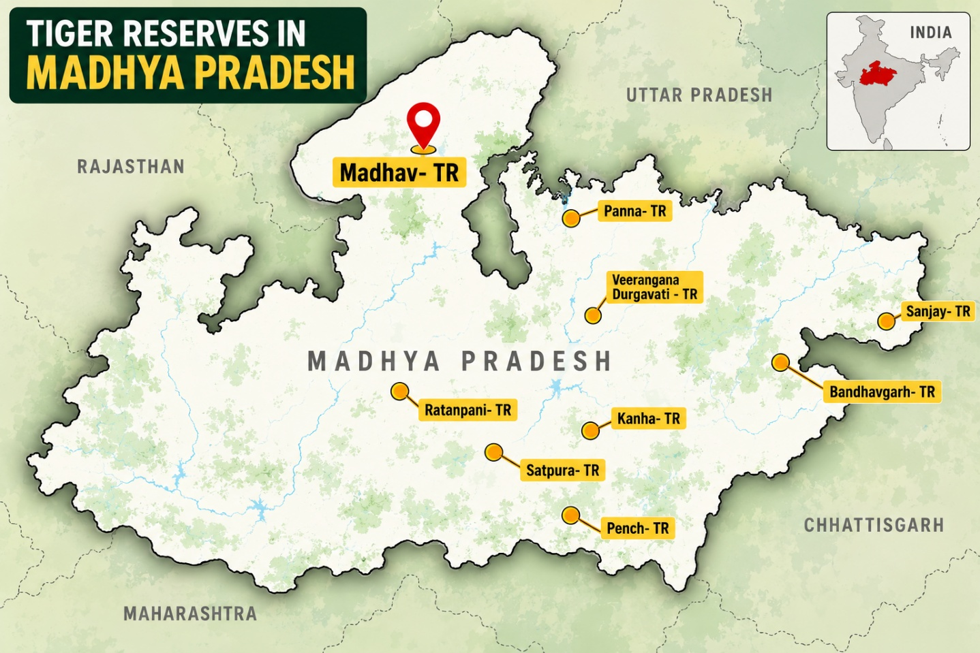
(ENVIRONMENT) (DD) Two cheetahs from Kuno National Park — the male Tholo and the female CCB-3 — are being shifted to Veerangana Durgavati Tiger Reserve, making it Madhya Pradesh’s third cheetah home after Kuno and Gandhi Sagar.
Profile of the reserve
| Feature | Details |
| Status | Madhya Pradesh’s 7th and largest tiger reserve; India’s 54th |
| Notification | 20 September 2023, under Section 38V of the Wild Life (Protection) Act, 1972 |
| Area | About 2,339 sq km across Sagar, Damoh and Narsinghpur districts (Bundelkhand–Mahakoshal) |
| Constituents | Nauradehi and Veerangana Durgavati wildlife sanctuaries |
| Why created | Partly to offset tiger habitat lost to the Ken–Betwa river link in Panna |
Physical setting
- Relief: Upper Vindhyan plateau at roughly 400–600 m, mostly sandstone with Lameta beds and Deccan Trap basalts.
- Drainage: About three-fourths drains through Ken tributaries into the Ganga–Yamuna system; the south drains to the Narmada — making it a bridge between two basins.
- Vegetation: Tropical dry deciduous forest dominated by teak, with open grasslands.
- Fauna: Tigers, leopards, Indian wolves, sloth bears and dholes, chital, sambar and nilgai.
Cheetah preparations
About 439 hectares of enclosures and soft-release ‘bomas’ allow the animals to acclimatise under monitoring and veterinary care before release. The move is part of spreading Project Cheetah beyond Kuno to reduce crowding and disease risk.
Landscape connectivity
Panna TR ➜ Veerangana Durgavati TR ➜ Satpura TR
The reserve links Panna with Satpura and opens connectivity towards Bandhavgarh — vital for tiger corridors in central India.
Significance and concerns
- Livelihoods: Eco-tourism through homestays, guides and safaris can bring income to backward Bundelkhand.
- Predator mix: Cheetahs will share space with tigers and leopards, so careful monitoring is needed.
- Human–wildlife conflict: Villages in and around the reserve need fair relocation and compensation.
📖 Read More: Big Cat Conservation in India • Wildlife Sanctuaries in India • Interlinking of Rivers • Wild Life (Protection) Act, 1972
Messengers from Deep Space: Nobel Physics 2026 Honours IceCube’s Neutrinos
(SCIENCE AND TECHNOLOGY) (IE) (TH) The 2026 Nobel Prize in Physics has gone to Francis Halzen of the University of Wisconsin–Madison “for decisive contributions to the IceCube Neutrino Observatory and the discovery of high-energy neutrinos of astrophysical origin.”
What are neutrinos?
Neutrinos are tiny subatomic particles with no electric charge and almost no mass. They come in three flavours — electron, muon and tau — and interact so weakly that trillions pass through our bodies every second. That is why they are called ‘ghost particles’.
Because they travel in straight lines and are not deflected by magnetic fields or absorbed by dust, neutrinos carry clean information from the most violent places in the universe.
How IceCube catches them
| Feature | Details |
| Location | Buried in the ice at the South Pole, Antarctica |
| Size | About one cubic kilometre of ice |
| Sensors | 5,160 light sensors on 86 strings, between 1,450 m and 2,450 m deep |
| Detection | A rare collision with ice creates charged particles that emit faint blue Cherenkov radiation |
| Completed | December 2010 |
Cosmic neutrino enters ice ➜ Rare collision ➜ Charged particle ➜ Cherenkov blue light ➜ Sensors record direction and energy
Milestones
| Year | Discovery |
| 2013 | First evidence of high-energy neutrinos from beyond the solar system |
| 2018 | Neutrino traced to the blazar TXS 0506+056 — the first source located this way |
| 2022 | Evidence of neutrinos from the active galaxy NGC 1068 |
| 2023 | Neutrino emission detected from the plane of our own Milky Way |
Why it matters
- Multi-messenger astronomy: Signals from neutrino observatories, light and gravitational waves together give a fuller picture of cosmic events.
- Cosmic accelerators: Helps trace the sources of the highest-energy cosmic rays.
- New physics: Probes supernovae, neutron-star mergers and the nature of dark matter.
- India’s stake: The proposed India-based Neutrino Observatory in Tamil Nadu would study atmospheric neutrinos.
📖 Read More: Current Astronomical Advances • Particle Physics • Important Global Scientists and Engineers