
UPSC CURRENT AFFAIRS — 9 NOVEMBER 2026
1. Voter ID for Welfare? The Debate Explained
(POLITY AND GOVERNANCE) (TH) Union Minister for Panchayati Raj Rajiv Ranjan Singh has said that the Electors Photo Identity Card (EPIC) number, combined with biometric authentication, would be used instead of Aadhaar to identify beneficiaries and process payments under Panchayati Raj schemes. The remark has opened a wider debate on how India should verify who gets welfare.
How Welfare Reaches People Today
| Instrument | Role in welfare delivery |
|---|---|
| JAM Trinity | Jan Dhan accounts + Aadhaar + Mobile; backbone of Direct Benefit Transfer (DBT) |
| Ration card and ONORC | Subsidised grain under the NFSA, 2013; One Nation One Ration Card makes it portable |
| Job cards | Wage-employment guarantee under the rural employment law |
| Ayushman Bharat (PM-JAY) card | Health cover of up to ₹5 lakh per family per year |
| e-Shram | National database of unorganised workers |
| State family IDs | Jan Aadhaar (Rajasthan), Samagra (Madhya Pradesh), Parivar Pehchan Patra (Haryana) |
The voter ID is mostly an entry document — proof of age and residence used to obtain other cards. It has no native link to bank accounts, unlike Aadhaar, which is mapped to the payment system for DBT.
Two Sides of the Argument
| Case for using EPIC | Concerns raised |
|---|---|
| Electoral rolls are revised through house-to-house verification by the Election Commission | Welfare could hinge on electoral status; people deleted from rolls may also lose benefits (“double exclusion”) |
| Helps states check residence-based eligibility and weed out duplicate claims | Internal migrants usually hold voter IDs from home states, weakening ONORC-style portability |
| Can stop the same person drawing state benefits in two states | Minors and unregistered citizens have no EPIC |
| Biometric check adds a second layer of identity proof | EPIC has no banking linkage, making payments harder to process |
The Constitutional Lens
- Right to food: in PUCL v. Union of India (2001), the Supreme Court treated the right to food as part of Article 21 and turned food schemes into legal entitlements; procedural hurdles should not defeat that right.
- Proportionality: in the 2018 Aadhaar judgment (Justice K.S. Puttaswamy), Aadhaar for welfare was upheld because it passed a proportionality test; any new ID must clear the same bar.
- Freedom of movement: tying benefits to local electoral rolls may burden the right to move and settle anywhere in India under Article 19.
Way Forward
Dynamic social registry ➜ Touchless Aadhaar fallbacks (iris, face, OTP) ➜ ONORC + e-Shram portability ➜ Social audits by Gram Sabhas ➜ Benefits continue during disputes
The goal is to cut leakages without shutting out the vulnerable: verification should strengthen delivery, never become a new gate.
📖 Read More: Election Commission of India • K.S. Puttaswamy Case (2017) • Internal Migration in India
2. Punjab Reopens the Ravi–Beas Water Dispute
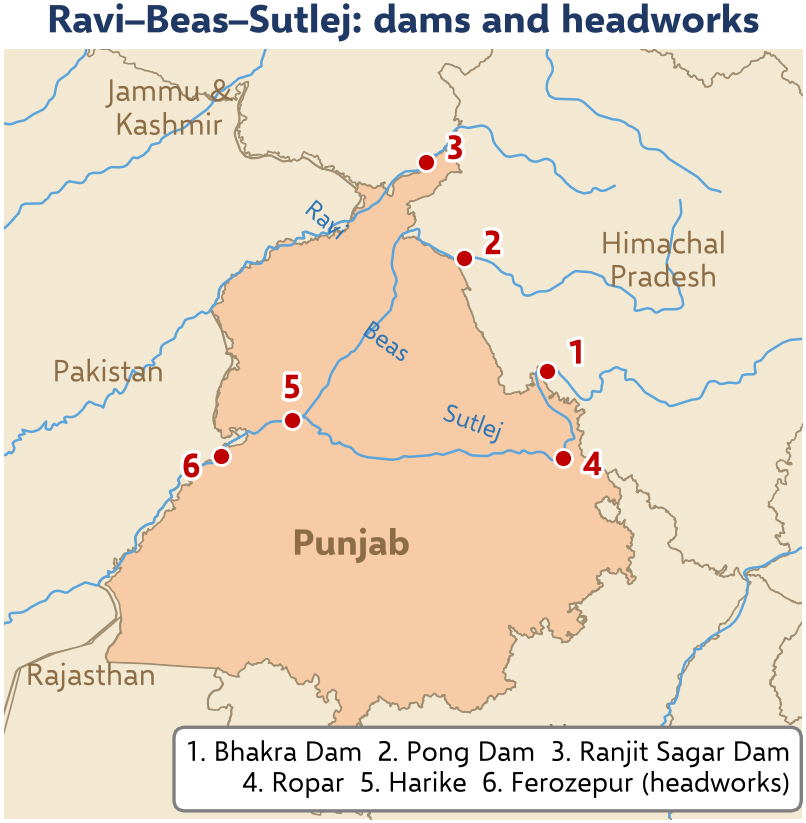
(POLITY AND GOVERNANCE) (IE) Ahead of its 60th Foundation Day (1 November), the Punjab Assembly passed five resolutions reviving inter-state water disputes. They seek a share in Yamuna waters, about ₹1.44 lakh crore in royalty from Rajasthan, control over the Ropar, Harike and Ferozepur headworks, repeal of the Dam Safety Act, 2021, and projects to use Ravi waters now flowing to Pakistan.
How the Dispute Evolved
1955: Ravi–Beas surplus shared ➜ 1960: Indus Waters Treaty ➜ 1966: Punjab reorganised ➜ 1981: Tripartite agreement ➜
1987: Eradi Tribunal ➜ 2004: Punjab termination law ➜ 2016: SC strikes it down
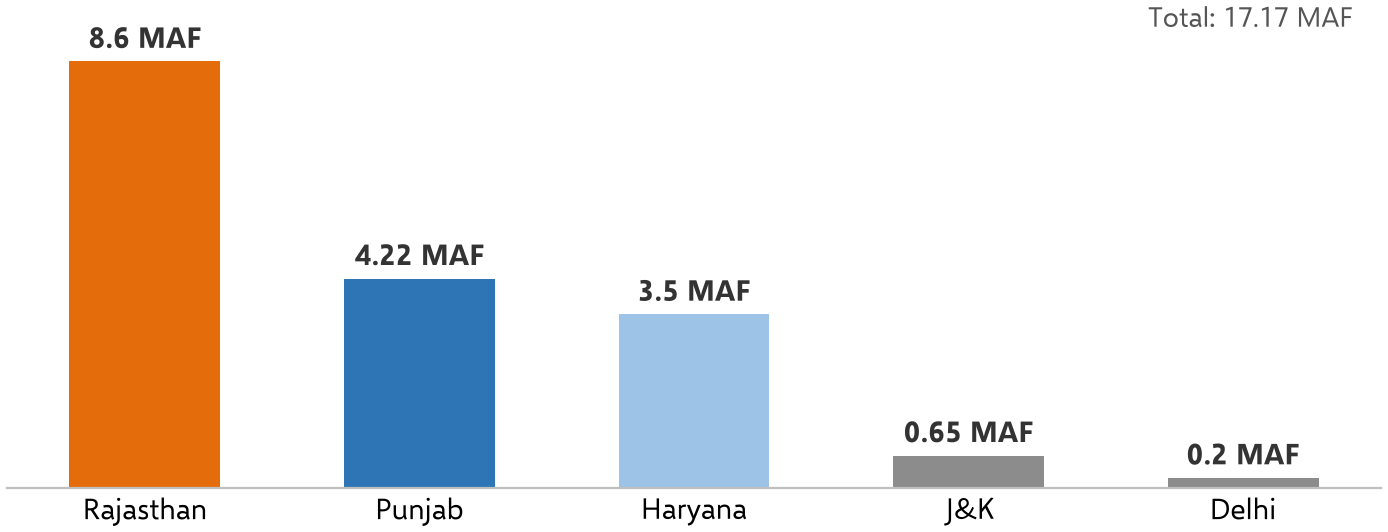
- 1955: surplus Ravi–Beas waters of about 15.85 MAF (million acre-feet) were divided, with 8 MAF to Rajasthan.
- 1960: the Indus Waters Treaty gave India unrestricted use of the eastern rivers (Sutlej, Beas, Ravi). Rajasthan stopped royalty payments, treating the flows as a national allocation.
- 1966: the Punjab Reorganisation Act empowered the Centre to fix shares of the successor states; in 1976 it gave 3.5 MAF each to Punjab and Haryana.
- 1981: a Centre-brokered pact reallocated 17.17 MAF and required the Sutlej–Yamuna Link (SYL) canal to carry Haryana's share; the canal remains incomplete.
- 1987: the Eradi Tribunal, set up after the 1985 Punjab Accord, recommended 5 MAF for Punjab and 3.83 MAF for Haryana.
- 2004–2016: Punjab's Termination of Agreements Act, 2004 cancelled its water pacts; on a Presidential Reference the Supreme Court held it unconstitutional in 2016.
What Each State Argues
| State | Position |
|---|---|
| Punjab (upper riparian) | Rivers do not flow through Haryana or Rajasthan; severe groundwater depletion leaves no surplus; seeks royalty under a pre-1960 arrangement with Bikaner; calls the Dam Safety Act an intrusion on a State subject |
| Haryana | Wants the SYL canal completed as per the 1981 pact and Supreme Court decrees; cites drinking-water stress in its south |
| Rajasthan | Relies on its 8.6 MAF share for the Indira Gandhi Canal; says post-1960 allocations are national, not commercial sales |
Constitutional and Legal Framework
| Provision | What it does |
|---|---|
| Entry 17, State List | Water is a State subject — subject to Entry 56 |
| Entry 56, Union List | Parliament may regulate inter-State rivers in the public interest |
| Article 262 | Parliament may provide for adjudication of inter-State water disputes and bar courts |
| Inter-State River Water Disputes Act, 1956 | Tribunal on a State’s request; a published award has the force of a Supreme Court decree |
Because the Punjab Reorganisation Act is a central law, Assembly resolutions cannot alter it; change must come through Parliament or the courts. See river water disputes and inter-state relations.
Way Forward
- Fresh hydrology: a basin-wide, independent reassessment of Ravi–Beas flows under climate change.
- Crop diversification: shift from paddy to millets, maize and pulses with assured procurement; expand drip and sprinkler irrigation.
- Permanent tribunal and river basin body: time-bound adjudication and joint management instead of endless litigation.
📖 Read More: River Water Disputes • Inter-State Relations • Irrigation and its Types
3. Samudrayaan: Human Deep-Sea Dive by 2028
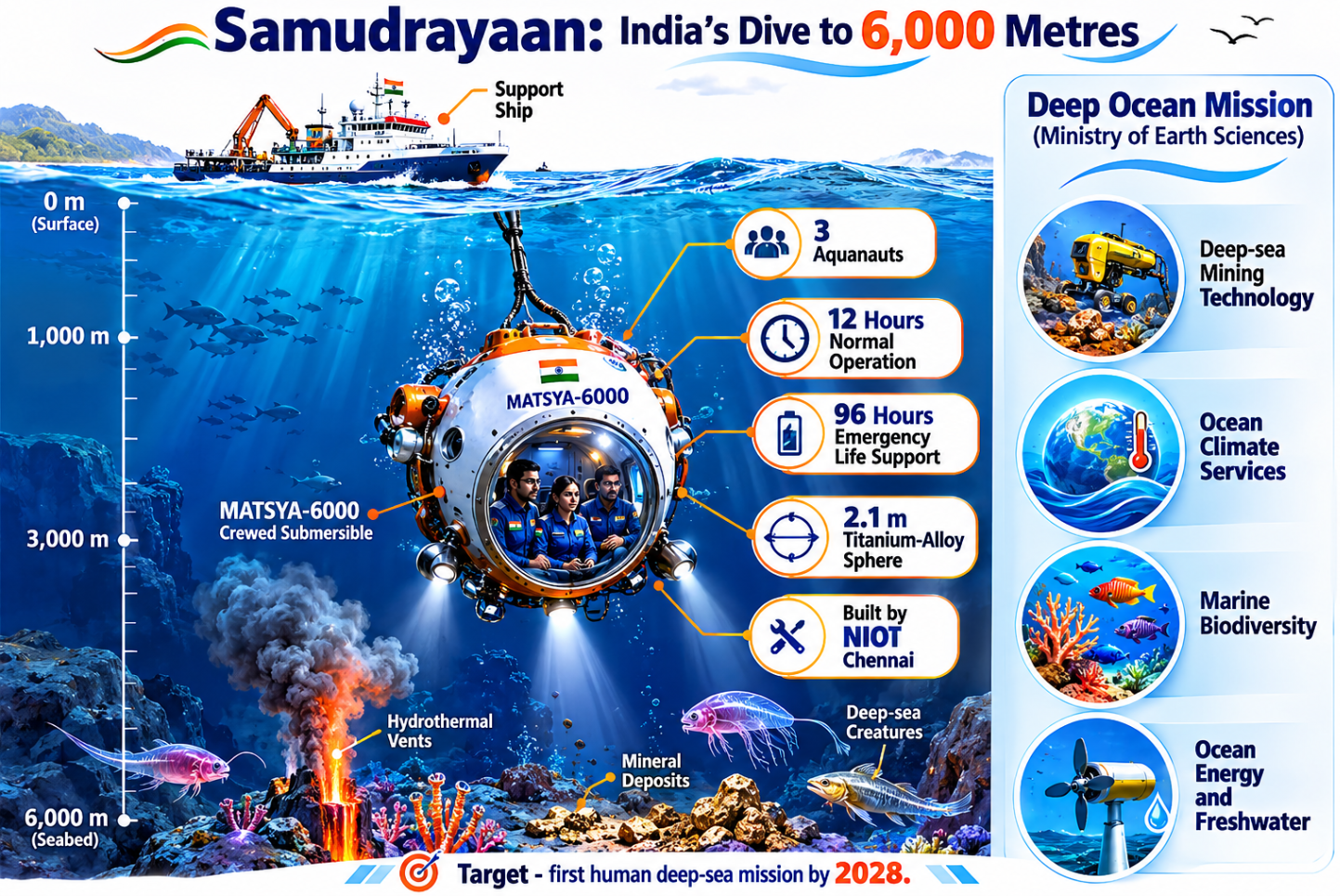
(SCIENCE AND TECHNOLOGY) (DD) At the Indo-Pacific Regional Dialogue (IPRD) 2026, Union Minister Dr Jitendra Singh said India is working towards its first human deep-sea mission to a depth of up to 6,000 metres by 2028 under the Samudrayaan programme of the Deep Ocean Mission.
MATSYA-6000: The Crewed Submersible
| Feature | Details |
|---|---|
| Developer | National Institute of Ocean Technology (NIOT), Chennai, under the Ministry of Earth Sciences |
| Crew | Three aquanauts |
| Personnel sphere | 2.1 m titanium-alloy sphere, built with ISRO; keeps 1 atmosphere inside against crushing outside pressure |
| Endurance | 12 hours of normal operation; up to 96 hours of emergency life support |
| Depth | Up to 6,000 m |
The Deep Ocean Mission
Approved by the Union Cabinet in 2021 and run by the Ministry of Earth Sciences, the mission covers deep-sea mining technology, ocean climate advisory services, deep-sea biodiversity, seabed survey, and ocean energy and freshwater. The Ocean Mineral Explorer maps hydrothermal sulphide deposits on the seabed.
Why It Matters
- Strategic minerals: the seabed holds nickel, cobalt, copper and manganese needed for batteries and clean energy — linked to India's Deep Ocean Mission.
- Elite club: only a handful of countries have built crewed submersibles that reach such depths.
- Ocean diplomacy: India proposed joint missions, shared facilities and data under the principle “One Ocean, Shared Knowledge and Equitable Prosperity”.
- Blue economy: better ocean observation and extreme-event forecasting support coastal communities.
📖 Read More: India's Deep Ocean Mission
4. RBI Forms Technical Committee for Financial Markets
(ECONOMICS) (IE) On 4 November 2026, the Reserve Bank of India constituted the Technical Consultative Committee for Financial Markets (TCCFM), announced earlier in its 7 October policy statement, to give market participants a structured voice on regulatory and operational issues.
Composition
- Chair: the RBI Deputy Governor in charge of the Financial Markets Regulation Department (FMRD), currently Rohit Jain.
- Members: seven external experts from banks, FIMMDA, the Clearing Corporation of India, foreign banks and academia.
- Meetings: at least once a quarter.
Terms of Reference
| Area | What the committee examines |
|---|---|
| Market functioning | Efficiency, liquidity and resilience of money, government securities, forex and related derivatives markets; ways to deepen them |
| Market infrastructure | Trading, clearing, settlement and reporting systems and their rules |
| Policy frictions | Implementation of RBI measures and unintended frictions they cause |
| Emerging risks | Domestic and global developments and financial innovations |
| Referred issues | Any specific market or macro issue the RBI refers |
Significance
Deep, liquid markets lower government borrowing costs and transmit monetary policy faster. A standing consultative forum lets the regulator spot frictions early, rather than discovering them after rules are notified.
📖 Read More: Introduction to Financial Market • Government Securities Market in India • Money Market Instruments
5. VAJRA-SAT: Preparing for an Exotic FMD Strain
(ECONOMICS) (PIB) The Department of Animal Husbandry and Dairying (DAHD), with ICAR-NIVEDI, held VAJRA-SAT, a two-day national tabletop exercise in Bengaluru (4–5 November 2026), to prepare for a possible entry of Foot-and-Mouth Disease (FMD) serotype SAT-1, which has never been reported in India.
Why Now?
SAT-1 has spread beyond Africa into parts of West Asia. Vaccines used in India protect against the serotypes found here, not SAT-1, so early planning is vital for a livestock economy that sustains crores of rural households.
The Exercise
Detect early ➜ Confirm in the lab ➜ Investigate spread ➜
Restrict animal movement ➜ Emergency vaccination ➜ Communicate risk
- Theme: “Detect Early, Confirm Fast, Contain Together”.
- Participants: 83 officials from 25 States, 3 UTs and national institutions, including border-guarding agencies and vaccine makers.
- Follow-up: strengthen regional FMD labs and Regional Disease Diagnostic Laboratories with technical support from ICAR-NIFMD.
Foot-and-Mouth Disease: Key Facts
| Feature | Details |
|---|---|
| Cause | Highly contagious virus (FMDV) of cloven-hoofed animals |
| Hosts | Cattle, buffaloes, sheep, goats and pigs |
| Serotypes | Seven: O, A, C, Asia-1, SAT-1, SAT-2, SAT-3; O, A and Asia-1 occur in India |
| Symptoms | Fever, blisters on mouth, feet and teats, lameness, sharp fall in milk yield |
| Why vaccines are serotype-specific | Immunity to one serotype does not protect against another |
FMD outbreaks hit milk output and keep Indian meat out of premium export markets, so preparedness links directly to livestock resources and the White Revolution.
📖 Read More: Livestock Resources and White Revolution • Schemes of the Ministry of Fisheries, Animal Husbandry and Dairying
6. ₹53,866 Crore Order for Eight New Corvettes
(INTERNAL SECURITY) (IE) On 2 November 2026, the Ministry of Defence signed contracts worth ₹53,866.50 crore for eight Next Generation Corvettes (NGCs) — five to be built by Garden Reach Shipbuilders & Engineers (GRSE), Kolkata and three by Goa Shipyard Limited (GSL) — after approval by the Cabinet Committee on Security.
Project at a Glance
| Feature | Details |
|---|---|
| Approval path | Acceptance of Necessity by the Defence Acquisition Council in 2022 → CCS approval → contracts in November 2026 |
| Design | Navy’s own design; built by defence shipyards chosen through competitive bidding |
| Roles | Anti-surface, anti-air and anti-submarine warfare, surveillance, coastal defence and escort of trade routes |
| Features | Stealth shaping and advanced weapon and sensor suites |
| Replaces | Khukri- and Kora-class corvettes |
What Is a Corvette?
A corvette is a small, agile surface warship — smaller than a frigate or destroyer — suited to coastal and near-sea operations. Using corvettes for these tasks frees larger warships for distant missions.
Significance
- Indian Ocean presence: more hulls for surveillance and sea-lane security — see naval defence.
- Aatmanirbharta: indigenous design and construction deepen the domestic shipbuilding and MSME supply chain.
- Fleet renewal: retires ageing corvettes while keeping the Navy’s force levels stable.
📖 Read More: Naval Defence
7. The Amazon Turns From Carbon Sink to Source
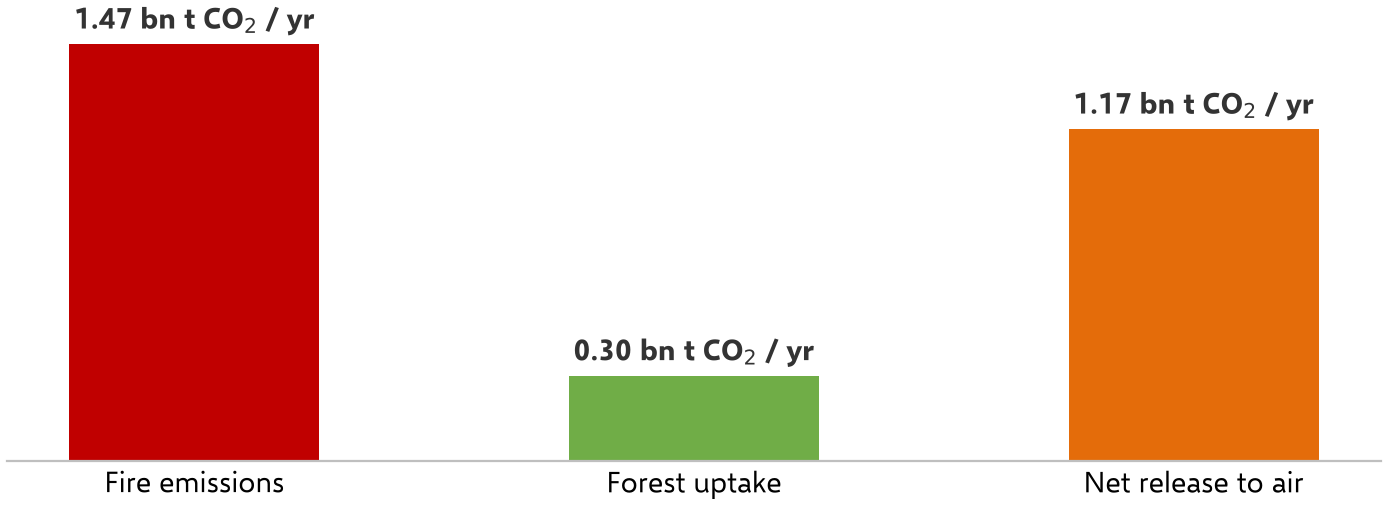
(ENVIRONMENT) (TH) A study published in Nature (21 October 2026), based on 15 years of aircraft measurements, finds that between 2010 and 2024 the Amazon rainforest released on average 1.17 billion tonnes more CO₂ each year than it absorbed — turning a vital carbon sink into a net source.
What the Study Found
- Fires dominate: wildfires emitted about 1.47 billion tonnes of CO₂ a year, far more than the forest's absorption of roughly 0.3 billion tonnes.
- Humans, not lightning: almost all fires were set for land clearing or pasture, then spread out of control.
- Drought as amplifier: hot, dry years linked to El Niño and a warm North Tropical Atlantic (2010, 2015, 2016, 2023, 2024) saw a sharp jump in burning.
Why the Amazon Matters
| Feature | Details |
|---|---|
| Extent | World’s largest tropical rainforest, about 5.5 million sq km across eight countries and French Guiana; largest share in Brazil |
| Biodiversity | Home to about 10% of known species |
| Climate role | Stores vast carbon and recycles moisture that feeds regional rainfall |
| River | The Amazon River has the largest discharge of any river |
How a Sink Becomes a Source
Deforestation and fires ➜ Hotter, drier forest ➜ Less photosynthesis, more tree death ➜ More CO₂ released ➜ Further warming
This is a classic positive feedback in the carbon cycle: the more the forest burns, the drier and more fire-prone it becomes. Protecting standing forests and ending deforestation are the most direct fixes.
📖 Read More: Biogeochemical Cycling • Terrestrial Ecosystems or Biomes • Walker Circulation and ENSO