
UPSC CURRENT AFFAIRS — 10 NOVEMBER 2026
1. Demonetisation at Ten: A Mixed Scorecard
(ECONOMICS) (TH) (IE) On 8 November 2026, the demonetisation of 2016 completed ten years. Central bank data now reveal a paradox: digital payments have exploded, yet Indians hold about as much cash relative to GDP as they did before the note ban, and forgers have learnt to copy the new ₹500 note.
What Happened in 2016
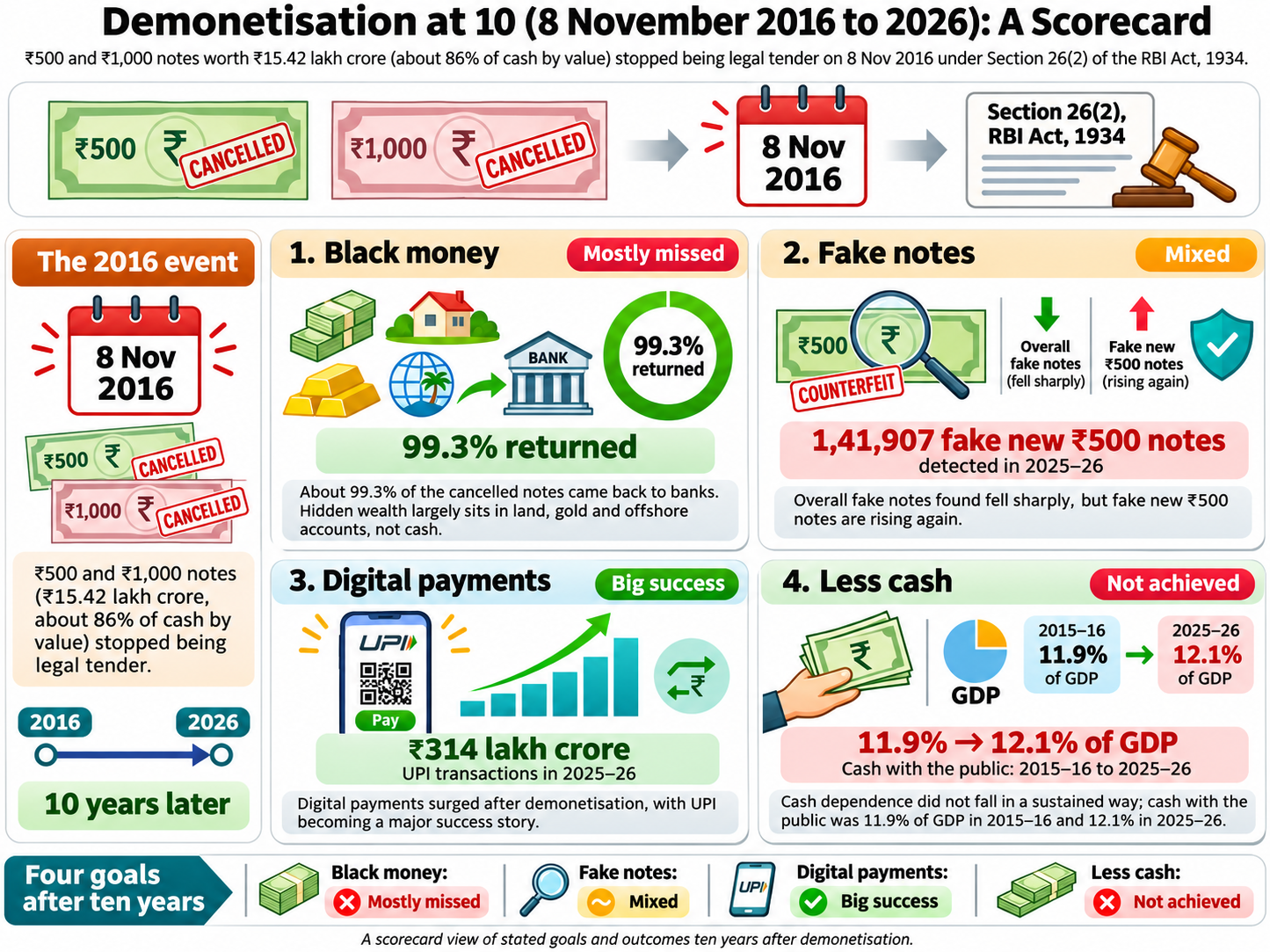
On the evening of 8 November 2016, the Government, acting on the RBI Central Board’s recommendation under Section 26(2) of the RBI Act, 1934, withdrew the legal-tender status of ₹500 and ₹1,000 notes. These notes were worth about ₹15.42 lakh crore, nearly 86% of all cash in circulation by value.
| Stated objective | What it meant |
|---|---|
| Black money | Make hoarded, untaxed cash worthless (see black money and the parallel economy) |
| Fake notes | Wipe out counterfeit notes in the old series |
| Terror and extremist funding | Choke cash pipelines of hawala, terror financing and Left-Wing Extremism |
| Less-cash economy | Push households and traders towards digital payments |
Two follow-ups matter for the exam. In Vivek Narayan Sharma v. Union of India (2023), a five-judge Bench upheld the decision 4:1; Justice B.V. Nagarathna dissented, holding that so large a step needed an Act of Parliament, not a gazette notification. In 2023, the RBI also withdrew ₹2,000 notes under its Clean Note Policy, but unlike 2016 they remain legal tender.
India Has Done This Before
1946: ₹500, ₹1,000, ₹10,000 notes scrapped ➜ 1978: ₹1,000, ₹5,000, ₹10,000 notes scrapped ➜ 2016: ₹500, ₹1,000 notes scrapped
The 1978 exercise was carried out through the High Denomination Bank Notes (Demonetisation) Act, 1978, following the Wanchoo Committee’s advice on curbing black money. Unlike 2016, those notes were rarely held by ordinary households.
Ten Years On: Goal-by-Goal Scorecard
| Goal | Outcome after ten years | Verdict |
|---|---|---|
| Black money | About 99.3% of cancelled notes returned to banks. Unaccounted wealth sits mostly in land, gold and offshore assets, not in cash. | Largely missed |
| Fake notes | Overall detection fell, but fake ₹500 notes detected by banks rose 20.5% to 1,41,907 pieces in 2025-26, about 62% of all fakes found. | Mixed |
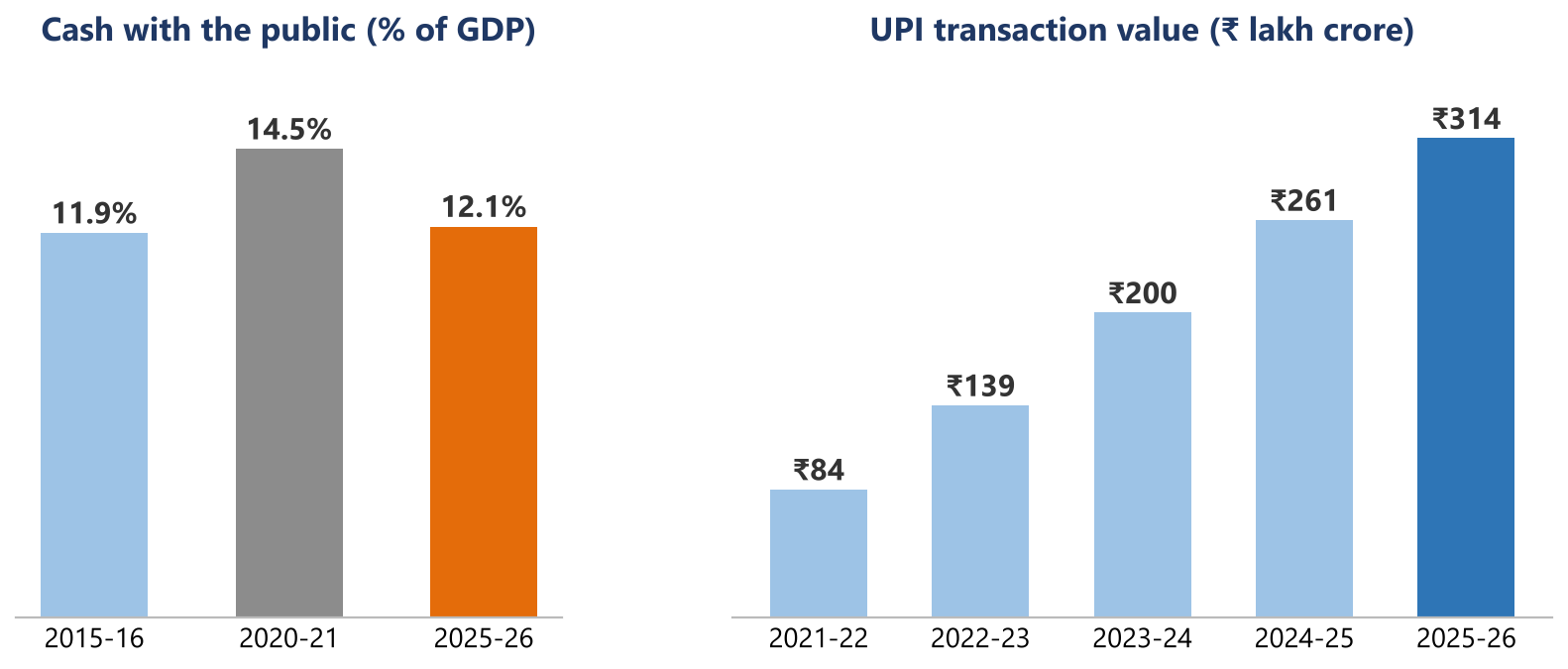
| Digital payments | UPI value grew from ₹0.07 lakh crore (2016-17) to about ₹314 lakh crore in 2025-26. | Achieved (with help from cheap data and Jan Dhan accounts) |
| Less cash | Currency with the public: 11.9% of GDP in 2015-16 versus 12.1% in 2025-26. | Not achieved |
| Tax base | Cash deposits were scrutinised under Operation Clean Money (2017); GST followed in July 2017, widening the formal net. | Improved |
Why Cash Refuses to Fade
- Precautionary demand: households hoarded cash during the COVID-19 pandemic, pushing currency with the public to about 14.5% of GDP in 2020-21.
- Store of value: UPI handles most transactions by number but mostly small ones; families and small traders still keep savings in notes.
- Informal economy: the large informal sector runs on daily cash wages; the 2016 liquidity shock hit farm and small-business payments hardest.
A rise in fakes detected can mean either more fakes in circulation or better screening by banks; the published data cannot tell the two apart.
Way Forward
Periodic upgrade of ₹500 security features ➜ Pilot polymer notes ➜ Publish sorter-detected fakes separately ➜ Offline e-rupee and UPI Lite ➜ Track benami property and gold
The lesson of 2016 is that black money is a flow that keeps moving into assets, not a stock of notes under the mattress. Tracking assets through linked tax, property and digital rupee data works better than shocks to cash.
📖 Read More: Black Money and the Parallel Economy • Digital Payment Infrastructure of India • Terror Financing and the Crime-Terror Nexus
2. Arrest Clock Starts at Detention: Supreme Court
(POLITY AND GOVERNANCE) (IE) In Sujit Das and Others v. Union of India (5 November 2026), the Supreme Court held that the Constitution recognises no gap between “detention” and “arrest”. The 24-hour limit under Article 22(2) starts the moment a person’s liberty is curtailed, not when police later write up a formal arrest.
The Constitutional Guarantee
Article 22(2) requires every person arrested and detained in custody to be produced before the nearest Magistrate within 24 hours, excluding travel time; further custody needs the Magistrate’s order. It is part of the Right to Freedom (Articles 19–22). Under Article 22(3), the safeguard does not cover enemy aliens or persons held under preventive detention laws.
What the Court Held
Person stopped or held by an agency ➜ Liberty curtailed: 24-hour clock starts ➜
Produce before Magistrate (only journey time excluded) ➜ Beyond 24 hours: release forthwith
- One phrase, one meaning: “arrested and detained in custody” is read together; agencies cannot create a “buffer zone” of informal custody for interrogation or search and seizure.
- Reasonableness test: relying on Section 58 of the BNSS, 2023 (old Section 57 CrPC), the Court said meeting the 24-hour limit does not by itself make custody lawful; the Magistrate must check whether the period was reasonable.
- Active Magistrates: a Magistrate may refuse police remand if there is an unexplained gap between actual detention and the recorded arrest.
- Rights over statutes: bail restrictions in special laws such as the NDPS Act, 1985 cannot override Articles 21 and 22.
- CCTV: the Court reiterated Paramvir Singh Saini v. Baljit Singh (2020), which requires audio-video CCTV with night vision in police stations and in offices of agencies such as the CBI, ED and NIA.
Why It Matters
Unrecorded custody is where coercion and custodial violence usually happen. By tying the clock to the actual loss of liberty, the ruling shifts the burden of proof to the agency and turns remand from a routine signature into a real judicial check on personal liberty.
📖 Read More: Right to Freedom (Articles 19–22) • Special Provisions and Exceptions to Fundamental Rights
3. Commercial Cropping Is No Forest Right: SC
(SOCIAL JUSTICE) (TH) The Supreme Court has held that planned cultivation of commercial crops inside reserve forests is not a right protected by the Forest Rights Act (FRA), 2006, and cannot by itself justify occupying forest land. The case (A. John Kennedy v. State of Tamil Nadu, 6 November 2026) concerns silk cotton farming in the Megamalai forests of Tamil Nadu.
Key Highlights of the Judgment
- Produce vs plantation: Section 3(1)(c) protects collecting, using and selling minor forest produce that grows naturally. Planned commercial cropping, such as silk cotton, is a different activity.
- Residence and dependence first: a claimant must primarily reside in the forest and depend on it for bona fide livelihood. Cultivation alone, or residence outside the forest boundary, does not create forest-dweller status.
- Oversight: a Special Committee headed by former Chief Justice of India B.R. Gavai will supervise verification of FRA claims in the region.
- Silk cotton question: the Court asked the Central Empowered Committee (CEC) to examine whether silk cotton can count as minor forest produce.
The Forest Rights Act at a Glance
The FRA, 2006 recognises the rights of forest-dwelling Scheduled Tribes and other traditional forest dwellers to correct a “historical injustice”: their dependence on forests was never recorded during colonial and post-colonial forest settlement.
| Type of right | What it covers |
|---|---|
| Individual rights | Self-cultivation and habitation on land occupied before 13 December 2005, up to 4 hectares |
| Community rights | Grazing, fishing, water bodies, traditional habitats and community forest resource management |
| Minor forest produce | Ownership, collection and sale of produce such as bamboo, tendu leaves, honey and medicinal herbs |
| Development rights | Protection from arbitrary eviction; basic public facilities on forest land |
| Who can claim | Condition |
|---|---|
| Forest-dwelling Scheduled Tribes | Primarily reside in and depend on forests for bona fide livelihood needs |
| Other traditional forest dwellers | Resided in forests for at least three generations (75 years) before 13 December 2005 |
How a Claim Is Decided
Gram Sabha receives and verifies claim ➜ Sub-Divisional Level Committee ➜ District Level Committee (final decision)
Placing the Gram Sabha at the base gives tribal communities a say, but it also explains why slow committee work leaves many claims pending for years.
Significance
The ruling draws a line between livelihood and land use change. Large plantations alter forest composition and break habitat links, so excluding them protects the conservation purpose of reserve forests without extinguishing genuine traditional rights.
📖 Read More: Forest Rights and Conservation Strategies • Understanding Scheduled Tribes in India
4. Bangladesh Garment Unrest: Opening for India?
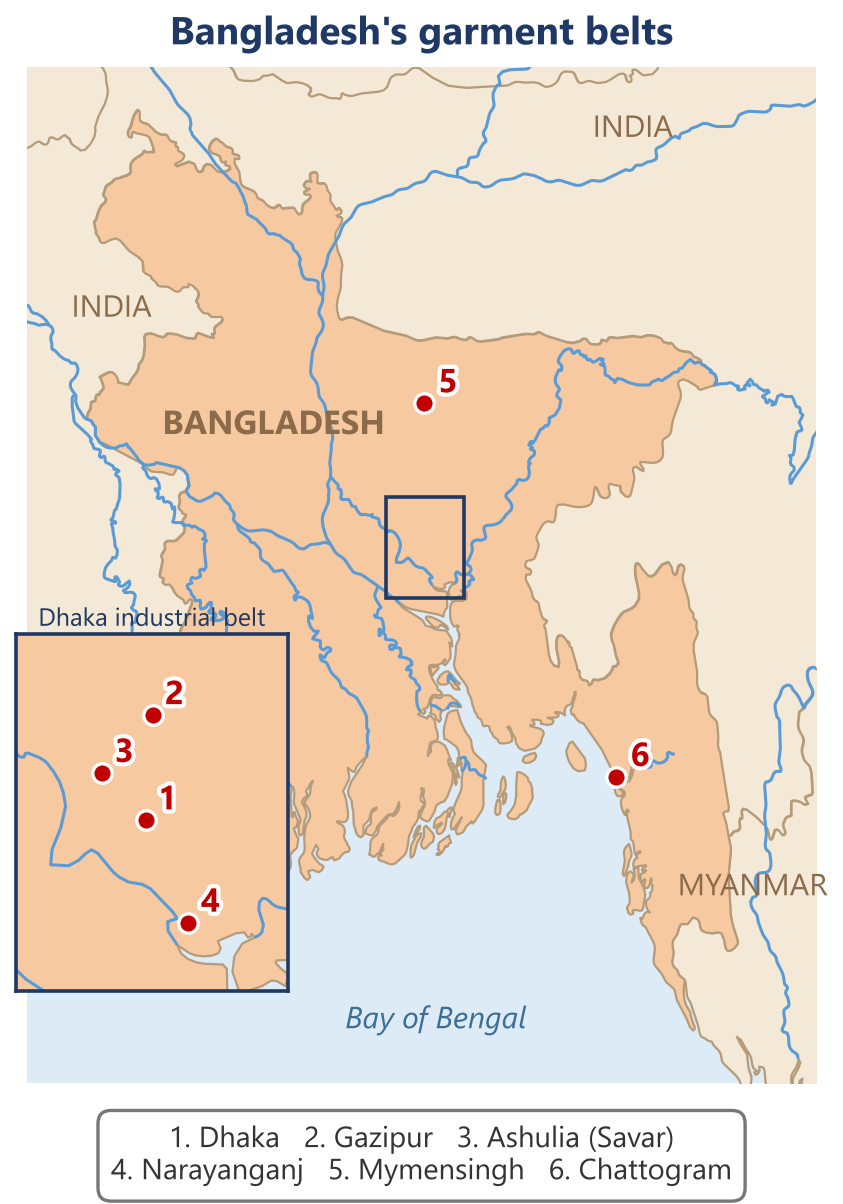
(ECONOMICS) (IE) Wage protests by ready-made garment (RMG) workers have shut hundreds of factories across Dhaka, Gazipur and Ashulia during the peak order season for Western brands. The disruption, coming as Bangladesh prepares to leave the LDC group, opens a window for India’s textile sector.
How Bangladesh Built Its Garment Engine
- Quota era: under the Multi-Fibre Arrangement (1974–1994), quotas capped exporters such as South Korea and Hong Kong, so investors shifted to Bangladesh.
- LDC privileges: as a Least Developed Country, it enjoys duty-free, quota-free access to the EU under Everything But Arms (EBA).
- Scale today: garments earned about USD 38.7 billion in FY2025-26, over 80% of the country’s merchandise exports; the EU takes nearly half.
Why the Sector Is in Trouble
| Pressure | Detail |
|---|---|
| Wages | Workers demand a higher minimum wage as inflation erodes pay |
| Energy | Falling domestic gas output and costly LNG imports raise production costs |
| Closures | Financial stress and weak orders have already closed hundreds of units |
| Trade preferences | On 29 October 2026, the UN General Assembly extended Bangladesh’s LDC graduation date from 24 November 2026 to 24 November 2029; after graduation and the EU’s transition period, EBA duty-free access will end. |
India’s Advantages
- “Bangladesh plus one”: global brands want a second sourcing base; capturing even a tenth of diverted orders would lift India’s apparel exports noticeably.
- Farm-to-fashion chain: Bangladesh imports almost all its cotton, while India grows it and has the full chain from spinning to garmenting (see cotton textile industry).
- Clusters: Tiruppur (knitwear), Surat (man-made fabrics) and the NCR belt already serve global buyers.
- Policy push: PM MITRA parks, the PLI scheme for textiles and trade deals with the UAE (CEPA), Australia (ECTA) and the UK (CETA).
India’s Weak Spots
| Gap | Why it hurts |
|---|---|
| Fragmented units | MSME-dominated sector lacks the mega-factories that fulfil large orders |
| Fibre mismatch | Global fast fashion is mostly man-made fibre (MMF); India’s exports remain cotton-heavy, and duties on MMF inputs raise costs |
| Competition | Vietnam offers faster lead times and duty-free EU access under its FTA |
| Boomerang effect | Bangladesh is a major buyer of Indian cotton yarn, so its slowdown also hurts Indian spinning mills |
Way Forward
Fast-track PM MITRA parks ➜ Fix inverted duties on MMF ➜ Skill workers under SAMARTH ➜ Meet EU green and labour norms
A neighbour’s crisis is a short window, not a strategy. Durable gains need scale, MMF capacity and compliance with buyer norms such as the EU’s carbon border rules; SAMARTH can supply the skilled, largely female workforce this requires.
📖 Read More: India and Bangladesh • PM MITRA Park • PLI Scheme for Textiles • Cotton Textile Industry in India
5. Entrepreneurship: Engine for Viksit Bharat 2047
(ECONOMICS) (PIB) National Entrepreneurship Day was observed on 9 November, the day the Ministry of Skill Development and Entrepreneurship was set up in 2014. India now has over 2.62 lakh DPIIT-recognised startups, the world’s third-largest startup ecosystem, up from fewer than 500 in 2014.
The Ecosystem in Numbers
| Indicator | Status |
|---|---|
| Recognised startups | 2.62 lakh+ (November 2026) |
| Record year | 55,200+ recognitions in FY2025-26, up 51.6% year on year |
| Jobs | 25 lakh+ direct jobs (up to October 2026) |
| Women | 1.07 lakh+ startups (about 48% as of March 2026) have at least one woman director or partner |
| Spread | About 52% of startups come from non-metro cities; Maharashtra, Karnataka, Uttar Pradesh, Delhi and Gujarat lead |
Who counts as a startup? Under the DPIIT notification of 4 February 2026, an entity up to 10 years old with turnover up to ₹200 crore qualifies; a new Deep Tech Startup category gets 20 years and ₹300 crore.
Key Support Schemes
| Scheme | What it does |
|---|---|
| Startup India | Self-certification, cheaper patent filing, faster exit; Fund of Funds (₹10,000 crore, run by SIDBI) invests via AIFs |
| Seed Fund (SISFS) | ₹945 crore for proof of concept, prototypes and market entry through incubators |
| Atal Innovation Mission | NITI Aayog’s innovation platform; AIM 2.0 has ₹2,750 crore till March 2028 |
| PM MUDRA Yojana | Collateral-free loans up to ₹20 lakh: Shishu, Kishor, Tarun, Tarun Plus |
| Stand-Up India | Bank loans of ₹10 lakh–₹1 crore for SC/ST and women entrepreneurs |
| PMEGP | Margin-money subsidy of 15–35% of project cost via KVIC for new micro-enterprises |
How Enterprise Builds Viksit Bharat
Demographic dividend (65% under 35) ➜ Job creators, not job seekers ➜ Formal, credit-linked MSMEs ➜ Deep-tech self-reliance ➜ Inclusive growth
Bottlenecks
- Thin research base: India’s gross R&D spending is only 0.84% of GDP (2023-24), against about 2.6% in China.
- Capital skew: venture money favours consumer apps over hardware and deep tech that need patient capital.
- Compliance load and credit gap: many licences and criminal penalties eat founder time, while collateral-based lending keeps small firms small (the “missing middle”).
Way Forward
- Cash-flow-based lending through Account Aggregators and OCEN instead of physical collateral.
- Use the ₹1 lakh crore Research, Development and Innovation (RDI) Scheme to back private R&D in sunrise sectors.
- Extend Jan Vishwas-style decriminalisation to State business laws and teach entrepreneurship under NEP 2020.
📖 Read More: Startup India Scheme • Atal Innovation Mission 2.0 • MSME Schemes
6. Physical AI: When Algorithms Get a Body
(SCIENCE AND TECHNOLOGY) (IE) At ADIPEC 2026 in Abu Dhabi, the state oil company ADNOC signed a partnership with OpenAI (and G42) to deploy AI across its oil and gas operations. The deal reflects a wider shift towards “Physical AI”: putting AI to work in factories, fields and ports rather than only in chat windows.
What Is Physical AI?
Physical AI refers to artificial intelligence systems that sense, reason about and act in the real world: robots, autonomous vehicles and smart machines. Traditional factory robots repeat fixed paths and fail if an object shifts; Physical AI adjusts in real time.
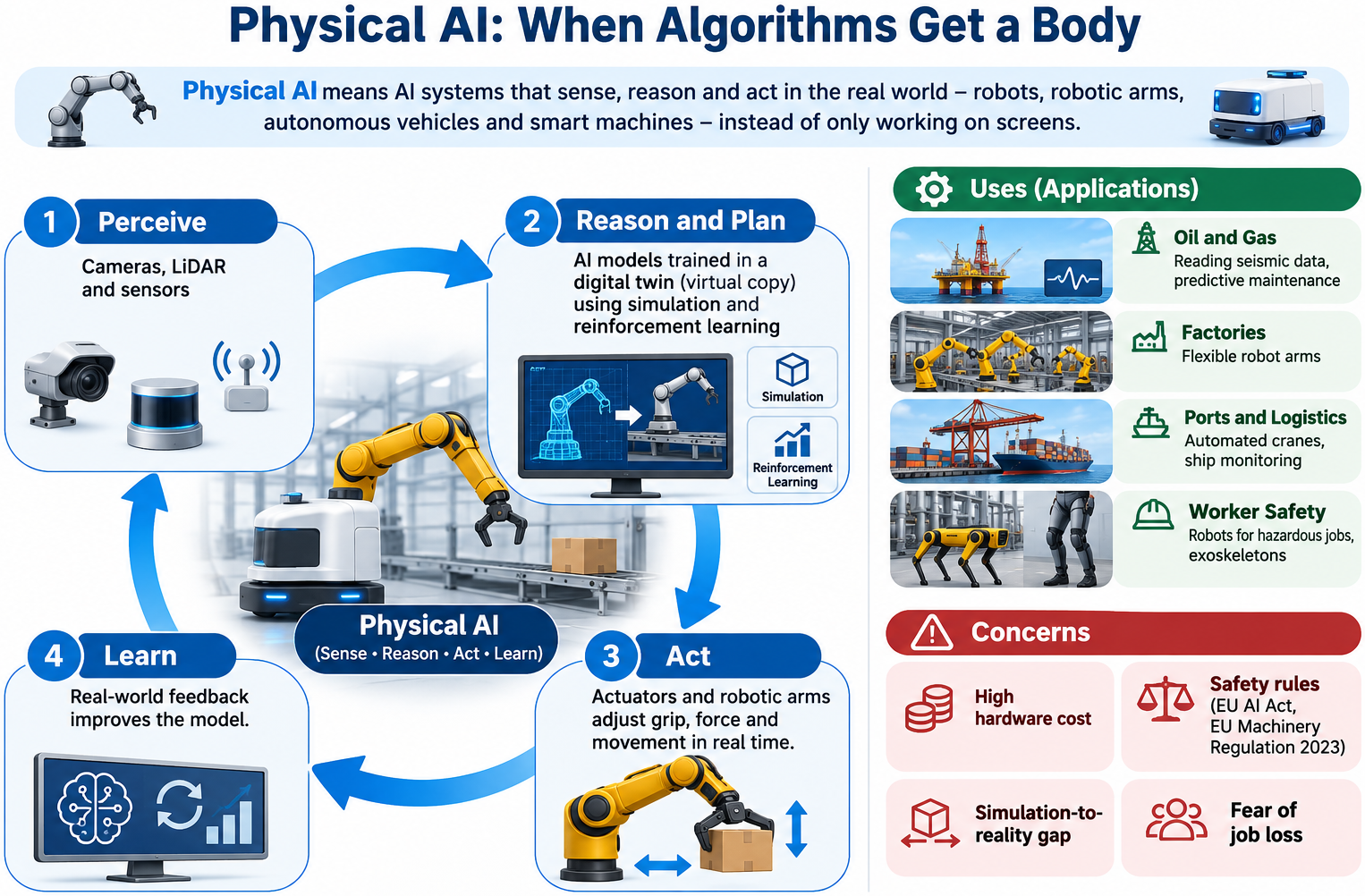
Perceive (cameras, LiDAR, sensors) ➜ Reason and plan (AI models) ➜ Act (actuators, robotic arms) ➜ Learn from feedback
Models are often trained first in a digital twin, a virtual copy of a machine or plant, using simulation and reinforcement learning before they touch real equipment.
Where It Is Being Used
| Sector | Example use |
|---|---|
| Oil and gas | Reading seismic data to pick drill sites; predictive maintenance of pumps and pipelines |
| Manufacturing | Robot arms that adjust grip and force to each object; flexible assembly lines |
| Ports and logistics | AI-assisted monitoring of ship movement and coordination of automated cranes |
| Worker safety | Robots for hazardous tasks; exoskeletons that cut fatigue in overhead work |
Concerns
- Cost: sensors, robot arms and mobile platforms remain capital-intensive.
- Safety and regulation: learning machines next to humans need rules; the EU’s Machinery Regulation 2023 (applicable from 2027) and the EU AI Act set compliance standards.
- Simulation-to-reality gap: models trained virtually can behave unpredictably in rare real-world situations.
- Jobs: fear of blue-collar displacement may slow social acceptance.
For India, the opportunity lies in pairing low-cost engineering talent with its AI governance approach so that productivity gains reach MSME manufacturing, not just large firms.
📖 Read More: Artificial Intelligence • Robotics • Governance and Artificial Intelligence
7. COP31 Puts Climate Finance on the Agenda
(ENVIRONMENT) (DTE) The opening plenary of COP31 to the UNFCCC in Antalya, Türkiye (9–20 November 2026), adopted a standalone Climate Finance Work Programme (CFWP) on its agenda, a key demand of India and other developing countries.
Where the Programme Comes From
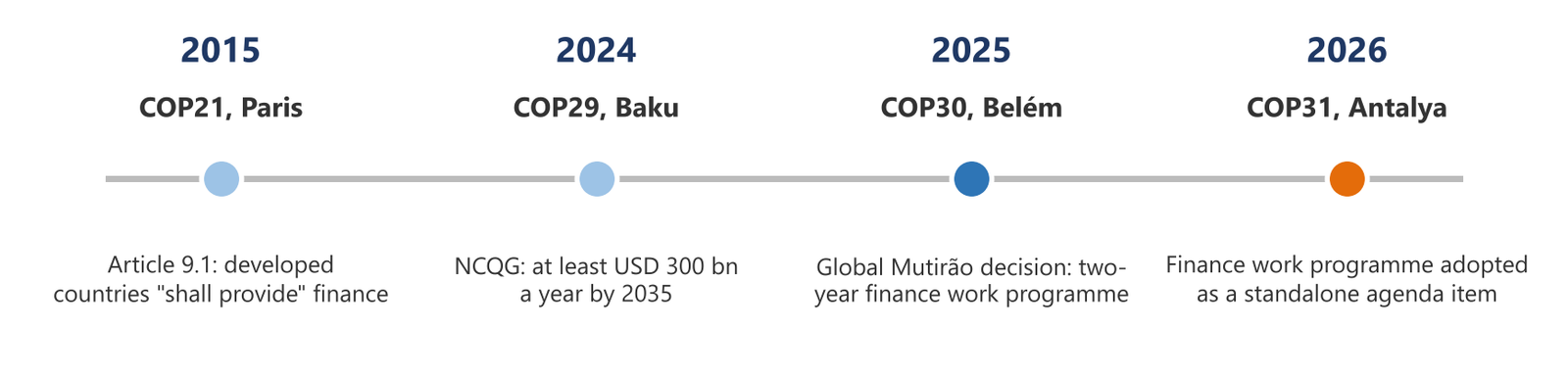
The programme flows from the Global Mutirão decision at COP30 in Belém, which set up a two-year work programme on climate finance. Under an unusual deal, Türkiye holds the COP31 presidency while Australia leads the negotiations.
Key Features
- Focus on Article 9.1: under the Paris Agreement, developed countries “shall provide” financial resources to help developing countries with mitigation and adaptation.
- Quality, not just quantity: it will examine the adequacy, accessibility, predictability and concessional nature of finance, and whether existing pledges are delivered.
- A forum, not a fund: the CFWP is a negotiation and review process; it creates no new money by itself.
Why It Matters for India
India and the BASIC group want the talks centred on what rich countries owe, since the NCQG agreed at Baku (at least USD 300 billion a year by 2035) is far below estimated needs. The EU objected to a separate agenda item, and a proposal to triple adaptation finance was not made a standalone item.
📖 Read More: UNFCCC • COP30 Belém, Brazil (2025) • Paris Climate Change Conference 2015 (COP21)
8. National Legal Services Day and Lok Adalats
(POLITY AND GOVERNANCE) (NOA) National Legal Services Day was observed on 9 November, marking the day the Legal Services Authorities Act, 1987 came into force in 1995. The Act turned the promise of free legal aid into a nationwide institutional network.
Constitutional Basis
Article 39A, a Directive Principle inserted by the 42nd Amendment Act, 1976, directs the State to provide free legal aid so that no citizen is denied justice for economic or other reasons.
The Legal Services Pyramid
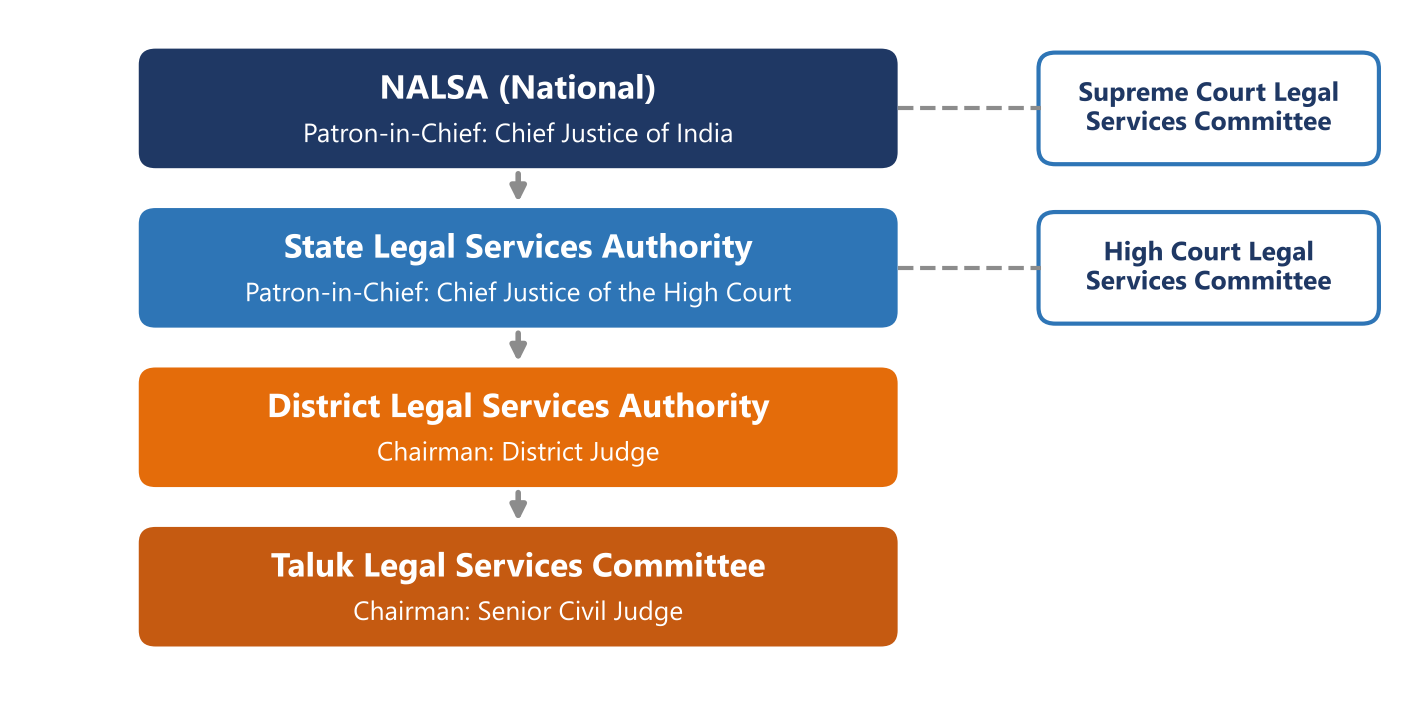
The National Legal Services Authority (NALSA) frames policy and funds schemes; State and District Authorities deliver free legal aid, legal literacy camps and Lok Adalats.
Lok Adalats: People’s Courts
- Origin: the first Lok Adalat camp was held in Gujarat (Junagadh) in 1982 as a voluntary body; the 1987 Act gave it statutory status.
- Award: deemed a decree of a civil court; final and binding, with no appeal.
- Scope: pending and pre-litigation disputes; offences that are not compoundable under any law are excluded.
- Permanent Lok Adalats: added by a 2002 amendment for public utility services (transport, postal, power, water) up to ₹1 crore; unlike regular Lok Adalats, they can decide on merits if conciliation fails.
📖 Read More: Lok Adalats and Other Courts • Concept and Nature of DPSPs
9. Naseem Al Bahr: India–Oman Naval Exercise
(INTERNATIONAL RELATIONS) (AIR) (DD) INS Surat has reached Muscat for the 15th edition of Naseem Al Bahr (“Sea Breeze”), the bilateral exercise of the Indian Navy and the Royal Navy of Oman, to be followed by a Coordinated Patrol (CORPAT).
| Aspect | Details |
|---|---|
| Started | 1993; held roughly every two years |
| Phases | Harbour phase (cross-deck visits, professional exchanges, sports) and sea phase (drills) |
| Follow-up | CORPAT to strengthen joint maritime surveillance |
| INS Surat | Fourth and last Project 15B (Visakhapatnam-class) stealth guided-missile destroyer, commissioned in 2025 |
Why Oman Matters
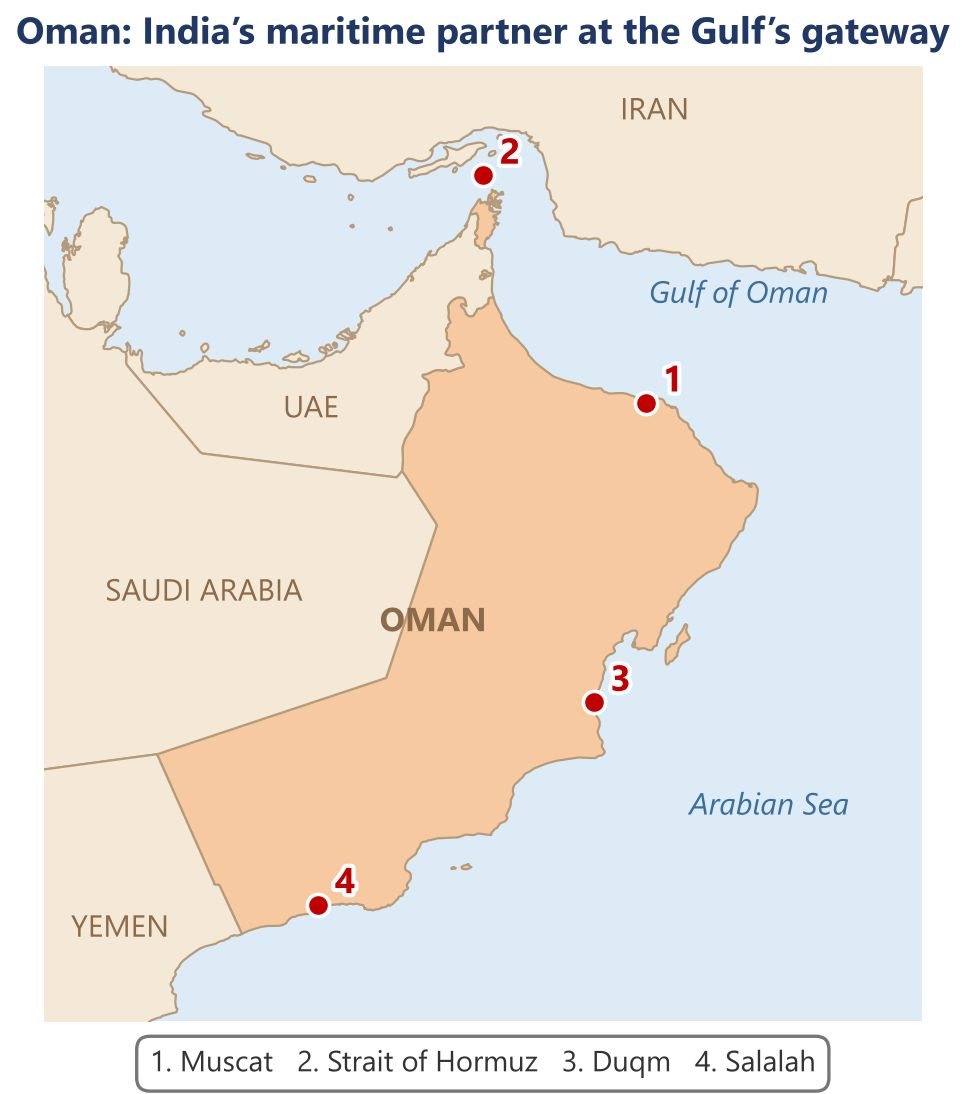
- Location: Oman sits at the mouth of the Strait of Hormuz, through which a large share of India’s crude oil imports pass.
- Access: India has access to the port of Duqm for logistics support, useful for anti-piracy patrols in the Arabian Sea.
- Vision: the exercise supports India’s MAHASAGAR (Mutual and Holistic Advancement for Security and Growth Across Regions) outlook and naval diplomacy in the western Indian Ocean.
📖 Read More: India and Oman Relations • Naval Defence • Coastal and Maritime Security
10. Bestu Varas: Gujarat Enters Vikram Samvat 2083
(HISTORY) (DD) The Prime Minister greeted people on the Gujarati New Year (Bestu Varas or Nutan Varsh), celebrated on 10 November 2026, the day after Diwali, marking the start of Vikram Samvat 2083 in the Gujarati calendar.
- When: the first day of the bright fortnight (Shukla Pratipada) of Kartik; traders close old account books and worship new ones (chopda pujan).
- Two new-year traditions: most of north India begins the Vikram Samvat in Chaitra (spring), while Gujarat begins it in Kartik (autumn).
Indian Eras Compared
| Era | Starting point | Note |
|---|---|---|
| Vikram Samvat | 57 BCE | Linked by tradition to King Vikramaditya of Ujjain; lunisolar, about 57 years ahead of the Common Era |
| Saka Samvat | 78 CE | Basis of the Indian National Calendar adopted in 1957; 1 Chaitra usually falls on 22 March |
| Gupta era | 319–320 CE | Used in Gupta inscriptions |
The coexistence of these eras is itself a lesson in how historical time was reckoned in India, and why dates in inscriptions must be converted with care.
📖 Read More: Festivals in India • Understanding Historical Time