
UPSC CURRENT AFFAIRS — 6 NOVEMBER 2026
1. ASI 2024-25: Inside India’s Factory Sector
(ECONOMICS) (PIB) The Ministry of Statistics and Programme Implementation (MoSPI) has released the detailed publications of the Annual Survey of Industries (ASI) 2024-25 — Volume I and the Summary Results of the Factory Sector — along with unit-level data. These deepen the headline results first put out on 30 September 2026.
What the ASI Measures
The ASI is India’s principal source of statistics on registered manufacturing. It tracks the structure of factories — their capital, employment, output, inputs and value added. The survey counts the establishment (factory), not the enterprise that owns it.
- Reference period: April 2024 to March 2025; fieldwork ran from October 2025 to June 2026.
- Legal basis: the Collection of Statistics Act, 2008; the 2024-25 round was conducted under the Collection of Statistics Rules, 2024.
- Coverage: factories registered under Sections 2(m)(i) and 2(m)(ii) of the Factories Act, 1948 (10 or more workers with power, or 20 or more without power); bidi and cigar units under the Bidi and Cigar Workers (Conditions of Employment) Act, 1966; electricity undertakings not registered with the CEA; and units with 100 or more employees in the Business Register of Establishments.
Headline Numbers at a Glance
| Indicator | 2023-24 | 2024-25 | Change |
|---|---|---|---|
| Number of factories | 2,60,061 | 2,66,931 | +2.64% |
| Gross output | ₹153.27 lakh crore | ₹165.24 lakh crore | +7.81% |
| Gross Value Added (GVA) | ₹24.58 lakh crore | ₹26.94 lakh crore | +9.59% |
| Persons engaged | 1.96 crore | 2.10 crore | +7.19% |
| Fixed capital (factsheet) | ₹46.24 lakh crore | ₹51.12 lakh crore | +10.54% |
- Corporate segment: it produces over 89% of manufacturing GVA; its GVA rose 9.28%, persons engaged rose 7.57%, net value added per factory rose 6.59%, but GVA per person engaged rose only 2.25%.
- Leading States by GVA: Maharashtra, Gujarat, Tamil Nadu, Karnataka and Uttar Pradesh — together over 54% of the total.
- Leading States by employment: Tamil Nadu, Maharashtra, Gujarat, Uttar Pradesh and Haryana.
- Job engines: food products, textiles, basic metals, motor vehicles and wearing apparel together provide over 41% of factory jobs.
The Missing Middle
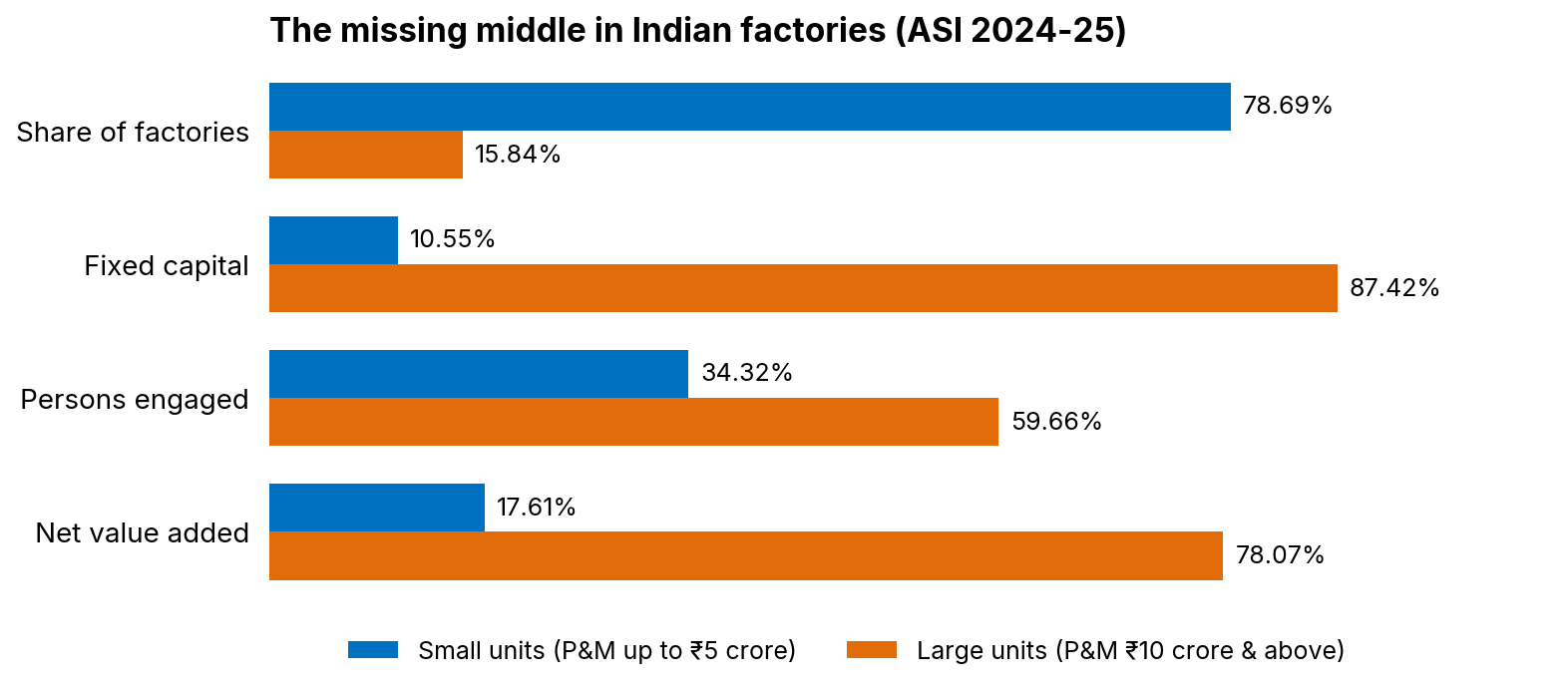
Factory India is split in two. A large base of small units holds little capital, while a thin layer of big plants controls most of the capital and value added. Units producing under ₹1 crore of output form 18.34% of factories but yield only 0.08% of gross output.
Fault Lines
- Productivity gap: value added is growing far faster than value added per worker, which limits wage growth.
- Regional skew: five western and southern States dominate, while mineral-rich eastern States remain suppliers of raw material.
- Sub-scale units: micro factories face thin or negative margins, high compliance costs and costly power.
Way Forward
- Technology upgrade: credit-linked capital support for small factories, building on RAMP and other MSME schemes.
- Eastward industrialisation: use industrial corridors and logistics planning to bring plants to Bihar, Odisha, Jharkhand and West Bengal.
- Skills and labour: apprenticeship-led reskilling and smoother compliance under the new labour codes.
- Shared facilities: plug-and-play clusters with common testing labs and effluent plants so tiny units can scale up, in line with Make in India.
📖 Read More: Industrial Sector of Indian Economy • National Income Accounting • RAMP
2. ₹14,500-Crore Push for Grid-Scale Energy Storage
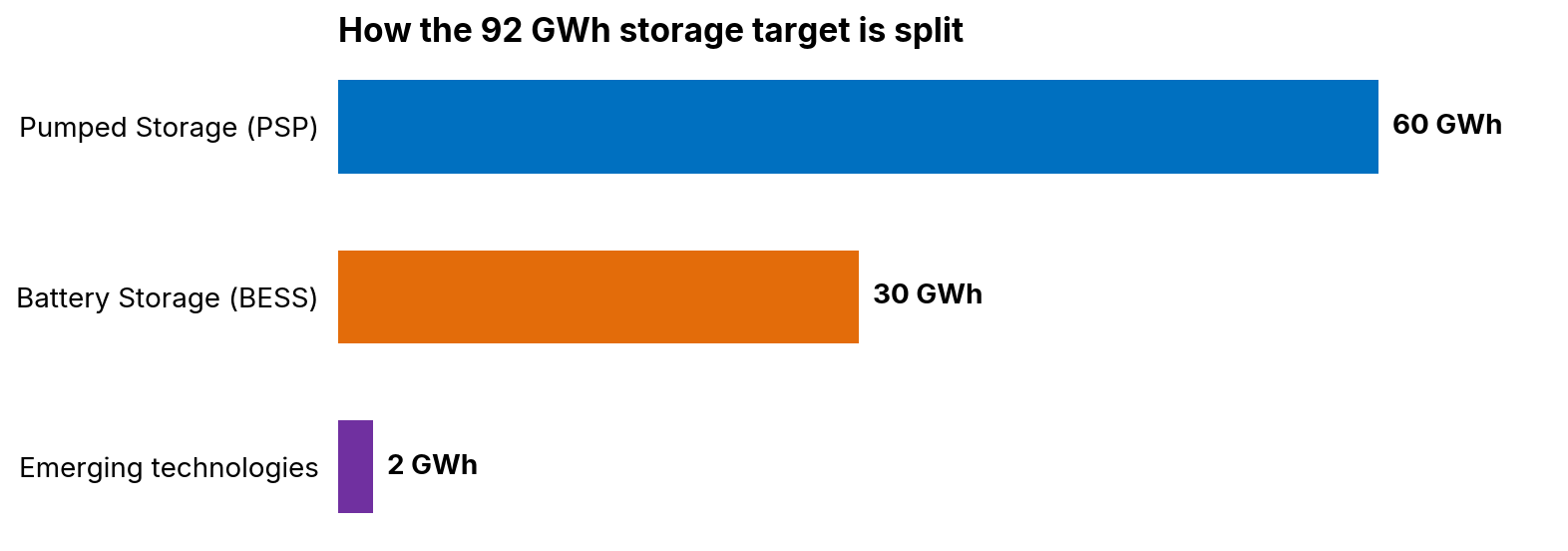
(ECONOMICS) (PIB) (PMI) The Union Cabinet has approved a Viability Gap Funding (VGF) Scheme with ₹14,500 crore of support for FY 2026-27 to FY 2030-31 to build 92 GWh of grid-scale energy storage.
Key Features
| Feature | Details |
|---|---|
| Target | 92 GWh of new storage — about 170% of present grid-scale storage capacity |
| Long-term need | India will require 411 GWh of grid-scale storage by 2031-32 |
| Selection | Tariff-based competitive bidding |
| Who gets VGF | Public and private DISCOMs for BESS and pumped storage; public and private entities for alternative technologies |
| Make in India | Minimum 40% Domestic Content Requirement (DCR) for BESS projects |
| Investment expected | About ₹97,600 crore |
Why Storage Matters
Solar power peaks at midday, but demand peaks in the evening. Storage shifts clean power across these hours and reduces the need for coal-based backup.
Midday solar surplus ➜ Stored in PSP/BESS ➜
Released at evening peak ➜ Round-the-clock green power
Understanding VGF
Viability Gap Funding is a one-time capital grant for projects that are economically necessary but not commercially viable on their own. It is a familiar tool in public–private partnerships. This scheme supports demand for storage, while the PLI scheme for ACC batteries supports the supply side.
Pumped Storage vs Battery Storage
| Aspect | Pumped Storage (PSP) | Battery Storage (BESS) |
|---|---|---|
| Principle | Water pumped uphill when power is cheap and released through turbines when needed (details) | Electrochemical cells store and release power |
| Strength | Large volumes over long durations; long asset life | Fast response; quick to build; flexible siting |
| Constraint | Needs suitable sites; longer construction | Imported cells and critical minerals |
📖 Read More: Measures to Boost Renewable Energy • Challenges Faced by Renewable Energy • PLI for ACC Battery Storage
3. Railways Tops Rooftop Solar Drive Among Ministries
(ENVIRONMENT) (ANI) The Vice President presented the PM Surya Ghar Excellence Award 2026 to the Ministry of Railways at the Renewable Energy Summit & Expo 2026 at Bharat Mandapam, New Delhi, on 5 November 2026. Railways ranked first in “Maximum Buildings Solarized by Central Ministries/Departments”.
The Numbers
| Indicator | Ministry of Railways | All Central Ministries/Departments |
|---|---|---|
| Buildings identified | 15,868 | 39,135 (77 Ministries/Departments) |
| Buildings solarised | 12,495 (79%) | 25,984 (66%) |
| Rooftop capacity | 351 MW of a 424 MW target | — |
| Share of all solarised buildings | About 48% | — |
- Next target: solarise every remaining feasible railway building by March 2027.
About PM Surya Ghar: Muft Bijli Yojana
- Launched in February 2024 and run by the Ministry of New and Renewable Energy, it aims to put rooftop solar on 1 crore households with up to 300 units of free power a month (scheme notes).
- Government buildings are a separate saturation drive under the same mission, with States and Central Ministries reporting progress on the national portal.
Significance
- Cuts power bills of stations, offices and workshops, and supports the Railways’ goal of becoming a net-zero carbon emitter by 2030.
- Public buildings act as a demonstration effect, making solar energy visible and normal for citizens.
📖 Read More: PM Surya Ghar: Muft Bijli Yojana • Solar Energy • Rail Transport in India
4. NDC-TIA II: Cleaning Up India’s Road Freight
(ENVIRONMENT) (PIB) NITI Aayog and GIZ (Deutsche Gesellschaft für Internationale Zusammenarbeit) signed an Implementation Agreement on 3 November 2026 under Phase II of the Nationally Determined Contribution – Transport Initiative for Asia (NDC-TIA II), to speed up decarbonisation of road freight.
About NDC-TIA
- Funding: a regional initiative backed by the German Government’s International Climate Initiative (IKI).
- Countries: India, China and Vietnam, with Germany as funder.
- Partners in India: GIZ with WRI India, ICCT India and Agora Energiewende.
- Focus of Phase II: electrifying medium- and heavy-duty freight vehicles, which remain at an early stage of adoption.
How the Initiative Works
Enabling regulation ➜ Charging on freight corridors ➜ Green finance ➜
Zero-emission trucks ➜ NDC targets met
- Charging and grid: high-power charging along major freight routes with grid upgrades.
- Finance: blended finance, risk-sharing and Total Cost of Ownership (TCO) models to make e-trucks bankable.
- Platforms: ministries, truck makers, logistics firms and power utilities on one table.
Link to India’s Climate Pledges
Under the Paris Agreement, India’s updated NDC aims to cut the emissions intensity of GDP by 45% by 2030 from 2005 levels and reach net zero by 2070. Freight decarbonisation is central because trucks are few in number but heavy emitters.
📖 Read More: Paris Climate Change Conference 2015 • Climate Mitigation Measures • Road Transport in India
5. New Travel Rules for the Nepal and Bhutan Borders
(INTERNAL SECURITY) (TOI) The Ministry of Home Affairs has notified the Immigration and Foreigners (Exemption) (Amendment) Order, 2026. It amends the 2025 Order to tighten documentation for travel across the India–Nepal and India–Bhutan borders while keeping visa-free movement.
The parent Order is issued under Section 33 of the Immigration and Foreigners Act, 2025, which repealed the Passport (Entry into India) Act, 1920, the Registration of Foreigners Act, 1939, the Foreigners Act, 1946 and the Immigration (Carriers’ Liability) Act, 2000.
What Changes
| Traveller | Rule under the amended Order |
|---|---|
| Indians travelling to or from Nepal/Bhutan (land or air) | Show any one identity document listed in the Visa Manual to the immigration officer and give information sought |
| Indians going to a third country through these borders | Valid passport needed; entry and exit only through designated immigration check posts |
| Citizens of Nepal and Bhutan | Show an identity document from the Visa Manual; exemption lost when travelling to or from a third country |
| Nepalese/Bhutanese arriving via China, Macau, Hong Kong or Pakistan | Valid passport and Indian visa required |
Visa Manual is now formally defined as the compendium of visa and immigration guidelines issued and updated by the Central Government.
Other Exempt Categories (2025 Order)
- Members of the Armed Forces on duty, and families travelling on government transport.
- Registered Sri Lankan Tamils who took shelter in India on or before 9 January 2015.
- Tibetans with valid entry or special entry permits, as specified in the Order.
- Persecuted minorities — Hindus, Sikhs, Buddhists, Jains, Parsis and Christians — from Afghanistan, Bangladesh and Pakistan who entered on or before 31 December 2024.
Why It Matters
India’s open borders with Nepal and Bhutan rest on decades of trust and treaty ties. Their very openness can be misused by third-country nationals. Requiring identity proof checks such misuse without ending visa-free travel for neighbours.
📖 Read More: India and Nepal • India and Bhutan • Citizenship
6. Three Indian Classics Enter UNESCO’s Asia-Pacific Register
(HISTORY) (TOI) Kalhana’s Rajatarangini, the Mahabharata and Kautilya’s Arthashastra have been inscribed on UNESCO’s Memory of the World (MoW) Regional Register for Asia and the Pacific at the 11th session of MOWCAP in Jakarta, Indonesia.
The Memory of the World Programme
- Launched by UNESCO in 1992 to protect documentary heritage — manuscripts, archives and rare records — and make it accessible.
- Three tiers: International, Regional and National registers.
- MOWCAP: the Asia-Pacific committee, set up in 1998, approves regional inscriptions, normally every two years.
- India’s recent entries: Ramcharitmanas, Panchatantra and Sahṛdayāloka-Locana joined the regional register in 2024; the Bhagavad Gita and Natyashastra manuscripts entered the International Register in April 2025.
The Three Works
| Work | Author and period | Why it matters |
|---|---|---|
| Rajatarangini | Kalhana; Sanskrit; c. 1148–1149 CE, in the reign of Jayasimha of Kashmir | History of Kashmir’s kings in eight books (Tarangas); drew on earlier chronicles, inscriptions and coins; a rare early example of critical history-writing in India |
| Mahabharata | Attributed to Vyasa; grew from Jaya to Bharata to the Mahabharata | Epic of the Kurukshetra war exploring Dharma, Artha, Kama and Moksha; contains the 700-verse Bhagavad Gita in the Bhishma Parva; inspired Yakshagana, Kathakali and Wayang |
| Arthashastra | Attributed to Kautilya (Chanakya/Vishnugupta); linked to Chandragupta Maurya | Treatise on statecraft in 15 books; rediscovered by R. Shamasastry in 1905 and published in 1909; sets out the Saptanga and Mandala theories |
Saptanga: Seven Limbs of the State
Swami ➜ Amatya ➜ Janapada ➜ Durga ➜ Kosha ➜ Danda ➜ Mitra
The seven limbs are the ruler (Swami), ministers (Amatya), territory and people (Janapada), fort (Durga), treasury (Kosha), army (Danda) and ally (Mitra).
For foreign policy, the Arthashastra offers the Mandala theory of circles of States, the six-fold policy (Shadgunya) and four methods — Sama, Dana, Bheda and Danda.
📖 Read More: Ancient Literature • Evolution of Indian Literature • UNESCO Intangible Cultural Heritage of India
7. Ambala Memorial Honours the Heroes of 1857
(HISTORY) (TP) Union Home Minister Amit Shah inaugurated the “Azadi Ki Pehli Ladai Ka Shaheed Smarak” — the Martyrs’ Memorial of the First War of Independence — at Ambala Cantonment, Haryana, on 5 November 2026. It spreads over 22 acres and cost ₹594 crore.
Inside the Memorial
- Galleries: themed galleries that use virtual reality, holography and projection mapping to tell the story of 1857.
- Local craft: Haryanvi Phulkari embroidery and Sarkanda reed work blend with the digital displays.
- Public spaces: an open-air theatre for 2,500 people and a light-and-sound show set in 1857.
- Why Ambala: a key cantonment on the Grand Trunk Road, it saw unrest among sepoys over the new cartridges in the weeks before the Meerut outbreak.
The Road to 1857 and After
Doctrine of Lapse (1848–56) ➜ Annexation of Awadh (1856) ➜
Mangal Pandey, Barrackpore (Mar 1857) ➜ Meerut rising (10 May 1857) ➜ Government of India Act (1858)
Political grievances such as the Doctrine of Lapse combined with economic, social and military causes. The greased Enfield cartridges were the trigger. After the revolt, Company rule ended and power passed to the Crown.
Leaders and Centres
| Centre | Leader(s) |
|---|---|
| Delhi | Bahadur Shah II (Zafar); General Bakht Khan |
| Kanpur | Nana Saheb, Tatya Tope, Azimullah Khan |
| Lucknow (Awadh) | Begum Hazrat Mahal (for her son Birjis Qadr) |
| Jhansi | Rani Lakshmibai |
| Jagdishpur / Arrah (Bihar) | Kunwar Singh |
| Faizabad | Maulvi Ahmadullah Shah |
| Bareilly | Khan Bahadur Khan |
| Rewari (Haryana) | Rao Tula Ram |
| Allahabad | Maulvi Liaquat Ali |
📖 Read More: Beginning and Spread of the Revolt • Causes of the Revolt • Reasons for Failure • Nature, Impact and Legacy
8. Hyderabad Gets a Private Hub for Space Debris Removal
(SCIENCE AND TECHNOLOGY) (NDTV) A Union Minister virtually inaugurated Base 1 of Hyderabad start-up Cosmoserve Space — reported as India’s first private facility for Active Debris Removal (ADR) and In-Orbit Servicing (IOS).
About Base 1
- Facility: about 14,800 sq ft at Hyderabad with robotics test labs, microgravity simulation, satellite clean rooms and a mission control centre.
- Technology: a soft robotic capture system that can grip tumbling, non-cooperative objects without breaking them into more pieces.
- Track record: its Mission Embrace demonstrator flew on Skyroot’s Vikram-1, which reached orbit in July 2026.
- Services: removing dead satellites, and commercial work such as refuelling, inspection and life extension.
Why Debris Removal Matters
Low-Earth orbit is crowded. One collision can set off a chain reaction known as the Kessler syndrome, making some orbits unusable.
Collision in orbit ➜ Thousands of fragments ➜
More collisions ➜ Cascading debris belt
India’s Framework
- Debris-Free Space Missions (DFSM): ISRO’s goal of debris-free Indian space missions by 2030.
- Project NETRA: ISRO’s network for tracking space objects and space situational awareness.
- IN-SPACe: authorises and promotes private space activity under the Indian Space Policy, 2023, widening the commercial space economy.
📖 Read More: Space Sustainability and Emerging Challenges • Space Governance and Traffic Management • Commercial Space Economy
9. S&T Scoreboard: Mapping States’ Research Strength
(SCIENCE AND TECHNOLOGY) (NOA) NITI Aayog Vice Chairman Ashok Kumar Lahiri launched the India Science and Technology (S&T) Scoreboard in New Delhi on 3 November 2026. It assesses the research and innovation performance of all 36 States and UTs.
What It Tracks
- Indicators: R&D spending, scientific publications, citations, patent applications and innovation infrastructure.
- Three sectors: academia, government R&D laboratories and industry.
- Period: FY 2021-22 to FY 2024-25, with 11 priority areas such as AI, semiconductors, clean energy, critical minerals, biotechnology and space.
Quality Signals for India
| Indicator | India |
|---|---|
| Papers in the top 10% most cited | 8.5% |
| Papers in Q1 (top-ranked) journals | 28.5% |
| Papers with international collaboration | 29.9% |
| Category Normalised Citation Impact (world average = 1.0) | 0.89 |
Research output is concentrated in Tamil Nadu, Uttar Pradesh, Maharashtra, Karnataka and Delhi.
Significance
- Competitive federalism: States can benchmark themselves and fix gaps, not just chase ranks.
- Lab to market: stresses translational research that reaches industry and start-ups, complementing the Atal Innovation Mission.
- Viksit Bharat 2047: aligns State science policy with national priorities.
📖 Read More: NITI Aayog in Governance • Atal Innovation Mission 2.0
10. Srishti: Navy’s Next-Generation Offshore Patrol Vessel
(INTERNAL SECURITY) (PIB) Srishti (Yard 1283), a Next Generation Offshore Patrol Vessel (NGOPV) for the Indian Navy, was launched at Goa Shipyard Limited (GSL) on 27 October 2026. “Srishti” means “creation” in Sanskrit.
The NGOPV Programme
| Feature | Details |
|---|---|
| Contract | Signed on 30 March 2023 under the Buy (Indian-IDDM) category |
| Ships and cost | 11 vessels for ₹9,781 crore |
| Builders | GSL, Goa (lead yard, 7 ships) and GRSE, Kolkata (follow yard, 4 ships) |
| Design | Indigenously designed and built |
| Roles | Surveillance, search and rescue, protection of offshore assets, HADR, anti-piracy, counter-infiltration and non-combatant evacuation |
Why OPVs Matter
- They patrol India’s vast Exclusive Economic Zone and guard offshore oil and gas platforms, freeing frontline warships for combat roles.
- Two shipyards building in parallel shortens timelines and spreads shipbuilding skills, a gain for Make in India in defence.
📖 Read More: Naval Defence • Coastal and Maritime Security
11. Yanbu: Saudi Arabia’s Red Sea Oil Lifeline
(GEOGRAPHY) (RT) Saudi Arabia issued danger alerts for Yanbu, its main Red Sea oil export hub, as missile and drone attacks by Yemen’s Houthis continued.
Location and Profile
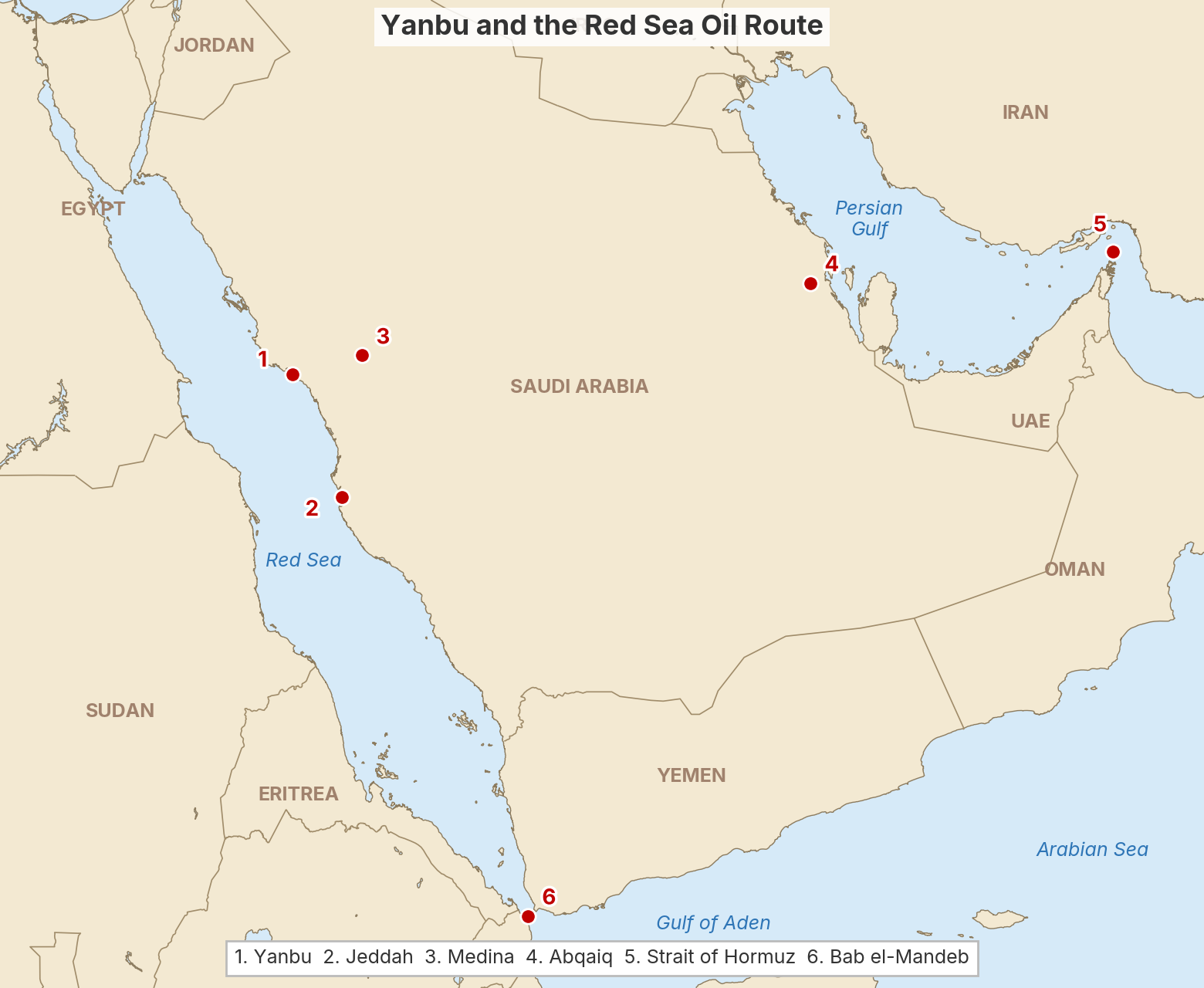
- Where: a port city in the Medina Province of western Saudi Arabia, on the eastern shore of the Red Sea.
- Ports and industry: King Fahd Industrial Port and Yanbu Commercial Port; refineries, petrochemical plants and Yanbu Industrial City, developed under the Royal Commission for Jubail and Yanbu.
- Pipeline terminus: end point of the 1,201-km East–West Pipeline (Petroline) from the Abqaiq field. It was built during the Iran–Iraq War to let Saudi crude bypass the Strait of Hormuz.
Why It Matters Now
Hormuz route disrupted ➜ Exports diverted to Yanbu ➜
Houthi strikes on Red Sea hub ➜ Higher oil, freight and insurance costs
- Chokepoint risk: Red Sea tankers must still pass the Bab el-Mandeb, which lies next to Houthi-held Yemen.
- For India: Saudi Arabia is a major crude supplier, and the Red Sea route carries much of India’s trade with Europe; price spikes feed into inflation and the import bill.
📖 Read More: India and Saudi Arabia Relations • India and West Asia Policy • Oil and Energy Diplomacy