
UPSC CURRENT AFFAIRS — 2 NOVEMBER 2026
1. World Bank Brief: Extreme Poverty Falls to 2.6%
(SOCIAL JUSTICE) (TH) (IE) The World Bank’s India Poverty and Equity Brief (October 2026) reports that extreme poverty, measured at USD 3.00 a day in 2021 purchasing power parity terms, fell to 2.6% in 2023 from 27.1% in 2011. At the USD 4.20 line, poverty dropped from 57.7% to 16.1%, lifting an estimated 496 million people above it.
Reading the Poverty Lines
| Line (2021 PPP) | What it represents | 2011 | 2023 |
|---|---|---|---|
| USD 3.00 a day | Extreme poverty line | 27.1% | 2.6% (about 7.5 crore people) |
| USD 4.20 a day | Lower-middle-income line | 57.7% | 16.1% |
Projections at the USD 4.20 line show a slower decline: 14.2% in 2026 and 12.1% by 2028. The brief draws on household consumption and labour-force surveys, so it is a modelled estimate, not an official Indian poverty line.
Key Findings
- Rural poverty at the USD 4.20 line is 19.3%, against 8.6% in urban areas.
- About 57% of the remaining poor live in a contiguous belt of States from Uttar Pradesh to West Bengal.
- Poverty is highest among children aged 0–14 (21.8%) and among females (16.6%); it is 21.3% for adults with no education but only 7.4% for those with tertiary education.
- The World Bank’s multidimensional poverty rate is 15.5% for 2022–23; the Multidimensional Poverty Index measure fell to 16.4% in 2019–21 (OPHI-UNDP).
- The consumption Gini index stands at 23.0 for 2023, though surveys may under-capture wealthy households.
- The median earnings of the top 10% of workers are about 13 times those of the bottom 10%.
What Drove the Decline
- Consumption growth and a rise in employment, especially rural women entering paid work (about 13.4 crore more jobs between 2017 and 2023, as reported).
- Social transfers such as food subsidies, which cushioned households against price shocks.
- Wider access to basic services: only about 1% of people lack electricity and 6.4% lack basic drinking water, as reported.
Why Progress Remains Fragile
- Job growth is concentrated in low-productivity informal and farm work, so real earnings have barely moved.
- Youth unemployment rose from 14.6% to 15.9% between the first quarters of FY 2025–26 and FY 2026–27, as reported, with rural young women hit hardest.
- Regional concentration means national gains depend on jobs in a handful of populous States.
How Poverty Has Been Measured in India
| Committee | Key contribution |
|---|---|
| Alagh (1979) | Based the poverty line on calorie norms: 2,400 (rural) and 2,100 (urban) per person per day |
| Lakdawala (1993) | State-specific poverty lines using consumption expenditure and State price indices |
| Tendulkar (2009) | Dropped calorie-based norms; one all-India basket; 2011–12 line of ₹816 (rural) and ₹1,000 (urban) per person per month |
| Rangarajan (2014) | Separate rural and urban baskets; lines of ₹972 (rural) and ₹1,407 (urban); not adopted officially |
Way Forward
- Push industrial and MSME investment into the Uttar Pradesh–to–West Bengal belt to create productive local jobs.
- Move rural and women workers from low-yield farm work into manufacturing, food processing and services.
- Align skilling with industry demand to ease youth unemployment.
- Update survey frames and the Census base so that poverty data keep pace with urbanisation.
Tackling poverty is also a constitutional duty: Article 39(c) directs the State to prevent concentration of wealth, and the Supreme Court in Olga Tellis (1985) read the right to livelihood into Article 21. Sustained progress needs jobs and human capital, not welfare transfers alone.
📖 Read More: Poverty • Poverty and Hunger • Inequality
2. Rooftop Solar Drives India’s Decentralised Energy Push
(ECONOMICS) (TH) The Union Minister for New and Renewable Energy described India’s shift to a people-led, decentralised solar economy, noting that over 21 lakh of the 65 lakh households under PM Surya Ghar: Muft Bijli Yojana now record zero electricity bills.
Headline Claims
- Solar capacity has risen from about 2.8 GW in 2014 to roughly 171 GW, according to the Minister’s statement.
- India has met its pledge of 50% non-fossil installed capacity ahead of the 2030 target, five years early as reported, under the Panchamrit commitments made at COP26.
Schemes Behind the Shift
| Scheme | What it does |
|---|---|
| PM Surya Ghar: Muft Bijli Yojana | Rooftop solar for 1 crore households, with up to 300 units of free power a month and net-metering income; outlay about ₹75,000 crore |
| PM-KUSUM | Solar pumps and grid-connected farm solar to replace diesel and ease feeder load |
| PLI for solar PV modules | Builds domestic module and cell capacity to cut import dependence |
| Green Energy Corridors | New transmission lines to evacuate renewable and stored power to demand centres |
Rooftop panel installed ➜ Subsidy and net metering ➜ Surplus power exported ➜
Bill falls to zero ➜ Lower peak purchase by DISCOMs
Panchamrit Targets (COP26, 2021)
- 500 GW non-fossil capacity and 50% of energy needs from renewables by 2030.
- Cut projected emissions by one billion tonnes by 2030 and carbon intensity by 45% against 2005.
- Reach net-zero emissions by 2070.
Challenges
- Intermittency and storage: the Central Electricity Authority projects a need for about 236 GWh of battery storage by 2031–32 to balance evening peaks.
- Imports of polysilicon, ingots and wafers keep the solar chain exposed to global price shocks.
- Weak DISCOM finances delay payments and net-metering approvals.
- Land and transmission bottlenecks, especially for mega parks in arid western India.
Way Ahead
- Channel incentives to upstream polysilicon, wafer and electrolyser manufacturing.
- Pair solar and wind with battery and pumped-storage capacity for round-the-clock supply.
- Fast-track smart prepaid meters and prompt payment mechanisms for utilities.
- Use the International Solar Alliance to export rooftop and off-grid know-how to the Global South.
Rooftop solar turns households into producers, but the gains hold only if storage, grids and utility finances improve alongside capacity.
📖 Read More: Solar Energy • PM Surya Ghar: Muft Bijli Yojana • PM-KUSUM • Measures to Boost Renewable Energy • Challenges Faced by Renewable Energy
3. Coal India Posts Record Monthly Output and Supply
(ECONOMICS) (PIB) Coal India Limited marked its 51st Foundation Day on 1 November 2026 after its best-ever month: 70.3 million tonnes (MT) of total coal supply in October 2026, up 19% year on year, with record production, power-sector supply and rail loading.
October 2026 Records
| Indicator | October 2026 | Previous record |
|---|---|---|
| Total coal supply | 70.3 MT (+19% y-o-y) | 69.4 MT (March 2026) |
| Supply to power sector | 57.1 MT (+19% y-o-y) | 56.5 MT (May 2024) |
| Coal production | 67.2 MT (+19% y-o-y) | 62.47 MT (October 2024) |
| Rail rakes loaded for power sector | 310 rakes a day | 302.8 rakes a day (March 2025) |
About Coal India
Coal India Limited is a Maharatna public sector enterprise under the Ministry of Coal and India’s largest coal producer. It was formed on 1 November 1975 after the nationalisation of the coal industry.
- Output grew from 79 MT in its first year to 768 MT in FY 2025–26, almost tenfold.
- The production target for FY 2026–27 is 815 MT.
Why It Matters
- Coal still anchors electricity generation, so reliable domestic supply protects energy security and limits import bills (see Coal Sector in India).
- Record rail loading shows that evacuation, not just mining, decides whether power plants get fuel on time.
- Strong output must be read alongside the clean-energy shift: coal output growth and renewable growth are running together, which raises questions about the pace of transition.
📖 Read More: Coal Sector in India • Recent Developments in Coal Sector • Overview of Public Sector in India
4. Catch the Rain 2026: Community-Led Water Conservation
(ENVIRONMENT) (PIB) The Jal Sanchay Jan Bhagidari: Catch the Rain (JSJB: CTR) 2026 initiative, launched on 1 June 2026, merges community-led groundwater recharge with the Jal Shakti Abhiyan: Catch the Rain campaign. A PIB factsheet reports over 1.55 crore recharge and storage structures built under the wider JSJB effort.
Evolution of the Campaign
| Phase | Highlights |
|---|---|
| Jal Shakti Abhiyan (2019) | Covered 1,592 water-stressed blocks in 256 districts |
| Catch the Rain (22 March 2021) | Launched on World Water Day with the theme “Catch the Rain, Where It Falls, When It Falls” |
| JSJB 1.0 (April 2024–May 2025) | Built on the Three Cs: Community, CSR and Cost; over 10 lakh recharge structures reported |
| JSJB 2.0 (from 1 June 2025) | Low-cost, hyper-local recharge in over-exploited and critical districts |
| JSJB: CTR (from 1 June 2026) | Integrates JSJB with Catch the Rain; portal and app for monitoring |
Key Interventions
- Rainwater harvesting systems, recharge pits and recharge shafts in homes, institutions and public spaces.
- Revival of traditional wells, baolis, ponds and abandoned borewells.
- Desilting of ponds and reservoirs, plus afforestation and catchment protection.
- District-level Jal Shakti Kendras that offer technical guidance and planning support.
Funds are pooled through convergence with schemes such as VB-G RAM G, PMKSY, CAMPA and Finance Commission grants. Panchayats, urban local bodies, women’s groups and schools take part in planning.
Results Reported
- An evaluation of 23 lakh structures built under JSJB 1.0 estimated about 2.43 billion cubic metres of groundwater recharge, using June–December 2025 rainfall data.
- JSJB 1.0 was recognised at the 6th National Water Awards in November 2025.
Way Forward
Structures need upkeep funds and community ownership, or recharge gains fade. Linking recharge sites to aquifer maps and to Atal Bhujal Yojana can focus effort where groundwater stress is highest.
📖 Read More: Water Conservation • Atal Bhujal Yojana • Schemes under Ministry of Jal Shakti
5. Ayushman Vay Vandana Completes Two Years
(SOCIAL JUSTICE) (DD) The Ayushman Vay Vandana initiative, launched on 29 October 2024, has completed two years with 23.46 lakh authorised hospital admissions worth ₹5,668.80 crore as of October 2026. It extends AB PM-JAY cover to every citizen aged 70 and above, irrespective of income.
Scheme Snapshot
| Feature | Detail |
|---|---|
| Eligibility | All senior citizens aged 70 years and above, regardless of socio-economic status |
| Cover | Up to ₹5 lakh per family a year for secondary and tertiary hospitalisation; about 6 crore senior citizens in 4.5 crore families |
| Top-up | Seniors in families already covered by AB PM-JAY get an extra ₹5 lakh a year, exclusively for themselves |
| Enrolment | Aadhaar e-KYC through the Ayushman App or the beneficiary portal; separate Vay Vandana card |
| Implementer | National Health Authority under the Ministry of Health and Family Welfare |
| Other schemes | Those under CGHS, ECHS or CAPF may choose either scheme; private insurance and ESI holders are also eligible |
Two-Year Record
- Cataract surgery was the most common treatment: 4.71 lakh procedures (20.1%).
- Chronic haemodialysis followed with about 2.90 lakh treatments.
- Coronary angioplasty (PTCA) led in spending, at about ₹649 crore.
- Knee replacement, COPD exacerbations, acute kidney injury and febrile illness also feature among top treatments.
Why It Matters
- India’s elderly population is growing, and out-of-pocket hospital costs push many households into debt.
- Cashless cover protects savings and dignity for older people, many of whom lack pensions.
- Challenges include hospital empanelment gaps, claim rejections and low awareness among the rural elderly.
📖 Read More: AB PM-JAY • Senior Citizens and Other Vulnerable Groups
6. Supreme Court to Test ‘Industry’ Under IR Code
(POLITY AND GOVERNANCE) (BS) The Supreme Court has agreed to hear a petition by the All India Trade Union Congress (AITUC) challenging the definition of ‘industry’ in the Industrial Relations Code, 2020, which excludes several categories of institutions from the Code’s protections.
What the Code Says
The Industrial Relations Code, 2020 merges the Trade Unions Act, 1926, the Industrial Employment (Standing Orders) Act, 1946 and the Industrial Disputes Act, 1947. It defines industry as systematic activity, through cooperation between employer and workers, for producing or distributing goods and services.
It excludes:
- Institutions owned or run by organisations mainly engaged in charitable, social or philanthropic work.
- Government activities relating to sovereign functions.
- Domestic service.
- Any other activity the Central Government may notify.
The Constitutional Challenge
- Article 14: the exclusion turns on who runs the establishment, not on the work done, so a nurse in a charitable hospital and one in a private hospital get unequal remedies.
- Excessive delegation: the power to notify further exclusions has no stated limiting criteria.
- Departure from precedent: the Court’s Bangalore Water Supply (1978) judgment held that the nature of activity, not the employer’s identity or profit motive, decides what is an industry.
| Triple test (Bangalore Water Supply, 1978) | Meaning |
|---|---|
| Systematic activity | Organised, not casual or isolated |
| Employer–employee cooperation | Work done through organised employment |
| Production or distribution of goods and services | Aimed at satisfying human wants |
Where the Law Stands
In Jai Bir Singh (August 2026), the Court held that the 1978 triple test continues for pending disputes under the Industrial Disputes Act, 1947, but that the Code’s definition must be read independently. Workers in excluded establishments lose statutory protection on retrenchment, lay-off, closure and conciliation.
The outcome will shape how the new labour codes treat hospitals, universities and charities, and will test equality under Article 14.
📖 Read More: New Labour Codes • Right to Equality
7. India–New Zealand Agree on Origin Data Exchange
(ECONOMICS) (AIR) India and New Zealand signed a Memorandum of Cooperation on the electronic exchange of origin data for trade in goods. The Central Board of Indirect Taxes and Customs (CBIC) and the New Zealand Customs Service signed it to support the India–New Zealand free trade agreement.
What Are Rules of Origin?
Rules of origin are product-specific conditions that decide whether a good qualifies for preferential tariffs under a trade agreement. A good may qualify if it is wholly obtained in a partner country, if it undergoes a change in tariff classification, or if enough value is added there.
Exporter claims origin ➜ Origin data sent electronically ➜
Importing customs verifies ➜ Preferential duty granted
Why Electronic Exchange Helps
- Customs can verify certificates of origin quickly and cut paperwork and delays.
- Digital checks reduce fake or inflated origin claims, such as goods routed through a partner to dodge duty.
- In India, the Customs (Administration of Rules of Origin under Trade Agreements) Rules, 2020 empower officers to verify claims for preferential imports.
Wider Context
- The FTA offers duty-free access to Indian exports and promotes cooperation in agriculture, services and technology.
- India’s other recent trade-pact partners include the EU, UAE, Australia, EFTA, the UK and Oman.
- New Zealand is an island country in the south-western Pacific; the Tasman Sea separates it from Australia and the Cook Strait separates its two main islands. Its capital is Wellington.
📖 Read More: Types of Trade Agreement • India and New Zealand Relations
8. Jaishankar’s Baku Visit Extends Central Asia Outreach
(INTERNATIONAL RELATIONS) (TH) External Affairs Minister S. Jaishankar visited Baku, Azerbaijan to review bilateral ties and also met Uzbekistan’s Foreign Minister, signalling renewed Indian focus on Central Asia and the Caucasus.
Outcomes of the Visit
- India–Azerbaijan: both sides agreed to expand cooperation in trade, investment, energy, tourism, connectivity and people-to-people ties.
- Ties had cooled after Azerbaijan opposed India’s Operation Sindoor against Pakistan; the visit aims to repair them.
- India–Uzbekistan: leaders’ agreements were reviewed with stress on timely implementation. Ties were raised to a Comprehensive Strategic Partnership in August 2026, covering trade, mining, energy and uranium supply.
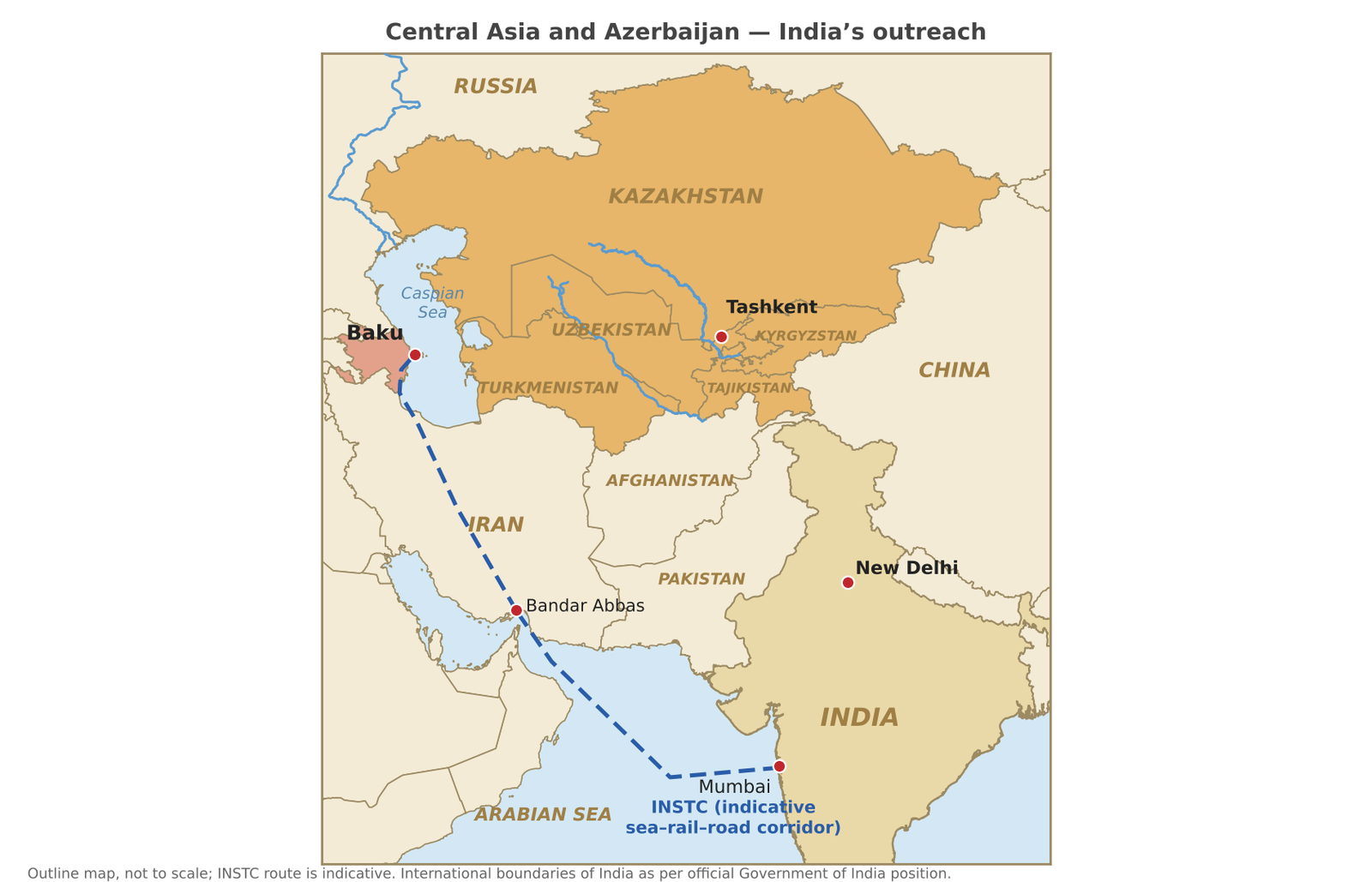
Connectivity: The INSTC
Both countries support the International North–South Transport Corridor (INSTC), a multimodal route linking India with Iran, the Caspian region, Russia, Central Asia and Europe. It was launched in 2000 by India, Iran and Russia.
Central Asia at a Glance
| Feature | Detail |
|---|---|
| Countries | Kazakhstan, Kyrgyzstan, Tajikistan, Turkmenistan and Uzbekistan; all landlocked and independent since the Soviet collapse in 1991 |
| Physical features | Tian Shan and Pamir ranges; Karakum and Kyzylkum deserts; Amu Darya and Syr Darya rivers that once fed the Aral Sea |
| Strategic value | Silk Road heritage; reserves of oil, natural gas and uranium |
| Kazakhstan | World’s largest landlocked country by area |
| Uzbekistan | Doubly landlocked: every neighbour is also landlocked |
| Lake Issyk-Kul | In Kyrgyzstan; the world’s second-largest alpine lake after Lake Titicaca |
| Darvaza Gas Crater | In Turkmenistan; burning since a 1971 collapse |
The Aral Sea, shared by Kazakhstan and Uzbekistan, has shrunk sharply because river water was diverted for irrigation. Central Asia matters to India for energy, minerals, connectivity and security linked to Afghanistan.
📖 Read More: India and Central Asia • India and Uzbekistan
9. UN Mission in Somalia Closes After Two-Year Transition
(INTERNATIONAL RELATIONS) (UN) The United Nations Transitional Assistance Mission in Somalia (UNTMIS) ceased operations on 31 October 2026, completing a two-year transition under Security Council resolutions 2753 (2024) and 2809 (2025), at the request of Somalia’s Federal Government.
Evolution of the UN Presence
| Period | Mission | Role |
|---|---|---|
| 1992–1995 | UNOSOM I and II | Humanitarian and military intervention after state collapse and civil war |
| 1995–2013 | UN Political Office for Somalia (UNPOS) | Political presence supporting peace processes and the provisional constitution |
| 2013–2024 | UN Assistance Mission in Somalia (UNSOM) | Helped build federal institutions, elections and the rule of law (Resolution 2102) |
| 2024–2026 | UNTMIS | Managed a phased handover of tasks to Somali authorities and the UN Country Team |
What UNTMIS Did
- Political mediation between the Federal Government and Federal Member States on constitutional and electoral issues.
- Capacity-building for ministries, Parliament and courts.
- Support for security-sector reform alongside African Union missions.
- Monitoring of human rights, child protection and sexual violence.
Why It Matters
- It shows a UN special political mission completing a planned exit, with ownership returned to the host state.
- Somalia still faces insurgency by al-Shabaab, clan-based politics and climate shocks, so the handover will be tested.
- India backs UN-led peacebuilding and has contributed peacekeepers across Africa.
📖 Read More: The United Nations • Civil War in Somalia
10. New Air Chief Dixit Unveils ‘VAYU’ Vision
(INTERNAL SECURITY) (PIB) (TH) Air Chief Marshal Ashutosh Dixit took over as the 29th Chief of the Air Staff on 1 November 2026 and unveiled ‘VAYU’, a four-pillar vision for operational readiness, self-reliance, innovation and jointness in the Indian Air Force.
The Chief of the Air Staff
The Chief of the Air Staff is the professional head of the IAF, holds the four-star rank of Air Chief Marshal and sits on the Chiefs of Staff Committee. Air Chief Marshal Dixit is an experimental test pilot and qualified flying instructor with over 3,500 flying hours. His earlier posts include Chief of Integrated Defence Staff and Vice Chief of the Air Staff.
The VAYU Vision
| Letter | Pillar | Focus |
|---|---|---|
| V | Vigilance, Victory and Readiness | High operational readiness and sustained combat strength |
| A | Aatmanirbharta | Indigenous platforms, sensors, weapons and technologies for sustained combat capability |
| Y | Yukti | Innovation in doctrine, technology and procedures, including AI-enabled command and control and counter-drone capability |
| U | Unity of Effort | Jointness with the Army, Navy and national agencies, in line with the national JAI vision |
JAI stands for Jointness, Aatmanirbharta and Innovation, the national theme for defence modernisation.
Why It Matters
- Modern air power depends on integration across services, space, cyber and unmanned systems, which VAYU explicitly addresses.
- Indigenous production lowers import dependence and spare-part risks during long operations.
- Jointness is a stated pillar, which fits India’s push for deeper tri-service integration.
📖 Read More: Air Defence • Aerospace Industry
11. Bundibugyo Ebola Outbreak Crosses 10,000 Cases
(SCIENCE AND TECHNOLOGY) (DD) A rare Bundibugyo-strain Ebola outbreak, declared in mid-May in the Democratic Republic of Congo’s eastern Ituri province, has passed 10,000 confirmed cases and nearly 5,000 deaths, and health officials warn it could spread beyond Africa.
About Ebola
Ebola disease is a severe, often fatal haemorrhagic fever caused by viruses of the genus Orthoebolavirus in the family Filoviridae. The World Health Organization puts the average fatality rate at about 50%, ranging from 25% to 90% across outbreaks.
| Feature | Detail |
|---|---|
| First identified | 1976, in Nzara (now South Sudan) and Yambuku (DR Congo); named after the nearby Ebola River |
| Reservoir | Fruit bats of the family Pteropodidae are the likely natural hosts |
| Species | Zaire, Sudan, Bundibugyo, Taï Forest, Reston and Bombali ebolaviruses |
| Spread | Direct contact with blood or body fluids of the sick or the dead; not routinely airborne |
| Incubation | 2–21 days; people are not contagious until symptoms begin |
| Symptoms | Fever, fatigue, muscle pain, headache, then vomiting, diarrhoea and organ failure |
Why This Outbreak Is Hard to Stop
- No treatment is approved specifically for Bundibugyo; care is supportive, and vaccine trials are still under way.
- About 80% of new infections arise outside monitored transmission chains, as reported.
- The Africa CDC has set a target of linking at least 95% of new cases to known contacts.
- Roughly 5,000 deaths among 10,000 cases implies a crude fatality near 50%.
Treatment Gaps
Monoclonal antibody drugs Inmazeb and Ebanga are approved only for Zaire ebolavirus disease, and the licensed vaccine also targets Zaire. Ebola can persist in semen, eyes and the nervous system after recovery, so survivors need follow-up.
Early detection ➜ Isolation of cases ➜ Contact tracing ➜
Supportive care and trials ➜ Safe burials and vaccination
Why It Matters for India
The outbreak tests global health governance, vaccine equity and the WHO’s emergency role. For India, it raises questions of preparedness and travel-health surveillance, and zoonotic outbreaks underline the One Health approach.
📖 Read More: Important Diseases Explained • Major Human Diseases
12. Digi Yatra Begins International Trials at Seven Airports
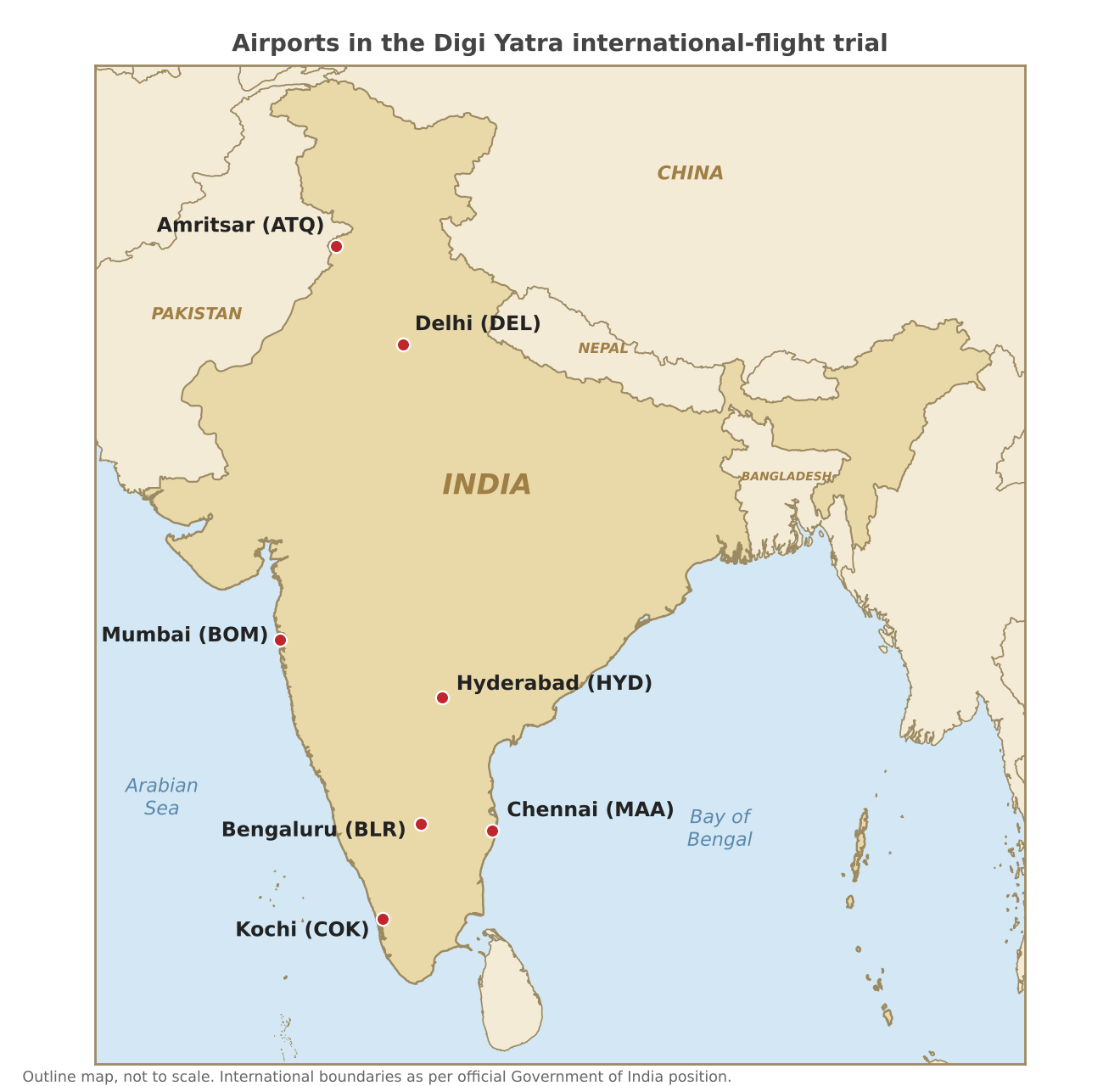
(SCIENCE AND TECHNOLOGY) (AIR) The Ministry of Civil Aviation has begun trials of Digi Yatra for international passengers at seven airports, running from November to December 2026. Eligible Indian nationals with e-passports can use it on select Air India and IndiGo international flights.
How It Works
- The passenger scans the Machine Readable Zone of the e-passport and reads its chip through the phone’s NFC feature.
- A verifiable credential is stored in the Digi Yatra wallet on the device.
- The credential works at terminal entry, security hold areas and boarding gates, where equipment exists.
Scan e-passport MRZ ➜ Read chip by NFC ➜
Credential in wallet ➜ Face match at touchpoints
About Digi Yatra
| Feature | Detail |
|---|---|
| Concept | Face-recognition-based, paperless, contactless processing at airport checkpoints |
| Launch | Domestic flights from 1 December 2022 at Delhi, Bengaluru and Varanasi |
| Operator | Digi Yatra Foundation, a not-for-profit company of the Airports Authority of India and major private airport operators |
| Data model | Self-sovereign identity: credentials stay in the user’s phone, not a central database |
Safeguards and Limits
- Digi Yatra does not replace passports, visas, immigration or airline checks; passengers must still carry valid documents.
- Privacy rests on local storage and deletion of airport-shared data soon after departure, which links to the Digital Personal Data Protection regime.
- Interoperability with international standards will decide whether the system works across borders.
📖 Read More: Civil Aviation Schemes • Digital Infrastructure in India • Data Localisation and Privacy Issues
13. Pranos Fusion Plans India’s First Private Tokamak
(SCIENCE AND TECHNOLOGY) (TH) Bengaluru-based start-up Pranos Fusion has built PRAGYA, a compact tokamak for testing plasma control and superconducting magnets, and aims to finalise the blueprint of PRANIK, India’s first privately built fusion reactor design, by 2027.
Fusion Basics
Nuclear fusion joins light nuclei, such as hydrogen isotopes, into heavier ones and releases energy, the process that powers the Sun. Fission, by contrast, splits heavy nuclei such as uranium.
| Aspect | Fission | Fusion |
|---|---|---|
| Process | Splitting of heavy nuclei | Joining of light nuclei |
| Fuel | Uranium or plutonium | Deuterium and tritium |
| Chain reaction | Yes; needs control | No; stops if conditions fail |
| Long-lived waste | Significant | Much lower |
The Pranos Roadmap
- PRAGYA: a small doughnut-shaped test bed to study plasma control and high-temperature superconducting (HTS) magnets.
- PRANIK: a larger tokamak, with a design to be finalised in 2027; generating electricity is a further step away, the founders say.
- The firm says compact machines, HTS magnets and India’s manufacturing base can cut costs sharply.
- It has raised $7.2 million from investors including Ankur Capital, pi Ventures and Industrial47.
Why It Matters
- Fusion needs no uranium, and India already produces plenty of deuterium; because it is not a chain reaction, the risk of runaway events is almost absent.
- Private entry complements public programmes and builds a deep-tech ecosystem.
- Fusion could support long-term energy security as electricity demand grows, but commercial power remains years away.
📖 Read More: Nuclear Energy in India • Basic Concepts of Nuclear Energy
14. Cyclone Murasu Heads for Andhra Pradesh Coast
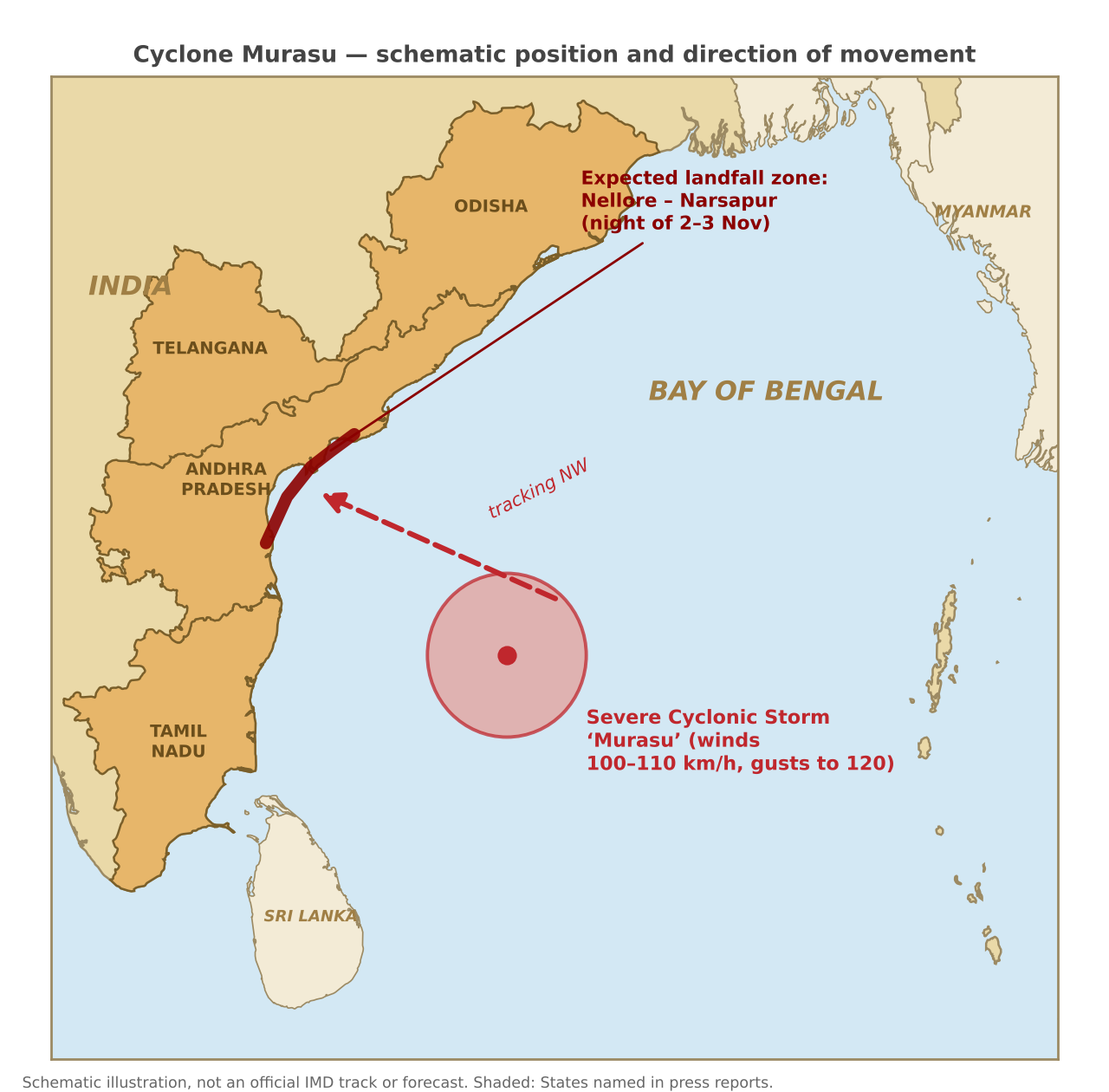
(GEOGRAPHY) (TH) A deep depression over the Bay of Bengal intensified into Severe Cyclonic Storm ‘Murasu’, moving north-westwards with sustained winds of 100–110 km/h. Landfall is expected between Nellore and Narsapur in Andhra Pradesh between 11.30 p.m. on 2 November and 4 a.m. on 3 November.
Expected Impact
- Winds at landfall of 100–110 km/h, with gusts up to 120 km/h.
- A storm surge of about 1.5–2 m above the astronomical tide, strongest in Bapatla and parts of Krishna and Prakasam districts.
- Extremely heavy rain for coastal Andhra Pradesh, Yanam and Rayalaseema on 2–3 November, and for Telangana on 3 November.
- Odisha has sped up evacuation; at least 19 domestic flights were cancelled at Vijayawada, Tirupati and Visakhapatnam.
Genesis and Alerts
Murasu began as a low-pressure area over the Andaman Sea on 29 October and became a cyclonic storm over the Bay of Bengal on 1 November; the IMD alerted 41 districts across Andhra Pradesh, Telangana, southern Odisha and north-east Tamil Nadu for 2–4 November. It is the second cyclone of the 2026 season, after Arnab, which also hit Andhra Pradesh within the past week.
IMD Cyclone Intensity Scale
| Category | Sustained wind (knots) | Sustained wind (km/h) |
|---|---|---|
| Depression | 17–27 | 31–49 |
| Deep Depression | 28–33 | 50–61 |
| Cyclonic Storm | 34–47 | 62–88 |
| Severe Cyclonic Storm | 48–63 | 89–117 |
| Very Severe Cyclonic Storm | 64–89 | 118–165 |
| Extremely Severe Cyclonic Storm | 90–119 | 166–220 |
| Super Cyclonic Storm | 120 and above | 221 and above |
How the Name Was Chosen
Names come from a rotating list agreed by the WMO/ESCAP Panel on Tropical Cyclones, with each member country contributing. ‘Murasu’ is India’s contribution and is a Tamil word for a traditional war drum. It follows ‘Arnab’ (Bangladesh) and precedes ‘Akvan’ (Iran) on the list.
IMD Warning Stages
Pre-cyclone watch (72 h ahead) ➜ Cyclone alert (48 h) ➜
Cyclone warning (24 h) ➜ Post-landfall outlook (12 h)
The north-east monsoon season (October–December) is the main period for Bay of Bengal cyclones hitting the Tamil Nadu–Andhra coast. Shallow shelves and funnel-shaped coasts amplify storm surges there, and agencies such as the NDMA and State disaster forces coordinate evacuation.
📖 Read More: Cyclones: A Natural Hazard • Naming of Tropical Cyclones • NDMA
15. Valley of Flowers Closes After Record 35,261 Visitors
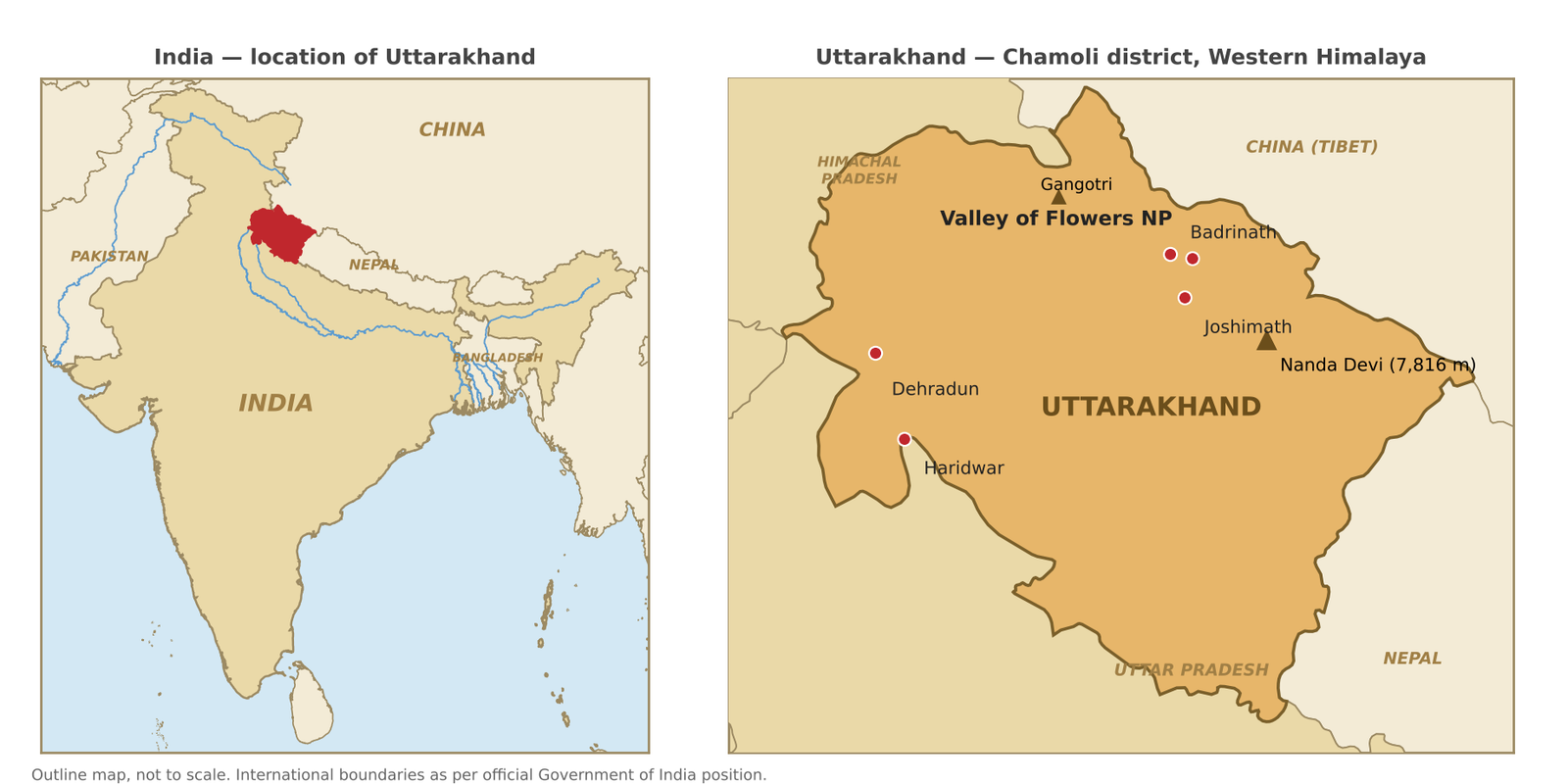
(GEOGRAPHY) (NIE) Uttarakhand’s Valley of Flowers National Park closed for winter after a record 35,261 visitors during its five-month open season, a record for the park.
Location and Status
| Feature | Detail |
|---|---|
| Location | Chamoli district, Uttarakhand, in the Bhyundar valley near Joshimath and Ghangaria; Western Himalaya at roughly 3,350–3,650 m |
| Area | About 87.5 sq. km |
| Status | National Park since 1982; part of the Nanda Devi Biosphere Reserve; UNESCO World Heritage Site, inscribed in 2005 as an extension of Nanda Devi National Park |
| Rivers | The Pushpawati, from the Tipra glacier, joins the Bhyundar Ganga near Ghangaria; this flows to the Alaknanda |
| Access | Open mainly June to October; heavy snow closes it for the rest of the year |
Natural Wealth
- Alpine meadows with hundreds of flowering species, including Brahmakamal, blue poppies and primulas, plus birch and rhododendron forest.
- Himalayan fauna such as snow leopard, musk deer, Asiatic black bear, red fox and blue sheep (bharal).
- A gene bank for medicinal herbs including Aconitum heterophyllum, Dactylorhiza hatagirea and Picrorhiza kurroa.
- It lies between the Zanskar and Great Himalayan ranges, where alpine meadow shades into cold desert.
History
Local lore calls the valley Bhyundar Ganga Valley. British mountaineers Frank Smythe, Eric Shipton and R. L. Holdsworth stumbled on it in 1931 while returning from Mount Kamet; Smythe later wrote The Valley of Flowers.
Management Concerns
Record footfall tests a fragile alpine ecosystem, so carrying-capacity limits, waste control and trail management matter. The park’s protected area, spanning the Biosphere Reserves in India network, needs visitor caps tied to ecological monitoring.
📖 Read More: India’s UNESCO World Heritage Sites • Biosphere Reserves in India • National Parks in India • Alpine Forests of India
16. Rani Chennamma’s 1824 Victory Over the British
(HISTORY) (PIB) The 202nd Victory Celebration of Kittur Rani Chennamma was marked at Prerana Sthal in the Parliament complex, New Delhi, honouring her early armed resistance to the British East India Company.
Who Was Rani Chennamma?
- Born in 1778 in a Lingayat family at Kakati near Belagavi, Karnataka.
- Queen of Kittur, in present-day Karnataka, and one of the earliest Indian rulers to fight the Company with arms.
The Kittur Rebellion (1824)
Ruler of Kittur dies ➜ Company refuses adopted heir Shivalingappa ➜
Attempt to take over Kittur ➜ Battle of 1824: British lose
- The Company would not recognise Shivalingappa as heir, an approach that anticipates the later Doctrine of Lapse.
- In the first battle at Kittur in 1824, British forces suffered heavy losses and the political agent St John Thackeray was killed.
- A larger British force later prevailed; Chennamma was captured and held at Bailhongal Fort, where she died on 21 February 1829.
- Sangolli Rayanna, her commander, carried the resistance forward.
Legacy
- The victory is remembered each year at the Kittur Utsava, held from 22 to 24 October.
- She lives on in Karnataka’s folk songs (Janapada).
- A statue of Rani Chennamma was unveiled in the Parliament complex in 2007.
Kittur shows that armed resistance to Company rule long predates 1857, and that succession disputes were a trigger for British annexation.
📖 Read More: British Conquest of India • Final Wave of British Annexation