
UPSC CURRENT AFFAIRS — 1 NOVEMBER 2026
1. Punjab’s Drug Crisis: Roots, Routes and Remedies
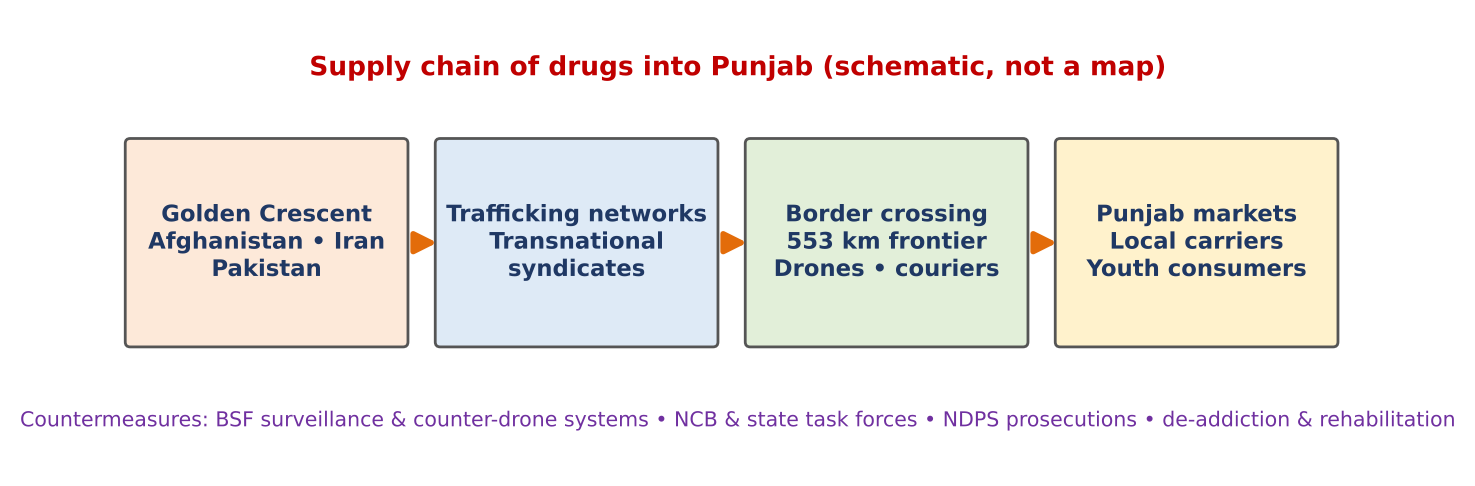
(INTERNAL SECURITY) (IE) Despite years of government campaigns, Punjab’s drug crisis persists and is now a public-health, social and border-security problem at once. The market has shifted from traditional substances to heroin, synthetic drugs and pharmaceutical opioids, moved by cross-border networks that increasingly use drones.
How the drug market has changed
- Traditional to synthetic: Opium, poppy husk and cannabis once dominated. Heroin, lab-made synthetic substances and pharmaceutical opioids are now widely available.
- Complex supply chains: International traffickers, local intermediaries and technology-enabled smuggling work as a linked chain, which makes organised crime hard to dismantle.
- Pharmaceutical opioids: Medicines prescribed for moderate-to-severe pain and severe cough, which are diverted into illicit use.
- Synthetic drugs: Man-made chemicals created in laboratories to mimic or alter the effects of natural or illicit drugs.
Why Punjab is vulnerable
Geographical factors
- Border exposure: Punjab shares a land border of roughly 553 km with Pakistan, a long frontier to patrol.
- Neighbourhood of the Golden Crescent: Afghanistan, Iran and Pakistan form the Golden Crescent, a historic hub of illicit opium production and trafficking, and a key source in the wider illicit economies.
- Drone smuggling: Small drones carry limited loads of heroin across the border and are hard to detect on radar.
- Transnational crime: Suppliers, distributors and criminal intermediaries operate across borders, a theme tied to terror financing and the crime–terror nexus.
Socio-economic factors
- Jobs and income: Limited livelihoods raise the risk of dependence and recruitment into trafficking.
- Agrarian distress: Income uncertainty in farming adds household stress.
- High profits: Illegal margins draw local intermediaries into the trade.
- Peer pressure and mental health: Easy availability, weak counselling access and psychological distress feed addiction.
Impact of the crisis
| Dimension | What it means |
| Public health | Opioid dependence and overdoses raise demand for emergency care, de-addiction and rehabilitation. |
| Family and economy | Financial hardship, domestic conflict and neglect of dependants; lost education, employability and workforce participation. |
| Crime | Trafficking strengthens networks involved in money laundering, violence and other offences. |
| Vulnerable groups | Women, children and poor households face exploitation, insecurity and exclusion. |
| National security | Cross-border trafficking strains border management and internal security. |
Policy response
| Measure | Focus |
| NDPS Act, 1985 | Principal law controlling narcotic drugs, psychotropic substances and trafficking. |
| Narcotics Control Bureau (NCB) | Coordinates drug law enforcement with national and international agencies. |
| Nasha Mukt Bharat Abhiyaan | Awareness, community participation, counselling and rehabilitation. |
| National Action Plan for Drug Demand Reduction (NAPDDR) | Preventive education, treatment, rehabilitation and capacity building. |
| Border measures | BSF and other agencies use surveillance, intelligence-sharing and counter-drone systems. |
| Punjab Government | Yudh Nashian Virudh anti-drug campaign, de-addiction services and operations against supply networks. |
The Narcotics Control Bureau was set up in 1986 as the national nodal agency under the NDPS framework (NCB). Separately, Article 47 of the Constitution, a Directive Principle, directs the State to work towards prohibiting the consumption of intoxicating drinks and drugs injurious to health, except for medicinal purposes (DPSP).
Way forward
- Treat addiction as a health condition: Expand opioid-substitution, counselling and community de-addiction capacity.
- Technology at the border: Combine counter-drone systems with intelligence sharing and financial tracking of trafficking proceeds.
- Livelihood alternatives: Skill-building and jobs for youth reduce the pool of vulnerable consumers and carriers.
Supply disruption ➜ Border technology ➜ Treatment and rehabilitation ➜ Livelihoods ➜ Community vigilance
📖 Read More: Organised Crime • Major Illicit Economies • Border Security • Terror Financing and the Crime–Terror Nexus
2. Israel’s Proportional System Versus India’s FPTP
(POLITY AND GOVERNANCE) (IE) Elections to Israel’s 26th Knesset have drawn attention to its party-list proportional representation, coalition politics and the process of forming a government. The model contrasts sharply with India’s constituency-based First-Past-the-Post (FPTP) system for the Lok Sabha.
Israel at a glance
- System of government: Parliamentary democracy in which the executive answers to the legislature.
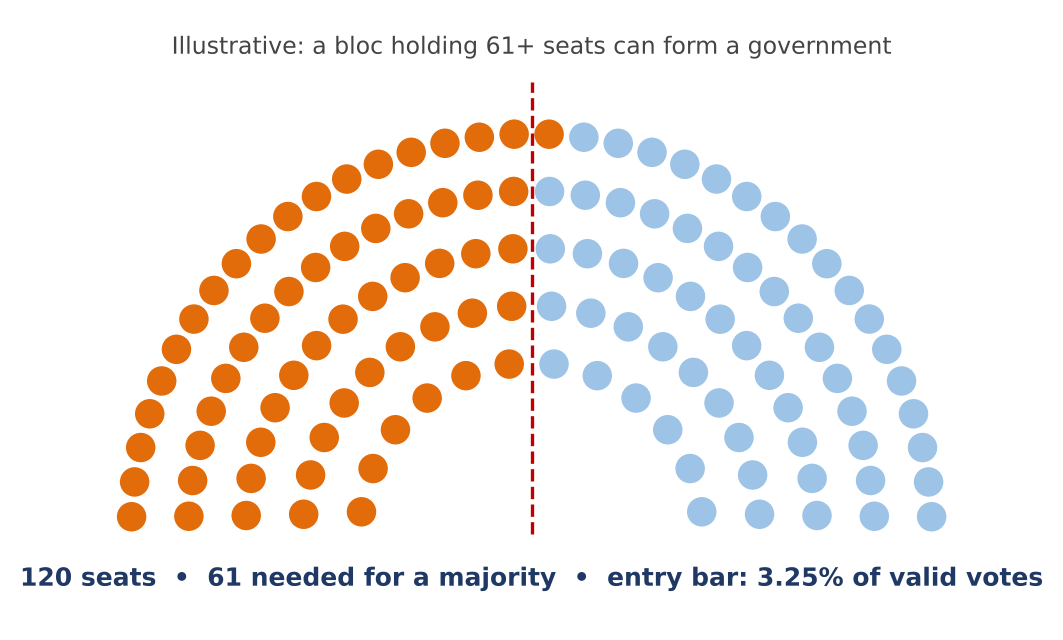
- Legislature: Unicameral Knesset with 120 members, elected for four years unless dissolved earlier.
- Executive: The Prime Minister heads the government and must retain the Knesset’s confidence.
- Election management: Elections are supervised by the Central Elections Committee (CEC).
Israel has no single written constitution; it is governed through a set of Basic Laws. Its President is a largely ceremonial head of state elected by the Knesset (President of Israel).
How Israelis vote
- Party-list voting: Voters choose a party list, not an individual candidate.
- One national constituency: The whole country is a single constituency.
- Seats follow vote share: The 120 seats are divided broadly in proportion to each qualifying party’s national vote, under proportional representation.
- Threshold: A list needs at least 3.25% of valid votes to enter the Knesset (an electoral threshold).
How a government is formed
Election result ➜ President consults parties ➜ Task given to an MK ➜ 28 days (+14 extension) ➜ Coalition of 61+ of 120
- Coalitions are the norm: No party has historically won an outright majority, so alliances decide who governs.
- President’s role: After consultations, the President asks the member most likely to command support to form a government.
- Time limit: The nominee gets 28 days, extendable by up to 14 days.
Israel versus India
| Feature | Israel | India |
| Legislature | Unicameral (Knesset) | Bicameral (Lok Sabha and Rajya Sabha) |
| Electoral system | Party-list proportional representation | First-Past-the-Post for the Lok Sabha |
| House strength | 120 members | 543 elected members in the Lok Sabha |
| Constituencies | One national constituency | 543 territorial constituencies |
| Winning rule | Seats follow national vote share | Candidate with the most votes in a constituency wins |
| Entry threshold | 3.25% of valid national votes | No nationwide vote-share threshold |
| Term | 4 years | 5 years unless dissolved earlier |
| Election body | Central Elections Committee | Election Commission of India |
Common ground: Both are parliamentary democracies with a Prime Minister as head of government, a President as head of state, and a government that must keep the confidence of the elected house.
Proportional representation versus FPTP
| Aspect | Proportional (Israel) | FPTP (India) |
| Fairness to small parties | Better: seats track vote share | Weaker: votes can be “wasted” |
| Government stability | Coalitions can be fragile | Often produces clear majorities, though not always |
| Voter–representative link | Weak: voters back lists | Strong: one local representative |
| Bargaining power | Small parties can become kingmakers | Larger parties dominate |
India does use proportional representation by the single transferable vote for Rajya Sabha and Presidential elections (STV). The Constitution (Article 81) fixes the Lok Sabha’s maximum strength at 550 members, of whom not more than 530 represent States and not more than 20 Union Territories (Lok Sabha).
📖 Read More: Post-Independence Political History of India • India–Israel Relations
3. Building India’s Carbon Future Through Today’s Investment
(ENVIRONMENT) (TH) India’s coming wave of capital spending can either lock in decades of high emissions or accelerate the path to net-zero by 2070. Choices made now on buildings, industry, power grids and critical minerals will decide the carbon cost of the next half-century.
India announced its net-zero-by-2070 goal at the Glasgow climate summit in 2021 (COP26).
Why timing matters
- Floor space will more than double: From about 18 billion m² (2020) to 42 billion m² (2070), so new buildings can be built efficient from day one.
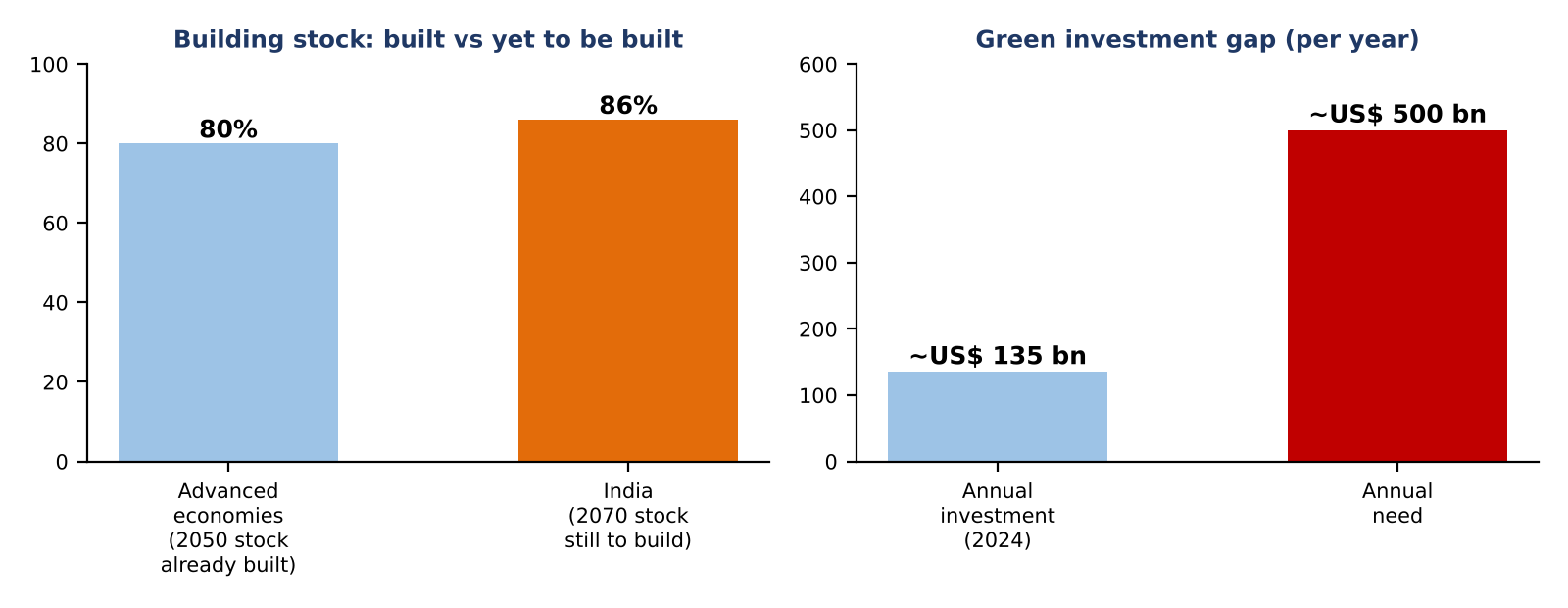
- Leapfrog window: About 80% of advanced economies’ 2050 building stock already exists, but 86% of India’s projected 2070 stock is yet to be built.
- Carbon lock-in risk: Conventional steel, cement and inefficient designs in the National Infrastructure Pipeline and PM Gati Shakti projects can fix high emissions for decades and raise future clean-up costs (carbon lock-in).
Where investment can bend the curve
| Area | Low-carbon choice | Why it matters |
| Buildings | Efficiency codes in all new construction | Locks in low energy use for the building’s lifetime |
| Industry | Green hydrogen, green steel, CCUS instead of legacy processes | Cuts emissions in steel, cement, fertilisers and refineries |
| Power grid | Grid-scale storage and smart transmission | Solar and wind capacity can rise from 164 GW (2025) to over 6,000 GW (2070) |
| Mobility | Upstream investment in critical-mineral assets | Avoids swapping oil dependence for mineral import dependence |
Policy tools already in place
- Building codes: The Bureau of Energy Efficiency issued the Energy Conservation and Sustainable Building Code (ECSBC) 2024 for commercial buildings and Eco-Niwas Samhita (ENS) 2024 for homes.
- Carbon Credit Trading Scheme (CCTS): Moves big polluters from energy targets to tradable carbon-intensity targets and prepares exporters for the EU’s CBAM.
- National Green Hydrogen Mission: Targets 5 MMT of green hydrogen capacity a year by 2030 (MNRE); see energy technologies.
- Production Linked Incentives: Support efficient solar modules, Advanced Chemistry Cell (ACC) batteries and vehicles including EVs.
- Sovereign Green Bonds (2023): Raise funds for eligible public projects with environmental benefits (see green bonds).
- Green procurement: The Ministry of Steel has proposed pooled public purchase of green steel through competitive bidding to create early demand.
From 1 January 2026 the EU’s Carbon Border Adjustment Mechanism entered its definitive phase, so carbon costs now apply to covered goods such as steel, cement and fertilisers entering the EU, which affects Indian exporters (CBAM).
Bottlenecks
| Bottleneck | Problem |
| Financing gap | India invests about US$135 billion a year (2024) against roughly US$500 billion needed; NITI Aayog projects a US$6.5 trillion gap by 2070. |
| Shallow capital markets | Thin corporate bond markets and limited household-savings channels make long-term green finance costly. |
| High cost of capital | Currency, regulatory and off-taker risks raise financing costs for clean infrastructure. |
| Weak code enforcement | Incomplete legal adoption leaves many new buildings without effective efficiency rules. |
| Transmission delays | Slow grid expansion strands renewable capacity. |
| Technology readiness | Green steel and large-scale cement CCUS are immature, risking costly early lock-in. |
Reform pathway
Green finance institution ➜ Corporate green bonds ➜ Transition taxonomy ➜ Code enforcement ➜ Anticipatory grids
- National Green Finance Institution: Use blended finance, credit enhancement and payment security to draw private money into mature clean technologies.
- Corporate green bonds: Tap pension and insurance funds through green and sustainability-linked bonds.
- Climate Finance Taxonomy: Finalise it, including transition activities, to curb greenwashing and steer funds to hard-to-abate sectors.
- Link codes to permits: Tie ECSBC and ENS compliance to building permits, occupancy certificates and power connections.
- Plan grids ahead: Build transmission and storage before generation arrives.
- Align procurement thresholds: Tighten emission limits as the green premium falls, in step with CCTS targets.
📖 Read More: Climate and Environment Diplomacy • Infrastructure Sector of the Indian Economy • Industrial Sector of the Indian Economy • Energy Technologies • Minerals
4. ARISE Cities Forum 2026 Adopts the Delhi Declaration
(ENVIRONMENT) (PIB) The second ARISE Cities Forum in New Delhi adopted the Delhi Declaration on Local Action for Global Climate Goals, to be carried to COP31 of the UNFCCC. It puts cities and local governments of the Global South at the centre of climate action.
What ARISE is
- Full form: Adaptive, Resilient, Innovative, Sustainable and Equitable Cities.
- Purpose: A resilience forum for Global South cities to advance urban climate action.
- Organisers: ICLEI South Asia and the National Institute of Urban Affairs (NIUA), supported by the Ministry of Housing and Urban Affairs.
- ICLEI – Local Governments for Sustainability: A network of over 2,500 local and regional governments, founded in 1990 at the UN in New York and headquartered in Bonn (ICLEI).
Key outcomes
| Outcome | Detail |
| Delhi Declaration | Ten commitments for Global South cities, including a return to the 1.5°C pathway and multilevel climate finance. Not a legally binding treaty. |
| Triple COP in 2026 | Aligns with the Rio Conventions’ agendas: climate (UNFCCC COP31), biodiversity (CBD COP17), land and desertification (UNCCD COP17). |
| Launches | Delhi Biodiversity Map (ICLEI South Asia); a Policy Framework for Gender Equality in Public Bus Transport; Guidelines on Canal Restoration using Nature-based Solutions. |
| Partnerships | ICLEI South Asia signed an MoU with the Global Buildings Performance Network. |
| Youth and health | A South Asian circular-cities hackathon; UNICEF India’s Early Action for Children’s Health (EACH) on heat resilience and clean air. |
The three Rio Conventions on climate, biodiversity and desertification all trace back to the 1992 Earth Summit in Rio de Janeiro (Earth Summit).
Local action ➜ Multilevel finance ➜ National and global agendas ➜ 1.5°C pathway
📖 Read More: Climate and Environment Diplomacy • Global Environmental Governance • UN Convention to Combat Desertification • Urbanization: Problems and Remedies
5. Jupiter’s Complex Shield Against the Solar Wind
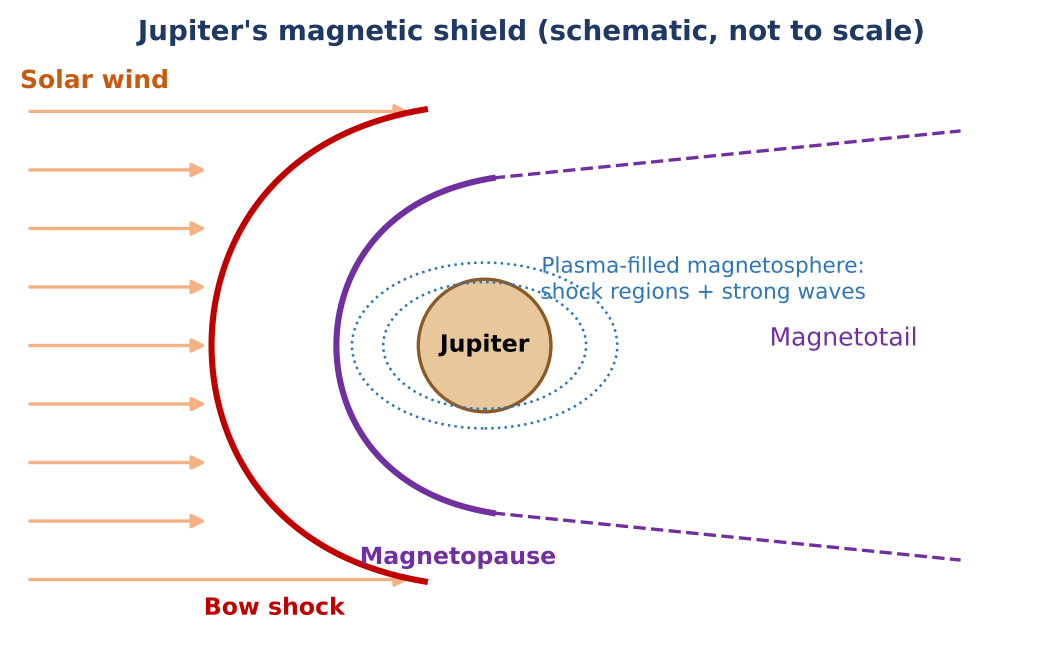
(SCIENCE AND TECHNOLOGY) (SD) Data from NASA’s Juno spacecraft show that Jupiter defends itself against the solar wind through powerful plasma waves and multiple shock regions. The result differs from Earth’s simpler magnetosphere and helps explain how shocks behave in space, including those from supernovae.
Juno was launched in 2011 to study Jupiter’s origin, interior, atmosphere, gravity and magnetic field. It reached Jupiter orbit in July 2016 (NASA Juno).
What Juno found
- Layered defence: Jupiter’s magnetosphere meets the solar wind with several shock regions, not one clean boundary.
- Strong plasma waves: They shape and slow the incoming charged particles.
- Different from Earth: The findings show how unlike each other these two planetary shields are.
- Wider value: Better insight into astrophysical shock waves, including those from exploding stars.
Jupiter fact card
| Feature | Detail |
| Position and size | Fifth planet from the Sun and the largest in the solar system; diameter about 143,000 km, roughly 11 times Earth’s (Jupiter) |
| Rotation | About 9 hours 56 minutes, the fastest of any planet |
| Orbit | About 11.86 Earth years around the Sun |
| Type | Gas giant of mainly hydrogen and helium, with no solid surface |
| Magnetic field | The strongest planetary field in the solar system |
| Rings | Faint ring system made mostly of dust |
| Major moons | Io, Europa, Ganymede (the largest moon in the solar system) and Callisto |
Io, Europa, Ganymede and Callisto are the four Galilean moons, first observed by Galileo in 1610.
Solar wind ➜ Bow shock ➜ Multiple shock regions ➜ Magnetopause ➜ Jupiter
📖 Read More: Solar, Lunar and Planetary Exploration • Gravitation and Planetary Motion • Orbits in Space Technology
6. UNDP’s Four Circuit Breakers for Regional Security
(INTERNATIONAL RELATIONS) (DTE) The UNDP report “Redefining Security: Development Circuit Breakers for a More Secure Future” argues that climate change, cybercrime, inequality and falling trust now form interlinked risks that traditional security thinking cannot handle. It proposes four “circuit breakers” for Asia-Pacific.
Key findings
| Theme | Finding |
| Cybercrime | The global online scam economy generated an estimated US$1.03 trillion in 2024; Asia-Pacific cybercrime losses could reach US$114 billion in 2025. |
| Economic insecurity | About 1.3 billion informal workers lack adequate employment protection and social security; 138.6 million young people in the region are unemployed. |
| Climate vulnerability | Asia-Pacific holds about 70% of the world’s population affected by disasters and about 40% of disaster-related economic losses. |
| SDG progress | Only 14 of 117 measurable SDG targets in the region are on track for 2030 (SDGs). |
| Core argument | Security and development are inseparable: inequality, exclusion and weak institutions deepen crises. |
The idea of human security, which places people rather than states at the centre, was popularised by UNDP’s 1994 Human Development Report (human security).
The four circuit breakers
| Circuit breaker | Aim | Typical action |
| Governance and institutional legitimacy | Rebuild public trust and prevent instability | Transparent, accountable institutions and effective services |
| Digital system integrity | Fight cybercrime and protect digital systems | Cybersecurity, safeguards and responsible regulation |
| Economic security | Reduce inequality and vulnerability | Social protection, decent work, inclusive opportunity |
| Climate and health architecture | Build resilience to future shocks | Climate adaptation, disaster preparedness, strong public health |
Shock arrives ➜ Circuit breaker trips ➜ Spread of crisis contained ➜ Stability protected
Why it matters for India: The same pressures show up at home in informal work, youth joblessness, online fraud and disaster exposure, so the report’s lens links directly to labour-market and cyber-security policy.
📖 Read More: Poverty and Hunger • Unemployment • New Labour Codes • Global and Emerging Cyber Security Challenges • The United Nations
7. Serbia’s Student-Led Movement Reshapes National Politics
(INTERNATIONAL RELATIONS) (IE) A student-led movement in Serbia is reported to have won the parliamentary elections, challenging more than a decade of rule by President Aleksandar Vučić. The result is being watched across the Balkans and the wider European Union neighbourhood.
The movement grew out of nationwide protests that began in late 2024 (Serbian protests).
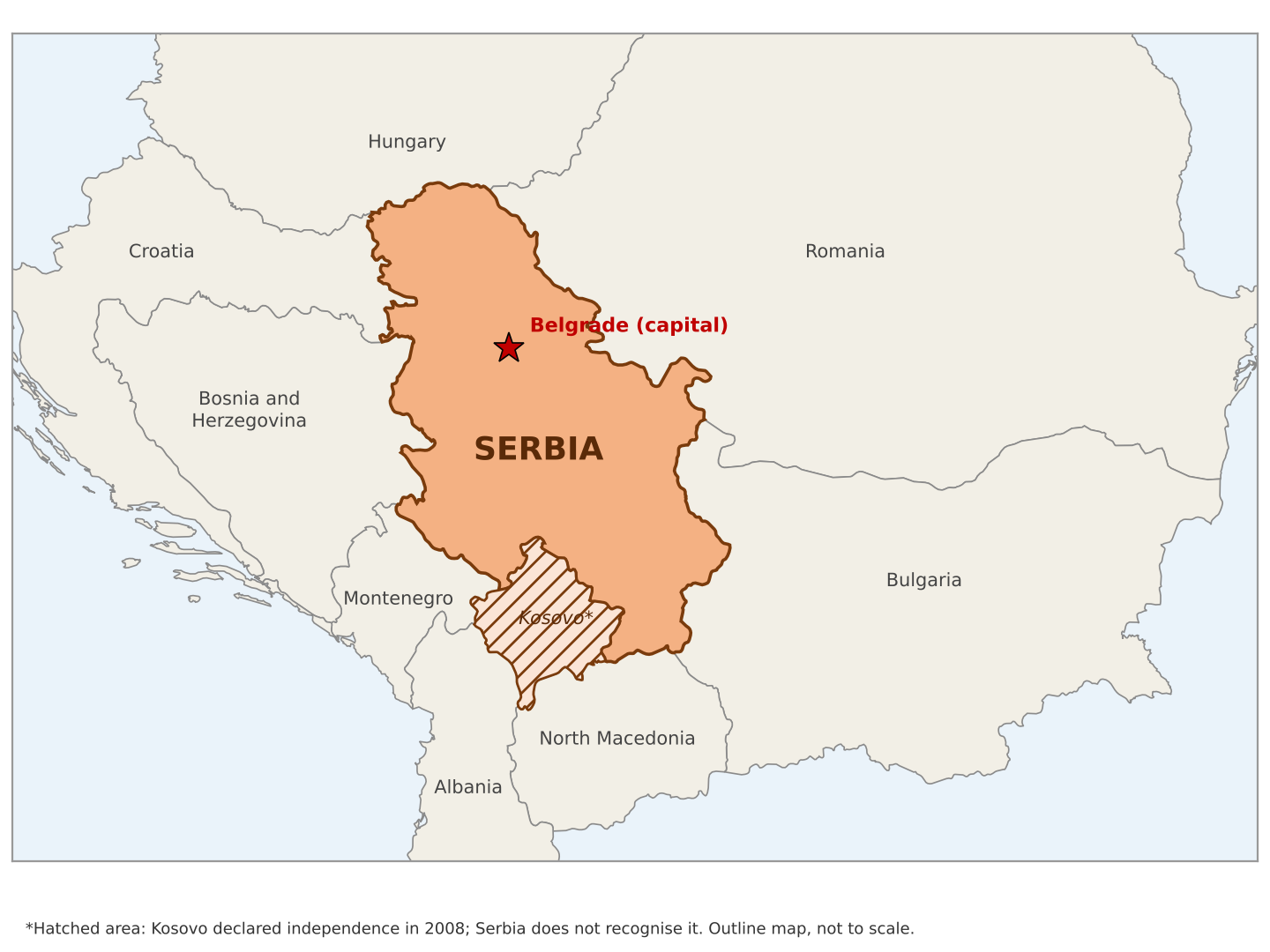
Serbia at a glance
| Feature | Detail |
| Location | Landlocked country in the west-central Balkans (Balkans) |
| History | Part of Yugoslavia for most of the 20th century (Yugoslavia) |
| Capital | Belgrade |
| Neighbours | Hungary (north); Romania and Bulgaria (east); North Macedonia (south); Montenegro (south-west); Bosnia and Herzegovina and Croatia (west); Kosovo (south, which Serbia does not recognise as independent) |
Serbia became independent in 2006 after Montenegro left their union. Kosovo declared independence in 2008, and India has not recognised it (recognition of Kosovo).
Why it matters
- Democratic signal: Mass youth mobilisation turning into electoral success reflects wider anger over governance and accountability.
- European alignment: The outcome may shape Serbia’s course towards the EU and its balance between Brussels, Moscow and Beijing.
- Regional stability: Relations with Kosovo remain a flashpoint in the western Balkans.
📖 Read More: Eastern Europe after the Second World War • Europe after the Cold War • India and Europe