
Global Environmental Governance for UPSC: UNEP, Earth Summit and Major Agreements
Chapter 06 · Visual overview and revision
International environmental governance can appear to be a collection of unrelated conferences, institutions and treaties. In reality, it is a connected system: conferences create institutions, framework conventions create negotiating bodies, protocols add specific commitments, and scientific and financial institutions support implementation.
This visual guide brings those relationships together through two maps. The first explains the institutional network around the United Nations Environment Programme (UNEP). The second traces the Earth Summit and the climate, biodiversity and sustainable-development pathways that followed it.
How to use this page
- First reading: follow only the solid arrows and identify the formal sequence.
- Second reading: follow the dashed arrows to understand scientific, administrative and coordination relationships.
- Third reading: cover the explanations and recall what each institution, convention or protocol actually does.
- Final revision: answer the self-test at the end without looking at the charts.
1. UNEP and the wider environmental institutional ecosystem
Begin with the 1972 Stockholm Conference. Its recommendation led the UN General Assembly to establish UNEP. From that central node, the chart separates four roles that aspirants often mix up: coordination, scientific assessment, environmental finance, and treaty support.
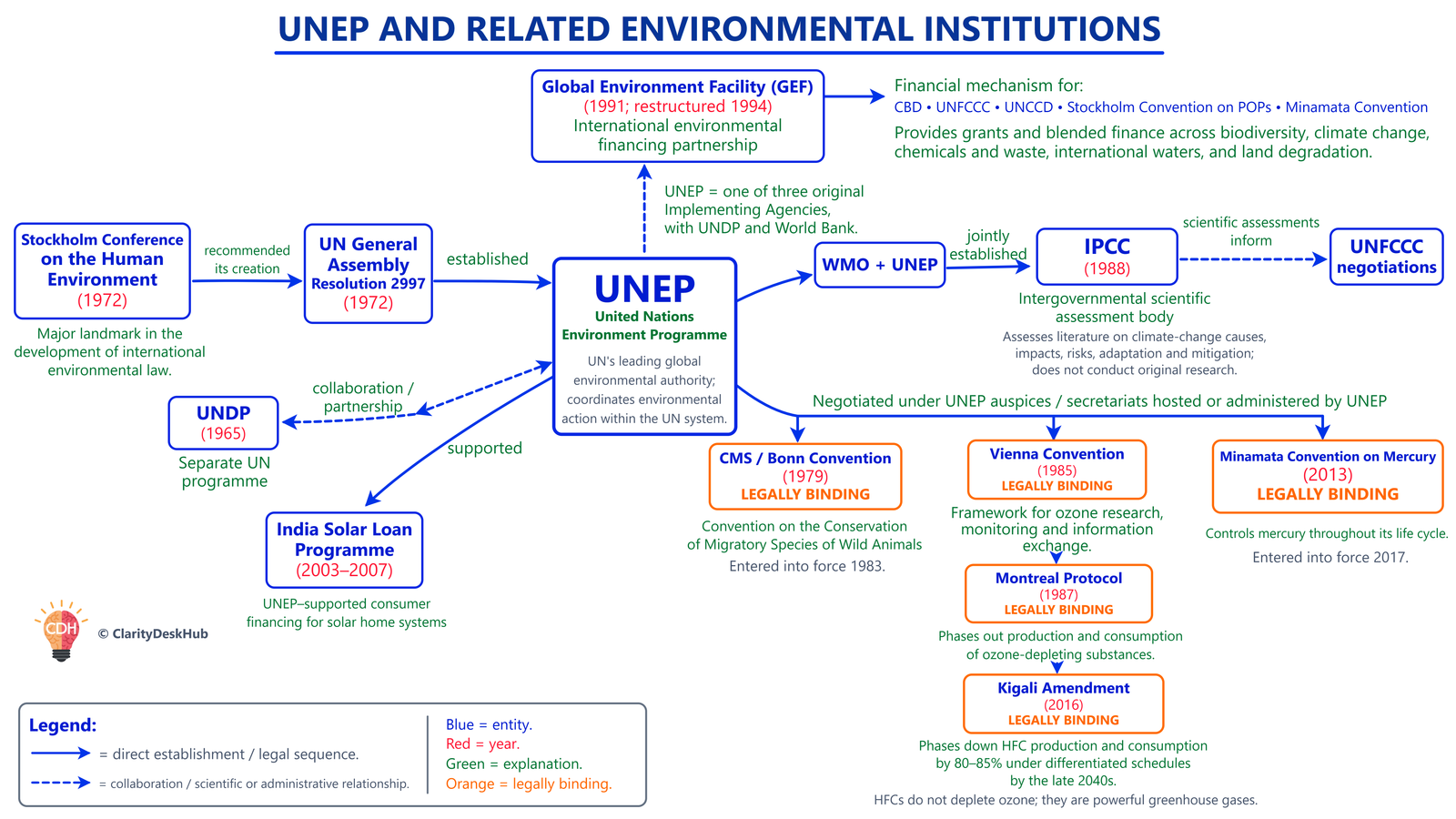
The central idea: UNEP is the UN system’s environmental coordinator. It works through partnerships. The IPCC assesses science, the GEF channels finance, and individual conventions govern specific environmental problems.
Read the map through four pathways
A. Birth of UNEP: Stockholm → UNGA Resolution 2997 → UNEP
The Stockholm Conference placed the human environment on the international political agenda. Its recommendation was carried forward through UN General Assembly Resolution 2997 in 1972, which established UNEP. This sequence explains why Stockholm is treated as the starting point of modern global environmental governance.
B. Science: WMO + UNEP → IPCC → climate negotiations
The World Meteorological Organization and UNEP jointly established the IPCC in 1988. The IPCC assesses the scientific literature; it does not negotiate treaties or conduct original research. Its assessments inform the UNFCCC process.
C. Finance: GEF as a financial mechanism
UNEP is one of the original implementing agencies of the Global Environment Facility, alongside UNDP and the World Bank. The GEF provides grants and blended finance across biodiversity, climate change, chemicals and waste, international waters and land degradation. In Prelims, distinguish the institution providing or coordinating finance from the treaties receiving financial support.
D. Treaty support: CMS, ozone regime and Minamata
The lower branch shows agreements negotiated under UNEP auspices or whose secretariats are hosted or administered by UNEP. Notice the legal sequence within the ozone regime: Vienna Convention → Montreal Protocol → Kigali Amendment. The Minamata Convention addresses mercury, while the Bonn Convention or CMS concerns migratory species.
Prelims distinctions from the UNEP map
| Pair | Do not confuse |
|---|---|
| UNEP and UNDP | UNEP coordinates environmental work; UNDP is a separate UN development programme. |
| IPCC and UNFCCC | IPCC assesses science; UNFCCC is the treaty framework and negotiating process. |
| GEF and UNEP | GEF is a financing partnership; UNEP is one of its implementing agencies. |
| Vienna and Montreal | Vienna provides the framework; Montreal establishes control measures for ozone-depleting substances. |
| Montreal and Kigali | Kigali amends the Montreal Protocol to phase down HFCs, which are powerful greenhouse gases but do not deplete ozone. |
Study the underlying notes: Stockholm Conference · UNEP · Institutional ecosystem beyond COPs
2. Earth Summit and the pathways that followed
The 1992 Rio Earth Summit is the organising centre of modern environmental diplomacy. It linked environment with development, produced non-binding policy documents, opened major conventions for signature, and influenced later sustainable-development, biodiversity and climate institutions.
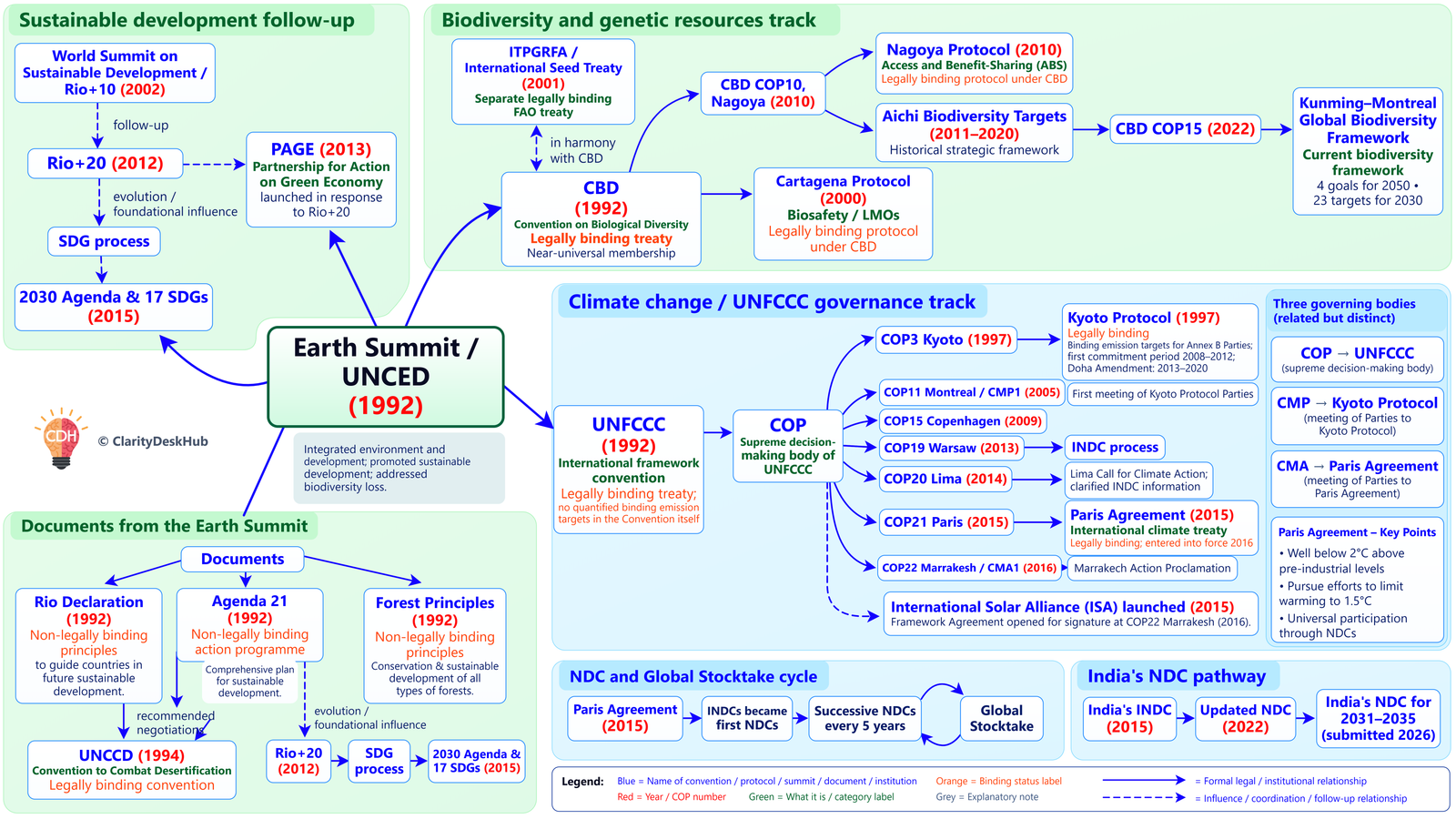
The central idea: Rio did not produce one single regime. It became the common origin of parallel tracks dealing with climate, biodiversity, land degradation and sustainable development.
Trace the four main pathways
A. Rio documents and land governance
The Rio Declaration, Agenda 21 and Forest Principles were non-legally binding outputs of the Earth Summit. The UN Convention to Combat Desertification (UNCCD), adopted in 1994, developed into the legally binding land and desertification pillar associated with the Rio process.
B. Sustainable development: Rio → Rio+10 → Rio+20 → SDGs
The sustainable-development track moved from Rio to the 2002 Johannesburg Summit and then to Rio+20 in 2012. Rio+20 helped initiate the process that culminated in the 2030 Agenda and 17 SDGs in 2015. PAGE, launched in 2013, supports countries in advancing an inclusive green economy. Follow this history in the detailed note on the evolution of the SDGs.
C. Biodiversity: CBD → protocols and global targets
The Convention on Biological Diversity created a broad treaty framework. The Cartagena Protocol addresses biosafety and living modified organisms, while the Nagoya Protocol addresses access and benefit-sharing. The Aichi Biodiversity Targets preceded the Kunming–Montreal Global Biodiversity Framework. For the wider conservation context, revise the international initiatives for biodiversity conservation.
D. Climate governance: UNFCCC → Kyoto and Paris
The UNFCCC is a legally binding framework convention, but it did not impose quantified binding emission-reduction targets of its own. The Kyoto Protocol added binding targets for Annex B Parties. The Paris Agreement established a universal system based on nationally determined contributions, five-year ambition cycles and the Global Stocktake.
Convention, protocol, COP and governing body
| Term | Meaning in this chapter | Example |
|---|---|---|
| Framework convention | Creates broad principles, duties and institutions for continuing cooperation. | UNFCCC |
| Protocol | A separate legal instrument adopted under or linked to a convention, usually adding more specific rules. | Kyoto, Cartagena, Nagoya |
| COP | Conference of the Parties; the supreme decision-making body of the parent convention. | COP under UNFCCC |
| CMP | COP serving as the meeting of Parties to the Kyoto Protocol. | CMP 1 at Montreal |
| CMA | COP serving as the meeting of Parties to the Paris Agreement. | CMA under Paris |
| NDC | A nationally determined climate contribution communicated and strengthened over successive cycles. | India’s NDC |
How the two charts connect
- UNEP provides institutional coordination; the Earth Summit created or accelerated treaty pathways.
- IPCC supplies assessed scientific knowledge; the UNFCCC process uses that knowledge in climate negotiations.
- GEF helps finance implementation; several conventions shown in the Earth Summit map use it as a financial mechanism.
- UNEP and UNFCCC are institutionally distinct; coordination or scientific influence does not mean that one treaty body is subordinate to the other.
- Legal form and policy strength are different questions; a framework treaty can be legally binding even when it does not prescribe quantified national emission caps.
A ready framework for Mains answers
If asked to discuss the evolution of global environmental governance:
- Introduction: begin with Stockholm 1972 as the political starting point.
- Institutional foundation: explain UNEP, IPCC and environmental finance through the GEF.
- Legal expansion: use Rio 1992 to introduce the climate, biodiversity and land pillars.
- Operationalisation: mention protocols, COP decisions, finance, reporting and scientific assessment.
- Evaluation: recognise near-universal participation and institution-building, while noting finance, implementation and ambition gaps.
- Conclusion: argue that the architecture has shifted from norm-setting to implementation, transparency and accountability.
Quick self-test
Try each question before opening the answer.
1. Which two organisations jointly established the IPCC?
The World Meteorological Organization (WMO) and UNEP.
2. Does the IPCC conduct original climate research?
No. It assesses the published scientific literature on climate change, its impacts, risks, adaptation and mitigation.
3. Which three major documents emerged from the Earth Summit?
The Rio Declaration, Agenda 21 and the Forest Principles. They are non-legally binding.
4. What is the difference between COP, CMP and CMA?
COP governs the UNFCCC, CMP serves the Kyoto Protocol, and CMA serves the Paris Agreement.
5. Which biodiversity protocol deals with access and benefit-sharing?
The Nagoya Protocol. The Cartagena Protocol deals with biosafety and living modified organisms.
6. Why is it inaccurate to call the UNFCCC simply “non-binding”?
The UNFCCC is a legally binding treaty. The crucial qualification is that it does not itself impose quantified binding emission-reduction targets comparable to those later established for Annex B Parties under Kyoto.
Continue with the detailed Chapter 6 notes
Use this page as the overview, then return to the detailed notes for concepts, chronology, criticism and current developments:
- United Nations Conference on the Human Environment, 1972
- United Nations Environment Programme (UNEP)
- UNCED / Earth Summit, Rio de Janeiro, 1992
- Historical evolution of the Sustainable Development Goals
- United Nations Framework Convention on Climate Change (UNFCCC)
- United Nations Convention to Combat Desertification (UNCCD)
- Kyoto Protocol, 1997 and UNFCCC summits after Kyoto
- Paris Climate Change Conference, 2015
- COP26 · COP27 · COP28 · COP29 · COP30
Revision takeaway: do not memorise institutions and treaties as isolated abbreviations. Ask four questions: Who created it? What is its legal nature? Which body governs it? What scientific, financial or administrative support helps it function?
Return to the International Conventions and Laws chapter for the complete study sequence.