
UPSC CURRENT AFFAIRS — 26 SEPTEMBER 2026
Shell Parties, Shadow Money: Fixing the RUPP Loophole in Political Funding
(Polity and Governance) (TH) A former Election Commissioner, Ashok Lavasa, has flagged a growing pool of unaccounted political money flowing through Registered Unrecognised Political Parties (RUPPs), after media investigations exposed suspicious donation trails. He has called for action against “shell” parties, independent audits and a rethink of tax exemptions.
What exactly is an RUPP?
An RUPP is a party registered with the Election Commission of India under Section 29A of the Representation of the People Act, 1951, which has not secured enough votes or seats to be recognised as a National or State party. Registration is easy; recognition is earned at the ballot box.
The catch is that even an unrecognised party enjoys some privileges of a registered one — most importantly, the ability to receive donations and claim income-tax exemption. That privilege without performance is the root of today’s problem. (See how recognition works in Recognition of Political Parties.)
The legal scaffolding
| Provision | What it does | Why it matters here |
| Article 19(1)(c) | Guarantees the right to form associations (including parties) | Party formation is a fundamental right; the State cannot casually stop it |
| Section 29A, RPA 1951 | Registration of associations as political parties with ECI | Creates RUPPs; the Act contains no express power to de-register |
| Section 13A, Income-tax Act, 1961 | Exempts party income, subject to audited accounts, donation records and timely returns | Tax benefit is conditional — but enforcement of those conditions is weak |
| Tenth Schedule | Anti-defection law recognises “political party” for legislators | Shows constitutional recognition of parties (Anti-Defection Law) |
| 2002 Supreme Court ruling | ECI may de-register a party only in exceptional cases (e.g., registration obtained by fraud) | Leaves ECI unable to strike off merely dormant parties |
The scale of the problem — in numbers
- Income surge: RUPP income jumped by about 223% in FY 2022–23, far outpacing any visible electoral activity.
- Compliance gap: only 739 of 2,764 RUPPs submitted audited accounts for that year — nearly three in four stayed silent.
- Election-year wealth (2024): 22 major parties together held ₹18,742.31 crore; they received ₹7,416.31 crore in fresh donations, spent ₹3,861.57 crore, and still retained ₹14,848.46 crore after the polls.
- Donor mix (FY 2022–23): individuals/HUFs claimed deductions of ₹2,275.85 crore, corporates ₹514.4 crore, and firms/associations ₹115.71 crore.
- Revenue forgone: tax exemptions over a decade cost the exchequer an estimated ₹11,813 crore; of ₹28,287 crore in donations reported over nine years, only 41.76% attracted deduction claims.
ECI’s clean-up drive
In August 2025, the ECI delisted 334 of 2,854 RUPPs that had not contested any election for six continuous years and could not be traced at their registered addresses. A second round on 18 September 2025 struck off 474 more, taking the total to 808 in two months, with another 359 flagged for non-filing of accounts.
Easy registration (S.29A) ➜ No contest, no accounts ➜ Tax-exempt donations ➜ Possible laundering / evasion ➜ ECI delisting — but no statutory de-registration power
Structural vulnerabilities
- Dormant parties as conduits: entities that never fight elections but keep receiving tax-exempt money can be misused for round-tripping or inflating expenditure.
- Opacity after electoral bonds: the Supreme Court struck down the Electoral Bond Scheme on 15 February 2024, holding that anonymous funding violated voters’ right to information under Article 19(1)(a). Concerns about donor transparency and quid pro quo still linger. (See Electoral Reforms.)
- RTI stand-off: the Central Information Commission held in 2013 that national parties are “public authorities” under the Right to Information Act, yet parties have not complied.
- No ceiling on party spending: candidates face statutory expenditure limits, but parties as a whole do not — leaving a large unregulated space.
Way forward
- Independent audits of party accounts by auditors empanelled by the Comptroller and Auditor General, with ECI given clear supervisory authority by law.
- Statutory de-registration power: amend Section 29A to allow de-registration for prolonged inactivity, proven financial fraud, or persistent non-disclosure.
- Cap party campaign expenditure and tie tax exemptions strictly to real electoral participation.
- One public reporting portal where every registered party uploads audited accounts, itemised expenditure and donor disclosures in a standard format.
- Independent investigation of credible red flags, with judicial oversight and due-process safeguards.
Bottom line: registration was meant to enable political participation, not tax arbitrage. Closing the Section 29A gap and making tax benefits conditional on transparent, active participation will restore the integrity of the electoral registry.
📖 Read More: Political Parties • Electoral Reforms • Election Commission of India • Election Laws in India • ADR Case (2002)
Bengal’s Anti-Goonda Bill Sent Back: Where Public Order Meets Personal Liberty
(Polity and Governance) (IE) The President has returned the West Bengal Public Safety and Control of Anti-Social Activities Bill, 2026 for reconsideration, because parts of it overlap with Central preventive-detention law — chiefly the Prevention of Illicit Traffic in Narcotic Drugs and Psychotropic Substances (PITNDPS) Act, 1988.
What the Bill proposes
Passed by the West Bengal Legislative Assembly in June 2026, the Bill targets habitual offenders (“goondas”) and activities that threaten public order. Its aim is to prevent repeat criminality and protect citizens from violence, intimidation and unlawful dispossession.
- Preventive detention of a notified “goonda” for up to 12 months without trial.
- Externment: a person can be barred from entering specified areas or districts for up to one year, and made to report to authorities.
- Broad definition of anti-social activity — habitual offences, intimidation, unlawful dispossession, illegal mining and acts endangering life or property.
- Search and seizure powers; offences made cognizable and non-bailable.
- Immunity for officials acting in “good faith”.
Why the President returned it — the federal angle
Preventive detention “for reasons connected with the security of a State, the maintenance of public order” is in the Concurrent List, so both Parliament and States can legislate. When a State law clashes with a Central law on a Concurrent subject, the Central law prevails unless the State law has received Presidential assent (Article 254).
Assembly passes Bill ➜ Governor reserves it for President ➜ President returns it for reconsideration ➜ Assembly amends / re-passes ➜ Sent back for President’s consideration
Under Article 201, when a reserved State Bill is returned, the Legislature must reconsider it within six months; the President is not bound to assent even after it is re-passed. (Revise the procedure at Veto Power of the President and Governor vs President.)
Liberty versus security
| Argument for the Bill | Concern with the Bill |
| Habitual offenders exploit slow trials; preventive tools break the cycle | Detention without trial for a year is a serious inroad into Article 21 and Article 22 protections |
| Externment protects victims and witnesses | Vague terms like “anti-social” invite misuse against critics |
| States are primary custodians of public order | Overlap with PITNDPS Act creates parallel, conflicting regimes |
| Good-faith immunity lets officers act quickly | Immunity weakens accountability for wrongful detention |
Under Article 22, preventive detention beyond three months needs the approval of an Advisory Board of persons qualified to be High Court judges — a safeguard any State law must respect.
📖 Read More: Right to Freedom (Articles 19–22) • Veto Power of the President • Governor vs President • State Police & Police Reforms
Fake Cancer Drugs in Bengaluru: Exposing Cracks in India’s Medicine Supply Chain
(Society) (DH) Authorities in Bengaluru seized a stock of counterfeit, expired and mislabelled critical medicines — including cancer therapies and ICU injectables — that had reached hospitals and pharmacies. The case exposes deep gaps in regulation, procurement ethics and supply-chain tracking.
How the racket worked
Buy expired / cheap drugs ➜ Repackage with fake branding ➜ Forged invoices & licences ➜ Sell at up to 50% discount ➜ Reaches hospitals across States
The operators exploited price-sensitive procurement and inter-State jurisdictional gaps — sourcing, packaging and sale happened in different States, so no single regulator saw the full picture.
Why a fake drug is worse than no drug
- Therapeutic failure: an inactive cancer drug lets tumours progress to untreatable stages.
- Secondary harm: contaminated injectables can trigger sepsis, septic shock or organ failure.
- Diagnostic misdirection: doctors may wrongly conclude drug resistance and switch to costlier, more toxic second-line drugs.
- Financial ruin: families pay full price for inert medicine — critical illness is already a leading cause of catastrophic health spending.
- Erosion of trust in hospitals and in modern medicine itself.
Governance gaps
| Gap | Explanation |
| Dual regulation | CDSCO (Central Drugs Standard Control Organisation) sets standards and approves new drugs; State Drug Control Administrations license manufacture, sale and distribution — coordination across borders is weak |
| Capacity deficit | Shortage of drug inspectors, modern testing equipment and accredited labs able to test biologics |
| Track-and-trace not used | QR codes are mandated on the top 300 drug brands and on APIs, but hospital pharmacies rarely scan them on receipt |
| Procurement ethics | Buying life-saving drugs from unverified channels at deep discounts breaches the hospital’s fiduciary duty; SOPs like verifying batch-release certificates were skipped |
Legal and constitutional lens
- Article 21: in Paschim Banga Khet Mazdoor Samity v. State of West Bengal (1996), the Supreme Court held the right to health to be part of the right to life — see Article 21.
- Article 47: a Directive Principle obliging the State to improve public health (DPSPs).
- Drugs and Cosmetics Act, 1940 — Section 27 (as amended in 2008) prescribes punishment extending to life imprisonment for spurious or adulterated drugs likely to cause death or grievous hurt. Convictions, however, need an unbroken evidentiary chain that is hard to maintain across States.
- Consumer Protection Act, 2019: patients can claim compensation for deficiency in service and product liability — see Consumer Protection.
Way forward
Immediate
- Trace and contact every patient who received suspect batches; recall remaining stock.
- Offer free medical evaluation and create an institutional compensation fund for corrective treatment.
Hospital procurement
- Buy high-value oncology drugs and critical injectables only from manufacturers or authorised tier-1 distributors.
- Build 2D barcode scanning into hospital software so nothing is stocked or administered without digital verification.
- Create internal reporting channels under NABH standards to flag off-channel purchases.
Structural reform
- Implement the Mashelkar Committee (2003) recommendations — a unified, well-funded Central Drug Authority, fast-track courts for spurious-drug cases and dedicated anti-counterfeiting intelligence units.
- Extend track-and-trace from factory floor to patient bedside for all critical-care medicines.
- Form joint Centre–State task forces to close jurisdictional loopholes.
Bottom line: India’s standing as the “pharmacy of the world” depends on the integrity of its own domestic supply. Zero tolerance for counterfeits is a constitutional duty, not merely a regulatory one.
📖 Read More: Drugs and Pharmaceuticals Industry • Right to Freedom (Article 21) • Consumer Protection
Eight Years of AB PM-JAY: How Far Has India Travelled Towards Universal Health Coverage?
(Society) (PIB) Ayushman Bharat – Pradhan Mantri Jan Arogya Yojana (AB PM-JAY), launched on 23 September 2018, completed eight years. About a third of India’s population now holds an Ayushman card.
The scheme at a glance
AB PM-JAY is a public health assurance scheme offering cashless hospitalisation cover of up to ₹5 lakh per family per year for secondary and tertiary care. It is among the world’s largest publicly funded health schemes.
| Indicator | Status |
| Ayushman cards issued | 48.51 crore (~33% of population), as of 21 Sept 2026 |
| Hospital admissions | 13.25 crore |
| Treatment value | ₹2.03 lakh crore |
| Empanelled hospitals | 38,000+ public and private (as on 31 Aug 2026) |
| Package coverage | 1,961 procedures across 27 specialties |
| Beneficiary identification | SECC 2011 deprivation (rural) and 11 occupational categories (urban) |
Expanding the net
- March 2024: about 37 lakh families of ASHAs, anganwadi workers and helpers included.
- September 2024: all citizens aged 70 years and above, regardless of income — about 6 crore seniors; over 1.36 crore Ayushman Vay Vandana cards issued so far.
- Other groups covered through linked initiatives: construction workers, road-accident victims (PM-RAHAT), transgender persons (SMILE), PM CARES children, sanitation workers (NAMASTE) and PVTGs (PM-JANMAN).
Funding pattern
| Category | Centre : State |
| General States | 60 : 40 |
| North-Eastern States, Himachal Pradesh, Uttarakhand, J&K | 90 : 10 |
| UTs without legislature | 100% Central |
The four pillars of Ayushman Bharat
Ayushman Arogya Mandirs (primary care) ➜ AB PM-JAY (hospital care) ➜ ABDM (digital health IDs) ➜ PM-ABHIM (infrastructure)
- Ayushman Arogya Mandirs — upgraded centres for screening, NCDs, eye/ENT/oral care, mental health and teleconsultation via e-Sanjeevani.
- Ayushman Bharat Digital Mission (Sept 2021) — ABHA health IDs; over 97 crore ABHA IDs are now operational.
- PM-ABHIM (Oct 2021) — ₹64,180 crore (2021–26) for critical-care blocks, integrated public-health labs and block public-health units.
Persisting challenges
- Uneven empanelment — private hospitals cluster in cities and richer States.
- Package rates seen as low by private providers; delayed claim settlements.
- Out-patient care and medicines, a major share of out-of-pocket spending, largely remain outside cover.
- Fraudulent claims and weak grievance redressal in some States.
📖 Read More: AB PM-JAY • Ayushman Bharat Digital Mission • PM-ABHIM • National Health Mission
Not Quite Paneer: FSSAI Moves Against “Analogue” Imitations
(Society) (TH) The Food Safety and Standards Authority of India (FSSAI) has proposed a draft amendment to the Food Safety and Standards (Prohibition and Restrictions on Sales) Regulations, 2011, to prohibit the manufacture, marketing and sale of non-dairy analogue products under the name “Paneer”.
What is analogue paneer?
It is a formulated imitation product that mimics the look, taste and texture of dairy paneer, but replaces milk fat and milk protein — partly or wholly — with vegetable oils, hydrogenated fats, starches and plant proteins.
Replace milk fat with vegetable fat ➜ Bind with starch & emulsifiers ➜ Add acidulants to coagulate ➜ Press into blocks
Milk paneer vs analogue paneer
| Feature | Milk paneer | Analogue paneer |
| Raw material | Milk coagulated by heat and permitted acids | Vegetable oils, starch, plant proteins, stabilisers (± milk solids) |
| Fat source | Natural milk fat | Vegetable oil — often palm or hydrogenated |
| Protein quality | High-quality milk protein with all essential amino acids | Variable content and quality |
| Cost | Higher — about 4–5 litres of milk per kg | 50–70% cheaper |
| Regulatory status | Standardised dairy product with fixed moisture/fat limits | Dairy analogue — cannot be labelled or sold as paneer |
Why the crackdown matters
- Consumer protection: prevents buyers — and diners — from unknowingly paying for a nutritionally inferior substitute.
- Farmer protection: shields dairy farmers and cooperatives from unfair price competition (India’s White Revolution rests on them).
- Disclosure by food businesses: hotels, restaurants, caterers and delivery apps must declare analogue products.
📖 Read More: Livestock Resources & White Revolution • Food Processing Industry
Taming the Veto: The Renewed Push to Restrain the P5
(International Relations) (TH | ANI) At the 81st session of the UN General Assembly, French President Emmanuel Macron renewed the call to regulate the use of the veto during mass atrocities. India attended the France–Mexico hosted meeting in New York and reiterated its “well established and consistent position on veto” while stressing the urgency of comprehensive Security Council reform.
Where does the veto come from?
The word “veto” never appears in the UN Charter. It flows from Article 27(3): decisions on non-procedural matters need nine affirmative votes “including the concurring votes of the permanent members”. A single “no” from any of the P5 — the US, Russia, China, France and the UK — therefore blocks a resolution. (Revisit the Council’s design at The Six Principal Organs.)
Three reform tracks, compared
| Initiative | Year / basis | Core idea | Nature |
| French-Mexican Initiative | Proposed 2013; launched 2015 | P5 voluntarily refrain from using the veto in cases of genocide, crimes against humanity and large-scale war crimes | Voluntary; backed by 128 Member States (21 joined in mid-2026). France and, now, the UK have formally committed |
| Liechtenstein Initiative | UNGA Resolution 76/262 (April 2022) | The UNGA President must convene a formal debate within 10 working days of any veto | Procedural — forces the vetoing member to explain itself publicly |
| ACT Code of Conduct | Accountability, Coherence and Transparency group | All Council members pledge not to vote against credible draft resolutions to prevent or halt mass atrocities | Voluntary pledge for all 15 members |
Why the debate is sharper now
Repeated vetoes have paralysed Council action on Syria, Sudan, Ukraine, Lebanon and Gaza — blocking humanitarian corridors, peacekeeping mandates and arms embargoes while civilian casualties mount.
The case for and against
| For regulating / abolishing the veto | Against abolition |
| Ends paralysis in humanitarian emergencies | Great-power realism: no collective-security body survives if it acts against an armed great power’s core interests |
| Sovereign equality — Article 2(1) of the Charter — is contradicted by a five-state negative vote | Charter amendment paradox: Article 108 needs ratification by two-thirds of members including all P5 |
| 1945 power map excludes G4 (India, Brazil, Germany, Japan) and Africa | P5 divergence: the US, Russia and China show no willingness to dilute the veto |
| Raises political cost of obstruction via UNGA scrutiny | Multiplication risk: giving vetoes to new members could deepen gridlock |
Way forward
- Norm-building: push the French-Mexican initiative past the two-thirds mark (129+ states) to crystallise a global norm.
- Post-veto follow-through: link Liechtenstein-style debates to concrete action — commissions of inquiry or humanitarian corridors under Uniting for Peace (Resolution 377A).
- Compromise expansion: admit the G4 as permanent members with a long moratorium on exercising the veto.
- Objective atrocity triggers: let the UN Secretary-General, ICJ or OHCHR issue factual alerts that activate voluntary restraint.
India’s stake: as a G4 aspirant, India prefers comprehensive reform — expansion in both permanent and non-permanent categories — over piecemeal fixes confined to the veto. (See The Debate on UN Reform and The Case of India.)
📖 Read More: The United Nations • UN as a Peacekeeping Organisation • Expanding Role of the UN
Ethiopia on the Brink Again: Tigray Tensions and the Geography of the Horn
(Geography) (BBC) Ethiopia’s military said it repelled attacks by the Tigray People’s Liberation Front (TPLF) and allied forces in the Amhara and Afar regions. The seizure of three Tigray airports — Mekelle, Shire and Axum — has revived fears of a return to civil war.
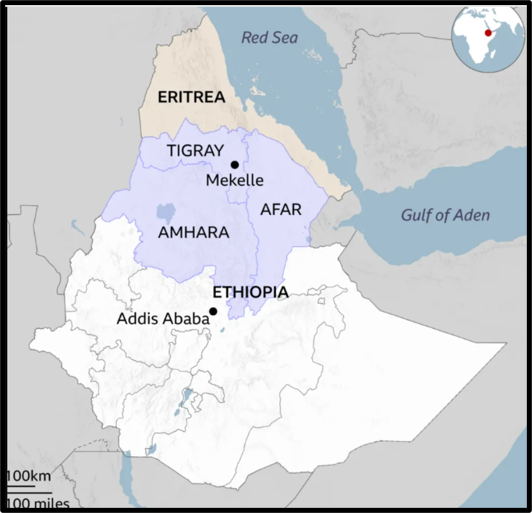
Country profile
| Aspect | Details |
| Location | Landlocked country in the Horn of Africa |
| Capital | Addis Ababa |
| Population | Most populous landlocked country in the world; 2nd most populous in Africa (about 139 million, 2025 estimate) |
| Neighbours (6) | Eritrea, Djibouti, Somalia, Kenya, South Sudan, Sudan |
| Highest peak | Ras Dashen — 4,550 m per the current standard survey (an older survey gives 4,533 m) |
| Lowest region | Danakil Depression — about 125 m below sea level, one of the hottest places on Earth |
| Polity | Federal democratic republic organised on ethno-linguistic lines; bicameral — House of Peoples’ Representatives and House of Federation |
Physical geography
- Water tower of East Africa: source of the Blue Nile (from Lake Tana), Tekeze, Omo (drains into Lake Turkana) and Awash.
- Rift and volcanoes: the country is split by the Great Rift Valley; the Afar Triple Junction hosts active volcanoes such as Erta Ale and Hayli Gubbi — the latter recorded its first known eruption on 23 November 2025. The region is a textbook case of plate divergence.
How the conflict evolved
TPLF dominates (1991–2018) ➜ Prosperity Party formed; TPLF stays out ➜ Tigray War (Nov 2020–2022) ➜ Pretoria Agreement (Nov 2022) ➜ Renewed clashes (late 2025–2026)
- Power shift: Abiy Ahmed became Prime Minister in 2018 and merged the ruling coalition into the Prosperity Party — formed on 1 December 2019 — which the TPLF refused to join.
- Tigray War (2020–2022): began after the TPLF attacked federal military bases in November 2020; caused mass displacement and a humanitarian catastrophe.
- Pretoria Peace Agreement: signed on 2 November 2022 under African Union mediation — provided for disarmament, restoration of federal authority and humanitarian access. Territorial disputes and slow implementation strained it.
- Flashpoints now: Mekelle, Shire and Axum in Tigray; the Kobo–Tumuga front, Wag Hemra, North Wello and disputed Western Tigray near the Tekeze in Amhara; and Abala, Erebti and Yallo in Afar — which sit on the vital trade corridor to Djibouti.
Why India should care: Ethiopia hosts the African Union headquarters, is a BRICS member and an important partner in India’s Africa policy; instability along the Djibouti corridor also affects Red Sea trade routes.
📖 Read More: The Great Rift Valley • Socialism and Civil War in Ethiopia (history) • Political Map of Africa • India and Africa Policy
Make in India Turns Twelve: Gains, Gaps and the Next Leap
(Economics) (PIB) Make in India, launched on 25 September 2014 to make India a global hub for manufacturing, design and innovation, completed twelve years. It now covers 27 sectors — 15 in manufacturing and 12 in services — under Make in India 2.0.
The scorecard
| Sector | Then | Now |
| Electronics production | ~₹1.9 lakh crore (2014-15) | ~₹13.11 lakh crore (2025-26) — nearly sevenfold |
| Mobile phones | ~₹18,900 crore | ~₹6.3 lakh crore — India is the world’s 2nd-largest mobile maker by volume |
| Vehicle production | — | 31.03 million units in 2024-25 (~33% above 2014-15) |
| Crude steel | 81.7 MT (2014-15) | 170.0 MT (2025-26) |
| Indigenous defence production | ₹46,429 crore (2014-15) | ₹1.78 lakh crore (2025-26) — up ~283% |
| Pharmaceuticals | — | 3rd globally by volume, 11th by value; exports ₹2,62,697 crore (2025-26) |
| Solar modules | 2.3 GW (2014) | 192 GW (June 2026) |
Policy toolkit
- PLI schemes in 14 sectors: ₹2.6 lakh crore investment, ₹23.8 lakh crore production and sales, ₹15.5 lakh crore exports and 14.6 lakh jobs (as of June 2026).
- 100% FDI via the automatic route in most sectors — cumulative FDI of USD 843 billion during 2014-15 to 2025-26.
- National Single Window System, India Industrial Land Bank, PM GatiShakti and Startup India for ease of doing business.
- New frontiers: Semicon 2.0 (₹1,27,500 crore), Mobile Phone Manufacturing Scheme (₹62,500 crore), rare-earth permanent magnet scheme (₹7,280 crore) and BHAVYA industrial parks (₹33,660 crore).
The unfinished agenda
- Manufacturing’s share in GVA has risen only modestly — well short of the original goal of 25% of GDP.
- India’s share of global merchandise exports remains below 2%.
- Private investment remains sluggish; many PLI units are assembly-heavy with limited domestic value addition.
- Logistics costs, skill gaps and dependence on imported components (e.g., from China) persist.
Assembly (PLI) ➜ Component ecosystems ➜ Capital goods & materials ➜ Design & R&D ➜ Global value-chain leadership
📖 Read More: Make in India Initiative • Industrial Sector of Indian Economy • PLI – Large Scale Electronics • Semiconductor Industry • Iron and Steel Industry
SWIFT and Its Challengers: The Plumbing of Global Finance
(Economics) (TH) BRICS and Global South economies are accelerating efforts to build alternatives to the Belgium-based SWIFT network, amid concerns over “weaponisation” of the US dollar and Western financial sanctions.
What SWIFT is — and is not
The Society for Worldwide Interbank Financial Telecommunication is a secure messaging network. Banks use it to send payment orders, letters of credit and securities instructions. It does not hold funds or settle payments — the actual money moves through correspondent banks.
| Feature | Details |
| Founded / HQ | 3 May 1973; La Hulpe, Belgium |
| Structure | Member-owned cooperative under Belgian law; overseen by G10 central banks, led by the National Bank of Belgium |
| Reach | 11,000+ banking and securities institutions in 200+ countries and territories |
| Standards | 8- or 11-character Business Identifier Codes (BIC); ISO 20022 messaging |
| Jurisdiction | Belgian and EU law — hence bound by EU sanctions |
| Security | End-to-end encryption, dedicated lines, geographically distributed operating centres |
SWIFT cut off sanctioned Iranian banks in March 2012 and selected Russian banks in 2022 — episodes that pushed several countries to build their own rails.
The alternatives
| System | Country / year | Purpose |
| CIPS | China, 2015 | Cross-border yuan clearing and messaging |
| SPFS | Russia, 2014 | Domestic/foreign messaging after Western sanctions; linked with Iran’s SEPAM |
| Project mBridge | Multi-CBDC platform | Blockchain-based direct settlement in central bank digital currencies, bypassing SWIFT |
India, for its part, is promoting rupee trade settlement and linking UPI with other countries’ fast-payment systems — see Payment and Settlement Systems in India and BRICS.
📖 Read More: Payment and Settlement Systems in India • BRICS • Exchange Rate
Rating Buildings for Bandwidth: TRAI’s Digital Connectivity Rating Platform
(Science and Technology) (PIB) The Telecom Regulatory Authority of India (TRAI) launched the Digital Connectivity Rating (DCR) Platform and a companion mobile app to assess and publicly rate indoor digital connectivity of properties.
Legal basis
The platform operationalises the TRAI (Rating of Properties for Digital Connectivity) Regulations, 2024, as amended on 13 May 2026, and the Rating Manual 2026 issued on 9 June 2026.
How it works
Property Manager registers property ➜ Selects a registered DCRA ➜ On-site tests via DCRA app ➜ eSigned report & rating ➜ QR-coded certificate published
- Parameters: fibre readiness, 4G/5G mobile coverage, in-building solutions and Wi-Fi infrastructure — including lifts, basements and common areas.
- Coverage: constructed and under-construction properties — residential, commercial, government and public spaces.
- Trust features: Aadhaar-based eSign, QR-verifiable certificates and a public search page (by property name, certificate ID or location).
Significance
- Makes connectivity a visible, comparable real-estate attribute, like parking or power backup.
- Nudges developers to plan ducts, fibre and in-building solutions at the design stage — a fix for poor indoor 5G coverage.
- Complements Digital India and BharatNet by addressing the “last few metres” problem.
📖 Read More: Mobile/Cellular Networks (1G to 5G) • Digital India Programme • BharatNet
WAVES OTT and MyWAVES: Public Broadcasting Goes Digital-First
(Science and Technology) (PIB) The Government highlighted the growth of WAVES OTT, Prasar Bharati’s streaming platform, and its citizen-creator companion MyWAVES.
| Platform | Key facts |
| WAVES OTT | Launched 20 November 2024 at the 55th IFFI, Goa. 20,000+ titles; content in 26+ languages; interface in 10+ languages; live access to 140+ TV channels and 220 radio services; available in 130+ countries; 1.4 crore registered users and over 1.7 crore downloads |
| MyWAVES | Launched 23 March 2026 as a citizen content-creation platform. Its Gems of India Challenge was piloted on 21 July 2026 in six States, with submissions from 1–31 August 2026, on culture, heritage, tourism, handicrafts and regional personalities |
Significance: gives public broadcasting a foothold in the OTT era, promotes regional-language content and cultural soft power, and brings grassroots creators into the fold. See how OTT is governed in OTT and Digital Streaming.
📖 Read More: Media and Broadcasting Governance in India
Linking Rivers, Dividing Opinions: Is Inter-Basin Transfer the Answer?
(Geography) (TH) At the Southern Zonal Council meeting in Mamallapuram, proposals to link the Brahmaputra with the Godavari and Cauvery resurfaced, reopening the debate on the ecological and federal costs of river-linking.
The framework
- National Perspective Plan (1980) identified 30 links — 14 Himalayan and 16 Peninsular — see NPP.
- Article 262 and the Inter-State River Water Disputes Act, 1956 govern dispute resolution — see Inter-State Water Disputes.
- Zonal Councils (statutory, States Reorganisation Act, 1956) provide a forum for such inter-State issues — see Zonal Councils.
Arguments on both sides
| In favour | Against |
| Moves water from surplus to deficit basins | Disrupts aquatic ecosystems, sediment flow and deltas |
| Boosts irrigation and farm productivity | Triggers new inter-State disputes (e.g., Pennaiyar, Mekedatu) |
| Mitigates floods and droughts | Large-scale displacement and rehabilitation challenges |
| Drinking water for cities | Climate change may erode “surplus” assumptions |
| Hydropower and navigation potential | Very high costs and long gestation |
Smaller transfers that worked
The Mullaperiyar Dam, Parambikulam–Aliyar Project, Krishna Water Supply Project (to Chennai) and Indira Gandhi Canal show that localised, negotiated transfers can succeed — suggesting a case for demand management, watershed development and basin-level planning over mega-links.
📖 Read More: Interlinking of Rivers • River Water Disputes • Inter-State Relations • Brahmaputra River System
Typhoon Dujuan Drenches Tokyo: Anatomy of a Record-Breaking Storm
(Geography) (The Guardian) Typhoon Dujuan battered Tokyo and eastern Japan, dumping a record 832 mm of rain on Izu Oshima island within 48 hours and producing the highest-ever rainfall in Tokyo’s Edogawa ward.
Key facts
- Japan’s 25th named storm of the 2026 season; formed over the north-western Pacific and tracked towards eastern Honshu.
- Maximum sustained winds 130 km/h; gusts up to 194 km/h.
- The name Dujuan (azalea) was contributed by China — see how typhoons are named.
How such a storm forms
Warm sea (≥26.5°C) ➜ Intense evaporation ➜ Rising air releases latent heat ➜ Falling surface pressure ➜ Coriolis deflection → cyclonic spin
Dujuan’s moisture also interacted with Japan’s stationary autumn rain front (Akisame zensen), which amplified rainfall and orographic precipitation. Revise the mechanism at Origin of Tropical Cyclones.
Impacts and lessons
- Destructive winds in Chiba and Kanagawa; landslides and debris flows on volcanic, hilly terrain.
- Flights disrupted at Haneda and Narita; bullet-train services suspended.
- Climate link: the atmosphere holds about 7% more moisture for every 1°C of warming, so warmer seas mean wetter storms.
- Tokyo’s giant underground flood-diversion tunnels show the value of investing in urban flood infrastructure.
📖 Read More: Origin of Tropical Cyclones • Characteristics of Tropical Cyclones • Naming of Cyclones
Project Cheetah’s Good News: Four Cubs Born to an India-Born Mother at Kuno
(Environment) (TH) India-born female cheetah KGP12 gave birth to four cubs at Kuno National Park, Madhya Pradesh, taking India’s cheetah population to 56.
Project Cheetah at a glance
| Aspect | Details |
| Launched | 17 September 2022 — the world’s first intercontinental large-carnivore translocation |
| Why | The cheetah was declared extinct in India in 1952 |
| Source countries | Namibia (8, 2022), South Africa (12, 2023), Botswana (9, February 2026) |
| Sites | Kuno National Park; Gandhi Sagar Wildlife Sanctuary as a second home (53 at Kuno and 3 at Gandhi Sagar now) |
| Implementing agency | National Tiger Conservation Authority (NTCA), with the MP Forest Department and Wildlife Institute of India |
Why this litter matters: a second-generation (India-born) mother breeding successfully is a key test of whether the population can become self-sustaining. About 36 of the 56 cheetahs are now India-born.
Continuing concerns: limited space and prey base at Kuno, conflict with leopards, heat stress, and the need for a genuine meta-population across multiple sites.
📖 Read More: National Parks in India • Biodiversity Conservation
VARUNA 2026: India and France Sail Together Off Toulon
(Internal Security) (PIB) INS Trishul arrived at Toulon, France, on 22 September 2026 for the 24th edition of the bilateral maritime exercise VARUNA between the Indian Navy and the French Navy.
- About VARUNA: India–France naval exercise, given the name VARUNA in 2001; includes harbour and sea phases, cross-deck visits and operational drills to enhance interoperability.
- INS Trishul (F43): a Talwar-class stealth frigate commissioned on 25 June 2003, fitted with BrahMos-capable launchers.
- Strategic value: France is among India’s most trusted partners — Rafale jets, Scorpène submarines and joint Indian Ocean patrols. See India and France.
📖 Read More: India and France • Naval Defence
Operation Drishti: Army Surgeons Restore Sight Along the LoC
(Internal Security) (PIB) Surgeons of the Armed Forces Medical Services (AFMS) performed 220 sight-restoring surgeries at an underground operation theatre in Tangdhar, Kupwara, along the Line of Control, during the 10th Mega Eye Surgical Camp under Operation Drishti (24–25 September 2026).
- What: a humanitarian outreach bringing free super-speciality eye care — mostly cataract surgery, plus retinal and minimally invasive glaucoma procedures — to remote border communities.
- How: phacoemulsification, vitreoretinal and glaucoma equipment carried across mountains; reinforced underground theatres allow sterile surgery in a shelling-prone zone.
- Outreach: patients from Khawarpora, Tangdhar, Tadd, Bagbela and Yangdar were mobilised through screening and broadcasts on Radio Rooh-e-Karnah; the Army handled transport, stay and post-operative care.
- Scale: the camp series has screened over 1.5 lakh patients and conducted 3,500+ surgeries across 10 cities; the 11th camp is scheduled in Srinagar from 27–29 September 2026.
Significance: strengthens trust between the Armed Forces and border populations — the “hearts and minds” approach central to internal security in J&K — and showcases military medicine for humanitarian assistance.
📖 Read More: Armed Forces and Internal Security • Border Security
Pandit Deendayal Upadhyaya: The Thinker Behind Integral Humanism and Antyodaya
(History) (PMIndia) The nation paid tributes to Pandit Deendayal Upadhyaya on his 110th birth anniversary (25 September).
Life at a glance
Born 25 Sept 1916, Nagla Chandrabhan (Mathura) ➜ Joins RSS (1937) ➜ Bharatiya Jana Sangh (1951) ➜ BJS President, Calicut (Dec 1967) ➜ Dies 11 Feb 1968, Mughalsarai
- Education: schooling at Sikar and Pilani; graduated from Sanatan Dharma College, Kanpur; teacher training at Prayag.
- Organiser: full-time RSS pracharak in Uttar Pradesh; worked with Dr Syama Prasad Mookerjee in founding the Bharatiya Jana Sangh (1951) and served as its General Secretary for about 15 years before becoming President in December 1967.
- Publisher: set up Rashtra Dharma Prakashan, Lucknow — associated with Rashtra Dharma (monthly), Panchjanya (weekly) and Swadesh (daily).
- Death: found near Mughalsarai railway station on 11 February 1968 in unexplained circumstances; the station was renamed Pt. Deen Dayal Upadhyaya Junction in 2018.
Core ideas
| Idea | Meaning |
| Integral Humanism | Presented in 1965 as the Jana Sangh’s doctrine; seeks balanced development of body, mind, intellect and soul in harmony with society and nature — an Indian alternative to both Western capitalism and Marxist communism |
| Antyodaya | Development must reach the last and poorest person first — echoed in schemes such as DAY-NRLM |
📖 Read More: DAY-NRLM • Political Parties (evolution)