
Media and Broadcasting Governance in India
The Landscape at a Glance
| What it covers | Regulation of television, cable, DTH, radio and OTT — the laws, the regulators, and the shift toward digital convergence. |
| Nodal ministry | Ministry of Information & Broadcasting (MIB) |
| Key bodies | MIB, TRAI and Prasar Bharati (the public broadcaster). |
| Core laws | Cable Television Networks (Regulation) Act, 1995; Prasar Bharati Act, 1990; IT Rules, 2021. |
| Emerging issue | Media convergence and the search for a single, unified broadcasting law. |
Why Media Governance Matters
Media is the nervous system of a democracy — it informs, entertains and holds power to account. But in India, the same half-hour of content is governed very differently depending on how it reaches you: a serial on a satellite channel, the same serial re-run on a cable network, and its clips on a streaming app each fall under a different rulebook. The result is a medium-by-medium patchwork of laws and regulators that is now straining against a converged, screen-agnostic world.
This note maps that architecture — the ministries, the statutes and the self-regulatory bodies — and the pressures reshaping it.
The Regulatory Architecture
At the apex sits the Ministry of Information & Broadcasting (MIB) — the policy-maker, licensor and content-code enforcer for most of the sector. Alongside it, the Telecom Regulatory Authority of India (TRAI) handles the economic plumbing of broadcasting — tariffs, interconnection, quality of service and formal recommendations — while Prasar Bharati runs the State’s own public broadcasting.
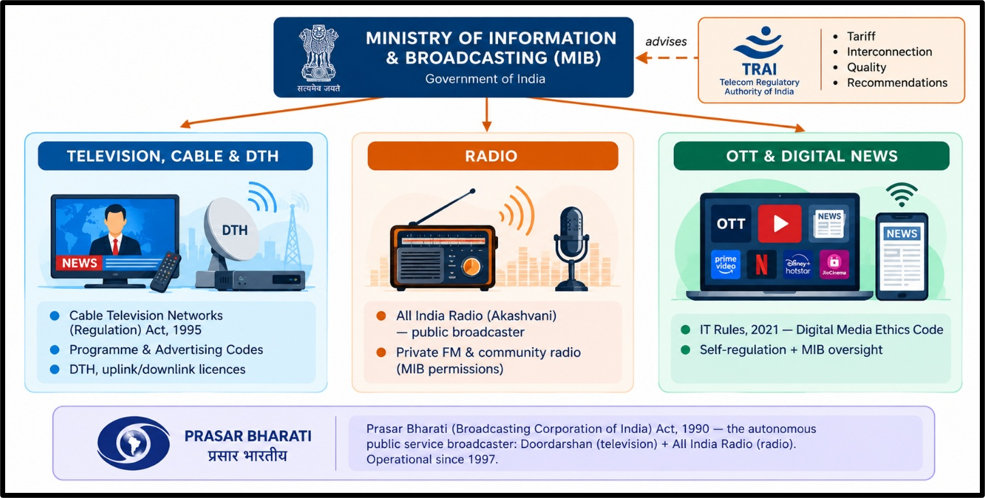
Read segment by segment, the map looks like this:
| Segment | Key law / instrument | Who regulates |
| Satellite TV channels | Uplinking/Downlinking Guidelines; Programme & Advertising Codes | MIB |
| Cable television | Cable Television Networks (Regulation) Act, 1995 | MIB; TRAI on tariffs |
| DTH & distribution | DTH licence; interconnection & tariff orders | MIB + TRAI |
| Radio | All India Radio; private FM & community-radio permits | MIB / Prasar Bharati |
| OTT & digital news | IT Rules, 2021 — Digital Media Ethics Code | MIB |
The Three Institutions to Know
- Ministry of Information & Broadcasting (MIB). The nodal ministry — it frames policy, issues channel and DTH licences, notifies the Programme and Advertising Codes, and administers public broadcasting and film certification.
- TRAI. A statutory regulator (TRAI Act, 1997) whose broadcasting remit is economic, not editorial: cable and DTH tariffs, interconnection between broadcasters and distributors, quality of service, and recommendations to the government — but not content.
- Prasar Bharati. India’s autonomous public service broadcaster under the Prasar Bharati (Broadcasting Corporation of India) Act, 1990 — operational since 1997 and comprising Doordarshan (television) and All India Radio.
- Its recurring governance question is how much genuine autonomy it enjoys from the government of the day.
- It has gone digital-first through WAVES, its OTT platform launched at the 55th IFFI, Goa (November 2024), offering live TV, radio and on-demand content in many Indian languages.
Television, Cable and DTH
The workhorse statute is the Cable Television Networks (Regulation) Act, 1995, which requires cable operators to register, obliges them to carry Doordarshan channels, and binds transmitted content to a Programme Code and an Advertising Code. Enforcement is largely post-broadcast — action follows a violation, rather than pre-clearing content the way film certification does. In a notable ease-of-doing-business move, offences under the Act were decriminalised in 2023 and converted into civil penalties.
Broadcasters also police themselves through industry self-regulatory bodies (for news and for general entertainment), backed by an inter-ministerial committee at the MIB as the final tier. Distribution over DTH, meanwhile, runs on separate licences, with TRAI setting the tariff and interconnection framework that keeps channels flowing to subscribers.
The Ratings Question: TRP Policy
Few numbers move as much money as television ratings. Advertising worth thousands of crores is allocated on the strength of Television Rating Points (TRPs), which makes the integrity of the ratings system a genuine governance concern.
India’s framework rests on the 2014 Policy Guidelines for Television Rating Agencies, under which the industry body BARC (Broadcast Audience Research Council) has run the measurement system.
- The vulnerability. Ratings are estimated from a relatively small panel of metered homes, which makes the system susceptible to manipulation — as the 2020 TRP controversy exposed.
- The 2025 reform push. The MIB has proposed opening the ratings market to multiple agencies, enlarging the sample and using new technology to capture smart-TV and streaming viewership — moving away from a single-agency model.
TV Ratings Policy, 2026
The Ministry of Information and Broadcasting (MIB) issued the TV Ratings Policy, 2026, replacing the 2014 guidelines and making MIB the sole authority for registering, regulating and monitoring TV rating agencies — ending overlap with TRAI.
Key Features
- Lower entry barriers: Minimum net-worth for agencies cut from ₹20 crore to ₹5 crore to encourage competition.
- Platform neutrality: Audience measurement must span Cable, DTH, connected TVs and OTT platforms.
- Demographic representation: Metered homes raised from 50,000 to 80,000; establishments surveyed every three years.
- Data integrity: Exclude landing-page viewership when calculating ratings, preventing artificially inflated numbers.
- Governance safeguards: Restrictions on cross-holdings; at least 33% independent directors; yearly independent audits with a graded penalty system.
- Data privacy: Agencies must comply strictly with the Digital Personal Data Protection (DPDP) Act, 2023.
OTT and Digital Streaming
Over-the-top (OTT) platforms deliver video directly over the internet, bypassing the cable and DTH gatekeepers — Netflix, Amazon Prime Video, JioHotstar and a host of regional services among them. India is now one of the world’s largest and fastest-growing OTT markets, with audiences in the hundreds of millions across dozens of languages.
Yet when streaming took off, it fell into a regulatory gap: unlike films, which are pre-certified by the Central Board of Film Certification, and unlike television, bound by broadcast codes, curated online content had no dedicated framework at all.
Four pressures pushed the government to act:
- Scale and reach. Explosive growth put mature, unfiltered content within easy reach of very large audiences, including minors.
- Content concerns. Complaints over obscene, violent or objectionable material with no age-gating.
- No pre-certification. Unlike cinema, streaming content faced no prior clearance.
- Data and privacy. Platforms collect large volumes of personal data, raising security and privacy questions.
The answer was the Information Technology (Intermediary Guidelines and Digital Media Ethics Code) Rules, 2021, administered by the MIB, which brought publishers of online curated content (OTT) and digital news under a Code of Ethics.
Rather than government pre-censorship, the Rules chose self-classification plus a graded grievance system. Publishers must classify every title into one of five age-based ratings — U, U/A 7+, U/A 13+, U/A 16+ and A — add content descriptors (such as violence, language or nudity), and provide parental locks and age-verification for adult (A) content.
Complaints are then handled through a three-tier grievance redressal mechanism:
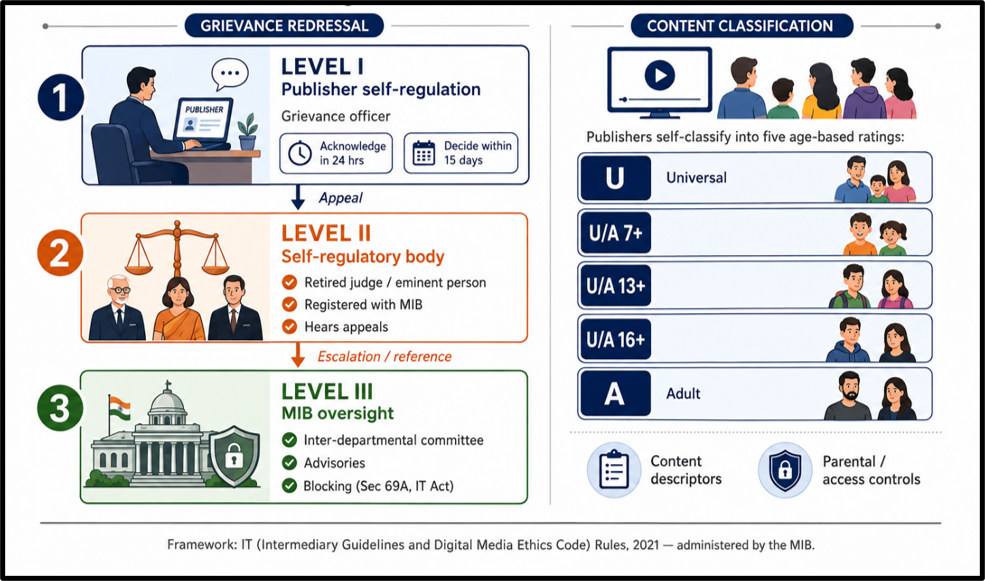
- Level I — the publisher. An in-house grievance officer must acknowledge a complaint within 24 hours and dispose of it within 15 days.
- Level II — a self-regulatory body. An industry body headed by a retired judge of the Supreme Court or a High Court (or an independent eminent person) and registered with the MIB hears appeals and enforces the Code of Ethics.
- Level III — the Ministry. An MIB oversight mechanism, with an inter-departmental committee, can issue advisories and warnings and, in emergencies, direct that content be blocked under Section 69A of the IT Act.
Running alongside this content code is a data-protection layer: the Digital Personal Data Protection Act, 2023 governs how platforms collect and process users’ personal data — through consent, the roles of “Data Principal” and “Data Fiduciary”, and a Data Protection Board — with its detailed Rules notified in 2025.
The guiding philosophy is best summed up as calibration, not censorship: protecting viewers, minors and public order while preserving creative freedom. Critics, however, question whether self-classification is enough, and press for clearer regional-language descriptors, independent audits and sharper limits on the government’s emergency blocking powers — debates that feed directly into the convergence question below.
Content Regulation and Media Convergence
The deepest challenge is structural. Television, telecom and the internet were once separate industries with separate regulators; today they carry the same content down the same digital pipe, viewable on any screen. This convergence scrambles the tidy segment-by-segment map above and leaves the MIB, TRAI and the Ministry of Electronics & IT with overlapping claims over the same service.
The government’s answer has been to attempt consolidation. Successive drafts of a Broadcasting Services (Regulation) Bill (2023 and 2024) sought to replace the 1995 Cable Act and bring broadcasting — potentially including OTT — under one modern framework.
The drafts drew concern over their scope and their implications for online creators and were ultimately withdrawn for wider consultation, leaving the convergence question open. Running beneath it is an older tension: how to protect viewers and public order through content codes without tipping into censorship — a thread that connects directly to the companion note on press and media freedom.
Challenges and the Way Forward
| Challenge | Why it matters |
| Fragmented, medium-wise rules | The same content faces different rules on TV, cable and mobile — uneven and hard to enforce. |
| Convergence outpacing law | Old silos blur while overlapping regulators (MIB, TRAI, MeitY) create uncertainty for industry. |
| Content vs free speech | Programme codes must safeguard viewers without sliding into censorship. |
| Ratings integrity | Manipulated TRPs distort the advertising market and can skew what news gets covered. |
| Public-broadcaster autonomy | Prasar Bharati’s independence from government shapes the credibility of public media. |
Conclusion
India’s media governance was built one medium at a time, and it shows. The institutions — MIB, TRAI and Prasar Bharati — remain sound, but the boundaries between them are dissolving as audiences migrate to a single converged screen. The task ahead is to modernise regulation for that world: coherent rules that protect viewers and competition, preserve the autonomy of the public broadcaster, and keep content regulation firmly on the right side of the line that the next post examines — the freedom of the press.