
BRICS
Why BRICS Matters
Few groupings capture the churn in the global order quite like BRICS. What began as a catchy investment-banking acronym for four fast-growing economies has become an eleven-member coalition that, on its own account, represents roughly half of humanity and about 40% of the world economy.
For an aspirant, BRICS is a live case study in how emerging powers try to reshape institutions built in the mid-twentieth century — and where India, straddling the Global South and its own great-power ambitions, chooses to place itself.
As India assumes the BRICS Chairship in 2026, the grouping sits at an inflection point: larger and more diverse than ever, but wrestling with internal asymmetries and questions about what it actually stands for.
What is BRICS?
BRICS is an informal grouping of major emerging-market and developing economies that use it as a platform for consultation and cooperation on global political and economic governance.
It has no charter, no permanent secretariat and no headquarters; instead, a rotating annual Chairship hosts the summit and steers the agenda. As of 2025 the grouping has eleven full members — Brazil, Russia, India, China, South Africa, Egypt, Ethiopia, Iran, Saudi Arabia, the United Arab Emirates and Indonesia — supported by a wider ring of ten Partner Countries.
Snapshot: Key Facts & Milestones
| Feature | Detail |
| Nature | Informal, consensus-based grouping; no charter or permanent secretariat |
| First summit | 2009, Yekaterinburg (Russia); grouping formalised at the 2006 BRIC Foreign Ministers’ meeting |
| Full members | 11 (as of 2025) — the original five plus six that joined in 2024–25 |
| Partner countries | 10 (added in 2025) |
| Share of world population | ≈ 49.5% |
| Share of global GDP | ≈ 40% |
| Share of global trade | ≈ 26% |
| Key institutions | New Development Bank (Shanghai) and the Contingent Reserve Arrangement |
| 2026 Chairship | India — theme: Resilience, Innovation, Cooperation & Sustainability |
From BRIC to BRICS+: A Short Evolution
The term “BRIC” was coined in 2001 by economist Jim O’Neill to describe four economies expected to dominate global growth. It moved from analysis to diplomacy when the BRIC Foreign Ministers first met in 2006 on the sidelines of the UN General Assembly, and became a summit-level forum with the inaugural 2009 summit in Yekaterinburg. South Africa’s inclusion in 2010–11 turned BRIC into BRICS and gave the grouping an African anchor.
A far bigger leap came in January 2024, when Egypt, Ethiopia, Iran, Saudi Arabia and the UAE became full members, followed by Indonesia in January 2025. The 2025 Rio Summit also created a new Partner Country tier — a halfway house for states keen to engage without full membership. This “BRICS+” expansion has broadened the grouping’s energy and demographic weight, but also its internal diversity of interests.

| Year | Milestone | Details |
| 2001 | Term “BRIC” coined | Economist Jim O’Neill groups Brazil, Russia, India & China as rising economies. |
| 2006 | Grouping formalised | First BRIC Foreign Ministers’ meeting on the sidelines of the UNGA, New York. |
| 2009 | First BRIC Summit | Leaders meet in Yekaterinburg, Russia — the grouping becomes a summit-level forum. |
| 2011 | BRIC becomes BRICS | South Africa joins; attends the 3rd Summit in Sanya, China. |
| 2014 | Financial architecture | New Development Bank & Contingent Reserve Arrangement agreed at the Fortaleza Summit. |
| 2024 | First major expansion | Egypt, Ethiopia, Iran, Saudi Arabia & the UAE become full members. |
| 2025 | Wider circle | Indonesia joins as a full member; 10 Partner Countries added. 17th Summit held in Rio. |
| 2026 | India’s Chairship | India chairs BRICS — theme: Resilience, Innovation, Cooperation & Sustainability. |
Membership & Expansion
BRICS today operates as two concentric circles: full members who shape decisions, and Partner Countries invited to associate with its work. Notably, Argentina declined an invitation following a change of government, a reminder that membership is a political choice, not merely an economic one.
| Full Members (11) | Partner Countries (10) |
| Brazil, Russia, India, China (founders, 2009) | Belarus |
| South Africa (2011) | Bolivia |
| Egypt (2024) | Cuba |
| Ethiopia (2024) | Kazakhstan |
| Iran (2024) | Malaysia |
| Saudi Arabia (2024) | Nigeria |
| United Arab Emirates (2024) | Thailand, Uganda |
| Indonesia (2025) | Uzbekistan, Vietnam |
Core Pillars & Areas of Cooperation
BRICS cooperation is structured around three pillars — political and security; economic and financial; and cultural and people-to-people exchanges. From an initial focus on economic coordination, the agenda has widened to counter-terrorism, climate change, food and energy security, digital public infrastructure, health, and reform of the international financial architecture and the WTO.
Climate-linked trade: BRICS has opposed unilateral climate-related trade measures such as the EU’s Carbon Border Adjustment Mechanism (CBAM), arguing that they can disadvantage developing economies and undermine CBDR-RC. It supports greater climate finance, technology cooperation and nationally appropriate transition pathways.
Cultural cooperation: The Bhopal Declaration (2026) strengthened BRICS cooperation in cultural and creative industries, heritage conservation and restitution, traditional knowledge and creators’ rights in the age of AI.
Anti-corruption cooperation: BRICS is strengthening cooperation on asset recovery, tracing of fugitive offenders, extradition and information-sharing among Financial Intelligence Units (FIUs) to tackle cross-border corruption and digital financial crimes.
Industrial & technological cooperation: The BRICS Partnership on New Industrial Revolution (PartNIR) promotes cooperation in digital transformation, artificial intelligence and advanced manufacturing.
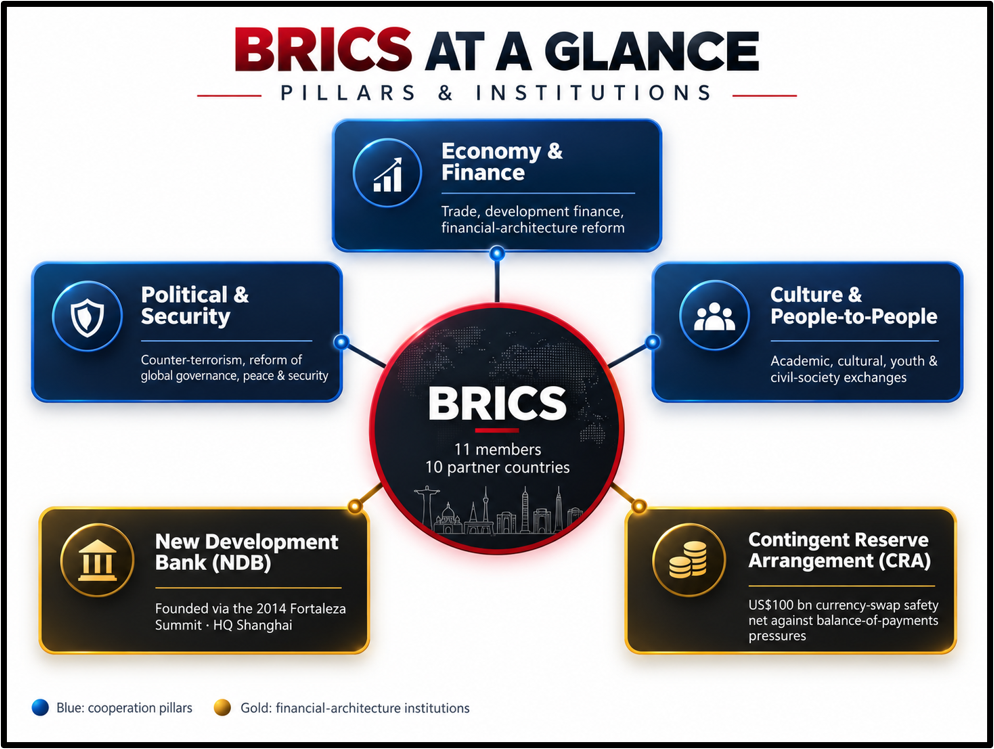
Recurring agenda items
- Global-governance reform: pressing for a more representative UN Security Council, IMF and World Bank — a theme India has led (see The United Nations).
- Development finance: channelling resources to infrastructure and sustainable-development projects through the New Development Bank.
- Financial resilience: building buffers against currency and balance-of-payments shocks via the Contingent Reserve Arrangement, and exploring local-currency trade settlement.
- Global South solidarity: positioning BRICS as a collective voice for developing economies on trade, technology and climate finance.
Financial Architecture: NDB & CRA
BRICS’ most concrete achievements are two financial institutions agreed at the 2014 Fortaleza Summit. The New Development Bank (NDB), headquartered in Shanghai, finances infrastructure and sustainable development in emerging economies; the Contingent Reserve Arrangement (CRA) is a currency-swap safety net against short-term liquidity pressures.
Crucially, the five founders hold equal shareholding in the NDB — a deliberate contrast with the weighted voting of the Bretton Woods institutions.
| Institution | New Development Bank (NDB) | Contingent Reserve Arrangement (CRA) |
| Purpose | Finance infrastructure & sustainable-development projects | Provide liquidity support during balance-of-payments / currency pressures |
| Agreed | Fortaleza Summit, 2014 | Fortaleza Summit, 2014 |
| Headquarters | Shanghai, China | Managed by member central banks (no HQ) |
| Size | Authorised capital US$100 bn; initial subscribed US$50 bn | US$100 bn currency-swap pool |
| India’s stake | US$10 bn subscribed (18.72%), equal to each founder | US$18 bn commitment |
India and BRICS
For India, BRICS is a key vehicle of strategic autonomy and multi-alignment — a forum where it cooperates with Russia and China even as it deepens ties with the West through the Quad and G20. India uses BRICS to press for a fairer global order, greater development finance for the South, and a united front on terrorism and climate finance, while carefully guarding against the grouping becoming an overtly anti-Western bloc.
India last chaired BRICS in 2021, hosting the 13th Summit and steering the New Delhi Declaration on reform of the multilateral system. It now returns to the chair for 2026, under the theme “Building for Resilience, Innovation, Cooperation and Sustainability.”
India’s four priorities for 2026
- Resilience: strengthening economic, social and institutional resilience against supply-chain, health and climate shocks.
- Innovation: deploying digital public infrastructure, fintech and AI for service delivery and inclusive growth.
- Cooperation: deeper policy coordination, development finance, trade facilitation and governance reform.
- Sustainability: advancing climate action, green finance and just energy transitions.
Challenges
- Internal asymmetry: China’s economy dwarfs the others, raising fears of Sino-centric dominance; the India–China rivalry adds friction.
- Coherence after expansion: eleven diverse members with divergent interests make consensus — the grouping’s operating principle — harder to reach.
- The “anti-West” perception: de-dollarisation talk and the inclusion of Iran and Russia risk framing BRICS as a rival bloc, which India resists.
- Institutional limits: the NDB remains small next to the World Bank, and the CRA has rarely been drawn upon.
- Absence of a secretariat: reliance on rotating chairs limits continuity and follow-through on commitments.
Way Forward
BRICS’ credibility will hinge less on how many members it adds and more on what it delivers. A realistic agenda would scale up the New Development Bank and diversify its currencies of lending, make the CRA genuinely usable, and pursue pragmatic gains — local-currency trade settlement, cross-border payment links, and cooperation on climate finance, health and food security — rather than symbolic anti-Western posturing.
2 Comments