
India – Malaysia Relations
Why India–Malaysia Matters
Few relationships blend the ancient and the modern quite like India and Malaysia’s. Long before diplomacy, monsoon winds carried Indian traders, scripts and temple builders to the Malay Peninsula; today, that same corridor carries semiconductors, digital payments and defence exercises. Malaysia sits at the heart of India’s Act East Policy — commanding the Strait of Malacca, anchoring India’s ASEAN outreach, and home to one of the world’s largest Indian-origin communities. The relationship hit a new high when it was elevated to a Comprehensive Strategic Partnership (CSP) in August 2024, turning decades of goodwill into a structured, forward-looking agenda.
A Relationship Centuries in the Making
The story runs deep. Indic religion, language and architecture shaped the Malay world for over a millennium. Modern ties, though, are traceable to a clear starting point: India established diplomatic relations with the Federation of Malaya (Malaysia’s predecessor state) in 1957.
The warmth of the Nehru–Tunku Abdul Rahman years gave way to a more transactional phase, before India’s Look East and Act East pivots put Malaysia back at centre-stage. The relationship was upgraded to an Enhanced Strategic Partnership during PM Modi’s 2015 visit — the launchpad for today’s Comprehensive Strategic Partnership.
| Year/Period | Development |
| 1957 | Diplomatic ties with Federation of Malaya |
| 1960s | Nehru–Tunku Abdul Rahman era |
| 1990s | ‘Look East’ Policy |
| 2014 | ‘Act East’ Policy |
| 2015 | Enhanced Strategic Partnership |
| August 2024 | Comprehensive Strategic Partnership |
| February 2026 | PM Modi’s official visit |
Five Pillars of the Partnership
The 2024 upgrade rests on five reinforcing pillars. Together they turn a friendly relationship into a strategic one.
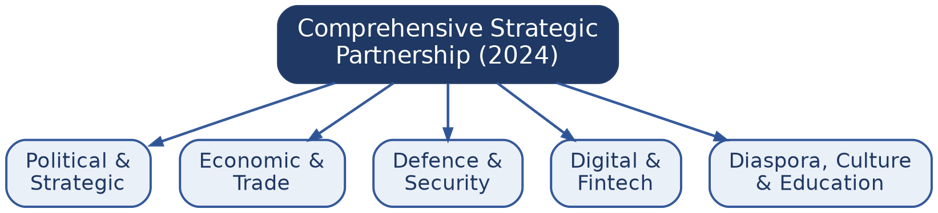
1. Political & Strategic
High-level trust drives the relationship. PM Anwar Ibrahim’s August 2024 visit to India — his first to South Asia — produced the CSP, and was reciprocated by PM Modi’s official visit to Malaysia in February 2026. India backed Malaysia’s 2025 ASEAN Chairmanship, and the two coordinate across the East Asia Summit and other regional forums.
2. Economy & Trade
Trade is the engine. Two-way commerce touched a record of about US$19.5 billion, and by early 2026 the Ministry of External Affairs placed it close to US$20 billion, with Malaysia among India’s largest ASEAN trading partners.
The ongoing review of the ASEAN–India Trade in Goods Agreement (AITIGA) aims to make the trade basket fairer and more balanced.
3. Defence & Security
Defence has moved from symbolism to substance:
- Institutional spine: the Malaysia–India Defence Cooperation Committee (MIDCOM), with a Strategic Affairs Working Group and a Su-30 Forum to sustain Malaysia’s fighter fleet.
- Joint exercise: Harimau Shakti — the Army-to-Army drill whose 5th edition ran in Rajasthan in December 2025.
- Maritime & multilateral: naval port calls (INS Sahyadri, INS Sandhayak), a renewed UN peacekeeping arrangement, and a joint Counter-Terrorism Working Group.
4. Digital & Fintech
This is the fastest-moving frontier. A Malaysia–India Digital Council steers cooperation on 5G, quantum computing, cybersecurity and IoT. The headline win is the UPI payment linkage between India’s NPCI International and Malaysia’s PayNet, while the 2026 visit opened a new track on semiconductors, where Malaysia brings deep chip-assembly expertise.
5. Diaspora, Culture & Education
- A living bridge: ~2.75 million Persons of Indian Origin — the second-largest PIO community in the world.
- Knowledge links: a Thiruvalluvar Chair of Indian Studies at Universiti Malaya, a Chair for Ayurveda and 100 ITEC seats in cybersecurity and AI.
- Shared causes: Malaysia has joined the India-led International Big Cat Alliance.
The Roadblocks
- Lopsided trade: India runs a deficit driven by palm oil and petroleum imports; the basket needs diversification and value-addition.
- Non-tariff barriers: Market-access and standards frictions persist — a key reason the AITIGA review matters.
- Political sensitivities: Past remarks by Malaysian leaders on India’s internal matters (Kashmir, CAA) have periodically strained ties.
- Security follow-through: Cooperation on fugitives and radicalisation needs sustained institutional delivery.
- The China factor: Malaysia’s deep economic links with China shape its choices, so India must compete on value in trade and technology.
The Road Ahead
The task now is execution: close a rebalanced AITIGA review, scale UPI interoperability, build semiconductor and green-energy supply chains, deepen maritime and defence-industrial cooperation across the Indian Ocean and the Malacca Strait, and keep leveraging the diaspora as enduring soft power. Firmly anchoring Malaysia within India’s Act East and wider foreign-policy framework strengthens India’s overall engagement with Southeast Asia and the Indo-Pacific.