
UPSC CURRENT AFFAIRS — 20 OCTOBER 2026
1. Online Is a Right: SC on Children’s Internet Access
(POLITY AND GOVERNANCE) (IE) The Supreme Court has held that the right to access and use the internet is a fundamental right under Article 21 read with Article 19(1)(a) — for every individual, including children of any age. It rejected blanket bans on minors and instead directed a safety architecture aimed at abusers and harmful content.
The order came on 15 October 2026 from a Bench of Justices J.B. Pardiwala and K. Vinod Chandran, in proceedings flowing from the 2024 child sexual exploitation and abuse material (CSEAM) judgment in Just Rights for Children Alliance v. S. Harish.
The constitutional road to this ruling
Cricket Association of Bengal (1995) ➜ Anuradha Bhasin (2020) ➜ Pragya Prasun (2025) ➜ Children’s internet right (2026)
| Case | What it added |
| Cricket Association of Bengal (1995) | Article 19(1)(a) includes the right to impart and receive information |
| Anuradha Bhasin v. UoI (2020) | Speech and trade over the internet protected under Articles 19(1)(a) and 19(1)(g) (see Anuradha Bhasin case) |
| Pragya Prasun (2025) | Digital access is part of the right to life under Article 21 |
| Just Rights for Children Alliance (2024) | Viewing or storing CSEAM is an offence under POCSO and the IT Act even without sharing |
What the Court said
- No blanket bans: Termed them “unproven measures of proven disproportionality”; keeping children offline “mistakes the victim for the problem”.
- Three-part test: Any curb needs enacted law, a legitimate state aim and strict proportionality (see right to freedom).
- Age-gating risks: Mandatory age verification invites surveillance and misuse of sensitive data — a Puttaswamy concern.
- Child mode: Private-by-default accounts, limits on contact from unknown adults and moderated advertising.
Directions at a glance
| Direction | Detail |
| National Hash & URL List Database | Stores hashes/URLs of verified CSEAM; each entry checked by at least three trained human analysts |
| Reporting | Unknown-origin CSEAM to be reported within two hours; database-match removals in weekly reports |
| Complaints | Acknowledged within 24 hours with a trackable number; CSEAM reporting within two clicks |
| Penalties | Exemplary fines; forfeiture of revenue from paywalled CSEAM |
| Schools | Digital safety and age-appropriate sex education via NCERT and SCERTs |
| Victims | Free counselling and psychological support |
Challenges ahead
- Enforcement gap: Past digital-rights rulings have seen patchy compliance during shutdowns.
- Algorithmic harm: Open access without design safeguards exposes children to addictive feeds and mature content.
- State laws: Karnataka and Andhra Pradesh proposals on age-based curbs must now meet the proportionality test.
- Compliance costs: Small platforms may struggle with 24/7 moderation and two-hour deadlines (see cyber security framework).
📖 Read More: Right to Freedom • Anuradha Bhasin Case (2020) • Children, Adolescents and Youth • Data Localisation and Privacy Issues • NCPCR
2. Conversion and Quota: SC Draws the Line
(SOCIAL JUSTICE) (IE) In Secretary to Government v. Sameer Ahamed N. (15 October 2026), the Supreme Court upheld the Madras High Court’s quashing of a 2024 Tamil Nadu Government Order that let converts from Hinduism to Islam claim the Backward Class (Muslim) quota. Backwardness from the earlier caste order, it held, does not automatically carry over.
Key holdings
- Not portable: Reservation under Article 16(4) attaches to a constitutionally identified class, not to an individual’s personal history.
- SC status lost: Under paragraph 3 of the Constitution (Scheduled Castes) Order, 1950, a convert out of Hinduism, Sikhism or Buddhism loses SC status.
- Reconversion: Returning to Hinduism does not automatically revive caste status; a competent authority must decide on facts.
- Private certificates: A religious body such as a jamath cannot certify backward-class or SC entitlement.
- Expert advice ≠ law: A commission’s recommendation does not shield an executive order from review under Articles 14, 15(4) and 16(4).
- Door left open: Converts can still qualify for BC/OBC quotas if they independently meet the criteria.
Who can be a Scheduled Caste?
Article 341: President notifies list ➜ Parliament alone can amend it ➜ 1950 Order, para 3: Hindu, Sikh or Buddhist only ➜ Conversion out → SC status lost
| Aspect | Scheduled Castes | Scheduled Tribes |
| Religion bar | Yes — only Hindu, Sikh or Buddhist | No — status is religion-neutral |
| Effect of conversion | Immediate loss of SC status and SC/ST Act protection | Retained if tribal identity and customs continue |
| Territorial scope | State/UT specific | State/UT specific |
The larger debate
| Milestone | Position |
| C.M. Arumugam (1976) | Reconverts may regain SC status if the caste community accepts them |
| Soosai v. UoI (1985) | Dalit Christians denied SC status for want of evidence of continuing discrimination |
| Ranganath Misra Commission (2007) | Recommended making SC status religion-neutral |
| K.G. Balakrishnan Commission (2022) | Examining SC status for Dalit converts to other religions |
The ruling restates the legal position but leaves the social question open: many converts still face caste discrimination on the ground (see SC, ST and OBCs).
📖 Read More: Scheduled Castes, Scheduled Tribes and OBCs • Special Provisions Relating to Certain Classes • Minorities in India • Champakam Dorairajan Case (1951)
3. Half-Empty After the Rains: India’s Reservoir Storage
(GEOGRAPHY) (DTE) The Central Water Commission’s bulletin of 15 October 2026 shows India’s 178 major reservoirs holding 126.717 BCM — 68.58% of live capacity. That is 24.53% less than last year and 16.44% below the ten-year normal, with the south hit hardest.
The numbers
| Indicator | Value |
| Live storage | 126.717 BCM of 184.762 BCM capacity (68.58%) |
| vs last year | 41.193 BCM (24.53%) lower |
| vs normal | 24.930 BCM (16.44%) lower |
| Hydropower reservoirs | 12 of 20 at or below normal |
Basin-wise picture
| Status | Basins (departure from normal) |
| Highly deficient | Pennar (−72.32%), Cauvery (−60.50%) |
| Deficient | Sabarmati (−38.03%), Krishna (−32.59%) |
| Surplus | Swarnarekha (+30.74%), Narmada (+7.81%), Mahanadi (+2.95%) |
Among individual dams, Idukki (Kerala) and Ujani (Maharashtra) stood at 10.62% of normal, Somasila (Andhra Pradesh) at 22.05% and Mettur (Tamil Nadu) at 32.49%. The south-peninsular deficit mirrors the weak monsoon there (see east-flowing peninsular rivers).
Why it matters
Weak monsoon in the south ➜ Low reservoir storage ➜ Stress on rabi irrigation, drinking water & hydropower ➜ Inter-state friction
- Farms: Rabi crops in deficient basins depend on stored water (see irrigation).
- Disputes: A dry Cauvery basin can reignite sharing tensions (see river water disputes).
- Way forward: Basin-level planning, micro-irrigation, groundwater recharge and climate-proof storage (see water conservation).
📖 Read More: River Water Disputes • Water Conservation • Irrigation and its Types • Drought • Interlinking of Rivers
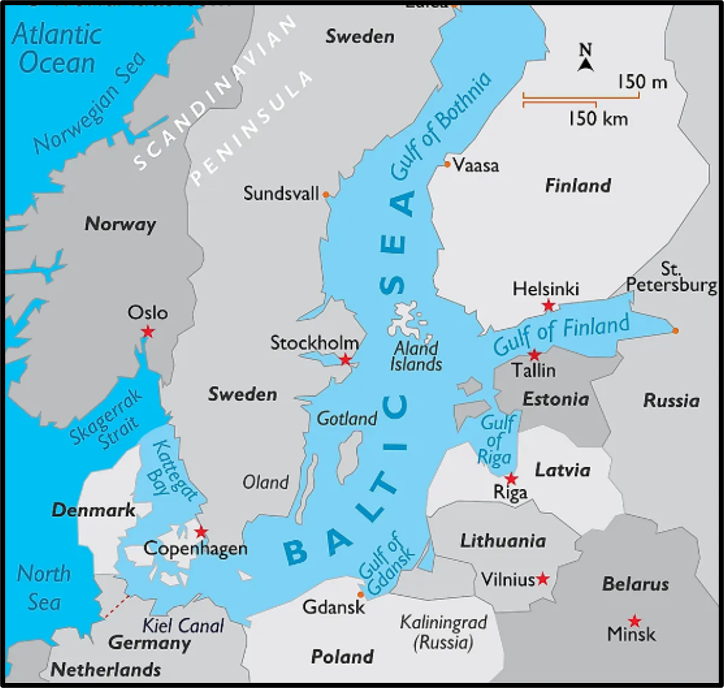
4. The Baltic Sea in the Map: A Sea Gasping for Oxygen
(GEOGRAPHY) (NC) The Nordic Council’s Committee for a Sustainable Nordic Region is pursuing new initiatives to tackle eutrophication, oxygen-depleted seabeds and declining fish stocks in the Baltic Sea, and will raise the issue at the upcoming biodiversity and climate COPs.
The Baltic at a glance
| Feature | Details |
| Type | Semi-enclosed arm of the Atlantic; the world’s largest brackish water basin |
| Bordering countries (9) | Denmark, Sweden, Finland, Russia, Estonia, Latvia, Lithuania, Poland, Germany |
| Link to North Sea | Danish Straits (Øresund, Great Belt, Little Belt) → Kattegat; also the Kiel Canal |
| Gulfs | Bothnia, Finland, Riga; Bay of Gdańsk |
| Major rivers | Neva, Vistula, Oder, Daugava, Neman |
| Islands | Gotland, Öland, Bornholm, Saaremaa, Åland archipelago |
| Ports | St Petersburg, Stockholm, Helsinki, Riga, Gdańsk, Copenhagen |
Why it is so vulnerable
Farm & sewage nutrients ➜ Algal blooms ➜ Decay uses up oxygen ➜ Dead zones on the seabed ➜ Fish stocks decline
- Low salinity: Heavy river inflow and a narrow outlet keep surface water fresh; salty, dense water sits below.
- Stratification: Layering blocks mixing, so deep basins lose oxygen — about a quarter of the seafloor is a variable dead zone.
- Fish: Between 2016 and 2021, on average only 4 of 15 assessed commercial stocks were in good condition.
Cooperation
- HELCOM: The Helsinki Commission runs the Baltic Sea Action Plan to restore good environmental status.
- Proposals: Protect at least 30% of marine and coastal areas by 2030, in line with the Kunming–Montreal framework (see water pollution control).
📖 Read More: Effects of Water Pollution • Water Pollution Control Measures
5. Basawan: The Mughal Master Who Painted Cheetahs
(HISTORY) (TOI) A Family of Cheetahs in a Rocky Landscape, a work attributed to the Mughal master Basawan, is back in the news. It sold at Christie’s London on 28 October 2025 for about £10.2 million — a world record for a classical Indian or Islamic painting — from the collection of Prince and Princess Sadruddin Aga Khan.
Who was Basawan?
| Aspect | Details |
| Era | Leading painter of Akbar’s imperial atelier; flourished c. 1580–1600 |
| The painting | A Family of Cheetahs in a Rocky Landscape, c. 1575–80 |
| Manuscripts | Illustrations for the Akbarnama, Razmnama, Darabnama and Baharistan of Jami |
| Legacy | His son Manohar continued as a court painter |
What made him special
- Expressive figures: Lively faces and postures in place of stiff, ornamental forms.
- Naturalism: Animals observed in their habitats rather than as mere emblems of royal power.
- Fusion: Blended Persian refinement with Indian vibrancy; among the first to use European-style light and shade.
- Space and depth: Rich backgrounds and a strong sense of space.
Mughal painting in one line
Humayun brings Persian masters ➜ Akbar’s atelier: Daswanth, Basawan ➜ Jahangir: Mansur’s natural history ➜ Shah Jahan: formal portraits
Basawan’s careful animal studies prepared the ground for the wildlife masterpieces of Ustad Mansur under Jahangir (see Indo-Persian and Mughal miniature paintings).
📖 Read More: Indo-Persian and Mughal Miniature Paintings • Akbar • Miniature Painting • Art and Culture during the Mughal Period
6. Young Talent Honoured: Ustad Bismillah Khan Yuva Puraskar
(HISTORY) (AIR) Union Culture and Tourism Minister Gajendra Singh Shekhawat conferred the Ustad Bismillah Khan Yuva Puraskar for 2024 and 2025 on 106 young artists at a ceremony in New Delhi organised by the Sangeet Natak Akademi.
About the award
| Feature | Details |
| Instituted | 2006, in memory of shehnai maestro and Bharat Ratna Ustad Bismillah Khan |
| Conferred by | Sangeet Natak Akademi, under the Ministry of Culture |
| Eligibility | Artists below 40 years of age |
| Award | ₹25,000, a tamrapatra (plaque) and an angavastram |
| Number | Up to 33 artists a year |
| Fields | Music, dance, theatre, traditional/folk/tribal arts and puppetry, and overall contribution |
This year’s awardees spanned forms such as Behrupiya, Chhau, Naga choir music and folk music of Bihar — reflecting the award’s reach to grassroots traditions (see performing arts of India).
- Recognition early: Encourages young practitioners to stay with traditional arts.
- Diversity: Supports endangered folk, tribal and puppetry forms.
📖 Read More: Awards and Honours in Art and Culture • Cultural Institutions in India • Performing Arts of India
7. Lab Animals and the Law: PETA Seeks Withdrawal of Draft Rules
(ENVIRONMENT) (TT) PETA India has asked the Centre to withdraw the draft Prevention of Cruelty to Animals (Control and Supervision of Experiment, Breeding and Trading of Laboratory Animals) Rules, 2026, arguing they dilute existing protections and weaken central oversight of animal experiments.
What the draft proposes
- Severity-based oversight: Regulation keyed to the pain and distress caused, not the animal’s size.
- Four tiers: Non-recovery, mild, moderate and severe experiments.
- Local approvals: Institutional Animal Ethics Committees can clear mild and moderate studies in all species.
- Central clearance: Severe studies, and non-recovery studies on animals other than rodents and rabbits, need the central committee’s nod.
- 3Rs: Replacement, Reduction, Refinement made explicit.
The regulator is the Committee for Control and Supervision of Experiments on Animals (CCSEA), a statutory body under the Prevention of Cruelty to Animals Act, 1960. PETA’s worry: devolving approvals to institutions could reduce independent scrutiny.
About PETA
| Feature | Details |
| Founded | March 1980, USA, by Ingrid Newkirk and Alex Pacheco (see PETA) |
| India arm | PETA India, launched in 2000 (Mumbai) |
| Landmark | Silver Spring monkeys case (1981) exposed lab cruelty and spurred stronger US law |
| Focus areas | Laboratories, factory farming, clothing (fur, leather) and entertainment |
Alternatives to animal testing
Human cell cultures ➜ Organ-on-chip ➜ Computer (in silico) models ➜ Fewer animals in research
📖 Read More: India’s Wildlife Laws, Policies and Institutions • Modern Ethical Conundrums
8. Water Batteries: India’s Push for Pumped Storage
(ECONOMICS) (PIB) India is fast-tracking Pumped Storage Projects (PSPs) to store surplus solar and wind power. The Central Electricity Authority (CEA) has identified 345.38 GW of potential across 320 sites and plans to take cumulative capacity to about 105.56 GW by 2035–36.
How a “water battery” works
Surplus solar/wind power ➜ Pump water uphill ➜ Store as potential energy ➜ Release through turbines at peak demand
Pumped-storage hydropower recycles the same water between two reservoirs. On-stream projects have both reservoirs on a river; off-stream projects keep at least one reservoir away from rivers (both, in closed-loop designs), easing ecological impact.
Status and potential
| Indicator | Value |
| Operational (Aug 2026) | 7.43 GW across 10 projects |
| Under construction | 15.87 GW across 11 projects |
| Concurred/appraised by CEA | 10.40 GW across 8 projects |
| Identified potential | 345.38 GW (62 on-stream: 56.67 GW; 258 off-stream: 288.71 GW) |
| Top region / state | Western Region 129.72 GW; Maharashtra 67.36 GW |
| Storage need by 2031–32 | 73.93 GW (26.69 GW PSP + 47.24 GW batteries) |
| Global rank | 4th; world capacity 159.8 GW (end-2025) |
Policy support
- Guidelines: Ministry of Power PSP guidelines (April 2023) and tariff-based bidding guidelines (2025).
- ISTS waiver: 100% transmission-charge waiver for PSPs awarded by 30 June 2028.
- Faster approvals: CEA concurrence time cut from 90 to 50 days.
PSP vs batteries
| Aspect | Pumped storage | Battery storage (BESS) |
| Duration | Long (hours) | Short, rapid response |
| Life | 40+ years | About 10–15 years |
| Constraint | Needs suitable terrain; long build time | Mineral supply chains; degradation |
With a target of 500 GW non-fossil capacity by 2030, storage is the bridge between variable supply and steady demand (see renewable energy measures).
📖 Read More: Energy Technologies • Measures to Boost Renewable Energy • Challenges Faced by Renewable Energy • Total Installed Power Capacity in India
9. When Crowds Turn Deadly: The Kolkata Pandal Crush
(DISASTER MANAGEMENT) (NDTV) A crowd crush at a Durga Puja pandal in north Kolkata on 17 October 2026 killed 19 people and injured 25. Heavy rain drove crowds forward and an announcement triggered a surge; organisers were among those arrested.
Crush, not just “stampede”
Experts call such events crowd crushes: when density passes about 4–5 persons per m², people lose control of their movement and pressure waves topple them. Most deaths come from compressive asphyxia, not trampling.
Density beyond safe limit ➜ Trigger: rain, rumour, announcement ➜ Surge at a bottleneck ➜ Falls & compression ➜ Deaths
Recent tragedies
| Event | Year | Deaths |
| Vaishno Devi shrine, J&K | 2022 | 12 |
| Hathras satsang, UP (permit 80,000; ~2.5 lakh attended) | 2024 | 121 |
| Tirupati token counters, AP | 2025 | 6 |
| Maha Kumbh, Prayagraj | 2025 | 30 |
| Mansa Devi, Haridwar | 2025 | 6 |
| Durga Puja pandal, Kolkata | 2026 | 19 |
Why they keep happening
- Demand–capacity mismatch: Crowds far exceed site capacity, without timed entry.
- Bottlenecks: Shared entry and exit paths; no holding areas.
- Triggers: Rain, rumours, falling barricades or careless announcements.
- Policing mindset: Treating crowds as law-and-order rather than flow engineering.
Way forward
- Follow NDMA guidance: NDMA’s guide on managing crowds at mass gatherings stresses capacity planning and drills (see NDMA).
- Timed, ticketed entry: As practised at Tirupati and Sabarimala.
- One-way flows: Separate entry and exit routes with zig-zag barricades.
- Tech: CCTV and drone-based density alerts.
- Communication: Trained marshals and calm, directional announcements.
📖 Read More: Stampede • Anthropogenic Disasters • NDMA • Disaster Management Cycle
10. Insuring Against the Weather: India’s Climate Protection Gap
(ENVIRONMENT) (TH) The 2026 monsoon — deficits in many regions alongside local extreme rain — has renewed calls for climate risk insurance. Most of India’s exposure to natural catastrophes remains uninsured, leaving households and the exchequer to absorb losses.
The scale of risk
| Indicator | Value |
| Climate Risk Index 2026 | India 9th (1995–2024); over 80,000 deaths; about US$170 billion losses |
| CEEW vulnerability index | 463 of 640 districts vulnerable to floods, droughts or cyclones; 183 hotspots |
| Protection gap | Swiss Re estimates about 93% of catastrophe exposure was uninsured (2022) |
| Crop insurance | Main form of weather cover via PMFBY; coverage has plateaued despite high premium subsidy |
Why insuring climate is hard
- Paradox of knowing more: Street-level risk maps can make premiums unaffordable for those most at risk.
- Underpricing: Market-share competition keeps premiums below true risk.
- Cascading losses: Crop failures, infrastructure damage and supply disruptions hit the poor hardest.
Parametric insurance explained
Pre-set trigger (e.g. rainfall > 200 mm/24 h) ➜ Trigger breached ➜ Automatic payout via DBT ➜ Quick recovery
Parametric insurance pays on a measurable trigger instead of a damage survey — faster and cheaper to administer. Nagaland has bought multi-year parametric cover for landslides and extreme rain.
Way forward
- Catastrophe pool: A national risk pool sharing losses among government, insurers and reinsurers.
- Targeted subsidy: Premium support for poor households and marginal farmers; JAM-based micro-insurance.
- Risk-informed planning: Zoning to keep housing out of floodplains (see climate mitigation).
📖 Read More: PMFBY • Climate Mitigation Measures • Introduction to Disaster Management • Global Climate and Environmental Indices
11. America Votes Mid-Term: What’s at Stake in 2026
(INTERNATIONAL RELATIONS) (Reuters) The United States holds its midterm elections on 3 November 2026: all 435 House seats and 35 of 100 Senate seats are on the ballot. The vote is widely seen as a referendum on President Donald Trump’s second term.
How it works
| Chamber | Term | At stake in 2026 | Majority |
| House of Representatives | 2 years | All 435 seats | 218 |
| Senate | 6 years (one-third every two years) | 35 seats (33 regular + 2 special) | 51 |
Republicans hold the Senate 53–47 (45 Democrats plus two independents who caucus with them), so Democrats need a net gain of four seats for control. Governorships and state legislatures are also being decided.
Issues shaping the vote
- Economy: Inflation, fuel prices and living costs dominate voter concerns.
- AI data centres: Local anger over water use, power demand and utility bills.
- Redistricting: Leaves only a few dozen House seats genuinely competitive.
Why India should watch
- Trade: Congressional mood shapes tariffs and the bilateral trade deal (see India–US relations).
- Immigration: H-1B and visa policy affect Indian professionals.
- Defence and tech: Congress approves arms sales and technology controls.
📖 Read More: India–United States Relations • USA since 1945
12. A Lifeline Extended: India Rolls Over Maldives Currency Swap
(INTERNATIONAL RELATIONS) (AIR) India has agreed to roll over the first ₹30 billion drawdown under its currency swap with the Maldives. The amount had been drawn on 23 April 2026. The Maldivian Foreign Minister thanked India, calling it a reaffirmation of longstanding friendship.
What is a currency swap?
Partner central bank needs liquidity ➜ Swaps its currency for INR/USD ➜ Eases balance-of-payments stress ➜ Reverses the swap at maturity
| Element | Details |
| Framework | RBI’s SAARC Currency Swap Framework, 2024–27 |
| Windows | INR window (₹25,000 crore) and USD/Euro window (US$2 billion) |
| India–Maldives deal | Signed by the RBI and Maldives Monetary Authority during President Muizzu’s state visit, October 2024 |
| Size | US$400 million (USD/Euro window) and ₹30 billion (INR window) |
Why it matters
- Neighbourhood First: Shores up a strategically located neighbour facing low forex reserves (see India and Maldives).
- Rupee internationalisation: INR-denominated support deepens use of the rupee in the region.
- MAHASAGAR: Fits India’s vision of security and growth across the Indian Ocean.
📖 Read More: India and Maldives • India and Neighbourhood Policy
13. Giving Sourashtra a Voice: AI Text-to-Speech for a Minority Language
(SCIENCE AND TECHNOLOGY) (AIR) The Digital India BHASHINI Division of MeitY and IISc Bengaluru have built AI-based text-to-speech (TTS) models for Sourashtra, a minority Indo-Aryan language spoken mainly in Tamil Nadu.
Key features
- Architecture: VITS — variational inference with adversarial learning — converting text directly into speech.
- Voices: Male and female voices.
- Scripts: Each voice reads text in both the Tamil and the Sourashtra scripts.
About the language
Sourashtra is spoken by a community — historically silk weavers — whose ancestors migrated from present-day Gujarat to the south in medieval times, settling around Madurai. Like many small languages, it has little digital presence (see classical Indian languages).
Why it matters
Low-resource language ➜ Open AI speech models ➜ Apps, learning & accessibility ➜ Language preservation
- Inclusion: Helps visually impaired and low-literacy users access content.
- Mission mode: BHASHINI aims to break language barriers across Indian languages (see AI governance).
📖 Read More: Governance and Artificial Intelligence • Artificial Intelligence • Digital India Programme
14. CISF Reorganised: From Geography to Function
(INTERNAL SECURITY) (TH) The Ministry of Home Affairs has approved an overhaul of the Central Industrial Security Force (CISF) from 1 November 2026: geographically organised sectors give way to sector-specific functional commands.
The new structure
| Command | Headquarters |
| Coal Sector | Ranchi |
| Steel Sector | Bhilai |
| Petroleum & Natural Gas Sector | Guwahati |
| Power Sectors | New Delhi and Kolkata |
| West Coast Port Sector | Mumbai |
| East Coast Port Sector | Chennai |
| GBMM & MRTS Sector | Government buildings, museums & monuments, metro systems |
Existing specialised arrangements for aviation, the Department of Atomic Energy and the Department of Space stay unchanged. CISF has also been designated a Recognised Security Organisation for ports under the IMO’s ISPS Code.
About CISF
- Origin: Set up in 1969 under the CISF Act, 1968; under the MHA (see CAPFs).
- Mandate: PSUs, airports, Delhi Metro, nuclear and space sites; private establishments since a 2009 amendment.
Why the change
Sector-specific threats ➜ Specialised commands ➜ Domain expertise ➜ Better protection of critical infrastructure
📖 Read More: Central Armed Police Forces • Coastal and Maritime Security • Major Ports of India
15. AUSTRAHIND 2026: Island Warfare Drills in Kerala
(INTERNAL SECURITY) (PIB) The 5th edition of the India–Australia joint military exercise AUSTRAHIND 2026 began at the Foreign Training Node, Thiruvananthapuram, and runs from 19 October to 1 November 2026.
| Feature | Details |
| Participants | About 120 personnel each; Garhwal Rifles (India) and 13 Brigade (Australia) |
| Theme | Joint sub-conventional operations in island and coastal environment under Chapter VII of the UN mandate |
| Training | Joint planning, surveillance, coastal and island operations, protection of vital installations, HADR |
| First | A New Zealand observer delegation |
| Previous edition | 4th edition at Irwin Barracks, Perth, October 2025 |
The drills strengthen interoperability between two Quad partners in the Indo-Pacific (see India and Australia relations).
📖 Read More: India and Australia Relations
16. KONKAN-26: India–UK Naval Exercise off Plymouth
(INTERNAL SECURITY) (PIB) The India–UK bilateral maritime exercise KONKAN-26 concluded off Plymouth, UK on 15 October 2026 after a week of drills from 8 October.
| Feature | Details |
| Ships | INS Trishul (stealth frigate) and HMS Sutherland (Duke-class anti-submarine frigate) |
| Conducted by | Royal Navy’s Fleet Operational Standards and Training (FOST) |
| Sea phase | 12–15 October: seamanship, tactics, anti-surface and anti-submarine warfare, weapon firings |
| Series | Annual Indian Navy–Royal Navy exercise, begun in 2004 |
Other India–UK exercises: Ajeya Warrior (army), Indradhanush (air force) and Konkan Shakti (tri-service) (see India–UK relations).
📖 Read More: India–United Kingdom Relations • Coastal and Maritime Security
17. Proof Without Understanding? Mathematics in the Age of AI
(ETHICS) (TC) AI systems now solve olympiad-level problems and check proofs automatically. When one lab released hundreds of AI-generated proofs this month, leading mathematicians warned that a verified answer is not the same as human understanding.
Checking truth vs real understanding
| Feature | Human mathematician | AI system |
| Goal | Why is it true? Meaning and insight | Is it true? Correct output |
| Method | Intuition, analogy, creative leaps | Massive search and pattern matching |
| Failure | Struggle teaches new ideas | Failed paths simply discarded |
| Output | An explanation others can learn from | Long logs or formal code few can read |
Henri Poincaré held that we prove by logic but discover by intuition; G.H. Hardy argued good mathematics is beautiful. A proof that no human can follow — a “black box” — may be correct yet teach us nothing.
Ethical questions
- Deskilling: Over-reliance can erode students’ capacity for deep reasoning.
- Credit: Who owns a discovery built from millions of uncited human papers — the lab, the user or the authors?
- Research bias: Fields easy to formalise may crowd out messier, abstract areas.
- Digital divide: Compute-heavy tools sit with a few firms in rich countries.
Where AI genuinely helps
Routine verification ➜ Error detection ➜ Finding counterexamples ➜ Humans free for creative work
Lessons for India
- NEP 2020: Shift from rote procedures to concepts and problem-solving.
- IndiaAI Mission: Back open, public research tools over proprietary dependence.
- Heritage: From the Sulba Sutras to the Kerala school, Indian mathematics blended rigour with intuition (see science and technology in India).
AI is like a telescope: it extends sight, but it does not understand astronomy.
📖 Read More: Digital Ethics • Modern Ethical Conundrums • Artificial Intelligence • Emerging Technology and Indian Society