
India and Maldives
Introduction: A Tiny Nation of Outsized Importance
The Maldives is one of the world’s smallest nations—an archipelago of coral islands scattered across the Indian Ocean—yet few neighbours matter more to India’s maritime security. It sits astride the sea lanes through which the bulk of India’s trade and energy flows, making it the ‘toll-gate’ of the western Indian Ocean.
This strategic weight, combined with the Maldives’ small size and limited defence capacity, has long made India its first responder and net security provider. But the relationship has also proved volatile, swinging with Malé’s turbulent politics—most recently from a hostile ‘India Out’ campaign to a pragmatic embrace of India as an economic lifeline.
| Why the Maldives Matters — The One-Line Case Over 80% of India’s trade and most of its energy imports pass through the sea lanes around the Maldives; a hostile or China-aligned Malé would sit directly on India’s maritime jugular. |
Background and Strategic Importance
A British protectorate from 1887, the Maldives gained independence in 1965, and India was among the first to establish diplomatic ties. The country’s significance is fundamentally geostrategic: it commands the Sea Lines of Communication (SLOCs) carrying crude oil and LNG from the Persian Gulf to East Asia.
Because the Maldives possesses a vast Exclusive Economic Zone (EEZ) but lacks the capacity to police it, it depends on India for surveillance, anti-piracy and disaster response—giving India a natural leadership role.
| Strategic Significance for India (a UPSC 2024 theme) Control over SLOCs — monitoring and securing the oil/LNG routes of the western Indian Ocean against piracy and terrorism. Energy security — stability in the Maldives underwrites the uninterrupted energy flows on which India’s economy depends. Buffer against rivals — the Maldives is a key node in China’s ‘String of Pearls’; keeping it friendly denies China a foothold on India’s southern flank. Maritime domain awareness — joint patrols, radar and intelligence-sharing extend India’s eyes across the ocean. |
The Foundational Moment: Operation Cactus (1988)
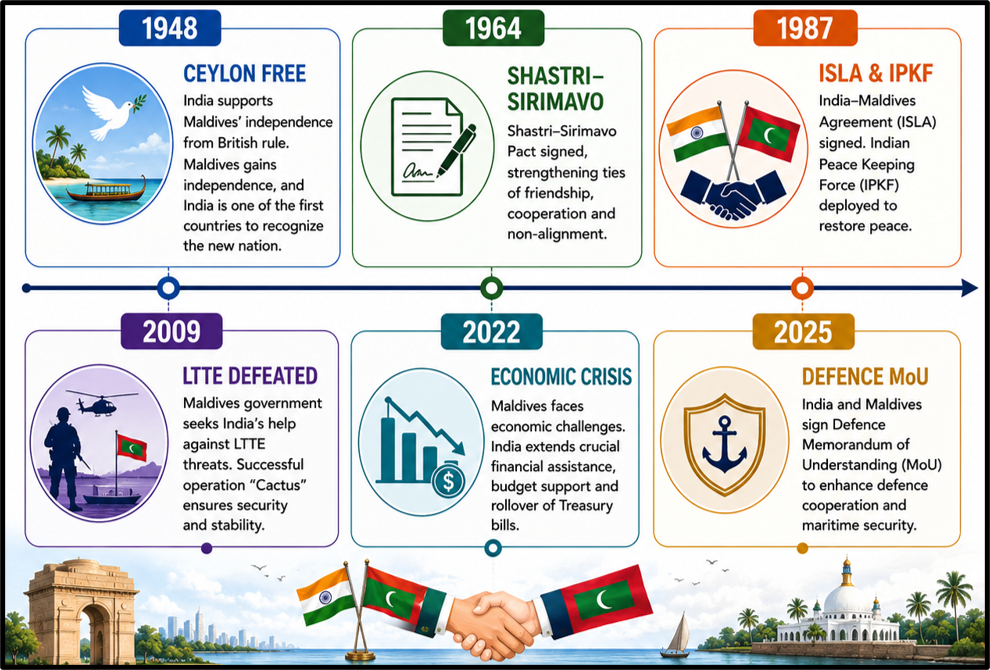
The bedrock of the security relationship was laid in 1988, when a group of mercenaries backed by Maldivian dissidents attempted a coup against President Gayoom. Malé sent out a distress call, and India responded within hours, airlifting paratroopers to restore the legitimate government in a swift, decisive intervention codenamed Operation Cactus.
It remains the defining example of India as the first responder in the neighbourhood and cemented its image as the region’s net security provider. India has repeated this role many times since—rescuing the Maldives from the 2004 tsunami and the 2014 Malé water crisis (see below).
| Case Study — Water-Aid Diplomacy (2014) A fire at the Malé Water and Sewerage Company knocked out the capital’s only water supply; with no rivers or streams, the city of 150,000 faced an immediate crisis. India responded within hours—airlifting bottled water and deploying INS Sukanya and INS Vivek to produce fresh water by reverse osmosis—a textbook demonstration of first-responder diplomacy. |
Areas of Cooperation
| Dimension | Substance |
| Economic & trade | India became the Maldives’ largest trade partner by 2023 (bilateral trade near USD 1 billion, 2023-24). India exports food staples, poultry and construction goods; SBI has anchored Maldivian development finance since 1974; Tata and Taj are among Indian investors. |
| Defence & security | India provides an estimated 70% of the Maldivian National Defence Force’s (MNDF) training, plus a Coastal Radar Surveillance System, a Composite Training Centre, and a 2016 Action Plan for Defence Cooperation. |
| Development | Flagship projects include the Greater Male Connectivity Project (GMCP, ~USD 500 million), Hanimaadhoo International Airport, Thilafushi Port, the Indira Gandhi Memorial Hospital, and the Maldives Institute of Technical Education. |
| Disaster & health | First responder in the 2004 tsunami and 2014 water crisis; Operation Sanjeevani delivered COVID-19 aid in 2020; recognition of Indian pharmacopoeia and planned Jan Aushadhi Kendras. |
| Digital & financial | Currency-swap support, T-bill roll-overs, and the launch of RuPay to deepen economic and people-to-people links. |
Issues and Challenges
The China factor
The central strategic challenge is China’s growing footprint. Under President Yameen (2013–18), the Maldives leaned sharply toward Beijing, joining the Belt and Road Initiative and accepting projects such as the USD 200 million China–Maldives Friendship Bridge. India fears the ‘String of Pearls’ and debt-trap diplomacy could give China access to strategic assets uncomfortably close to Indian shores.
Radicalisation
Despite high literacy, the Maldives has seen worrying Islamist radicalisation: Salafi-Jihadi ideology spread through students returning from abroad, a 2007 bombing targeted tourists in Malé’s Sultan Park, and over 200 Maldivian youths are reported to have joined ISIS—one of the world’s highest per-capita rates. A radicalised Maldives, potentially exploited by Pakistan, is a direct security concern for India.
Political volatility and the GMR precedent
The relationship is hostage to Malé’s political instability. The GMR controversy is the cautionary tale: the Indian firm GMR won a 25-year contract to run Malé’s airport in 2010, only to have it abruptly cancelled after the 2012 change of government, triggering years of international arbitration (which India’s side largely won). It showed how quickly a change of regime can sour commercial and diplomatic ties.
The ‘India Out’ Crisis and the Pragmatic Reset (2023–24)
The most recent test came with the ‘India Out’ campaign, a nationalist movement—championed by the Yameen camp—demanding the removal of Indian military presence, framed as a sovereignty issue. It carried Mohamed Muizzu to the presidency in 2023 on an explicitly pro-China, anti-India platform.
On taking office he demanded the withdrawal of Indian personnel, and by May 2024 the roughly 75 Indian military personnel (operating two helicopters and a Dornier aircraft for humanitarian and surveillance tasks) were replaced by civilian technical staff. The Maldives also declined to renew a hydrographic-survey agreement.
| From ‘India Out’ to ‘Economic Lifeline’ — The Reset A looming debt and foreign-exchange crisis forced Muizzu to recalibrate; anti-India rhetoric gave way to pragmatism. Modi and Muizzu met on 7 October 2024 and adopted a Vision for a Comprehensive Economic and Maritime Security Partnership. India extended a crucial financial rescue: T-bill roll-overs (~USD 100 million via SBI) and a USD 400 million + INR 30 billion currency swap to shore up Maldivian reserves. Cooperation resumed on the GMCP, Hanimaadhoo airport and Thilafushi port, with talks on an FTA and a RuPay launch. The lesson: economic interdependence proved more durable than nationalist politics— ‘India Out’ quietly became ‘India In’. |
Way Forward
- Engage all political factions — maintain dialogue across Malé’s polarised politics to weather anti-India campaigns and avoid another GMR-style rupture.
- Offer credible alternatives to China — deliver sustainable, transparent infrastructure (Hanimaadhoo airport, GMCP) that out-competes Chinese debt financing.
- Ensure transparency in security ties — reassure Maldivian public opinion by right-sizing military footprints while preserving genuine security cooperation.
- Deepen economic integration — sustain currency-swap and trade support, advance an FTA, and expand RuPay and digital linkages so interdependence anchors the relationship.
- Strengthen counter-radicalisation and maritime cooperation — intelligence-sharing, MNDF training and Colombo Security Conclave coordination to secure the shared ocean.
Conclusion
The India–Maldives relationship is a study in the power of geography over politics. However fierce the ‘India Out’ rhetoric, the Maldives’ economic fragility and India’s role as first responder, development partner and lender of last resort keep pulling the two back together—as Operation Cactus, the 2014 water airlift and the 2024 financial rescue each proved.
The task for India is to convert this structural dependence into genuine goodwill: to be seen not as an overbearing patron but as a reliable partner, out-delivering China while respecting Maldivian sovereignty. Mastering this tiny archipelago is, in the end, central to India’s command of its own ocean.