
UPSC CURRENT AFFAIRS — 15 NOVEMBER 2026
1. WHO TB Report 2026: India Cuts Deaths by 38%
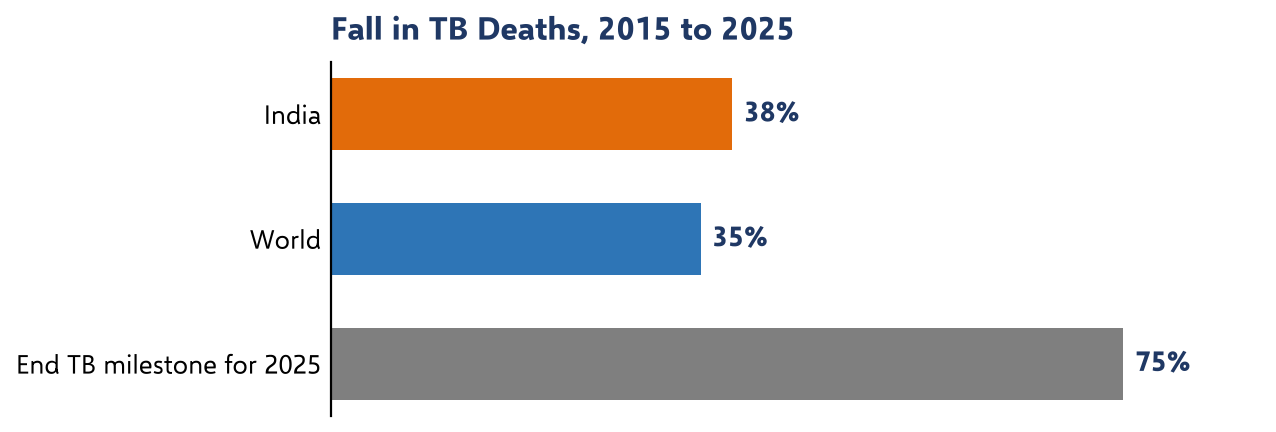
(SOCIAL JUSTICE) (DD) The WHO Global Tuberculosis Report 2026, released on 12 November 2026, shows that India's TB deaths fell 38% between 2015 and 2025 — faster than the global fall of 35% — with a 94% treatment success rate for drug-susceptible TB.
Global Picture (2025)
| Indicator | Finding |
|---|---|
| New cases | About 10.6 million people fell ill — 0.7% fewer than in 2024; India accounts for roughly one-fourth of the world's cases |
| Deaths | About 1.13 million deaths; 35% lower than in 2015 |
| Diagnosis | About 8.4 million newly diagnosed (79% of estimated cases); only 59% first tested with WHO-recommended rapid tests |
| Treatment success | About 90% for drug-susceptible TB and 70% for rifampicin-resistant TB |
| Drug-resistant TB | About 3.7 lakh rifampicin-resistant cases, but only 42% received treatment |
| Funding | US$ 6.6 billion for low- and middle-income countries, far short of the US$ 22 billion a year targeted by 2027 |
Benchmark: the WHO End TB Strategy had set 2025 milestones of a 75% fall in deaths and a 50% fall in incidence against 2015. By 2024 the world had managed only about 29% and 12% respectively.
India's Scorecard
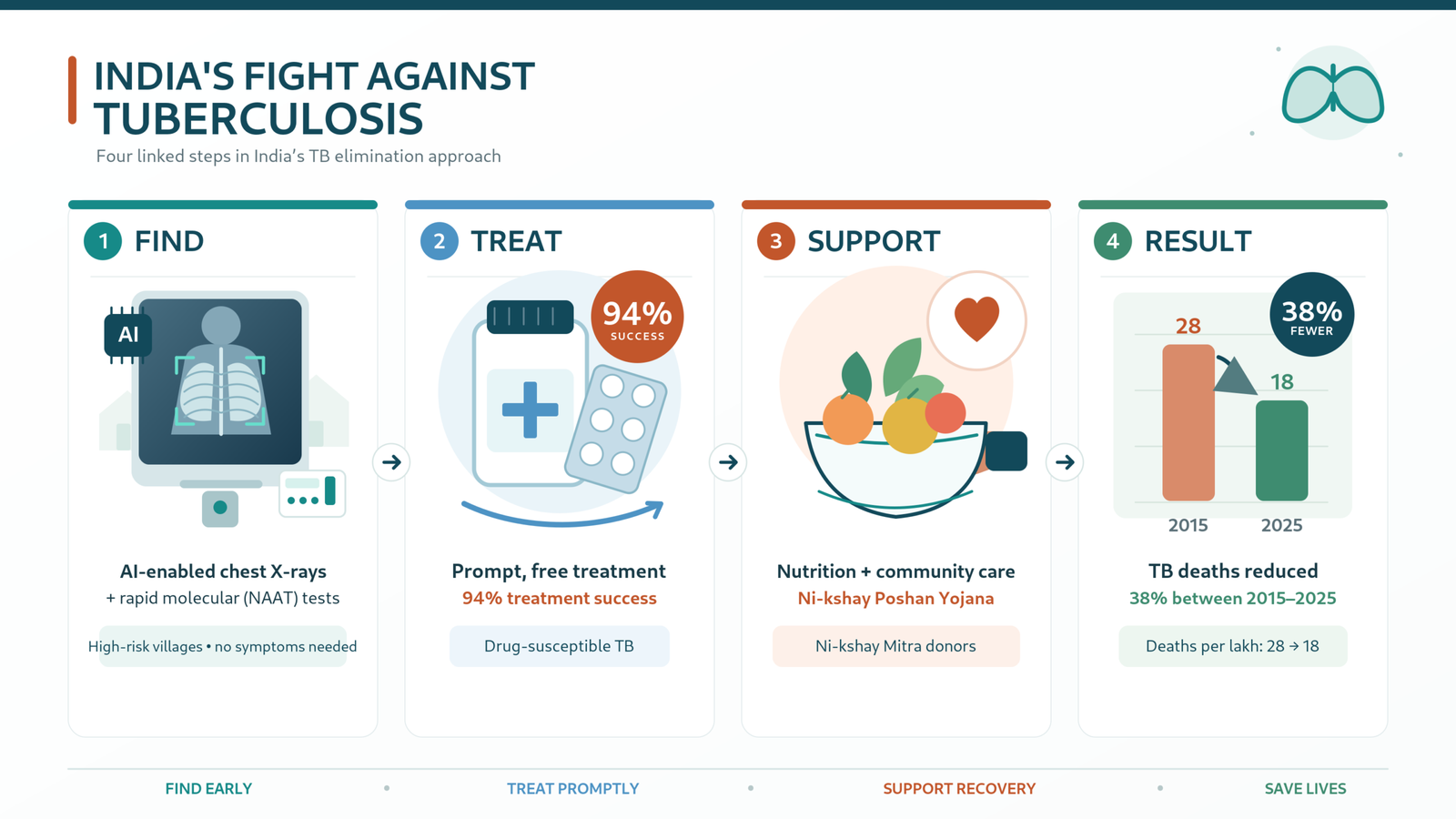
- Mortality rate: down from 28 to 18 deaths per lakh population between 2015 and 2025.
- Treatment success: 94% among drug-susceptible patients.
- Self-financed: 96% of the money for India's TB programme comes from domestic resources.
- TB-free panchayats: 67,933 panchayats were declared TB-free in 2025.
What Is Driving the Decline
The National TB Elimination Programme (NTEP) combines aggressive case-finding with patient support. Its flagship is the TB Mukt Bharat Abhiyaan, a community-led screening drive.
| Phase | Details |
|---|---|
| First 100-day campaign | Launched 7 December 2024 in 347 high-priority districts across 33 States/UTs; later extended nationwide |
| Second intensified drive | From 24 March 2026, focused on 1.58 lakh high-risk villages and wards, congregate settings and vulnerable groups |
| Reach (7 Dec 2024 – 8 Nov 2026) | 25 crore+ people screened; 11 crore+ chest X-rays; 3 crore+ NAAT tests; 48.64 lakh new cases found, including 14.97 lakh with no symptoms |
- Technology: portable AI-enabled digital X-rays, rapid molecular tests, AI tools to map hotspots and predict high-risk cases, and the Khushi AI chatbot for patient engagement.
- Nutrition: cash support for food under the Ni-kshay Poshan Yojana.
- Community: Ni-kshay Mitra volunteers and institutions 'adopt' patients and give them food baskets and support.
Gaps That Remain
- Missing cases: asymptomatic and private-sector patients still escape notification.
- Drug resistance: fewer than half of rifampicin-resistant patients worldwide get treated.
- Deadline missed: India had set 2025 as its target to end TB — five years ahead of the SDG 3.3 deadline of 2030 — and deaths, though falling, are not yet near elimination levels.
- Social drivers: undernutrition, diabetes, tobacco use and crowded housing keep feeding new infections.
📖 Read More: Important Diseases Explained • Major Human Diseases • National Health Mission • Ayushman Bharat Digital Mission
2. Gravitational-Wave Astronomy Enters Its Statistical Era
(SCIENCE AND TECHNOLOGY) (TH) A decade after the first detection, gravitational-wave science has moved from celebrating single events to studying hundreds of black-hole mergers together. Its standout signal, GW250114, is the clearest ever recorded and has confirmed Stephen Hawking's 1971 area theorem with record precision.
What Are Gravitational Waves?
They are ripples in spacetime created when very heavy objects — black holes or neutron stars — accelerate violently, for example while spiralling into each other. Albert Einstein predicted them in 1916 from his General Theory of Relativity. They travel at the speed of light and pass through matter almost untouched. See also Gravitation and Planetary Motion.
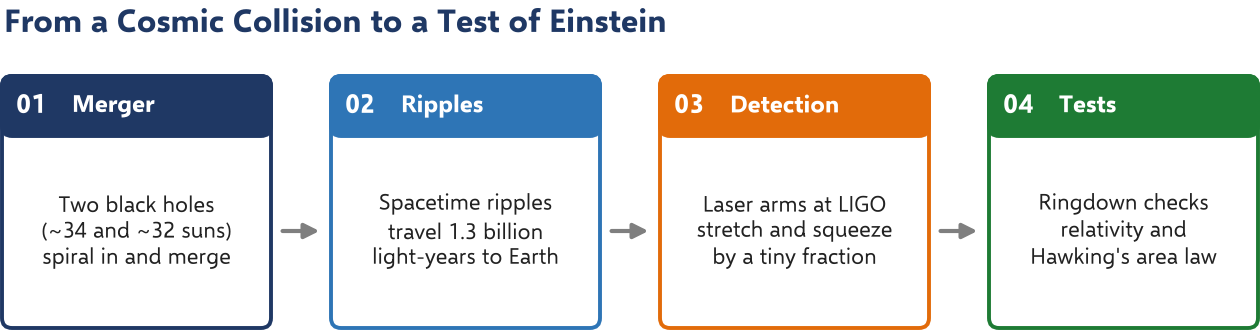
- First detection: LIGO caught the first signal, GW150914, on 14 September 2015, from two black holes about 1.3 billion light-years away.
- Nobel Prize: the discovery earned Rainer Weiss, Barry Barish and Kip Thorne the 2017 Nobel Prize in Physics.
- How detectors work: each LIGO detector has two 4-km laser arms at right angles; a passing wave stretches one arm and squeezes the other by a tiny fraction of a proton's width, shifting the laser interference pattern.
Why GW250114 Matters
| Feature | Details |
|---|---|
| Event | Detected on 14 January 2025 by the twin LIGO detectors; two black holes of about 34 and 32 solar masses merged 1.3 billion light-years away |
| Clarity | Signal-to-noise ratio of about 80, against 26 for GW150914 |
| Hawking's area theorem (1971) | The total event-horizon area of black holes can never shrink. Horizon area grew from about 2.4 lakh km² to about 4 lakh km², confirming the theorem with about 99.999% confidence (95% in the 2021 test) |
| General Relativity | No deviation found from Einstein's predictions even in this extreme gravity; the 'ringdown' tones match a Kerr (spinning) black hole |
The 'Statistical Era'
By 2025, upgraded detectors were recording mergers every few days. With hundreds of events in hand, scientists can now ask population-level questions: how black holes form, why some are unusually heavy, and how fast the Universe is expanding (the Hubble constant) — measured independently of light-based telescopes.
LIGO-India
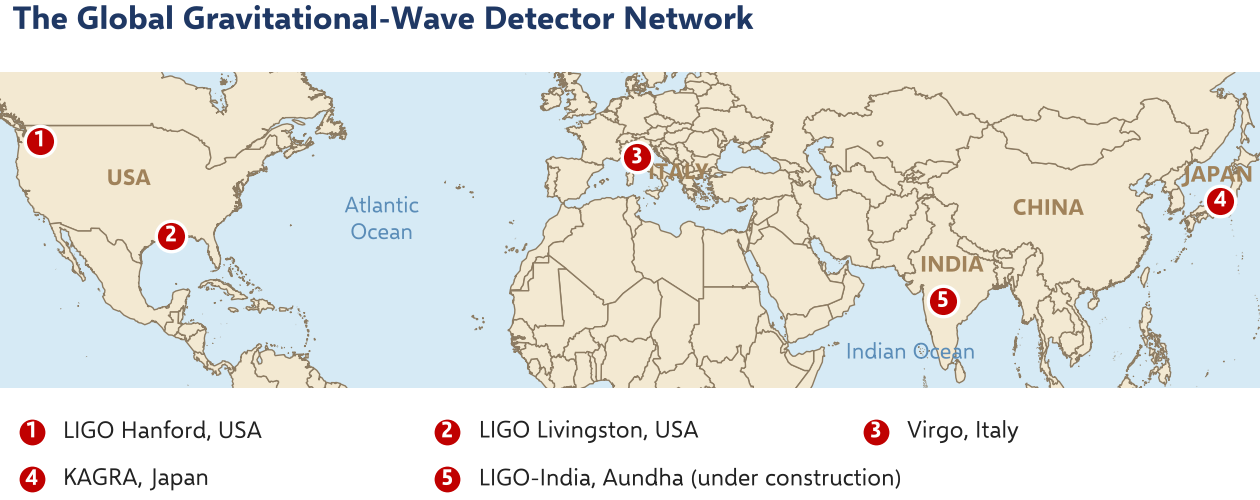
- Location: Aundha, Hingoli district, Maharashtra — chosen for very low seismic noise.
- Approval and cost: cleared by the Union Cabinet in April 2023 at about ₹2,600 crore.
- Agencies: built by the Department of Atomic Energy (DAE) and the Department of Science and Technology (DST) under an MoU with the US National Science Foundation.
- Progress: ground was broken on 23 April 2026; first observations are targeted for 2030.
- Value: a detector far from the US and Europe will sharply improve how precisely the network can locate sources in the sky, helping telescopes catch the light from the same events.
📖 Read More: Gravitation and Planetary Motion • Big Bang Theory • Understanding Galaxies and Dark Matter • Waves and Electromagnetic Radiation
3. Rethinking Stamp Duty: A Smarter Tax on Property Deals
(ECONOMICS) (TH) With Tamil Nadu's new Revenue Augmentation Committee — chaired by economist Montek Singh Ahluwalia — reviewing the State's revenues, a fresh analysis argues that stamp duty and registration fees (SDR) on property transfers need a reset.
Tamil Nadu set up the six-member committee in July 2026 after its tax-revenue-to-GSDP ratio fell to 5.45% in 2025-26, a two-decade low. Its remit covers GST, SDR, State excise, motor-vehicle tax, mining and non-tax revenue.
Understanding SDR
- Stamp duty is a tax on instruments (sale deeds, mortgages, leases), not on the transaction itself; registration fees pay for recording the document with a Sub-Registrar.
- Valuation base: the higher of the declared sale value and the State-notified guideline value (called circle rate, or 'ready reckoner rate' in Maharashtra).
- Outside GST: SDR stays with the States, unlike the VAT and entry taxes that were folded into GST.
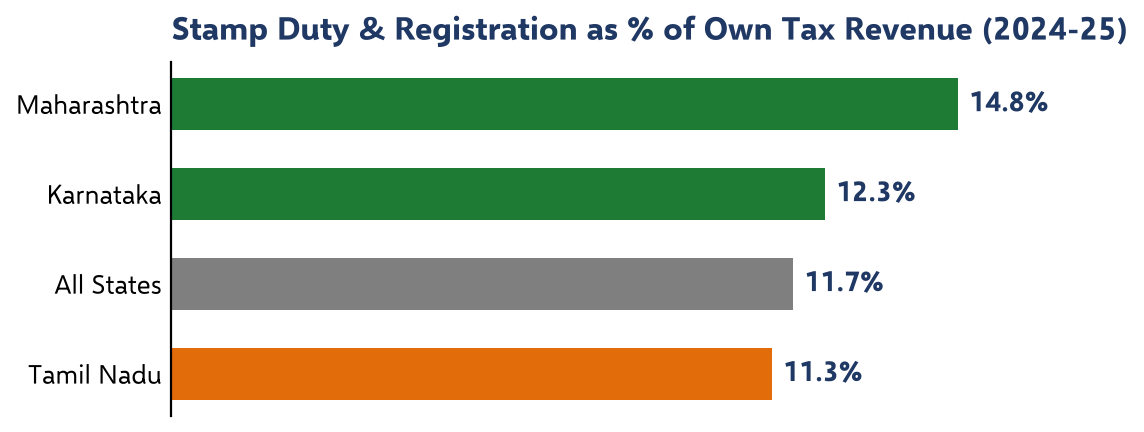
- Revenue weight: SDR made up 11.7% of States' own tax revenue in 2024-25.
Constitutional and Legal Basis
| Provision | What it covers |
|---|---|
| Entry 63, State List | Rates of stamp duty on all documents except those in Entry 91 of the Union List |
| Entry 91, Union List | Rates on bills of exchange, cheques, promissory notes, insurance policies, share transfers, debentures and similar instruments |
| Article 268 | Stamp duties in the Union List are levied by the Union but collected and kept by the States |
| Entry 44, Concurrent List | Stamp duties other than judicial stamps (but not rates) — basis of the Indian Stamp Act, 1899 |
| Entry 6, Concurrent List | Transfer of property and registration of deeds — basis of the Registration Act, 1908 |
See Schedules of the Indian Constitution and Indirect Taxes in India.
Where the System Breaks
| Problem | Suggested reform |
|---|---|
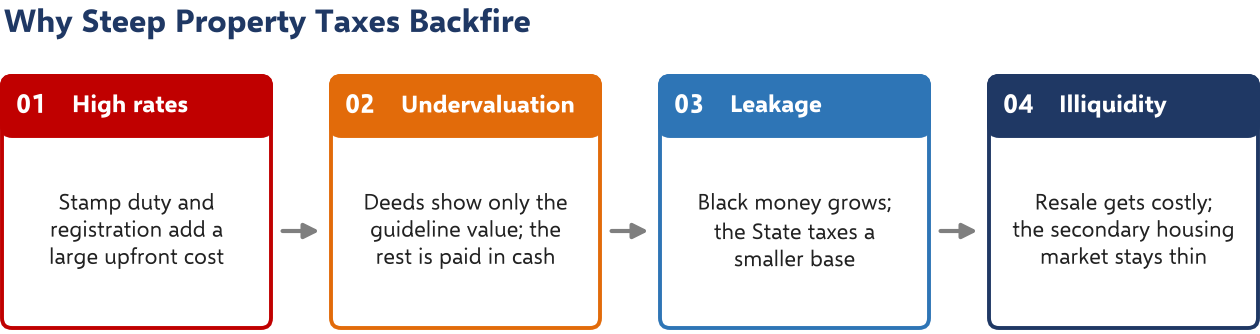
| High rates encourage under-declaration (a Laffer-curve effect) | Rationalise rates so that declaring the true value pays; widen the base |
| Outdated guideline values lag far behind market prices | An autonomous valuation body to revise values every year using recent sale prices, rents and nearby infrastructure |
| Uncapped registration fees charged as a % of value, far above the cost of the service | Cap the fee at a flat amount tied to service cost (Maharashtra caps it at ₹30,000) |
| Costly resale keeps the second-hand housing market thin | Graduated concessions — lower rates for higher declared values — to reward honesty and improve liquidity |
Why it matters: States have limited taxes of their own after GST. A cleaner SDR regime would raise revenue, curb black money and tax evasion in real estate, and make housing transactions more transparent.
📖 Read More: Indirect Taxes in India • Goods and Services Tax (GST) • Recent Developments in Taxation • 16th Finance Commission
4. Head-Worn AI Fitness Tracker Sparks a Validation Debate
(SCIENCE AND TECHNOLOGY) (IE) Zomato founder Deepinder Goyal has launched Temple, an AI-enabled wearable stuck to the side of the head that claims to track blood flow and give insights on many body systems. Doctors have questioned whether its readings are scientifically validated.
The Device and the Claims
- Worn near the temple with adhesive patches; priced at about ₹85,000.
- Claims to read signals linked to blood flow to the brain and score systems such as thermal, immune, digestive, cognitive, emotional and recovery.
- Goyal says it is strictly a fitness + AI device, makes no medical claim, and does not diagnose or prevent any disease.
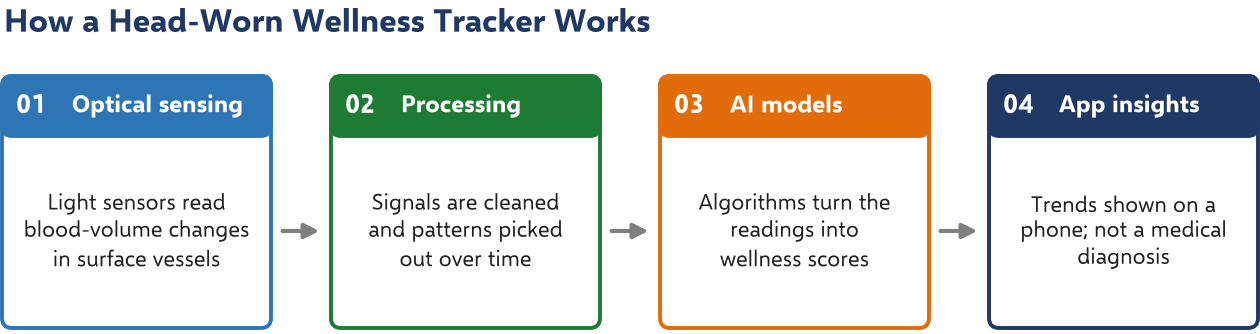
The underlying idea resembles photoplethysmography (PPG) — the optical method smartwatches use to sense pulse from blood-volume changes under the skin.
Why Doctors Are Sceptical
| Concern | Explanation |
|---|---|
| Indirect measurement | A sensor on the temple reads superficial vessels; it cannot look inside the skull at blood flow in the brain itself |
| Limited validation | Early comparisons with Transcranial Doppler are not enough to make it a clinical tool |
| Noisy readings | Movement, activity, sensor placement and individual physiology all shift the signal |
| Brain health is complex | It depends on neuronal activity, electrical signalling and cognition — not blood flow alone |
| Disease prediction | One blood-flow signal cannot reliably predict Alzheimer's, stroke or cognitive decline |
The Bigger Policy Questions
- Wellness vs medical device: products that claim to diagnose or treat must be licensed under the Medical Devices Rules, 2017 (Drugs and Cosmetics Act, 1940), regulated by the CDSCO; pure fitness gadgets fall outside this net — a grey zone that marketing can exploit.
- Health data: continuous body data is sensitive personal data; its handling falls under the Digital Personal Data Protection Act, 2023 — see Data Localisation and Privacy Issues.
- AI accountability: opaque algorithms turning raw signals into health scores need independent testing — a live theme in governance of AI.
- Way forward: larger, independent studies across diverse users, clear labelling of 'not for medical use', and trust-building through peer-reviewed evidence.
📖 Read More: Artificial Intelligence (AI) • Governance and AI • Biotechnology in Healthcare • Data Localisation and Privacy Issues