
UPSC CURRENT AFFAIRS — 14 NOVEMBER 2026
1. One Nation One Ration Card: Food Security Without Borders
(POLITY AND GOVERNANCE) (PIB) The Ministry of Consumer Affairs, Food and Public Distribution has showcased the progress of One Nation One Ration Card (ONORC), which now runs in all 36 States/UTs and lets a ration-card holder draw subsidised grain from almost any Fair Price Shop in the country.
What ONORC Does
Launched in 2019 by the Department of Food and Public Distribution, ONORC makes ration entitlements portable for beneficiaries of the National Food Security Act (NFSA), 2013. Grain still moves through the Targeted Public Distribution System (TPDS) and its Fair Price Shops (FPS); what changes is that the card is no longer tied to one shop.
- Inter- and intra-State portability: a family can buy its quota at any e-PoS-enabled FPS without applying for a new card.
- Split entitlement: a migrant worker can draw part of the quota at the place of work while the family draws the rest back home.
- Technology base: digitised ration-card databases, Aadhaar-based biometric authentication and electronic Point of Sale (e-PoS) devices.
Beneficiary at any FPS ➜ Aadhaar biometric check on e-PoS ➜ Central database verifies quota ➜ Grain issued
The Scorecard
| Indicator | Status (2026) |
|---|---|
| Coverage | All 36 States/UTs; 100% of PMGKAY beneficiaries |
| Portability | About 3.27 crore transactions a month; over 233 crore since inception, moving over 614 LMT of grain |
| Digitisation | 100% of ration-card and beneficiary data (about 78.65 crore beneficiaries) as of October 2026 |
| Aadhaar seeding | 98.8% of 20.51 crore ration cards (20.27 crore); 76.97 crore beneficiaries seeded |
| e-KYC | 71.52 crore beneficiaries (91%) as of 30 September 2026 |
| e-PoS at FPS | 99.8% — 5.50 lakh of 5.51 lakh shops; supply chain computerised in 31 States/UTs |
All figures above are from the Department's official factsheet.
Cleaning and Upgrading the Pipes
- Rightful Targeting: Aadhaar and PDS data analytics flagged about 5.95 crore suspicious records; Version 1 of the exercise deleted 2.58 crore duplicate or ineligible entries.
- SARTHAK-PDS: an umbrella scheme (Scheme for Assistance in Ration Transport and Handling-Income with Automation in PDS) running till 31 March 2031. It funds intra-State grain movement, handling and FPS dealer margins. The Cabinet approved it in May 2026 with a central outlay of ₹25,530 crore for the 16th Finance Commission period.
- Its tech components: NIRMAL strengthens data architecture and analytics; SAKSHAM adds real-time integration through Vehicle Location Tracking Systems; SMART-PDS digitally links ration cards, distribution, supply chains and grievance redressal.
- Mera Ration app: available in 13 languages; shows entitlements and past transactions, Aadhaar-seeding status and portability eligibility, and locates nearby FPS using GPS.
Why It Matters
- For migrants: food security travels with the worker, removing a major cost of moving for work.
- For governance: biometric authentication and de-duplication cut ghost cards and leakages — a showcase of Digital India in welfare delivery.
- For federalism: a Union scheme works only because every State/UT agreed to common data standards.
- Watch-outs: biometric mismatches for manual workers and the elderly, weak connectivity in remote areas, and risk of exclusion if a genuine card is wrongly deleted.
📖 Read More: PDS and NFSA • Internal Migration in India • Food Corporation of India • Digital India Programme
2. Cleaner Air Need Not Cost India Its Growth
(ENVIRONMENT) (TH) A fresh analysis argues that cleaning India's air will not slow its economy; it is the dirty air that is already eating into output, health and even the yield of the country's solar plants.
India's Air in Numbers
| Indicator | Latest finding |
|---|---|
| Environmental Performance Index 2026 | India 176th of 177 countries (score 22.46), ahead only of Laos |
| IQAir World Air Quality Report 2025 | India 6th most polluted country; population-weighted PM2.5 fell about 3%, from 50.6 to 48.9 µg/m³. Delhi (82.2 µg/m³) was the most polluted capital; Loni (UP, 112.5 µg/m³) the most polluted city |
| State of Global Air 2025 | About 20 lakh (2 million) deaths in India in 2023 linked to air pollution — a 43% rise since 2000 |
| CREA snapshot, October 2026 | 261 of 267 cities exceeded WHO's daily PM2.5 guideline of 15 µg/m³; 38 breached India's daily standard of 60 µg/m³ |
| NCAP progress, FY 2025-26 | 108 of 130 cities recorded lower PM10 than in 2017-18; 26 cut it by more than 40% |
Dirty Air Hurts Clean Energy
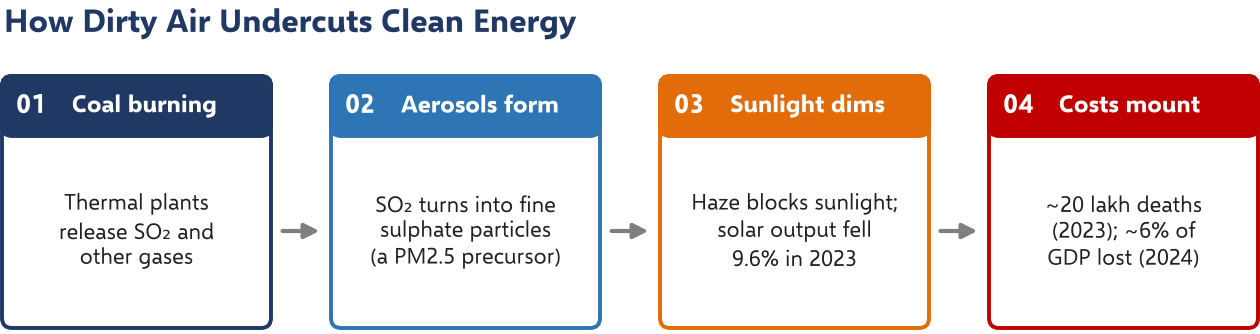
A study in the journal Nature Sustainability (May 2026) found that aerosol pollution cut India's solar generation by 9.6% in 2023 (about 15 TWh), against a global average loss of 5.8%. India's losses showed no improvement over 2013–2023.
Sulphur dioxide (SO₂) from coal plants is a key culprit, since it turns into fine sulphate particles. Yet in July 2025 the Centre relaxed the flue-gas desulphurisation (FGD) mandate, limiting it largely to plants near big cities and critically polluted areas, to contain power costs and water use.
The Economic Case
- Cost of inaction: a Dalberg–Clean Air Fund estimate puts India's 2024 loss at about USD 260 billion — around 6% of GDP, through lost productivity, absenteeism, lower consumer footfall and premature deaths.
- Gains from action: cutting PM2.5 by about 20% could avert USD 85 billion in business losses by 2030.
- China's lesson: strict coal-plant retrofits with FGD let China reduce its pollution-related solar losses by about 1.4% a year between 2013 and 2023 — even while its coal fleet grew.
- Legal anchor: the Supreme Court reads the right to pollution-free air into Article 21 (Right to Life).
Way Forward
- Airshed governance: pollution in the Indo-Gangetic Plain crosses State borders, so plans must cover the whole airshed, not single cities.
- Power sector: restore time-bound FGD retrofits and push efficiency under the Perform, Achieve and Trade (PAT) scheme.
- Households: income-linked support for LPG refills under PM Ujjwala Yojana to cut solid-fuel smoke.
- Waste and farms: Swachh Bharat Mission – Urban 2.0, GOBARdhan and biomethanation to stop open burning of waste and residue.
- Money for results: outcome-linked grants, as suggested for the 16th Finance Commission period, and Heat and Health Action Plans aligned with NDMA guidelines.
📖 Read More: Air Pollution • Effects of Air Pollution • Prevention and Control of Air Pollution • Global Climate and Environmental Performance Indices • Coal Sector in India
3. First BIMSTEC Health Ministers' Meeting in Colombo
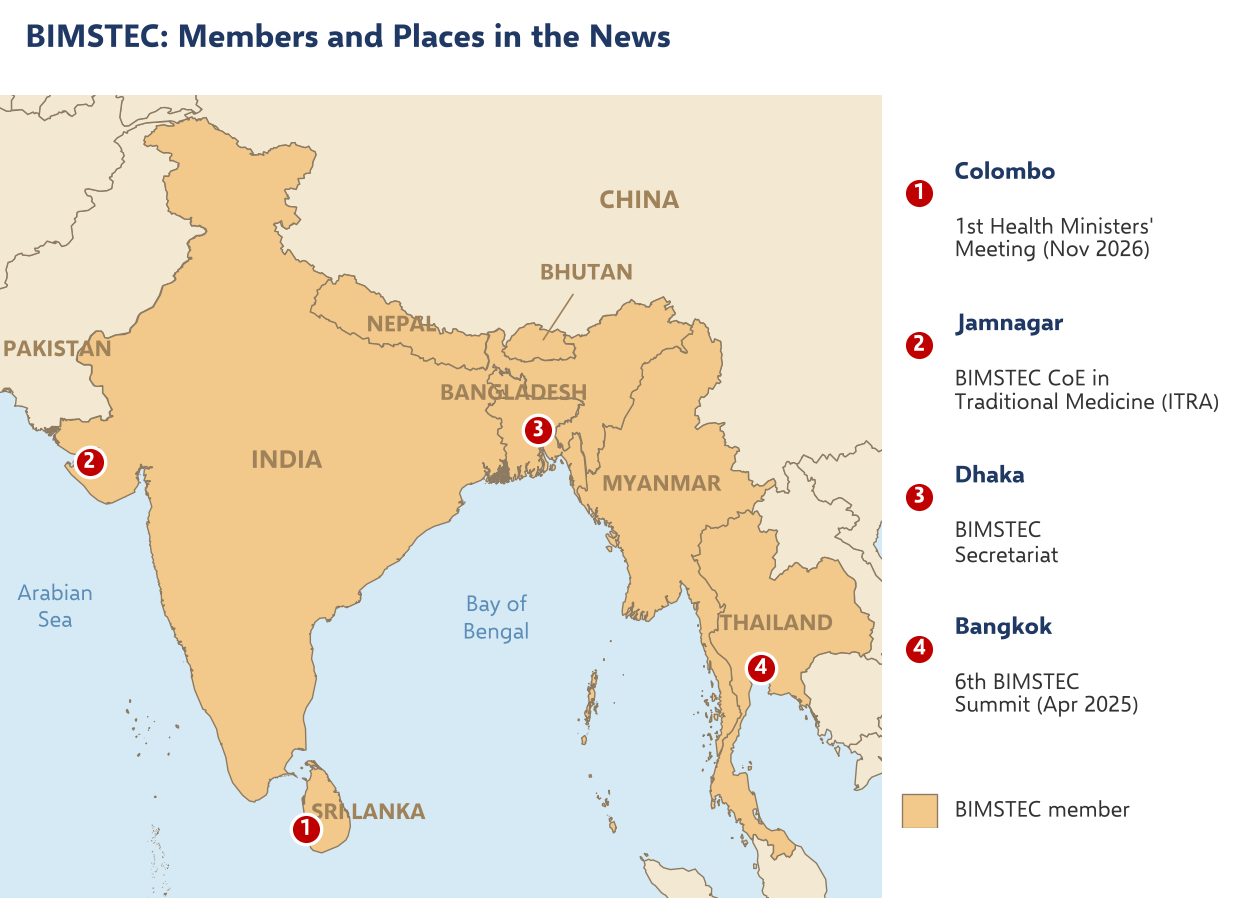
(INTERNATIONAL RELATIONS) (DD) Health ministers of all seven BIMSTEC members met for the first time in Colombo, Sri Lanka, on 11 November 2026, giving the Bay of Bengal grouping a dedicated ministerial track on health.
The meeting followed a decision of the 6th BIMSTEC Summit (Bangkok, April 2025). A Senior Officials' Meeting on Health on 10 November finalised the agenda. Union Health Minister J.P. Nadda led the Indian delegation.
Outcomes at a Glance
| Area | Decision |
|---|---|
| Documents adopted | Joint Ministerial Statement and the Revised BIMSTEC Plan of Action on Public Health (2026–2030) |
| Priority themes | Disease surveillance, pandemic preparedness, antimicrobial resistance, digital health, traditional medicine, One Health, health workforce |
| Shared goals | Universal Health Coverage and SDG 3 (good health and well-being) |
| Proposed framework | BIMSTEC Digital Health Framework — telemedicine, interoperable health records, AI in diagnostics |
| Regional institutions | Centre of Excellence for Public Health (Sri Lanka); Centre of Excellence on Tropical Medicine (Thailand); Regional Zoonotic Disease Observatory and Early Warning System (proposed by Bangladesh) |
| Frequency | Ministerial and senior officials' meetings every two years; Thailand to host the second in 2028 |
India's Offer
- Share its experience in primary care, digital health and public-health infrastructure: Ayushman Arogya Mandirs, PM-JAY (cover up to ₹5 lakh per family per year), eSanjeevani teleconsultation and the Ayushman Bharat Digital Mission.
- Host the BIMSTEC Centre of Excellence in Traditional Medicine at the Institute of Teaching and Research in Ayurveda (ITRA), Jamnagar, Gujarat.
India–Sri Lanka Side Deals
- An MoU to supply 100 ambulances to Sri Lanka's 1990 Suwa Seriya free emergency service through an Indian grant of about USD 5.28 million, fulfilling a commitment made during PM Modi's April 2025 visit. India had helped launch the service in 2016.
- Support for 50 medical kiosks (Health ATMs).
- These sit alongside India's USD 450 million reconstruction package for Sri Lanka after Cyclone Ditwah (2025).
Why Health Cooperation Fits BIMSTEC
The region shares rivers, coasts and disease vectors — dengue, malaria and new zoonoses do not stop at borders. With a common traditional-medicine heritage and India's low-cost digital tools, health is a natural area where the grouping can deliver quick, visible results under India's Neighbourhood First and Act East policies.
📖 Read More: BIMSTEC • India and Sri Lanka • Ayushman Bharat PM-JAY • Ayushman Bharat Digital Mission • National AYUSH Mission
4. India–Sri Lanka Innovation Forum Launched
(INTERNATIONAL RELATIONS) (DD) An India–Sri Lanka Innovation Forum was launched in Colombo on 12 November 2026 to turn growing goodwill between the two neighbours into startups, investment and market access.
About the Forum
| Feature | Details |
|---|---|
| Nature | An informal, business-led platform |
| Members | Business leaders, startup founders, incubators and investors from both countries |
| Focus | Startup collaboration; mentorship and knowledge-sharing; investment facilitation; market access |
| Aim | Move ideas from mentorship into commercial projects and investment |
The Wider Tech Bridge
Days earlier, Nalanda College, Colombo, opened what is described as Sri Lanka's first Tinkering Lab, with technical expertise and training from India's Atal Innovation Mission (NITI Aayog), facilitated by the Indian High Commission. The two steps together extend India's Startup India and tinkering-lab model across the Palk Strait.
Significance: the forum complements India's Neighbourhood First Policy by adding a people-and-business layer to a relationship long dominated by government-to-government aid, credit lines and security ties.
📖 Read More: India and Sri Lanka • India and Neighbourhood Policy • Atal Innovation Mission 2.0 • Startup India Scheme
5. Khet Bachao Abhiyan: A Campaign to Save Farm Soil
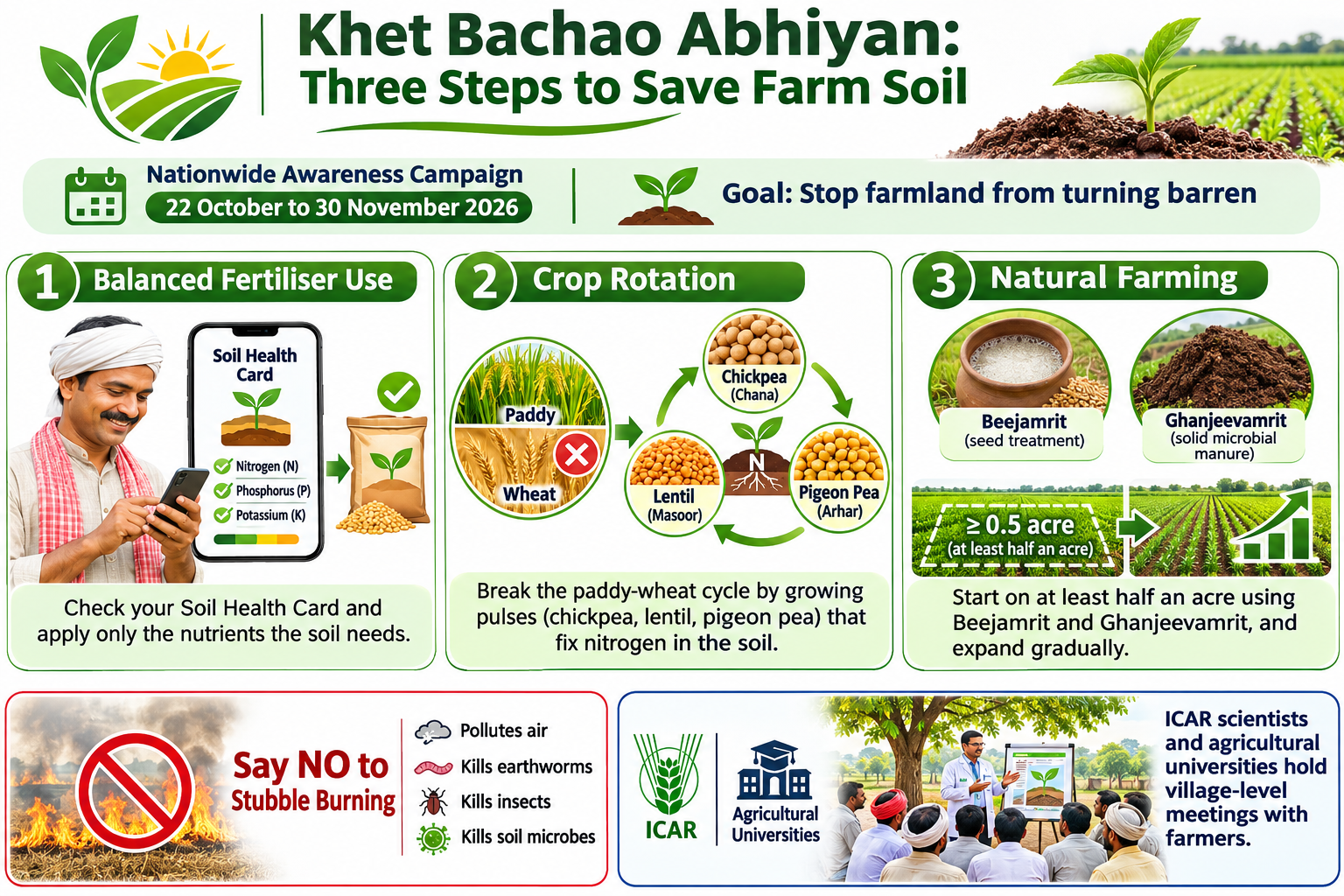
(ECONOMICS) (DD) Union Agriculture Minister Shivraj Singh Chouhan has launched the nationwide Khet Bachao Abhiyan from Taraori, Karnal district (Haryana) — an awareness drive running from 22 October to 30 November 2026 to stop farmland from turning barren.
Aim of the Campaign
The drive promotes soil conservation, balanced fertiliser use and sustainable farming to halt land degradation. Agricultural scientists, university vice-chancellors and ICAR officials have been asked to hold village-level meetings and talk to farmers directly.
Three Measures for Farmers
| Measure | What farmers are asked to do | Why it helps |
|---|---|---|
| Balanced fertiliser use | Check the Soil Health Card on a mobile phone and apply only the nutrients the soil needs | Stops over-use of urea and DAP that acidifies soil and wastes subsidy |
| Crop rotation | Break the paddy–wheat cycle with pulses such as chickpea, lentil and pigeon pea | Legumes fix atmospheric nitrogen and restore soil fertility |
| Natural farming | Start on at least half an acre using Beejamrit and Ghanjeevamrit, then expand | Rebuilds soil organic matter and microbial life — see Natural Farming |
Stubble Burning and the Subsidy Burden
- The Minister called crop-residue burning a self-destructive practice: it fouls the air and kills earthworms, insects and soil microbes.
- The Centre's fertiliser subsidies exceed ₹1.5 lakh crore; a bag of urea costs farmers ₹266 and DAP ₹1,350. Over-use therefore hurts both soil and public finances.
- The Minister also pitched green ammonia as a route to self-reliance in fertiliser production.
📖 Read More: Soil Conservation • Causes of Soil Degradation • Natural Farming • Pulses • Fertilisers
6. Global Carbon Budget 2026: A Dip, Not a Peak
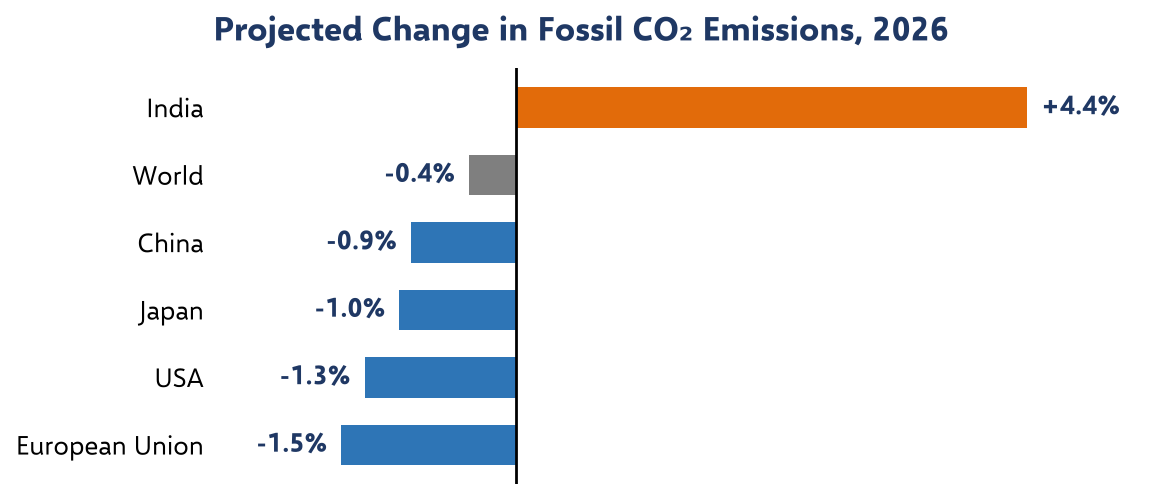
(ENVIRONMENT) (IE) The Global Carbon Budget 2026, released at COP31 in Antalya, Türkiye, projects the first fall in fossil CO₂ emissions since 2020 — but India is the only major emitter whose emissions are still rising.
What Is the Global Carbon Budget?
It is an annual stock-take by the Global Carbon Project (GCP), set up in 2001. It tracks CO₂ from fossil fuels and land-use change, how much of it the oceans, land and atmosphere absorb, and the remaining carbon budget — the CO₂ the world can still emit before warming crosses a given limit such as 1.5°C.
Key Global Findings
| Indicator | 2026 projection |
|---|---|
| Fossil CO₂ (fossil fuels + cement) | 38.2 billion tonnes, down 0.4% from 38.4 Bt in 2025 — first fall since 2020 (−2% in the COVID year) |
| Total CO₂ (with land use) | A record 43.3 billion tonnes, up from 42.8 Bt, as land-use emissions jump to 5.1 Bt (peat fires in Southeast Asia) |
| Oil emissions | Down 1.9% after oil prices spiked with the Strait of Hormuz closure |
| Atmospheric CO₂ | About 427.7 ppm, ~54% above pre-industrial levels |
| Natural sinks (2016–25) | Oceans took up about 27% and land about 22% of emissions; the rest stayed in the air |
| Remaining 1.5°C budget | 150 billion tonnes from 2027 — less than four years of current emissions |
Where India Stands
- Fossil emissions projected to rise 4.4% in 2026, above India's 3.5% average annual growth of the past decade, led by higher coal use.
- Share of global fossil CO₂: China 32%, USA 13%, India 8%, EU 6%.
- Per-capita emissions (2025): India 2.2 tonnes against 14.5 tonnes in the USA — the core of India's equity argument under the UNFCCC.
Why the Dip Is Not Good News Yet
The decline is driven largely by a geopolitical oil shock, not structural change. Past one-year dips (1981, 1992, 2009, 2020) were all followed by a rebound. Solar, wind and EVs are now offsetting much of the demand growth, but not fast enough to lock in a peak.
Meanwhile, total greenhouse gas emissions keep rising: the WMO's State of the Climate report says they hit a new high in 2025. Human-caused warming had already reached about 1.37°C in 2025.
📖 Read More: Greenhouse Gases • Carbon Footprint • IPCC • Paris Climate Conference (COP21) • Climate Mitigation Measures
7. CCPI 2027: India Slips to 28th
(ENVIRONMENT) (DTE) India has fallen five places to 28th in the Climate Change Performance Index (CCPI) 2027, released at COP31 in Antalya — its second straight slide after ranking 10th in CCPI 2025.
About the Index
| Feature | Details |
|---|---|
| Publishers | Germanwatch and the NewClimate Institute, with Climate Action Network (CAN) International |
| First edition | 2005; published annually |
| Coverage | 64 countries + the EU, together responsible for over 90% of global greenhouse-gas emissions |
| Categories and weights | GHG emissions 40%; renewable energy 20%; energy use 20%; climate policy 20% |
Key Findings of CCPI 2027
- Top three ranks left vacant: no country did well enough in all categories to earn an overall 'very high' rating.
- Denmark is the best performer (4th, 84.05 points), followed by Lithuania and Luxembourg.
- India: 28th with 60.85 points; overall rating still 'medium', with a 'high' rating for its renewable-energy trend.
- G20: the UK is the only member rated 'high'; 10 G20 members are 'very low'. Saudi Arabia (65th), Russia (66th) and the USA (67th) are near the bottom.
- EU: 19th, up one place; nine member states rated 'high'.
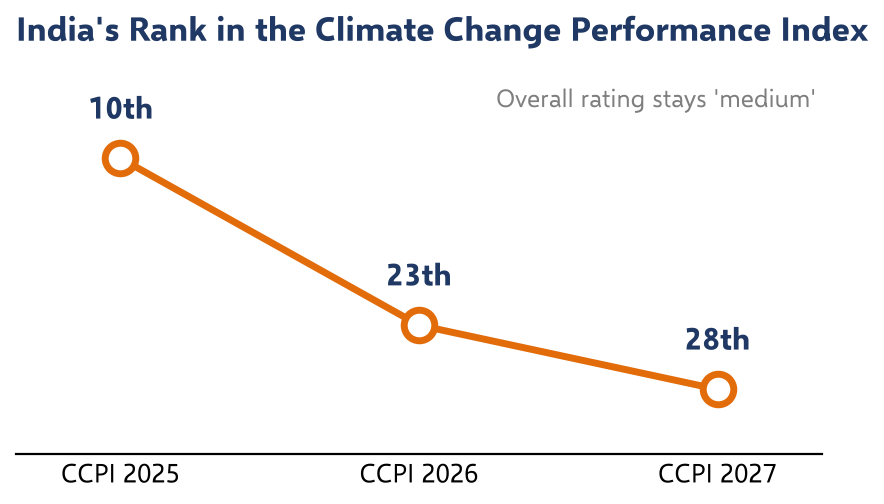
Takeaway: India's strong renewable build-out keeps it in the 'medium' band, but rising coal-based emissions — the same trend seen in the Global Carbon Budget — pull its rank down.
📖 Read More: Global Climate and Environmental Performance Indices • UNFCCC • COP30 Belém (2025)
8. Videocon Case Tests India's Personal Bankruptcy Law
(ECONOMICS) (IE) On 5 November 2026, the National Company Law Tribunal (NCLT) declared former Videocon promoter Venugopal Dhoot bankrupt as personal guarantor for State Bank of India loans worth ₹12,668 crore — a rare case that has reached the final stage of the Insolvency and Bankruptcy Code (IBC), 2016.
Insolvency vs Bankruptcy
Insolvency is the inability to repay debts when they fall due. Bankruptcy is the formal legal process by which an insolvent individual is declared bankrupt and his assets are shared out among creditors.
The Legal Framework
- Part III of the IBC governs insolvency resolution and bankruptcy of individuals and partnership firms.
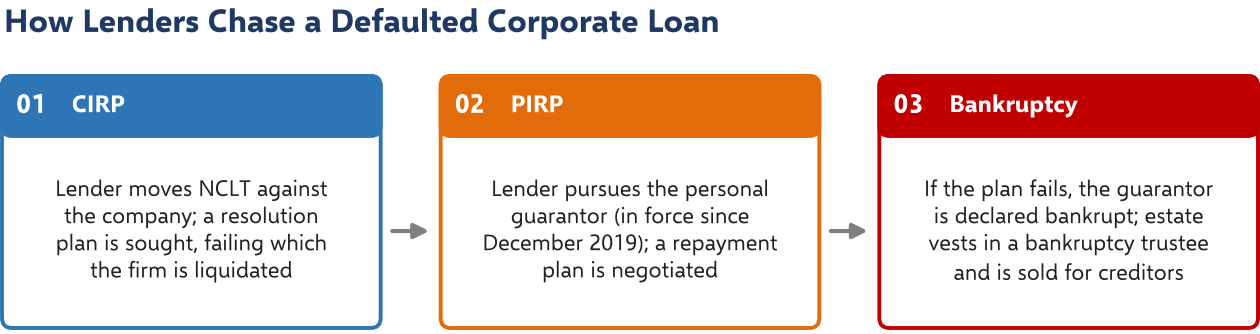
- Personal Insolvency Resolution Process (PIRP): in force for personal guarantors to corporate debtors since December 2019.
- Forum: the NCLT hears cases of personal guarantors to companies; Debt Recovery Tribunals (DRTs) hear those of other individuals and firms.
- Parallel action: a lender may run the company process (CIRP) and PIRP at the same time, but total recovery cannot exceed the debt.
- Lalit Kumar Jain v. Union of India (2021): the Supreme Court held that approval of a company's resolution plan does not discharge the personal guarantor's liability.
- Section 121: if the repayment plan is rejected or fails, the debtor or a creditor can apply for bankruptcy.
What Bankruptcy Means for Dhoot
- His estate vests in a bankruptcy trustee appointed by the NCLT; he must disclose all assets, income and net worth, which will be sold for creditors.
- Certain assets are excluded — for instance, a single dwelling unit up to a prescribed value (₹20 lakh in urban areas).
- A bankrupt cannot act as a company director or take part in promoting, forming or managing a company.
How the Case Unfolded
| Year | Event |
|---|---|
| 2010–12 | SBI and associate banks lend to Videocon Industries and Videocon Telecommunications; Dhoot gives unconditional guarantees |
| 2018 | Demand notices (February); CIRP admitted (June); 12 more group firms added; claims of ₹72,078 crore filed |
| 2021–22 | NCLT approves Twin Star's ₹2,962 crore plan (June 2021); NCLAT sets it aside in January 2022 for a haircut of over 95% — appeal pending in the Supreme Court |
| 2026 | PIRP against Dhoot begins in April; his ₹600 crore offer is rejected; PIRP ends in July; bankruptcy declared on 5 November |
Recovery Remains Thin
Data of the Insolvency and Bankruptcy Board of India (IBBI) show the personal-guarantor route rarely pays: of 5,186 PIRP applications since 2019, only 64 produced approved repayment plans, and creditors realised about 1% of admitted claims. Only 310 bankruptcy applications have been filed.
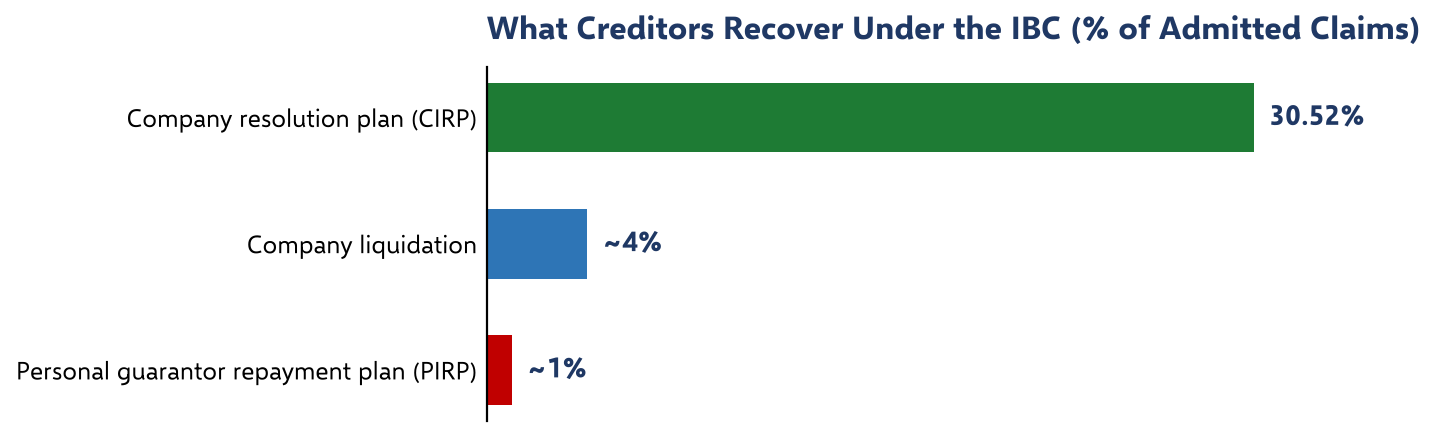
By contrast, of 9,166 CIRP cases admitted since 2016, resolution plans were approved in 1,484 and liquidation ordered in 3,074. Proving an individual's true net worth is the main hurdle, unlike companies that have hard assets — a key lesson for the fight against bad loans.
📖 Read More: NPA Crisis in India • Banking Sector Reforms in India • Corporate Governance
9. LHCb Spots a One-in-Ten-Billion Particle Decay
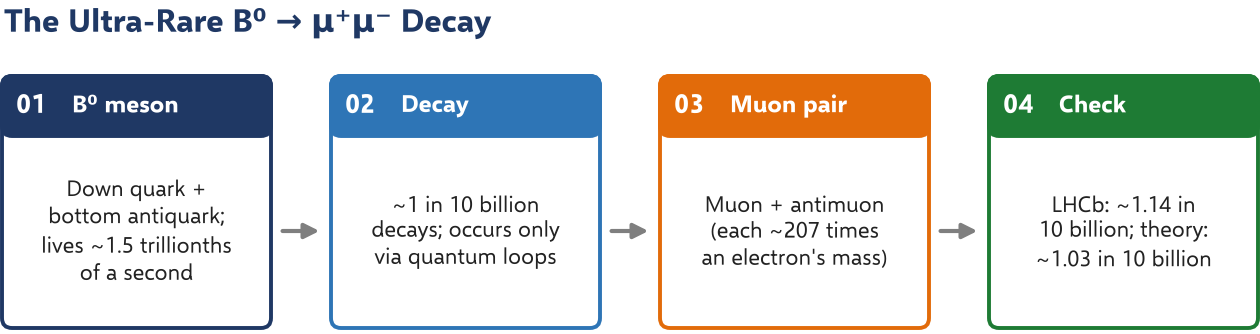
(SCIENCE AND TECHNOLOGY) (TH) The LHCb experiment at CERN has reported the first single-experiment evidence that a neutral beauty meson (B⁰, also called Bd) can decay into a muon–antimuon pair — a process expected only about once in 10 billion decays.
Decoding the Particles
- Meson: a subatomic particle made of one quark and one antiquark held by the strong force; all mesons are unstable.
- B⁰ meson: a down quark + a beauty (bottom) antiquark; it survives only about 1.5 trillionths of a second.
- Muon: an elementary particle like the electron but about 207 times heavier.
Why It Matters
- Test of the Standard Model: the measured rate (about 1.14 in 10 billion) is close to the theory's prediction. The Standard Model explains fundamental particles and three forces — electromagnetic, weak and strong — but not gravity.
- Narrowing new physics: because the decay happens only through quantum loops, any unknown heavy particle could alter its rate. The close match limits the masses and strengths such particles can have.
- Evidence, not discovery: the combined signal stands at about 3.2 sigma; physicists need 5 sigma to claim a discovery. If confirmed, it would be the rarest beauty-particle decay ever observed.
- Long chase: a joint LHCb–CMS analysis in 2015 had observed the sister decay of the Bs meson; data from the upgraded LHCb (2024–25) made the rarer B⁰ signal visible, helped by machine-learning background suppression.
About CERN and the LHC
| Feature | Details |
|---|---|
| CERN | European Organisation for Nuclear Research, founded 1954, near Geneva; India became an Associate Member in 2017 |
| Large Hadron Collider | World's largest particle accelerator — a 27-km ring on the France–Switzerland border |
| LHCb | One of the LHC's four big experiments; studies 'beauty' (bottom) quarks and matter–antimatter asymmetry |
| Next step | The LHC is in a long shutdown to prepare the High-Luminosity LHC, due around 2030, which will multiply data rates |
📖 Read More: Particle Physics
10. Public Service Broadcasting Day: Gandhi's Only Studio Visit
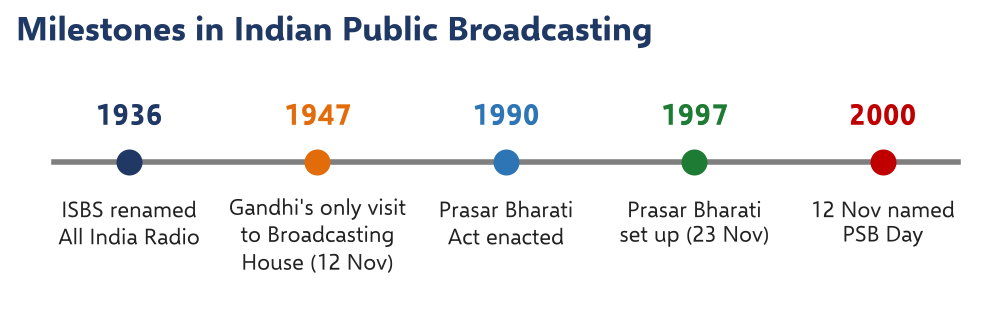
(HISTORY) (AIR) India observed Public Service Broadcasting Day on 12 November, marking Mahatma Gandhi's first and only visit to the Broadcasting House of All India Radio in New Delhi in 1947.
Why 12 November?
On 12 November 1947, Gandhi spoke through a special broadcast to people uprooted by Partition who were living in refugee camps at Kurukshetra. In 2000, the then Information and Broadcasting Minister Sushma Swaraj announced that the day would be observed every year as Public Service Broadcasting Day.
Akashvani marks the day with special programmes; its artists sing bhajans dear to Gandhi, and programmes on Gandhian thought run through the year.
Akashvani and Prasar Bharati
- Akashvani (All India Radio) is India's public radio broadcaster; the Indian State Broadcasting Service was renamed All India Radio in 1936.
- Prasar Bharati is the statutory public-service broadcaster under the Prasar Bharati (Broadcasting Corporation of India) Act, 1990; it came into existence on 23 November 1997.
- Both Akashvani and Doordarshan function under Prasar Bharati.
Relevance today: public broadcasting carries the public-interest mandate — reaching remote areas, minority languages and disaster alerts — that commercial media may not. See Media and Broadcasting Governance in India.
📖 Read More: Media and Broadcasting Governance in India • Partition and the Indian Independence Act, 1947 • Gandhian Ideology
11. Wangala: Meghalaya's Hundred Drums Festival
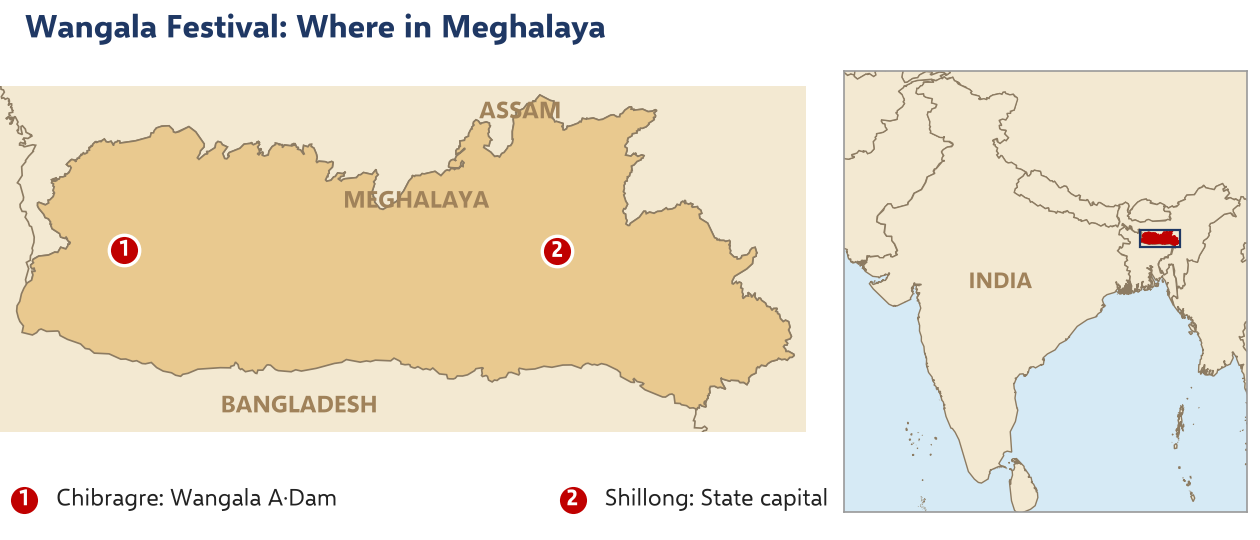
(HISTORY) (AIR) The 100 Drums Wangala Festival opened at Wangala A·Dam, Chibragre in West Garo Hills, Meghalaya, with a 1,000-drum performance as the centrepiece of its Golden Jubilee celebration.

About the Festival
| Feature | Details |
|---|---|
| Community | Garo tribe of Meghalaya |
| Type | Post-harvest thanksgiving festival |
| Deity honoured | Misi Saljong, the Sun God, linked to fertility and a good harvest |
| Signature | Rhythmic dances by men and women in traditional attire, led by the dama (Garo drum) — hence the name 'Hundred Drums' |
| 2026 highlights | 1,000-drum introductory round joined by Chief Minister Conrad K. Sangma; a 300-stall handloom and handicrafts exhibition; folk performances and a Guinness record attempt at the finale |
Know the Garos
- Live mainly in the Garo Hills of Meghalaya, with communities in Assam, Tripura and Bangladesh; they call themselves A·chik.
- A Tibeto-Burman-speaking people with a matrilineal society — clan identity and inheritance pass through the mother.
- Traditionally practise shifting (jhum) cultivation; the indigenous faith is Songsarek, though many Garos today are Christian.
📖 Read More: Festivals in India • Tribal Dances of India • Tribes of North East India • Shifting Cultivation