
BIMSTEC
| Snapshot — Key Facts & Milestones | |
| Full form | Bay of Bengal Initiative for Multi-Sectoral Technical and Economic Cooperation |
| Established | 6 June 1997, via the Bangkok Declaration (originally “BIST-EC”) (Nepal MoFA) |
| Members | Seven — Bangladesh, Bhutan, India, Myanmar, Nepal, Sri Lanka and Thailand (bimstec.org) |
| Secretariat | Dhaka, Bangladesh (established 2014) |
| Sectors | Seven priority sectors, one lead country each; India leads Security |
| Legal framework | The BIMSTEC Charter, signed 2022 and in force since 20 May 2024 |
| Latest summit | 6th Summit, Bangkok, April 2025 — adopted Bangkok Vision 2030 (bimstec.org) |
Bridging Two Regions
BIMSTEC is the natural meeting point of India’s Neighbourhood First and Act East policies. Linking five South Asian states with two from Southeast Asia around the Bay of Bengal, it has gained fresh salience as an alternative to a stalled SAARC — a way for India to pursue regionalism without Pakistan at the table.
Evolution and Membership
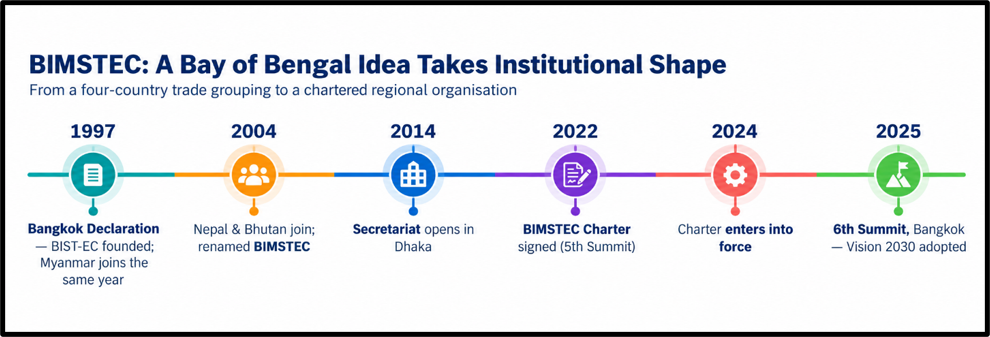
The grouping was launched on 6 June 1997 through the Bangkok Declaration as BIST-EC — Bangladesh, India, Sri Lanka and Thailand. Myanmar joined later in 1997, and with the accession of Nepal and Bhutan in 2004, the grouping was renamed BIMSTEC, reaching its present seven members.
A permanent Secretariat was established in Dhaka in 2014, and the BIMSTEC Charter — signed at the 2022 summit — entered into force on 20 May 2024, giving the organisation legal personality for the first time.
Structure — Seven Sectors and Lead Countries
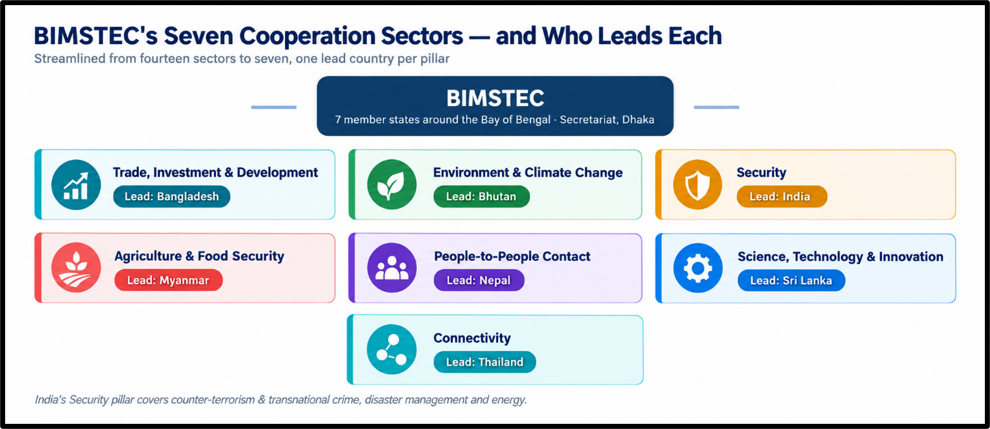
BIMSTEC’s cooperation was streamlined from fourteen overlapping sectors into seven focused pillars, each steered by a lead country. India leads the Security pillar — which covers counter-terrorism and transnational crime, disaster management and energy — reflecting its role as the region’s security anchor.
Recent Momentum
The 6th BIMSTEC Summit in Bangkok (April 2025) marked a step-change. Leaders adopted “Bangkok Vision 2030” — the grouping’s first vision document — signed an Agreement on Maritime Transport Cooperation, and approved host-country agreements for two India-based centres: the BIMSTEC Centre for Weather and Climate in Noida and the BIMSTEC Energy Centre in Bengaluru.
Security cooperation was institutionalised further when India hosted the first BIMSTEC Home Ministers’ Meeting (New Delhi, October 2026). Its Delhi Declaration recognised the Bay of Bengal as a common security space, condemned cross-border terrorism, flagged trafficking of persons into online scam centres, and called for implementing the BIMSTEC Convention on Combating International Terrorism, Transnational Organised Crime and Illicit Drug Trafficking (in force since March 2021) and the Convention on Mutual Legal Assistance in Criminal Matters (signed in 2022).
India and BIMSTEC
For India, BIMSTEC delivers on several fronts at once: it revives regional cooperation with its eastern neighbours, opens a land-and-sea bridge to Southeast Asia, and centres the Bay of Bengal in India’s security and connectivity plans (the Kaladan Multimodal project and the Trilateral Highway both feed into it). It complements both India’s Neighbourhood Policy and India and South-East Asia Policy.
Challenges
- Slow delivery: for much of its life BIMSTEC was criticised as a “talk shop”, with infrequent summits and thin implementation.
- No FTA yet: a BIMSTEC Free Trade Area has been negotiated for years without conclusion, and intra-regional trade remains low.
- Myanmar instability: political turmoil in Myanmar — a crucial land bridge — clouds connectivity and cooperation.
- China’s shadow and bilateral frictions: growing Chinese influence around the Bay of Bengal and unresolved bilateral disputes among members test cohesion.
Way Forward
- Operationalise the Charter and Vision 2030 with funded projects, a working Secretariat and regular summits.
- Conclude the FTA and deepen connectivity to raise intra-regional trade and integrate value chains.
- Prioritise security and disaster management under India’s lead, the pillars with the clearest early wins.
One Comment