
International Criminal Court (ICC)
| Snapshot — Key Facts & Milestones | |
| Founding treaty | The Rome Statute, adopted on 17 July 1998 |
| Entry into force | 1 July 2002, after the 60th ratification (UN) |
| Seat | The Hague, the Netherlands (icc-cpi.int) |
| Nature | The world’s first permanent international criminal court |
| Core crimes | Genocide, crimes against humanity, war crimes, and the crime of aggression |
| States parties | 125 states (ICC Assembly of States Parties) |
| Key non-parties | India, the United States, China and Russia are not parties |
A Court of Last Resort
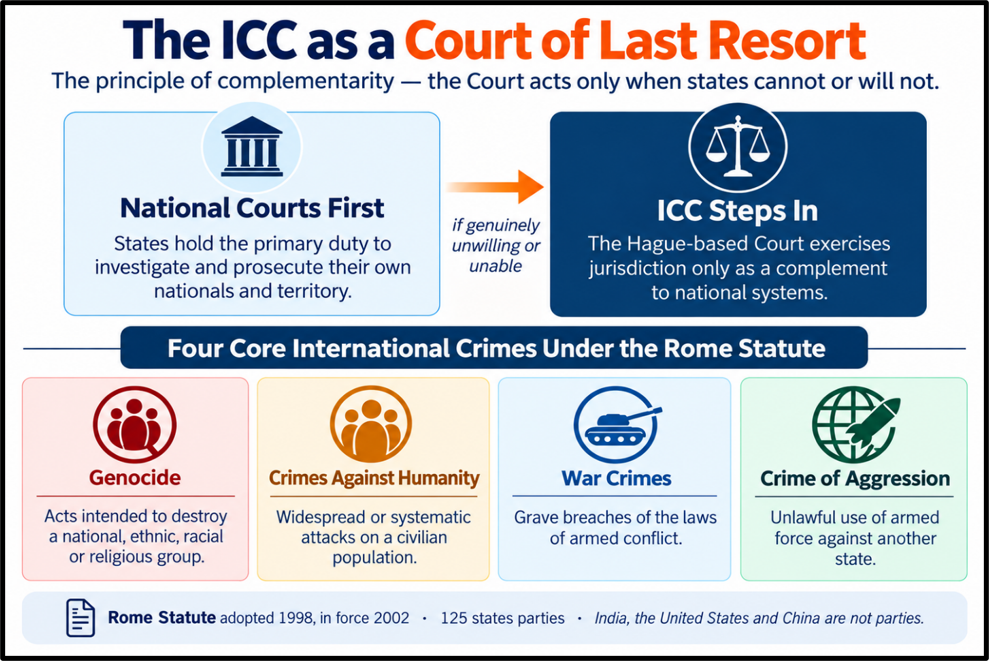
The ICC is the first permanent tribunal empowered to try individuals — not states — for the gravest international crimes. Created to end impunity where national systems fail, it is deliberately a court of last resort, not a world criminal court that overrides sovereign jurisdictions. Understanding that limit is the key to the whole topic.
The Rome Statute and Establishment
The Court was established by the Rome Statute, adopted at a diplomatic conference in Rome on 17 July 1998 by a vote of 120 in favour, 7 against and 21 abstentions. The treaty entered into force on 1 July 2002 after the 60th instrument of ratification, and the Court is seated at The Hague.
Jurisdiction and the Four Core Crimes
Under the Rome Statute the ICC has jurisdiction over four core international crimes: genocide (acts intended to destroy a national, ethnic, racial or religious group), crimes against humanity (widespread or systematic attacks on civilians), war crimes (grave breaches of the laws of armed conflict), and the crime of aggression (the unlawful use of armed force against another state). Its jurisdiction is generally prospective and tied to states parties or UN Security Council referral.
How the Court Works — Complementarity
The organising principle is complementarity: the ICC “is intended to complement, not to replace, national criminal systems” and prosecutes only when a state is genuinely unwilling or unable to act.
Situations reach the Court by three routes — referral by a state party, referral by the UN Security Council, or an investigation opened by the Prosecutor on their own initiative with judicial authorisation.
ICC versus ICJ — A Common Confusion
| Feature | ICC | ICJ |
| Established by | The Rome Statute (1998/2002) | The UN Charter (1945) |
| Tries whom | Individuals | States only |
| Subject matter | Grave international crimes | Inter-state disputes & advisory opinions |
| Part of the UN? | Independent treaty body | Principal judicial organ of the UN |
| Seat | The Hague | The Hague (Peace Palace) |
India and the ICC
India signed neither the Rome Statute nor acceded to it, and so is not a state party — a position it shares with the United States, China and Russia. India’s stated reservations, argued in neutral terms, include: the power given to the UN Security Council to refer and defer cases (seen as privileging the five permanent members and cutting against sovereign equality); the broad, self-initiating powers of the Prosecutor; concerns about jurisdiction touching on national security and armed forces; and the exclusion of certain crimes — such as terrorism and the use of nuclear weapons — from the Statute.
India has generally supported the goal of accountability while declining to cede jurisdiction to the Court.
Challenges and Criticisms
- No enforcement arm: the ICC has no police force and depends on states to arrest suspects and enforce warrants — cooperation is often withheld.
- Great-power absence: with India, the US, China and Russia outside, the Court’s universality and legitimacy are questioned.
- Selectivity charge: critics — especially in Africa — have accused the Court of a geographic bias in the situations it pursues.
- Political friction: high-profile arrest warrants have drawn sanctions and non-cooperation from powerful states, testing the Court’s authority.
Way Forward
- Strengthen state cooperation on arrests and evidence, without which judgments remain unenforced.
- Broaden participation to blunt the “selective justice” critique and widen legitimacy.
- Reinforce complementarity by helping national systems prosecute atrocity crimes themselves.
One Comment