
ASEAN
| Snapshot — Key Facts & Milestones | |
| Full Form | Association of South East Asian Nations |
| Established | 8 August 1967, through the Bangkok Declaration (asean.org) |
| Founding members | Indonesia, Malaysia, the Philippines, Singapore and Thailand (five states) |
| Membership (2025) | Eleven — the “ASEAN-10” plus Timor-Leste, admitted as the 11th member in October 2025 (asean.org) |
| Legal framework | The ASEAN Charter, in force since 15 December 2008 |
| Community pillars | Political-Security (APSC), Economic (AEC), Socio-Cultural (ASCC) |
| Secretariat | Jakarta, Indonesia |
| India’s status | Comprehensive Strategic Partner since 2022 (MEA) |
Why ASEAN Matters
If any single body sits at the heart of the Indo-Pacific’s diplomatic architecture, it is ASEAN. A grouping born in the Cold War to insulate Southeast Asia from great-power rivalry has become the convenor of the region’s most important dialogues — and the principle of ASEAN centrality means that the major powers, India included, largely engage the region on ASEAN’s terms and through its forums.
For an aspirant, ASEAN is the thread that connects Act East, maritime security, trade policy and the Indo-Pacific concept.
Background and Evolution
ASEAN was founded on 8 August 1967 when five foreign ministers signed the Bangkok Declaration. Its early purpose was as much political as economic: to build regional resilience and manage intramural tensions at a time of Cold War anxiety and decolonisation. Membership then widened in waves — Brunei Darussalam (1984), Viet Nam (1995), Lao PDR and Myanmar (1997) and Cambodia (1999) — completing the so-called “ASEAN-10”.
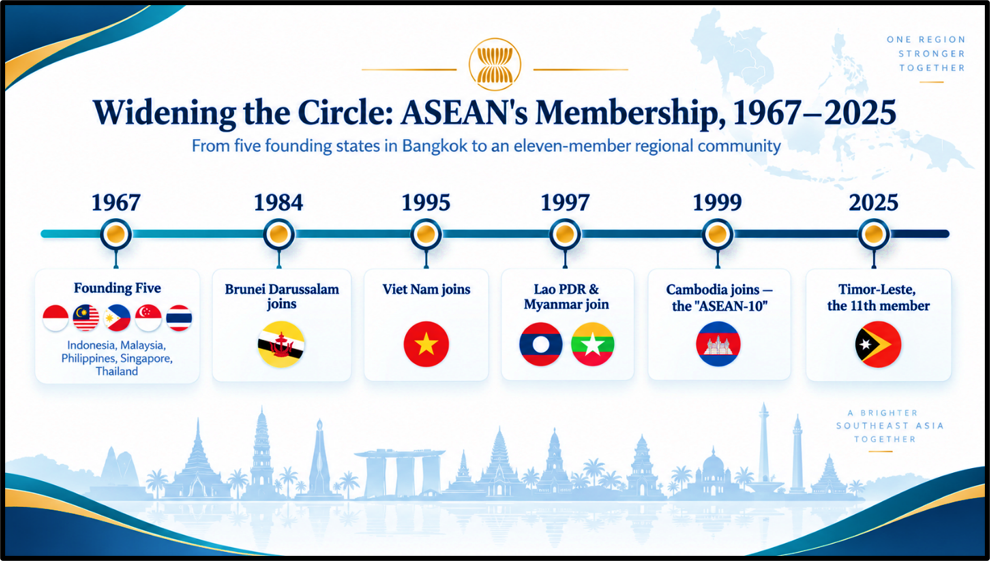
A decisive institutional leap came with the ASEAN Charter, which entered into force on 15 December 2008 and gave the grouping a legal personality, a rules-based framework and formal organs. The most recent milestone is the admission of Timor-Leste as ASEAN’s eleventh member in October 2025 — the first enlargement in over two decades.
The ASEAN Community and Its Three Pillars
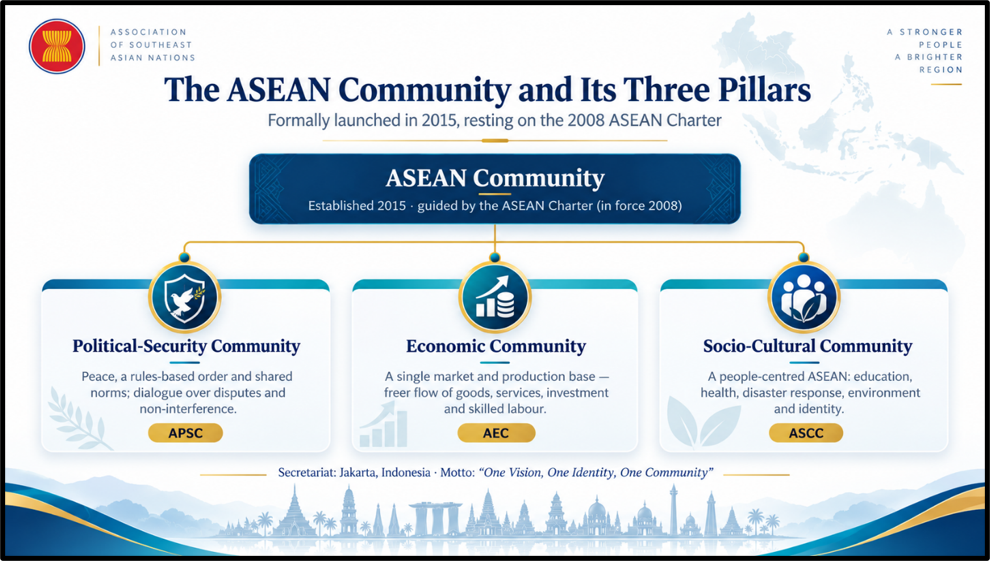
Since 2015, ASEAN has organised its work around a three-pillar ASEAN Community. The Political-Security Community anchors a rules-based regional order; the Economic Community pursues a single market and production base; and the Socio-Cultural Community builds a people-centred, shared regional identity. Together they translate a loose association into a structured community-building project.
ASEAN Centrality and the Regional Architecture
ASEAN’s real weight lies in the forums it convenes. It sits at the centre of the East Asia Summit (EAS), the ASEAN Regional Forum (ARF) on security, the ASEAN Defence Ministers’ Meeting-Plus (ADMM-Plus), and the “ASEAN+1” dialogues with partners such as India. This convening power — rather than hard capability — is the source of ASEAN centrality, and it is why India routes much of its Indo-Pacific engagement through ASEAN-led mechanisms.
East Asia Summit (EAS): Established in 2005, the EAS is the premier ASEAN-led, Leaders-level forum for dialogue on strategic, political and economic issues in the Indo-Pacific. It currently has 19 participants — 11 ASEAN members plus India, China, Japan, South Korea, Australia, New Zealand, the US and Russia.
India and ASEAN
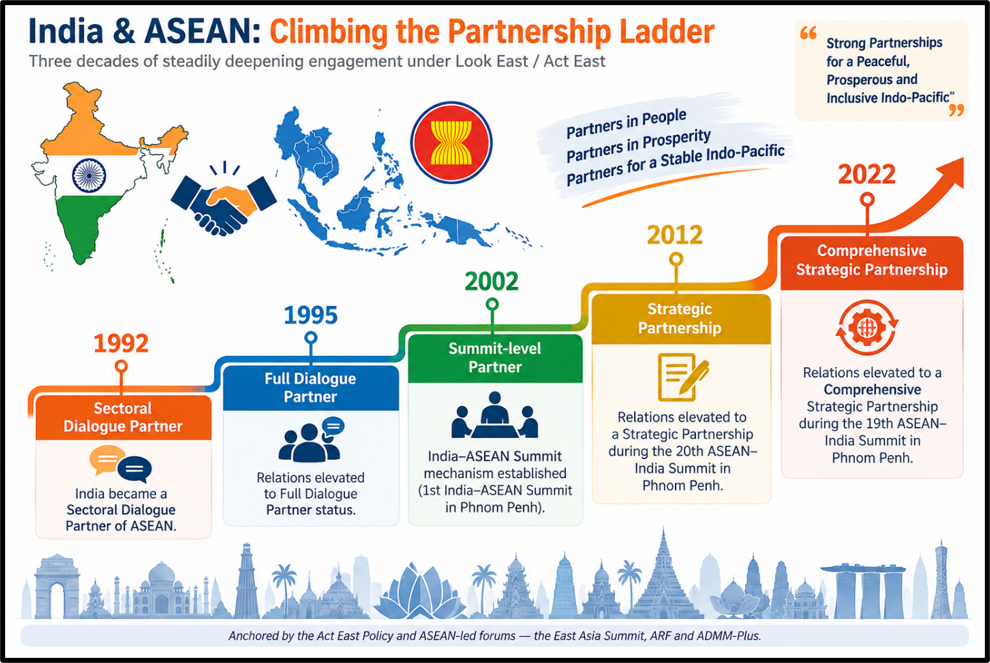
India’s ties with ASEAN have climbed steadily for three decades. India became a Sectoral Dialogue Partner in 1992, a full Dialogue Partner in 1995, a Summit-level partner in 2002, a Strategic Partner in 2012, and a Comprehensive Strategic Partner in 2022. This ladder is the institutional spine of the Act East Policy.
The relationship is now substantial in economic terms: two-way trade reached about USD 120.87 billion in 2023–24, making ASEAN one of India’s largest trading partners. It rests on the ASEAN-India Trade in Goods Agreement (AITIGA), which took effect on 1 January 2010 and is currently under review to make it more balanced and business-friendly. For the fuller story of Look East to Act East, see India and South-East Asia Policy notes.
Challenges
- The consensus trap: ASEAN decides by consensus and non-interference, which protects sovereignty but can paralyse action — visible on the South China Sea disputes and the post-2021 Myanmar crisis.
- China’s economic gravity: deep trade and investment dependence on China limits ASEAN’s room for manoeuvre and complicates a united stance on maritime disputes.
- India’s trade deficit: India runs a large and widening goods deficit with ASEAN, and stayed out of the RCEP mega-trade bloc over fears of import surges.
- Delivery gap: flagship connectivity projects such as the India–Myanmar–Thailand Trilateral Highway and the Kaladan project have suffered chronic delays.
Way Forward
- Conclude the AITIGA review to correct the trade imbalance and add services and investment depth.
- Fast-track physical and digital connectivity to convert diplomatic goodwill into supply-chain integration under the “China+1” moment.
- Deepen maritime-security and defence cooperation through ADMM-Plus while respecting ASEAN centrality.
2 Comments