
UPSC CURRENT AFFAIRS — 22 OCTOBER 2026
1. India’s Digital Public Infrastructure
(POLITY AND GOVERNANCE) (ENT) India’s Digital Public Infrastructure (DPI) — identity, payments and data-sharing rails built as open public goods — is now a global reference for low-cost, population-scale service delivery. UPI alone handled a record 21.70 billion transactions worth ₹28.33 lakh crore in January 2026.
What makes it ‘public infrastructure’
- Open and interoperable: Open APIs let any bank or app plug in, avoiding closed ‘walled gardens’.
- Minimal and modular: Each layer does one job and others build on top.
- Public-interest rules: The State sets standards while private players innovate at the front end.
The India Stack
| Layer | Key systems | What it enables |
| Identity | Aadhaar, DigiLocker | eKYC, paperless documents |
| Payments | UPI, AePS | Instant, low-cost transfers |
| Data | Account Aggregator | Consent-based data sharing for credit |
| Commerce | ONDC, GeM | Open e-commerce, transparent public procurement |
Identity (Aadhaar) ➜ Bank account (Jan Dhan) ➜ Mobile + UPI ➜ Direct Benefit Transfer
The JAM trinity links Jan Dhan accounts, Aadhaar and mobile numbers to send subsidies straight to beneficiaries, cutting leakages (see India Stack).
Challenges
- Digital literacy: Rural and elderly users still depend on intermediaries.
- Fraud: Fake QR codes and phishing grow with instant payments (see Cyber threats).
- Authentication failures: Worn fingerprints and poor connectivity can deny ration or pensions.
- Concentration: A few third-party apps carry most UPI volume.
Way forward
- Data protection: Fully operationalise the Digital Personal Data Protection Act, 2023.
- Offline options: Expand UPI Lite and offline payment modes for low-connectivity areas.
- Global South: Share open-source DPI through the G20-era Global DPI Repository.
📖 Read More: Digital Infrastructure in India • India’s Cyber Security Framework
2. Hill Councils for All Ladakh Districts
(POLITY AND GOVERNANCE) (TH) The President has promulgated the Ladakh Autonomous Hill Development Councils (LAHDC) (Amendment) Regulation, 2026, allowing hill councils in all eight districts of Ladakh, including the new Sankoo district. The Union Cabinet approved it on 14 October; it was promulgated on 16 October.
Key changes
| Feature | Change |
| Coverage | From two councils (Leh, Kargil) to eight — adding Sankoo, Changthang, Nubra, Sham, Zanskar and Drass |
| Seats | Flexible size per council instead of a fixed 26 |
| Nomination | Limited nominated seats for women and unrepresented communities |
| Elections | Under the State Election Commission for Ladakh |
Legal basis
- Article 240: The President can make regulations for certain Union Territories, including Ladakh, which has no legislature (see Union Territories).
- Proposed UT body: A Home Ministry draft for an elected UT-level body, with laws needing the Lieutenant Governor’s assent, is being debated.
Unmet demands
Statehood ➜ Sixth Schedule protection ➜ Separate Public Service Commission ➜ Separate Lok Sabha seats for Leh & Kargil
Critics argue that more councils do not amount to the legislative autonomy offered by the Sixth Schedule.
📖 Read More: Union Territories
3. From Forest Titles to Farm Incomes
(SOCIAL JUSTICE) (TH) Land titles under the Forest Rights Act (FRA), 2006 have secured rights for lakhs of tribal and forest-dwelling families. But without credit, irrigation and markets, much of this land stays under-used. Experts call for linking FRA lands with mainstream farm schemes.
Individual Forest Rights (IFR) at a glance
| Feature | Provision |
| Area cap | Land actually cultivated, up to 4 hectares |
| Cut-off | Occupation before 13 December 2005 |
| Other Traditional Forest Dwellers | Three generations (75 years) of residence and dependence |
| Nature of title | Heritable, not transferable; joint in the names of spouses |
Gram Sabha (claim & verify) ➜ Sub-Divisional Level Committee ➜ District Level Committee (final approval) ➜ Title issued
Why FRA land stays idle
- No collateral: Banks rarely accept IFR titles, limiting Kisan Credit Card loans.
- Scheme exclusion: Recorded as forest land, not revenue land, so holders often miss PM-KISAN or crop insurance.
- Rainfed terrain: Hilly plots lack irrigation and need costly land development.
- Weak markets: Few mandis or Farmer Producer Organisations nearby.
Making titles productive
- Convergence: Link FRA lands with PMKSY, edible-oil and pulse missions and Van Dhan Yojana.
- Crop choice: Millets, pulses and oilseeds suit rainfed tribal belts.
- Records: Add FRA titles to state digital land records (see Forest Rights Act).
📖 Read More: Forest Rights and Conservation Strategies • Tribes of Central India • Vulnerable Sections and Social Justice
4. The Badr Defence Pact
(INTERNATIONAL RELATIONS) (TH) (FP) Pakistan, Turkiye, Qatar and Indonesia signed the Badr Memorandum of Understanding in Doha on 21 October 2026 to cooperate on defence manufacturing, technical training and research. It is an industrial partnership, not a mutual-defence treaty.
Who brings what
| Country | Main contribution |
| Turkiye | Defence technology and systems integration |
| Qatar | Investment capital |
| Pakistan, Indonesia | Manufacturing base, workforce and domestic demand |
- Name: Badr means ‘full moon’ and recalls the Battle of Badr (624 CE).
- Contrast: The Makkah Joint Defence Agreement (August 2026) of Pakistan, Saudi Arabia and Turkiye treats an attack on one as an attack on all; Badr does not.
Implications for India
Turkish technology ➜ Pakistani production ➜ Less reliance on China ➜ New security challenge for India
- Military balance: Pakistan may gain easier access to Turkish drones and electronic warfare systems (see India–Pakistan Relations).
- Balancing partners: India has strong energy ties with Qatar and strategic ties with Indonesia (see India–Indonesia, India–Qatar).
📖 Read More: India–Pakistan Relations • India and Qatar Relations • India and Indonesia Relations
5. India at UN on WMD Safeguards
(INTERNATIONAL RELATIONS) (DD) At the UN General Assembly’s First Committee, India called for stronger safeguards to stop sensitive technologies and weapons of mass destruction (WMD) from reaching terrorists. It reaffirmed full, non-discriminatory implementation of the Chemical and Biological Weapons Conventions.
Key frameworks
| Instrument | Key facts |
| Chemical Weapons Convention | In force 1997; bans development, production, stockpiling and use; India is a party |
| Biological Weapons Convention | In force 1975; bans biological and toxin weapons; India is a party |
| UNSC Resolution 1540 (2004) | States must stop non-state actors from acquiring WMD |
| WMD Act, 2005 (India) | Criminalises unlawful WMD activities; amended in 2022 to cover financing |
- India’s resolution: Since 2002, India has piloted the UNGA resolution on preventing terrorists from acquiring WMD.
- First Committee: Deals with disarmament and international security.
Dual-use technology ➜ Export controls ➜ National laws (WMD Act) ➜ Denial to terrorists
📖 Read More: India’s Nuclear Foreign Policy • Countering Terrorism in India
6. Emissions Gap Report 2026
(ENVIRONMENT) (UNEP) UNEP’s Emissions Gap Report 2026: The Point of Return (17th edition) finds that warming is now set to exceed 1.5°C. The goal has shifted to limiting the size and length of the overshoot and bringing temperatures back to 1.5°C by 2100.
Key findings
| Pathway | Required / projected |
| ‘Lowest possible overshoot’ | Peak of 1.7–1.8°C around mid-century, back to 1.5°C by 2100 (≈50% chance) |
| Cuts needed (vs 2025) | 18% by 2030, 45% by 2035, 69% by 2040 |
| Full NDC implementation | Only 5–8% cut by 2030 and 11–15% by 2035 |
| Resulting warming | About 2.6°C this century |
- Carbon removal: Rising levels of Carbon Dioxide Removal are needed to return to 1.5°C.
- Good news: Renewables have boomed and coal and oil supply grew slower than projected since Paris.
- Sectoral benchmarks: New targets for renewables, energy intensity, fossil share and methane, building on the first Global Stocktake.
Emissions keep rising ➜ 1.5°C overshoot ➜ Deep cuts + carbon removal ➜ Return to 1.5°C by 2100
India’s angle
- Intensity targets: India’s NDC targets emissions per unit of GDP, so absolute emissions can still grow (see Greenhouse Gases).
- Equity: Low per-capita emissions strengthen India’s case for CBDR-RC in negotiations (see UNFCCC summits).
📖 Read More: UNFCCC Summits Post-Kyoto • Impact of Global Warming • Greenhouse Gases
7. GRAP Stage I Invoked in Delhi-NCR
(ENVIRONMENT) (NDTV) The Commission for Air Quality Management (CAQM) invoked Stage I of the Graded Response Action Plan (GRAP) across Delhi-NCR for the first time this season after Delhi’s AQI hit 244 (‘Poor’).
GRAP stages
| Stage | AQI category | AQI range |
| I | Poor | 201–300 |
| II | Very Poor | 301–400 |
| III | Severe | 401–450 |
| IV | Severe+ | Above 450 |
Stage I measures
- Vehicles: Ban on diesel vehicles over 10 years and petrol vehicles over 15 years old.
- Dust: Mechanised sweeping, water sprinkling and anti-smog guns at sites.
- Fuel: No coal or wood in eateries; restricted use of diesel generators.
- Waste: Immediate halt to garbage burning.
Background
M.C. Mehta case (SC, 2016) ➜ GRAP notified (2017) ➜ CAQM takes charge ➜ Graded, AQI-linked action
GRAP acts early, before winter inversions trap pollutants (see Air Pollution).
📖 Read More: Air Pollution
8. Southeast Asia’s Haze Crisis
(ENVIRONMENT) (BBC) Indonesia is facing its worst wildfire season in a decade. Over 10 lakh fire hotspots have burned about 9 lakh hectares, mainly in Kalimantan and Sumatra, sending toxic haze to Singapore and Malaysia.
Causes
- Slash-and-burn: Fire used as a cheap way to clear land, often for commercial plantations.
- Peatlands: Drained peat smoulders underground for long periods, releasing PM2.5 and greenhouse gases.
- El Niño: An unusually strong event has deepened drought, making fires harder to control.
Response
- Indonesia: Suspended licences of 26 companies; President called the practice ‘ecological terrorism’.
- Singapore: Its Transboundary Haze Pollution Act, 2014 allows action against foreign firms, but past attempts strained ties with Jakarta.
ASEAN framework
| Feature | Details |
| AATHP | Signed 2002, in force 2003; Indonesia was the last to join — ratified in 2014, deposited January 2015 |
| Mechanism | ASEAN Coordinating Centre for Transboundary Haze Pollution Control |
| Weakness | No strong sanctions; the ‘ASEAN Way’ of consensus and non-interference limits enforcement |
Land clearing by fire ➜ Peat & forest burn ➜ Cross-border haze ➜ Health & diplomatic costs
📖 Read More: ASEAN • Air Pollution
9. SUVIKALP: Second Life for Coal Mines
(ENVIRONMENT) (PIB) The Coal Controller Organisation (CCO) under the Ministry of Coal won the SKOCH Gold Award 2026 for SUVIKALP, its in-house tool to choose the best reuse for closed coal mines.
SUVIKALP ranks reuse options ➜ PRISM guides implementation ➜ Projects on closed mines ➜ Jobs & restored land
- SUVIKALP: Scores repurposing projects on technical, environmental, social and economic criteria.
- PRISM: Post-Mining Repurposing Implementation Strategy Model — offers project concepts, case studies, sample DPRs and tender documents.
- SUVIKALP Samvaad: 12 webinars on frameworks such as RECLAIM and L.I.V.E.S., tourism, livelihoods and use of mine voids.
Why it matters
- Just transition: Coal-dependent regions need new livelihoods as mines close.
- Land and water: Mine voids can become reservoirs, fisheries, solar parks or eco-parks (see Sustainable mining).
10. New Technologies under Namami Gange
(ENVIRONMENT) (PIB) A PIB feature highlights how the Namami Gange Programme (2014) uses a technology-neutral approach to sewage treatment, choosing processes to suit local terrain, land and sewage type.
Progress so far
| Indicator | Figure |
| Projects | 219 worth ₹35,664 crore; 147 completed |
| STP capacity | 6,603 MLD sanctioned; 4,341 MLD created |
| Coverage | 10 Ganga basin states |
Technologies in use
| Technology | Key feature | Where |
| Food Chain Reactor | Fixed media and plant roots; small footprint, low power | Bhatpara (WB), Prayagraj (UP) |
| Electrocoagulation | Non-biological; works in cold, hilly sites | 17 units in Uttarakhand, e.g. Badrinath |
| Sequential Batch Reactor | Cyclic activated-sludge process | Several cities |
Sewage collection ➜ Treatment suited to site ➜ Treated water reuse ➜ Cleaner Ganga
📖 Read More: Namami Gange Programme • Water Pollution
11. Core Sector Grows 7.9% in September
(ECONOMICS) (ANI) Growth of the Index of Core Industries (ICI) rose to 7.9% in September 2026 from 5.9% in August (revised). April–September growth was 5.1%, against 2.5% a year earlier.
Sector performance (September 2026)
| Sector | Growth (%) |
| Iron ore | 18.4 |
| Electricity | 11.4 |
| Coal | 10.7 |
| Refinery products | 10.3 |
| Cement | 9.8 |
| Steel | 4.9 |
| Crude oil | −1.4 |
| Natural gas | −4.6 |
| Fertilisers | −11.7 |
About the index
- Compiled by: Office of the Economic Adviser, DPIIT (Ministry of Commerce and Industry), monthly.
- New series: Base year 2022–23 (released July 2026), with iron ore added to the original eight industries.
- Use: A lead indicator for the Index of Industrial Production (see High-frequency indicators).
Core inputs (coal, steel, power) ➜ Manufacturing output ➜ IIP ➜ GVA
📖 Read More: Industrial Sector of Indian Economy • Infrastructure Sector
12. World Bank’s First Digital Strategy
(ECONOMICS) (WB) The World Bank Group launched its first digital strategy in Seoul on 20 October 2026 to widen affordable digital access and create jobs. Over 2 billion people were offline in 2025; internet use was 23% in low-income countries against 94% in high-income ones.
Four priorities
| Priority | Focus |
| Connectivity | Cables, shared networks, private investment; plan power and internet together |
| Affordable devices & data | Cheaper smartphones and data; refurbishment and pay-over-time |
| Digital services & skills | Digital ID, payments, data sharing, job-linked skills |
| AI readiness | Compute, local data and ‘small AI’ for local tasks |
- Jobs gap: 1.2 billion young people will reach working age in developing countries in 10–15 years, but only about 420 million jobs are projected.
- AI Infrastructure and Readiness Initiative: Shared, pay-as-you-go computing for emerging markets.
The strategy echoes India’s DPI model of identity, payments and data rails (see World Bank).
📖 Read More: International Economic Organisations • Digital Infrastructure in India
13. India Hosts Agrivoltaics World Conference
(ECONOMICS) (PIB) The 7th AgriVoltaics World Conference (AWC) 2026 opened at Bharat Mandapam, New Delhi — the first time it is held in the Global South. The Ministry of New and Renewable Energy hosted it with German support under the theme ‘Powering the Global South’.
- Agrivoltaics: Growing crops and producing solar power on the same land.
- Scale: 1,200+ delegates, including 150+ from abroad.
- Launches: MNRE’s AgriPV Policy Handbook, the India Agrivoltaics Alliance’s Decision-Making Tool and IWMI’s Book of Abstracts.
- Message: Turning farmers from Annadatas into Urjadatas (energy providers).
Benefits
Panels above crops ➜ Shade cuts heat & water loss ➜ Power + crop income ➜ Climate-resilient farms
- Land use: Eases the conflict between solar parks and farmland (see Solar Energy).
- Income: Steady earnings from power sales alongside crops.
📖 Read More: Solar Energy
14. Browsers Block eMudhra Certificates
(INTERNAL SECURITY) (IE) Google, Mozilla, Apple and Microsoft blocked certificates linked to Bengaluru-based eMudhra after a flaw was found in how it generated cryptographic keys. Eight intermediate certificates had private keys with too little randomness, making them easy to reconstruct.
What went wrong
- Origin: A key-generation exercise on 30 April 2025 created a second set of weak keys that reached browser trust stores.
- Scope: Six certificates for website authentication and two for code signing.
- Risk: Attackers could forge certificates, impersonate websites or sign malware.
- Response: Emergency browser updates; CERT-In issued an advisory on 21 October.
How web trust works
Root CA (in browser) ➜ Intermediate CA ➜ Website certificate ➜ HTTPS padlock
A weak link anywhere in this chain can undermine trust in all sites below it (see Cyber threats).
Indian context
- Regulation: Certifying Authorities in India are licensed by the Controller of Certifying Authorities under the IT Act, 2000.
- Separate systems: eMudhra says its Indian digital signature and eSign services were unaffected.
📖 Read More: Understanding Cyber Security and Cyber Threats • India’s Cyber Security Framework
15. SIMBEX-2026 Begins
(INTERNAL SECURITY) (DD) The 33rd Singapore–India Maritime Bilateral Exercise (SIMBEX-2026) began at Visakhapatnam on 21 October. A harbour phase runs to 23 October, followed by a sea phase in the Bay of Bengal from 24–26 October.
| Feature | Details |
| Started | 1994, as Exercise Lion King |
| Ships | RSS Supreme (Singapore); INS Nilgiri, INS Kamorta (India) |
| Drills | Anti-submarine, anti-surface and anti-air warfare; seamanship |
- Significance: Interoperability with a key ASEAN partner near the Malacca Strait, supporting India’s Act East policy (see Maritime strategy).
📖 Read More: Naval Defence • ASEAN • Maritime Foreign Policy Strategy
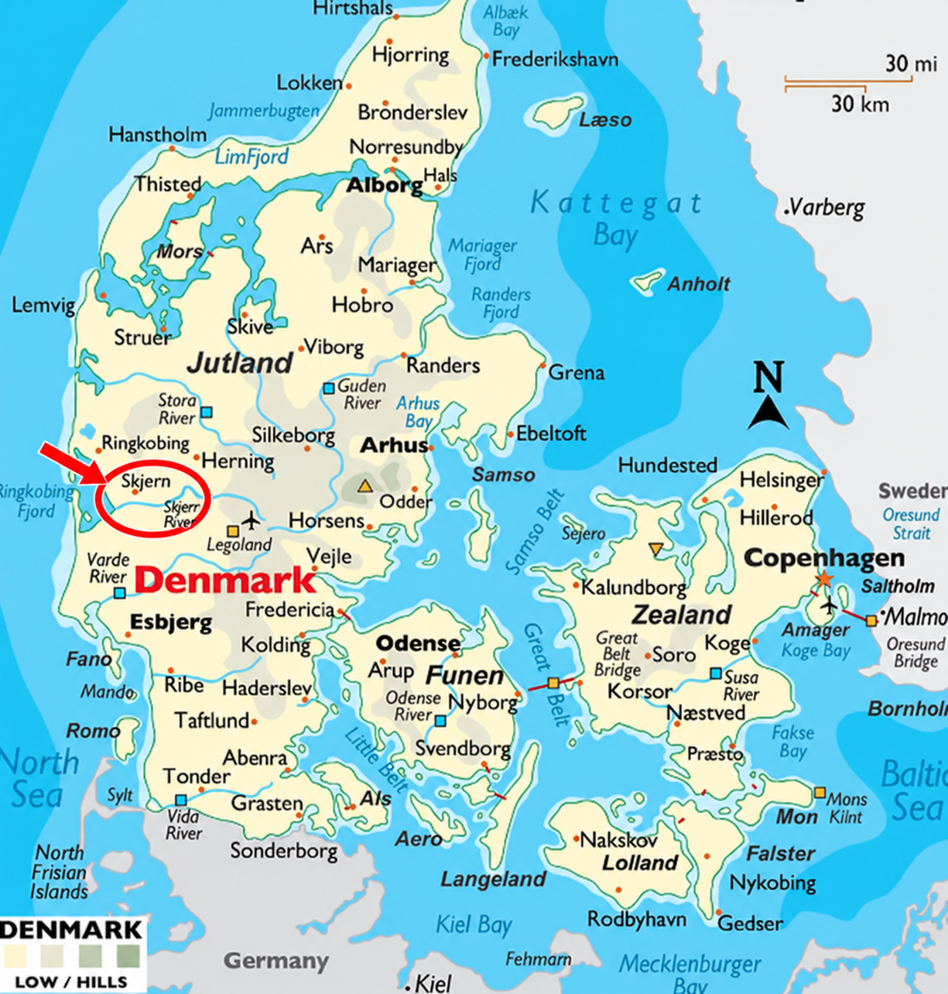
16. Skjern River in the Map
(GEOGRAPHY) (TOI) Denmark’s restoration of the Skjern River is being cited as a model for nature recovery. About 26 km of river bends were restored and around 2,200 hectares of farmland returned to wetland.
| Feature | Details |
| Location | Western Jutland, Denmark |
| Rank | Largest river in Denmark by volume; about 94 km long |
| Source | Tinnet Krat, central Jutland |
| Mouth | Ringkøbing Fjord, a lagoon opening to the North Sea |
| Restoration | Approved 1997; mostly complete by 2002 |
Straightened channel & drained farms (1960s) ➜ Re-meandering ➜ Floodplain wetlands return ➜ Salmon, otters & birds recover
- Benefits: Natural filtering of farm runoff, flood control and ecotourism (see Wetland Ecosystem).
📖 Read More: Political Map of Europe • Wetland Ecosystem