
National Parks in India
From the snow-fed valleys of Ladakh to the tidal creeks of the Sundarbans, India protects some of the planet’s richest and most fragile ecosystems inside a network of about[1] 107 national parks (As of Sep. 2026). These are the strictest, most jealously guarded slices of India’s wild estate — landscapes where the tiger, the one-horned rhino, the Asiatic lion and the snow leopard are given the legal equivalent of sanctuary in the truest sense of the word. For the UPSC aspirant, national parks sit at the intersection of ecology, geography, polity and governance, making them a perennial favourite in both Prelims and Mains.
This note maps the full picture: the constitutional and legal scaffolding that creates a national park, where parks fit within India’s wider environment and ecology framework, the institutions that run them, the flagship parks and species you must know, and the conservation debates that examiners love to probe. Figures are drawn from official government sources, linked inline for verification.
At a Glance — Key Facts & Milestones
Before the detail, a revision-ready snapshot. A national park is the highest category of legal protection an area can receive under Indian wildlife law, and India’s roster has grown steadily since the very first was notified in the foothills of the Himalaya.
| Indicator | Status / Figure |
| National parks | 106 parks covering 44,402.95 km² — roughly 1.35% of India’s geographical area (as of Aug 2025). |
| Place in the wider network | Part of 1,014 Protected Areas that together span about 5.32% of the country. |
| First national park | Jim Corbett (1936), originally Hailey National Park; renamed in 1957. |
| Largest national park | Hemis National Park, Ladakh (high-altitude cold desert; snow-leopard country). |
| Smallest national park | South Button Island National Park, Andaman & Nicobar Islands. |
| State with the most parks | Madhya Pradesh — the ‘Tiger State’ of central India. |
| Legal basis | Section 35 of the Wild Life (Protection) Act, 1972. |
| IUCN classification | Category II (national park) — ecosystem protection with minimal human interference. |
The Legal Foundation — Wild Life (Protection) Act, 1972
The idea of a national park in India is not merely administrative; it is statutory. The Wild Life (Protection) Act, 1972 (WPA) is the parent legislation, enacted to provide a uniform framework for protecting wild animals, birds and plants and for constituting protected areas. It replaced a patchwork of state-level laws and gave the Centre a firm footing to coordinate conservation across the country.
Constitutional Backing
The Act draws its strength from the Constitution. The 42nd Constitutional Amendment (1976) moved ‘Forests’ and ‘Protection of Wild Animals and Birds’ from the State List to the Concurrent List, enabling Parliament to legislate on wildlife.
Two other provisions supply the moral and civic backbone:
- Article 48A (a Directive Principle directing the State to protect and improve the environment and safeguard forests and wildlife) and
- Article 51A(g) (a Fundamental Duty of every citizen to protect and improve the natural environment).
Together they anchor national parks within India’s broader polity and governance as well as its ecology.
National Parks under Section 35
A national park is declared by the State Government under Section 35 of the WPA. What sets it apart from every other category is the degree of protection: within a national park, no human activity is permitted, no grazing of livestock is allowed, and no destruction or exploitation of wildlife or habitat may take place except under strictly controlled conditions for improving wildlife.
Crucially, the boundaries of a national park cannot be altered except by a resolution passed by the State Legislature — a safeguard that makes de-notification deliberately difficult.
| Stage | Process | Description |
| 1 | Intention to declare | The State Government issues a preliminary notification declaring its intention to constitute an area as a National Park. |
| 2 | Settlement of rights | The Collector investigates and settles the existing rights of individuals and communities over the land. |
| 3 | Final notification | After settlement of rights, the State Government issues a final notification specifying the boundaries of the National Park. |
| 4 | Strict protection | Grazing and exploitation of wildlife or forest produce are prohibited, except where specifically permitted under the Act. |
| 5 | Alteration of boundaries | The boundaries of a National Park can be altered only through a resolution passed by the State Legislature. |
National Park vs Wildlife Sanctuary — the Fine Line
Aspirants routinely confuse the two most restrictive categories. The distinctions below are worth committing to memory.
| Feature | National Park (Sec. 35) | Wildlife Sanctuary (Sec. 18) |
| Primary objective | Protect the entire ecosystem — flora, fauna, landscape. | Protect particular species / groups of wildlife. |
| Human activity | Not permitted; no rights allowed inside. | Certain regulated rights and activities may be allowed. |
| Grazing | Prohibited. | May be regulated / permitted in some cases. |
| Boundaries | Altered only by State Legislature resolution. | Can be altered by State notification. |
| Legal protection | Highest. | High, but a notch below a national park. |
| Upgrade path | A sanctuary can be upgraded to a national park. | Often the starting point for stricter protection. |
Who Governs India’s National Parks
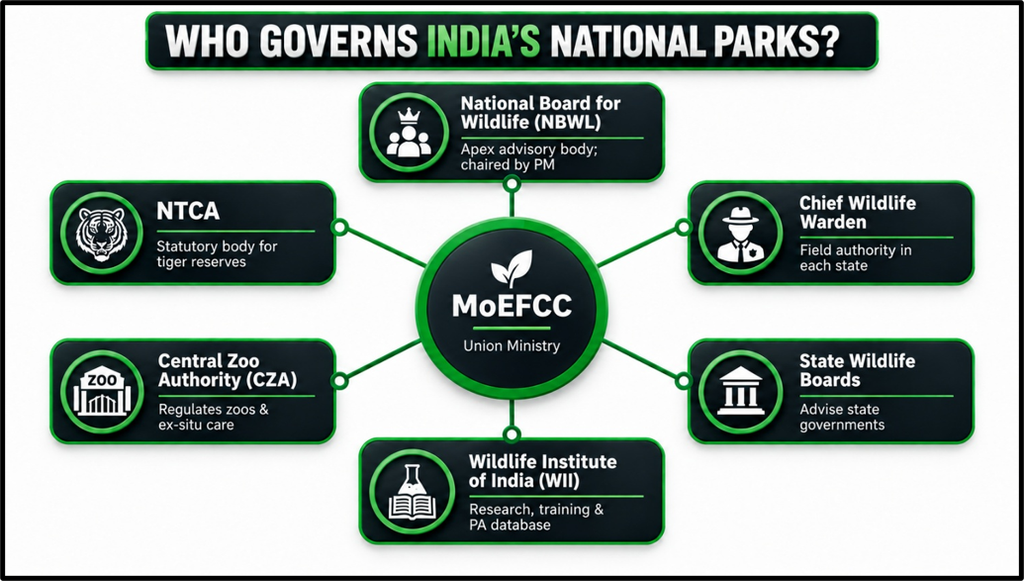
Wildlife sits on the Concurrent List, so governance is genuinely federal — a web of central ministries, statutory authorities, expert institutions and state officials. The Ministry of Environment, Forest and Climate Change (MoEFCC) is the apex policy body at the Centre, but the day-to-day custodian of any park is a state forest officer.
- National Board for Wildlife (NBWL): The apex advisory body on wildlife conservation, chaired by the Prime Minister; its clearance is mandatory for projects inside or near protected areas.
- National Tiger Conservation Authority (NTCA): A statutory body constituted in 2006 that administers Project Tiger and oversees India’s tiger reserves.
- Wildlife Institute of India (WII): A Dehradun-based research and training institute that maintains the National Wildlife Database and provides the technical backbone for park management.
- Central Zoo Authority (CZA): Regulates zoos and ex-situ conservation, complementing the in-situ protection that parks provide.
- Chief Wildlife Warden & State Wildlife Boards: The Chief Wildlife Warden is the statutory head of the wildlife wing in each state — the officer in whom the real field authority over a national park vests.
The Landmark Parks — A Guided Tour
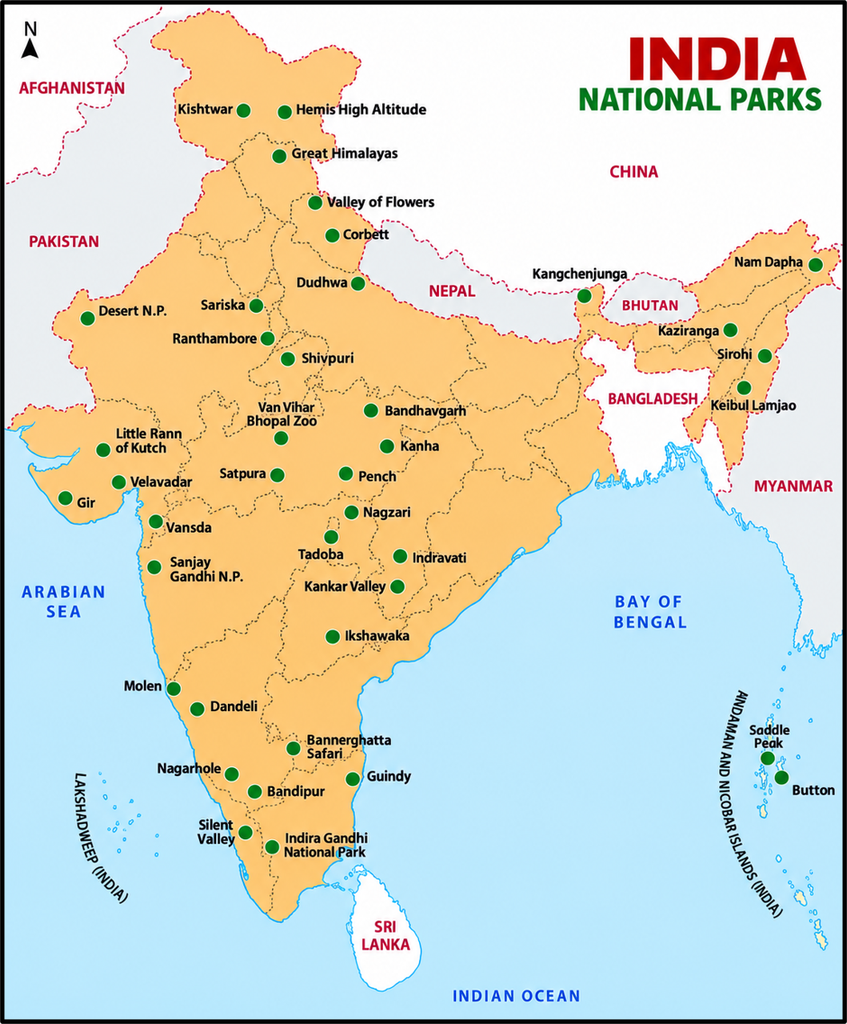
India’s parks are as varied as its geography. A quick regional tour fixes the major names to their landscapes and signature species — exactly the associations examiners test through map-based and matching questions. Reading this alongside your geography notes helps lock the locations in place.
Himalayan & Northern India
- The Himalaya host India’s highest and wildest parks. Hemis in Ladakh is the country’s largest national park and a global stronghold for the snow leopard.
- Uttarakhand carries the historic weight of Corbett, while its Nanda Devi and Valley of Flowers National Parks and Himachal’s Great Himalayan National Park are inscribed as UNESCO natural World Heritage Sites for their alpine biodiversity.
Central Indian Highlands
- The Satpura–Maikal ranges of Madhya Pradesh form India’s tiger heartland: Kanha (whose barasingha, or hard-ground swamp deer, was brought back from the brink and which inspired Kipling’s The Jungle Book), Bandhavgarh, Pench, Satpura and Panna.
- It is here, at Kuno National Park, that India staged its most ambitious rewilding experiment — the reintroduction of the cheetah.
Western India
- Gujarat’s Gir is the last refuge on Earth of the Asiatic lion, while Rajasthan offers the tiger-rich ruins of Ranthambore and the world-famous bird haven of Keoladeo (Bharatpur).
- Gujarat’s Marine National Park in the Gulf of Kutch protects coral reefs and a mosaic of intertidal life.
Eastern & North-East India
- Assam’s Kaziranga — a UNESCO site — is synonymous with the greater one-horned rhinoceros, and neighbouring Manas is a rare park that is simultaneously a tiger reserve, an elephant reserve, a biosphere reserve and a World Heritage Site.
- Arunachal Pradesh’s Namdapha is one of the few areas on the planet said to host four large cats — tiger, leopard, clouded leopard and snow leopard.
Peninsular, Coastal & Island Parks
- The Western Ghats shelter Kerala’s Silent Valley, a pristine tropical rainforest and last stand of the lion-tailed macaque, and Periyar, built around a reservoir.
- On the coast, West Bengal’s Sundarbans — the world’s largest mangrove forest and home to swimming tigers — is both a national park and a World Heritage Site, while the Andaman & Nicobar Islands hold India’s smallest park, South Button Island.
Flagship National Parks at a Glance
| National Park | State / UT | Best Known For |
| Jim Corbett | Uttarakhand | India’s first national park (1936); Bengal tiger. |
| Kaziranga | Assam | Greater one-horned rhinoceros; UNESCO natural site. |
| Gir | Gujarat | The only wild population of the Asiatic lion. |
| Sundarbans | West Bengal | Mangrove delta; tigers; UNESCO natural site. |
| Kanha | Madhya Pradesh | Barasingha revival; inspired ‘The Jungle Book’. |
| Ranthambore | Rajasthan | Tigers amid Aravalli–Vindhya ruins. |
| Keoladeo (Bharatpur) | Rajasthan | Wetland birding; UNESCO natural site. |
| Hemis | Ladakh | India’s largest park; snow leopard. |
| Great Himalayan | Himachal Pradesh | Alpine biodiversity; UNESCO natural site. |
| Kuno | Madhya Pradesh | Site of India’s cheetah reintroduction. |
| Silent Valley | Kerala | Tropical rainforest; lion-tailed macaque. |
| Periyar | Kerala | Elephants and tigers around a reservoir. |
| Marine (Gulf of Kutch) | Gujarat | India’s first marine national park; coral reefs. |
India has over a hundred National Parks, but studying each one individually is neither practical nor necessary. Focus primarily on the flagship National Parks listed above and those appearing in current affairs.
For a complete state-wise reference, you may consult: List of National Parks of India – Wikipedia.
Beyond the Park Boundary — Allied Conservation Designations
A national park rarely stands alone. The same forest may simultaneously be a tiger reserve, part of a biosphere reserve, or an internationally recognised wetland or heritage site. These overlapping labels come from different legal or international frameworks and serve different purposes
| Designation | Latest Status | Framework / Purpose |
| Tiger Reserves | 58 reserves across 18 states. | Project Tiger, administered by the NTCA under the WPA. |
| Elephant Reserves | 33 reserves (14 states; ~80,777 km²). | Project Elephant (1992) for elephants and corridors. |
| Biosphere Reserves | 18 reserves (13 in UNESCO’s WNBR). | UNESCO Man and the Biosphere Programme; MoEFCC. |
| Ramsar Wetlands | 101 sites | Ramsar Convention on wetlands of international importance. |
| Natural World Heritage | 7 natural + 1 mixed site. | UNESCO World Heritage Convention. |
Of India’s natural World Heritage Sites, most are national parks — Kaziranga, Keoladeo, Sundarbans, the Great Himalayan and Nanda Devi & Valley of Flowers — a fact best revised alongside the full list of India’s UNESCO World Heritage Sites. Wetland parks such as Keoladeo also feature among the country’s Ramsar sites, underlining how a single landscape can carry several layers of protection at once.
Flagship Species & Conservation Wins
National parks are ultimately judged by whether their wildlife recovers — and on that count India has genuine success stories to tell. The ‘umbrella species’ approach, protecting a charismatic animal so that its entire habitat benefits, has driven measurable gains. Recent official estimates are summarised below; deeper profiles sit in the species of conservation concern notes.
| Species | Latest Official Estimate | Stronghold Park(s) |
| Bengal Tiger | 3,682 (2022); ~75% of the world’s wild tigers. | Corbett, Kanha, Bandhavgarh, Ranthambore. |
| Asiatic Lion | 891 (2025), up from 674 in 2020. | Gir and the surrounding Saurashtra landscape. |
| One-horned Rhinoceros | 2,613 in Kaziranga (2022). | Kaziranga, Manas, Orang, Pobitora. |
| Cheetah (reintroduced) | 30 including India-born cubs (Dec 2025). | Kuno National Park (Project Cheetah). |
- The tiger tells the headline story: from a low ebb, India’s tigers have climbed to an average of 3,682 animals in the 2022 estimation, growing at about 6.1% a year.
- Project Cheetah, meanwhile, is the world’s first intercontinental large-carnivore translocation: eight cheetahs arrived at Kuno National Park from Namibia on 17 September 2022, followed by twelve from South Africa in 2023, with the population since bolstered by cubs born on Indian soil.
These wins are supported by an ecosystem of government schemes spanning funding, habitat restoration and community incentives.
Challenges & Pressures
For all the success, national parks operate under mounting strain. The threats are interlinked, and the strongest Mains answers connect them rather than listing them in isolation.
- Habitat fragmentation: Roads, railways, canals and mines slice through parks and the corridors that connect them, isolating populations and eroding genetic health.
- Human–wildlife conflict: As parks fill to capacity, animals spill into farms and settlements, triggering crop and livestock losses and, sometimes, retaliatory killing — a challenge examined in depth in the note on human–animal conflict in India.
- Poaching and illegal wildlife trade: Demand for skins, horn, bone and exotic pets keeps organised poaching networks alive despite tighter enforcement.
- Development vs conservation: Linear infrastructure, hydropower and tourism pressure force difficult trade-offs, often testing the strength of NBWL clearances and eco-sensitive zone rules.
- Invasive species and climate change: Weeds like Lantana crowd out native forage, while shifting rainfall and temperature reshape habitats faster than species can adapt.
- Rights and livelihoods of forest communities: Balancing strict protection with the rights of forest-dwelling communities under the Forest Rights Act remains a live governance and ethical dilemma.
The Way Forward
Contemporary conservation thinking has moved from fencing parks off to embedding them within functioning landscapes and local economies.
- Landscape and corridor conservation: Protecting the wildlife corridors between parks so that populations can disperse, breed and remain resilient.
- Community-led and eco-tourism models: Turning local communities into stakeholders through employment, revenue-sharing and eco-development committees.
- Technology in monitoring: Camera traps, drones, GPS collars and AI-assisted analytics for real-time surveillance and anti-poaching response.
- Science-based translocation and rewilding: Carefully planned reintroductions — as with the cheetah and rhino range expansion — to rebuild lost populations.
- Strengthening eco-sensitive zones: Using the buffer around parks to cushion them from development pressure while permitting sustainable local use.
Conclusion
India’s national parks are more than tourist destinations; they are the load-bearing pillars of a conservation architecture that shelters a disproportionate share of the world’s tigers, its only Asiatic lions, and species found nowhere else. Their story is one of steady legal strengthening, hard-won recoveries and unresolved tensions between people and wildlife.
[1] Total numbers may differ across sources.