
India and Afghanistan
Introduction: The Graveyard of Empires
Afghanistan has been called both the ‘Heart of Asia’ and the ‘Graveyard of Empires’—a landlocked crossroads that has swallowed the ambitions of the British, the Soviets and the Americans in turn.
For India, the relationship (the ancient Gandhara–Bharata connection) is civilizational and strategic, but it comes with a defining feature: India has built its influence through development and soft power, not military force.
Afghanistan is India’s gateway to Central Asia, a buffer against Pakistan’s quest for strategic depth, and a test of whether India can shape outcomes in a theatre where it has no direct border and limited leverage.
The 2021 Taliban takeover has forced India into its most difficult recalibration yet.
| The Core of India’s Afghan Policy India’s enduring goal is a stable, sovereign Afghanistan that is not a launchpad for Pakistan-backed terror—pursued through aid, connectivity and goodwill (‘winning hearts and minds’) rather than boots on the ground. |
Historical Background
Modern Afghanistan was forged as a buffer state in the 19th-century Great Game between British India and Tsarist Russia; the Third Anglo-Afghan War (1919) and the Treaty of Rawalpindi won it full independence.
Independent India and Afghanistan signed a Treaty of Friendship in 1949. The pivotal rupture was the Soviet invasion of 1979, which drew in a US–Saudi–Pakistan sponsored Mujahideen jihad and gave birth to Al-Qaeda.
After the Soviet withdrawal (Geneva Accord, 1989), the ensuing chaos produced the Taliban, which seized power in 1996. India opposed it, backing the Northern Alliance alongside Russia and Iran.
The US-led Operation Enduring Freedom (2001) toppled the Taliban after 9/11, and the Bonn Conference installed the Karzai government. India seized the opening to become a leading development partner.
Two decades later, the chaotic US withdrawal and the Taliban’s return in August 2021 swept away the republic and confronted India with a hostile new reality.
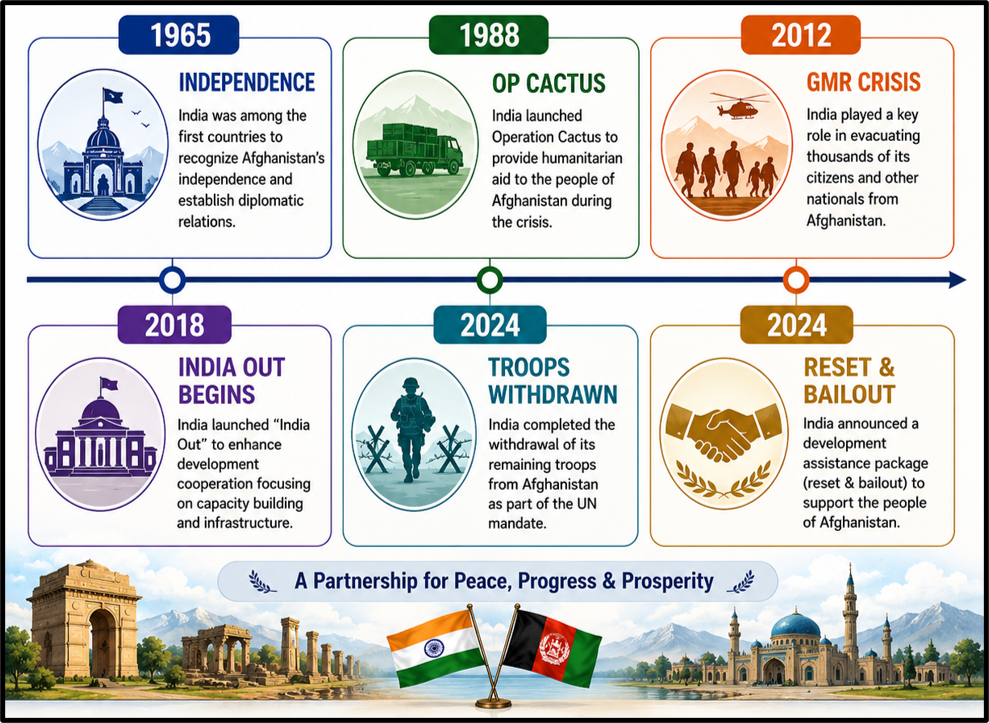
Why Afghanistan Matters to India
| Driver | Significance |
| Countering Pakistan | India’s foremost interest: preventing Pakistan from securing ‘strategic depth’ and installing a proxy regime that could train and turn militants against India, especially in Kashmir. |
| Gateway to Central Asia | A landlocked crossroads connecting South, Central and West Asia; India’s access runs through Iran’s Chabahar port, bypassing Pakistan, toward Central Asia’s energy and markets. |
| Counter-terrorism | Afghanistan is a historic hub of radical ideology, the opium trade and groups (Al-Qaeda, ISKP, LeT, JeM) whose spillover threatens Indian security. |
| Energy & minerals | A key transit for the TAPI gas pipeline; an estimated USD 1 trillion in untapped minerals (copper, iron, lithium). |
| Great-power balance | Denying China (via CPEC extension and mining deals) and Pakistan an uncontested grip on a strategically pivotal state. |
| Regional leadership | Success in Afghanistan is a ‘litmus test’ of India’s ability to act as a regional stabiliser and net security provider. |
India’s Development Partnership: Soft Power in Action
India’s signature contribution has been development, not deployment. Since 2001 it has invested over USD 3 billion in more than 400 projects spanning every province, earning deep goodwill among ordinary Afghans. This ‘hearts and minds’ strategy is India’s principal instrument of influence.
| Flagship Indian Projects in Afghanistan Afghan Parliament building in Kabul — a symbol of India’s commitment to Afghan democracy (a block named for Vajpayee). Afghan–India Friendship Dam (Salma Dam) — a 42 MW hydro-and-irrigation project in Herat, inaugurated in 2016. Zaranj–Delaram Highway — a 218 km road linking Afghanistan to Iran’s Chabahar port, bypassing Pakistan. Air Freight Corridor (2017) — direct India–Afghanistan cargo flights defeating Pakistan’s transit blockade. Humanitarian aid — wheat, medicines, school-feeding for 2 million children, COVID vaccines, and scholarships/ITEC training for Afghan students and officials. |
India also concluded a Strategic Partnership Agreement (2011)—its first with any country—and Modi received Afghanistan’s highest honour, the Amir Amanullah Khan Award (2016).
Cricket and Bollywood remain powerful soft-power bridges.
The Pakistan Factor and the Regional Great Game
The India–Afghanistan relationship cannot be understood apart from Pakistan. Islamabad views Afghanistan through the prism of its rivalry with India, seeking ‘strategic depth’ and treating any Indo–Afghan closeness as encirclement.
Pakistan has blocked India’s overland transit to Afghanistan, sponsored the Haqqani Network (behind attacks on the Indian embassy in 2008 and 2009), and long nurtured the Taliban.
This forced India to build an alternative route via Iran (Chabahar) and to align with Russia and Iran—all wary of Sunni-extremist and Pakistani dominance. The wider ‘Great Game’ now pits shifting coalitions: China (mining, potential CPEC extension, Xinjiang security), Russia, and Iran each jockey for influence, while India relies on patient, development-led diplomacy and platforms like the Heart of Asia (Istanbul) Process.
The 2021 Taliban Takeover: India’s Dilemma
The Taliban’s return in August 2021 was a strategic setback. India, which had bet on the democratic republic, evacuated its embassy and saw its projects imperilled. The takeover raised acute concerns:
- Security — fears that Afghan soil would again host anti-India groups (LeT, JeM, ISKP) and fuel the drug trade affecting Punjab.
- Pakistan’s apparent gain — the Taliban seen as Islamabad’s ‘patron saint’ triumph (though Afghan–Pakistan ties have since soured badly).
- China’s opening — Beijing’s mining deals and diplomatic outreach threatening to fill the vacuum.
- Human rights — the Taliban’s harsh rule, especially the ban on girls’ education, complicating any engagement.
India’s Pragmatic Recalibration (2022–2025)
Rather than disengage, India has undertaken a striking policy shift: abandoning its old refusal to deal with the Taliban in favour of cautious, pragmatic engagement without formal recognition.
The logic is hard-headed—to protect its investments, retain a foothold against China, and exploit the collapse in Afghan–Pakistan relations (Pakistani airstrikes and refugee expulsions have alienated the Taliban from Islamabad).
| The Engagement Timeline June 2022 — India reopened a ‘technical mission’ in Kabul to oversee humanitarian aid. January 2025 — Foreign Secretary Vikram Misri met Taliban acting FM Muttaqi in Dubai; Jaishankar followed with a phone call in May. October 2025 — Muttaqi made the first visit by a Taliban leader to India, during which India announced it would upgrade its Kabul technical mission to full embassy status. India continues humanitarian aid (wheat, medicines) and ₹100 crore in grants for 2025–26, while withholding formal recognition (Russia became the first state to recognise the Taliban, in 2025). |
The essence of the shift: India will not cede Afghanistan to Pakistan or China by default. Engagement lets New Delhi seek security guarantees in exchange for development aid, keep humanitarian channels open, and preserve its long-cultivated goodwill—all without endorsing the regime’s record.
Challenges and Way Forward
Key challenges
- Recognition dilemma — the Taliban’s human-rights record (girls’ education ban) bars full diplomatic recognition.
- Terrorism and drugs — the presence of ISKP, Al-Qaeda and opium-funded networks remains a serious threat.
- Chinese influence — a possible CPEC extension into Afghanistan could squeeze India’s space.
- Connectivity risk — Chabahar’s value depends on US–Iran tensions and Iran’s own tilt toward China.
Way forward
- Deepen humanitarian aid and resume infrastructure and education projects to sustain goodwill.
- Engage the Taliban pragmatically — trade continued aid for verifiable security guarantees on terror.
- Leverage Chabahar and TAPI to anchor connectivity to Central Asia through an ‘Act West’ approach.
- Cooperate regionally — coordinate with Iran, Russia, Central Asian states and even China where interests align on stability.
- Adopt a realistic, proactive posture — as scholars note, acknowledge India’s limited leverage but shape outcomes through targeted diplomacy and mediation.
Conclusion
India’s Afghan policy embodies the promise and the limits of its regional power. For two decades, development diplomacy bought India genuine affection among Afghans but few strategic guarantees—and the 2021 Taliban takeover exposed how much depends on forces beyond India’s control.
Yet India has adapted with characteristic pragmatism: neither recognising the Taliban nor abandoning Afghanistan, but engaging to protect its interests as Pakistan’s grip loosens and China circles.
The October 2025 outreach and the embassy upgrade signal a mature, interest-driven diplomacy. How India manages this fragile, high-stakes theatre—balancing values, security and connectivity—remains, as ever, a litmus test of its arrival as a global power.