
Modern Ethical Conundrums
Introduction
Imagine you are in a courtroom of ethics. On one side sit ancient religious traditions, centuries-old social customs, and time-tested natural laws. On the other side sit scientific discoveries, expanding human rights, and the relentless march of technology. This section is the proceedings of that courtroom — where old certainties meet new realities, and where the jury is still out on some of the most pressing moral questions of our time.
This chapter applies the discipline of Applied Ethics — which means we are not just theorising in the abstract, but using ethical tools (consequentialism, Kantian deontology, natural law, and contractarianism) to analyse real, concrete moral problems that affect real human lives. These are problems that have entered the public discourse in India and worldwide, and they are fair game for UPSC’s Paper 4.
The Four Ethical Lenses — Your Analytical Toolkit
Think of these four frameworks as four different camera lenses. Each reveals something the others might miss. A sophisticated UPSC answer uses at least two or three of these lenses on any ethical problem.
| Framework | Core Question | In Plain English |
| Consequentialism / Utilitarianism | What produces the greatest good for the greatest number? | Judge the action by its outcomes. The ends can justify the means — but look at all the consequences. |
| Kantian Deontology | Is this universalisable? Does it treat persons as ends, not means? | Some actions are intrinsically right or wrong regardless of consequences. Rules and duties matter. |
| Natural Law | Is this in conformity with nature and human reason? | Humans have an inherent purpose and nature. What violates that purpose is immoral. |
| Contractarianism | What rules would free and rational people agree to behind a veil of ignorance? | Justice is what we would choose if we did not know our own place in society (Rawls). |
Homosexuality & LGBTQ+ Rights
Setting the Stage: What Are We Talking About?
Here is a question to begin with: If two adults, of the same sex, in the privacy of their home, engage in a consensual relationship — does the State have any business interfering? For centuries, the answer in most societies was ‘yes’. Today, that answer is undergoing a fundamental revision. This is the essence of the homosexuality debate.
| Term | Meaning |
| Homosexual / Gay | A man sexually attracted to other men |
| Lesbian | A woman sexually attracted to other women |
| Bisexual | Attracted to both men and women |
| Transgender | Gender identity does not match sex assigned at birth (separate from sexual orientation) |
| LGBTQ+ | Lesbian, Gay, Bisexual, Transgender, Queer, and other sexual/gender minority identities |
| Sexual Orientation | The direction of emotional and sexual attraction — this is what this section is about |
Historical and Global Context
‘History is not a fixed story — it is a conversation between the past and the present.’ Homosexuality has existed in every culture and civilisation across recorded human history. Ancient Greece celebrated it; medieval Christianity condemned it. The American Psychiatric Association removed it from the list of mental disorders as far back as 1973.
Today, countries like the USA (Obergefell v. Hodges, 2015), UK, Canada, Germany, France, South Africa, and Australia legally recognise same-sex marriages. Yet, as of 2026, it remains criminalised in approximately 64 countries. The debate is not settled globally.
Arguments Against Homosexuality
| Arguments Against (Pro-Prohibition) | Arguments For (Pro-Rights) |
| Natural Law: Homosexuality frustrates the biological purpose of sex (procreation) and violates the natural moral order. | It is a natural variation in sexual orientation with biological and genetic components — not a pathology. |
| Religious Traditions: The Bible, Quran, and certain strands of Hinduism condemn same-sex relations. | No divine commands can be empirically verified. A secular state cannot legislate based on any one religion’s tenets. |
| Threatens the Family: Marriage between man and woman is the foundational building block of stable society. | The Harm Principle (J.S. Mill): Only acts harming others can be lawfully prohibited. Consensual adult acts harm no one. |
| Public Health: Homosexuals are classified as a high-risk group for HIV/AIDS — a public health concern. | Homosexuals are human beings. Their sexual orientation, which they do not choose, cannot bar their right to dignity and equality. |
| Minority Practice: A minuscule minority has no claim to legal equivalence with the majority. | Research from countries with same-sex marriage shows no harm to heterosexual families. The ‘threat to family’ argument is empirically unsustainable. |
The Indian Legal Journey — A Flowchart
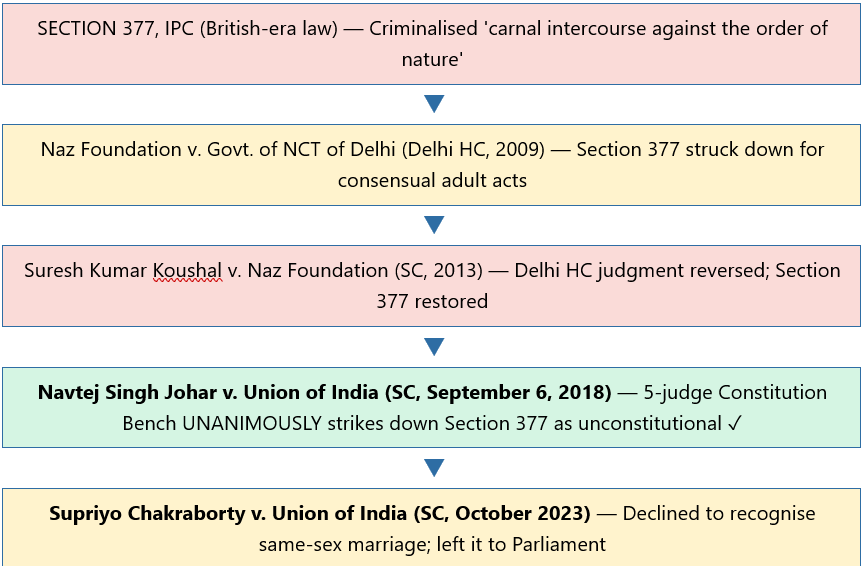
| Key Point | Detail |
| Articles Violated by Section 377 | Article 14 (Equality), Article 15 (non-discrimination), Article 19 (Freedom of expression), Article 21 (Life and Liberty) |
| What Section 377 still covers | Non-consensual acts between adults; sexual acts involving minors |
| Petitioners in Navtej Singh Johar | Navtej Singh Johar (dancer), Sunil Mehra (journalist), Ritu Dalmia (chef), and others |
| Current legal status | Consensual same-sex activity between adults = FULLY LEGAL. Same-sex marriage = NOT recognised. |
| Ethical Framework | Key Principle | Verdict on the Issue |
| Consequentialism | Criminalisation causes more harm (stigma, depression, HIV-spread) than good | Supports decriminalisation |
| Kantian Ethics | Persons must be treated as ends. Criminalising innate identity = treating persons as means | Supports decriminalisation |
| Natural Law | Sexual acts for non-procreative purpose violate nature’s telos | Opposes (traditional view) |
| Contractarianism | Behind veil of ignorance, not knowing one’s orientation, we’d protect all orientations equally | Supports decriminalisation |
| 🔑 MODERATE VIEW (Balanced Answer for UPSC) The State has no legitimate interest in criminalising consensual sexual acts between adults in private. The right to sexual autonomy flows from Article 21. The 2018 judgment correctly vindicates this. However, the question of same-sex marriage involves complex social and legal considerations — Parliament is the appropriate arena. In the interim, same-sex couples should receive legal protection for healthcare decisions, shared property, and inheritance through suitable legislation. |
Transgender Rights
Orientation vs. Identity — A Crucial Distinction
Before we begin, let us draw a line that many people blur. Sexual orientation (the subject of Section 1) is about who you are attracted to. Gender identity (the subject of this section) is about who you are — whether you feel yourself to be male, female, both, or neither. These are entirely separate questions. A transgender woman may be heterosexual, homosexual, or bisexual — her sexual orientation is a separate matter from her gender identity.
| Concept | Meaning | Example |
| Sex Assigned at Birth | Biological classification as male or female at birth | Born with male anatomy → assigned male at birth |
| Gender Identity | Internal, deeply felt sense of one’s own gender | A person assigned male at birth but identifies as a woman → transgender woman |
| Gender Expression | External presentation through clothing, behaviour, etc. | May or may not match gender identity |
| Cisgender | Gender identity matches sex assigned at birth | Born female, identifies as a woman |
| Transgender | Gender identity differs from sex assigned at birth | Born male, identifies as a woman or as non-binary |
The Indian Context: Hijras and Social Marginalisation
India has a complex, centuries-old relationship with transgender persons. The hijra community historically occupied religious and ceremonial roles — they were present at royal births, weddings, and auspicious occasions. Yet severe social stigma ran alongside this ceremonial role.
Today, transgender persons in India face disproportionately high rates of poverty, unemployment, violence, and mental health challenges. This reality of structural injustice — not just individual prejudice — makes legal protection not merely desirable but constitutionally imperative.
The Transgender Persons (Protection of Rights) Act, 2019
- A ‘transgender person’ is one whose gender does not match the gender assigned at birth, including trans-men, trans-women, intersex persons with gender variations, and gender-queers: Definition
- Transgender persons have the right to be recognised as their self-perceived gender identity: Right to Self-Perceived Gender Identity
- District Magistrate issues identity certificates. Revision allowed post sex-reassignment surgery under Section 7: Certificate of Identity (Section 6 & 7)
- Prohibition of discrimination in education, employment, healthcare, and access to goods, services, and public places: Anti-Discrimination
- Forced labour, harm, or abuse against transgender persons: imprisonment from 6 months to 2 years: Penalties
- Inclusion in welfare schemes; National Council for Transgender Persons to be established: Welfare Measures
Recent Developments — A Timeline
| Year | Event | Significance |
| 2019 | Transgender Persons Act enacted | First comprehensive legislation for transgender rights in India |
| 2024–25 | Karnataka HC ruling | Transgender Persons Act prevails over Registration of Births & Deaths Act; name/gender change on birth certificates without surgery |
| 2024–25 | Andhra Pradesh HC | Similar ruling reinforcing self-identification rights |
| 2025 | Jane Kaushik v. Union of India (SC) | Reaffirmed self-identification without surgery; established ‘omissive discrimination’ and ‘reasonable accommodation’ doctrines for employment. |
| 2026 | Proposed Amendment Bill | Seeks to narrow definition to socio-cultural identities (kinner, hijra, aravani) — widely criticised as regressive |
Key Ethical Debates
| Debate | Two Sides |
| Self-Identification vs. Medical Certification | Human rights view: requiring surgery before recognition is coercive, violates bodily autonomy, and pathologises transgender identity. Medical view: physical alignment provides objective basis for legal recognition. The SC (2025) endorsed self-declaration as the standard. |
| Gender-Affirming Care for Minors | Pro: Withholding treatment causes severe psychological harm to gender-dysphoric adolescents. Against: Children’s decision-making capacity is insufficient for irreversible medical decisions. India’s law does not yet address this specifically. |
| The 2026 Amendment Bill | Narrowing the definition to specific socio-cultural identities would exclude many transgender persons from statutory protection — a step widely condemned as regressive and unconstitutional. |
| 🔑 MODERATE VIEW (Balanced Answer for UPSC) The State should provide legal recognition of gender identity based on self-declaration by adults — no surgical intervention should be required. Anti-discrimination protections must be actively enforced, and the proposed 2026 amendment narrowing the definition should be rejected as regressive. For gender-affirming care for minors, a cautious approach involving comprehensive psychological assessment, parental involvement, and case-by-case judicial oversight is appropriate. |
Abortion
The Biology You Need to Know
The abortion debate begins with a biological question: when does a human life begin? Different stages of foetal development attract different moral intuitions. Let us first map that biological journey — because the ethics flows from it.
| Stage | Timeframe | Key Features |
| Zygote | 1–3 days after fertilisation | Ovum + sperm = unique genetic code (46 chromosomes). Life as a distinct genetic entity begins here. |
| Blastocyst | 2nd day to end of 2nd week | Cluster of cells; attaches to uterine wall at end of week 2 |
| Embryo | Week 3 to Week 8 | Major organs begin forming; no conscious experience |
| Foetus | Week 9 until birth | Increasingly complex; from week 13–20: quickening (mother feels movement) |
| Viability | From approximately Week 24 | Foetus can potentially survive outside the uterus with medical support |
The Core Ethical Tension: Two Rights in Collision
| 🔑 THE CENTRAL CONFLICT Pro-Life: The foetus has a right to life from conception, which overrides all other considerations. Pro-Choice: The woman has an absolute right over her own body, including whether to continue a pregnancy. Both are rights-based arguments — which right prevails, and when, is the crux of the debate. |
| PRO-LIFE Arguments (Against Abortion) | PRO-CHOICE Arguments (For Abortion Rights) |
| Life begins at conception. From fertilisation, a unique human organism with its own genetic code exists. Abortion at any stage terminates a human life. | Women have absolute rights over their bodies, including procreative rights. No state or religion can compel a woman to continue a pregnancy against her will. |
| The foetus has an absolute right to life. Its sanctity demands respect at every stage of human existence. | An early embryo is not a ‘person’ in the morally relevant sense. Personhood requires consciousness, capacity to feel pain, reasoning, and self-awareness. |
| Abortion procedures are physically and psychologically harmful. Alternatives like adoption exist. | Restrictive laws force poor women into dangerous illegal abortions. Access to safe, legal abortion is a public health imperative. |
| Most religions oppose abortion. Contraception is widely available — use it responsibly. | In cases of rape, incest, foetal abnormalities, or health threats to the mother, abortion may be the only viable option. |
| Devaluing early human life erodes respect for human life in general. | Historically, strict abortion laws arose from patriarchal mindsets. The decision belongs to the woman alone. |
Indian Law: MTP Act and Its Evolution
The Medical Termination of Pregnancy (MTP) Act, 1971 was enacted to provide a legal framework for abortion in India, aiming to reduce maternal mortality and morbidity caused by unsafe abortions and to protect women’s reproductive rights (India Code, 1971).
The Act allows registered medical practitioners to terminate pregnancies under defined circumstances, balancing medical, ethical, and social considerations.
| Legislation | Key Provisions | Status |
| MTP Act, 1971 (Original) | Up to 12 weeks: 1 doctor’s opinion. 12–20 weeks: 2 doctors’ opinions. Grounds: health risk, foetal abnormalities, rape, contraceptive failure (married women only). | Superseded in key respects by 2021 Amendment |
| MTP (Amendment) Act, 2021 (in force from Sep 24, 2021) | Upper limit extended to 24 weeks for special categories: rape survivors, minors, differently-abled women, women whose marital status changes. No upper limit for substantial foetal abnormalities (Medical Board decides). Contraceptive failure clause extended to unmarried women. Confidentiality clause added. | CURRENT LAW |
| Pre-Conception and Pre-Natal Diagnostic Techniques (PCPNDT) Act, 1994 | Prohibits sex determination before birth. Strictly regulates ultrasound use. Violations are cognisable and non-bailable. | CURRENT LAW |
| 🔑 GLOBAL CONTEXT: Dobbs v. Jackson (USA, 2022) In June 2022, the US Supreme Court overturned Roe v. Wade (1973) — eliminating the constitutional right to abortion that had existed for nearly 50 years. This landmark reversal shows that abortion rights are not permanently secured even in established liberal democracies. Over a dozen US states promptly banned or severely restricted abortion. The lesson: law reflects power, and power can shift. |
| Ethical Framework | Key Principle | Verdict on the Issue |
| Consequentialism | Maximise welfare of all — including avoiding harms of unsafe illegal abortions, maternal death, unwanted children | Generally pro-choice, with nuance |
| Kantian Ethics | Treats the foetus as an end (pro-life) BUT ALSO: forcing women to continue pregnancies treats them as means (pro-choice). Tension is unresolved by Kant himself. | Contested — both sides use Kant |
| Natural Law | Sexual intercourse is ordered toward procreation; abortion frustrates this natural purpose | Pro-life (traditional) |
| Contractarianism | Behind veil of ignorance: not knowing if born as a woman facing unwanted pregnancy, we’d want the option of safe abortion | Pro-choice |
| 🔑 MODERATE VIEW (Balanced Answer for UPSC) A defensible position respects both the evolving moral status of the foetus and women’s bodily autonomy. Early abortions (pre-viability) are morally distinct from late-term abortions. The 2021 Amendment’s framework — 24-week limit for vulnerable categories, no limit for severe foetal abnormalities, extension to unmarried women — represents a progressive step toward a rights-based framework. Sex-selective abortion remains an ethical crisis requiring vigorous enforcement of the PCPNDT Act. |
Cloning
What is Cloning? — Starting Simple
A clone is an exact genetic copy of a living organism. Before your mind goes to science-fiction, note this: cloning happens in nature all the time. Bacteria reproduce by cloning themselves. Identical twins are natural clones. What science has done is figure out how to do this deliberately — and that is where the ethics begins.
| Type of Cloning | What Happens | Ethical Status |
| Reproductive Cloning | Creating a genetically identical new human being. Dolly the sheep (1996) — first mammal cloned from adult somatic cell. | Universally prohibited internationally |
| Therapeutic Cloning | Creating embryos to harvest stem cells for medical treatment. No new person is created — but embryos are created and destroyed. | Permitted for limited research in some jurisdictions; ethically contested |
| Natural Cloning | Bacteria cell division; identical twins | Morally unproblematic |
| Arguments IN FAVOUR of Cloning | Arguments AGAINST Cloning |
| Advances understanding of how traits are shaped by genetics vs. environment. | Reproductive cloning treats human beings as manufactured products rather than as ends in themselves (Kant). |
| Therapeutic cloning can generate genetically matched replacement tissues, eliminating immune rejection in transplants. | The ‘open future’ argument: a clone’s individuality is compromised by knowing the original’s life history. |
| Reproductive cloning could offer infertile couples a genetically related child. | Could lead to alarming social engineering — designing humans for specific social or military roles (Huxley’s Brave New World). |
| Preserves genetic material from endangered species. | Reduces genetic diversity of the human species, increasing vulnerability to disease. |
| Therapeutic cloning has genuine medical promise. | Therapeutic cloning requires creating and destroying embryos — same moral issue as abortion debate about the status of early human life. |
| 🔑 MODERATE VIEW (Balanced Answer for UPSC) Reproductive human cloning should remain prohibited — it treats human life instrumentally and raises profound concerns about human dignity. Therapeutic cloning for specific medical purposes may be permitted within a strict regulatory framework that treats embryonic research as requiring exceptional justification. The guiding principle: scientific advance must not come at the cost of human dignity. |
Gene Therapy, CRISPR & Stem Cells
Gene Therapy: Fixing the Code of Life
Think of human DNA as a book with three billion letters. Gene therapy is the art of finding and correcting ‘typos’ in that book — typos that cause diseases like cystic fibrosis, sickle cell anaemia, haemophilia, and Huntington’s disease. There are two kinds of gene therapy, and the ethical stakes are very different for each.
| Type | What it does | Who is affected | Ethical Concern Level |
| Somatic Gene Therapy | Modifies non-reproductive cells (e.g., blood cells, liver cells) | Only the individual patient | Lower — changes do not pass to future generations |
| Germline Gene Therapy | Modifies reproductive cells (eggs, sperm) or embryos | All future generations of the individual’s descendants | Very High — permanent, heritable, consent of future generations impossible |
The CRISPR Revolution — Precision Editing at Scale
In 2012, Emmanuelle Charpentier and Jennifer Doudna developed CRISPR-Cas9 — a tool that can find a specific sequence of DNA and cut it with extraordinary precision. This won them the 2020 Nobel Prize in Chemistry.
Think of it as ‘find and replace’ for the genome — vastly cheaper, faster, and more accurate than earlier techniques. CRISPR has transformed gene therapy from a distant dream to an approved clinical reality.
| Milestone | Date | Details | Significance |
| He Jiankui Case | Nov 2018 | Chinese scientist created world’s first gene-edited human babies (twin girls, CCR5 gene edited to resist HIV) without ethical oversight. Sentenced to 3 years in prison (2019). | Cautionary tale: science without ethics is dangerous. Global call for moratorium on heritable human genome editing. |
| Casgevy Approved | Nov–Dec 2023 | UK and US approved Casgevy (exagamglogene autotemcel) by Vertex/CRISPR Therapeutics for sickle cell disease and beta-thalassaemia. | World’s FIRST approved CRISPR-based gene therapy — historic milestone. |
| BIRSA 101 (India) | 2025 | India’s first indigenous CRISPR therapy for sickle cell disease, developed by CSIR-IGIB. Named after Bhagwan Birsa Munda. Technology transfer to Serum Institute for affordable production. | Addresses access equity: Casgevy costs ~USD 2.2 million; BIRSA 101 aims to be affordable for tribal populations. |
Ethical Issues in Gene Therapy and CRISPR
- Gene therapy is in clinical trial stages for most conditions. Patients often participate out of desperation — is consent truly voluntary in such circumstances: Safety and Informed Consent
- Using germline editing for enhancement (intelligence, appearance, athleticism) raises concerns about eugenics and commodification of children: Designer Babies
- Modifications to the germline affect all future generations — whose consent do we have? None.: Germline Editing
- Casgevy costs USD 2.2 million per patient — inaccessible to most in developing countries where the disease is most prevalent. BIRSA 101 directly addresses this justice gap.: Access Equity
- Genetic data is valuable. Discrimination by employers and insurers based on genetic profiles is a real and growing risk.: Genetic Privacy
Stem Cells: The Body’s Raw Material
| Type | Source | Capability | Ethical Status |
| Embryonic Stem Cells (ES cells) | Inner cell mass of embryo at ~day 6 — embryo is destroyed in the process | Pluripotent: can become ANY cell type in the body | Ethically contested: same moral status question as abortion |
| Induced Pluripotent Stem Cells (iPSCs) | Adult cells reprogrammed to pluripotent state — Shinya Yamanaka, Nobel Prize 2012 | Same capabilities as ES cells | Much less ethically contested — no embryo destroyed |
| Adult Stem Cells | Bone marrow, blood, skin | Limited range of cell types | Ethically uncontested |
| 🔑 MODERATE VIEW (Balanced Answer for UPSC) Somatic gene therapy for disease treatment is ethically sound. Germline editing for therapy should be subject to a strict moratorium until the science is safe and governance frameworks are robust. Germline editing for enhancement is ethically unacceptable — it is eugenics by another name. India’s BIRSA 101 embodies the principle of access equity — the right approach is to ensure that life-saving therapies are not the exclusive preserve of the wealthy. |
Surrogacy
What is Surrogacy?
Surrogacy is when a woman (the surrogate mother) carries and gives birth to a child on behalf of another person or couple (the intending parents). For years, India was the world’s largest commercial surrogacy market — ‘the surrogacy capital of the world.’
This brought both economic opportunity and profound exploitation. The law has now radically changed that landscape.
| Type | Meaning | Indian Legal Status |
| Altruistic Surrogacy | Surrogate receives no payment beyond medical expenses and insurance | PERMITTED under the 2021 Act |
| Commercial Surrogacy | Surrogate is paid for her reproductive services | PROHIBITED under the 2021 Act |
The Surrogacy (Regulation) Act, 2021 — Key Provisions
- Regulation of surrogacy:
- Prohibits commercial surrogacy but allows altruistic surrogacy.
- Provides for compulsory registration of surrogacy clinics.
- Surrogacy is permissible when it is,
- for intending couple having a medical indication necessitating gestational surrogacy
- for altruistic surrogacy purposes
- not for producing children for sale, prostitution or any other form of exploitation.
- for any condition or disease specified through regulations.
- Eligibility criteria for surrogate mother
- A willing & married woman between the ages of 25 to 35 years having a child of her own.
- No woman shall be a surrogate mother more than once in her lifetime.
- Should possess a certificate of medical and psychological fitness for surrogacy from a registered medical practitioner.
- Eligibility criteria for couples: The intending couple should have a ‘certificate of essentiality’ and a ‘certificate of eligibility’ issued by the appropriate authority.
| Certificate of Essentiality for Intended Couple | Certificate of Eligibility for Intended Couple |
| Certificate of proven infertility of one or both members of the intending couple, issued by a District Medical Board. | Age Criteria: Wife should be 23–50 years and husband should be 26–55 years. |
| Order of parentage and custody of the surrogate child passed by a Magistrate’s Court. | The couple must not have any surviving child (biological, adopted, or through surrogacy), except where the existing child is mentally or physically challenged or suffers from a life-threatening disorder. |
| Insurance coverage for the surrogate mother for a period of 36 months, covering postpartum delivery complications. | — |
- Under the act, an Indian woman who is a widow or divorcee between the ages of 35 to 45 years can also avail the surrogacy, subject to the fulfilment of other conditions.
- Rights of surrogate child: Child born out of surrogacy is deemed to be a biological child of the intending couple or intending woman with entitlement to all the rights and privileges available to a natural child.
- Prohibition of abortion: No person, organisation, surrogacy clinic, laboratory or clinical establishment of any kind shall force the surrogate mother to abort at any stage of surrogacy except in such conditions as may be prescribed.
Amendments — The Law is Evolving
The 2024 Amendment to Surrogacy (Regulation) Rules, 2022 allow surrogacy using a donor gamete. Benefits of this provision could be availed if District Medical Board certifies that either of the intending couples suffers from a medical condition necessitating the use of a donor gamete.
Three Core Ethical Concerns
| Concern | The Worry | Counter-argument |
| Exploitation | Economic vulnerability may compel women to ‘rent their wombs’ even in ‘altruistic’ arrangements | Strict regulation, consent procedures, and prohibition of commercial surrogacy reduce — though cannot eliminate — this risk |
| Commodification | Treating reproduction as a commercial transaction reduces children to purchased products | Altruistic surrogacy, when truly voluntary, is an act of profound generosity — a gift of life |
| Identity Concerns | Children born through surrogacy (especially with donor gametes) may face complex questions about their biological origins | Legal transparency, child’s right to know origins, and counselling can address this |
| 🔑 MODERATE VIEW (Balanced Answer for UPSC) Regulated altruistic surrogacy is defensible when it is truly voluntary, fully informed, and properly supervised. The 2021 Act’s prohibition on commercial surrogacy addresses the most serious exploitation concerns. The 2023 and 2024 amendments sensibly widen access while retaining safeguards. The core ethical principle: the surrogate is a person with dignity, not a vessel to be hired. |
Capital Punishment
Why This Debate Never Ends
John Stuart Mill argued in 1868 that the death penalty is the proportionate punishment for the most heinous crimes.
Immanuel Kant said ‘whoever has committed murder must die’ — a demand of pure justice.
Yet today, two-thirds of countries have abolished the death penalty in law or practice. What does that tell us? That the question is not settled by philosophy alone — it is also a question of what kind of state we want to be.
Four Theories of Punishment — Quick Reference
| Theory | Core Logic | Supports Death Penalty? |
| Retribution | Offender deserves to suffer in proportion to harm caused — ‘an eye for an eye’ | Yes — for the gravest crimes |
| Prevention (Incapacitation) | Remove the offender permanently so they cannot offend again | Yes — most permanent form |
| Deterrence | The threat of punishment discourages others from committing crimes | Contested — empirical evidence is weak |
| Reform / Rehabilitation | Punish to reform the offender and return them to society | No — you cannot reform a dead person |
| Arguments AGAINST Capital Punishment | Arguments FOR Capital Punishment |
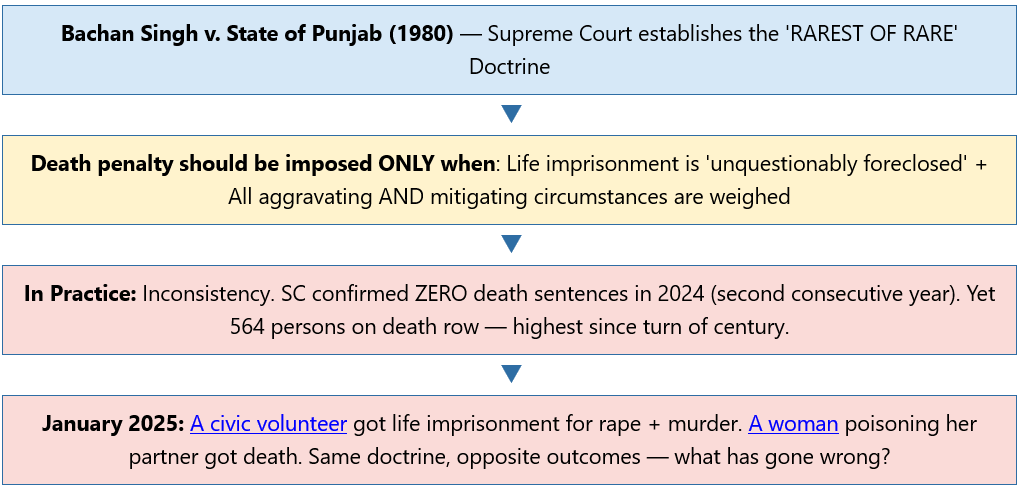
| Irreversibility: No court system is infallible. With 564 people on death row in India (end 2024), the risk of wrongful execution is real and terrifying. | Retributive Justice: Society has the right — and duty — to express moral condemnation of the most depraved crimes. Death alone is proportionate for mass murder. |
| No Deterrent Effect: Statistical evidence from multiple jurisdictions shows death penalty has no greater deterrent effect than long-term imprisonment. Most murders happen in passion, not calculation. | Permanent Prevention: Life imprisonment does not guarantee that murderers cannot harm prison staff, fellow inmates, or the public if ever released. |
| Systemic Bias: Poor and marginalised communities are disproportionately represented on death row. Class and caste bias in the justice system contaminate death row. | The Deterrence Logic: Death is the most severe penalty. Its severity must have some effect on rational criminal calculation. |
| Procedural Failure: Project 39A (NLU Delhi) — in over 90% of trial court death sentences, no information about the accused’s mental health, background, or mitigating circumstances was placed before the court. | Systemic Bias is a Justice System Problem: The remedy is judicial reform, not abolition of the penalty itself. |
| State Sanction of Killing: The death penalty is state-sanctioned killing and degrades the moral standing of the State itself. | Victim’s Families: The grievous nature of the crime demands a punishment commensurate with the loss suffered by victims and their families. |
The Indian Legal Position: ‘Rarest of Rare’
| Statute | Offences Attracting Death Penalty |
| IPC | Murder (Section 302), rape resulting in victim’s death, waging war against the State |
| POCSO Act (amended 2019) | Penetrative sexual assault on child below 12 years |
| NDPS Act | Certain drug offences after prior conviction |
| 🔑 MODERATE VIEW (Balanced Answer for UPSC) The ‘rarest of rare’ doctrine is sound in principle but has failed in practice — its inconsistent application violates constitutional guarantees of equal treatment. The immediate priority should be procedural reform: ensure mitigating circumstances are always placed before courts. The larger question of abolition deserves a national debate grounded in data, not emotion. A moratorium on executions pending this debate would be defensible. |
Animal Rights
Who Counts in the Moral Community?
Traditional ethics drew the boundaries of moral consideration around human beings. Why? Because Kant grounded moral status in the capacity for reason — and animals, it was assumed, could not reason.
Descartes went further: he believed animals were biological automata — essentially sophisticated machines with no inner life. These assumptions are today under sustained challenge.
| 🔑 The Key Question Peter Singer (Animal Liberation, 1975): ‘The question is not, can they reason? nor, can they talk? But, can they suffer?’ — quoting Jeremy Bentham. Singer popularised the term ‘speciesism‘ to describe unjustified discrimination in favour of the human species — a form of prejudice analogous to racism or sexism. |
| Case FOR Animal Rights | Case AGAINST Formal Animal Rights (Carl Cohen) |
| Animals are sentient beings capable of experiencing pain, fear, joy, and suffering — this is now scientifically established. | Rights are universally human. They arise in a human moral sphere — the capacity to bear moral duties is the basis for rights. Animals cannot bear duties. |
| The criterion of rationality for moral status is arbitrarily drawn. Severely cognitively disabled humans — who also cannot reason — are not excluded from moral protection. Why exclude animals? | Without duties, rights have no foundation. Granting rights to animals would logically prohibit all medical experimentation on animals — devastating human medicine. |
| Our moral community should extend to all beings capable of having a welfare that can be helped or harmed. | While we have duties of humane treatment towards animals, this falls short of formal rights. |
New Developments
| Development | What it means | Ethical Significance |
| Lab-Grown (Cultivated) Meat | Animal cells grown in a bioreactor — no slaughter. Approved in Singapore and USA. | Dissolves traditional objections to meat-eating: no killing, vastly reduced environmental impact. A potential technological resolution to the ethics of meat. |
| Legal Personhood for Natural Entities | Uttarakhand HC (2017): Ganga and Yamuna declared legal persons (SC subsequently stayed this). New Zealand: Whanganui River granted legal personhood by statute. | Expands the concept of legal personhood beyond humans — implications for both environmental protection and animal rights philosophy. |
| 🔑 MODERATE VIEW (Balanced Answer for UPSC) Animals are sentient beings deserving of humane treatment. We have genuine moral duties to minimise their suffering. This falls short of full legal rights but imposes real obligations. Factory farming causing severe, unnecessary suffering should be regulated and progressively phased out. Medical experimentation is justified only when necessary for significant human benefit, using minimum animals with strict pain-minimisation guidelines. Traditional animal sports like Jallikattu — which have deep cultural roots and do not inherently aim at animal death — should be permitted subject to regulatory safeguards. |
Euthanasia & The Right to Die with Dignity
What Does ‘Euthanasia’ Actually Mean?
The word euthanasia comes from the Greek: ‘eu’ (good) + ‘thanatos’ (death). A good death. We are not talking about suicide driven by despair — we are talking about the deliberate ending of a person’s life to relieve unbearable, irremediable suffering in the context of terminal illness or a persistent vegetative state. This is one of the most human ethical questions there is: who has the final say over a person’s death?
| Type | Definition | Indian Legal Status (2026) |
| Active Euthanasia | A positive act (e.g., administering a lethal drug) that causes death | ILLEGAL |
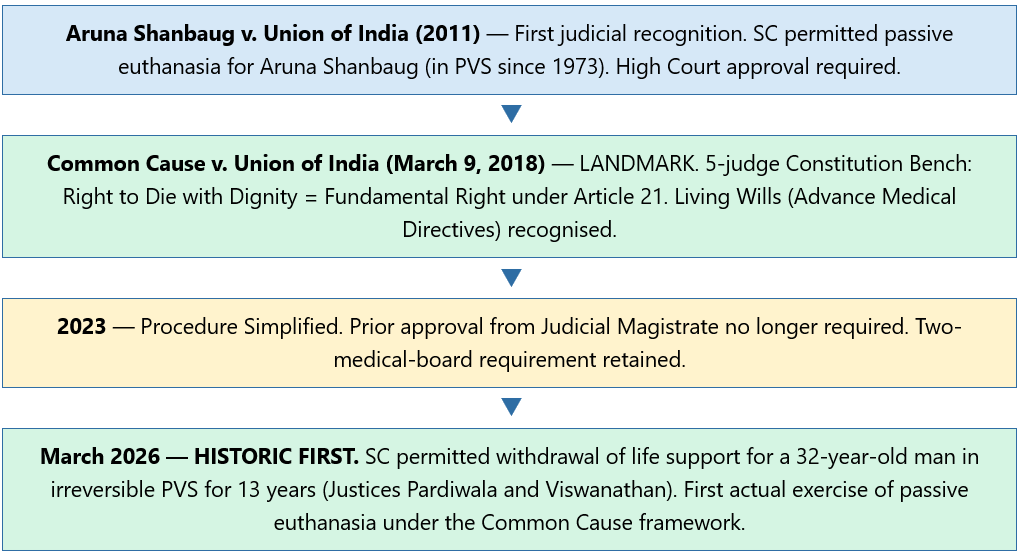
| Passive Euthanasia | Withholding or withdrawing life-sustaining treatment, allowing death to occur naturally | LEGAL with safeguards (Common Cause, 2018) |
| Voluntary Euthanasia | Carried out at the express, informed request of the patient | Only passive form is legal in India |
| Involuntary Euthanasia | Carried out without or against the patient’s consent | UNIVERSALLY condemned — equivalent to murder |
| Non-Voluntary Euthanasia | Patient is incapable of giving consent (e.g., in a coma) | The most common scenario in Indian judicial decisions |
| Physician-Assisted Suicide | Physician provides means; patient administers it themselves | Legal in Switzerland, Canada, some US states — ILLEGAL in India |
The Indian Legal Journey
| Arguments FOR Euthanasia | Arguments AGAINST Euthanasia |
| Respect for Autonomy: Each person has the right to determine their own medical treatment. Forcing a person to remain alive against their expressed wishes violates dignity — a core value of Article 21. | Sanctity of Life: All major religious traditions affirm the absolute sanctity of human life. Euthanasia fundamentally contradicts this. |
| Compassion: Compelling terminally ill patients or those in PVS to remain on machines is cruel and inhumane. | Risk of Abuse: Elderly, disabled, and terminally ill may feel social pressure to choose death to avoid being a burden to their families. |
| Resource Allocation: Prolonging lives with no prospect of recovery consumes enormous medical resources that could save other patients. | Medical Ethics: The Hippocratic principle — primum non nocere (‘first, do no harm’) — prohibits physicians from causing death. |
| Palliative care has limits. For some, pain cannot be adequately managed — the only relief is death. | Slippery Slope: Belgium and Netherlands show euthanasia, once legalised, tends to expand from terminally ill adults to psychiatric cases — a dangerous progression. |
| Country | What is Legal |
| Netherlands, Belgium (since 2002) | Active euthanasia and physician-assisted suicide |
| Canada (MAID, since 2016) | Medical assistance in dying |
| Switzerland | Assisted suicide |
| Oregon, USA (since 1997) | Death with Dignity Act — physician-assisted suicide |
| India (from 2018) | Passive euthanasia only, with two-medical-board safeguards and living wills |
| 🔑 MODERATE VIEW (Balanced Answer for UPSC) The right to die with dignity is a genuine fundamental right — Article 21 protects the quality of life, not merely its existence. Passive euthanasia with appropriate safeguards (two medical boards, family involvement, judicial oversight) is the right approach for India. Active euthanasia and physician-assisted suicide carry greater risks of abuse and should not be legalised at this stage. Living wills should be actively encouraged — every person should have the right to specify, in advance, the medical treatment they wish to receive if they become incapacitated. |
Artificial Intelligence Ethics
Why AI Ethics is the Ethics of Our Epoch
Artificial intelligence is no longer science fiction. It is already inside your phone (face unlock), your bank (fraud detection), your hospital (diagnostic imaging), and — in some countries — your courtroom (sentencing algorithms).
When AI systems take consequential decisions about human lives, at a scale and speed no human institution can match, the ethical questions they raise are among the most consequential of the twenty-first century.
Six Key Ethical Issues in AI
| Issue | The Problem | Real-World Example |
| 1. Algorithmic Bias & Discrimination | AI trained on historical data perpetuates and amplifies existing biases. Invisible, systematic, and massive in scale. | COMPAS algorithm in US courts: systematically over-predicted recidivism for Black defendants. Facial recognition: significantly less accurate for darker skin tones. |
| 2. Autonomous Weapons (LAWS) | Lethal Autonomous Weapon Systems — ‘killer robots’ — select and engage targets without human intervention. No one is accountable when a machine kills. | Who bears criminal responsibility when an autonomous drone kills a civilian? The developer? The deploying army? The algorithm? |
| 3. Deepfakes & Synthetic Media | AI-generated fake videos, audio, and images of real people — used for disinformation, electoral manipulation, sexual abuse imagery. | India’s IT Rules 2021 (amended 2026): platforms must take down deepfakes within 2 hrs. for most sensitive content and 3 hrs. for other unlawful AI generated content. |
| 4. Surveillance AI & Privacy | Mass deployment of AI-powered facial recognition and predictive policing erodes privacy at an unprecedented scale. | Puttaswamy (2017): privacy is a fundamental right. Disproportionate AI surveillance must be constitutionally challenged. |
| 5. Job Displacement & Economic Justice | Automation displaces workers — from factory floors to white-collar jobs. What obligations do corporations and governments owe to displaced workers? | Proposals: robot tax, universal basic income, large-scale retraining programmes |
| 6. The Accountability Gap | When AI causes harm, legal responsibility is unclear. Is the developer liable? The deploying company? The user? | A self-driving car kills a pedestrian. A diagnostic AI misses cancer. Who is responsible? Existing law cannot answer. |
Regulatory Approaches: India vs. EU
| India’s Approach | EU AI Act, 2024 |
| India AI Mission (2024): INR 10,372 crore allocated for AI research, infrastructure, and governance. | World’s first comprehensive AI regulation — enacted 2024. |
| India AI Governance Guidelines (MeitY, November 5, 2025): Seven foundational sutras — Trust, People First, Innovation over Restraint, Fairness & Equity, Accountability, Understandable by Design, Safety & Sustainability. | Risk-based classification: Minimal Risk → Limited Risk → High Risk → Unacceptable Risk (banned). |
| Principles-based approach: leverages existing legal frameworks (DPDP Act, IT Rules) rather than a new AI statute. | Strict requirements for high-risk AI in healthcare, education, employment, law enforcement. |
| AI (Ethics and Accountability) Bill, 2025: Private Member Bill — proposes statutory Ethics Committee, mandatory ethical reviews, bias audits, penalties up to INR 5 crore. Not yet enacted. | Banned applications: social scoring by governments, real-time biometric surveillance in public spaces. |
| Ethical Framework | Key Principle | Verdict on the Issue |
| Consequentialism | AI that amplifies bias causes enormous aggregate harm at unprecedented scale | Strong regulation of high-risk AI is justified |
| Kantian Ethics | AI that treats persons as data points (means) without dignity violates the categorical imperative | Human oversight and dignity must be embedded in AI design |
| Contractarianism (Rawls) | Behind veil of ignorance, not knowing if we’d be a Black defendant judged by a biased algorithm, we’d demand unbiased AI | Risk-based regulation; stricter for high-stakes applications |
| Rights-Based | Privacy (Puttaswamy), dignity, equality (Articles 14, 15, 21) are fundamental rights that AI must not violate | Constitutional floor for AI governance in India |
| 🔑 MODERATE VIEW (Balanced Answer for UPSC) AI has enormous potential to improve healthcare, education, and public administration in India. Blanket prohibition would be counterproductive. But ungoverned AI will embed discrimination and undermine democratic accountability at unprecedented scale. A risk-based regulatory framework — stricter requirements for high-risk applications (criminal justice, healthcare, credit), lighter touch for low-risk innovation — is the most defensible approach. India’s AI Governance Guidelines are a step in the right direction; they must now be backed by legislative force. |
Data Privacy & Digital Rights
Your Data: The New Oil (and Why That’s Worrying)
Think about everything your smartphone knows about you: your location every minute of the day, who you call, what you search, what you buy, what you read, how long you slept, who your friends are, what your political opinions might be. This data, aggregated and analysed, is extraordinarily valuable.
The philosopher Shoshana Zuboff calls the dominant business model of digital platforms ‘surveillance capitalism’ — the commodification of human experience through the relentless accumulation of behavioural data.
Four Core Ethical Concerns with Data
- Users ‘consent’ to data collection through opaque terms of service no one reads. Pre-ticked boxes, bundled consent, and impenetrable language produce nominal, not genuine, consent.: Consent Theater
- When platforms use data to predict and manipulate user behaviour — through curated content and targeted advertising — they undermine autonomous rational agency.: Autonomy
- Individuals lack meaningful ability to know what data has been collected, correct errors, or limit its use.: Power Asymmetry
- The bulk of the world’s data is generated by users in the Global South but monetised by corporations headquartered in the Global North.: Data Colonialism
The Constitutional Foundation: Puttaswamy (2017)
| 🔑 K.S. Puttaswamy v. Union of India (August 24, 2017) A nine-judge Constitution Bench of the Supreme Court UNANIMOUSLY held that the right to privacy is a fundamental right guaranteed under Article 21. This overruled M.P. Sharma (1954) and Kharak Singh (1962). The Court held that privacy encompasses: (a) Informational privacy — the right to control one’s personal data; (b) Bodily integrity; (c) Spatial privacy in one’s home; and (d) Decisional autonomy. This is one of the most significant constitutional judgments in India’s history — and the foundation of all data protection law.’, |
The Digital Personal Data Protection Act, 2023 (DPDP Act)
| Provision | Detail |
| Presidential Assent | August 11, 2023 |
| Substantive Provisions in Force from | May 13, 2027 |
| Scope | Digital personal data processed by data fiduciaries in India + foreign entities serving Indian users |
| Consent Requirements | Must be free, specific, informed, unconditional, and unambiguous. A ‘Consent Manager’ may help users manage consents. |
| Rights of Data Principals (individuals) | Right to access; right to correction and erasure; right to grievance redressal; right to nominate a person in case of death or incapacity |
| Children’s Data | Verifiable parental consent required. Behavioural monitoring and targeted advertising directed at children: PROHIBITED |
| Data Protection Board of India | Independent body to investigate breaches and impose penalties |
| Penalties | Up to INR 250 crore for significant data breaches; INR 200 crore for failure to notify; INR 10,000 for breach of data principals’ duties |
Key Ethical Issues with the DPDP Act
- Privacy policies written by lawyers for regulators, not by communicators for users — genuine reform requires plain-language, granular consent: Consent Theater
- The Act contains broad national security exceptions. The Pegasus spyware controversy showed state surveillance is a live threat — the Act does not adequately address this: State Surveillance Gap
- India’s data localisation provisions raise questions about economic nationalism vs. global data flows: Data Sovereignty
- India’s biometric database enables efficient welfare delivery but creates infrastructure for mass surveillance. Puttaswamy II (2018) upheld Aadhaar with limitations — the tension remains: Aadhaar Tension
| 🔑 MODERATE VIEW (Balanced Answer for UPSC) Digital rights are as fundamental as physical liberty. India’s DPDP Act is a necessary and overdue step — but its effectiveness will depend on the genuine independence of the Data Protection Board, rigorous enforcement of consent requirements, and robust protections against state surveillance alongside corporate surveillance. The state that protects its citizens from corporate data predators must not itself become a data predator. |
Climate Change Ethics
Why Climate Change is an Ethical Problem, Not Just a Scientific One
Consider this: the countries that industrialised first — burning coal, driving cars, cutting forests — are the ones that caused the bulk of greenhouse gas accumulation.
Yet the countries bearing the worst consequences of climate change — coastal nations being swallowed by rising seas, African nations facing prolonged droughts, Small Island States threatened with extinction — are among the lowest historical emitters. This is the moral asymmetry at the heart of climate change. It is not just a scientific or economic challenge. It is a question of justice.
The Ethical Frameworks Applied to Climate Change
| Ethical Framework | Key Principle | Verdict on the Issue |
| Consequentialism | Maximise aggregate welfare — prevent catastrophic harm to billions of people and countless species | Demands strong, immediate climate action |
| Kantian Ethics | Future generations have the same right to a liveable planet as we do; we must act on principles we could universalise across all generations | Duty to future generations; not merely about our own comfort |
| Rights-Based Theory | Right to a clean environment; right to life free from climate-induced disasters | Individual states must act — recognised as fundamental right in India (Ranjitsinh, 2024) |
| Intergenerational Justice (Rawls) | Behind the veil of ignorance, not knowing which generation we would be born into, we would choose principles protecting future persons | Present generations are trustees of the Earth |
Key Concepts: CBDR and Climate Justice
| 🔑 CBDR: Common but Differentiated Responsibilities Enshrined in the UNFCCC (1992) and Paris Agreement (2015): All nations share responsibility for climate change — but responsibility differs based on historical emissions and current capacities. Translation: developed nations, who got wealthy by burning fossil fuels over 200 years, must bear a heavier burden than developing nations currently trying to lift their people out of poverty. |
| India’s Position | Detail |
| Per Capita Emissions | India’s per capita emissions remain far lower than those of developed nations — a powerful moral argument |
| Right to Develop | India has the right to develop economically to lift its citizens out of poverty — same path taken by wealthy nations |
| Historical Obligation | Developed nations must provide promised climate finance and technology transfer — they have not fulfilled these obligations |
| India’s Commitment | 500 GW non-fossil fuel energy capacity by 2030; Net-zero emissions by 2070 |
Landmark Legal Developments
| Case / Event | Year | Significance |
| M.K. Ranjitsinh v. Union of India (SC India) | March 21, 2024 | First recognition in India that the right to be free from adverse effects of climate change is a FUNDAMENTAL RIGHT under Articles 21 and 14. Grounded in Article 48A (DPSP) and Article 51A(g) (Fundamental Duty). Noted ‘legislative vacuum’ — absence of a comprehensive national climate law. |
| ICJ Advisory Opinion on Climate Change | July 2025 | States have LEGALLY BINDING obligations under international law (UNFCCC, Paris Agreement, human rights law) to protect the climate for present and future generations. 133-page opinion expected to shape global climate litigation. |
| Paris Agreement (reference) | 2015 (ongoing) | Legally binding international climate treaty; India is a signatory |
| 🔑 MODERATE VIEW (Balanced Answer for UPSC) India’s position in climate negotiations — insisting on development rights and CBDR while committing to ambitious renewable energy targets — is broadly defensible on climate justice grounds. The ethical obligation is not merely to reduce emissions but to ensure the transition to a low-carbon economy does not exacerbate inequality — between nations or within them. The recognition of a constitutional climate right in Ranjitsinh (2024) provides a powerful domestic tool for accountability. Parliament must fill the legislative vacuum identified by the Supreme Court by enacting a comprehensive national climate change law. |
Terrorism, State Action & Human Rights
Defining Terrorism — And Why Definitions Matter
Terrorism, at its core, is the deliberate targeting of civilians — non-combatants — for political ends. The military strategist Caleb Carr’s definition cuts to the heart:
‘Terrorism is warfare deliberately waged against civilians with the purpose of destroying their will to support either leaders or policies that agents of such violence find objectionable.’
This distinguishes terrorism from armed resistance against combatants. The ethical case against terrorism is not about the political goal — it is about the means.
All Four Frameworks Oppose Terrorism
| Ethical Framework | Key Principle | Verdict on the Issue |
| Consequentialism | Terrorism imposes terrible costs on large civilian populations for the aims of small groups; typically hardens opposition rather than achieving objectives; outcomes are unpredictable | Cannot justify terrorism in practice |
| Kantian Ethics | Killing innocents treats them as mere means for the terrorist’s political goals — a categorical violation of the moral law | Absolute prohibition on targeting civilians |
| Natural Law | Killing of innocents is intrinsically wrong — no just cause can justify unjust means | Absolute prohibition |
| Contractarianism | Terrorist groups place themselves outside the cooperative framework of justice and law, forfeiting the protections of that framework | Terrorism is self-defeating — it abandons the only framework within which rights can be claimed |
New Dimensions of Terrorism in the 21st Century
| New Form | What it is | Ethical Analysis |
| Cyber Terrorism | Attacks on critical national infrastructure (power grids, banking, healthcare, elections) to terrorise or coerce populations | Same moral principles apply: deliberately targeting civilians — even through digital means — is terrorism. India has faced attacks on power infrastructure from state-sponsored actors. |
| Information Warfare / Disinformation | Fabricated news, synthetic media (deepfakes), coordinated social media behaviour to polarise societies and incite violence | Disinformation that causes physical harm (WhatsApp-linked mob violence) is an indirect form of warfare against civilian minds. Democratic challenge: regulating disinformation without stifling free speech. |
| Online Radicalisation | Internet lowers barriers to radicalisation; lone-wolf attacks inspired by online content — no physical network needed | Conventional security intelligence struggles to detect lone-wolf threats; requires a whole-of-society response, not just law enforcement. |
AFSPA: Current Status
| 🔑 Armed Forces Special Powers Act (AFSPA) AFSPA provides special powers to armed forces in ‘disturbed areas’: arrest without warrant, search premises, use force up to the point of causing death to maintain public order. Army officers receive legal immunity for acts done in good faith. Current Status (2025-26): • Manipur: AFSPA reimposed across most of the state (October 2024) following severe Meitei-Kuki-Zo ethnic violence from May 2023 (260+ deaths, thousands displaced) • Nagaland and parts of Arunachal Pradesh: AFSPA extended for 6 months from October 2025 Key SC Judgment: Extra-Judicial Execution Victim Families Association v. Union of India (2016): AFSPA immunity does NOT extend to acts in excess of what the law authorises. Every death caused by armed forces in a disturbed area must be investigated. |
| Civil Liberties Perspective (Against AFSPA) | Security Perspective (For AFSPA) |
| AFSPA provides blanket immunity that enables extrajudicial killings and enforced disappearances — documented by the SC itself (2016). | In genuinely disturbed areas, armed forces need the ability to act decisively against non-State armed groups — normal law enforcement powers are insufficient. |
| The lack of accountability violates the right to life (Article 21) and India’s obligations under international human rights law. | Without legal protection, soldiers would face frivolous prosecution for actions taken in good faith under extreme duress. |
| Prolonged imposition of AFSPA in areas like Nagaland (decades-long) suggests it is used to avoid resolving political grievances rather than to address genuine security threats. | The 2016 SC judgment already provides the right balance: immunity exists, but does not extend to excesses. The remedy is better implementation, not repeal. |
| 🔑 Karl Popper’s Paradox of Tolerance Karl Popper argued: ‘Unlimited tolerance must lead to the disappearance of tolerance.’ A society that extends unlimited tolerance even to those who are intolerant — who preach the destruction of democracy — will eventually have its tolerance destroyed. Liberal democracies are not required to extend unlimited tolerance to movements that seek to destroy the very foundations of liberal democracy. This does not mean we suppress all dissent — it means we can and should regulate speech and organisation that directly incites violence or aims to overthrow the constitutional order. |
| 🔑 MODERATE VIEW (Balanced Answer for UPSC) The framework of human rights does not dissolve when terrorism threatens the state. Captured terrorists are entitled to fair trial, freedom from torture, and humane treatment — not as a reward for their behaviour, but because human rights flow from our humanity and are inalienable. However, liberal democracies are not required to be suicidal — strong counter-terrorism measures, including special legal frameworks like AFSPA in genuinely disturbed areas, can be justified. The key test: are measures proportionate? Are they subject to judicial oversight? Is there accountability for excesses? Civil servants must adopt a hard-nosed, realistic approach — neither romanticising terrorism nor sacrificing legitimate civil liberties. |