
Emotional Intelligence
| “Data seeks to feel, knowing that something essential is missing… The lesson of Data’s yearning is that the higher values of the human heart — faith, hope, devotion, love — are missing entirely from the cognitive view. Emotions enrich; a model of mind that leaves them out is impoverished.” — Daniel Goleman |
Think about the character ‘Data’ from Star Trek — a super-intelligent android who can solve any problem, compute any formula, and even write poetry with technical virtuosity. Yet he cannot feel. He lacks the very thing that makes us human. This is the most elegant entry point into understanding Emotional Intelligence (EI) — the concept we are about to explore in depth.
Throughout the history of philosophy, the terms ‘appetites’, ‘passions’, and ’emotions’ were treated as the opposites of ‘reason’, ‘intellect’, and ‘understanding’.
Philosophers saw a sharp dichotomy — a hard wall — between the emotional and the intellectual sides of the human mind. Great saints and moralists saw moral life as a constant war: reason must keep emotions under control.
But as modern thought evolved, we came to appreciate that emotions are not enemies of reason — they are, in many ways, its partners.
| The UPSC Perspective GS Paper IV (Ethics, Integrity & Aptitude) asks you to understand emotional intelligence not just as a psychological concept, but as a practical tool for effective governance, compassionate administration, and ethical decision-making. When you study EI, think: How does this help a civil servant serve the people better? |
Skill Sets Required by Public Servants
Before diving into emotional intelligence itself, it is important to place it in context. A public servant — whether an IAS, IPS, or IFS officer — needs three distinct (though overlapping) sets of skills. Think of these as three pillars that hold up the temple of good governance.
| PILLAR 1 Intellectual Abilities | PILLAR 2 Moral Qualities | PILLAR 3 Emotional Intelligence |
| • Mathematical & Logical Skills • Verbal Communication Skills • Analytical Thinking • Structured Problem Solving | • Core Virtues & Ethics • Codes of Conduct • Integrity & Honesty • Impartiality in Duty | • Self-Awareness & Regulation • Empathy & Social Skills • Motivation & Resilience • Interpersonal Excellence |
Among these three, Emotional Intelligence is the one that has gained enormous significance in the 21st century. Empirical research has repeatedly shown that EI contributes far more than academic intelligence — IQ — to an individual’s success in management, profession, and administration. A UPSC topper with a 99th percentile IQ but zero empathy will be a disastrous administrator. This is the fundamental insight.
Brief Historical Background
The Age of IQ — Intelligence Quotient
For over a hundred years, when people said “intelligent”, they meant only one thing: a high score on an Intelligence Quotient (IQ) test. IQ is a score that measures an individual’s cognitive ability in comparison to the general population, using a standardized scale where 100 is the median score.
| IQ Score | Level of Intelligence | What it Means |
| 90 – 100 | Average / Normal | Most of the population falls here |
| > 130 | Exceptionally High | Gifted; top 2% of population |
| < 70 | Very Poor / Retarded | Significant cognitive challenges |
IQ tests measure several key cognitive abilities. Let us understand what these tests actually capture:
| Ability Tested | What It Measures |
| Spatial | Visualize and manipulate shapes in the mind |
| Mathematical | Solve problems and use logical reasoning |
| Language/Linguistic | Complete sentences; recognize words with missing/rearranged letters |
| Memory | Recall visuals seen or words heard |
| Historical Note: IQ and World War I During World War I, the Stanford psychologist Lewis Terman developed intelligence tests that were extensively used for army recruitment. This created the ‘IQ way of thinking’ — where intelligence was seen as one-dimensional, a monolithic, fixed, innate quality. The Scholastic Aptitude Test (SAT), GRE, and GMAT — even today — reflect this same tradition of measuring purely cognitive intelligence. |
The Core Limitation of IQ: IQ was considered an innate, unalterable, fixed endowment — you were born with it and nothing could change it. Practice might improve the speed of information processing, but not the underlying intelligence. This view, dominant for a century, was eventually challenged — and that challenge is the genesis of Emotional Intelligence.
Howard Gardner — The Revolution of Multiple Intelligences
Howard Gardner, a Harvard educational psychologist, questioned everything. In his groundbreaking book Frames of Mind, he argued: a single type of intelligence is completely inadequate for success in life. He proposed the theory of Multiple Intelligences — identifying seven varieties, of which the last two directly form the foundation of Emotional Intelligence.
| Type of Intelligence | Related Activity | Great Practitioners |
| Mathematical / Logical | Solving structured problems | Newton, Einstein, Raman, Russell |
| Linguistic | Literature and language | Milton, Joyce, Goethe, Tagore |
| Spatial Visualization | Painting, architecture, artistic design | Raphael, Michelangelo, Le Corbusier |
| Kinaesthetic Genius | Physical fluidity — dance, gymnastics | Latynina, Anna Pavlova, Birju Maharaj |
| Musical | Great classical musical compositions | Mozart, Beethoven, Tansen, Thyagaraja |
| Interpersonal ★ | Understanding and working with other people | Mahatma Gandhi, Abraham Lincoln |
| Intrapersonal ★ | Insights into human psyche; inner peace | Sigmund Freud, Aurobindo, Buddha |
(★ = The last two directly constitute Emotional Intelligence)
Gardner’s radical insight was this: interpersonal intelligence (understanding and working with others) and intrapersonal intelligence (understanding oneself) — these are not soft extras. They are genuine, valuable forms of intelligence that lead to success in leadership, governance, and life. This cracked open the door through which Emotional Intelligence walked.
| Howard Gardner on Interpersonal Intelligence “Interpersonal intelligence is the ability to understand other people: what motivates them, how they work, how to work cooperatively with them. Successful sales people, politicians, teachers, clinicians, and religious leaders are all likely to be individuals with high degrees of interpersonal intelligence.” “Intrapersonal intelligence is a capacity to form an accurate, veridical model of oneself and to be able to use that model to operate effectively in life.” |
The Theory of Emotional Intelligence
Salovey & Mayer (1990) — The Founding Theory
Two psychologists, Peter Salovey and John Mayer, proposed the first comprehensive, academic theory of Emotional Intelligence in 1990. They defined EI as the ability to monitor one’s own and others’ emotions, to discriminate among them, and to use this information to guide one’s thinking and actions.
Daniel Goleman — Popularising EI
Daniel Goleman brought Emotional Intelligence to the world at large through his landmark works. He defines EI as consisting of abilities such as being able to motivate oneself, persist in the face of frustration, control impulse and delay gratification, regulate one’s moods, and empathize. He conceptualized EI on the basis of five main aspects.
Goleman’s Five Components — The EI Framework
These five components form the complete architecture of Emotional Intelligence. Together, they cover virtually the whole of one’s personal, social, and official life:
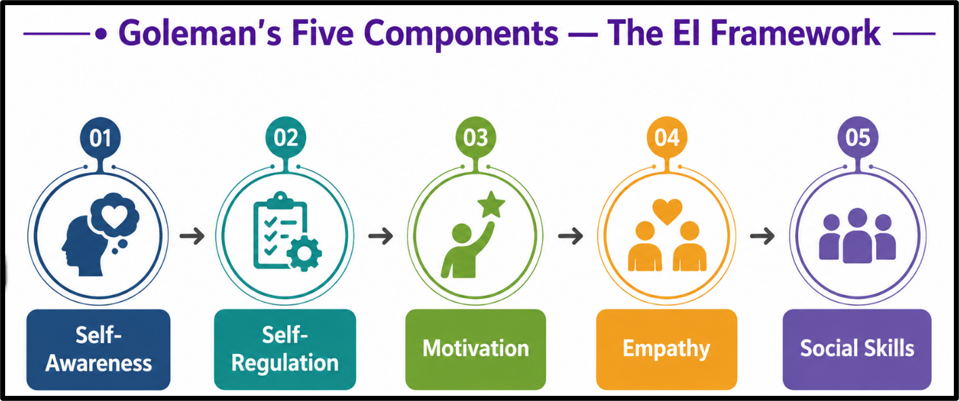
Read this as a progression: Know yourself → Control yourself → Drive yourself → Understand others → Work with others. Each step builds on the previous one.
| 1. SELF-AWARENESS |
| Definition: The ability to accurately assess your own feelings at any given moment and take decisions accordingly. Civil Services Lens: A civil servant who knows their own biases won’t let personal prejudice affect public welfare delivery. |
| 2. SELF-REGULATION |
| Definition: Control over emotions so they help—not hinder—the task; willingness to delay immediate gratification; ability to bounce back from stress. Civil Services Lens: An IAS officer handling a communal tension situation must regulate anger, stay calm, and think strategically. |
| 3. MOTIVATION |
| Definition: Relying on deepest preferences to guide you toward cherished goals; persevering in the face of setbacks and heavy odds. Civil Services Lens: Staying committed to tribal welfare even after transfers to remote areas — this is motivation in action. |
| 4. EMPATHY |
| Definition: The ability to sense what others are feeling; to understand their perspective; to adapt to diverse groups of people. Civil Services Lens: Translating government schemes to a poor, illiterate villager requires empathy, not just knowledge of the scheme. |
| 5. SOCIAL SKILLS |
| Definition: Handling emotions in relationships, reading social situations accurately, leading, persuading, negotiating, and promoting team work. Civil Services Lens: Managing inter-departmental conflicts, inspiring a demoralized team — all require strong social skills. |
Changing Business Environment & EI
Why has Emotional Intelligence become so critical today, especially in organizations? The answer lies in a fundamental transformation of the work environment driven by two twin forces:
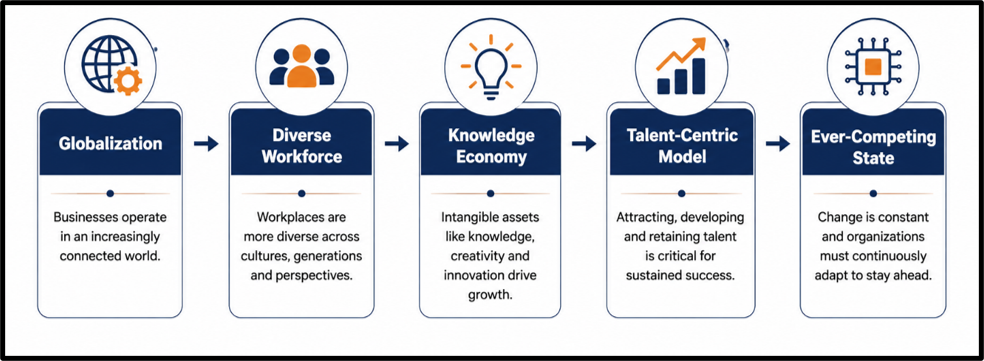
The Old-World vs The New World
| Dimension | Old Management Model | New Management Model |
| Structure | Hierarchical, top-down commands | Flat, collaborative, team-based |
| Leadership Style | Boss as distant authority figure | Leader as empathetic facilitator |
| Workers | Routine, replaceable workers | Knowledge workers with specialized skills |
| Management Tool | Authority, orders, fear | Persuasion, inspiration, social skills |
| EI Importance | Considered dysfunctional, irrelevant | Critical for organizational effectiveness |
Knowledge Workers & Group IQ
Peter Drucker, the doyen of management theory, coined the term ‘Knowledge Worker’ — specialists like financial analysts, software programmers, and writers whose productivity depends on integrating individual expertise into a work team. With knowledge work, the team replaces the individual as the work unit. Hence the concept of Group IQ becomes critical.
| The Indian Paradox — Prof. MGK Menon’s Observation “A single Indian worker matches or exceeds the skills of his Japanese counterpart; but two Indians working together are far less productive than their Japanese counterparts.” This is a powerful commentary on our collective failure of Emotional Intelligence — the inability to collaborate, defer ego, and work in teams. For a UPSC aspirant, this is a deeply relevant observation about Indian administration. |
The Art of Criticism — Harry Levinson’s Principles
In modern organizations, constructive criticism is an everyday activity. However, most managers do it poorly — causing resentment, confusion, and demotivation rather than improvement. Harry Levinson identifies four key principles of effective criticism:
| PRINCIPLE 1: SPECIFICITY Use examples. Point to specific patterns of deficiency. Indicate exactly where reworking is needed. Call a spade a spade — do not be vague or indirect. |
| ▼ |
| PRINCIPLE 2: PROVIDE SOLUTIONS Offer a solution or at least point to possibilities and alternatives. Mere criticism without direction creates frustration, disheartment, and demotivation. |
| ▼ |
| PRINCIPLE 3: FACE-TO-FACE CONTACT Criticise and praise people in their presence. A one-to-one talk promotes dialogue, reduces distance, and ensures the message lands with full impact. |
| ▼ |
| PRINCIPLE 4: EMPATHY Understand the viewpoint of the other person sympathetically. Without empathy, criticism breeds ill-will. Daniel Goleman: destructive criticism creates ‘an emotional backlash of resentment, bitterness, and defensiveness.’ |
For Those Receiving Criticism — Levinson’s Advice
- Look upon criticism as a means of improvement — not a personal attack.
- Avoid the tendency to defensiveness; cool down for a few days before discussing again.
- Consider criticism as an opportunity of working with your critic — a collaborative process.
New Management Tools — EI In Practice
Modern organizations can no longer be managed by handing down commands. Management today relies on persuasion and social intelligence. The following five tools are vital for this purpose:
| EI Tool | What It Means | Civil Services Application |
| Influence | Deploying suitable means of effective persuasion; building coalitions; using dramatic examples to make ideas land | Convincing stakeholders about a new welfare scheme; building political consensus for a policy |
| Communication | Two-way process; accurate sensing of non-verbal cues; honest handling of difficult questions; mutual understanding | Explaining government policy to illiterate villagers; conducting transparent public hearings |
| Conflict Management | Handling quarrels through tact and diplomacy; identifying root causes; resolving through organizational measures | Managing inter-departmental disputes; handling communal tensions; mediating public grievances |
| Leadership | Inspiring and guiding groups; formulating shared vision; involving others; acting in difficult times; catalyst for change | Motivating a demoralized district administration; driving digital transformation in a department |
| Catalysts for Change | Recognizing need for change; removing obstacles; explaining why status quo is unviable; setting personal example | Computerising a government office; introducing new schemes; overcoming bureaucratic inertia |
Leadership — A Deeper Look
Leadership in the context of EI is not about authority or position. No one becomes a leader merely by occupying the top slot. Leadership emerges from:
- Acting decisively in difficult times — especially when things go wrong.
- Assuming responsibility for decisions that fail — never passing the buck.
- Consulting all concerned — democratic decision-making in spirit, not just procedure.
- Avoiding favourites — evaluating all on the same criteria, no charmed circles.
- Managing change — recognizing the learning curve and helping people traverse it.
| The Key Test of a Leader “Leadership is not domination, but the art of persuading people to work toward a common goal.” When computerisation or a new programme is introduced, the manager who embraces the change personally, learns the basics, and makes it work — that is true leadership. Vishvambar (Case 9, we will see later) failed precisely here: he took a ‘hands-off’ approach to a critical IT project in his department. |
EI in Welfare Programmes for The Poor
This is a section with deep relevance for UPSC. Mere mechanical efficiency is not enough for successful implementation of welfare programmes for Scheduled Castes, Scheduled Tribes, women, and children. These programmes require personal commitment, heart, and soul.
| Challenge | Why EI is Needed |
| Client groups are poor, illiterate, unorganised | Empathy — understanding their world without condescension |
| These programmes lack glamour and visibility | Intrinsic Motivation — serving out of idealism, not recognition |
| Officers often seek transfers to better departments | Self-Regulation and Commitment — staying the course even without reward |
| Beneficiaries cannot confer benefits on officers | Altruism over self-interest — the highest form of EI in governance |
Empathy — The Crown Jewel of Emotional Intelligence
| “Never send to know for whom the bell tolls; it tolls for thee.” — John Donne — on the universality of human suffering and empathy |
Empathy is arguably the most important aspect of Emotional Intelligence. It is defined as the ability to sense what others are feeling, to look at things from their perspective, and to build rapport across diverse groups. Empathy is literally the capacity to feel with another person — its opposite is antipathy.
Self-Awareness opens the gate to empathy. If you cannot gauge your own emotions, you will hardly understand how others feel. Emotional states of people are revealed through bodily clues, facial expressions, gestures, and postures. Paying attention to these enables better interaction.
Dimensions of Empathy
- Personal Level: Caring about the troubles of others as your own — ‘when a bystander meets an accident, we rush to aid.’
- Justice & Law: The idea of punishment for a crime originates in empathy — we feel one with the victim and seek redress.
- Organizational Level: Understanding the feelings and perspectives of colleagues; following their interests; building trust.
- Political Dynamics: Empathy helps managers understand how senior managers combine forces in decision making — the informal politics of organizations.
- Governance Level: The ability to explain government policy to villagers; to design inclusive schemes; to implement welfare programmes with heart.
Empathy vs. Mere Curiosity
Empathy does not mean unwholesome curiosity about others’ personal lives or malicious gossip. Empathy means deep, attentive, purposeful interest in fellow human beings — observing their moods and feelings not to exploit their vulnerability but to help them better.
| Why Empathy is the Cornerstone of Civil Services The goal of governance is human welfare. A collector who cannot understand the anguish of a farmer who has lost his crop to floods will never design an effective relief policy. A DM who cannot read the fear of a riot-threatened community will never de-escalate tension effectively. An IPS officer who cannot empathize with a victim of violence will never deliver justice with sensitivity. |
Conclusion — EI As Character
| “The bedrock of character is self-discipline; the virtuous life, as philosophers since Aristotle have observed, is based on self-control… The ability to defer gratification and control and channel one’s urges to act is a basic emotional skill, one that in a former day was called will… Being able to put away one’s self-centered focus opens the way to empathy, to real listening, to taking another person’s perspective. Empathy leads to caring, altruism, and compassion.” — Daniel Goleman |
The components of Emotional Intelligence, taken together, constitute what moral philosophers since ancient times have called Character.
One writer described character as the “psychological muscle needed for moral conduct.” This is the deepest insight of this section: Emotional Intelligence is not a trick or a management technique. It is the architecture of a good human being — and therefore, of a good civil servant.
CASE STUDIES
Now, let us begin the case studies for this section. The detailed nature of these case studies is intentional. Ethics is best understood not through memorisation, but through the analysis of real-world situations involving dilemmas, emotions, values, and competing interests.
The objective of these exercises is not merely to help you answer examination questions, but to develop the ability to think critically, empathise with stakeholders, and make balanced decisions. The insights gained from these case studies will prove useful not only in your professional career but also in navigating the challenges and decisions of everyday life.
Case Study 1: Shekhar’s Examination Anxiety
Setting the Stage
Meet Shekhar — a bright, ambitious young man pursuing a BBA programme at a mid-tier American university with his sights firmly set on an MBA from a Top-10 Business School and a career in management consulting. He is a man with a plan — until the plan meets reality. In his penultimate semester, he takes two marketing courses. His performance in the first term paper of both is disappointing. The professors, to their credit, have given him detailed feedback and a reading list for improvement.
But here is where Shekhar’s real problem begins — and it has nothing to do with marketing. Instead of channelling his energy into the prescribed readings and improving his next paper, Shekhar has mentally teleported six months into the future. He imagines the rejection letter from the MBA programme. He sees himself failing. Every time he sits down to study, that imagined rejection floats in front of him like a ghost. He can’t concentrate. He is trapped in a classic case of what psychologists call ‘anticipatory anxiety’ — fearing a future that hasn’t happened yet.
| EQ Concept | Self-Regulation (Daniel Goleman): The ability to manage disruptive emotions and impulses — including anxiety — so that they don’t overwhelm the ability to think clearly and act effectively in the present. |
The Four Options — What Would You Advise Shekhar?
| Opt 1 | Marketing is perhaps not Shekhar’s subject. In the next semester, he should not take any marketing courses. |
| Opt 2 | Indian-origin professors in the USA think too highly of themselves and Shekhar should avoid their courses. |
| Opt 3 | Shekhar should absolutely focus on the current semester, act on the professors’ advice, and not worry about eventual rejection from Graduate Schools. |
| Opt 4 | Shekhar should realise that even without a select Graduate School, he could do well in life. |
The Deep Dive — Why Option 3 is Correct
Option 1 is a hasty, premature conclusion. Shekhar is in his last-but-one semester and has done marketing courses before with good grades. Poor performance in one term paper is not an aptitude verdict — it is a data point that calls for analysis and course correction, not abandonment of the subject.
Option 2 is simply prejudiced. Shekhar also received poor feedback from a non-Indian professor. Attributing the problem to the ethnic identity of one evaluator, while ignoring the other, is motivated reasoning — the search for an explanation that spares us from self-examination.
Option 3 is the emotionally intelligent answer because it addresses the actual problem: Shekhar’s anxiety is not about the present — it is about an imagined future. Emotional intelligence demands ‘living in the present while keeping the goal in view’. The present demands reading, revising, acting on feedback. The goal of MBA admission is not served by worrying about rejection but by excelling in the work at hand. Mild anxiety motivates; excessive anxiety paralyses. Shekhar has crossed into paralysis.
Option 4 is philosophically true but practically useless. ‘You can do well without the top school’ is a comfort statement, not an action plan. It offers no guidance on what Shekhar should do right now. Good advice must be actionable.
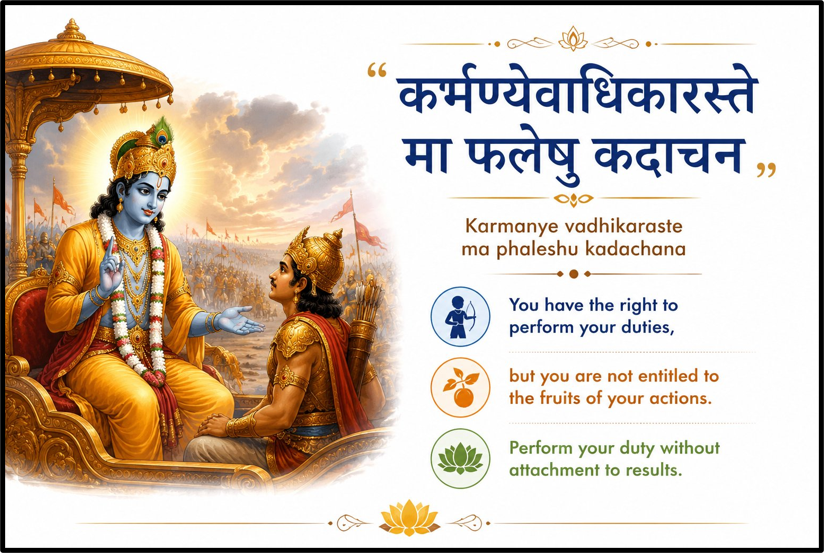
| Philosophical Anchor | The Bhagavad Gita: ‘You have a right to perform your prescribed duties, but you are not entitled to the fruits of your actions.’ Shekhar’s duty is the coursework in front of him — not the MBA admission that lies in the future. Anxiety about fruits poisons the work of the present. |
| Option | Verdict | Ethical Reasoning |
| Opt 1 | INCORRECT | Hasty generalisation from one poor term paper; no aptitude problem exists, only an anxiety problem. |
| Opt 2 | INCORRECT | Prejudiced attribution; ignores feedback from a second, non-Indian professor. |
| Opt 3 | CORRECT ✓ | Present-moment focus + acting on feedback = the emotionally intelligent prescription. |
| Opt 4 | INCORRECT | Philosophically valid but practically empty — offers consolation without an action plan. |
Case Study 2: Pavitran, Sunita, and the UPSC Mains
Setting the Stage
Pavitran is a serious UPSC aspirant, deep in the thicket of monetary economics — CAD, FII sell-off, RBI money supply, bond yields. These are not exactly page-turners. Then his friend Armugam drops a conversational grenade: Sunita, Pavitran’s favourite actress, has just released her latest film, Trichy Junction, and the item number is apparently ‘mind-blowing’. In an instant, Sunita’s imagined dance sequences are floating alongside CAD figures and yield curves in Pavitran’s head.
He wonders: should he just watch the movie and get it out of his system? The UPSC Mains examination is approaching. The question here is not about Sunita — it is about whether Pavitran can exercise the self-discipline to delay a pleasurable gratification when his immediate task demands undivided focus. This is the Walter Mischel ‘marshmallow test’ of UPSC preparation.
| EQ Concept | Self-Regulation — Delaying Gratification: Emotionally mature individuals possess the ability to postpone pleasurable activities that would disrupt the pursuit of more important, longer-term goals. This capacity is one of the strongest predictors of life success. |
The Four Options — What Would You Advise Pavitran?
| Opt 1 | Avoid thinking about Sunita; also avoid Armugam’s film discussions until the examination is over. |
| Opt 2 | This being a one-time distraction, Pavitran might as well watch the movie and move on. |
| Opt 3 | Pavitran should focus on studies as the Mains is near and it is a critical examination. |
| Opt 4 | Both (1) and (3) |
The Deep Dive — Why Option 4 (Both 1 and 3) is Correct
Option 1 is correct. Pavitran is not dealing with a minor, forgettable distraction. By his own admission, Sunita’s image keeps him ‘obsessed for days’ after watching her movies. For someone with this level of susceptibility, the ‘just watch and forget’ strategy will not work — it will simply restart the cycle. Cutting off from friends who fan the flames is also a legitimate emotional management strategy. It is not social rudeness; it is competitive self-protection, done politely.
Option 2 sounds reasonable but misunderstands the nature of the problem. The three hours spent in a cinema hall are not the real cost. The real cost is the days of mental residue that follow. The question is not about three hours — it is about Pavitran’s ability to set priorities and demonstrate the emotional control that a difficult competitive examination demands. Someone who cannot resist a film during the Mains run-up may struggle to maintain sustained focus through more significant temptations in life.
Option 3 is the rational anchor. Powerful urges require moderation by reason — Pavitran needs to keep reminding himself of what is actually at stake. This is not repression of emotion; it is the emotionally intelligent channelling of motivation toward the larger goal.
Option 4 combines the emotional control strategy (Option 1) with the rational reminder strategy (Option 3). Together they work better than either alone. The ideal UPSC aspirant needs both: internal discipline AND an external environment that minimises temptation. This is why Option 4 is the complete answer.
| Philosophical Anchor | Walter Mischel’s Marshmallow Experiment: Children who could delay eating one marshmallow in order to receive two later performed significantly better in school and life. Pavitran’s dilemma IS the marshmallow test. The examination is the two marshmallows — Trichy Junction is the one. |
| Option | Verdict | Ethical Reasoning |
| Opt 1 | VALID ✓ | Environmental management of temptation — avoidance + social distancing from distraction sources. |
| Opt 2 | INCORRECT | Underestimates the multi-day mental residue of the obsession; the real cost is not three hours but days of lost focus. |
| Opt 3 | VALID ✓ | Rational motivation reminder — reason moderates impulse. Necessary but insufficient alone. |
| Opt 4 | CORRECT ✓ | Both strategies together: environmental control + rational anchoring = the complete, emotionally intelligent approach. |
Case Study 3: Akshay Pande and the Cancer Scare
Setting the Stage
Akshay Pande is three months away from the State Forest Services examination. He has been working hard, navigating the unfamiliar terrain of ecology and environmental law — a subject far removed from his physics and chemistry background. Then, his world is disturbed. His mother, the anchor of the household, has been asked to undergo a CT scan to check for a possible cancerous growth. Akshay begins to spiral.
He assumes the worst. He is unable to study. He feels that there is ‘no hope’ for success this time. The examination is still months away; the cancer diagnosis has not even come yet. Yet Akshay has already lost the battle in his mind. He is experiencing two simultaneous failures of emotional intelligence: catastrophising (assuming the worst about an unconfirmed situation) and hope-abandonment (giving up before the contest has begun). His mother’s health is uncertain — his exam outcome is not yet determined. Both deserve a more calibrated emotional response.
| EQ Concept | Motivation and Hope (Goleman): Hope — the belief that one will find the means to achieve goals despite obstacles — is a core component of motivation. Psychologist Charles Snyder’s research shows that hopeful people perform better on examinations, handle adversity more effectively, and recover faster from setbacks. |
One of the most powerful expressions of the role of hope comes from the acclaimed film The Shawshank Redemption:
“Fear can hold you prisoner. Hope can set you free.”
Akshay’s situation illustrates this idea perfectly. Fear has led him to assume the worst about both his mother’s health and his examination outcome, despite neither being certain. Hope, in contrast, does not mean ignoring reality; it means retaining the belief that positive outcomes are still possible and continuing to act constructively until the facts are known.
The Four Options — What is Your Assessment?
| Opt 1 | His apprehensiveness is entirely understandable — cancer is deadly and incurable, so no emotional problem exists. |
| Opt 2 | Akshay should not presume cancer at this stage. Worrying will not change the diagnosis outcome. |
| Opt 3 | Losing hope is the worst thing that can happen to a competitive examination aspirant. Hope is the most powerful motivator. |
| Opt 4 | Both (2) and (3) |
The Deep Dive — Why Option 4 (Both 2 and 3) is Correct
Option 1 suggests there is no emotional problem — that Akshay’s response is proportionate. This is wrong. Some anxiety about a possible cancer diagnosis is human and understandable. But Akshay has moved beyond appropriate concern into uncontrolled catastrophising. He has not yet received a diagnosis; he is already planning for the worst.
Norman Vincent Peale’s wisdom applies perfectly here: pray for the wisdom to distinguish between what your actions can change and what they cannot. Worrying about cancer cannot change the CT scan result. Getting the best medical opinion can. Akshay should focus on the actionable, not the imagined worst.
Option 2 is correct. The discipline to not presume unconfirmed disasters is a fundamental skill of emotional self-regulation. Calm acceptance of uncertainty — not paralysis, not panic — is the first step before seeking solutions. Akshay can (and should) ensure his mother gets the right diagnostic care. Beyond that, the rest is outside his control. What is inside his control is the next three months of exam preparation.
Option 3 is correct and draws on fascinating research into elite sports psychology. Studies of Olympic champions consistently show that what separates the gold medallists from the rest is not superior physical ability alone — it is the quality of their internal mental narrative. Great champions, even after setbacks, maintain high levels of hope and belief in eventual success. They quickly analyse errors, make adjustments, and return to the field with renewed energy. Akshay is surrendering hope for ‘no good reason’ — the examination is still three months away and the obstacle (mother’s health scare) is an external variable, not a reflection of his own capacity.
Option 4 is correct because both insights must work together: the realism of Option 2 (don’t catastrophise about unconfirmed fears) and the motivation of Option 3 (never abandon hope before the battle is over) form the complete emotional framework Akshay needs.
| Philosophical Anchor | Epictetus (Stoic philosophy): ‘Seek not that the things which happen should happen as you wish; but wish the things which happen to be as they are, and you will have a tranquil flow of life.’ Akshay cannot control the CT scan result. He can control his exam preparation and his calm presence for his mother. |
| Option | Verdict | Ethical Reasoning |
| Opt 1 | INCORRECT | Normalises catastrophising; some anxiety is appropriate, but uncontrolled worry about an unconfirmed diagnosis is an EQ failure. |
| Opt 2 | VALID ✓ | Emotional self-regulation: distinguish the actionable from the imagined worst; calm focus on what can be controlled. |
| Opt 3 | VALID ✓ | Hope as motivation: the signature mental quality of champions across all competitive fields. |
| Opt 4 | CORRECT ✓ | Realism + Hope together = the complete emotional prescription for navigating adversity and examination simultaneously. |
Case Study 4: Velayudham’s Toxic Leadership vs. Vasanthi’s Wisdom
Setting the Stage
Ramana Rao holds a postgraduate degree in economics and statistics — a strong analytical foundation. Compelled by family circumstances, he joins a popular periodical as assistant to a sub-editor. The publication thrives on racy political and film gossip, with the occasional economic piece. Ramana Rao prepares himself diligently: he studies books on economic journalism and the Indian economy, works hard, and writes careful, fact-based pieces. His Telugu-medium background shows occasionally in his writing style, and his mathematical training makes ‘gushy’ emotionalism feel artificial to him.
His boss, Velayudham, is from an aggressive, investigative journalism background. He dismisses Ramana’s detailed, fact-based writing as ‘watery tea’ and ‘sambar without masala’. But he doesn’t stop there. He mocks Ramana’s English, ridicules his rural background, and taunts his humble origins — all in a professional setting.
Ramana is miserable, trapped by economic necessity. Then, mercifully, Vasanthi arrives — the owner’s niece, freshly graduated from LSE. She sets clear expectations, consults Ramana on his pieces, and genuinely values his fact-rich style. The contrast could not be starker.
| EQ Concept | Empathy in Feedback (Harry Levinson): Constructive criticism requires specificity, actionable suggestions, face-to-face delivery, and empathy. Its purpose is improvement, not humiliation. Criticism that attacks identity rather than work destroys motivation and violates professional dignity. |
The Four Options — What are Velayudham’s Shortcomings?
| Opt 1 | No deficiency — Velayudham is just giving the market what it wants. |
| Opt 2 | Velayudham has no grasp of the fact that economic journalism cannot be given the garb of masala film stories. |
| Opt 3 | He fails to provide workable guidance; and his personal attacks on Ramana’s background are crude, distasteful, and professionally unacceptable. |
| Opt 4 | Both (2) and (3) |
The Deep Dive — Why Option 4 (Both 2 and 3) is the Complete Answer
Option 1 is partly true — a segment of readers does prefer sensational content. But this does not justify Velayudham’s intellectual confusion between different journalistic genres. Economic analysis requires precision, data, and logical structure. This simply cannot be ‘masala-ised’ in the same way as film gossip or political scandal. Agriculture distress, inflation, monetary policy — these demand the kind of rigorous writing that Ramana Rao naturally produces. Velayudham fails to understand this fundamental distinction.
Option 2 is correct. A supervisor must first understand the nature of the work before critiquing its execution. Velayudham imposes an entertainment-journalism template on a field (economic analysis) where it simply does not apply. This is an intellectual shortcoming that directly limits his effectiveness as an editor and mentor.
Option 3 is correct — and arguably more serious. There are two distinct failings here. First, Velayudham never gives Ramana Rao specific, actionable guidance on how to improve. He says ‘no punch, no kick’ but never explains what ‘punch’ means in an economics context or how to achieve it. Harry Levinson would call this a failure of specificity and constructive engagement.
Second, and far more grave: his personal attacks on Ramana’s caste, regional, and socioeconomic background are not merely rude — they are unprofessional, potentially discriminatory, and in extreme cases may constitute a violation of dignity in the workplace. No supervisor has the right to weaponise a subordinate’s background as a tool of humiliation.
Vasanthi’s contrast reveals the correct approach: clear direction on content, collaboration on execution, and respect for the subordinate’s specific strengths. She ‘liked stories loaded with facts and figures’ — meaning she found value in what Ramana naturally does, and directed it rather than mocked it. This is emotionally intelligent leadership.
| Philosophical Anchor | Daniel Goleman on Destructive Criticism: ‘Instead of opening a way for a corrective, it creates an emotional backlash of resentment, bitterness, defensiveness, and distance.’ Velayudham’s criticism generates exactly this backlash — it is the textbook example of how NOT to develop subordinates. |
| Option | Verdict | Ethical Reasoning |
| Opt 1 | INCORRECT | Market preference for sensationalism does not justify imposing an entertainment template on economic journalism. |
| Opt 2 | VALID ✓ | Intellectual failure: inability to distinguish between journalistic genres leads to inappropriate expectations. |
| Opt 3 | VALID ✓ | Managerial failure: no actionable guidance + personal attacks on background = toxic, unprofessional leadership. |
| Opt 4 | CORRECT ✓ | Both intellectual and emotional failings together constitute Velayudham’s complete supervisory pathology. |
Case Study 5: Mallick’s Ego and Prajapati’s Revenge Fantasy
Setting the Stage
A team is commissioned to prepare a project proposal for a foreign philanthropic fund. Mallick is the project leader. He is a smooth talker, politically savvy, and excellent at creating an impression of being indispensable. But beneath the polished surface is a fragile ego: he belittles other team members, hogs all the credit, never allows anyone else to represent the team externally, and bypasses the finance specialist — Prajapati, a rank-holding CA — to consult with more pliable junior staff on financial projections.
When the appraisal team’s visit is imminent, Prajapati — reviewing the financials — discovers serious errors in the project’s viability calculations. Here is the ethical fork in the road. Does Prajapati alert Mallick and fix the error in the interest of the organisation? Or does he stay silent, savour the coming embarrassment, and let the project fail? Prajapati chooses the second. He wants Mallick to ‘lose face’. This is where the case stops being about Mallick and becomes equally about Prajapati.
| EQ Concept | Group IQ and Team Cohesion: Emotional intelligence determines the collective effectiveness of a team. When ego, rivalry, and mutual resentment dominate team dynamics, the group IQ drops — and organisational goals are sacrificed on the altar of personal conflict. |
Key Dysfunctionalities — Identified and Analysed
| # | Key Finding / Dysfunctionality | What Should Have Been Done / Why It Matters |
| 1 | Mallick’s Ego-Driven Leadership | He has no real grasp of the technical content but insists on being seen as the sole driver. A leader who cannot acknowledge the limits of his own knowledge, and who excludes specialists from the process, creates conditions for exactly the kind of errors that now threaten the project. |
| 2 | Mallick’s Manipulative Window-Dressing | He bypasses the qualified finance expert and pressures junior, malleable staff to inflate the project’s apparent viability. Foreign fund appraisal teams are trained evaluators — they will see through inflated projections. The result will be loss of credibility not just for Mallick but for the entire organisation. |
| 3 | Prajapati’s Passive Revenge | Rather than flagging the financial errors upfront — which would be in the interest of the organisation — Prajapati chooses to watch Mallick fail. This is shooting at one’s own feet: if the project gets rejected, Prajapati loses too. Resentment-driven silence is not a moral position; it is an organisational betrayal dressed up as personal satisfaction. |
The Complete Analysis
Two characters, three distinct failures. Mallick’s ego generates an exclusionary culture that produces bad financial modelling. Prajapati’s wounded pride converts a correctable error into a potential catastrophe.
The correct behaviour for Prajapati was simple: present the financial errors to Mallick professionally, on record if necessary, in the interest of the project and the organisation. Whether Mallick would have listened is uncertain — but Prajapati’s professional and ethical obligation was the disclosure, not the silence.
This case perfectly illustrates why emotional intelligence is not just a ‘soft’ competency — it has hard business consequences. Two technically capable individuals (a smooth talker and a rank-holder CA) produce a potentially fraudulent project proposal because their interpersonal dysfunction overrides their professional competence.
| Philosophical Anchor | Peter Drucker on Teams: ‘The productivity of knowledge workers depends on their individual effort being integrated into the work of a team.’ Mallick’s exclusion and Prajapati’s silence both prevent this integration — making both of them enemies of organisational productivity. |
Case Study 6: Manjit and the 50-Slide Disaster
Setting the Stage
Manjit is asked to present his company’s new product to a room of wholesale agents. The communications team — specialists in this domain — advise him to keep it to 20 minutes, 20 slides, with no more than 5 lines per slide. Manjit disregards this advice. He believes these constraints are too limiting for a serious product presentation. With the communications head away, he proceeds unrestrained.
The result: 50 cluttered slides, tiny fonts, no graphics, a drone-like delivery. The wholesalers begin yawning. They interrupt him, asking for brochures instead. The product may have been excellent — but Manjit’s presentation buried it under an avalanche of data. The wholesalers left unconvinced, not because the product was bad, but because the communicator was tone-deaf.
| EQ Concept | Empathy in Communication — Audience Awareness: Effective communication requires accurately sensing the mood, attention capacity, and information needs of the audience, and then calibrating the message accordingly. Failing this, even excellent content fails to land. |
Fault Lines in Manjit’s Emotional Competence
| # | Key Finding / Dysfunctionality | What Should Have Been Done / Why It Matters |
| 1 | Failed to Read the Audience | Wholesale agents are businesspeople with short attention spans focused on commercial essentials: marketability, price, commission. They are not researchers interested in comprehensive technical data. Manjit made no attempt to understand or respond to what his audience actually wanted. Empathy in communication begins with asking: ‘What does this specific audience need from me?’ |
| 2 | Lacked Focus and Priority | The core concerns of wholesalers — profitability and convenience — should have driven the entire presentation. A short, punchy overview of key product features + pricing + commission structure would have been far more effective than 50 slides of dense data. Overwhelming an audience with information is not thoroughness; it is a failure of editorial judgment. |
| 3 | Overconfidence and Failure to Listen | Manjit dismissed the advice of communications specialists — people who know their audience — in favour of his own untested judgment. This is a failure of two emotional competencies simultaneously: social awareness (inability to recognise the expertise of others) and self-regulation (inability to contain the impulse to ‘do it my way’). The communications team gave sound, evidence-based advice. Manjit’s overconfidence cost the company a presentation opportunity. |
The Complete Analysis
Three failures stack together: empathy failure (not reading the audience), focus failure (not editing content to essentials), and ego failure (not listening to experts). Each of these is a component of emotional intelligence.
And notice: the product itself may have been excellent. What failed was not the product — it was Manjit’s emotional intelligence in communicating it. This is why Goleman argues that EQ often matters more than IQ in professional effectiveness — the most brilliant product pitch can fail if the presenter cannot read the room.
| Philosophical Anchor | Gandhi’s Communication Principle: ‘A man of few words will rarely be thoughtless in his speech; he weighs every word.’ Effective communicators edit ruthlessly. Manjit’s 50-slide avalanche was the opposite of this — it was communication by exhaustion, not persuasion. |
Case Study 7: Pravir’s Mental Vacation During Meetings
Setting the Stage
Pravir is the regional marketing head of a growing business. His office has expanded — new specialist staff hired, team growing. Every two months, there is a mandatory open meeting with all staff. The problem: every meeting is the same. Staff complain about inadequate space, insufficient bathrooms, absence of a crèche.
Pravir has explained the constraints. But the complaints keep coming, meeting after meeting. Pravir has developed a coping mechanism: he sits through the meeting with a pleasant expression while mentally being completely elsewhere. The meeting has become, for him, a meaningless ritual to be endured.
But here is the irony: Pravir himself is the cause of the recurring complaints. The office has grown; the infrastructure has not kept pace. The staff keeps raising the same issues because the same problems remain unsolved. Pravir’s disengagement — his emotional ‘switch-off’ — is not a response to trivial complaints; it is a leader failing to solve a problem he created.
| EQ Concept | Active Listening and Leadership Responsiveness: A leader who is physically present but mentally absent fails the most basic test of emotional intelligence. Attentive listening — even to repeated grievances — signals respect and genuine concern. Problem-solving follows listening; it does not precede it. |
What Should Pravir Have Done? — Key Actions
| # | Key Finding / Dysfunctionality | What Should Have Been Done / Why It Matters |
| 1 | Fix the Root Cause First | The office has grown due to Pravir’s own success. The resulting inadequacy of facilities is a management responsibility. He should have already initiated expansion plans. A time-bound plan for facility enhancement — say within six months — would have transformed the recurring complaint into a resolved issue. |
| 2 | Communicate the Plan and Seek a Moratorium | Until facilities are expanded, Pravir should present the concrete plan to the team and request a moratorium on repeating the same complaints. Staff who know a solution is underway will accept the temporary wait. What creates sustained grievance is not discomfort itself — it is the perception that no one is listening or acting. |
| 3 | Never Mentally Switch Off in Team Meetings | Pravir’s mental disengagement is the most serious failure. Team meetings are not a ritual to be survived — they are the primary channel through which a leader understands the human condition of the organisation. A leader who stops listening loses touch with the real state of morale, motivation, and functionality. His visible attention — or its absence — is felt by every team member in the room. |
The Complete Analysis
Pravir’s frustration is entirely understandable — hearing the same complaint for the fifth consecutive meeting would test anyone’s patience. But the frustration is misdirected. The complaint is not the problem. The complaint is the symptom.
The problem is that the underlying issue has not been resolved. By mentally checking out, Pravir signals to his team that their concerns do not merit his full attention — a leadership message that is devastating for team morale and trust.
| Philosophical Anchor | Stephen Covey — 7 Habits of Highly Effective People: ‘Seek first to understand, then to be understood.’ Pravir has given up understanding. He hears without listening. He attends without engaging. The result is a leader in name only — one who has lost touch with the human reality of the organisation he leads. |
Case Study 8: Rashmi vs. Pinky — and the Boss Who Ducked
Setting the Stage
Rashmi and Pinky are colleagues in the finance wing — once close friends, now locked in open hostility after a personal quarrel. Their mutual animosity has crossed the professional line: it spills over into customer meetings, creating visible tension in front of clients. Their direct supervisor Tarun has tried to mediate but failed. He escalates to his own boss, who responds with one of the most revealing sentences in workplace management literature: ‘I have no stomach for mediating in a women’s quarrel.’
In five words, Tarun’s boss has displayed three separate failures: he has abdicated his managerial responsibility, he has made an assumption based on gender, and he has framed a professional conduct issue as a personal drama beneath his dignity. Meanwhile, customers are experiencing an organisation in dysfunction. The business cost is real and growing.
| EQ Concept | Conflict Management and Social Awareness: A manager who avoids workplace conflict because it is ‘unpleasant’ confuses personal comfort with professional responsibility. Unresolved interpersonal conflict in a customer-facing role directly translates to loss of business trust. |
Deficiencies in Tarun’s Boss’s Conduct
| # | Key Finding / Dysfunctionality | What Should Have Been Done / Why It Matters |
| 1 | Abdication of Managerial Responsibility | When a workplace conflict reaches the point of affecting customer interactions, it becomes an organisational emergency. Tarun’s boss has the authority and the responsibility to intervene. Refusing to engage because the mediation is personally distasteful is not a management strategy — it is dereliction. His discomfort with conflict cannot take priority over the organisation’s reputation with clients. |
| 2 | Failure to Investigate Root Causes | Interpersonal conflicts in organisations rarely arise from ‘just a personal quarrel’. Underlying causes — overlapping job descriptions, perceived favouritism by the direct supervisor, an unresolved professional disagreement — often fuel what appears to be a personal dispute. Tarun’s boss makes no attempt to explore these. A competent, empathetic manager would have spoken individually to Rashmi, Pinky, and Tarun to uncover the real source of the friction. |
| 3 | Sexist Bias — ‘Women’s Quarrel’ | This is perhaps the most serious failure. The phrase presupposes that this type of conflict is characteristically female behaviour — an illicit generalisation. Men engage in equally severe workplace conflicts all the time. By gendering the conflict, Tarun’s boss reveals a prejudice that has no place in a professional setting and that, in extreme interpretations, could constitute discriminatory conduct. Managers must hold themselves to a higher standard of impartiality in language and assumption. |
The correct response would have been firm, empathetic, and structured: a direct conversation with both Rashmi and Pinky (separately, then together) to establish that continued public display of their conflict is a professional misconduct issue that will invite disciplinary action; a deeper investigation into root causes; and structural solutions such as clearly demarcating their job responsibilities to reduce overlap-based friction.
| Philosophical Anchor | Daniel Goleman on Conflict Management: ‘The emotionally intelligent manager identifies the sources of conflict and addresses them directly — not by sweeping problems under the carpet, but by creating structures for frank dialogue and equitable resolution.’ Tarun’s boss is a textbook illustration of what not to do. |
Case Study 9: Vishvambar and the IT Project He Ignored
Setting the Stage
Vishvambar is Transport Commissioner of a progressive state. Responding to audit findings of revenue losses and corruption at vehicle registration centres and toll points, the government has deployed a major IT intervention: computer systems, CCTV cameras, and a real-time control centre at state headquarters.
The project has clear goals — plug corruption, enhance transparency, protect revenue. It has faced opposition from vested interests, which is expected. What is unexpected is the Commissioner’s own disengagement.
Vishvambar, a literature graduate, privately admits to his close aides that the whole technology process ‘goes over his head’. He delegates the entire IT project to his IIT-trained officers and makes no effort to understand even the basics. When asked to visit and supervise the control room, he jokes that ‘new tricks cannot be taught to old dogs’. In doing so, he confuses humility with abdication and treats his own limitations as permanent rather than learnable.
| EQ Concept | Motivation and Leadership as Catalyst for Change: A leader’s duty is not to be a technical expert in every domain under his charge. But he must be passionate about major initiatives, understand their strategic dimensions, and provide leadership that goes beyond delegation. Technical ignorance is a starting condition — not a permanent excuse. |
The Four Options — Select and Justify
| Opt 1 | Vishvambar is over-delegating. He should understand the what’s and why’s of every important step in the IT project from a management perspective. |
| Opt 2 | In a position of responsibility like Vishvambar’s, the leader has a duty to be passionate about major departmental projects. By that test, he is failing. |
| Opt 3 | Government made a blunder posting a literature graduate into such a technically intensive role as Transport Commissioner. |
| Opt 4 | Only (1) and (2) |
The Deep Dive — Why Option 4 (Both 1 and 2) is Correct
Option 1 is correct. Vishvambar is not being asked to write code or design software architecture. He is the Commissioner — the person accountable for this project’s success or failure. That accountability requires him to understand the project’s goals, the risks at each stage, the interface between the technology and the public who will use it, and the administrative and anti-corruption implications of every design decision. IIT officers can handle the technical depth. Only Vishvambar can provide the administrative judgment and public-interface wisdom that comes from years of field experience. He is not doing so.
Option 2 is correct. Passion in a leader is not the same as technical mastery — it is the visible energy and commitment that drives an organisation forward. When Vishvambar jokes about old dogs and new tricks, he sends a clear signal to his team: the Commissioner is not invested in this project. In the face of vested interest opposition — which the project is already experiencing — a disengaged leader emboldens the opponents and demoralises the champions of reform.
Option 3 is wrong, and importantly so. It reflects a prejudice that liberal arts graduates cannot excel in technically intensive roles. This is demonstrably false. History is full of distinguished civil servants with humanities backgrounds who mastered technically complex portfolios through motivated self-learning. Academic background is never an insurmountable barrier for an achiever who is motivated. Vishvambar’s problem is not his literature degree — it is his unwillingness to learn.
Option 4 (Both 1 and 2) correctly identifies the two distinct but related failures: over-delegation (an accountability lapse) and lack of passion (a leadership lapse). Together, they constitute a failure of the catalytic leadership that major reform projects demand.
| Philosophical Anchor | Peter Drucker on Leadership: ‘The leaders who work most effectively, it seems to me, never say I. They think we; they think team. They accept responsibility and don’t sidestep it.’ Vishvambar has sidestepped responsibility for the most important reform project in his department. |
| Option | Verdict | Ethical Reasoning |
| Opt 1 | VALID ✓ | Over-delegation without strategic understanding = accountability gap. Leaders must know what’s and why’s even if not the how’s. |
| Opt 2 | VALID ✓ | Lack of visible passion signals disengagement to the team and emboldens opposition to the reform. |
| Opt 3 | INCORRECT | Liberal arts background is not a professional disqualifier. The failure is attitudinal, not educational. |
| Opt 4 | CORRECT ✓ | Both leadership failures together — strategic disengagement AND lack of passion — constitute Vishvambar’s complete failure. |
Case Study 10: Sen Gupta’s Transfer and Poornima’s Resistance
Setting the Stage
Arjun Sen Gupta is a Sub-Divisional Officer in Visakhapatnam — a vibrant coastal city with a rich cultural life. His wife Poornima Chaterjee is a fine arts graduate who has found her community: a cultural forum that organises concerts and events regularly. She is happy, engaged, and socially fulfilled. Then Arjun volunteers for a posting in a remote tribal area, responding to the government’s call for officers willing to serve disadvantaged communities. He is transferred.
Poornima is devastated. She has not been consulted, or if she was, her views were not persuasive. She will lose her cultural community, her city comforts, and the social world she has built. She chides Arjun — calling his choice ‘folly’. The case asks us to examine multiple perspectives simultaneously: Arjun’s idealism, Poornima’s disappointment, and the nature of life in the civil services.
| EQ Concept | Empathy in Intimate Relationships + Motivation (Self-Actualisation): Civil services require officers to sometimes prioritise larger social duties over personal comfort. But marriages in the civil services also require partners to understand the nature of the commitment they have both entered. Emotional intelligence here means recognising and validating different perspectives without losing sight of higher purpose. |
Evaluating All Four Statements
| Stmt 1 | Poornima is right — governments don’t appreciate such sacrifices, so there’s no point in volunteering for hardship postings. |
| Stmt 2 | Sen Gupta has an idealist streak. Poornima, as his childhood friend, should have known and appreciated this aspect of his personality. |
| Stmt 3 | Sen Gupta is selfish and a careerist — using the tribal posting to attract government attention. |
| Stmt 4 | Poornima’s disappointment is understandable, but her perspective is somewhat myopic given the nature of civil service careers. |
The Deep Dive — What’s Correct, What’s Not, and Why
Statement 1 is incorrect. It reduces human motivation to a transactional calculation: effort rewarded by institutional recognition. But many of the most meaningful career choices — by doctors in rural postings, teachers in tribal schools, officers in conflict zones — are not made for government recognition. Arjun may have a genuine intrinsic motivation to serve disadvantaged communities — what psychologist Abraham Maslow called ‘self-actualisation’. This kind of motivation transcends commercial logic.
Statement 2 is correct. Arjun’s volunteer choice is an expression of character — a character Poornima has known since childhood. An idealist streak is not a sudden aberration; it is a personality trait that would have manifested in many earlier choices. Poornima’s surprise (or refusal to accept this) suggests she has either not been paying attention or has not emotionally prepared herself for the kind of life she signed up for.
Statement 3 is incorrect. Government memory is indeed notoriously short. The idea that Arjun is strategically volunteering to attract institutional attention reflects a cynicism about public service motivation that the evidence simply does not support. Officers who seek visibility and promotions generally pursue high-profile urban postings — not remote tribal areas.
Statement 4 is correct. Civil servants, by the nature of their service, do not control where they are posted. Transfers to remote areas are not exceptions to the career — they are features of it. Poornima, as an educated person who married into the IAS, should have prepared herself for this. Moreover, tribal areas are not cultural deserts — they offer rich, though different, cultural landscapes. With an open mind, a fine arts graduate like Poornima might discover unique folk art forms, indigenous music, and artistic traditions unavailable in any city.
| Philosophical Anchor | Maslow’s Hierarchy of Needs — Self-Actualisation: At the peak of human motivation is the desire to fulfil one’s deepest potential and purpose. Arjun Sen Gupta is operating at this highest level. Poornima’s challenge is to recognise that her husband’s calling deserves not resistance but partnership. |
| Option | Verdict | Ethical Reasoning |
| Stmt 1 | INCORRECT | Reduces idealism to transactional logic. Self-actualisation as a motivation transcends institutional recognition. |
| Stmt 2 | VALID ✓ | Idealism is a character trait, not a sudden decision. Poornima should have known and appreciated this in Sen Gupta. |
| Stmt 3 | INCORRECT | Tribal postings don’t attract institutional attention. The career-strategic accusation is unfounded. |
| Stmt 4 | VALID ✓ | Transfers are features, not bugs of civil service careers. Poornima’s perspective, while understandable, needs broadening. |
Case Study 11: Rohini’s CEO Appointment and Malathi’s Response
Setting the Stage
Rohini is the marketing chief of a globally reputed multinational. This evening, after eighteen years of extraordinary professional effort as an immigrant in the United States, she has just been appointed CEO and President of the Board — a truly remarkable achievement. She is bursting with joy and drives home to share the news with her family. She arrives late, having stayed to exchange greetings with well-wishers at the office.
As she parks, she sees her mother Malathi waiting on the balcony. Rohini begins with a cheerful announcement of ‘great news’. Malathi’s response: there is no milk in the house — could Rohini go pick some up immediately? Rohini’s husband Ashwath is resting — apparently too tired to have managed this errand. Rohini goes. She returns 45 minutes later. She shares her news. Malathi’s response to the CEO announcement: a sober lecture that a woman’s first duty is to husband, children, and parents — and that Rohini should ‘leave her crown in office’.
Rohini, the first immigrant woman to break through the glass ceiling to the top of a global corporation, has returned home on the most significant day of her professional life — to buy milk and receive a duty lecture. The emotional intelligence of this family moment is almost surgically exposed.
| EQ Concept | Empathy in Intimate Relationships: The ability to recognise, share in, and celebrate the emotional states of those we love is the foundation of meaningful relationships. The failure to do so — especially at moments of peak joy — is a profound emotional intelligence deficit. |
Evaluating All Four Statements
| Stmt 1 | Rohini did not expect this treatment. Before asking her to get milk, Malathi should have at least shown curiosity about the ‘great news’ Rohini had hinted at. |
| Stmt 2 | Malathi is right — an individual owes their first duty to family members. |
| Stmt 3 | Malathi showed poor emotional competence — even after hearing the good news, she lectured rather than celebrated. |
| Stmt 4 | Indian parenting, with too little positive emotion and obsessive focus on duty, sometimes acquires a robotic quality. Malathi reflects this cultural pattern. |
The Deep Dive — What’s Correct, What’s Not, and Why
Statement 1 is valid. When a family member returns home late and explicitly mentions having ‘great news to share’, the emotionally intelligent response is curiosity and attention. The news was clearly significant to Rohini — she had telegraphed its importance. Malathi’s immediate pivot to ‘no milk in the house’ is not just insensitive; it is a failure to attune to her daughter’s emotional state. The only scenario where the milk would have overridden the news is if someone were critically ill or an emergency was unfolding. Buying milk is not an emergency.
Statement 2 is partially wrong. The first half is correct in principle — families do have claims on us. But the second half — elevating the errand of purchasing milk to the level of ‘first duty’ — is a reductio ad absurdum of the concept of duty. Trivial domestic chores cannot be used to subordinate the profound joys of life. And critically, Malathi directs this duty almost exclusively at Rohini (not at Ashwath who is ‘resting’ — from what, precisely?), which itself reveals an unexamined gender assumption.
Statement 3 is valid — and arguably the most important observation. After Rohini returns with the milk and shares her extraordinary achievement, Malathi’s response is a lecture. Not a hug. Not a tearful congratulation. Not ‘beta, I always knew you would get there’. A lecture about women’s duties. Breaking the glass ceiling as an immigrant woman in corporate America is not ‘ordinary’ — it is exceptional. The achievement deserved profound emotional recognition. Malathi’s failure to provide it is not merely a social awkwardness — it is a failure of empathy toward her own daughter at her highest moment.
Statement 4 is valid and culturally insightful. Indian parenting, historically, has emphasised performance, duty, sacrifice, and endurance. These are genuine virtues. But the emphasis on duty, unchecked by its emotional counterpart — celebration, warmth, affirmation, joy in others’ joy — can produce what the question aptly calls a ‘robotic quality’. Malathi is not a cold or malicious person; she is a product of a cultural pattern that underweights positive emotional expression. Recognising this does not excuse the behaviour, but it explains it.
| Philosophical Anchor | Daniel Goleman on Empathy: ‘Self-awareness opens the gates to empathy. The bedrock of empathy is attuning oneself to another’s emotional state.’ Malathi’s inability to attune — to feel what Rohini is feeling on the most important day of her career — is the precise deficit this case study diagnoses. |
| Option | Verdict | Ethical Reasoning |
| Stmt 1 | VALID ✓ | Good news hinted at + late return = a moment for curiosity and warmth, not an errand assignment. |
| Stmt 2 | PARTIAL | Duty to family is real, but cannot be invoked to subordinate a daughter’s peak joy to a milk errand. |
| Stmt 3 | VALID ✓ | Post-news lecture instead of celebration = failure of empathy at the most critical emotional moment. |
| Stmt 4 | VALID ✓ | Cultural pattern diagnosis: duty-over-emotion parenting, while producing resilience, sacrifices relational warmth. |