
USA since 1945

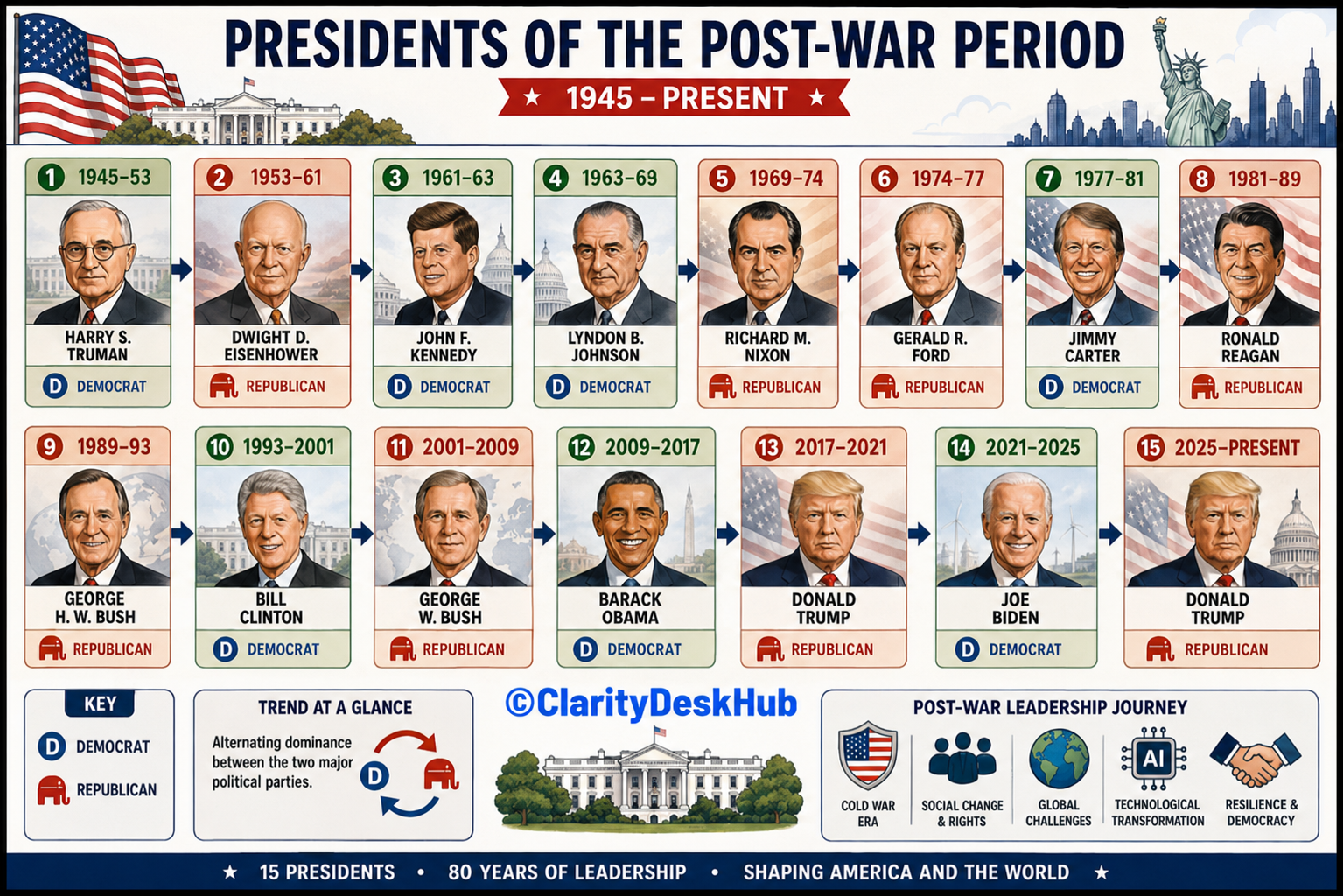
Usually, when we think of the USA after 1945, we imagine the “American Dream”—Hollywood, big cars, and skyscrapers. But if you look beneath this glittering surface, you will find a different reality. Even in the world’s wealthiest garden, there were patches of dry land.
Let us analyze how the United States, while fighting the Cold War abroad, was simultaneously fighting a “War on Poverty” at home, and why it struggled to win it.
Poverty and Social Policies
The Great Paradox: Poverty in the Land of Plenty
Before we dive into the Presidents, understand the Context. Post-1945 America was an industrial titan. Exports were booming, and the middle class was growing. Yet, ironically, poverty remained a persistent “social ailment.”
- The Structural Gap: By 1960, unemployment had crept up to 5.5 million.
- The Missing Safety Net: Unlike Europe, the US had no national health system.
- The Invisible Millions: In 1966, nearly 30 million Americans lived below the poverty line. A significant portion of these were senior citizens over 65, left behind by the fast-moving capitalist machinery.
The Truman Era (1945–1953): The ‘Fair Deal’
After Roosevelt, Harry S. Truman took the stage. He was like a “bantam-weight prize fighter”—small but incredibly tough. He inherited a country trying to transition from a war economy to a peace economy.
The Vision: The Fair Deal
Truman wanted to extend FDR’s New Deal. He proposed:
- A National Health Scheme (Universal Healthcare).
- Higher minimum wages and slum clearance.
The Conflict: President vs. Congress
Here we see the classic American “Checks and Balances” in action. The Republicans controlled Congress and viewed Truman’s ideas as “socialistic.”
- Taft-Hartley Act (1947): Congress passed this over Truman’s veto to curb the power of trade unions.
- Outcome: While Truman won the 1948 election by gaining working-class sympathy, Congress remained a “bottleneck.” They gave him higher minimum wages but “strangled” his health and pension schemes.
The Eisenhower Years (1953–1961): Modern Republicanism
Dwight D. Eisenhower, a war hero, didn’t have a radical anti-poverty “mission,” but he was pragmatic. He didn’t destroy the New Deal; he stabilized it.
Key Developments:
- Infrastructure as Growth: He launched a massive Road-Building Programme (1956). This wasn’t just about cement; it revolutionized the American economy. It boosted the motor industry, created suburbs, and changed how Americans lived.
- The Sputnik Shock: When the Soviets launched Sputnik in 1957, America panicked. The response? Massive federal spending on Science and Math education. Poverty was now a matter of National Security.
- The Agrarian Crisis: Technology made farmers too efficient. Overproduction crashed prices. The government tried to pay farmers not to grow crops, but the benefits went to big landowners. Small farmers were forced into city slums.
The Kennedy Era (1961–1963): The ‘New Frontier’
Then comes J.F. Kennedy—young, articulate, and charismatic. He realized that the “American Dream” was stalling.
The Concept of the ‘New Frontier’
Kennedy argued that America was standing on a frontier. On one side was prosperity; on the other, the “unconquered” territory of poverty and ignorance.
- Successes: He managed to raise the minimum wage to $1.25 and extended benefits to children of the unemployed.
- Failures: Again, the “conservative coalition” in Congress blocked his major healthcare and education bills. By 1962, the situation was so dire that soup kitchens—a symbol of the Great Depression—returned to American cities.
The Johnson Era (1963–1969): The ‘Great Society’
After JFK’s tragic assassination, Lyndon B. Johnson (LBJ) took over. LBJ was a master of political maneuvering. He didn’t just want a “Fair Deal”; he wanted a “Great Society.”
The War on Poverty
LBJ declared an unconditional war on poverty. His achievements were monumental:
- Medicare (1965): Finally, a partial national health scheme for the elderly.
- Economic Opportunity Act: Job training for the youth.
- Appalachian Regional Development Act: Targeted aid for the poorest geographical regions.
The Great Dilemma: ‘Guns vs. Butter’
This is a crucial analytical point. LBJ wanted to fight poverty at home (Butter) but was sucked into the Vietnam War (Guns).
- The Consequence: The Vietnam War drained the treasury. You cannot fight a multi-billion dollar war abroad and a war on poverty at home simultaneously without consequences.
- Social Unrest: By the mid-60s, race riots and anti-war protests shook the nation. The “Great Society” felt like it was crumbling. LBJ, exhausted and unpopular, chose not to run again in 1968.
The Nixon Shift and the Lasting Legacy (1969–1974)
Richard Nixon entered with a mandate for “Law and Order.” He was a Republican, so he naturally wanted to cut spending on LBJ’s programs.
- The Reality Check: Even Nixon couldn’t ignore the poor. He actually increased social security benefits and extended Medicare to the disabled.
- The Structural Failure: By the late 20th century, despite periods of growth, America developed a “Permanent Underclass.” While Western Europe built robust welfare states, the US remained committed to “Self-Help” and “Rugged Individualism.”
Critical Analysis & Conclusion
If we look at this period holistically, we see a constant struggle between Social Justice and Fiscal Conservatism.
- The Ideological Barrier: Many Americans viewed government help as “Socialism,” which was a dirty word during the Cold War. This prevented the creation of a true Welfare State.
- The Racial Dimension: Poverty in America was (and is) deeply linked to race. Many Southern politicians blocked reforms because they didn’t want the Black population to benefit.
- The Vietnam Factor: Foreign policy decisions directly crippled domestic social progress.
In essence: America proved that wealth alone does not eliminate poverty. It requires political will and social empathy—two things that were often sacrificed at the altar of the Cold War and internal political friction.
Next, we move into one of the most emotional and intellectually profound chapters of American history: The Civil Rights Movement.
Imagine a country fighting a world war to “save democracy” while its own soldiers are segregated by the color of their skin. This was the American hypocrisy of the 1940s. We will now analyze how this contradiction began to melt, not just through laws, but through the blood, sweat, and moral courage of millions.
Racial Problems and the Civil Rights Movement
The Great Awakening: Why did the Government’s Attitude Change?
For decades, the US government turned a blind eye to the “Jim Crow” laws (segregation). But after 1945, things shifted. President Truman’s committee identified five critical reasons for this “change of heart.”
The Multi-Dimensional Causes:
- The Moral Conscience: Many leaders felt a genuine ethical burden. How can you call yourself a “civilized” nation while treating humans like cattle?
- Economic Rationality: Segregation was a waste of talent. If a Black person is a brilliant scientist but forced to work as a janitor, the nation’s GDP suffers.
- The Cold War Pressure (Geopolitics): This is a very important point. The USSR was using American racism as propaganda. Every time a Black person was lynched in Alabama, Moscow told the world, “Look at American ‘democracy’!”
- The Global Wave of Decolonization: India became independent in 1947; Ghana followed. Non-white nations were rising. If the USA wanted these new nations as allies against Communism, it had to stop mistreating non-whites at home.
The Legal Battleground: Eisenhower & the Supreme Court
While Truman had the “intent,” the actual legal teeth came during the Eisenhower era.
Key Developments:
- Brown v. Board of Education (1954): The Supreme Court made a historic ruling—segregated schools are unconstitutional. Education must be equal.
- The Little Rock Nine (1957): This was a test of “State vs. Centre.” When the Governor of Arkansas used the National Guard to block Black students from a high school, Eisenhower sent federal paratroopers to escort them. It showed that the federal government would use force to uphold civil rights.
Critical Analysis: Even with these laws, the “ground reality” changed slowly. By 1961, only 25% of Southern schools were desegregated. Law is one thing; social acceptance is quite another.
The Era of Dr. Martin Luther King Jr.: The Power of Non-Violence
Now we enter the most famous phase. In 1955, a woman named Rosa Parks refused to give up her bus seat in Montgomery. This sparked a 381-day boycott led by a young Baptist minister: Dr. Martin Luther King Jr.
The Philosophy of King:
King brought the concept of Satyagraha (though he called it Christian love and non-violent resistance) to America.
- The Goal: Not just to change laws, but to change the heart of the oppressor.
- The 1963 March on Washington: Here, he delivered his famous “I Have a Dream” speech. He didn’t want a “Black America” or a “White America”; he wanted a “United America” based on character, not color.
The Radical Shift: Malcolm X and Black Power
While King was preaching “Love,” another group was growing restless. They felt the pace of change was too slow and that “non-violence” was a sign of weakness.
The Alternatives:
- The Black Muslims (Nation of Islam): Led by the charismatic Malcolm X. They initially rejected integration, calling for “Black Supremacy” and separation. Malcolm X later moderated his views after a pilgrimage to Mecca, acknowledging the possibility of peace, but he was tragically assassinated in 1965.
- The Black Panthers: A more militant group focused on “Self-Defence” against police brutality. They were Marxist in ideology and believed in “Black Power.”
The Legislative Victory: Johnson’s Great Society
Lyndon B. Johnson, using the momentum of JFK’s assassination and the pressure from MLK’s movement, passed the “Big Three” acts:
- Civil Rights Act (1964): Made discrimination in public places and jobs illegal.
- Voting Rights Act (1965): Removed the “literacy tests” and hurdles that prevented Black people from voting.
- Civil Rights Act (1968): Targeted discrimination in housing.
Conclusion: A Story of ‘Mixed Fortunes’
If we analyze the consequences, we see a “Two-Tiered” progress:
- Political Success: We see the rise of a Black middle class. We see figures like Colin Powell (Secretary of State) and eventually Barack Obama (President).
- Economic Failure: Despite the laws, the “Ghetto” remained. Poverty, unemployment, and incarceration rates remained disproportionately high for African Americans. The 1992 Los Angeles Riots proved that beneath the surface, the volcano of racial frustration was still active.
The Lesson: You can change a law in a day, but changing the “Societal DNA” takes generations. The movement achieved Legal Equality, but the battle for Social and Economic Equity continues to this day.
How do you think the Vietnam War—which we discussed earlier—affected the focus and funding of this Civil Rights movement?
We have already seen how America was struggling with poverty and racial inequality. Now, let’s look at a different kind of “fever” that gripped the American mind during the same period: The Red Scare.
It is a fascinating study of psychology. How can a nation that is the most powerful on Earth be so terrified of a tiny political party at home? This was the era of McCarthyism—a period of “shadow-boxing” where the enemy was often invisible, and the climate was one of deep suspicion.
Anti-Communism and Senator McCarthy
The Context: A Nation in Paranoia
The paradox of post-war America was that while the American Communist Party was tiny (never more than 100,000 members), the fear of Communism was massive. Why?
The Ideological Clash: ‘Rugged Individualism’ vs. ‘Socialism’
- Traditional Values: Conservative Americans believed in “Self-Help.” They saw the New Deal and Fair Deal (welfare schemes) not as helping the poor, but as “Creeping Socialism.”
- The Foreign Trigger: Between 1949 and 1950, the world changed. China became Communist, and the Korean War began. To many Americans, it felt like a global “Red Wave” was about to drown them.
- Demobilization Anxiety: Congress reduced the army from 5.5 million to 600,000 very quickly. This created a feeling of vulnerability—”Are we too weak to stop them?”
The Catalysts: Spies and Secrets
Fear needs fuel, and in the late 1940s, three cases provided enough fuel to start a fire.
| Case | Key Figure | Outcome | Impact |
| Loyalty Boards | 6 Million Employees | 500 sacked | Created an atmosphere of “Questionable Loyalty.” |
| Alger Hiss | State Dept. Official | Jailed for Perjury | Suggested that “Communists are at the top of our government.” |
| The Rosenbergs | Julius & Ethel | Executed (1953) | Convicted of giving Atomic secrets to the USSR. Sent shockwaves of fear. |
The Rise and Fall of McCarthyism
Enter Senator Joseph McCarthy. He wasn’t just a politician; he became a “symbol” of an era.
The Methodology of McCarthy
In 1950, he claimed to have a list of 205 Communists working in the State Department. He never actually proved a single name, but that didn’t matter.
- The Targets: He didn’t just attack Communists. He attacked socialists, liberals, intellectuals, and artists.
- The Consequence: This led to “Un-American Activities” investigations. People were “blacklisted”—meaning they lost their jobs and could never work again, simply because of a suspicion.
The Turning Point: The Bully on Television
McCarthy’s downfall came when he became too arrogant. He began attacking the US Army generals.
- In 1954, the hearings were televised. For the first time, the public saw his brutal methods—the shouting, the bullying, the lack of evidence.
- The Senate eventually condemned him. He died disgraced, but the “ghost” of McCarthyism remained in the form of a law that made the Communist Party illegal.
The Alliance for Progress: Soft Power vs. Red Fever
After McCarthy, the focus shifted to Latin America. When Fidel Castro took over Cuba in 1959, America panicked again.
Kennedy’s Strategy: Instead of just using guns, he used “Butter” (Aid). The Alliance for Progress (1961) pumped billions into Latin America.
- The Logical Interlinkage: If we help the poor in Latin America, they won’t turn to Communism.
- The Hidden Motive: Much of this money was used to buy American goods, benefiting US industry.
The ‘Military-Industrial Complex’: A Warning
Now, we must look at President Eisenhower’s famous parting warning. He spoke of a “partnership” between:
- The Military (Generals wanting more weapons).
- The Industry (Companies making massive profits from those weapons).
The Analysis:
- Profit in Conflict: For arms manufacturers, the Cold War was a “Gold Mine.” Every time Khrushchev talked about “Peaceful Coexistence,” these companies worried about their profits.
- The Budget Explosion:
- 1950: $12 Billion (Military)
- 1960: $46 Billion
- 1970: $80 Billion
- Historiographical Perspective: Some historians believe the U-2 Spy Plane incident (1960) was a deliberate attempt by this “complex” to ruin peace talks and keep the orders for missiles coming.
Summary and Analytical Conclusion
If you look at these three topics together—Poverty, Civil Rights, and Anti-Communism—you see the “Soul of America” in conflict.
- They were fighting for Liberty abroad but denying Equality to Black citizens at home.
- They were spending billions on Missiles (Military-Industrial Complex) while millions lived below the Poverty Line.
It was a period of high growth, but also high anxiety. The “American Dream” was being guarded by a “Garrison State” that was often as afraid of its own citizens as it was of its enemies.
Tell me, considering the massive military spending we just discussed, do you think America’s “War on Poverty” ever really stood a chance?
Next, we shall continue our discussion on the American post-war journey by looking at the period from 1969 to 1993. This was an era of extreme contrasts: it began with the glory of a man walking on the moon and ended with the rise of a permanent “underclass” in the world’s wealthiest nation.
We will analyze this through the lens of three major themes: Political Ethics, Economic Experiments, and the Global Role of the US.
1969 to 1993
The Nixon Era (1969–1974): The Height of ‘Realpolitik’ and the Depth of Scandal
Richard Nixon was a complex man. Intellectually, he was a giant in foreign policy, but psychologically, he was deeply insecure. This duality defined his presidency.
(a) Foreign Policy Successes: ‘Détente’
Nixon, along with Henry Kissinger, practiced Realpolitik—politics based on practical rather than moral or ideological considerations.
- The China Opening (1972): In a brilliant move, Nixon visited Mao Zedong. This shifted the Cold War balance, using China as a “counter-weight” against the USSR.
- The Exit from Vietnam: He finally extricated the US from the Vietnam quagmire in 1973. Although South Vietnam fell later in 1975, Nixon gave the US “Peace with Honor.”
- The Moon Landing (1969): A moment of supreme national pride that boosted American morale during the Cold War.
(b) The Watergate Scandal: The Fall of the ‘Imperial Presidency’
In 1972, men linked to Nixon’s re-election campaign broke into the Democratic Party headquarters at the Watergate Building.
- The Crime vs. The Cover-up: The crime was a burglary; the tragedy was the cover-up. Nixon used the CIA and FBI to hide the truth and refused to hand over secret White House tapes.
- The Consequence: Facing certain Impeachment, Nixon became the first US President to resign (1974).
- Historiographical Analysis: Watergate wasn’t just a political scandal; it was a constitutional crisis. It shattered the public’s “blind faith” in the Presidency, leading to a long-term decline in trust in government.
The Carter Interlude (1977–1981): The Moralist’s Struggle
Jimmy Carter, a “peanut farmer” from Georgia, was the “anti-Nixon.” He was deeply religious and honest. But in politics, sometimes “good men” struggle to be “effective leaders.”
- The Successes: He brokered the Camp David Accords, bringing a historic peace between Egypt and Israel.
- The Failures: He faced Stagflation (stagnant growth + high inflation) and the Iran Hostage Crisis (1979), where US diplomats were held for 444 days. The image of a helpless America led to his defeat in 1980.
The Reagan Revolution (1981–1989): ‘Supply-Side’ Economics
Ronald Reagan, “The Great Communicator,” changed the very definition of the American state. His philosophy was simple: “Government is not the solution to our problem; government is the problem.”
(a) Reaganomics: The Theory of ‘Trickle-Down’
Reagan applied Supply-side economics, influenced by Milton Friedman.
- The Strategy: Cut taxes for the rich and corporations → They invest more → More jobs are created → Prosperity “trickles down” to the poor.
- The Reality: While inflation dropped (12% to 4.5%) and jobs were created, the National Debt tripled. Why? Because while he cut taxes (revenue), he massively increased military spending (expenditure).
(b) The Social Cost
The gap between the rich and the poor widened significantly.
- The Statistics: In 1984, the poorest families were losing more in benefits than they gained in tax cuts, while the richest gained thousands.
- The ‘Underclass’: By the late 80s, American inner cities (ghettos) were decaying, suffering from drugs, crime, and a lack of infrastructure.
(c) Irangate (Iran-Contra Scandal)
Reagan’s second term was tarnished by a secret deal: selling arms to Iran (an enemy) to fund “Contra” rebels in Nicaragua (illegal under US law). It showed that even after Watergate, the “shadow government” within the White House was still active.
The Bush Era (1989–1993): The New World Order
George H.W. Bush was a master of foreign affairs but a victim of his own economic promises.
- The Gulf War (1991): After Saddam Hussein invaded Kuwait, Bush led a global coalition to victory. This was the peak of his popularity.
- The Economic Trap: He famously said, “Read my lips: no new taxes.” But the Reagan-era debt forced him to raise taxes to save the economy.
- The Result: The American public felt betrayed. Combined with a recession in 1990, this paved the way for Bill Clinton in 1992.
Analytical Conclusion: The Post-War Balance Sheet
If we look at the period from 1945 to 1993, we see a country that achieved Superpower status but struggled to achieve Social Harmony.
| Dimension | Achievements | Failures/Challenges |
| Global | Won the Cold War; Moon landing; Space dominance. | Vietnam failure; Loss of prestige in Iran/Latin America. |
| Domestic | Rise of a Black middle class; High technology; Wealth. | Rise of a “Permanent Underclass”; Decaying inner cities. |
| Political | Strong institutions (survived Watergate). | Deep public cynicism and distrust of the “Establishment.” |
Critically speaking, the US during this period proved that “Economic Growth” is not the same as “Human Development.” While the GDP reached the sky, the social fabric in the “ghettos” was tearing apart.
In your opinion, looking at the contrast between Nixon’s foreign policy success and his domestic disgrace, is it possible for a leader to be “great” for the world while being “harmful” to their own nation’s democratic values? Think!
Next, we continue our discussion through modern American history. We are entering the era of Globalization, Digital Revolution, and Deep Polarization.
1993 to 2013
When we look at the period from 1993 to 2013, we see three very different personalities—Clinton, Bush Jr., and Obama. Yet, they all faced the same fundamental American struggle: How to balance a booming capitalist economy with the needs of a struggling underclass.
Bill Clinton (1993–2001): The ‘New Democrat’ and the Economic Goldmine
Bill Clinton entered the White House like a “breath of fresh air.” He represented a generational shift—young, charismatic, and intellectually sharp.
(a) Social Reform vs. Political Resistance
Clinton’s primary goal was Universal Health Insurance.
- The Failure: Much like Kennedy and Truman before him, Clinton was “mugged” by reality. The insurance industry and a Republican-controlled Congress killed the bill.
- The Strategy Shift: He realized that if he couldn’t pass big social reforms, he had to focus on the Economy. He introduced a minimum wage hike and signed NAFTA (North American Free Trade Agreement), turning the US, Canada, and Mexico into one giant market.
(b) The Economic Miracle
By his second term, the US experienced the longest period of continuous economic expansion in peacetime.
- Context: The budget was balanced for the first time since 1969.
- Result: Unemployment hit a 30-year low. This “Economic Shield” is what saved Clinton when the scandals arrived.
(c) Scandal and Impeachment
The Whitewater and Monica Lewinsky scandals were used as political weapons.
- The Irony: Although he was impeached by the House for perjury, the Senate acquitted him. Interestingly, his popularity remained high. Why? Because for the average American, a “fat wallet” was more important than the President’s personal character.
George W. Bush (2001–2009): Neo-Conservatism and the ‘War on Terror’
The 2000 election was a historic “judicial anomaly.” Al Gore won the popular vote, but the Supreme Court stopped the Florida recount, handing the victory to Bush.
(a) The Philosophy: ‘Compassionate Conservatism’ or Hard-Right?
Bush moved the country sharply to the right.
- Tax Cuts: He passed massive cuts ($1.35 trillion) mostly benefiting the top 1%.
- Laissez-faire: He believed the government should stay out of business. This lack of regulation led to the Enron Scandal (2001), where thousands lost their pensions due to corporate fraud.
(b) 9/11 and the Global Shift
The 11 September attacks changed his presidency from domestic policy to a global ‘War on Terror.’
- Consequence: The US invaded Afghanistan and Iraq. While it removed dictators, it created a “financial black hole.”
- The Debt Spiral: Bush inherited a surplus but left a massive debt. He fought two expensive wars while cutting taxes—a logical contradiction that crippled the US treasury.
(c) The Failure of the State: Hurricane Katrina
In 2005, Hurricane Katrina exposed the “hollowed-out” nature of the US social safety net. The slow response showed that the world’s richest country couldn’t even protect its own poorest citizens (mostly Black Americans) in New Orleans.
Barack Obama (2009–2013): The Symbol of ‘Change’
Barack Obama’s victory in 2008 was a “sociological earthquake.” For a country with a history of slavery and segregation, electing an African American president was a moment of immense symbolic power.
(a) Rescuing the Titanic: The 2008 Crash
Obama inherited the “worst economic crisis since the Great Depression.”
- The Stimulus: He signed the $787 billion Recovery Act to save the economy and even took over General Motors to prevent an industrial collapse.
- The Financial Reform: The 2010 Act tried to rein in the “greedy” banks that caused the crash.
(b) Obamacare: The Holy Grail
After a 70-year struggle by various Presidents, Obama finally passed the Affordable Care Act (Obamacare).
- The Resistance: It was met with fierce opposition. The Tea Party movement (conservative populists) rose up, calling it “socialism.”
- The Victory: Despite 26 states challenging it, the Supreme Court ruled it legal in 2012. It brought 30 million more people under the umbrella of health insurance.
Analytical Comparison: The ‘Wealth Gap’ (1993-2013)
If we compare these three presidencies, a disturbing trend emerges regarding American inequality:
| President | Economic Approach | Resulting National Debt | Impact on Poverty |
| Clinton | Balanced Budget / Free Trade | Surplus (first in decades) | Poverty decreased slightly. |
| Bush Jr. | Tax Cuts / War Spending | Massive Increase | Poverty rose; inequality peaked. |
| Obama | Stimulus / Social Safety Net | Increased (to save economy) | Saved middle class, but recovery was slow. |
Critical Analysis: The Changing Face of America
Notice a major Historiographical Shift.
- The Demographic Factor: The Democrats (Obama) began winning because the US was no longer just a “WASP” (White Anglo-Saxon Protestant) nation. The rise of Hispanic and African American voters changed the political map.
- The Polarization: Politics became “Zero-Sum.” If the President was a Democrat, the Republican Congress would block everything, even if it was good for the country. This “deadlock” has become the new normal.
- The Paradox Remains: By 2013, the US could kill Osama bin Laden in a secret raid across the world, but it still couldn’t fix the “permanent underclass” living in its own inner cities.
History, as we often say, is not just about the dead past; it is a flowing river that shapes the ground we stand on today.
By 2013, we saw a nation struggling to heal from the 2008 crisis. But from 2013 to 2026, the United States has undergone a Metamorphosis. We have moved from the “Age of Hope” to the “Age of Polarization” and, finally, to the “Age of Realignment.”
2013 to Present
The Late Obama Era (2013–2017): The Persistence of Gridlock
In his second term, Barack Obama faced a “Legislative Fortress.” The Republican-controlled Congress made it nearly impossible to pass major domestic laws.
- The Foreign Policy Pivot: Facing a deadlock at home, Obama turned to “Executive Diplomacy.” He signed the Iran Nuclear Deal (JCPOA) and the Paris Climate Agreement without Congress.
- The Social Undercurrent: This was also the era of the “Digital Awakening.” Movements like Black Lives Matter emerged, signaling that despite having a Black president, the structural racial issues we discussed earlier remained unresolved.
- The Economic Paradox: While the stock market was at an all-time high, the “Rust Belt” (the industrial heartland) felt abandoned by globalization. This frustration was the “dry wood” that would soon catch fire.
The Trump Era (2017–2021): The Populist Earthquake
In 2016, Donald Trump won an election that many historians call a “Black Swan” event. He was the antithesis of the Washington establishment.
(a) “America First”: A New Ideology
Trump dismantled the post-1945 consensus.
- Trade Wars: He moved away from Free Trade (NAFTA) and toward Protectionism, specifically targeting China.
- The Judicial Shift: His most lasting legacy was the appointment of three conservative Supreme Court justices. This shifted the American legal landscape for the next 30 years—culminating in the 2022 overturning of Roe v. Wade (abortion rights).
(b) The Breaking Point: COVID-19 and 2020
The pandemic acted as a “Stress Test” for the American state.
- Structural Failure: The lack of a national health system (which Truman and Clinton fought for) became a catastrophe.
- The 2020 Election: The transition of power was no longer “peaceful” in the traditional sense, leading to the January 6th Capitol riot. This event is a deep scar on the history of American democracy.
The Biden-Harris Era (2021–2025): The Return of the ‘Big State’
Joe Biden entered with a mission to “Restore the Soul of America.” His approach was a return to “LBJ-style” government intervention.
(a) The “New Deal” of the 21st Century
- Industrial Policy: Biden passed the Inflation Reduction Act (IRA) and the CHIPS Act. For the first time in decades, the US government began spending hundreds of billions to bring manufacturing back home, especially in green energy and semiconductors.
- The Inflation Crisis: Post-pandemic supply chains and the Russia-Ukraine war led to the highest inflation in 40 years. This hit the “Underclass” very hard, erasing many of the wage gains of the working class.
(b) A Fragmented World
The 2021 withdrawal from Afghanistan marked the end of the “Longest War.” However, the US was quickly pulled into two new fronts:
- Supporting Ukraine against Russia.
- The Middle East crisis (post-October 7, 2023), which created massive internal friction within the Democratic party, especially among young voters and minorities.
The 2024 Election and the Reality of 2026
As we stand here in May 2026, we can see that the 2024 election was perhaps the most consequential since the Civil War. It was not just a choice between two men, but two entirely different visions of what America is.
- The Social Fabric: In 2026, America is more divided than ever. We see a “Two Americas” phenomenon: “Blue States” (liberal) and “Red States” (conservative) are passing diametrically opposite laws on education, health, and civil rights.
- The Technological Frontier: The sudden explosion of Generative AI (2023–2026) has created a new economic crisis. While it has boosted GDP, it is threatening the jobs of the middle class, creating a new layer of “Technological Poverty.”
Comprehensive Analysis: The State of the Union in 2026
If we look back at our entire journey from 1945 to 2026, what do we see?
- The Decline of Unipolarity: In 1945, the US was the undisputed master. In 2026, it is one of many poles in a “Multipolar World,” facing a massive challenge from a China-Russia-BRICS alignment.
- The Persistence of the ‘Underclass’: Despite the “Fair Deal,” “Great Society,” and “Obamacare,” the US still has a poverty problem. In 2026, the “homelessness crisis” in major cities like San Francisco and New York is at historic levels.
- The Institutional Crisis: The “checks and balances” that Truman and Eisenhower respected are now under immense strain. The Supreme Court, Congress, and the Presidency are often in open “warfare” with each other.
Conclusion: The “Fractured Dream”
History teaches us that no empire is permanent. The story of the USA from 1945 to 2026 is the story of a nation that solved the problem of production (wealth) but failed the problem of distribution (equity).
In 2026, the “American Dream” is no longer a physical destination (like moving to a suburb); it has become a “Digital Mirage.” The country remains the world’s laboratory for innovation, but it is also its most volatile social experiment.
My final question for you to reflect upon: Given the deep internal divisions we see in 2026, do you think America can continue to lead the “Free World,” or must it first “liberate” its own citizens from the cycles of poverty and political hatred?