
Russia and the Revolutions, 1900-24
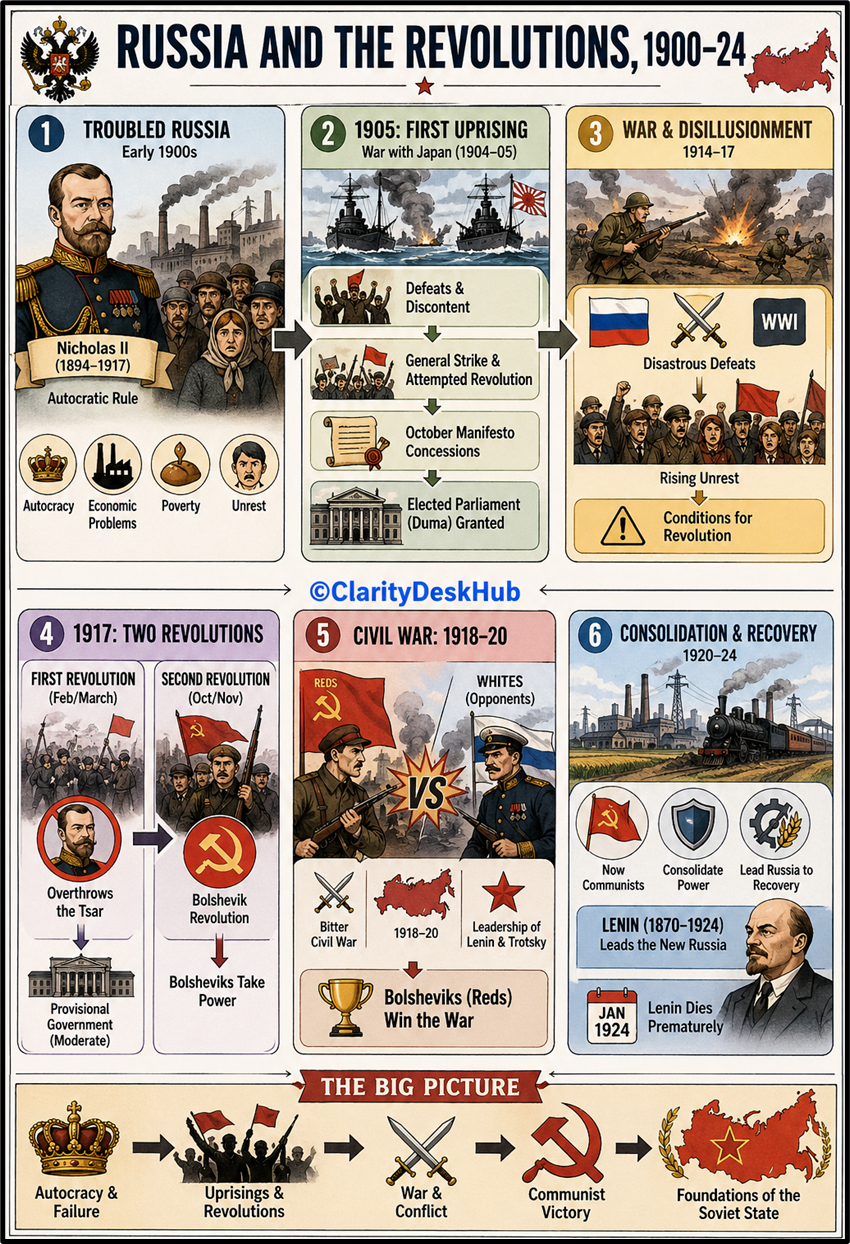
In this section, we shall delve into one of the most fascinating “What Ifs” of modern history. After the 1905 Revolution, Russia stood at a crossroads. Was the Romanov dynasty destined to fall, or did Nicholas II have a genuine chance to save his throne?
To understand this, we must look beyond mere dates and events. We must analyze the structural tensions of the Russian Empire and the subjective failures of its leadership.
Were the 1917 Revolutions inevitable?
Background
To understand the outbreak of the 1905 Revolution, it’s important to see that tensions in Russia had been building steadily throughout the late 19th and early 20th centuries.
Before 1905, Russia was still an autocratic state under Tsar Nicholas II, where political power was concentrated entirely in the hands of the monarch. There was no elected parliament, no real constitution, and strict censorship was imposed. Although serfdom had been abolished in 1861, most peasants continued to live in poverty due to heavy redemption payments and outdated agricultural methods.
At the same time, rapid industrialization in cities like St. Petersburg and Moscow created a growing working class that faced harsh conditions—long hours, low wages, and unsafe environments. This combination of rural distress and urban exploitation created widespread dissatisfaction across society.
Adding to this instability was the regime’s failure to reform and its reliance on repression. Political opposition—liberals, socialists, and revolutionaries—was suppressed by the secret police. However, new ideologies like Marxism began to spread among workers and intellectuals.
The situation worsened dramatically with Russia’s defeat in the Russo-Japanese War (1904–05), which exposed the incompetence of the government and shattered its prestige. By early 1905, economic hardship, military humiliation, and political frustration had combined to create an explosive situation—making some form of upheaval almost inevitable.
This background sets the stage for understanding why the events of 1905 were not sudden, but rather the first major eruption of long-standing structural tensions in Tsarist Russia.
The Post-1905 “Breathing Space”: Tactical Retreat or Genuine Change?
In 1905, the Tsarist regime faced a near-death experience. Nicholas II survived not because he was strong, but because his opponents were fragmented. The October Manifesto was his “Life-Saving Pill”—it promised civil liberties and an elected parliament, the Duma.
Why the Regime Survived in 1905:
- Lack of Unity: The liberals wanted a constitution; the workers wanted bread and 8-hour days; the peasants wanted land. They weren’t singing the same song.
- Military Loyalty: The backbone of the autocracy—the army—largely remained loyal.
- Strategic Concession: By issuing the Manifesto, Nicholas “bought off” the moderate liberals (Octobrists), isolating the radical revolutionaries.
The Crucial Nuance: Nicholas II never accepted the spirit of a constitutional monarchy. For him, the Duma was a nuisance, not a partner. He saw himself as an autocrat appointed by God, and this ideological rigidity became his greatest liability.
The Era of the Dumas: A Throttled Democracy
Between 1906 and 1917, four Dumas were called. This was Russia’s chance to transition from Autocracy to Democracy.
| Duma | Period | Character & Fate |
| First & Second | 1906–1907 | Radical and confrontational. Demanded land reform and ministerial accountability. Nicholas dissolved them within weeks. |
| Third & Fourth | 1907–1917 | “The Submissive Dumas.” The voting system was rigged (Stolypin’s Coup) to favor landowners. They lasted longer but had little real power. |
Nicholas famously remarked that a democratic republic would be “senseless and criminal.” By castrating the Duma, he closed the “Safety Valve” of legal political protest, forcing the opposition back into the shadows of revolution.
Stolypin’s Gamble: Can Capitalism Save the Tsar?
Enter Peter Stolypin, perhaps the only man who could have saved the monarchy. His philosophy was simple: “Suppression first, then reform.”
The “Wager on the Strong”
Stolypin realized that the peasants were the ticking time bomb of Russia. He abolished Redemption Payments and encouraged peasants to leave the Mir (commune) to become independent, profit-seeking farmers (Kulaks).
- The Logic: A peasant who owns land and makes a profit will not throw bombs at the government.
- The Failure: Stolypin asked for “20 years of peace.” He got only five. He was assassinated in 1911, and the land reforms were too slow to keep up with the exploding rural population.
The Rising Tide: Signs of Fragility (1912–1914)
By 1912, the “breathing space” was over. The Lena Goldfields Massacre, where hundreds of striking miners were shot, acted as a catalyst. It signaled that the regime had learned nothing.
The Intellectual & Social Re-awakening:
- Industrial Unrest: Strikes tripled between 1912 and 1914.
- The Intelligentsia: Students and thinkers were alienated by the secret police and state repression.
- The “Rasputin Factor”: The royal family’s reputation was rotting. The influence of the “holy man” Rasputin over Empress Alexandra discredited the monarchy in the eyes of the aristocracy and the public alike. To the people, if the Tsar couldn’t manage his own household, how could he manage the Empire?
The Great Debate: Was Revolution Inevitable?
This is where historians disagree, and as students of history, we must appreciate both sides of the “Historiographical Divide.”
Perspective A: The “Optimist” (Liberal) View
Historians like Christopher Read and Robert Service argue that revolution was NOT inevitable.
- The economy was growing (6% annually).
- Education was spreading.
- If not for the “Accident” of the First World War, Russia might have evolved into a modern state.
Perspective B: The “Pessimist” (Soviet/Structuralist) View
Historians like Sheila Fitzpatrick argue that the regime was “inherently brittle.”
- The gap between a 20th-century economy and a 17th-century political system (Autocracy) was too wide.
- The 1905 Revolution was just a “Dress Rehearsal.” The contradictions of Tsarism were so deep that any “jolt” would have toppled it.
The Catalyst: World War I (The “Chemical Reaction”)
If the Russian Empire was a house infested with termites, World War I was the hurricane that blew it down.
- Military Incompetence: Nicholas took personal command in 1915. Now, every defeat at the front was his personal failure.
- Economic Collapse: The railway system broke down. Food rotted in the countryside while cities like Petrograd starved.
- The Loss of the “Shield”: By 1917, the elite guards had been killed in battle. They were replaced by peasant-conscripts who shared the grievances of the strikers. When the order came to fire on the crowds in February 1917, the soldiers pointed their guns at their officers instead.
Analytical Conclusion
In final analysis, was 1917 inevitable?
History is a combination of Continuity and Change. While the structural flaws (the land hunger of peasants, the anger of workers) provided the fuel, and the Tsar’s blindness provided the oxygen, it was World War I that provided the spark.
Without the war, Nicholas might have lingered on for decades in a state of decay. But a regime that refuses to bend will eventually break. The tragedy of Nicholas II was that he tried to govern a changing Russia with an unchanging mind.
The Lesson: Stability is not the absence of change; it is the capacity to manage change. Tsarism failed this test.
What do you think? If Stolypin had not been assassinated in 1911, could his “Wager on the Strong” have created a stable middle class capable of preventing the Bolshevik rise?
OK, next, we are going to analyze one of the most defining moments of the 20th century—the year 1917. In this single year, Russia didn’t just change its government; it changed the very grammar of global politics.
We often speak of the “Russian Revolution” as one event, but it was actually a two-act play: the February Revolution and the October Revolution. Let us understand the “Why,” the “How,” and the “What” of these seismic shifts through a structured lens.
The Two Revolutions
The Calendar Confusion
Before we start, look at the dates. You will see “February” events happening in March and “October” events in November. Why? Because Russia was using the Julian Calendar, which was 13 days behind the Gregorian Calendar used by the West. For our discussion, we will stick to the Russian dates to maintain the flavor of the era.
The February Revolution: The Spontaneous Collapse
If 1905 was a “leak” in the ship of Autocracy, February 1917 was the “shipwreck.”
The Context and Causes:
- Bread and Blood: It started on International Women’s Day (23 Feb) with bread riots in Petrograd. It wasn’t a planned political strike initially; it was a cry of hunger.
- The Garrison Mutiny: This is the turning point. In 1905, the army stayed loyal. In 1917, the soldiers—mostly peasant conscripts tired of the war—refused to fire on the crowds. They joined the protestors.
- The End of the Romanovs: Nicholas II, isolated and advised by his generals that he had lost the mandate of the people and the army, abdicated on 2 March. When his brother Michael refused the throne, 300 years of Romanov rule vanished in a week.
Historiographical Debate: “Top-Down” or “Bottom-Up”?
- The Elite Conspiracy (Katkov): Some argue the nobles and generals forced the abdication to prevent a bigger mess.
- The Spontaneous Mass (Chamberlin): Others call it the most “leaderless” revolution ever. It was the “pressure from below” that forced the “elite above” to act.
- The Revisionist View: Modern historians (Read, Smith) argue it was an “outburst of desperation” for basic material needs rather than high-level politics.
The Provisional Government: A House Built on Sand
After the Tsar, a Provisional Government (PG) was formed, initially led by Prince Lvov and later by Alexander Kerensky. But it was born with a “terminal illness.”
Why did the Provisional Government fail?
Look at the logic of their failures—it’s a classic case of “too little, too late.”
- Dual Power (Dvoyevlastiye): The PG had the responsibility but the Petrograd Soviet (the council of workers and soldiers) had the power. The Soviet’s “Order No. 1” meant the army would only obey the PG if the Soviet agreed.
- The War Trap: Kerensky insisted on staying in WWI to honor international treaties. The June Offensive failed miserably, causing mass desertions.
- The Land Question: They delayed land reforms, telling peasants to “wait for the legal elections.” The peasants didn’t wait; they started seizing land themselves.
- Lenin’s Return: In April, Lenin returned in a “sealed train” provided by Germany. He issued the April Theses, with a simple, brilliant slogan: “Peace, Bread, and Land!” He told the people: “All Power to the Soviets!”
The Turning Point: The Kornilov Affair
In August 1917, General Kornilov attempted a military coup to “restore order.” A panicked Kerensky had to ask the Bolsheviks for help and even armed them!
- The Result: Kornilov failed, but the Bolsheviks emerged as the “Saviors of the Revolution.” Their popularity soared, and they soon won majorities in the Petrograd and Moscow Soviets.
P.S: The Bolsheviks were a radical socialist faction led by Vladimir Lenin that aimed to overthrow the provisional government and establish a proletarian (workers’) state.
The October Revolution: The Surgical Strike
Unlike the chaotic February, October was a masterclass in organized insurrection.
The Execution:
While Lenin provided the “will,” Leon Trotsky provided the “way.” As Chairman of the Petrograd Soviet, Trotsky organized the Red Guards.
- On the night of 25 October, they didn’t storm the city with millions; they seized the “commanding heights”—the post offices, railway stations, and the Winter Palace.
- It was almost bloodless. Kerensky fled, and Lenin announced the birth of a Soviet government (Sovnarkom).
Analysis: Coup d’état or Mass Uprising?
This is the most debated question in Russian history:
- The Liberal View (Pipes/Ulam): It was a classic “Coup.” A small, disciplined group of professional revolutionaries hijacked the chaos to seize power.
- The Soviet View: it was a “Great October Socialist Revolution”—a mass movement of the proletariat led by the vanguard party.
- The Modern Synthesis: Most historians now agree the Bolsheviks had popular backing (especially in the cities), but the actual takeover was a highly organized coup by a minority. They “picked up” power because the PG had dropped it.
Conclusion: The New Reality
By the end of 1917, the Bolsheviks were in power, but the country was in ruins. They had promised everything to everyone—land to peasants, factories to workers, and peace to soldiers.
The question shifted from “Will the revolution happen?” to “Can the Bolsheviks survive the coming storm?” They had caught the tiger by the tail; now they had to ride it through a brutal Civil War.
Critical takeaway: The February Revolution was a revolution that no one organized, while the October Revolution was a revolution that no one could stop. One was the collapse of the Old; the other was the forceful birth of the New.
What do you think was the fatal mistake? Was it Kerensky’s decision to continue the war, or was it the Tsar’s initial refusal to share power in 1905?
Now, let’s move on.
After the high of the October Revolution, Lenin found himself in a position that every revolutionary dreads: the transition from a rebel to a ruler.
It is easy to criticize a government; it is infinitely harder to run one—especially when you are in a minority, the treasury is empty, and a world power is knocking at your door with bayonets. Now, we shall analyze how Lenin navigated this “tightrope walk” between 1917 and 1924.
Lenin and Bolsheviks dealing with problems
The Dilemma of Legitimacy: The Constituent Assembly
Imagine you have just led a coup in the name of the “people,” but when the people actually vote, they choose someone else. This was Lenin’s nightmare in November 1917.
- The Election Results: The Bolsheviks won only 175 out of 700 seats. The Social Revolutionaries (SRs), who had a deep connection with the peasantry, won a landslide with 370 seats.
- Lenin’s Logic: In a move that would define Soviet politics for 70 years, Lenin argued that “Soviets” (worker councils) were a higher form of democracy than a “parliament.”
- The “Solution”: In January 1918, after just one day of meeting, the Red Guards forcibly dissolved the Assembly.
Critical Analysis: This was the moment Russia’s brief experiment with Western-style democracy died. Lenin believed he didn’t need a parliament to tell him what the workers wanted because he was the vanguard of the workers.
This is the “Philosopher-King” complex—the belief that the party knows the “truth” even if the public is currently “misguided.”
The Humiliation of Brest-Litovsk: Space for Time
The Second massive problem was World War I. Lenin had promised Peace, but the Germans weren’t giving it for free.
- The Price of Peace: In March 1918, Russia signed the Treaty of Brest-Litovsk. It was a territorial amputation. Russia lost its “breadbasket” (Ukraine), the Baltic states, and a massive chunk of its industry and population.
- The Internal Rift: Even within the Bolsheviks, many (like Bukharin) wanted a “Revolutionary War” against Germany. Trotsky suggested “Neither War nor Peace.”
- Lenin’s Realism: Lenin insisted on signing. He argued that the revolution needed a “breathing space.” He was essentially sacrificing the Russian “Nation” to save the Bolshevik “Revolution.”
Historiographical Perspective: Was this a betrayal of Russia? Liberal historians often say yes. However, Marxist historians argue it was a brilliant strategic retreat. Lenin gambled that a revolution would soon break out in Germany anyway, making the treaty a “scrap of paper.” (Interestingly, he was partially right).
The Philosophy of Violence: Was it Choice or Necessity?
This is the most debated “moral question” of the era. Did Lenin want to be violent, or did the circumstances force his hand?
The Two Schools of Thought:
- The Circumstantial View (Marxist/Revisionist): This view suggests that the Bolsheviks started “soft”—they released prisoners and abolished the death penalty. But when the SRs started assassinating Bolsheviks (and almost killed Lenin in August 1918) and the “Whites” started a Civil War, Lenin had to use terror to survive. It was Reactive Violence.
- The Ideological View (Traditional Liberal/Richard Pipes): This school argues that violence was baked into the Bolshevik DNA. They cite the creation of the Cheka (secret police) in December 1917—before the Civil War really started. Lenin famously said, “How can you make a revolution without executions?” To him, terror was a Proactive Tool of class war.
The “Red Terror” and the End of the Romanovs
Once the “Red Terror” was unleashed, it became a state policy. It wasn’t just about catching spies; it was about “Class War.”
- The “Bourgeois” Enemy: The Cheka didn’t just look for actions; they looked at backgrounds. If you were a priest, a businessman, or an officer, you were an “enemy of the people” by default.
- The Fate of the Tsar: In July 1918, the ultimate symbol of the old world—Tsar Nicholas II and his entire family—were executed in a basement in Ekaterinburg.
Interlinkage: Why kill the children? From a cold, Machiavellian perspective, Lenin couldn’t risk the “White Army” rescuing a royal heir who could then become a unifying figurehead for the counter-revolution. By killing the family, he burnt the bridge back to the past.
Structural Flaws in the Bolshevik Strategy
As we analyze this period, we see two major miscalculations by Lenin:
- The Peasant Paradox: Marx predicted revolution in industrial countries (like England). Russia was 80% peasants. Lenin “telescoped” the revolution, but this left him as a leader of a “Workers’ Party” in a country that had very few workers. This forced him to treat the peasants as a resource to be “exploited” for grain, leading to massive friction.
- The Missing World Revolution: Lenin expected the “domino effect”—that Russia would be the first of many. When the German and Hungarian revolutions failed, the Soviet Union found itself as a “Red Island” in a “Capitalist Sea.” This isolation bred a siege mentality that justified further authoritarianism.
By 1919, Lenin had secured the “Apparatus of Power,” but he had lost the “Moral High Ground” of a liberator. He had traded the Autocracy of the Tsar for the Dictatorship of the Party.
The question remains: Could he have survived without the Cheka? Or was the “Terror” the only thing holding a collapsing Russia together?
After seizing the steering wheel of the Russian state in October 1917, Lenin and the Bolsheviks found themselves driving a vehicle that was not only running out of fuel but was being attacked from every side. The period between 1918 and 1924 is a story of survival at any cost.
To understand this era, we must look at how the Bolsheviks transformed from a revolutionary party into a rigid, military-style government. Let us analyze this through the lens of the Civil War, the Economic Crisis, and the Final Political Consolidation.
The Russian Civil War: A Fight for Survival
Imagine you have just captured the capital, but 90% of the rest of the country refuses to recognize your authority. This was the reality of 1918.
The Opposing Forces: The “Whites” and the Foreigners
The opposition was known as the Whites. However, calling them a “group” is misleading—they were a “mixed bag.” You had monarchists, liberals, and Social Revolutionaries (SRs). Their only common ground was their hatred for the Bolsheviks.
- The Foreign Intervention: Britain, France, the USA, and Japan sent troops. Why? Because they wanted a government that would rejoin World War I and because they feared the “virus” of communism spreading to their own workers.
- The Czech Legion: In a bizarre twist of fate, 40,000 armed Czech soldiers seized control of the Trans-Siberian Railway, effectively cutting the Bolsheviks off from the East.
Why did the “Reds” (Bolsheviks) Win?
If the world was against them, how did they win? It boils down to Geography, Discipline, and Unity.
- Centralized Geography: The Reds controlled the “Heartland” (Moscow and Petrograd). They had the factories and the railways. The Whites were scattered on the edges, unable to communicate or coordinate.
- Trotsky’s Red Army: Leon Trotsky was a brilliant organizer. He turned a chaotic militia into a disciplined Red Army, even using former Tsarist officers (with political commissars watching them) to ensure professionalism.
- The “Lesser Evil”: The peasants hated the Bolsheviks for taking their grain, but they feared the Whites more. A White victory meant the return of the old landlords and the loss of their land.
The Great Debate: Did the War Create the Dictatorship?
This is a critical analytical point. Historians like Robert C. Tucker argue that the Civil War “brutalized” the party. It created a Siege Mentality. To win, the Bolsheviks had to become ruthless, centralized, and militaristic. This “culture of violence” then became permanent.
However, others like Richard Pipes argue that the brutality was already there in Lenin’s ideology. They point out that the Cheka (secret police) was created before the Civil War began. As students of history, we must ask: Was the violence a response to a crisis, or was the crisis an excuse to use violence?
The Economic U-Turn: From “War Communism” to “NEP”
Lenin’s economic policy is a classic example of Ideology meeting Reality.
The Failure of War Communism
During the war, Lenin introduced War Communism. All industry was nationalized, and “Food Detachments” were sent to the countryside to seize grain from peasants by force.
- Result: The economy collapsed. Peasants stopped growing surplus grain because they knew it would be stolen. By 1921, Russia was facing a horrific famine.
- The Turning Point: In March 1921, the Kronstadt Mutiny occurred. These were the sailors who had been the “pride and joy” of the 1917 Revolution. When they revolted, Lenin realized the party was losing its soul.
The New Economic Policy (NEP): “One Step Back to Take Two Steps Forward”
Lenin made a dramatic retreat. He reintroduced elements of capitalism through the NEP (1921).
- Peasants could now sell their surplus in the open market after paying a tax.
- Small-scale private trade was allowed.
- The Result: The economy began to breathe again. Food returned to the cities.
Historiographical Perspective: Was the NEP a betrayal of Socialism? Leaders like Kamenev and Zinoviev thought so. But Lenin was a Pragmatist. He believed that in a backward, peasant-dominated country, you couldn’t jump straight to Communism. You had to use “Capitalist methods” to build the “Socialist foundation.”
The Iron Fist: Political Consolidation
While Lenin was “liberalizing” the economy with the NEP, he was “tightening” the political screw. This is the Paradox of Leninism.
- Banning Factionalism (1921): Lenin banned any internal disagreement within the Communist Party. Once a decision was made, everyone had to follow it. This ended internal democracy.
- The Rise of the Politburo: Power moved away from the “Soviets” (worker councils) to a small elite group called the Politburo.
- The USSR (1922): Russia was renamed the Union of Soviet Socialist Republics. On paper, it was a federation; in reality, it was a highly centralized state run from Moscow.
The Final Verdict: Lenin’s Legacy
When Lenin died in January 1924, he left behind a mixed legacy.
- Success: He had saved the Revolution. He had survived the Civil War and stabilized the economy with the NEP.
- Failure: He had not achieved the “World Revolution” he dreamed of. Russia was isolated.
- The Seed of Totalitarianism: By banning other parties and even banning debate within his own party, he created the machinery of a dictatorship. He left no clear successor, setting the stage for a brutal power struggle between Stalin and Trotsky.
Analytical Insight: The tragedy of the Russian Revolution is that in the process of defending the “Dictatorship of the Proletariat” from its enemies, the Bolsheviks ended up creating a “Dictatorship of the Party” over the Proletariat.
As we conclude, remember: Lenin’s greatest strength was his flexibility (as seen in the NEP), but his greatest flaw was his belief that the end justifies the means. This philosophy would eventually take a much darker turn under his successor.
After the revolutions, the civil war, and the economic shifts, we must now sit in the “court of history” and deliver a verdict on the man himself: Vladimir Ilyich Lenin.
Was he a “Secular Saint” who sought to liberate the worker, or was he an “Evil Genius” who designed the blueprint for modern tyranny? To understand this, we must look beyond the black-and-white narratives and examine the historiographical layers and the Stalinist legacy.
Lenin – An Evil Genius?
The Apotheosis: The Creation of a “Secular Saint”
When Lenin died in 1924, something very “un-Marxist” happened. Marxism is about the “masses,” not the “individual.” Yet, the Politburo (led by Stalin) decided to embalm Lenin’s body and place it in a mausoleum.
- The Cult of Personality: Petrograd became Leningrad. His words became “scripture.”
- The Political Logic: Why did Stalin encourage this? Because by turning Lenin into a God-like figure, Stalin could position himself as the “High Priest.” If you criticize the Priest, you are blaspheming against the Saint. This provided Stalin with the ideological legitimacy he desperately needed.
The Historiographical Spectrum: Three Lenses on Lenin
Historians don’t just record facts; they interpret them through different philosophical lenses. Let’s look at the three major schools of thought regarding Lenin:
A. The “Great Man” Perspective (A.J.P. Taylor)
This view sees Lenin as the indispensable architect of the 20th century. Without him, there is no USSR.
- The Argument: Despite his faults, he was a “good man” who fundamentally changed the world for the better by challenging the global capitalist order.
B. The “Evil Genius” Perspective (Richard Pipes, Alexander Potresov)
This is the traditional liberal/Western view, especially prominent during the Cold War.
- The Argument: Lenin was driven by a pathological lust for power. He had a “hypnotic” control over others and was devoid of remorse. For Pipes, the October Revolution wasn’t a social movement; it was a coup by a man who simply wanted to rule.
C. The “Pragmatic Visionary” Perspective (Robert Service, Moshe Lewin)
This is arguably the most balanced view.
- The Logic: Lenin was certainly ruthless and repressive. He believed dictatorship was a necessary “midwife” to give birth to a better world. However, he wasn’t just a power-hungry tyrant. He genuinely believed in a future without exploitation.
- The Evidence: During his final years, Lenin’s introduction of the NEP showed he could moderate his stance. He was a visionary who was unfortunately caught in a cycle of violence that he himself helped start.
The “Straight Line” Debate: Leninism vs. Stalinism
The most serious intellectual question we must face is this: Is Stalin the “natural son” of Lenin, or a “betrayer” of his vision?
The “Continuity” Argument (Stalin = Lenin+)
Many Western historians argue there is a “straight line” from Lenin to Stalin.
- The Blueprint: It was Lenin who banned other parties, suppressed the Constituent Assembly, and created the Cheka (Secret Police).
- The Logic: Lenin built the “machinery of suppression.” Stalin simply increased the horsepower. If Lenin hadn’t destroyed democracy in 1917, Stalin wouldn’t have been able to build a totalitarian state in 1929.
The “Discontinuity” Argument (Stalin = A Betrayal)
Revisionist historians (like Stephen F. Cohen and Moshe Lewin) argue that Stalinism was a radical departure.
- Scale of Violence: While Lenin used coercion, Stalin waged a “holocaust” against his own people (Collectivization and the Great Purge).
- Party Culture: Lenin encouraged debate within the Politburo; Stalin murdered his colleagues.
- The Target: Lenin used terror against “Class Enemies”; Stalin used terror against the Communist Party itself. In fact, Stalin killed more Bolsheviks than the Tsar ever did.
Analytical Synthesis: The Structural Tragedy
If we look at this multidimensionally, we can conclude that the truth lies in the interlinkage of personality and structure.
- The Authoritarian Structure: Lenin created a “Vanguard Party” that was centralized and secretive. This was a “loaded gun.”
- The Moral Vacuum: By justifying any means (terror, lies, execution) to achieve the “End” (Socialism), Lenin removed the moral guardrails of the state.
- The Stalinist Takeover: Stalin, a master of bureaucracy, walked into this moral vacuum and used the “loaded gun” Lenin had built to serve his own paranoia.
Final Verdict: The Man Who Turned the World Upside Down
As Robert Service notes, Lenin’s achievement—for better or worse—is monumental. He founded the first socialist state and laid the rudiments of Marxist-Leninism.
The Paradox of Lenin: He sought a world without a “state” (where the state would “wither away”), yet he ended up creating one of the most powerful and pervasive state apparatuses in human history. He was a man of high ideals who used low methods—and in history, the methods often end up defining the legacy more than the ideals do.
When you write about Lenin, do not look for a simple “Hero” or “Villain.” Look for the Revolutionary Dilemma: Can you use absolute power to create absolute freedom? In the case of Russia, the “power” became permanent, and the “freedom” remained a distant dream.