
World War II Explained
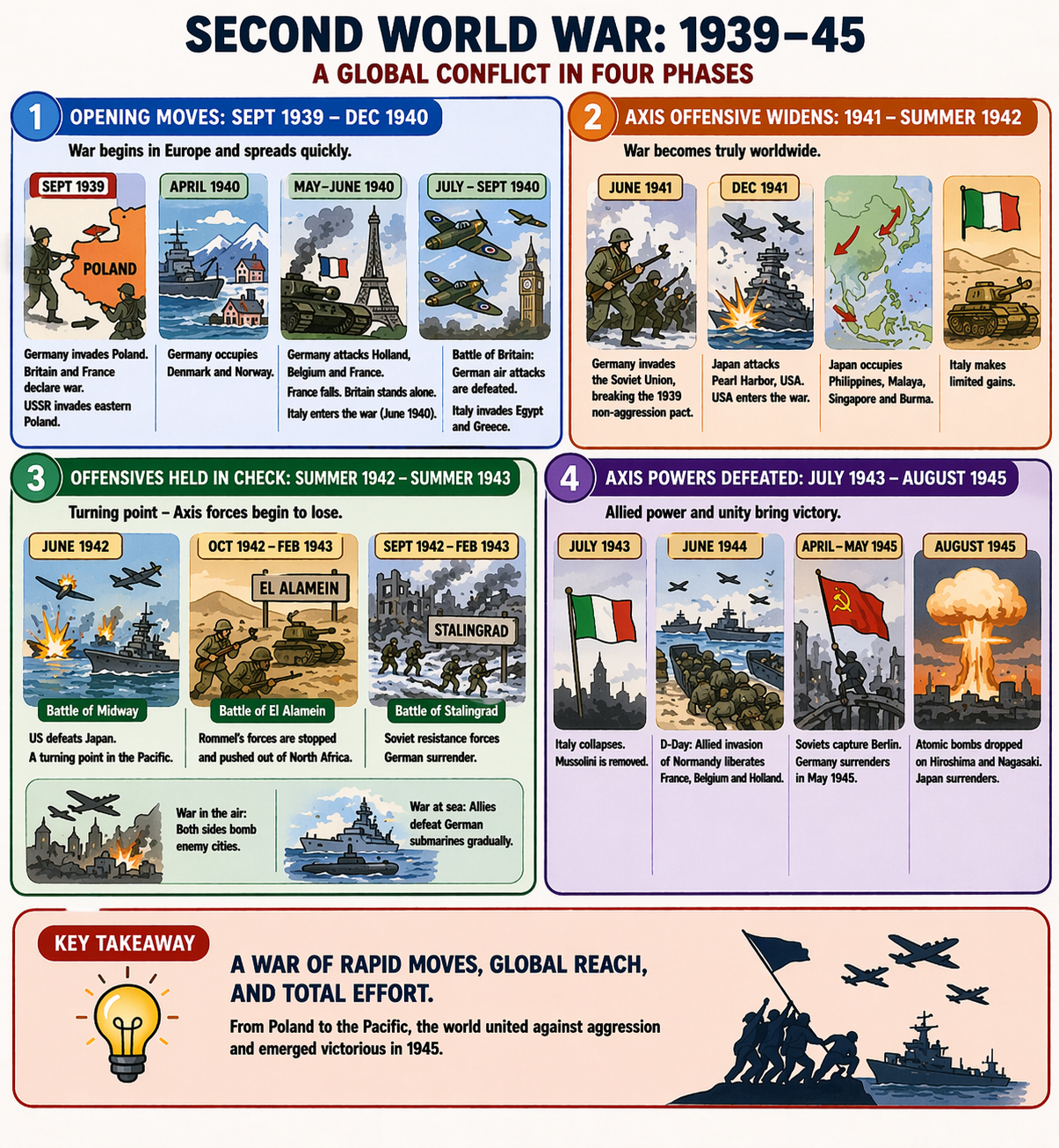
Opening Phase of the Second World War (1939–1940)
The early phase of the Second World War marks a decisive break from the static trench warfare of the First World War. What unfolds between September 1939 and late 1940 is a story of speed, surprise, and systemic collapse—driven largely by German innovation in warfare and the internal weaknesses of its opponents.
Let us understand this phase not as isolated events, but as a connected chain where military strategy, political indecision, and psychological factors together shaped outcomes.
The Fall of Poland: The First Demonstration of Blitzkrieg
Context and Strategy
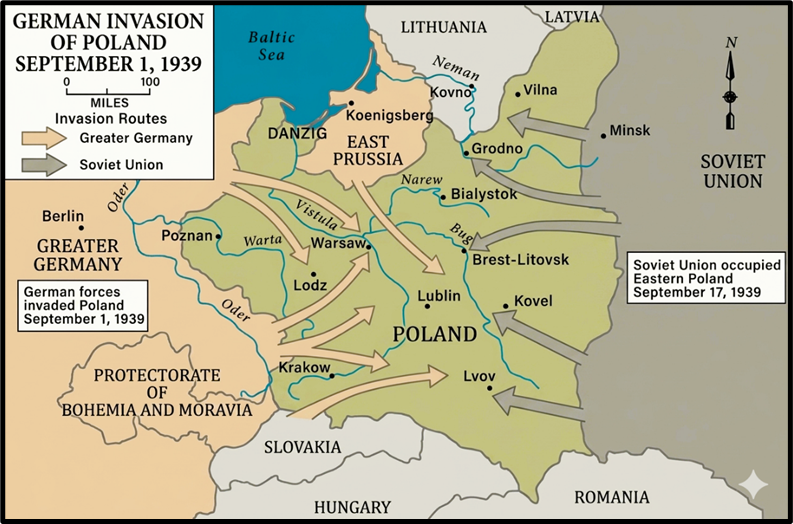
The German invasion of Poland in September 1939 introduced the world to Blitzkrieg (lightning war)—a method combining fast-moving tanks (Panzers), motorized infantry, and coordinated air strikes by the Luftwaffe. This was not just a military tactic; it was a psychological weapon designed to overwhelm before resistance could organize.
Course of Events
Poland, lacking mechanized divisions and modern air power, was quickly destabilized. Its railway systems and air force were neutralized early, crippling mobility and coordination. Despite courageous resistance, including outdated cavalry charges, Poland stood little chance.
The final blow came when the Soviet Union invaded from the east, in accordance with the Nazi-Soviet Pact. By 29 September 1939, Poland was partitioned between Germany and the USSR.
Analytical Insight
Poland’s defeat highlights a crucial theme: wars are not just fought with courage, but with technological and organizational superiority. It also exposed the hollowness of British and French guarantees, undermining smaller nations’ trust in collective security.
The ‘Phoney War’: A Pause Before the Storm
Nature of the Phase
Between late 1939 and early 1940, the Western Front witnessed an eerie calm. Despite being formally at war, Britain and France took no major offensive action.
Developments Elsewhere
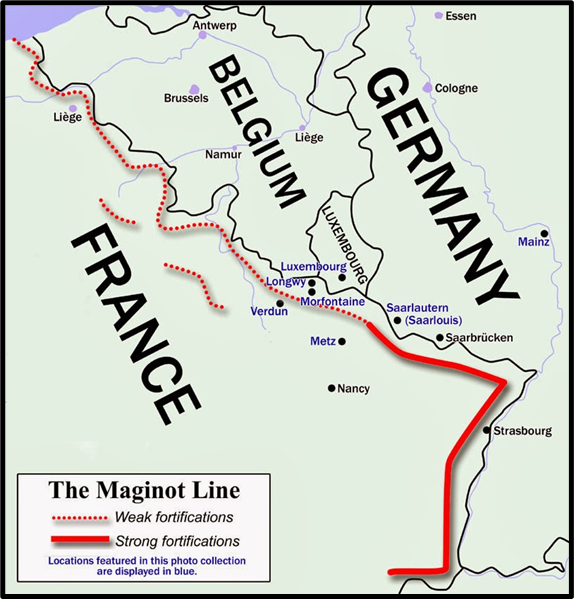
Meanwhile, the USSR expanded westward, occupying the Baltic states and attacking Finland. In Western Europe, both sides fortified themselves along defensive lines:
- France: Maginot Line
- Germany: Siegfried Line
Interpretation
This period, termed the ‘Phoney War’ by the American press, reflects strategic hesitation and misplaced expectations. Hitler hoped for a negotiated peace, while Allied indecision allowed Germany to consolidate gains.
From a historiographical perspective, many scholars view this phase as a lost opportunity—had France attacked Germany while it was engaged in Poland, the war’s trajectory might have changed.
Denmark and Norway: Strategic Expansion (April 1940)
Strategic Importance
Germany’s invasion of Denmark and Norway was not random—it was driven by:
- Access to Swedish iron ore via Narvik
- Control of North Sea naval routes
- Preempting British plans to occupy Norway
Execution and Outcome
German forces swiftly occupied key Norwegian ports. Despite Allied intervention, they failed due to lack of air support and delayed response. Local collaboration, especially by Vidkun Quisling, further aided Germany.
Consequences
- Germany secured vital resources and naval bases
- British political crisis led to the resignation of Neville Chamberlain
- Rise of Winston Churchill, marking a shift toward more decisive leadership
Critical Reflection
This episode shows how economic geography (iron ore routes) can shape military strategy. It also demonstrates the importance of air superiority, a recurring theme in WWII.
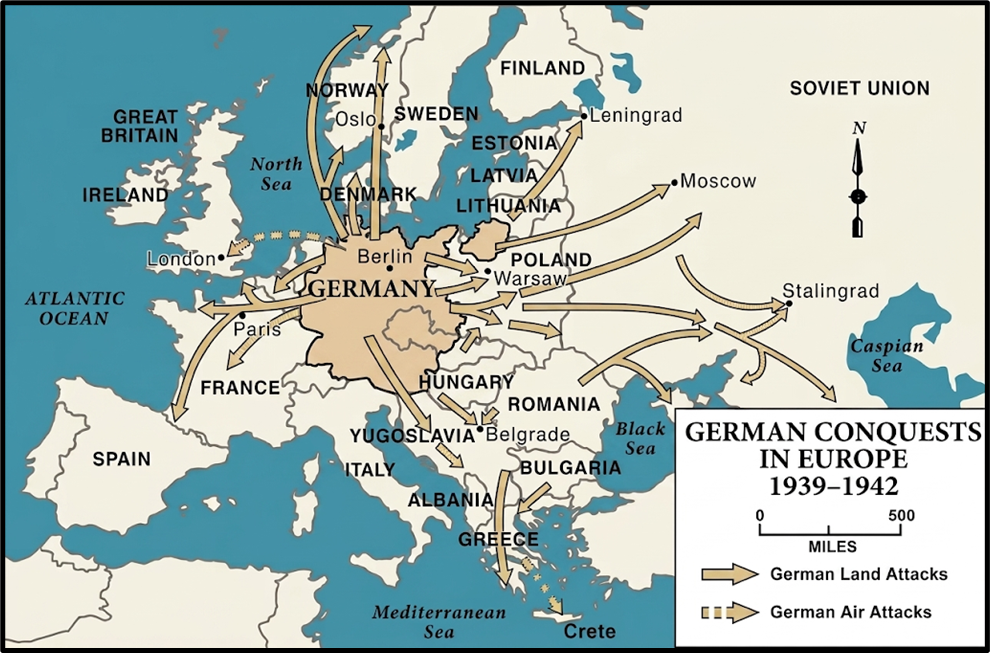
The Fall of Western Europe: Holland, Belgium, and France (May–June 1940)
Rapid German Advance
On 10 May 1940, Germany launched simultaneous attacks on Holland, Belgium, and France. Again, Blitzkrieg tactics ensured swift success:
- Netherlands surrendered in 4 days after Rotterdam bombing
- Belgium fell by late May
- German forces bypassed strong defenses via the Ardennes
The Miracle of Dunkirk
As Allied forces were trapped, over 338,000 soldiers were evacuated from Dunkirk (27 May–4 June). Though a tactical retreat, it became a symbol of resilience—the famous ‘Dunkirk Spirit’.
Fall of France
Paris fell on 14 June; France surrendered on 22 June 1940. Northern France came under German occupation, while a puppet regime under Philippe Pétain governed the south.
Interpretation
This phase represents the collapse of a major European power in weeks, shocking the world. It demonstrated that defensive warfare (Maginot mentality) was obsolete against mobile warfare.
Why Was France Defeated So Quickly?
Psychological and Political Divisions
French society was deeply divided:
- Right-wing factions admired Hitler
- Communists opposed war after the Nazi-Soviet Pact. This weakened national unity and morale.
Military and Strategic Weaknesses
France relied heavily on the Maginot Line, ignoring the Ardennes sector. Tanks were dispersed rather than concentrated, reducing effectiveness. Air support was inadequate.
Leadership Failures
French generals failed to adapt:
- No offensive against Germany during Poland crisis
- Slow response to German breakthroughs
- Poor coordination between army and air force
Historiographical View
Modern historians often argue that France’s defeat was not inevitable—it was a result of institutional rigidity and failure to learn from WWI lessons.
The Battle of Britain: First Check to Hitler
Nature of the Battle
Fought entirely in the air (Aug–Sept 1940), this battle was Germany’s attempt to destroy the RAF before invading Britain.
Key Factors in British Success
- Advanced radar system provided early warnings
- German aircraft had limited range and endurance
- Tactical error: shifting bombing focus from airfields to London
Outcome and Significance
Germany suffered heavy losses and abandoned invasion plans. This was the first major defeat of Nazi Germany.
Churchill famously remarked: “Never was so much owed by so many to so few.”
Strategic Importance
This battle ensured Britain’s survival and set the stage for a two-front war when Germany later invaded the USSR—something that would prove fatal for Hitler.
Mussolini’s Misadventures: The Weak Axis Partner
Italian Campaigns
Eager to match German success, Benito Mussolini launched:
- Invasion of Egypt (Sept 1940)
- Invasion of Greece (Oct 1940)
Outcome
Both campaigns failed disastrously:
- British forces pushed Italians back into Libya
- Greece repelled Italian advances
Implications
Italy became a liability, forcing Germany to divert resources. This highlights a key theme: alliances can be double-edged swords if partners are unequal in strength.
Conclusion: A Phase of German Ascendancy—But Not Invincibility
The period from 1939 to 1940 represents the zenith of German military success, built on speed, coordination, and surprise. However, beneath this success lay structural weaknesses:
- Overdependence on rapid victories
- Emergence of resilient opposition (Britain)
- Strategic overreach beginning to take shape
The Battle of Britain marks a turning point—not in ending German dominance immediately, but in proving that it could be resisted.
The Axis Offensive Widens (1941–Summer 1942)
The period from 1941 to mid-1942 represents a decisive expansion of the war, both geographically and strategically. What began as a European conflict now transformed into a truly global war involving multiple theatres—North Africa, Eastern Europe, and the Pacific. This phase reveals not only the aggressive ambitions of the Axis powers but also the structural weaknesses and strategic miscalculations that would eventually shape their downfall.
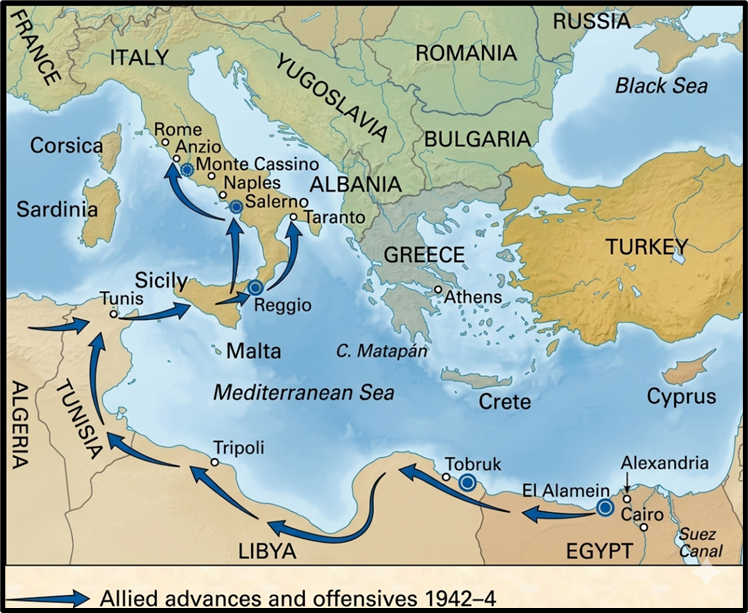
The Mediterranean Theatre: North Africa and Greece
The North African Campaign: A Struggle for Strategic Control
In early 1941, Adolf Hitler intervened to rescue his struggling ally, Italy, in North Africa. The dispatch of Erwin Rommel and the Afrika Korps marked a turning point. Rommel’s dynamic leadership pushed British forces out of Libya and deep into Egypt.
This campaign was not merely territorial—it was about control over the Suez Canal and access to Middle Eastern oil. By June 1942, Axis forces reached El Alamein, dangerously close to Alexandria. The fluctuating advances and retreats reflected a broader pattern: tactical brilliance but strategic overstretch.
The Balkan Diversion: Greece and Yugoslavia
Simultaneously, Germany intervened in the Balkans. In April 1941, German forces invaded Greece, swiftly overwhelming Allied resistance despite the presence of British and Commonwealth troops. The fall of Athens and the subsequent airborne invasion of Crete demonstrated Germany’s military versatility.
However, this success came at a cost. The campaign drained Axis resources and forced the redeployment of Allied troops from North Africa, weakening British resistance there.
Strategic Consequence: Delay of Operation Barbarossa
The most significant long-term impact of the Balkan campaign was the delay in launching the invasion of the Soviet Union. Originally planned for May 1941, the operation was postponed by about five weeks. This seemingly minor delay proved critical, as it meant that German forces would confront the harsh Russian winter before achieving decisive victory—a factor that would later cripple their advance.
Operation Barbarossa: The German Invasion of the Soviet Union
Ideological and Strategic Motivations
The launch of Operation Barbarossa on 22 June 1941 marked the largest land invasion in history. Hitler’s motives were deeply ideological and strategic:
- His hatred for communism and desire to destroy Joseph Stalin’s regime
- The quest for Lebensraum (living space) in Eastern Europe
- The belief that a quick victory would secure Germany’s long-term dominance
Historians differ in interpretation. Alan Bullock emphasizes ideological inevitability, while Hugh Trevor-Roper argues that the invasion was central—not optional—to Nazi objectives.
The Blitzkrieg at Its Peak
The invasion unfolded in three major thrusts:
- North toward Leningrad
- Centre toward Moscow
- South toward Ukraine
This was Blitzkrieg on an unprecedented scale, involving millions of troops and massive mechanized support. Initial successes were spectacular: cities like Kiev and Smolensk fell rapidly, and Soviet forces were caught unprepared.
This unpreparedness was partly due to Stalin’s miscalculation—he trusted the Nazi-Soviet Pact and ignored warnings from Britain and the USA. Additionally, Stalin’s purges had weakened the Red Army’s leadership.
The Turning Point: Nature and Overconfidence
Despite early victories, Germany failed to capture Moscow or Leningrad. Two critical factors intervened:
- Rasputitsa (autumn mud): immobilized German forces
- Severe winter: temperatures dropped to –38°C, for which German troops were unprepared
Hitler’s overconfidence—his belief in a quick victory—proved disastrous. By early 1942, the war in the east had turned into a prolonged conflict, fundamentally altering the nature of the war.
The Entry of the United States: Globalization of the War
The Attack on Pearl Harbor
On 7 December 1941, Japan launched a surprise attack on Attack on Pearl Harbor, destroying much of the US Pacific fleet. Orchestrated by Isoroku Yamamoto, the attack was a tactical success but a strategic gamble.
Franklin D. Roosevelt famously called it “a date which will live in infamy,” and the USA formally entered the war.
Underlying Causes: Economic Pressures and Strategic Ambition
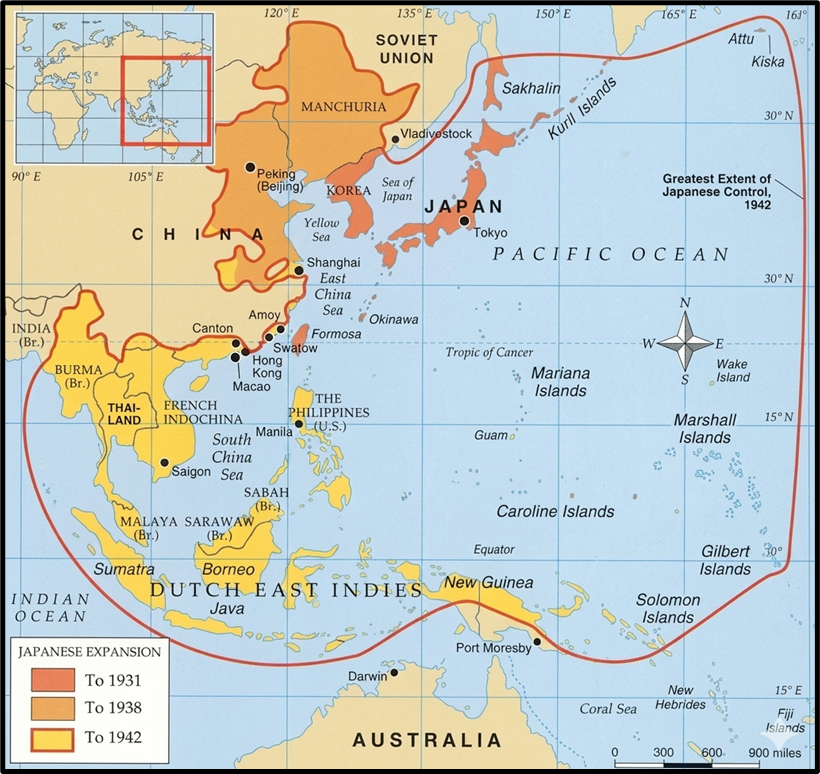
Japan’s expansionist policies were driven by economic necessity—particularly the need for oil, rubber, and tin. American embargoes, especially on oil, threatened Japan’s survival as a military power.
Negotiations failed because the USA demanded Japanese withdrawal from China and Indo-China, which Japan was unwilling to accept. The rise of militarist leadership under Hideki Tojo made war increasingly inevitable.
Immediate Consequences: Japanese Expansion
Following Pearl Harbor, Japan rapidly expanded across Southeast Asia and the Pacific, capturing territories like Malaya, Singapore, Burma, and the Philippines. This created a vast empire, seemingly validating Japanese strategy.
Hitler’s Strategic Miscalculation: War with the USA
After Pearl Harbor, Hitler declared war on the United States. This decision is widely regarded as one of his greatest strategic blunders.
He was not obligated to do so immediately, and the US was initially focused on Japan. However, Hitler believed conflict with the USA was inevitable and sought to appear proactive.
This decision transformed the war:
- Germany now faced the combined industrial might of the USA
- The Allies now included three major powers: the USA, USSR, and British Empire
In the long run, this ensured that the Axis powers were fighting a war of attrition they could not win.
Brutality and Occupation Policies: A Strategic and Moral Failure
Nazi Atrocities in Europe
The Nazi regime implemented a brutal racial policy in occupied territories. Slavic populations were treated as inferior, and Jews were targeted for systematic extermination.
Historian William L. Shirer highlights the unprecedented scale of suffering—millions were enslaved, tortured, or killed.
This brutality was not only immoral but strategically counterproductive. In regions like Ukraine and the Baltic states, where resentment against Soviet rule existed, humane treatment might have gained local support. Instead, Nazi policies alienated potential allies.
Japanese Occupation in Asia
Similarly, Japan’s vision of a “Greater East Asia Co-Prosperity Sphere” initially attracted support from populations seeking liberation from European colonialism.
However, harsh treatment, exploitation, and brutality soon led to widespread resistance movements. Ironically, many of these movements were led by communist groups, strengthening anti-Axis forces.
Critical Analysis: Why This Phase Matters
This period marks the peak of Axis expansion but also the beginning of their strategic overreach. Several interconnected developments stand out:
- The failure to secure quick victories (especially in the USSR) turned the war into a long-term conflict
- The entry of the USA shifted the balance of power irreversibly
- Brutal occupation policies undermined local support and strengthened resistance
Historiographically, this phase is often seen as the turning point in potential, even if not yet in outcome. The Axis powers appeared dominant, but their internal contradictions—overconfidence, ideological rigidity, and strategic miscalculations—had already set the stage for eventual defeat.
Conclusion: Expansion Without Consolidation
Between 1941 and mid-1942, the Axis powers expanded rapidly across continents. Yet, this expansion lacked consolidation. Military success was not matched by sustainable strategy or political wisdom.
The delay in Russia, the entry of the USA, and the alienation of occupied populations together transformed what seemed like imminent Axis victory into the beginning of their long decline.
The Offensives Held in Check (Summer 1942 – Summer 1943)
A Phase of Strategic Reversal
By mid-1942, the Second World War had reached a critical inflection point. Until this stage, the Axis powers—particularly Nazi Germany and Imperial Japan—had enjoyed rapid territorial expansion. However, between summer 1942 and summer 1943, the momentum began to shift decisively. In three geographically distant yet strategically interconnected theatres—Midway Island, El Alamein, and Stalingrad—the Axis advance was not just halted but reversed.
These were not isolated battles; they collectively marked the transition from Axis dominance to Allied resurgence.
(a) Midway Island (June 1942): Turning the Tide in the Pacific
Context and Strategic Importance
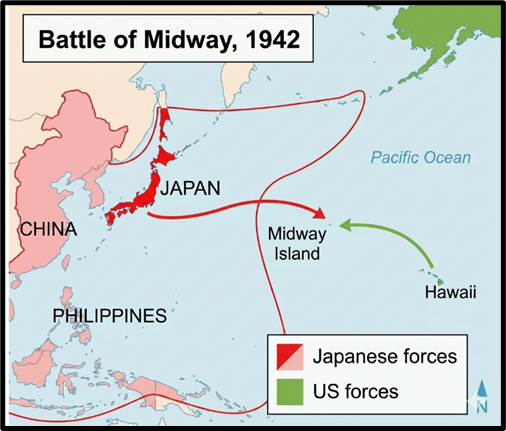
After the shock of Attack on Pearl Harbor, Japan had established naval supremacy in the Pacific. The attack on Midway was intended to eliminate the remaining American naval threat and consolidate Japanese control.
Why Did Japan Lose?
Despite numerical superiority, Japan suffered a catastrophic defeat. The reasons reveal the deeper dynamics of modern warfare:
First, American intelligence proved decisive. By breaking Japanese naval codes, the United States anticipated both the timing and location of the attack. This transformed the battle from a defensive reaction into a planned ambush.
Second, Japanese strategic errors compounded their vulnerability. Overconfidence led them to divide their fleet, weakening concentration of force—a classical violation of military principle. More critically, launching simultaneous air operations left their aircraft carriers exposed during rearming.
At this precise moment, American dive-bombers struck from high altitude, destroying four Japanese carriers. This was not merely a tactical victory—it was a structural collapse of Japan’s naval air power.
Consequences and Wider Impact
The Battle of Midway fundamentally altered the nature of the Pacific War. Aircraft carriers, not battleships, emerged as the decisive instruments of naval warfare. From this point onward, the United States, under leaders like Douglas MacArthur, adopted the strategy of “island hopping”—selectively capturing key islands to gradually close in on Japan.
Thus, Midway represents not just a victory, but a paradigm shift in military strategy—from surface naval dominance to carrier-based air power.
(b) El Alamein (October 1942): Securing the Suez Lifeline
Context: The North African Theatre
North Africa was crucial because of the Suez Canal, the lifeline connecting Britain to its empire, especially India and the Far East. Control over Egypt would have given the Axis access to Middle Eastern oil and strategic depth.
The Battle and Its Dynamics
The Axis forces, led by Erwin Rommel, had pushed deep into Egypt. However, their advance was gradually stalled and finally reversed by the British Eighth Army under Bernard Montgomery.
This victory was not sudden—it was the culmination of months of attrition. During a crucial pause, the Allies amassed overwhelming superiority in men and equipment. Equally important was control of the air: Allied aircraft disrupted Axis supply lines across the Mediterranean, creating acute shortages of fuel and ammunition.
Montgomery’s methodical preparation ensured success, though critics argue he was overly cautious and allowed Rommel to retreat with part of his army.
Consequences and Strategic Significance
El Alamein had far-reaching consequences. It safeguarded Egypt and the Suez Canal, preventing a potentially disastrous Axis breakthrough. It also prevented a strategic convergence between German forces in North Africa and those advancing into the Soviet Union.
More importantly, it initiated the complete collapse of Axis power in North Africa. Subsequent Allied landings in Morocco and Algeria trapped Axis forces in Tunisia, leading to the surrender of 275,000 troops in May 1943.
From a broader perspective, El Alamein demonstrated the importance of logistics, air superiority, and coordinated planning—factors often more decisive than battlefield bravery alone.
(c) Stalingrad (1942–43): The Psychological and Strategic Collapse of Nazi Germany
Context: Operation Barbarossa and the Eastern Front
The German invasion of the Soviet Union under Operation Barbarossa had initially been spectacularly successful. By 1942, German forces had penetrated deep into Soviet territory, aiming to capture oil fields in the Caucasus.
The Battle: From Blitzkrieg to Attrition
The German Sixth Army, commanded by Friedrich von Paulus, reached Stalingrad in August 1942. The city was reduced to ruins, yet Soviet resistance did not collapse.
In November 1942, the Soviets launched a massive counter-offensive, encircling German forces in a classic pincer movement. With supply lines overstretched and winter setting in, the Germans were trapped.
Despite opportunities to retreat, Hitler ordered them to hold their ground. The result was inevitable: on 2 February 1943, Paulus surrendered with 94,000 troops.
Consequences: A Decisive Turning Point
The defeat at Stalingrad was catastrophic for Germany. It shattered the myth of Nazi invincibility and marked the beginning of a sustained Soviet offensive.
Subsequent battles, especially the Battle of Kursk, reinforced this shift. By 1944, German forces were in full retreat across the Eastern Front.
Historiographically, Stalingrad is often seen as the single most decisive battle of the European war—not merely for its military outcome, but for its psychological and symbolic impact.
The Role of Allied Naval Forces
Maritime Power as the Backbone of Victory
The war was not decided on land alone. Control of the seas determined the ability to sustain armies, transport resources, and maintain global supply chains.
While the United States dominated the Pacific, the British Navy played a crucial role in the Atlantic and Mediterranean.
(a) British Naval Achievements
The British Navy demonstrated resilience despite early setbacks due to inadequate air support. Aircraft carriers gradually became central to naval strategy.
Key successes included the crippling of the Italian fleet at Taranto using the carrier HMS Illustrious and the sinking of the German battleship Bismarck.
Equally important were Arctic convoys supplying the Soviet Union. Despite heavy losses, these convoys delivered crucial war material, sustaining Soviet resistance.
(b) The Battle of the Atlantic: War of Survival
Context and Crisis
The Battle of the Atlantic was essentially a war of supply lines. German U-boats aimed to starve Britain into submission by sinking merchant ships.
By early 1943, losses were so severe that Britain’s survival was at stake.
Turning the Tide
The eventual Allied success was a product of technological and tactical innovation. Long-range aircraft provided air cover for convoys, while improved radar systems enabled detection of submarines even at night.
Gradually, ship production outpaced losses, and by mid-1943, the crisis had been contained.
Strategic Significance
The victory in the Atlantic was as crucial as victories on land. Without secure supply lines, Britain could not have continued the war. It also ensured that the United States could project power into Europe.
Air Power and the Defeat of the Axis
The Second World War marked a turning point in the use of air power. Unlike earlier conflicts, air warfare was not merely auxiliary—it became central to strategy, logistics, and psychological warfare. The contribution of air power to the defeat of the Axis powers was therefore both military and moral, decisive yet debated.
Strategic and Tactical Achievements of Allied Air Power
Securing Survival: The Battle of Britain (1940)
The first major success of Allied air power came during the Battle of Britain, where the Royal Air Force (RAF) successfully repelled the German Luftwaffe. This was not just a defensive victory—it had profound strategic implications. Hitler’s plan to invade Britain (Operation Sea Lion) had to be abandoned.
This moment fundamentally altered the course of the war. Britain remained a base for future Allied offensives, including the eventual liberation of Europe. Thus, air superiority became a precondition for survival and resistance.
Air-Sea Coordination: Dominance in Naval Warfare
Air power also revolutionized naval warfare. Aircraft worked closely with naval forces to achieve several key successes:
- The destruction of the Italian fleet at Taranto and Cape Matapan
- The sinking of the German battleship Tirpitz in 1943
- Protection of Atlantic convoys and anti-submarine warfare
A crucial technological factor here was radar, which significantly improved detection and targeting. German naval chief Admiral Doenitz admitted that by 1943, aircraft were sinking more U-boats than traditional naval vessels.
This reflects a broader transformation: control of the seas increasingly depended on control of the skies.
The Pacific Theatre: Carrier-Based Air Power
In the Pacific, air power—especially from aircraft carriers—was decisive. The Battle of Midway (1942) demonstrated how dive-bombers could destroy enemy fleets without direct naval confrontation.
Later, during the “island-hopping” campaign, heavy bombers softened Japanese defenses before amphibious landings in places like the Mariana Islands and the Philippines. Air transport also ensured logistical continuity in difficult terrains such as Burma.
Thus, air power enabled a mobile, flexible, and long-range strategy, crucial in the vast Pacific theatre.
Supporting Ground Campaigns: North Africa and Europe
Air support proved indispensable in land campaigns:
- In North Africa, RAF aircraft attacked Rommel’s supply lines, weakening his operational capacity.
- During invasions such as Sicily (1943) and Normandy (1944), airborne troops were deployed behind enemy lines.
- Air superiority ensured protection for advancing ground forces.
However, not all operations succeeded—Arnhem (1944) exposed the risks of overambitious airborne strategies.
The Strategic Bombing Campaign: Effectiveness vs Morality
Nature of the Strategic Air Offensive
The Allied bombing of German and Japanese cities—termed the “strategic air offensive”—aimed to:
- Destroy industrial and military infrastructure
- Disrupt transport and communication networks
- Undermine civilian morale
Cities like Ruhr, Hamburg, Berlin, and Tokyo suffered devastating attacks. The scale of destruction was unprecedented.
Effectiveness: A Delayed but Decisive Impact
Initially, the bombing campaign seemed inefficient. However, from 1944 onwards, improvements in accuracy and fighter escorts (like the Mustang) transformed its effectiveness.
Key outcomes included:
- Collapse of synthetic oil production
- Destruction of key industrial hubs like Krupp factories
- Severe disruption of railway networks
- Diversion of German aircraft from the Eastern Front
By 1945, Germany’s war machinery was paralyzed, and Japan too was brought to the brink of collapse.
Historians like Richard Overy and Adam Tooze emphasize that bombing played a crucial role in weakening the Axis economically and militarily.
Human Cost and Moral Debate
The darker side of air power lies in its devastating human toll:
- German civilian deaths: 600,000 to 1 million
- British civilian deaths from German bombing: over 60,000
- Massive casualties in Japan, including 80,000 in a single Tokyo raid
The bombing of Dresden (1945) alone killed around 50,000 people in one night.
This raises a fundamental ethical question: Can total war justify the targeting of civilians?
Historiographical Debate
The morality of strategic bombing remains deeply contested:
- Sven Lindquist argued that such bombings were violations of international humanitarian law.
- Jörg Friedrich portrayed them as war crimes, blaming leaders like Churchill.
- Critics like Corelli Barnett dismissed such views as distortions that ignore Nazi atrocities.
- Richard Overy defended the campaign as both necessary and effective.
- Peace activist Bruce Kent acknowledged the moral issues but noted that the Axis powers had initiated such tactics (e.g., Guernica, Warsaw).
This debate reflects a broader historiographical divide between realist (war necessity) and moralist (ethical accountability) perspectives.
Air Power and the Final Collapse of the Axis
Role in the Fall of Italy (1943–45)
Air power facilitated the Allied invasion of Sicily and mainland Italy. Continuous bombing:
- Disrupted German supply lines
- Enabled amphibious landings
- Forced Germany to divert troops
Italy’s surrender weakened the Axis and opened a new front in southern Europe.
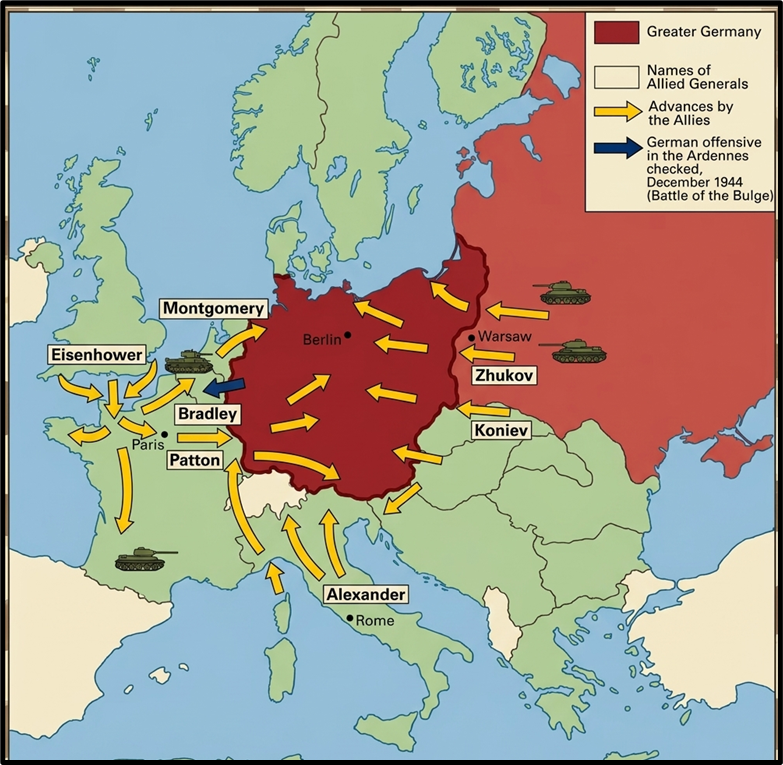
Operation Overlord (D-Day, 1944)
The success of the Normandy landings depended heavily on air superiority:
- Airborne troops were deployed behind enemy lines
- German defenses were bombed prior to landings
- Allied troops received continuous air cover
Without control of the skies, such a massive operation would have been impossible.
Weakening Germany Before Final Invasion
By 1945, sustained bombing had:
- Crippled Germany’s fuel and armaments production
- Destroyed infrastructure
- Lowered morale
This made the final Allied advance into Germany more feasible, even though resistance remained fierce.
Japan and the Culmination of Air Power
The war in Japan demonstrated the ultimate escalation of air power:
- Firebombing of cities like Tokyo caused massive destruction
- Atomic bombs on Hiroshima and Nagasaki forced Japan’s surrender
This marked the beginning of the nuclear age, where air power acquired an unprecedented destructive capacity.
Critical Evaluation: Was Air Power Decisive?
Military Perspective
Air power was undoubtedly a force multiplier:
- It enabled coordination across land, sea, and air
- It weakened enemy economies and logistics
- It shortened the war, especially after 1944
However, it did not operate in isolation. Ground forces (especially the Soviet advance) and naval dominance were equally crucial.
Moral and Philosophical Perspective
The use of air power blurred the line between combatants and civilians. The idea of “total war” justified mass destruction, but at the cost of ethical norms.
This raises a larger question for modern warfare: Does technological superiority justify humanitarian compromise?
Conclusion: A Double-Edged Sword
Air power was one of the decisive factors in the Allied victory, particularly in the later stages of the war. It crippled Axis economies, supported major offensives, and hastened the collapse of Germany and Japan.
Yet, it also introduced a new form of warfare—impersonal, large-scale, and devastating to civilians. The legacy of World War II air power is therefore deeply ambivalent: it represents both strategic brilliance and moral tragedy.
Why Did the Axis Powers Lose the Second World War?
The defeat of the Axis powers—Germany, Italy, and Japan—was not the result of a single decisive factor, but rather a complex interaction of structural weaknesses, strategic miscalculations, and the growing strength of the Allied coalition. To understand this fully, we must move beyond a simple list and see how these causes interlinked over time, gradually shifting the balance of the war.
Structural Weakness: Shortage of Raw Materials
At the core of the Axis defeat lay a fundamental economic limitation: resource scarcity.
Germany, despite its industrial strength, lacked essential raw materials such as oil, rubber, nickel, and cotton. Italy and Japan were even more dependent on imports. In a short war, this might not have mattered—but once the war dragged on, these shortages became critical.
This explains why early German strategy emphasized Blitzkrieg—a rapid, decisive war. The entire Axis war effort was built on the assumption of quick victory. However, when Britain survived in 1940 and the war extended, the Axis economies began to strain under prolonged pressure.
Thus, we see a key insight: 👉 The Axis powers were structurally unprepared for a long, industrial war.
Adaptive Superiority: The Allies Learned and Evolved
Another crucial factor was the learning curve of the Allies.
In the early years (1939–41), the Axis powers appeared almost invincible. However, by 1942, the Allies had adapted:
- They developed strategies to counter Blitzkrieg tactics
- They recognized the central role of air power and aircraft carriers
- They improved coordination between land, sea, and air forces
This transformation led to decisive victories in:
- The Battle of the Atlantic, where Allied naval-air coordination defeated German U-boats
- The Pacific War, where aircraft carriers replaced battleships as the dominant force
The key takeaway here is analytical: 👉 Wars are not static; the side that adapts faster often wins.
Strategic Overreach: Fighting Too Many Fronts
One of the most critical mistakes of the Axis powers was overexpansion.
Germany’s Overstretch
Adolf Hitler underestimated the global nature of the war. By attacking multiple regions simultaneously, Germany ended up fighting on:
- The Eastern Front (against the USSR)
- The Western Front (against Britain and later the USA)
- The Mediterranean and North Africa
This dispersion of forces weakened Germany’s ability to concentrate strength at decisive points.
Japan’s Overreach
Similarly, Japan expanded rapidly across East and Southeast Asia. However, as historian B. H. Liddell Hart observed, Japan became “stretched beyond its capacity.” Its industrial base was too limited to sustain such a vast empire.
Italy as a Liability
Benito Mussolini’s military failures forced Germany to divert resources to support Italy, further weakening its overall position.
👉 This highlights a classic geopolitical principle: Expansion without consolidation leads to collapse.
The Decisive Factor: Allied Economic and Industrial Superiority
Perhaps the most decisive reason for the Axis defeat was the overwhelming resource advantage of the Allies, especially → United States, Soviet Union, United Kingdom and its empire
Industrial Power of the USA
The United States emerged as the “arsenal of democracy”, producing:
- Over 70,000 tanks annually
- Around 120,000 aircraft annually
This level of production simply could not be matched by Germany or Japan.
Soviet Resilience
The Soviet Union demonstrated remarkable adaptability by relocating industries east of the Ural Mountains, beyond German reach. Despite losing vast territories, it continued production and eventually outproduced Germany in tanks and manpower.
The Myth of Speer
Albert Speer claimed to have revived German production. However, historian Adam Tooze argues that Speer exaggerated his achievements and manipulated statistics.
👉 The deeper insight here: Modern war is ultimately decided not just on battlefields, but in factories.
Tactical and Strategic Mistakes of the Axis
Beyond structural issues, critical decisions by Axis leadership accelerated their defeat.
Misjudgment of Air and Naval Warfare
Japan failed to recognize the importance of aircraft carriers, continuing to invest heavily in battleships—an outdated strategy in modern naval warfare.
Failure to Defeat Britain First
Hitler’s decision to invade the Soviet Union in 1941 without first defeating Britain proved disastrous. It forced Germany into a two-front war, historically a fatal strategic error.
Britain’s survival allowed it to become the launching base for Allied offensives, including D-Day.
Underestimating the Soviet Union
Germany made several critical errors in its invasion of the USSR:
- No preparation for winter warfare
- Underestimation of Soviet resilience
- Overextended supply lines
Hitler’s insistence on “no retreat” led to catastrophic losses, especially at Stalingrad.
Declaring War on the USA
After Japan’s attack on Pearl Harbor, Hitler unnecessarily declared war on the United States. This brought the full industrial might of the USA into the European war.
👉 This was a strategic blunder of the highest order.
Misallocation of Resources
Hitler prioritized V-weapons (V-1 and V-2 rockets) over potentially more effective technologies like jet aircraft, which might have challenged Allied air superiority.
Ideological Failure: The Impact of Nazi Racial Policy
Beyond military and economic factors, ideology also played a role.
Nazi racial policies—especially in the Soviet territories—were brutal:
- Jews, Slavs, Roma (gypsies), and others were persecuted
- Local populations, especially in Ukraine, were alienated
Ironically, many of these groups initially resented Soviet rule and might have supported Germany. However, Nazi brutality turned potential allies into enemies.
👉 This reveals a crucial insight: Ideology can undermine strategy.
Integrated Analysis: Why the Axis Was Doomed
When we connect all these factors, a clear pattern emerges:
- Short-term strength vs long-term weakness
- Initial success vs strategic overreach
- Technological innovation vs poor decision-making
- Ideological rigidity vs Allied adaptability
The Axis powers were not defeated suddenly—they were gradually worn down by a combination of → Economic exhaustion, Strategic miscalculations, Allied coordination and superiority
Historiographical Perspective
Historians differ in emphasis:
- Economic historians like Adam Tooze stress industrial capacity
- Military historians like B. H. Liddell Hart highlight strategic overreach
- Others focus on leadership failures, especially Hitler’s decisions
However, there is broad consensus that no single factor explains the defeat—it was the cumulative effect of multiple weaknesses.
Conclusion: A War Lost from Within
Ultimately, the Axis powers lost not just because the Allies were strong, but because they themselves were structurally flawed.
Their early victories created an illusion of invincibility, but beneath that lay → Fragile economies, Overambitious strategies, Rigid ideologies
As the war prolonged, these weaknesses became fatal.
8 Comments