
Motion and Kinematics
Everything in the universe is in motion — from electrons orbiting nuclei to galaxies hurtling through space. Motion is perhaps the most fundamental phenomenon in physics. But what exactly is motion? And how do we describe, measure, and analyse it?
This chapter answers all these questions systematically, building from basic definitions to the elegant equations that govern how objects move.
Motion is defined as the change in the position of an object with respect to a reference point and time. Conversely, Rest is the state in which an object’s position does not change with respect to a reference point over time. Here is a subtle but important insight: rest and motion are relative.
A passenger sitting in a moving train is at rest relative to the train, but in motion relative to someone standing on the platform.
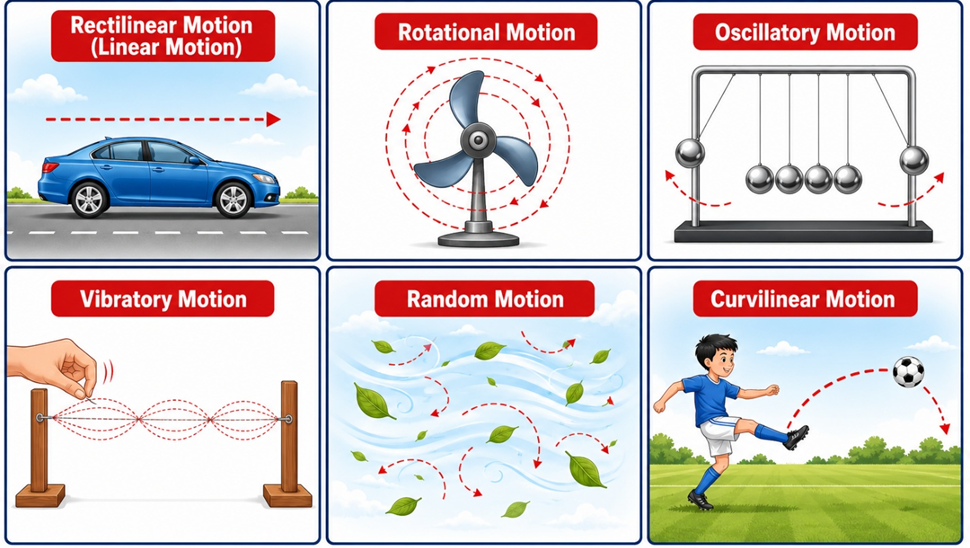
Types of Motion
A. Based on the Nature of Movement
- Translational Motion: All parts of an object move in the same direction by the same distance simultaneously — the object shifts from one point to another without changing its orientation. It can be along a straight or curved path. Example: a car moving on a straight road.
- Rotational Motion: The object revolves around a fixed axis or point, and every point traces a circular path. Example: a ceiling fan rotating.
- Periodic Motion: The motion repeats itself at regular intervals of time. Example: the revolution of the Earth around the Sun.
- Oscillatory Motion: A special type of periodic motion in which an object moves back and forth about a fixed equilibrium position. Example: a pendulum swinging, a child on a swing.
- Vibratory Motion: A type of oscillatory motion — the object moves back and forth, up and down, or pulsates around a fixed point. Example: plucking a guitar string.
- Random Motion: Irregular and unpredictable movement — neither direction nor speed follows any pattern. Example: dust particles moving in air (Brownian motion).
📌 Key Insight: Simple Harmonic Motion (SHM) is a special type of oscillatory (periodic) motion in which the restoring force is directly proportional to the displacement from the equilibrium position and always directed towards it. SHM is the basis for understanding waves, sound, and AC circuits.
B. Based on the Path an Object Follows
- Rectilinear (Linear) Motion: Motion along a straight line — direction does not change. Example: a train moving on a straight track.
- Curvilinear Motion: Motion along a curved path — direction continuously changes. Example: a car navigating a bend.
- Circular Motion: A special case of curvilinear motion where the object moves along a circular path at a constant distance (radius) from a fixed central point. Example: a satellite orbiting the Earth.
C. Based on Speed
- Uniform Motion: Equal distances in equal intervals of time — constant velocity throughout. Example: a car cruising at a steady 60 km/h on a highway.
- Non-Uniform Motion: Unequal distances in equal intervals of time — variable speed throughout. Example: a car in city traffic, constantly slowing down and speeding up.
D. Based on Dimensions
- One-Dimensional (1D) Motion: Along a straight line; only one coordinate (x) changes. Example: a car on a straight road.
- Two-Dimensional (2D) Motion: In a plane; two coordinates (x, y) change. Example: a ball following a parabolic arc.
- Three-Dimensional (3D) Motion: In space; all three coordinates (x, y, z) change. Example: a bird in flight.
Distance and Displacement
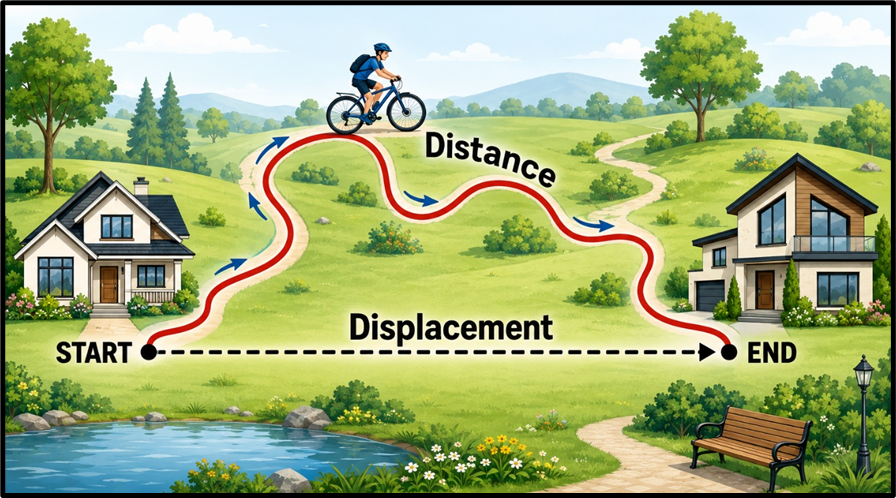
These two terms are routinely confused — even by students who have studied physics before. The key is to remember one simple rule: distance counts every step you take, displacement only cares about where you started and where you ended up.
Distance
Distance is the total path length an object travels, irrespective of direction. It is a scalar quantity — only magnitude, no direction.
Distance is always positive or zero; it can never be negative. Example: if you walk 3 km east and then 4 km west, the distance you have covered is 3 + 4 = 7 km.
Displacement
Displacement is the shortest straight-line distance between the initial position and the final position, along with the direction.
It is a vector quantity — has both magnitude and direction. It can be positive, negative, or zero, and it is independent of the path taken.
Using the same example: you walked 3 km east and 4 km west, so your net displacement is 1 km west (or −1 km if east is positive). You are 1 km west of where you started.
| Feature | Distance | Displacement |
| Type | Scalar | Vector |
| Direction | Not considered | Considered (essential) |
| Value | Always positive or zero | Can be positive, negative, or zero |
| Path dependence | Depends on actual path taken | Only initial and final positions matter |
| Example | Total steps walked on a journey | Straight-line distance from start to end |
Speed
Speed is the rate at which an object covers distance over time, irrespective of direction. It is a scalar quantity — it tells you how fast, not in which direction.
Speed = Distance ÷ Time.
Common units: m/s, km/h, mph. Speed is always zero or positive — never negative.
Types of Speed
- Uniform Speed: Equal distances in equal time intervals. Example: a car moving steadily at 60 km/h.
- Non-Uniform Speed: Unequal distances in equal time intervals. Example: a car in city traffic.
- Average Speed: Total Distance ÷ Total Time. Example: if a car travels 100 km in 2 hours, average speed = 50 km/h.
- Instantaneous Speed: Speed at a specific moment in time — what your speedometer shows at any given instant.
Velocity
Velocity is the rate at which an object changes its position — it is speed with a direction.
Velocity = Displacement ÷ Time.
It is a vector quantity. The difference is crucial: a car going around a circular track at a constant 60 km/h has constant speed, but its velocity is constantly changing because its direction keeps changing.
Types of Velocity
- Uniform Velocity: Equal displacements in equal time intervals — both speed and direction are constant. Example: a car on a perfectly straight road at constant speed.
- Non-Uniform Velocity: Unequal displacements in equal time intervals. Example: a car accelerating from a red light.
- Average Velocity: Total Displacement ÷ Total Time. Note: if you walk 5 km north and 3 km south in 2 hours, total displacement = 2 km north; average velocity = 1 km/h (north).
- Instantaneous Velocity: Velocity at a specific point in time — the limiting value of average velocity as time interval approaches zero.
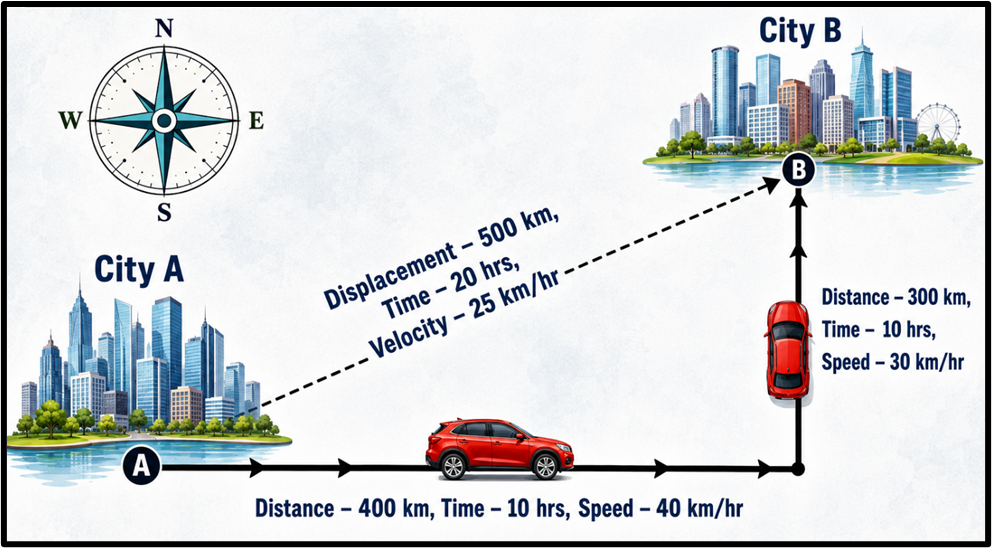
| Feature | Speed | Velocity |
| Type | Scalar | Vector |
| Depends on | Distance (path length) | Displacement (net change in position) |
| Direction | Not required | Direction is essential |
| Formula | Speed = Distance / Time | Velocity = Displacement / Time |
| Sign | Always positive or zero | Can be positive, negative, or zero |
Relative Velocity
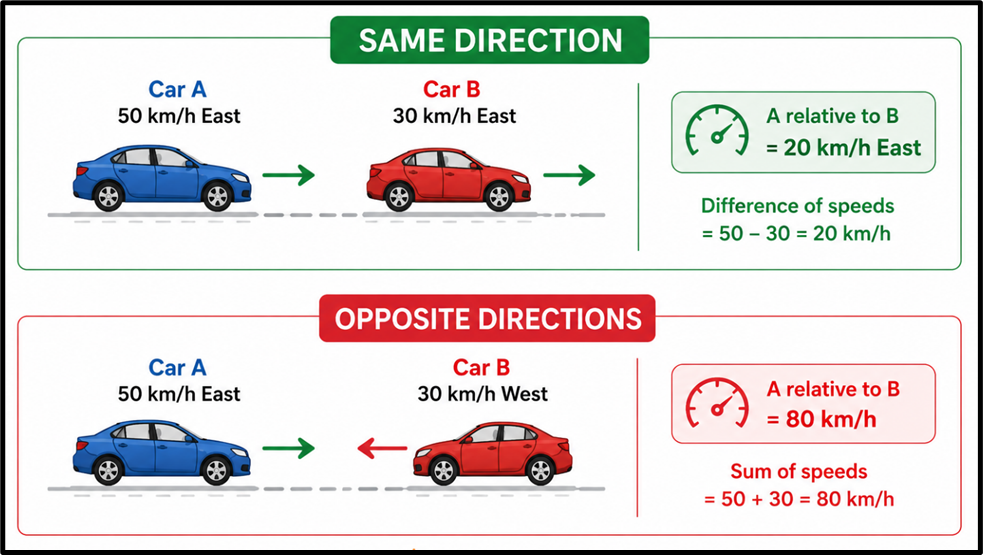
Relative velocity is the velocity of an object as observed from the frame of reference of another object. It answers the question: “How fast is A moving relative to B?”
This concept is fundamental to understanding everyday situations — like why a bus overtaking you on the highway appears to move slowly when you are also driving fast.
- Objects moving in the SAME direction: Relative Velocity = Difference in their speeds.
- Example: if car A moves at 50 km/h east and car B at 30 km/h east, then A’s velocity relative to B = 20 km/h east.
- Objects moving in OPPOSITE directions: Relative Velocity = Sum of their speeds.
- Example: if car A moves at 50 km/h east and car B at 30 km/h west, their relative velocity = 80 km/h.
Acceleration
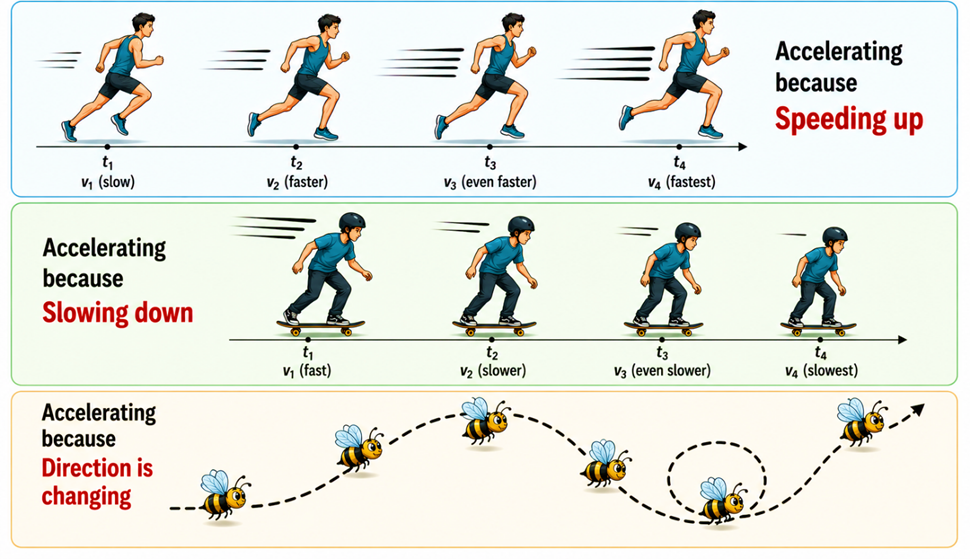
Acceleration is the rate of change of velocity with respect to time. Notice: it is the rate of change of velocity — not speed.
This means an object can be accelerating even if its speed is constant, as long as its direction changes (like circular motion).
Acceleration = (Final velocity − Initial velocity) ÷ Time interval.
SI unit: m/s².
Acceleration is a vector quantity. This means it has both magnitude and direction — and understanding the sign of acceleration is crucial.
Types of Acceleration
- Uniform Acceleration: Velocity changes by the same amount in equal time intervals — constant rate of change. Example: free fall under gravity (ignoring air resistance).
- Non-Uniform Acceleration: Velocity changes by different amounts in equal time intervals — the rate of change itself changes. Example: a car in stop-and-go traffic.
- Positive Acceleration: Velocity increases over time. Example: a car speeding up from a standstill.
- Negative Acceleration (Deceleration/Retardation): Velocity decreases over time. Example: a car applying brakes.
- Zero Acceleration: Velocity remains completely constant — no change in either speed or direction. Example: a car on a perfectly straight highway at constant speed.
- Average Acceleration: Total change in velocity ÷ Total time taken.
- Instantaneous Acceleration: Rate of change of velocity at a specific instant in time.
Graphical Representation of Motion
Graphs are the language through which motion speaks visually. For UPSC, you must be able to read and interpret three key types of graphs: Distance-Time, Velocity-Time, and Displacement-Time. Each reveals something different about the motion.
A. Distance-Time Graph (D-T Graph)
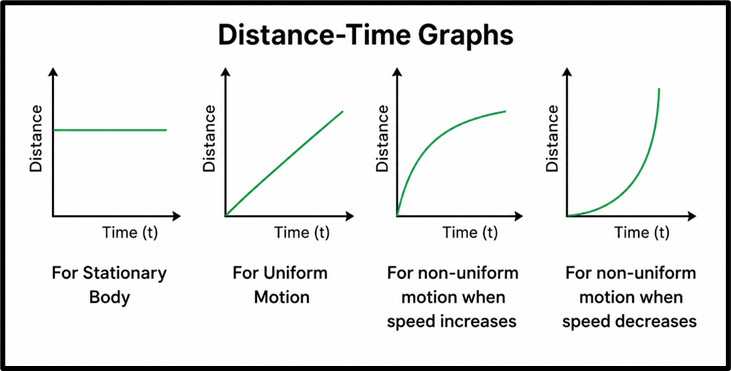
X-axis = Time | Y-axis = Distance | Slope of the line = Speed
- A straight diagonal line: constant speed (uniform motion).
- A flat horizontal line: object is stationary (distance not changing).
- An upward-curving line: speed is increasing (positive acceleration).
- A downward-curving line: speed is decreasing (deceleration).
- A steeper line: higher speed.
B. Velocity-Time Graph (V-T Graph)
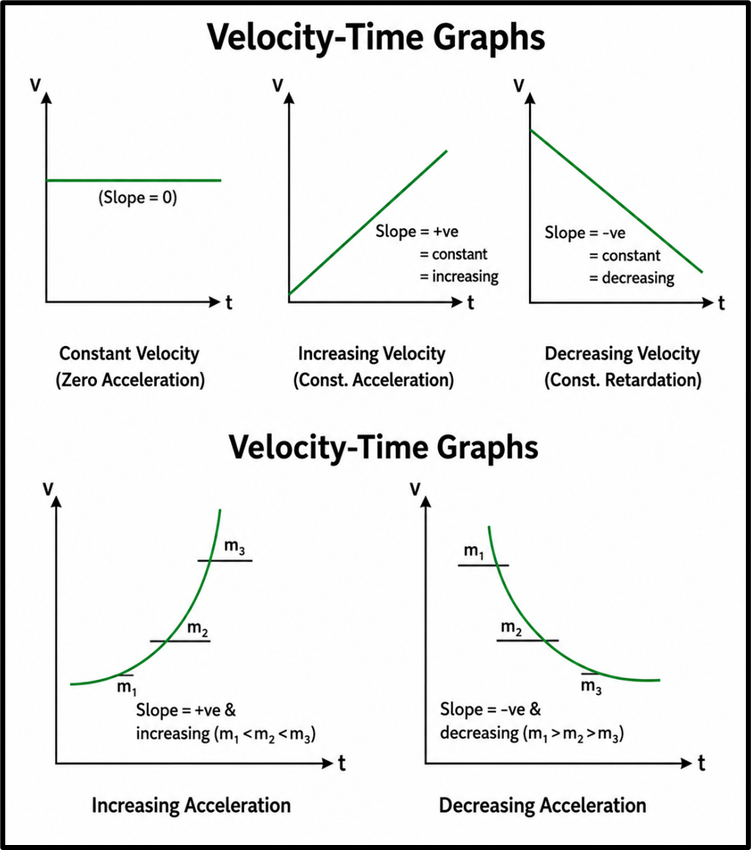
X-axis = Time | Y-axis = Velocity | Slope = Acceleration | Area under curve = Displacement
- A horizontal line: constant velocity (zero acceleration).
- A straight line with positive slope: uniform acceleration.
- A straight line with negative slope: uniform deceleration.
- A curved line: non-uniform acceleration.
- A steeper line: higher acceleration.
- Line touching X-axis: velocity = zero.
- Line below X-axis: motion in the opposite direction.
C. Acceleration-Time Graph (A-T Graph)
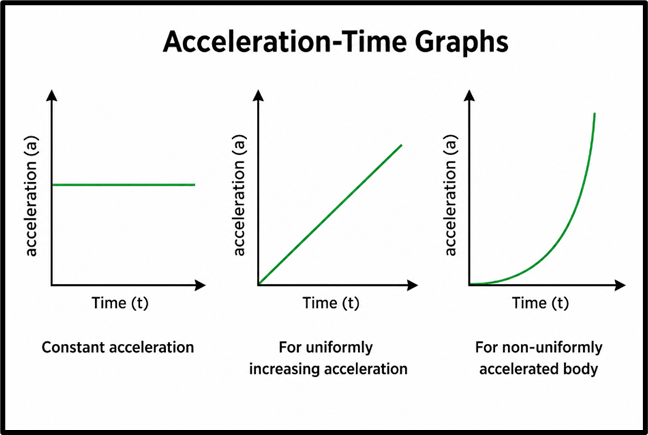
X-axis = Time | Y-axis = Acceleration | Area under the curve = Change in velocity
- Horizontal line: uniform acceleration.
- Non-horizontal line: non-uniform acceleration.
- Line along X-axis (a = 0): constant velocity.
- Line above X-axis: positive acceleration (object speeding up).
- Line below X-axis: negative acceleration / deceleration.
D. Displacement-Time Graph (S-T Graph)
X-axis = Time | Y-axis = Displacement | Slope = Velocity
- Straight diagonal line: constant velocity.
- Upward curve: positive acceleration.
- Downward curve: deceleration.
- Horizontal line: object is stationary.
- Downward-sloping line: motion in the negative direction.
| Graph Type | X-axis | Y-axis | Slope gives | Area gives |
| Distance-Time (D-T) | Time | Distance | Speed | — |
| Velocity-Time (V-T) | Time | Velocity | Acceleration | Displacement |
| Acceleration-Time (A-T) | Time | Acceleration | — | Change in velocity |
| Displacement-Time (S-T) | Time | Displacement | Velocity | — |
Equations of Motion
The three equations of motion are among the most important mathematical tools in classical mechanics.
They describe the relationship between displacement (s), initial velocity (u), final velocity (v), acceleration (a), and time (t) — but only for objects moving with uniform (constant) acceleration.
The Three Equations
| Equation | Mathematical Form | What it relates | Variable it eliminates |
| First Equation of Motion | v = u + at | v, u, a, t | s (displacement) |
| Second Equation of Motion | s = ut + ½at² | s, u, a, t | v (final velocity) |
| Third Equation of Motion | v² = u² + 2as | v, u, a, s | t (time) |
Where: v = final velocity, u = initial velocity, a = acceleration, t = time, s = displacement.
📌 Key Insight: A common trick question: “An object has uniform velocity. What is its acceleration?” Answer: Zero.
Because if velocity is constant, there is no change in velocity, so a = 0. The equations of motion apply only when acceleration is uniform (non-zero).
Motion Under Gravity
When you drop a ball from a building (ignoring air resistance), only one force acts on it — the gravitational pull of the Earth. This gives the ball a constant acceleration directed downward, towards the centre of the Earth.
This constant acceleration is called the acceleration due to gravity, denoted by g, and its value near Earth’s surface is approximately 9.8 m/s².
Sign convention: g is treated as positive when the object moves downward (in the direction of gravity), and as negative when the object moves upward (against gravity). The equations of motion are simply modified by replacing a with ±g:
| Equation | Moving Upward (against gravity) | Moving Downward (free fall) |
| First | v = u − gt | v = u + gt |
| Second | h = ut − ½gt² | h = ut + ½gt² |
| Third | v² = u² − 2gh | v² = u² + 2gh |
Free Fall
Free fall is a special case of motion under gravity where the object is simply dropped (not thrown) — meaning its initial velocity u = 0.
The equations simplify beautifully:
v = gt, h = ½gt², and v² = 2gh.
In free fall, all objects — irrespective of their mass — fall with the same acceleration g. This was famously demonstrated by Galileo Galilei, who debunked Aristotle’s incorrect belief that heavier objects fall faster.
Objects Thrown Upward
When you throw an object upward, gravity acts as a retarding force — decelerating it. The object slows down, comes to a momentary halt (v = 0) at the highest point, and then falls back down, accelerating under gravity.
The time of ascent equals the time of descent (when air resistance is neglected), making the entire journey beautifully symmetric.
Projectile Motion
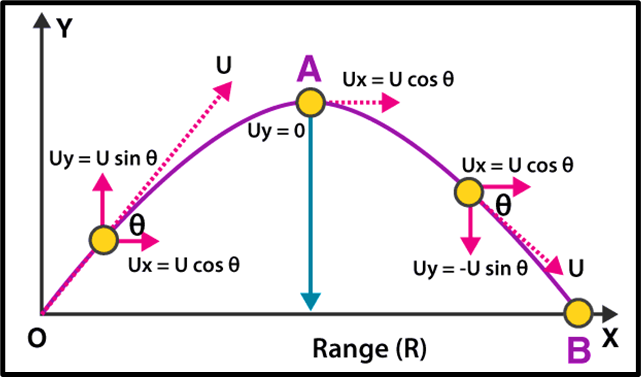
Projectile motion is one of the most elegant applications of motion in two dimensions. When you throw a ball at an angle, it moves horizontally as well as vertically.
The key insight: these two components are completely independent of each other.
The horizontal motion is uniform (constant velocity — no force acts horizontally). The vertical motion is uniformly accelerated (gravity pulls it down at 9.8 m/s²).
The combined effect of constant horizontal velocity and increasing vertical velocity (due to gravity) results in a parabolic trajectory — the object traces out a beautiful parabola in the air.
Think of a cricket ball hit by a batsman, a bullet fired from a gun, or water from a hose — all follow projectile motion.
Key Characteristics of Projectile Motion
- Two-Dimensional Motion: Has both horizontal and vertical components.
- Parabolic Trajectory: Due to constant horizontal velocity and accelerating vertical velocity.
- Independent Components: Horizontal and vertical motions are independent — changing one does not affect the other.
- Zero Horizontal Acceleration: No horizontal force acts, so horizontal velocity remains constant throughout.
- Constant Vertical Acceleration: Gravity acts downward at g = 9.8 m/s².
- At the Highest Point: Vertical velocity = 0; horizontal velocity is unchanged.
Circular Motion
Circular motion refers to the motion of an object along a circular path. It can be uniform (constant speed) or non-uniform (varying speed).
Here is the fundamental paradox of circular motion: an object can move at a perfectly constant speed in a circle and still be accelerating.
How? Because velocity is a vector — it has direction. Since the direction of motion continuously changes as the object goes around the circle, the velocity is continuously changing, which means there is acceleration.
Key Characteristics of Circular Motion
- Constant Radius: The distance from the object to the centre remains constant.
- Continuously Changing Direction: Even at constant speed, velocity changes because direction changes.
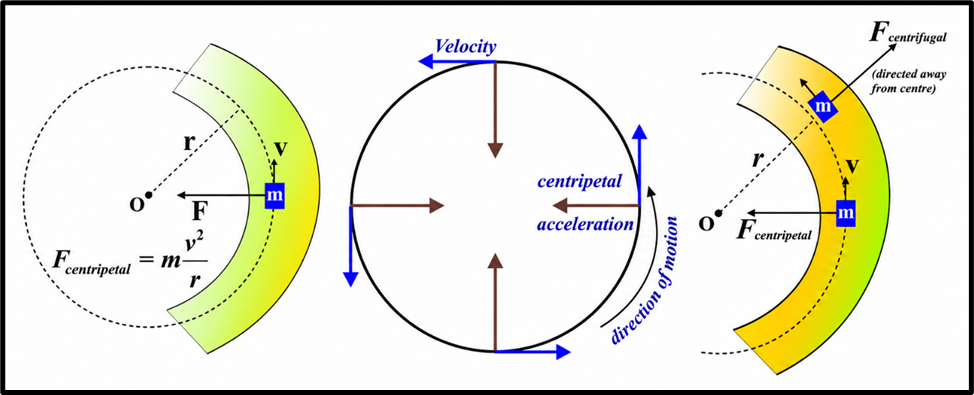
- Centripetal Acceleration: The acceleration is always directed towards the centre of the circle. “Centripetal” literally means “centre-seeking.” It is caused by the centripetal force.
- Centripetal Force: The force that keeps the object moving in a circular path, directed towards the centre. Example: tension in a string for a ball swung in a circle; gravity for a satellite.
- Centrifugal Force: A pseudo-force (apparent force) experienced in a rotating reference frame, directed away from the centre. It is not a real force — it is the result of inertia.
- Tangential Velocity: The velocity of the object is always tangent to the circular path at any given point.
- Angular Velocity (ω): The rate of change of angular displacement — how quickly the angle is swept out. Angular displacement measures the angle (in radians) through which the object has moved. It is a vector quantity.
📌 Key Insight: Centripetal force is the REAL force directed inward. Centrifugal force is a PSEUDO (fictitious) force felt by an observer in a rotating reference frame, directed outward.
Examples of centripetal force: gravity (for satellites), tension (for a stone in a sling), friction (for a car going around a curve).
Quick Revision: Key Formulas at a Glance
| Concept | Formula / Definition | Unit | Scalar / Vector |
| Distance | s = total path length | m | Scalar |
| Displacement | s = final pos. − initial pos. | m | Vector |
| Speed | v = d / t | m/s | Scalar |
| Velocity | v = s / t | m/s | Vector |
| Acceleration | a = (v − u) / t | m/s² | Vector |
| 1st Eq. of Motion | v = u + at | — | — |
| 2nd Eq. of Motion | s = ut + ½at² | — | — |
| 3rd Eq. of Motion | v² = u² + 2as | — | — |
| Free Fall (drop) | v = gt, h = ½gt² | — | — |
| g (near Earth) | ≈ 9.8 m/s² | m/s² | Vector (downward) |