
Work and Energy
In everyday language, ‘work’ means any effort you make. But in physics, the word ‘work’ has a very specific, mathematical meaning. Similarly, ‘energy’ is not just a vague feeling of vitality — it is a precise, measurable quantity. And ‘heat’ is not just warmth — it is the transfer of thermal energy. Let us unpack these concepts with clarity and precision.
Work — The Physics Definition
Here is where physics surprises you: a weightlifter holding a 100 kg barbell overhead, perfectly still, does ZERO work in the physics sense! Work only happens when a force causes displacement.
- Work is done when a force is applied to an object AND the object moves in the direction of the applied force.
- Formula: Work (W) = Force (F) x Displacement (d) x cos(angle between F and d)
- S.I. unit: Joule (J). One joule = the work done when a force of 1 Newton moves an object 1 metre in the direction of the force.
Three important cases based on the angle (theta) between force and displacement:
- When theta = 0 degrees (force is parallel to displacement): Maximum work is done. Example: pushing a box along the floor in the direction you are pushing.
- When theta = 90 degrees (force is perpendicular to displacement): No work is done. Example: a coolie carrying luggage on his head while walking horizontally — the force is vertical, displacement is horizontal, so NO work done in the physics sense.
- When theta > 90 degrees (force opposes displacement): Work is negative. Example: friction acting on a sliding box — friction opposes motion, so it does negative work.
Types of Work
- Positive Work: Force and displacement are in the same direction. Example: lifting a box upward; pushing a box along the floor.
- Negative Work: Force and displacement are in opposite directions. Example: friction slowing down a moving object (friction acts backward while the object moves forward).
- Zero Work: Force is perpendicular to displacement, OR there is no displacement.
- Examples:
(i) A coolie carrying luggage on his head — force is vertical, displacement is horizontal;
(ii) A satellite orbiting Earth — the gravitational force is inward, motion is tangential;
(iii) A body completing a full circular journey — net displacement is zero.
Power — How Fast Work is Done
Two workers can do the same amount of work, but one does it in an hour and the other in a day. The first worker is more powerful. Power tells us the rate of doing work.
- Power is defined as the rate at which work is done or energy is transferred.
- It is a scalar quantity.
- Formulae: (1) Power = Work / Time; (2) Power = Force x Velocity
- S.I. unit: Watt (W) = 1 Joule per second (J/s).
- Other unit: Horsepower (hp); 1 hp = 746 W.
| Everyday connection When you see a 60W light bulb, it means the bulb consumes 60 joules of electrical energy every second. When your electricity bill shows units in kWh (kilowatt-hour), that is power (kW) multiplied by time (hours) — which gives you energy consumed. |
Energy — The Capacity to Do Work
Energy is the underlying currency of the physical world. Every process — from a falling leaf to a nuclear explosion — involves the transfer or transformation of energy. Here is the fundamental definition:
- Energy is defined as the capacity to do work.
- It is a scalar quantity.
- S.I. unit: Joule (J).
- Other units:
- Calorie (cal) [used in nutrition];
- Kilowatt-hour (kWh) [used in electricity bills];
- Electron Volt (eV) [used in atomic and nuclear physics].
Mechanical Energy
Mechanical energy is the total energy of an object due to its motion and position. It has two components:
Kinetic Energy (KE) — Energy of Motion
Any object that is moving possesses kinetic energy. The faster it moves and the heavier it is, the more kinetic energy it has.
- Formula: KE = (1/2) x Mass x Velocity2
- Characteristics of Kinetic Energy:
- Depends on mass and velocity:
KE increases with both mass and velocity.
Doubling the velocity quadruples the KE (because of the velocity squared term).
- Cannot be negative: Mass is always positive, and velocity is squared — so KE is always zero or positive. KE = 0 only when the object is stationary.
- Examples: a moving car, a falling object, a bullet fired from a gun.
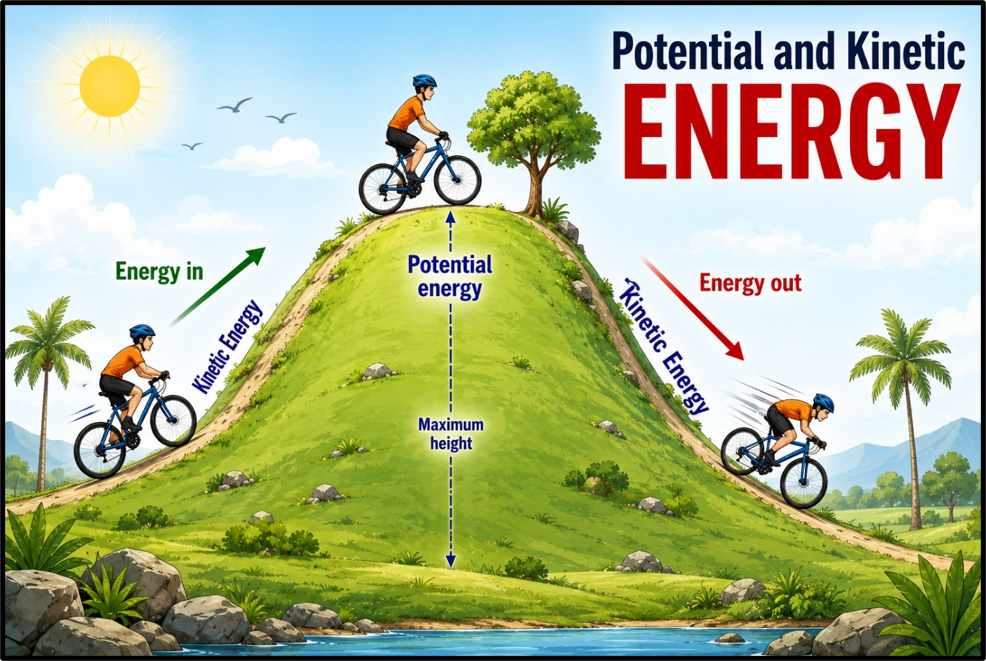
Potential Energy (PE) — Stored Energy
Potential energy is stored energy — energy that an object has because of its position or condition. Think of it as ‘energy waiting to be released’.
- Formula: PE = Mass x Acceleration due to gravity (g) x Height (h)
- Characteristics of Potential Energy:
- Stored energy: It is not active — it is the potential to do work.
- Converts to kinetic energy: A ball at the top of a hill has PE; as it rolls down, PE converts to KE.
- Depends on position: The higher the object, the greater its gravitational PE.
- Depends on mass: Heavier objects have more PE at the same height.
- Independent of motion: An object can have PE whether it is at rest or moving.
- Examples: a stretched rubber band, a compressed spring, water stored in a dam.
- Gravitational Potential Energy: Stored due to an object’s position above Earth’s surface. Example: water in a hydroelectric dam — when released, the PE converts to KE, which drives turbines to generate electricity.
Types of Energy
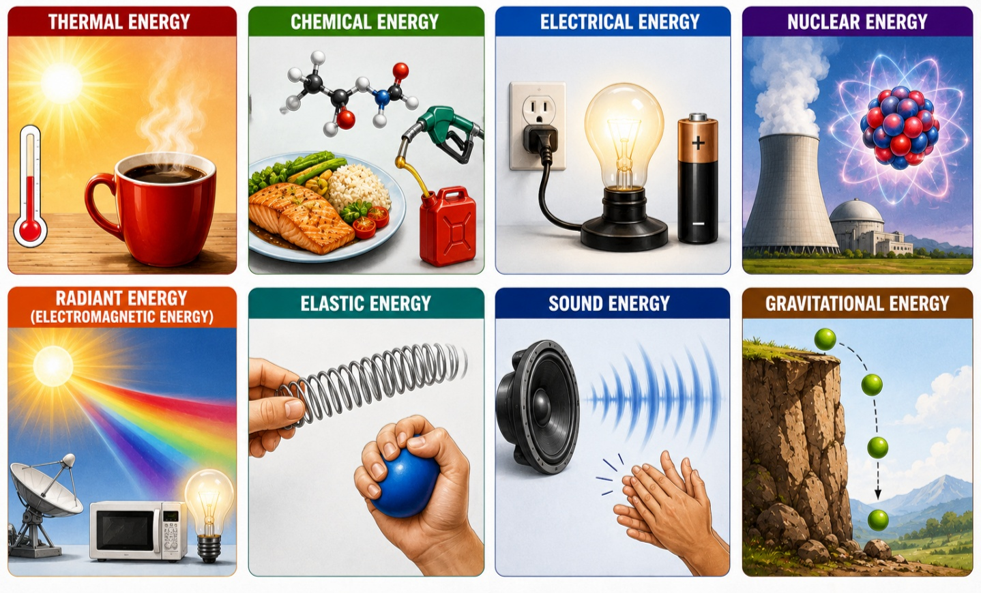
Energy takes many forms, and it can transform from one form to another. Here are the major types:
- Thermal Energy: Internal energy of an object due to the motion of its molecules. Related to temperature. Example: heat from the Sun; hot coffee.
- Chemical Energy: Stored in chemical bonds; released during chemical reactions. Example: food provides energy to the body; combustion of fuels like coal or petrol.
- Electrical Energy: Caused by the movement of electric charges. Example: electricity powering a light bulb; batteries storing energy.
- Nuclear Energy: Stored in the nucleus of atoms; released during fission (splitting) or fusion (combining) of atomic nuclei. Example: nuclear power plants; the Sun (which is powered by nuclear fusion).
- Radiant Energy (Electromagnetic Energy): Energy that travels in the form of electromagnetic waves. Example: sunlight, X-rays, microwaves, radio waves, light from bulbs.
- Elastic Energy: Stored in objects due to deformation (stretching or compression). Example: a stretched spring; a compressed rubber ball.
- Sound Energy: Carried by sound waves caused by the vibration of particles in a medium. Example: music from speakers; a clap.
- Gravitational Energy: Also called gravitational potential energy — the energy an object has due to its position in a gravitational field.
Work-Energy Theorem
This theorem creates a beautiful bridge between the concepts of work and kinetic energy:
| Statement The net work done on an object is equal to the change in its kinetic energy. Mathematically: Net Work Done = Final KE – Initial KE |
- If the net work done is positive: Kinetic energy increases and the object speeds up.
- If the net work done is negative: Kinetic energy decreases and the object slows down.
- Example: When you push a stalled car and it starts moving, you are doing positive work — the car’s kinetic energy increases from zero to some value.
Law of Conservation of Energy
| Statement: Energy cannot be created or destroyed; it can only be transformed from one form to another. The total energy of an isolated system remains constant. |
- The total mechanical energy (KE + PE) of an isolated system remains constant, provided no non-conservative forces (like friction) act.
- Example: A ball thrown upward — as it rises, KE converts to PE (it slows down). At the maximum height, all KE has become PE. As it falls back, PE converts back to KE (it speeds up). The total energy at every point remains the same.
- Transformation of energy: Conversion of one form of energy to another (e.g., electrical energy to light energy in a bulb).
- Dissipation of energy: The transformation of energy from a useful form to a useless form (e.g., heat generated by friction in a car engine — this heat is ‘wasted’ energy).
Mass-Energy Equivalence — E = mc2
This is possibly the most famous equation in all of science. Albert Einstein published this in 1905 as part of his Special Theory of Relativity. It fundamentally changed our understanding of the universe.
- Mass and energy are interchangeable — they are two forms of the same thing.
- Mass can be converted into energy, and energy can be converted into mass.
- Formula: E = m x c2, where E = energy (in Joules), m = mass (in kg), c = speed of light in vacuum = 3 x 10⁸ m/s
| Why is this important? Because c (speed of light) is an enormous number, even a tiny amount of mass produces a colossal amount of energy. This is the principle behind nuclear reactors and nuclear weapons. In the Sun’s core, hydrogen nuclei fuse into helium — the tiny mass difference is converted into the enormous energy we receive as sunlight. |
Collision
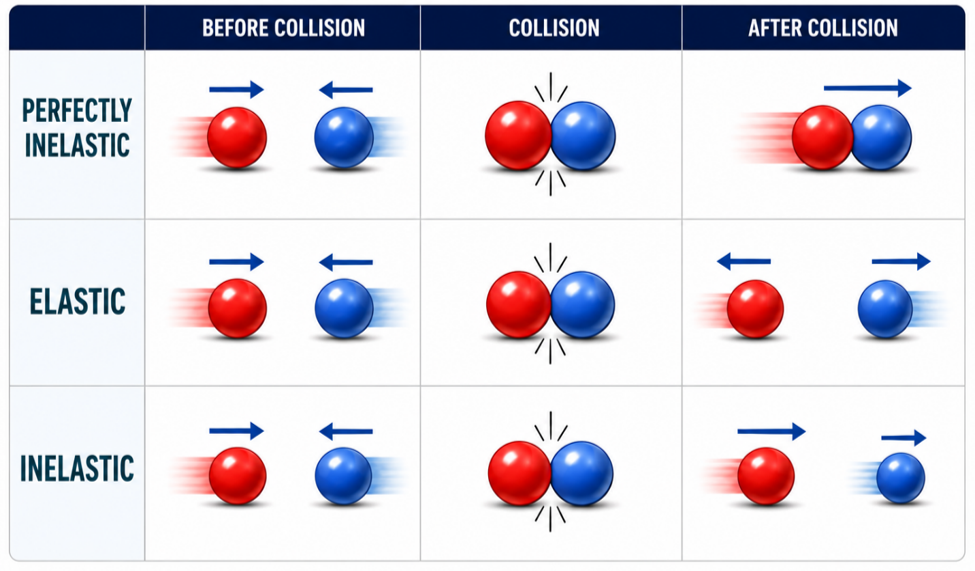
A collision is an event where two or more objects come into contact for a brief period and exert strong forces on each other. Collisions change the energy and momentum of the objects involved. Based on what happens to kinetic energy, collisions are classified as follows:
- Elastic Collision: Both kinetic energy AND momentum are conserved. Objects bounce off each other without deformation or heat generation. Example: billiard balls colliding; ideal gas molecules bouncing off container walls.
- Inelastic Collision: Momentum is conserved but kinetic energy is NOT (some KE converts to heat, sound, or deformation energy). Most real-world collisions are inelastic. Example: a car crash where vehicles crumple but move apart.
- Perfectly Inelastic Collision: A special case of inelastic collision where the objects stick together and move as one combined mass. Maximum kinetic energy is lost. Example: a lump of clay thrown against a wall that sticks to it.
| Quick memory tip: Elastic = Energy saved; Inelastic = Energy lost (to heat/sound/deformation); Perfectly Inelastic = Maximum energy lost + objects stick together. |
Heat — Energy in Transit
Here is an important distinction that many students miss: Heat is NOT the same as temperature. Heat is energy in transit. It is the transfer of thermal energy from a hotter object to a cooler object.
- Heat is a form of energy that transfers from one body or system to another due to a temperature difference between them.
- Heat flows from a higher temperature system to a lower temperature system until thermal equilibrium is achieved (both reach the same temperature).
- Heat is the transfer of thermal energy, creating the sensation of warmth.
- S.I. unit: Joule (J).
- Another common unit: Calorie (cal); 1 cal = 4.184 J.
- Calorie is defined as the heat required to raise the temperature of 1 gram of water by 1 degree Celsius.
Types of Heat
Sensible Heat
- Sensible heat is the heat that causes a change in the temperature of a substance without altering its phase (state of matter).
- It is related to the change in the substance’s kinetic energy — the faster the molecules move, the hotter it feels.
- Example: Heating water from 20 degrees Celsius to 80 degrees Celsius without it boiling. You can ‘sense’ the temperature change — hence the name ‘sensible’ heat.
Latent Heat — The Hidden Heat
This is a fascinating concept.
When a substance is changing its state (e.g., ice melting into water), it absorbs heat without any change in temperature.
That heat is ‘hidden’ — hence ‘latent’ (meaning hidden/concealed).
- Latent heat is the heat absorbed or released during a phase change of a substance — without affecting temperature but changing the state.
- Types of Latent Heat:
- Latent Heat of Fusion: Heat required to change a solid into a liquid at its melting point. Example: ice absorbs latent heat of fusion to melt into water at 0 degrees Celsius — the temperature stays at 0 degrees C throughout the melting.
- Latent Heat of Vaporisation: Heat required to change a liquid into a gas at its boiling point. Example: water absorbs latent heat of vaporisation at 100 degrees Celsius to become steam.
- Latent Heat of Sublimation: Some substances, like dry ice (solid CO₂), skip the liquid stage and turn directly into vapor—this process is called sublimation.
Specific Heat
- Specific heat is the amount of heat required to raise the temperature of 1 unit mass of a substance by 1 degree Celsius (or 1 Kelvin).
- It indicates a material’s ability to store heat energy.
- Example: Water has a very high specific heat, meaning it takes a lot of heat to change its temperature. This is why coastal areas have milder climates than inland areas — the sea acts as a massive heat buffer.
| High Specific Heat of Water: Water’s unusually high specific heat is the reason: (1) Oceans moderate coastal climates; (2) The human body uses water for thermoregulation; (3) Water is used as a coolant in car radiators and industrial processes. |
Transfer of Heat — Three Modes
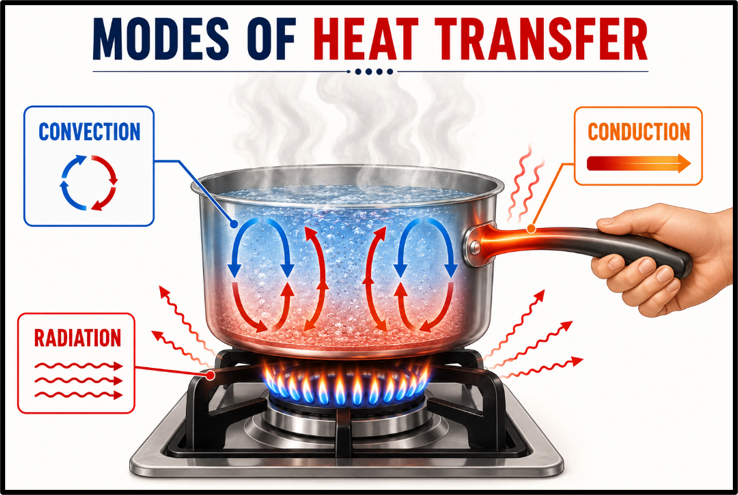
Heat travels from hotter regions to cooler regions through three distinct mechanisms. Understanding each mode is essential for multiple topics — from climate science to daily life applications.
1. Conduction — Heat by Contact
Imagine holding one end of an iron rod while the other end is in a flame. Within moments, your hand feels the heat. That is conduction — heat transfer through direct contact, molecule by molecule.
- Heat transfer through direct contact between molecules in a solid, liquid, or gas, without the movement of the substance itself.
- Mechanism: Energy is transferred via collisions between adjacent particles (atoms or molecules). The hot molecules vibrate faster and bump into their neighbours, passing energy along.
- Characteristics: Requires a medium for heat transfer; most effective in solids, especially metals (which are good conductors).
- Examples: Touching a hot stove (heat transfers from stove to your hand); heating a pot on a burner (heat travels from the burner through the pot metal).
2. Convection — Heat by Fluid Movement
Unlike conduction, convection involves the actual physical movement of the medium (fluid). Think of it as the hot particles themselves travelling to carry energy elsewhere.
- Heat transfer through the movement of fluids (liquids and gases) is called convection.
- Mechanism: Warmer, less dense fluid rises; cooler, denser fluid sinks. This creates a circulating current (convection current) that transfers heat.
- Characteristics: Requires a fluid medium; occurs due to bulk motion of particles; differences in temperature and density drive convection.
- Examples: Boiling water (hot water at the bottom rises, cooler water sinks — creating a circulation); atmospheric convection (warm air rises, creating weather patterns, clouds, and rain).
| Monsoons and Convection The Indian monsoon is fundamentally a large-scale convection system. In summer, the land heats up faster than the ocean. Hot air over land rises (convection), creating a low-pressure zone. Cooler, moist air from the ocean rushes in to fill this gap — that rushing moist air is the southwest monsoon! |
3. Radiation — Heat Without a Medium
This is the most remarkable mode of heat transfer. The Sun heats the Earth across 150 million km of near-vacuum space. No medium, no contact, no fluid movement — just electromagnetic waves carrying energy.
- Heat transfer through electromagnetic waves (such as infrared radiation) without requiring a medium is called radiation.
- Mechanism: Hot objects emit electromagnetic radiation, which is absorbed by cooler bodies.
- Characteristics: Can occur in a vacuum (outer space); the rate of heat transfer depends on the surface’s emissivity and temperature; does not require direct contact.
- Examples: Heat from the Sun (solar radiation travels through space to warm Earth); feeling the warmth of a campfire (infrared radiation from the fire warms you even without touching it).
Comparison of Heat Transfer Modes
| Feature | Conduction | Convection | Radiation |
| Medium Required | Yes (Direct Contact) | Yes (Fluid) | No (Vacuum possible) |
| Mechanism | Molecular collisions | Fluid movement (bulk) | Electromagnetic waves |
| Speed | Slow | Moderate | Fast (speed of light) |
| Example | Heating a metal rod | Boiling water | Sunlight, campfire heat |
Heat and Change in States of Matter
Matter exists in three primary states — solid, liquid, and gas (and a fourth called plasma). When you add or remove heat, matter can change from one state to another. These changes are physical changes (chemical properties remain the same) and are reversible.
- Two main factors driving state changes: Temperature (adding energy promotes higher-energy states like gas; removing energy promotes lower-energy states like solid) and Pressure (higher pressure promotes denser states; lower pressure promotes less dense states).
Melting (Fusion)
- Melting: A solid changes into a liquid when heat is applied.
- Energy absorption: Heat energy breaks the bonds between particles, allowing them to move more freely. The heat energy required to convert a solid into liquid at its melting point without changing its temperature is called Latent Heat of Fusion.
- Melting Point: The specific temperature at which melting occurs. For water: 0 degrees Celsius (32 degrees F or 273 K) at standard atmospheric pressure.
- Factors: Impurities lower the melting point (salt lowers the melting point of ice — basis of using salt to clear icy roads); Higher pressure can raise the melting point for most substances.
- Examples: Ice turning into water; wax melting near a flame; metals melting in a furnace.
Freezing (Solidification)
- Freezing: A liquid turns into a solid when its temperature falls to or below its freezing point.
- Energy release: Heat energy is released as the liquid transitions to a solid (exothermic process). The temperature remains constant during freezing.
- Freezing Point: For water: 0 degrees Celsius at standard pressure.
- Factors: Impurities lower the freezing point; Higher pressure generally increases the freezing point for most substances.
- Examples: Water turning into ice; molten lava solidifying into rock; wax solidifying into a candle.
Vaporisation
Vaporisation is the process by which a liquid changes into a gas. It occurs when liquid molecules gain enough energy to overcome intermolecular forces. There are two types:
- Evaporation: Occurs at the surface of a liquid at ANY temperature below its boiling point. It is a slow process — only surface molecules escape. Example: Drying clothes in the sun; a puddle of water slowly disappearing.
- Boiling: Occurs throughout the liquid when it reaches its boiling point (when vapour pressure equals atmospheric pressure). It is a rapid process with visible bubble formation. Example: Water boiling on a stove (at 100 degrees Celsius at standard pressure).
- Latent Heat of Vaporisation: Energy required to convert liquid to gas at boiling point. For water at 100 degrees Celsius.
- Cooling Effect: During evaporation, high-energy molecules escape, lowering the average KE of the remaining liquid — this is why evaporation causes cooling. Example: Sweating cools your body; applying water on skin in summer provides relief.
- Factors affecting vaporisation: Higher temperature, larger surface area, more airflow, and lower pressure all increase vaporisation rate.
Condensation
- Condensation: A gas changes into a liquid when its temperature is lowered to its Dew Point (the temperature at which air becomes fully saturated) or when it contacts a cooler surface.
- Energy release: Gas releases latent heat during condensation (exothermic process).
- Factors: Lower temperature, higher pressure, cool surfaces, and high humidity all promote condensation.
- Examples: Water droplets forming on the outside of a cold glass; dew on grass in the morning; clouds forming as water vapour cools and condenses.
Sublimation
- Sublimation: A solid transitions directly into a gas without passing through the liquid phase.
- It is an endothermic process (absorbs heat). It typically occurs at low pressure and temperatures below the substance’s triple point.
- Triple Point: The specific temperature and pressure at which all three phases of a substance — solid, liquid, and gas — coexist in thermodynamic equilibrium.
- Examples: Dry ice (solid CO2) sublimates directly into CO2 gas; naphthalene balls (used for pest control) sublimate into vapour; frost forming directly from water vapour.
Deposition
- Deposition: A gas transitions directly into a solid without passing through the liquid phase. It is the reverse of sublimation.
- It is an exothermic process (releases heat). Occurs under low-temperature and high-pressure conditions.
- Examples: Frost formation (water vapour in air turns directly into ice on cold surfaces); snowflake formation in the atmosphere.
Change in the State of Plasma
Plasma is considered the fourth state of matter (found in stars, lightning, and neon lights):
- Ionisation (Gas to Plasma): Adding energy to gas strips electrons from atoms, creating plasma. Example: Formation of plasma in neon lights; lightning.
- Deionisation (Plasma to Gas): Plasma loses energy and returns to a gaseous state. Example: Plasma in lightning dissipating after the lightning bolt ends.
Temperature — The Measure of Hotness
We have talked about heat at length. Now let us be very precise about temperature — and clearly distinguish it from heat:
Temperature is a measure of the average kinetic energy of the particles in a substance.
- Hotter objects have particles moving faster (higher average KE). Colder objects have slower particles (lower average KE).
- Temperature governs the direction of heat transfer — heat always flows from higher temperature to lower temperature.
- Temperature is measured using a thermometer.
Scales of Temperature
Celsius Scale (degrees C)
- Reference points: Water freezes at 0 degrees C and boils at 100 degrees C (at standard atmospheric pressure).
- Most widely used scale in daily life worldwide (except the USA).
- Conversion to Kelvin: Temp (K) = Temp (degrees C) + 273.15
Fahrenheit Scale (degrees F)
- Reference points: Water freezes at 32 degrees F and boils at 212 degrees F.
- Mostly used in the United States.
- Conversion to Celsius: Temp (degrees C) = [Temp (degrees F) – 32] x (5/9)
- Conversion from Celsius: Temp (degrees F) = [Temp (degrees C) x (9/5)] + 32
Kelvin Scale (K)
- The S.I. unit of temperature; used in scientific research and thermodynamics.
- It is an absolute temperature scale — 0 K (absolute zero = -273.15 degrees C) is the lowest possible temperature, where all molecular motion theoretically stops.
- Kelvin has NO negative values — it cannot go below zero.
- Reference points: Water freezes at 273.15 K and boils at 373.15 K.
- Conversion to Celsius: Temp (degrees C) = Temp (K) – 273.15
Comparison of Temperature Scales
| Scale | Freezing Point of Water | Boiling Point of Water | Absolute Zero |
| Celsius (degrees C) | 0 degrees C | 100 degrees C | -273.15 degrees C |
| Fahrenheit (degrees F) | 32 degrees F | 212 degrees F | -459.67 degrees F |
| Kelvin (K) | 273.15 K | 373.15 K | 0 K |
Relationship Between Scales: C/5 = (F – 32)/9 = (K – 273)/5
Heat vs. Temperature — The Critical Distinction
This is one of the most commonly confused pairs in physics. Let us clear it up with a comprehensive comparison:
| Feature | Heat | Temperature |
| Definition | Total energy transferred between objects due to a temperature difference | Measure of average kinetic energy of particles in a substance |
| Nature | Form of energy | Measure of energy |
| Unit | Joules (J) or calories (cal) | Degrees Celsius (C), Kelvin (K), or Fahrenheit (F) |
| Depends On | Mass, specific heat, and temperature difference | Independent of mass of the object |
| Measured By | Calorimeter | Thermometer |
| Transfer | Flows from hotter to colder body | No transfer; indicates thermal state |
| State Change | Responsible for causing change in state (e.g., solid to liquid) | Remains constant during phase change for a pure substance |
| Example | Heat energy required to boil water or melt ice | Boiling point of water is 100 degrees C; freezing point is 0 degrees C |
Humidity — Moisture in the Air
Humidity refers to the amount of water vapour present in the air. It is a critical factor in weather and climate, and directly affects how we perceive comfort and temperature.
Types of Humidity
- Absolute Humidity: The actual amount of water vapour in a given volume of air.
- Expressed in grams of water vapour per cubic metre of air (g/m3).
- Formula: Absolute Humidity = Mass of Water Vapour / Volume of Air.
- Relative Humidity (RH): The ratio of the current amount of water vapour in the air to the maximum amount the air can hold at that temperature, expressed as a percentage.
- Formula: RH (%) = (Actual Vapour Pressure / Saturated Vapour Pressure) x 100.
- Higher temperatures allow air to hold more water vapour, affecting relative humidity.
- Specific Humidity:The mass of water vapour per unit mass of moist air (including the water vapour).
- Expressed in grams of water vapour per kilogram of moist air (g/kg).
- Dew Point: The temperature at which air becomes fully saturated (RH = 100%) and water vapour condenses into liquid droplets.
- When the air temperature falls to the dew point, condensation begins — forming dew, fog, or clouds.
Factors Affecting Humidity
- Temperature: Warm air can hold more water vapour than cold air — humidity levels often rise with temperature.
- Air Pressure: Lower air pressure (at higher altitudes) decreases the air’s capacity to hold water vapour.
- Geography: Proximity to water bodies (oceans, lakes) increases humidity; arid and desert regions typically have low humidity.
- Weather Conditions: Rain and storms temporarily increase local humidity levels.
Thermal Expansion
Almost all materials expand when heated. This is because rising temperature increases the kinetic energy of particles, causing them to vibrate more vigorously and move further apart. This phenomenon is called Thermal Expansion.
Types of Thermal Expansion
- Linear Expansion: Increase in one dimension (length) of a solid. Example: railway tracks have small gaps between sections to allow for linear expansion in summer — without these gaps, the tracks would buckle.
- Area Expansion: Increase in the surface area of a solid. Example: a metal sheet expands in all directions when heated.
- Volumetric Expansion: Increase in the volume of a material (solids, liquids, or gases).
- Apparent Expansion: The observed expansion of a liquid when heated in a container — accounts for both the liquid’s expansion and the container’s expansion.
- Real Expansion: The true increase in volume of a liquid when heated, without considering the container’s expansion.
| Anomalous Expansion of Water Water behaves unusually between 0 degrees C and 4 degrees C. Instead of contracting as it cools (as most substances do), water actually EXPANDS when cooled from 4 degrees C to 0 degrees C. This means water is densest at 4 degrees C. This is why ice floats on water (ice is less dense), and why aquatic life survives in frozen lakes — the ice layer on top insulates the warmer water below. |
Thermal Conductivity
- Thermal conductivity is a material property that measures a substance’s ability to conduct heat.
- It represents the amount of heat energy transferred per unit time and per unit area through a unit thickness of material, under a given temperature difference.
- Metals generally have high thermal conductivity (good conductors); non-metals like wood and rubber have low thermal conductivity (poor conductors / good insulators).
Black Body
- A black body is an idealised physical object that absorbs ALL electromagnetic radiation incident upon it — regardless of frequency or angle of incidence.
- It is a perfect absorber AND a perfect emitter of radiation — it does not reflect or transmit any light.
- No real physical object is a perfect black body, but some materials closely approximate this behaviour (e.g., a cavity with a tiny hole, charcoal).
- Black bodies are important in understanding heat radiation and have applications in astrophysics (modelling stars), climate science, and thermal imaging.
Newton’s Law of Cooling
| Statement The rate of heat loss of an object is directly proportional to the temperature difference between the object and its surroundings, provided the temperature difference is small and the nature of the body’s surface remains constant. |
- Practical implication: A hot cup of tea cools more quickly when placed in a cool room than in a warm room. As the temperature difference decreases, the rate of cooling also slows down.
Thermodynamic Processes
Thermodynamic processes describe how a system moves from one equilibrium state to another, involving changes in pressure, volume, temperature, and energy. Each type has a special characteristic that remains constant during the process:
| Process | What Stays Constant | What Happens | Example |
| Isothermal | Temperature (Iso = same, Thermal = temperature) | Heat is absorbed/released to maintain constant temperature | Melting ice at 0 degrees C |
| Isobaric | Pressure (Isobar = constant pressure) | Volume and temperature can change | Heating water in an open container |
| Isochoric | Volume (Isochoric = constant volume) | Pressure changes as temperature changes; no work is done | Heating gas in a rigid container |
| Adiabatic | No heat exchange with surroundings | Internal energy changes; temperature changes | Compression of gas in an insulated cylinder; rising air in atmosphere |
| Cyclic | System returns to initial state | Net change in internal energy is zero over one complete cycle | Operation of a heat engine (like a steam engine) |
| Adiabatic Processes in Atmosphere When air rises in the atmosphere, it expands adiabatically (no heat exchange with surroundings) and therefore COOLS. This is why temperatures decrease with altitude. When air descends, it compresses adiabatically and WARMS. This principle explains the formation of clouds, rain, and various atmospheric phenomena. |