
Force and Laws of Motion
Before we dive in, let me ask you something simple — why does a football move when you kick it? Why does a spinning top eventually fall? Why does a satellite keep going around the Earth without any engine? The answer to all of these questions lies in this chapter.
Newton figured this out more than 300 years ago, and his ideas are so powerful that we still use them today — from designing cars to launching rockets. Let us understand this.
What is Force?
Think of force as the most fundamental ‘action’ in the physical world. Whenever anything moves, stops, bends, breaks, or changes direction — a force is responsible. Simply put, force is a push or a pull.
- Force is an external agent that can change an object’s state of motion or rest.
- It can cause an object to accelerate, decelerate, change direction, or even deform (change shape).
- Force is a vector quantity — meaning it has both magnitude (how much force) and direction (which way).
- The S.I. unit of force is Newton (N). (Named after Isaac Newton — rightly so!)
| Key Insight: Imagine pushing a stationary car. The car starts moving — that change from rest to motion happened because you applied a force. Now imagine pushing it again, but from the opposite side — the car slows down or changes direction. This is the essence of force. |
Basic or Fundamental Forces in Nature
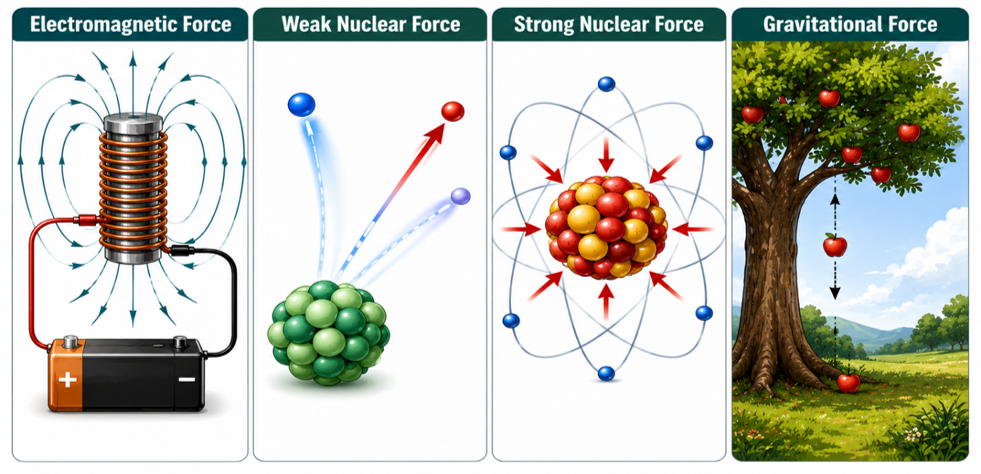
Here is something beautiful about nature — despite all the complexity we see around us, every single interaction in the universe can be explained by just FOUR fundamental forces. Four! Let that sink in.
- Gravitational Force
- Electromagnetic Force
- Strong Nuclear Force
- Weak Nuclear Force
Gravitational Force
This is the force of attraction between any two objects that have mass. It is what keeps you on the ground, keeps the Moon orbiting Earth, and holds entire galaxies together.
- According to Einstein’s General Theory of Relativity, gravity arises from the curvature of space-time caused by mass and energy.
- (Think of a heavy ball placed on a stretched rubber sheet — it creates a dip, and smaller balls roll toward it.)
- Gravitational force is the weakest of the four forces, but acts over infinite distances.
- It diminishes with distance — inversely proportional to the square of the distance (the farther you go, the weaker it gets).
- Example: Earth’s gravitational pull keeps the Moon in orbit and makes objects fall toward the ground.
Electromagnetic Force
This force acts between electrically charged particles. It governs almost everything we encounter in daily life — electricity, magnetism, light, chemical bonds, and even the reason you don’t fall through your chair (because the electrons in your body repel the electrons in the chair!).
- Also called Lorentz force, it can be attractive or repulsive depending on the charges (like charges repel, opposite charges attract).
- It is much stronger than gravitational force and also acts over infinite range.
- Mediated by photons (particles of light and electromagnetic radiation); governed by Coulomb’s Law.
- Example: Force between two magnets, and electrostatic force between a comb and hair.
Strong Nuclear Force
Now we enter the world of the atomic nucleus. Inside every nucleus, positively charged protons are packed tightly together. But like charges repel — so why doesn’t every nucleus explode? Because the Strong Nuclear Force holds them together. It is the strongest force in nature.
- Acts between protons and neutrons (collectively called nucleons) in the atomic nucleus.
- Mediated by particles called gluons.
- Its range is very short (generally acts within the nucleus only), but it is extremely powerful within that range.
- Responsible for the stability of atomic nuclei; governs nuclear reactions like fusion and fission.
- Example: The Sun’s energy comes from nuclear fusion — the Strong Nuclear Force binds the helium nucleus together.
Weak Nuclear Force
Despite its name, this force plays a crucial role — it is responsible for radioactive decay, specifically a type called beta decay. Without it, the Sun wouldn’t shine the way it does!
- It is responsible for the radioactive decay of atoms (causes beta decay).
- Weaker than the strong nuclear force and electromagnetic force, but stronger than gravity.
- Its range is extremely short — acts only at subatomic distances.
- Plays a key role in nuclear reactions in stars and helps produce neutrinos and other subatomic particles.
- Example: Beta minus decay — a neutron decays into a proton, an electron, and an antineutrino.
Comparison Table: Four Fundamental Forces of Nature
| Force | Relative Strength | Range | Acts On | Mediating Particle |
| Gravitational Force | Weakest | Infinite | All masses | Gravitons (hypothetical) |
| Electromagnetic Force | 2nd Strongest | Infinite | Charged particles | Photons |
| Strong Nuclear Force | Strongest | Very Short | Nucleons (protons & neutrons), quarks | Gluons |
| Weak Nuclear Force | 3rd Strongest | Very Short | Subatomic particles | W and Z bosons |
Types of Forces
Beyond the four fundamental forces, there are several practical categories of force that you encounter in daily life. Understanding them helps in solving real-world physics problems and questions.
Contact Forces
These forces arise only when two objects are physically touching each other. Think of them as forces that need a ‘handshake’ to exist.
- Frictional Force: Opposes the relative motion between two surfaces in contact. Example: a rolling ball eventually stops because of friction with the ground.
- Tension Force: The pulling force transmitted through a string, rope, or cable when it is stretched. Example: a rope pulling a bucket up from a well.
- Normal Force: The perpendicular force a surface exerts on an object resting on it — it acts vertically upward, keeping the object in equilibrium (neither sinking nor flying up). Example: the floor pushing up against your feet.
- Air Resistance Force (Drag): The force that opposes the motion of an object moving through air. Example: a skydiver feels this force pushing against them as they fall.
- Fluid Resistance Force (Water Drag): The frictional force of water on an object moving through it. Example: a swimmer feels this opposing their forward motion.
- Buoyant Force: The upward force exerted by a fluid on a submerged object. According to Archimedes’ Principle: ‘The upward buoyant force equals the weight of the fluid displaced by the body.’ Example: a boat floating on water.
- Applied Force: The force manually or mechanically exerted on an object. Example: pushing a car to move it.
- Spring Force: The restoring force of a stretched or compressed spring — it always tries to return to its original shape. Example: a stretched rubber band snapping back.
Non-Contact Forces
These forces act over a distance — no physical touching required. The four fundamental forces we just discussed (gravitational, electromagnetic, strong nuclear, and weak nuclear) are all non-contact forces. Nature is remarkable — these forces act through empty space!
Balanced and Unbalanced Forces
- Balanced Forces: Equal in magnitude, opposite in direction — they cancel each other out, resulting in no change in motion. Example: leaning against a wall (you push the wall, the wall pushes you back equally).
- Unbalanced Forces: Different magnitudes, they do not cancel out — this results in a change in the object’s motion. Example: a soccer ball being kicked (the kick force far exceeds friction, so the ball moves).
Internal and External Forces
- Internal Forces: Forces acting within a system. Example: tension within a stretched rubber band.
- External Forces: Forces acting on a system from outside. Example: wind pushing against a car.
Conservative and Non-Conservative Forces
- Conservative Forces: Work done is path-independent; depends only on start and end points. Example: gravitational force and electrostatic force.
- Non-Conservative Forces: Work done depends on the path taken. Example: friction and air resistance (the longer the path, the more energy lost).
Centripetal and Centrifugal Forces
- Centripetal Force: Acts toward the centre of a circular path, keeping the object in circular motion. Example: tension in a string while swinging a ball in a circle.
- Centrifugal Force: An apparent (fictitious) outward force experienced in a rotating frame of reference. Example: the sensation of being pushed outward when a car takes a sharp turn.
Real and Apparent (Pseudo) Forces
- Real Force: Arises from actual physical interactions; has a measurable origin (gravity, friction, electromagnetic effects). Obeys Newton’s Laws. Example: all four fundamental forces and contact forces.
- Apparent/Pseudo Force: Appears to exist because the observer is in an accelerating (non-inertial) reference frame. It is not caused by any physical interaction. Example: Centrifugal force (in a rotating frame) and Coriolis force (on a rotating Earth — crucial for understanding wind patterns and ocean currents!).
| Coriolis Force The Coriolis force is an apparent force due to Earth’s rotation. It deflects winds to the right in the Northern Hemisphere and to the left in the Southern Hemisphere. This explains why cyclones rotate anticlockwise in the Northern Hemisphere and clockwise in the Southern Hemisphere — a very important concept in Physical Geography! |
Cohesive and Adhesive Forces
- Cohesive Force: Attraction between similar molecules. Example: water molecules sticking together (this is why water forms droplets).
- Adhesive Force: Attraction between different types of molecules. Example: water molecules sticking to a glass surface (this is why water wets glass).
Inertia — The ‘Laziness’ of Matter
Here is a beautiful concept: every object in the universe is ‘lazy’. It does not want to change what it is doing. If it is resting, it wants to keep resting. If it is moving, it wants to keep moving. This property is called Inertia.
- Inertia is the property of an object that resists any change in its state of motion or rest.
- Inertia is directly proportional to mass — the heavier the object, the harder it is to change its state. (It is much easier to push a bicycle than a truck!)
Types of Inertia
- Inertia of Rest: The tendency to remain at rest.
Example: When a carpet is suddenly shaken, dust particles fly up because they resist the sudden motion — they want to stay at rest.
- Inertia of Motion: The tendency to continue moving uniformly.
Example: When a moving car suddenly brakes, passengers lurch forward — their bodies want to keep moving forward.
- Inertia of Direction: The tendency to resist changes in direction.
Example: When a vehicle takes a sharp turn, objects inside slide sideways — they resist the directional change.
Moment of Inertia
Just as mass measures resistance to linear (straight-line) motion changes, Moment of Inertia measures an object’s resistance to rotational motion about a given axis. It is the rotational equivalent of mass. The further the mass is from the rotation axis, the higher the moment of inertia.
Momentum — The ‘Quantity of Motion’
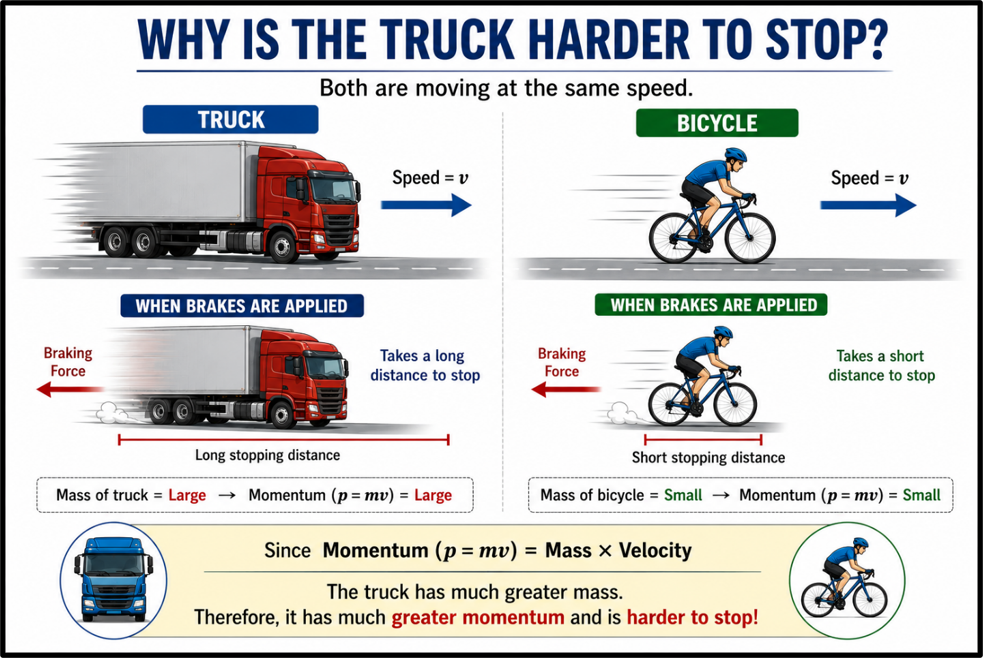
Imagine a truck and a bicycle both moving at the same speed. Which one is harder to stop? The truck, of course! That is because the truck has much greater momentum. Momentum captures both the mass and the velocity of a moving object.
- Momentum (p) is a measure of the quantity of motion an object possesses.
- It is a vector quantity (has both magnitude and direction).
- Formula: Momentum (p) = Mass (m) x Velocity (v)
- S.I. unit: kg.m/s
Law of Conservation of Momentum
This is one of the most important laws in physics:
| Statement The total momentum of a closed or isolated system remains constant if no external forces act on it. In other words: Total initial momentum = Total final momentum. |
- Internal forces (like collisions or explosions) may change the individual momenta of objects, but the total system momentum remains constant.
- Examples: collisions (billiard balls), explosions (a gun recoiling when fired — the bullet goes forward, the gun goes backward), and rocket propulsion (exhaust gases go backward, rocket goes forward).
Impulse — Force Applied Over Time
- Impulse is the change in momentum of an object when a force is applied over a time interval.
- It is a vector quantity, acting in the direction of the applied force.
- Formula: Impulse = Force (F) x Time duration (t)
- S.I. unit: Newton-second (N.s) or kg.m/s
- Examples: A cricket batsman hitting a ball (the bat applies a large force for a short time); airbags in cars (they increase the time of impact, thereby reducing the force on the passenger — saving lives!).
Newton’s Laws of Motion
Isaac Newton published these three laws in 1687 in his masterpiece ‘Principia Mathematica’. They revolutionized our understanding of motion and form the backbone of classical mechanics. Let us understand each law deeply.
Newton’s First Law of Motion — The Law of Inertia
| Statement An object at rest stays at rest, and an object in motion continues at constant speed in a straight line — unless acted upon by an external (unbalanced) force. |
Key concepts:
- Inertia: This law is fundamentally about inertia — the resistance of any object to change its state of motion.
- Unbalanced External Force: In the absence of a net external force, there is no change in the state of motion. A book on a table stays put. A ball rolling on a frictionless surface would roll forever.
- Example: A book sitting on a table remains still because all forces (gravity pulling down, normal force pushing up) are balanced.
- Roll a ball on a smooth floor — it eventually stops, not because motion ‘runs out’, but because friction acts as an external force.
Newton’s Second Law of Motion — Force = Mass x Acceleration
| Statement The acceleration of an object is directly proportional to the net force acting on it, and inversely proportional to its mass. Mathematically: F = m x a |
Key concepts:
- Direct proportionality: Larger the force, greater the acceleration. Push a cart harder — it speeds up faster.
- Inverse proportionality: For a given force, more massive objects accelerate less. It takes far more force to push a heavy truck than a bicycle.
| Important note: Newton’s Second Law actually gives us the definition of force — Force is that which changes or tends to change the state of motion. It also explains why we measure force in Newtons: 1 Newton = the force needed to accelerate a 1 kg mass at 1 m/s2. |
Newton’s Third Law of Motion — Action and Reaction
| Statement: For every action, there is an equal and opposite reaction. |
Key concepts:
- Forces always come in pairs: If object A exerts a force on object B, then object B simultaneously exerts an equal and opposite force on object A.
- Equal magnitude, opposite direction: The action force and reaction force are always equal in size but point in opposite directions.
- Simultaneous forces: Action and reaction always occur at the same time — one does not cause the other; they occur together.
- Example 1: Walking — you push the ground backward with your feet (action); the ground pushes you forward (reaction). This reaction force propels you forward.
- Example 2: A rocket — burning fuel is expelled downward (action); the rocket moves upward (reaction). This is how rockets work in space, where there is no ground to push against!
- Example 3: Swimming — you push water backward with your hands (action); water pushes you forward (reaction).
- Example 1: Walking — you push the ground backward with your feet (action); the ground pushes you forward (reaction). This reaction force propels you forward.
Friction — The Helpful Nuisance
Friction is one of those concepts that has two faces. It is the reason you can walk, drive, and write — but it is also the reason machines wear out, fuel gets wasted, and tyres need replacement. Let us understand this ‘helpful nuisance’ thoroughly.
- Friction is a resistive force that opposes the relative motion between two surfaces in contact.
- It acts parallel to the surfaces and in the direction opposite to the applied force or movement.
Static Friction
Static friction prevents an object from moving when an external force is applied. Think of it as the ‘guard’ that keeps objects from sliding. It is a self-adjusting force — it increases to match the applied force, up to a maximum limit.
- Prevents motion: Keeps an object at rest by opposing the force trying to move it.
- Maximum static friction (Limiting Friction): The maximum value of static friction — the threshold just before the object starts moving. Once the applied force exceeds this, the object begins to slide.
- Variable / Self-adjusting force: Static friction adjusts itself to match the applied force until it reaches the limiting friction value.
- Coefficient of static friction: Depends on the nature of the surfaces in contact — rougher surfaces generally have a higher coefficient.
Kinetic Friction (Dynamic Friction)
Once an object starts moving, kinetic friction takes over. It is the friction that resists ongoing motion. An important fact: kinetic friction is generally less than static friction — that is why it is easier to keep sliding something than to start sliding it.
- Opposes motion: Resists the relative motion between two surfaces in contact.
- Constant force: The kinetic friction force is relatively constant and does not depend on the velocity of the moving object (mostly).
- Coefficient of kinetic friction: Typically smaller than that of static friction.
Types of Kinetic Friction
- Sliding Friction: Resistance when an object slides over a surface. Example: applying brakes on a bicycle (tyres slide on road).
- Rolling Friction: Resistance experienced by a rolling object. Rolling friction is much smaller than sliding friction — that is why wheels were such a revolutionary invention! Example: a ball rolling on the ground.
- Fluid Friction (Drag): Resistance experienced by an object moving through a fluid (liquid or gas). Unlike sliding/rolling friction, fluid drag increases with velocity. Denser fluids (like water) exert greater fluid friction than less dense fluids (like air). Example: a swimmer moving through water; an aircraft moving through air.
Static Friction vs. Kinetic Friction
| Property | Static Friction | Kinetic Friction |
| State of Object | Object is at rest | Object is in motion |
| Function | Resists motion initiation | Resists ongoing motion |
| Velocity Dependence | No dependence on velocity | Mostly constant; increases slightly at very high speeds in some cases |
| Magnitude | Larger than kinetic friction | Smaller than static friction |
Advantages of Friction
- Enables motion control: Friction provides grip to start, stop, or change motion. Example: walking, car brakes, tyres on roads.
- Provides stability: Prevents objects from sliding. Example: furniture stays in place on the floor; climbers rely on friction between shoes and rocks.
- Facilitates gripping and holding: Allows secure gripping of objects. Example: writing friction between pen and paper; holding tools securely.
- Generates heat: Friction produces useful heat. Example: a matchstick lights up due to frictional heat; rubbing hands together on a cold day.
- Essential for braking: Example: car and bicycle brakes use friction to stop wheels.
- Useful wear: Example: sharpening tools and pencils; sanding and polishing surfaces.
- Supports construction: Nails and screws stay in place due to friction; bricks are held together until cement sets
Disadvantages of Friction
- Causes wear and tear: Shoes, tyres, and machine parts degrade over time.
- Generates unwanted heat: Excessive heat in engines can cause overheating and failure.
- Reduces efficiency: Extra fuel is consumed in vehicles due to friction; machines lose energy to heat.
- Opposes motion: Moving heavy furniture requires extra effort due to friction.
- Noise production: Poorly lubricated machinery creates distracting sounds.
- Material deformation: Conveyor belts and gears may deform due to prolonged friction.
- Limits speed: Air and water resistance reduce maximum achievable speeds of vehicles and aircraft.
- Requires maintenance: Machinery needs constant lubrication and care to overcome friction.
2 Comments