
Propulsion Systems in Space Technology
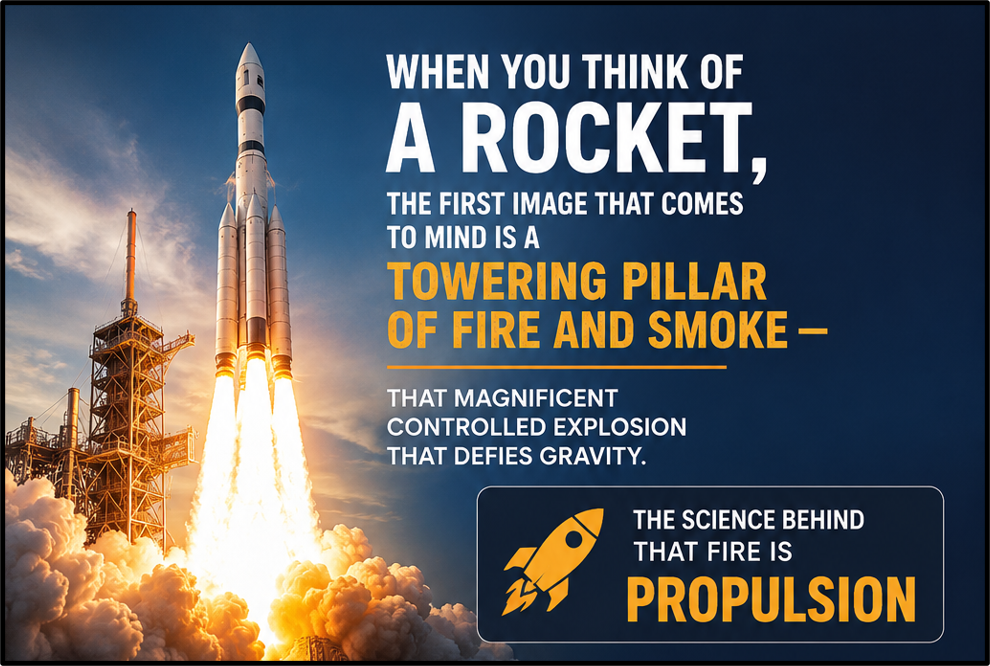
In space technology, propulsion systems are the mechanisms that generate thrust to launch, steer, and manoeuvre spacecraft. Propulsion derived from the Latin ‘propellere’, meaning ‘to drive forward.’
The key measure of propulsion efficiency is Specific Impulse (Isp) — the thrust produced per unit of propellant consumed per second. Higher Isp = more efficient engine. This single number tells you everything about an engine’s fuel efficiency.
💡 Think of specific impulse like ‘kilometres per litre’ for your car. A diesel SUV at 12 km/l and an electric car at 400+ km per charge — both move, but the efficiency is dramatically different. Similarly, a solid rocket might have Isp ~250s while an ion thruster achieves ~3,000s. The ion thruster needs vastly less fuel for the same result — but takes much longer to accelerate.
| Propulsion Type | Thrust Level | Specific Impulse (Isp) | Best Use | Indian Connection |
| Chemical (Solid) | Very High | 200-300 s | Launch vehicle boosters | PSLV solid strap-on boosters, HTPB |
| Chemical (Liquid) | High | 300-450 s | Main engines, orbital manoeuvres | Vikas Engine (PSLV/GSLV), CE-20 cryogenic |
| Chemical (Hybrid) | Medium-High | 250-350 s | Flexible missions | SpaceShipOne concept; ISRO R&D |
| Electric (Ion/Hall) | Very Low | 1,500-10,000 s | Station-keeping, deep space | GSAT-9 ion thruster |
| Nuclear Thermal | High | 700-1,000 s | Mars missions | NASA/DARPA project; future ISRO potential |
| Solar Sail | Extremely Low | Very high (fuel-free) | Interplanetary missions | JAXA’s IKAROS; Breakthrough Starshot |
| Antimatter | Theoretical max | Millions of seconds | Interstellar (theoretical) | Not yet developed |
Chemical Propulsion Systems
Chemical propulsion is the backbone of all current space missions — from ISRO’s PSLV to SpaceX’s Falcon 9 to NASA’s SLS. The idea is elegantly simple: burn a fuel with an oxidiser, and the hot expanding gases rush out of a nozzle at enormous speed, pushing the rocket forward (Newton’s Third Law).
Solid Propellant Rocket Engines — The Simple but Unstoppable
Solid propellant rockets have pre-mixed fuel and oxidiser cast into a solid grain inside the motor casing. Once ignited, they burn continuously until the propellant is exhausted. You cannot throttle them, you cannot turn them off — it is a controlled explosion, and once started, it runs to completion.
| Type | Composition | Thrust | Application | Example |
| Single-Base | Nitrocellulose only | Moderate | Small arms, artillery shells | Smokeless powder |
| Double-Base | Nitrocellulose + Nitroglycerin | Higher | Military missiles | Cordite |
| Composite | Ammonium Perchlorate (oxidiser) + Polybutadiene (fuel) + Binder | High — widely used | Space launch vehicles, ICBMs | PSLV’s PS1 core, HTPB propellant |
| CMDB | Double-Base + Aluminium powder additive | Highest in solid class | Advanced missiles, boosters | Agni series boosters |
Solid Propellant: Advantages vs Disadvantages
- Simplicity: No pumps, valves, or plumbing. Fewer parts = fewer failure points.
- High initial thrust: Ideal for launching heavy payloads from standstill.
- Long storage life: HTPB composite propellant can be stored for years — ideal for military missiles (Agni, Prithvi).
- Rapid launch: No fueling required — launch-ready almost immediately.
- No control once ignited: Cannot be throttled or shut down — like pressing the accelerator and the pedal gets stuck.
- Lower efficiency: Specific impulse (~250s) is significantly lower than liquid propellants.
- Toxic byproducts: Ammonium perchlorate combustion produces HCl (hydrochloric acid) — environmental concern.
- Temperature sensitivity: Cold temperatures can cause propellant cracking, leading to uneven burning and catastrophic failure. The 1986 Space Shuttle Challenger disaster was partly due to O-ring failure in cold conditions on a solid rocket booster.
⚠ HTPB (Hydroxyl-Terminated Polybutadiene) is the fuel binder in India’s composite solid propellants. Ammonium Perchlorate is the oxidiser. Know these for UPSC. ISRO’s PSLV uses solid propellant in its first stage (PS1) and third stage (PS3).
Liquid Propellant Rocket Engines — Controllable Power
Liquid propellant rockets store fuel and oxidiser separately in tanks, mixing them in a combustion chamber only when needed. This gives engineers the power to throttle, restart, and shut down the engine — making liquid rockets far more flexible than solid ones.
| Type | Composition | Key Characteristic | ISRO Application |
| Monopropellant | Single liquid — Hydrazine (N2H4) | Low thrust, reliable, storable. Used for attitude control. | Satellite thrusters, orbit corrections |
| Bipropellant | Fuel (UDMH/kerosene) + Oxidiser (N2O4/LOX) | High thrust, high efficiency, controllable. | Vikas Engine (PSLV/GSLV L110 stage) |
| Cryogenic | Liquid Hydrogen (LH2) + Liquid Oxygen (LOX) | Highest efficiency but -253°C storage. | CE-7.5 (GSLV Mk II), CE-20 (GSLV Mk III / LVM3) |
| Hypergolic | UDMH + Nitrogen Tetroxide (N2O4) | Self-igniting — no ignition system needed. Reliable but toxic. | Vikas Engine second stage, satellite orbit raising |
💡 India’s cryogenic engine story is a fascinating geopolitical saga. In the 1990s, Russia agreed to transfer cryogenic technology to India — but US pressure forced Russia to back out mid-way. ISRO’s scientists, led by Dr. S. Nambi Narayanan and later K. Sivan’s team, developed the CE-7.5 and CE-20 cryogenic engines entirely indigenously. The CE-20 now powers GSLV Mk III (LVM3), the same rocket that launched Chandrayaan-3. What was denied, we built ourselves.
The extraordinary journey of scientific perseverance and the espionage case that nearly derailed India’s cryogenic programme was portrayed in the acclaimed film Rocketry: The Nambi Effect, based on the life of S. Nambi Narayanan.
⚠ CE-20 = India’s most powerful cryogenic engine (20 tonnes of thrust), used in LVM3’s C25 upper stage. It burns liquid hydrogen (-253°C) and liquid oxygen. Chandrayaan-2, Chandrayaan-3, and OneWeb commercial launches all used this engine.
Hybrid Propellant Rocket Engines — Best of Both Worlds
Hybrid rockets use solid fuel (e.g., HTPB) combined with liquid or gaseous oxidiser (e.g., liquid oxygen or nitrous oxide). The oxidiser flow can be controlled — giving throttle capability — while the solid fuel provides structural simplicity.
- Advantages: Throttleable (unlike solid), simpler than liquid, safer (fuel/oxidiser stored separately), lower cost.
- Disadvantages: Lower Isp than liquid rockets, unpredictable combustion interface, limited flight heritage, slow thrust response.
- Example: Virgin Galactic’s SpaceShipOne/Two uses hybrid propulsion (HTPB fuel + nitrous oxide oxidiser). ISRO is conducting R&D on hybrid systems.
Electric Propulsion Systems — The Future is Electric
Electric propulsion systems use electric power (from solar panels or nuclear reactors) to ionise and accelerate propellant atoms (typically xenon, argon, or krypton) to extremely high speeds. The thrust is tiny — but the efficiency is 10× higher than chemical rockets.
💡Electric propulsion is like comparing a bicycle to a car for a very long journey. The bicycle is slow but extremely efficient — it uses very little ‘fuel’ (your energy). For short, urgent trips, the car (chemical rocket) wins. For long missions spanning years, the bicycle (electric propulsion) wins because it needs 90% less propellant for the same final velocity.
| Type | Working Principle | Specific Impulse | Example |
| Electrostatic (Ion Thruster) | Electric fields accelerate positive ions (xenon) to high speed through grids | 3,000 – 10,000 s | NASA Dawn (asteroid belt), Deep Space 1, ISRO GSAT-9 |
| Electromagnetic (Hall Effect Thruster) | Magnetic + electric fields trap electrons, create plasma, accelerate ions | 1,500 – 3,000 s | ESA BepiColombo, SpaceX Starlink satellites |
| Electrothermal (Arcjet, Resistojet) | Electric heating expands and accelerates gas propellant | 500 – 1,000 s | Small satellites, ISRO R&D stage |
- High efficiency: Specific impulse far exceeds chemical propulsion — less propellant needed.
- Precise control: Ideal for station-keeping (maintaining satellite position in GEO orbit).
- Long operational life: Suitable for missions lasting 10+ years in deep space.
- Very low thrust: Cannot lift off from Earth — useless for launch vehicles. Only suitable in vacuum of space.
- High power needed: Large solar panels or nuclear sources required.
- Slow acceleration: Takes months to years to reach significant velocities.
⚠ GSAT-9 (South Asia Satellite, 2017) used an electric propulsion system for station-keeping in GEO orbit — a milestone for ISRO. Electric propulsion is increasingly used in commercial geostationary satellites to reduce launch mass (less chemical propellant needed).
Nuclear Propulsion Systems — The Mars Mission Engine
Chemical rockets will never get humans to Mars quickly — the journey takes 6–9 months each way with chemical propulsion. Nuclear propulsion could cut this to 3–4 months, dramatically reducing radiation exposure and mission risk. That is why NASA and DARPA are actively developing nuclear thermal propulsion for crewed Mars missions.
| Feature | Nuclear Thermal Propulsion (NTP) | Nuclear Electric Propulsion (NEP) | Nuclear Fusion Propulsion |
| How It Works | Nuclear reactor heats hydrogen propellant which expands through nozzle | Reactor generates electricity → powers ion/Hall thruster | Fusion reactions create plasma jet for thrust |
| Thrust | HIGH — comparable to chemical | LOW — like electric propulsion | VERY HIGH — theoretical |
| Specific Impulse | 700-1,000 s (2-3× chemical) | Very high (like ion thruster) | Potentially millions of seconds |
| Propellant | Liquid Hydrogen | Xenon / Ionised Gas | Deuterium / Tritium plasma |
| Best Application | Crewed Mars/Moon missions | Robotic deep space probes | Future interstellar travel |
| Key Challenge | Radiation shielding for astronauts | Heat dissipation in space | Controlling fusion reaction — not yet achieved |
| Status | DARPA/NASA DRACO project (active) | Space nuclear reactors being developed | Theoretical — no practical demonstration |
- Advantages: Higher efficiency than chemical, long-duration capability, reduced propellant mass, continuous thrust.
- Disadvantages: Radiation hazards, political/safety concerns, complex design, high cost.
💡The fear of nuclear materials in space is not irrational — Soviet RORSAT nuclear-powered radar satellites occasionally crashed back to Earth (Cosmos 954 contaminated northern Canada in 1978). But modern designs keep the reactor subcritical until in orbit, dramatically reducing launch risk. The trade-off between risk and the immense benefits for human Mars missions is a genuine debate.
Solar Propulsion Systems — Wind at the Speed of Light
What if a spacecraft had no fuel at all? Solar propulsion makes this dream real — using the Sun’s energy either directly as radiation pressure (Solar Sail) or converted to electricity for ion thrusters (Solar Electric Propulsion).
| Feature | Solar Sail Propulsion | Solar Electric Propulsion (SEP) |
| Thrust Source | Photon pressure from sunlight on large reflective sail | Solar panels generate electricity → powers ion thruster |
| Thrust Level | Extremely low — measured in micronewtons | Low but continuous |
| Efficiency | Very high — zero propellant consumed! | Very high Specific Impulse |
| Speed Profile | Gradually builds up over months | Controlled, steady acceleration |
| Best For | Interplanetary, deep-space, interstellar | Long-duration deep-space travel |
| Limitations | Ineffective far from the Sun (force drops as 1/r²) | Dependent on solar panel area and efficiency |
- Advantages: Fuel-free (solar sail), long-term efficiency, low maintenance, environmentally friendly.
- Disadvantages: Very low thrust, limited in deep space, requires huge sail areas, slow initial acceleration.
💡JAXA’s IKAROS (2010) was humanity’s first operational solar sail spacecraft — it flew to Venus using nothing but sunlight pressure on a 20-metre aluminised polyimide sail. The Breakthrough Starshot initiative proposes using powerful Earth-based lasers to push tiny solar sails to 20% the speed of light for interstellar missions to Alpha Centauri. Science fiction becoming science.
Laser Propulsion Systems — Beam Me Up
Laser propulsion uses an external laser (ground-based or space-based) to provide energy to the spacecraft, rather than the spacecraft carrying its own fuel. This eliminates the need for heavy onboard propellant — enabling extremely lightweight spacecraft.
- Laser-Thermal: Laser heats hydrogen propellant → expansion → thrust.
- Laser-Electric: Laser powers onboard photovoltaic cells → electricity → ion thruster.
- Laser-Driven Light Sail (Photon Propulsion): High-intensity laser pushes a reflective sail using photon momentum. The Breakthrough Starshot concept.
- Advantages: No onboard propellant, extremely high specific impulse, scalable from CubeSats to interstellar probes.
- Disadvantages: Needs ground/orbital laser infrastructure, atmospheric interference, precision alignment challenging.
📌 Key Fact: Breakthrough Starshot aims to send a gram-scale ‘Starchip’ probe to Alpha Centauri (4.37 light-years away) using a 100 GW laser array pushing a light sail to 20% speed of light. Travel time: ~20 years. Stephen Hawking was a patron of this project.
Antimatter Propulsion — The Ultimate Fuel
Antimatter is matter’s mirror-image — when matter and antimatter meet, they annihilate each other completely, converting 100% of their mass to energy (E=mc²). This makes antimatter the most energy-dense fuel physically possible — 1 gram of antimatter + 1 gram of matter releases the energy of a ~43 kiloton nuclear bomb.
- Advantages: Unmatched energy density, highest theoretically possible specific impulse, minimal fuel mass, ideal for interstellar travel.
- Disadvantages: Producing 1 gram of antimatter requires more energy than currently produced globally. Storage requires magnetic containment (no material container exists). Extreme safety risk.
💡Currently, CERN’s Large Hadron Collider produces femtograms (10⁻¹⁵ grams) of antiprotons per year at a cost of billions of dollars. To fuel even a small antimatter rocket, you’d need kilograms. At current production rates, that would take longer than the age of the universe. This is theoretical propulsion for the very far future.
Green Propellants — Clean Fuel for a Sustainable Space Age
Traditional rocket propellants — especially hydrazine (N₂H₄) — are highly toxic, carcinogenic, and require elaborate safety protocols. Green propellants are environmentally friendly alternatives that maintain or improve performance while drastically reducing health and environmental hazards.
| Green Propellant | Example | Key Advantage | Application |
| Ionic Liquid-based | AF-M315E (NASA) | Higher density impulse, lower toxicity than hydrazine | Satellite propulsion, spacecraft manoeuvring |
| ADN-based | LMP-103S (ESA) | Non-toxic, better performance than hydrazine | European satellites, deep-space probes |
| Cryogenic LOX/Methane | SpaceX Raptor (CH₄+LOX) | Non-toxic; methane can be produced on Mars! (In-Situ Resource Utilisation) | SpaceX Starship, future Mars missions |
| Hydrogen Peroxide (H₂O₂) | 90%+ purity H₂O₂ | Clean decomposition to water+oxygen, simple handling | Historical rockets, experimental spacecraft |
| Hydrocarbon Green | Refined RP-1 alternatives | Less soot, cleaner combustion than regular kerosene | Future reusable launch vehicles |
| Metal-based (Nano-Al) | Nanoaluminium fuels | High energy density, non-toxic, fast burn | Hybrid propulsion, experimental rockets |
- Advantages: Eco-friendly, safer handling, improved performance in some cases, regulatory compliance.
- Disadvantages: Some have lower specific impulse, still in development, compatibility issues with existing systems, limited commercial availability.
💡Elon Musk’s choice of methane (CH₄) + liquid oxygen for Starship is not random. Methane is ‘green’ compared to hydrazine, and — critically — Mars has CO₂ in its atmosphere. A Sabatier reactor can combine CO₂ + water (from Martian ice) to produce methane and oxygen, allowing Starship to refuel on Mars for the return journey. This is called In-Situ Resource Utilisation (ISRU) — a game-changer for sustainable space exploration.
⚠ ISRU (In-Situ Resource Utilisation) refers to using local planetary resources (Martian CO₂, lunar water ice, asteroidal minerals) to reduce mission costs and enable long-duration exploration. Methane as green propellant + ISRU = sustainable Mars colonisation.
Quick Revision
| Propulsion | Fuel | Thrust | Efficiency (Isp) | Can Start/Stop? | ISRO Example |
| Solid Chemical | HTPB + AP | Very High | ~250 s | NO — once ignited, burns to completion | PSLV-PS1, GSLV-S200 |
| Liquid Chemical | UDMH/LH2 + N2O4/LOX | High | 310–450 s | YES — throttleable, restartable | Vikas Engine, CE-20 |
| Cryogenic | LH2 + LOX | High | 430–450 s | YES | CE-20 (LVM3 upper stage) |
| Hypergolic | UDMH + N2O4 | Medium-High | ~320 s | YES — self-igniting | Vikas Engine (liquid stage) |
| Hybrid | Solid fuel + liquid oxidiser | Medium | ~300 s | Partial throttle | R&D stage at ISRO |
| Ion Thruster (Electric) | Xenon | Very Low | 3,000+ s | YES — precise control | GSAT-9 station-keeping |
| Nuclear Thermal | H2 + nuclear heat | High | 700-1000 s | YES | Future Mars missions |
| Solar Sail | None! | Extremely Low | Infinite (no fuel) | N/A | Concept stage |
| Green Propellant | AF-M315E / LOX-Methane | Variable | ~250-380 s | YES | Next-gen satellites |