Science is not just about equations and experiments — it is about people. Behind every great discovery is a human being with curiosity, courage, and often, a streak of obsession. Let us meet the architects of the modern world — those individuals whose ideas changed everything. UPSC frequently asks about their contributions; remember these profiles for both Prelims (facts) and Mains (contextual usage).
👤Who was he? A German-born theoretical physicist who revolutionised our understanding of space, time, gravity, and energy. He is arguably the most famous scientist in human history — and for good reason.
Theory of Relativity
Einstein did not just make one major contribution — he made two, and both were revolutionary:
Special Relativity (1905): Introduced the concept that space and time are interconnected as space-time, and that the speed of light is constant regardless of the observer’s motion. This gave us the famous equation E = mc² — mass and energy are equivalent and interconvertible.
General Relativity (1915): Explained gravity not as a force (Newton’s concept) but as the curvature of space-time caused by mass and energy. A massive object like the Sun literally bends space-time around it, and planets follow that curve. Imagine rolling a ball on a stretched rubber sheet — it curves toward a heavy weight placed on it. That is Einstein’s gravity.
Photoelectric Effect (1905)
Einstein explained how a material emits electrons when light of a specific frequency strikes it — this is the Photoelectric Effect. This earned him the Nobel Prize in Physics (1921).
It proved the quantum nature of light — light behaves as both a wave AND a particle (photon). This concept is called wave-particle duality.
Modern Applications: Solar panels (photovoltaic cells), photoelectric sensors, light meters, digital cameras — all based on this principle.
👤Who was he? An English mathematician, physicist, and astronomer who laid the foundations of classical mechanics. If Einstein rewrote the rules at extreme speeds and scales, Newton wrote the rules for everything else. His Principia Mathematica is one of the most influential books ever written.
Three laws covering inertia, acceleration (F=ma), and action-reaction — the basis of all engineering, mechanics, and space science. Everything from a cricket ball to a satellite follows Newton’s laws.
Every object attracts every other object with a force proportional to the product of their masses and inversely proportional to the square of the distance between them. Explained falling bodies, planetary orbits, and ocean tides.
Contributions to Optics
Demonstrated that white light is composed of all colours of the spectrum (dispersion via prism). Built the first practical REFLECTING TELESCOPE, improving astronomical observation.
Calculus
Co-invented calculus (independently of Leibniz) — the mathematical language of change and motion. Without calculus, modern physics, engineering, and economics would be impossible.
👤Who was she? A pioneering Polish-French physicist and chemist who broke every glass ceiling — in a world that actively tried to keep her out. She is the ONLY person to win Nobel Prizes in TWO different sciences, and the first woman to win a Nobel Prize.
Radioactivity Research
Curie coined the term “radioactivity” — the phenomenon of atoms spontaneously emitting radiation. In 1898, she and her husband Pierre discovered two new elements: Polonium (named after her homeland Poland) and Radium.
Key Method: She developed techniques to isolate radioactive isotopes — this laid the foundation of nuclear physics and radiation therapy.
Medical Pioneer: She developed radioactive treatment for cancer and created mobile X-ray units (called “Little Curies”) during World War I — saving thousands of lives on the battlefield.
🏆AwardsNobel Prize in Physics (1903, shared with Pierre Curie and Henri Becquerel) for radioactivity research. Nobel Prize in Chemistry (1911, solo) for the discovery of radium and polonium. First woman Nobel laureate; only person to win Nobel Prizes in two different sciences.
👤Who was he? The ‘Father of Modern Science’ — an Italian astronomer, physicist, and mathematician who pioneered the use of observation and experiment over authority. He was put under house arrest by the Church for supporting heliocentrism. Yet, as legend has it, he muttered: ‘And yet, it moves.’
Telescopic Astronomy Discoveries
Lunar craters and mountains — proving that the Moon was not a perfect sphere (challenging Aristotle’s ideal celestial spheres).
Jupiter’s four largest moons (Io, Europa, Ganymede, Callisto — the ‘Galilean moons’) — proving not everything orbits Earth.
Phases of Venus — proved Venus orbits the Sun, not Earth — devastating for the geocentric model.
Sunspots — proved the Sun was not perfect and unchanging.
All these observations supported Copernicus’s Heliocentric Theory — that the Sun is at the centre of our solar system, not Earth. Galileo was the first to provide empirical evidence for what Copernicus had theorised.
👤Who was he? An English naturalist who published what may be the most consequential book in biology — ‘On the Origin of Species’ (1859). His theory of evolution by natural selection explained how the extraordinary diversity of life on Earth came to be.
Theory of Evolution by Natural Selection
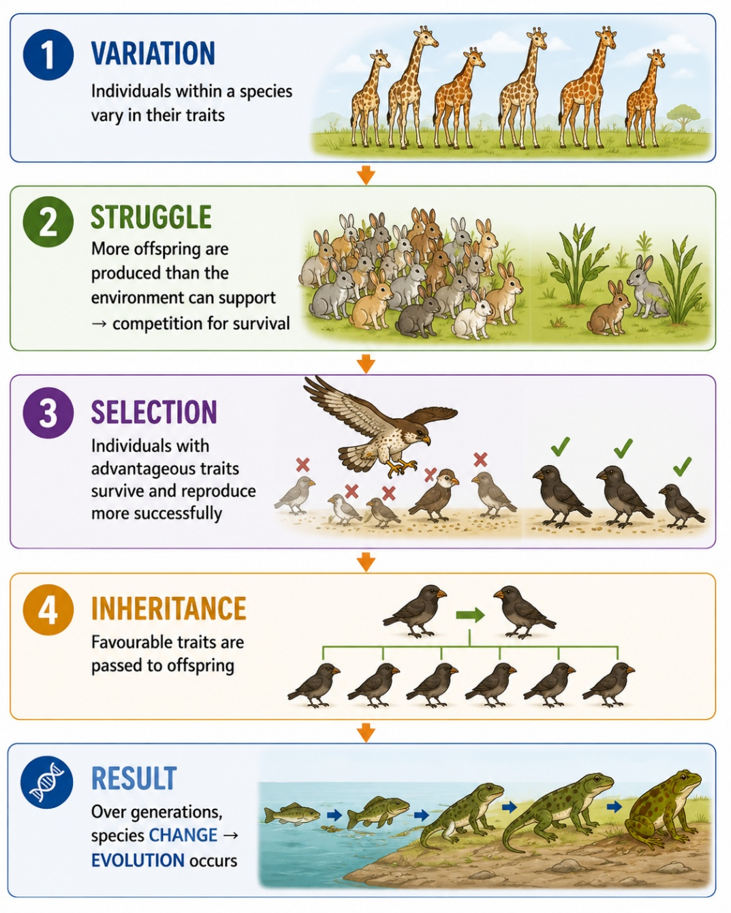
Darwin’s logic was elegantly simple:
Key Work
Significance
On the Origin of Species (1859)
Explained evolution through natural selection — 1,250 copies sold on the first day; changed biology forever.
The Descent of Man (1871)
Applied evolutionary theory to human origins — humans and apes share common ancestors.
👤Who was he? An Austrian monk who, in a monastery garden with pea plants, laid the foundation of modern genetics — without a microscope, without knowing what DNA was, and without recognition during his lifetime. He is the ‘Father of Genetics’.
Mendel’s Laws of Inheritance
Law
What it Says
Simple Analogy
Law of Segregation
Each organism has two hereditary factors (alleles) for each trait; they separate during gamete formation, with only one going to each offspring.
Imagine two coins. You can only flip one to your child — but both parents flip together.
Law of Dominance
In a pair of contrasting traits, one is dominant (expressed) and masks the recessive trait. E.g., Tallness is dominant over dwarfness in peas.
If your parents have one ‘tall’ gene and one ‘short’ gene, you are tall — ‘tall’ dominates.
Law of Independent Assortment
Genes for different traits are inherited independently of each other (if on different chromosomes).
The coin you flip for height is independent of the coin you flip for hair colour.
👤Who was he? A French chemist and microbiologist whose work saved more lives than any general or politician in history. He proved that microorganisms cause disease, developed pasteurisation, and created vaccines for rabies and anthrax.
Germ Theory of Disease
Before Pasteur and Robert Koch, people believed disease was caused by miasma — foul-smelling air rising from decaying matter (this is why hospitals used to smell of flowers, not antiseptics!). Pasteur and Koch proved that specific microorganisms cause specific diseases — a revolutionary insight that forms the entire basis of modern medicine, hygiene, and pharmacology.
Contribution
Details & Significance
Pasteurisation
Heating liquids (milk, juice, beverages) to a specific temperature for a short time to kill harmful bacteria and extend shelf life — still used globally today.
Vaccines for Rabies & Anthrax
Demonstrated that weakened (attenuated) pathogens can stimulate immunity without causing disease — the foundational principle of all vaccines.
Swan-neck Flask Experiment
Definitively disproved the theory of spontaneous generation — life comes only from pre-existing life (biogenesis).
👤Who was he? A Scottish microbiologist who discovered the world’s first antibiotic — almost by accident. A contaminated Petri dish in 1928 changed medicine forever. Fleming’s carelessness (leaving a dish uncovered before a holiday) may have saved more lives than any other ‘accident’ in history.
Discovery of Penicillin
Fleming noticed that the mould Penicillium notatum had contaminated his Staphylococcus bacteria culture — and the bacteria around the mould were dying. Instead of discarding the dish (as most would), Fleming investigated. He isolated the active substance — penicillin — the world’s first true antibiotic.
Impact: Proved effective against pneumonia, syphilis, wound infections, and septicaemia. Widely used in WWII, saving millions of lives.
Mass Production: Fleming’s discovery was later purified and mass-produced by Howard Florey and Ernst Boris Chain. All three shared the Nobel Prize in Physiology or Medicine (1945).
Legacy: Launched the Antibiotic Era — transformed infection management and modern surgery. Without antibiotics, even routine surgeries would be life-threatening.
👤Who was he? A British mathematician, cryptanalyst, and the father of theoretical computer science and Artificial Intelligence. He cracked the Nazi Enigma code in WWII and asked the most profound question in computer science: ‘Can machines think?’ His tragic story is as important as his scientific legacy.
Contribution
Details & Significance
Foundations of Computer Science
Formalised the concept of computation — showed that any computable problem could be solved algorithmically by a machine. This is the theoretical basis for all modern computers.
The Turing Machine
Proposed an abstract computing device (not a physical machine) that defined the theoretical limits of what can and cannot be computed. Every modern computer is, theoretically, a Turing Machine.
WWII Cryptography (Enigma)
At Bletchley Park, Turing helped crack the German Enigma code — enabling Allied forces to decrypt Nazi military communications. Historians estimate it shortened the war by 2-4 years, saving ~14 million lives.
The Turing Test (AI)
Proposed a test to assess machine intelligence: if a machine can converse with a human without the human knowing it is a machine, the machine ‘thinks.’ This is the foundational concept in AI.
❗Important Note: Despite his extraordinary service, Turing was prosecuted in 1952 for his homosexuality and subjected to chemical castration. He died at 41. The UK government issued a formal apology in 2009, and Queen Elizabeth II granted a posthumous pardon in 2013. His story is a powerful reminder that science is done by humans — and humanity must protect its geniuses.
👤Who is he? A British computer scientist who invented the World Wide Web (WWW) in 1989 while working at CERN. And then — remarkably — gave it to the world for FREE. He is possibly the most generous inventor in history.
Invention of the World Wide Web
A critical distinction first: The Internet is not the same as the Web. The Internet (the global network of computers) already existed when Berners-Lee invented the Web. He created the application layer — the system of hyperlinked pages and documents that runs ON the Internet. Think of the Internet as the roads, and the Web as the cars driving on those roads.
HTML (HyperText Markup Language) — the language of web pages.
HTTP (HyperText Transfer Protocol) — the protocol for transferring web data.
URL (Uniform Resource Locator) — the address system of the Web.
He also created the first web browser and the first web server.
Most importantly, Berners-Lee did not patent the Web. He made it freely available to everyone — ensuring global access, interoperability, and open standards. This single act of generosity may be the greatest gift ever given to humanity.
👤Who was he? A Serbian-American electrical engineer and visionary inventor, best known for developing the AC (Alternating Current) power system — the foundation of our entire modern electricity grid. Underappreciated in his lifetime, Tesla is now recognised as one of history’s greatest inventors. The SI unit of magnetic flux density (Tesla, T) is named after him.
Contribution
Details & Significance
AC (Alternating Current) System
Developed a practical AC system for electricity generation and transmission. AC allows long-distance power transfer with minimal loss and easy voltage transformation using transformers. This became the foundation of modern global electricity distribution.
AC Induction Motor
Invented the AC induction motor — uses electromagnetic induction, requires minimal maintenance, and is widely used in everything from industrial machinery to household appliances.
Tesla Coil
Developed the Tesla Coil — a high-voltage resonant transformer used in early wireless and radio experiments. Precursor to wireless transmission technology.
Tesla vs. Edison
Tesla’s AC system won the famous ‘War of Currents’ against Edison’s DC system — AC proved more practical for long-distance power transmission. Edison was the better businessman; Tesla was the better engineer.
👤Who was he? An American inventor and industrial innovator who commercialised the practical incandescent light bulb and built the first commercial power station. Edison did not just invent — he built the SYSTEM around inventions. He invented organised industrial research itself, creating the world’s first R&D laboratory at Menlo Park, New Jersey.
Key Contributions
Incandescent Light Bulb (1879): Edison did not invent the first light bulb — but he developed the first practical, long-lasting one with a carbonised filament. His key achievement was scaling and commercialising electric lighting for widespread public use.
First Commercial Power Station (1882): Built on Pearl Street, New York City — providing DC electricity to 85 customers. This launched the age of commercial electricity.
Phonograph: Invented the first device to record and replay sound. Edison reportedly said it was his favourite invention.
Motion Picture Technology: Developed the Kinetoscope — an early motion picture device — laying the groundwork for cinema.
Industrial R&D Model: Created the concept of team-based, goal-oriented research — the template for all modern corporate R&D labs.
💬 Edison’s Famous Quote:
“Genius is one percent inspiration and ninety-nine percent perspiration.”
— This is why Edison, despite losing the ‘War of Currents’ to Tesla, became one of the most prolific inventors in history with over 1,093 US patents.
The Internet is the single most impactful invention of the 20th century — more impactful than the automobile or the television, because it contains and accelerates all other technologies. The Internet is a global network of interconnected computers and communication systems that allows users to share information, access services, and communicate across long distances. It…
Space Debris: The Scattered Danger in Orbit Let’s begin with a small everyday picture. Imagine you are driving on a highway at 100 km/h, and suddenly a tiny pebble flies up and hits your windscreen. Even at that modest speed, a small stone can crack the glass. Now take that same scene and move it…
Militarisation of Space There is an important conceptual distinction you must remember: Militarisation vs. Weaponisation. Militarisation is using space to SUPPORT military operations — like using GPS for troop coordination. Weaponisation is placing or using WEAPONS in space itself. The Outer Space Treaty (1967) does not ban militarisation. It only bans WMDs in orbit. This…
Space Traffic Management (STM) Think of outer space as a busy international airspace — except there is no Air Traffic Control, no unified radar network, no binding rules for who gives way to whom, and no international police. Over 9,000 active satellites and millions of debris fragments share the same sky. Without STM, catastrophic collisions…
Major Lunar Missions — The Story of the Moon The Moon has always been humanity’s first space destination — simply because it is the nearest. But getting there was never a straight line; it was a clear evolution: first we went just to take photographs, then we attempted soft landings, then we sent humans, and…
India is not a latecomer to science. Before Europe had universities, India had Nalanda and Takshashila. Before the West developed algebra, India gave the world Zero. Before modern surgery, India had Sushruta performing rhinoplasty. The story of Science and Technology in India is, in many ways, the story of a civilisation’s journey — from ancient…