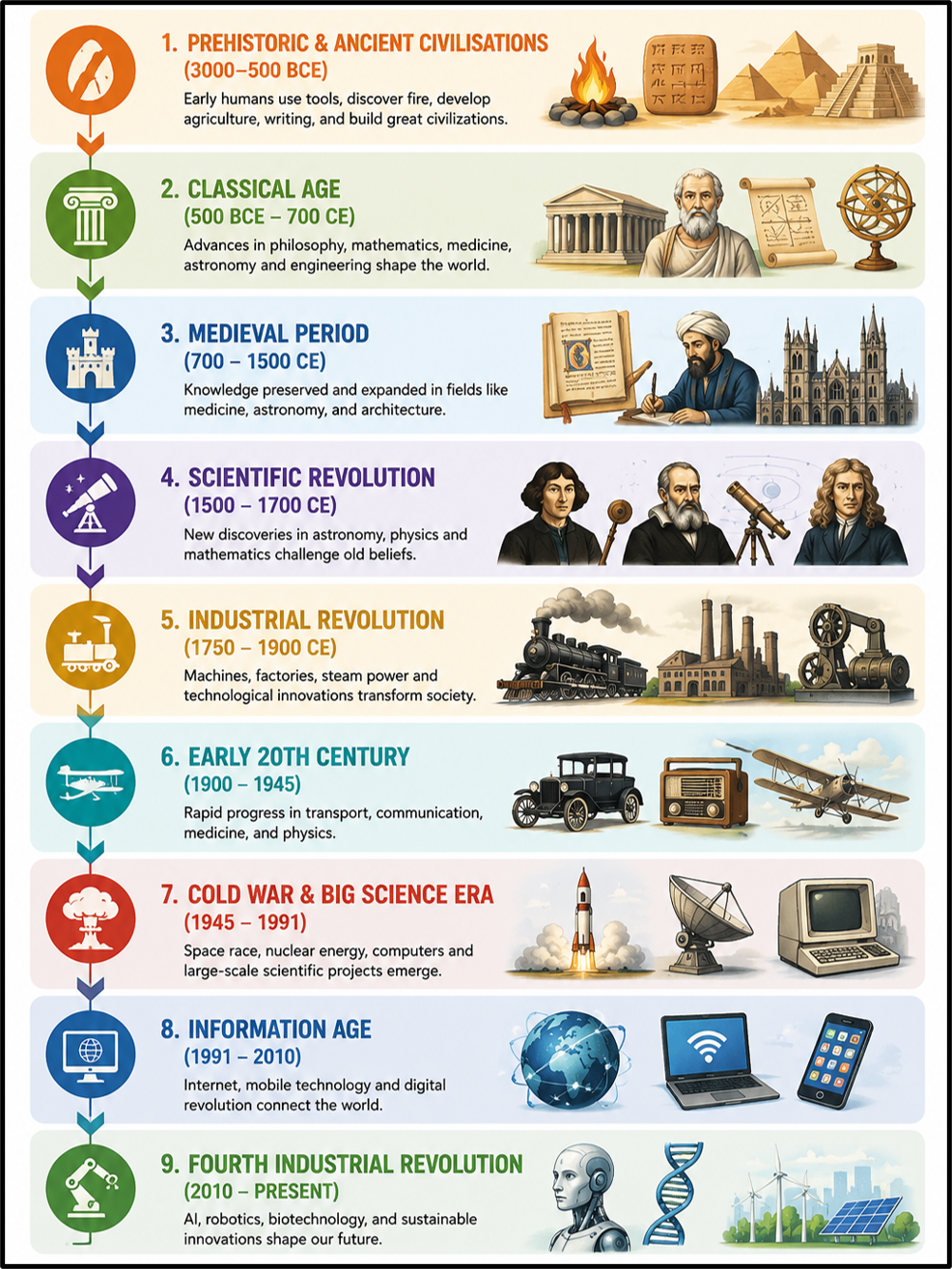
History is the best teacher of Science. To understand where we are, we must understand how we got here. The story of S&T is the story of human civilisation itself — full of genius, courage, curiosity, and sometimes, tragedy. Let us travel through time, era by era. Think of this as a cinematic journey — from the first stone tool to the first quantum computer.
🌍Era Essence: This was the age of OBSERVATION and SURVIVAL. Technology came first — not as a product of theory, but of necessity. Humans did not study gravity before making a bow; they just shot arrows and learned from experience.
🏛️Era Essence: If the ancient era was about DOING, this era was about THINKING. Logic, abstraction, and rational explanation became the hallmarks of knowledge. This is the age of the great intellectual traditions — Greek philosophy, Indian mathematics, and Chinese invention.
Euclid systematised GEOMETRY. Archimedes advanced PHYSICS and MECHANICS (Archimedes’ Principle). Ptolemy developed the GEOCENTRIC MODEL of astronomy (Earth at centre).
India
ZERO was formalised as a number — one of the most impactful inventions in human history. ALGEBRA and TRIGONOMETRY were developed. Aryabhata and Brahmagupta advanced RATIONAL ASTRONOMY — Aryabhata even proposed Earth’s rotation on its axis!
China
Zhang Heng invented the SEISMOGRAPH. PAPER was invented during the Han period — revolutionising knowledge preservation. The MAGNETIC COMPASS emerged in early form.
Rome
Romans constructed ROADS and AQUEDUCTS — engineering marvels that held empires together. ROMAN CONCRETE enabled large-scale civil engineering (some Roman structures stand to this day!).
📜Era Essence: This era is often misunderstood as a ‘Dark Age’ in the West — but globally, it was a golden age of synthesis and inter-civilisational exchange. Knowledge flowed through trade routes like a river of light. The Islamic Golden Age literally saved Greek knowledge for the world.
The Islamic world from 700-1200 CE was the global centre of scientific progress. While Europe was in relative stagnation, Baghdad’s House of Wisdom (Bayt al-Hikmah) was translating, preserving, and advancing knowledge from Greek, Indian, and Persian sources.
Al-Khwarizmi (Father of Algebra) — systematised algebra (the word algebra comes from his book Al-Kitab al-mukhtasar fi hisab al-jabr wal-muqabala)
Ibn al-Haytham (Father of Modern Optics) — pioneered optics and the experimental method. He argued that you see because light enters your eye — not because your eye emits light!
The Translation Movement — transferred knowledge from Greek → Arabic → Latin, preserving classical learning for the Renaissance.
Hospitals, pharmacology, and medical ethics were institutionalised.
Region
Key Contributions
China
Gunpowder, printing press, and advanced metallurgy. Navigation technologies improved long-distance trade. These innovations later transformed European warfare and communication.
India
Brahmagupta formalised ZERO as a number. Progress in astronomy and calendrical science. Wootz Steel (ultra-high carbon steel) demonstrated advanced metallurgy — exported globally as ‘Damascus Steel’. Irrigation and water-management systems supported agriculture.
Europe
Scholasticism integrated theology with reason (Thomas Aquinas). Cathedral engineering advanced structural design (flying buttresses). Mechanical clocks improved time measurement — critical for later navigation.
⚡Era Essence: This is the era when humanity fundamentally changed HOW it does science. Before this, authority and scripture determined truth. After this, OBSERVATION and EXPERIMENT determined truth. This was the most profound intellectual revolution in human history.
Revolutionised HUMAN ANATOMY through direct dissection — challenged Galen’s 1400-year-old theories.
William Harvey
England
Discovered the CIRCULATION OF BLOOD — heart pumps blood in a closed loop, not consumed by organs.
🎯UPSC Connect: The Scientific Revolution is a perfect example of how a PARADIGM SHIFT in thinking can transform human progress. For Mains, you can quote Thomas Kuhn’s concept of ‘paradigm shifts’ to show intellectual depth.
🏭Era Essence: Science finally became MONEY. For the first time, scientific knowledge directly translated into industrial power and economic dominance. Those who mastered science and technology, mastered the world. This is why Britain, a small island, came to rule a quarter of the Earth.
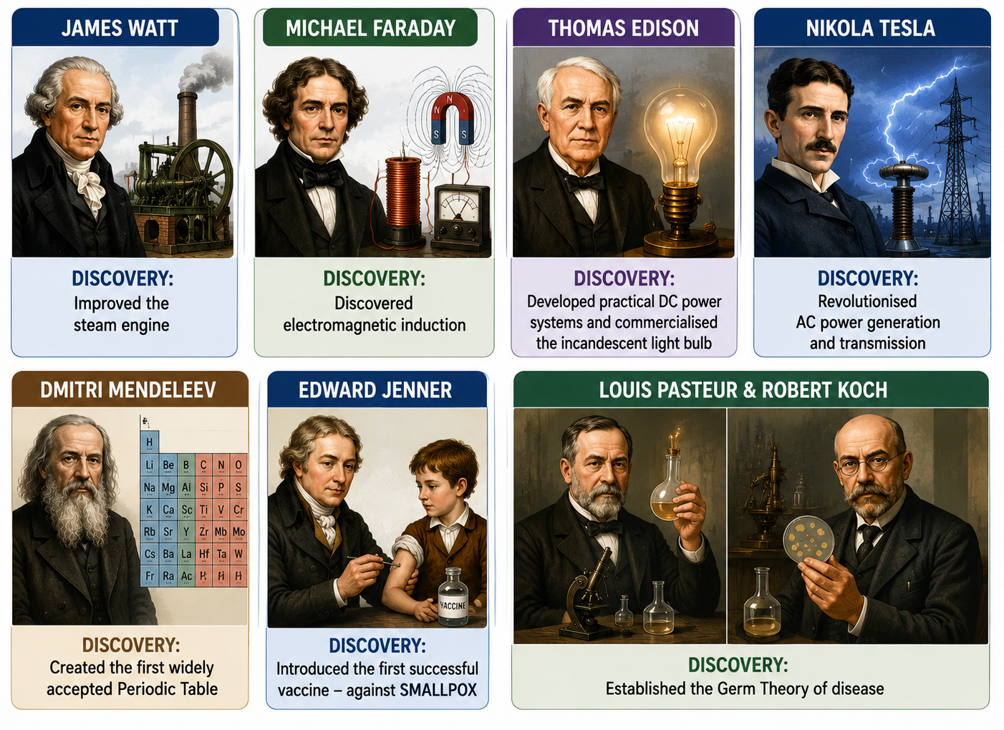
James Watt improved the steam engine → powered factories, railways, and ships → reshaped global trade.
Mechanised textile production reshaped manufacturing — humans were no longer the machines.
Michael Faraday discovered ELECTROMAGNETIC INDUCTION → principle behind all electric generators and motors today!
Thomas Edison developed practical DC power systems and commercialised the incandescent light bulb (1879) → first commercial power station in New York (1882).
Nikola Tesla revolutionised AC POWER GENERATION and transmission → the basis of our entire electricity grid today.
Dmitri Mendeleev created the first widely accepted PERIODIC TABLE (1869) — arranged 63 known elements by atomic weight.
Edward Jenner introduced the first successful vaccine — against SMALLPOX → the template for all future vaccines.
Louis Pasteur & Robert Koch established GERM THEORY of disease → ended the era of miasma theory (bad air causes disease) → foundation of modern medicine.
💥Era Essence: This era cracked the atom and rewired our understanding of reality. The scale of science became ‘BIG’ — requiring state funding, large teams, and national strategy. And tragically, science became a weapon of mass destruction.
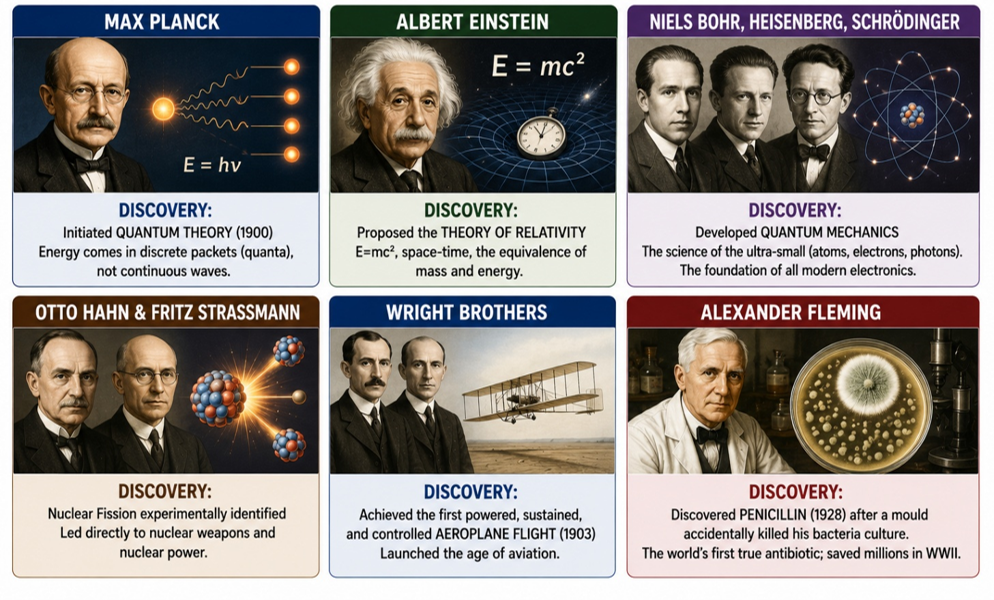
Max Planck initiated QUANTUM THEORY (1900) — energy comes in discrete packets (quanta), not continuous waves. This single idea upended all of classical physics.
Albert Einstein proposed the THEORY OF RELATIVITY — E=mc², space-time, the equivalence of mass and energy. One of the most consequential equations in human history.
Niels Bohr, Heisenberg, Schrödinger developed QUANTUM MECHANICS — the science of the ultra-small (atoms, electrons, photons). The foundation of all modern electronics.
Nuclear Fission experimentally identified by Otto Hahn and Fritz Strassmann → led directly to nuclear weapons and nuclear power.
Wright Brothers achieved the first powered, sustained, and controlled AEROPLANE FLIGHT (1903) → launched the age of aviation.
Alexander Fleming discovered PENICILLIN (1928) after a mould accidentally killed his bacteria culture → the world’s first true antibiotic; saved millions in WWII.
🚀Era Essence: Science became a geopolitical weapon. The USA and USSR were not just fighting wars — they were competing in science. Who reaches the Moon first? Who builds the bigger bomb? Who maps DNA first? Science became NATIONALISM by another name.
Sputnik 1 (1957) — Soviet Union: World’s first artificial satellite. When it beeped across American radio signals, it triggered a national panic in the USA — and the Space Race began.
Apollo 11 (1969) — USA: First human landing on the Moon. Neil Armstrong’s words — “One small step for man, one giant leap for mankind” — encapsulated the era.
Nuclear Energy and Weapons: Expansion of civilian nuclear power alongside arsenals capable of ending human civilisation.
Transistors and Integrated Circuits: Revolutionised computing — from room-sized computers to pocket-sized calculators.
ARPANET (1969):Developed under the U.S. Department of Defense’s ARPA (later DARPA), ARPANET was the world’s first operational packet-switching computer network. Originally created to connect research institutions and enable resource sharing, it became the technological foundation of the modern Internet.
Watson and Crick discovered the DNA DOUBLE HELIX (1953) → launched the age of molecular biology and biotechnology.
🌐Era Essence: The world shrank. Information became the new currency. The person sitting in a village in Rajasthan could access the same knowledge as a professor at Harvard — if they had internet access. This was the promise of the Information Age.
🤖Era Essence: We are LIVING in this era right now. This is the era of convergence — where digital, biological, and physical technologies are merging. AI writes poetry, edits genes, and drives cars. The question is no longer ‘what can technology do?’ but ‘what SHOULD technology do?’
3D Printing, Autonomous Vehicles, Advanced Robotics, Renewable Energy Storage
Custom manufacturing; self-driving transport; clean energy transition
Global Governance
Digital Public Infrastructure, Ethical AI frameworks, Data Governance, Cyber Sovereignty
Debates on who controls data, AI accountability, and digital colonialism
📌India’s 4IR Moment: India is actively participating in 4IR through the Digital India initiative, Aadhaar-based Digital Public Infrastructure, ONDC for e-commerce, and India Stack. For UPSC, connecting 4IR to India’s domestic policy is essential.
The Internet is the single most impactful invention of the 20th century — more impactful than the automobile or the television, because it contains and accelerates all other technologies. The Internet is a global network of interconnected computers and communication systems that allows users to share information, access services, and communicate across long distances. It…
Space Debris: The Scattered Danger in Orbit Let’s begin with a small everyday picture. Imagine you are driving on a highway at 100 km/h, and suddenly a tiny pebble flies up and hits your windscreen. Even at that modest speed, a small stone can crack the glass. Now take that same scene and move it…
Militarisation of Space There is an important conceptual distinction you must remember: Militarisation vs. Weaponisation. Militarisation is using space to SUPPORT military operations — like using GPS for troop coordination. Weaponisation is placing or using WEAPONS in space itself. The Outer Space Treaty (1967) does not ban militarisation. It only bans WMDs in orbit. This…
Space Traffic Management (STM) Think of outer space as a busy international airspace — except there is no Air Traffic Control, no unified radar network, no binding rules for who gives way to whom, and no international police. Over 9,000 active satellites and millions of debris fragments share the same sky. Without STM, catastrophic collisions…
Major Lunar Missions — The Story of the Moon The Moon has always been humanity’s first space destination — simply because it is the nearest. But getting there was never a straight line; it was a clear evolution: first we went just to take photographs, then we attempted soft landings, then we sent humans, and…
India is not a latecomer to science. Before Europe had universities, India had Nalanda and Takshashila. Before the West developed algebra, India gave the world Zero. Before modern surgery, India had Sushruta performing rhinoplasty. The story of Science and Technology in India is, in many ways, the story of a civilisation’s journey — from ancient…