
Introduction to Science and Technology
Think of it this way. You wake up in the morning, switch on the light, check your phone, drink pasteurised milk, and take a paracetamol for your headache.
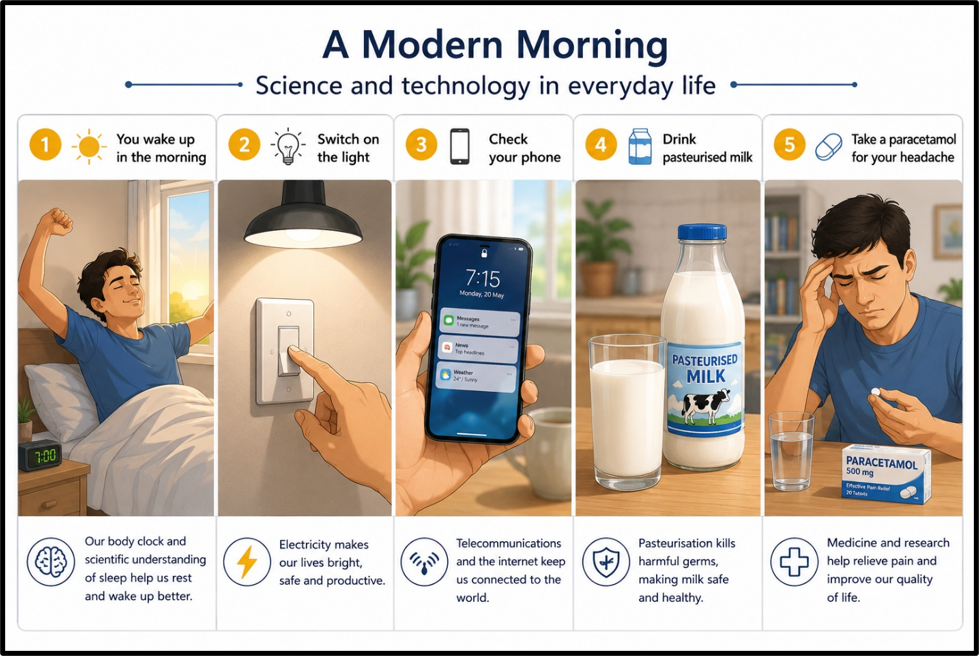
In the span of just five minutes, you have benefited from at least six different scientific discoveries! Every single convenience of modern life — from the electricity in your socket to the GPS on your smartphone — is the result of human curiosity meeting human necessity.
That curiosity is Science; that necessity is Technology. Together, they form the most powerful engine of human civilisation.
What Exactly is Science and Technology?
Before we jump into the deep end, let us establish the basics — and trust me, even these basics have profound implications for UPSC Mains answers.
| Term | Definition & Analogy |
| Science | The systematic study of the natural and physical world through observation, experimentation, and reasoning — to discover fundamental laws and principles. Think: Newton watching an apple fall and asking “WHY?” — that is science. |
| Technology | The practical application of scientific knowledge to develop tools, systems, and techniques that solve real-world problems and improve human life. Think: Using that understanding of gravity to launch a satellite — that is technology. |
| 💡 The Golden Rule: Science EXPLAINS how things work. Technology APPLIES that knowledge to solve real-world problems. One without the other is incomplete — like a map without a compass, or a compass without a map. |
To make this even simpler: Imagine Science as Understanding and Technology as Doing. When you understand that fire produces heat (science), and then use that knowledge to build a stove (technology) — that loop is the foundation of all human progress.
The Relationship Between Science, Technology, and Society
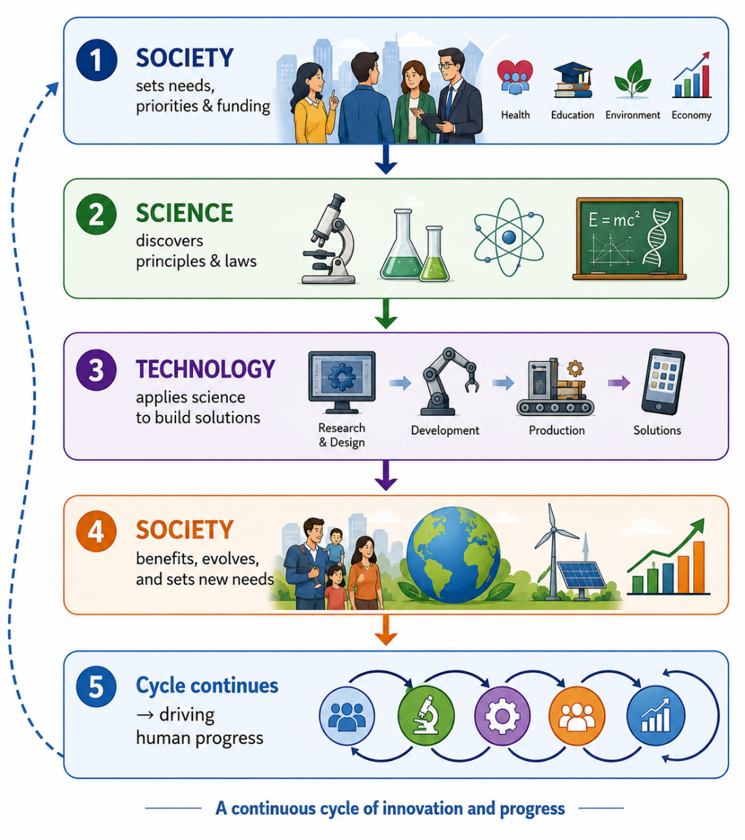
Here is a question: “How does Science & Technology influence society and vice versa?” The answer lies in understanding that Science, Technology, and Society are not separate islands — they are deeply interconnected rivers that flow into each other. Let us trace each connection.
Science → Technology
Science generates knowledge. Technology harvests that knowledge to create tools and systems. This is a one-way gift from the lab to the world — but it keeps the world alive.
- Example: Quantum physics (science) → Semiconductor chips → Computers and smartphones (technology)
- Key Insight: Without scientific discovery, technological advancement eventually stalls.
Technology → Science
Now here is the beautiful feedback loop. Technology provides the tools that allow scientists to discover even more. The telescope did not just help sailors navigate — it helped Galileo discover Jupiter’s moons!
- Telescope → Astronomy
- Microscope → Microbiology
- Particle Accelerators (e.g., CERN) → Particle Physics
- Key Insight: Technology expands the frontier of science.
Society → Science & Technology
Society is the great driver of both science and technology. What problems does the world face? Those become the research priorities. Where does the money go? Where the political will points.
- Food shortages → Green Revolution research
- COVID-19 Pandemic → mRNA vaccine development at unprecedented speed
- Climate Change → Renewable energy innovation (solar, wind, hydrogen)
- Key Insight: Society determines funding priorities and ethical boundaries.
Science & Technology → Society
And the circle completes. Once new science and technology emerge, they reshape society — its economy, its governance, its culture, and its global power dynamics.
- Internet → Globalisation and knowledge economy
- Nuclear Technology → Strategic deterrence; changed geopolitics permanently
- Artificial Intelligence (AI) → Workforce restructuring; automation of white-collar jobs
Relationship Flow at a Glance
Benefits of Science and Technology
Now that we understand what S&T is and how it relates to society, let us ask the most important question: What has it done for us? The answer, quite simply, is everything.
A. Human Resource Development (HRD)
Technology has transformed how humans are educated, trained, and deployed in the workforce. Here is how:
- Education & Skill Development: Industry-oriented training in IT, Biotechnology, Engineering, and Data Science — aligned with evolving job-market needs.
- Healthcare & Well-being: Disease prevention, advanced treatment, and occupational safety technologies ensure a healthy, productive workforce.
- Productivity & Efficiency: Automation and Artificial Intelligence (AI) reduce repetitive work, freeing humans for creative and analytical tasks.
- Innovation & Creativity: R&D ecosystems and problem-solving education drive new products and solutions — from startups to space agencies.
- Employment Generation: Emerging technology-driven industries create skill-intensive jobs; lifelong learning enables workforce transition.
- Skill Alignment: Skill mapping, targeted training, and industry-academia collaboration bridge skill gaps (e.g., India’s Skill India Mission).
B. Socio-Economic Development
- Economic Growth: Productivity gains, innovation-led industries, job creation, and global competitiveness.
- Improved Quality of Life: Advances in healthcare, communication, transportation, and digital education improve living standards and life expectancy.
- Social Progress: Agricultural productivity, digital access to health/education, and poverty reduction empower citizens.
- Environmental Sustainability: Renewable energy, efficient resource management, and sustainable agriculture support climate mitigation.
C. Daily Life Transformation
Let us look at a table that maps the domain of daily life to the S&T impact:
| Domain | S&T Impact | Example |
| Communication | Instant global connectivity | Smartphones, Internet, Social Media |
| Transportation | Safer, faster, smarter movement | GPS, Electric Vehicles, Hyperloop |
| Healthcare | Prevention, diagnosis, cure | Vaccines, MRI, Wearables, Telemedicine |
| Education | Accessible, flexible learning | MOOCs, Online platforms, Digital libraries |
| Agriculture | Higher yields, food security | HYV seeds, Drip irrigation, Precision farming |
| Safety & Security | Reduced risks and accidents | Surveillance systems, ABS brakes, Smart locks |
| Entertainment | On-demand interactive leisure | OTT platforms, Digital gaming, VR/AR |
| Governance | Transparent, efficient services | e-Governance, Aadhaar, GSTN, DigiLocker |
D. National Development and Security
For India — a developing nation with enormous aspirations — S&T is not a luxury but a strategic necessity.
- National Development: S&T strengthens infrastructure (transport, energy, communication), improves resource efficiency, and builds a skilled, innovative workforce.
- National Security: S&T enables advanced defence technologies (DRDO, BrahMos), intelligence and surveillance systems, cybersecurity infrastructure, and disaster prediction and management (NDMA).
| 📌 UPSC Mains Tip: When asked about the role of S&T in development, always structure your answer into: HRD + Socio-Economic + Daily Life + National Security. This 4-part framework scores well in GS Paper 3. |
Concerns and Challenges of Science & Technology
“Technology is like fire. It can cook your food, or burn down your house. The question is: who is holding the torch?”
Every benefit of S&T comes with a corresponding challenge.
| Challenge Category | Key Concerns | Examples / Context |
| Inequality & Digital Divide | Unequal access to technology excludes marginalized groups; Brain Drain widens gaps | Rural-urban digital divide in India; STEM gender gap globally |
| Employment & Skills | Automation displaces jobs; Skill mismatch; Outdated curricula | AI replacing data entry jobs; Education-industry mismatch in India |
| Ethical & Psychological | Data privacy risks; Algorithmic bias; Mental health impacts | Facebook data scandal; AI bias in hiring algorithms |
| Environmental Challenges | E-waste pollution; Resource depletion; Carbon emissions from data centres | India is 3rd largest e-waste generator globally |
| Security Risks | Cyberattacks; Information warfare; Dual-use dilemma | Pegasus spyware; Deepfake misinformation; Autonomous weapons |
| Governance Gaps | High costs; Resistance to change; Regulatory lag | Small countries unable to afford 5G; AI governance vacuum |
1. Inequality, Accessibility and Inclusivity
- Digital Divide: Unequal access to technology, the internet, and digital skills excludes marginalised groups and regions — creating a two-tier society.
- Accessibility Barriers: Non-inclusive technology design excludes persons with disabilities.
- Brain Drain: Concentration of S&T benefits in urban/developed regions and migration of skilled talent widen regional and global gaps.
2. Employment and Skills Challenges
- Job Displacement: Automation and AI can displace specific tasks and occupations, leading to transitional unemployment and labour market restructuring.
- Skill Mismatch and Deskilling: Rapid technological change creates skill mismatches. Automation may reduce demand for routine skills but increases demand for advanced cognitive and digital competencies.
- Education-Industry Mismatch: Outdated curricula in many Indian universities limit job readiness.
3. Ethical, Social and Psychological Issues
- Data Privacy and Surveillance: Extensive data collection risks misuse and erosion of privacy (e.g., social media companies harvesting personal data).
- Algorithmic Bias: AI systems may reinforce social biases in hiring, governance, and services — discriminating based on race, gender, or class.
- Ethical Dilemmas: AI decision-making and genetic engineering raise concerns of accountability and unintended consequences (e.g., designer babies via CRISPR).
- Social and Mental Health: Excessive digital media use is associated with stress, anxiety, reduced attention spans, and social isolation.
4. Environmental Challenges
- Resource Depletion: Resource-intensive technologies strain natural resources (e.g., rare earth mining for batteries).
- E-waste Pollution: Hazardous electronic waste harms ecosystems and human health. India generated ~1.4 million MT of e-waste in FY 2024-25.
- Climate Change: High energy demand and emissions from certain technologies (data centres, aviation, heavy industry) exacerbate climate change.
5. Security Risks
- Cybersecurity Threats: Cyberattacks, data breaches, and cyber warfare threaten critical infrastructure and national security (e.g., attacks on power grids).
- Information Warfare: Misinformation, propaganda, and electoral interference undermine democracy and public trust (e.g., deepfakes, bot networks).
- Dual-use Dilemma: Civilian technologies with military applications pose governance challenges (e.g., drone technology, satellite imaging).
- Autonomous Weapons: Rapid technological advances in AI-powered weapons fuel arms races and raise serious ethical concerns about accountability in warfare.